Author: BTCLFGTEAM

  • Gnosis price outlook as GnosisDAO GIP-140 proposal passes

    Gnosis price outlook as GnosisDAO GIP-140 proposal passes

    Gnosis price outlook as GnosisDAO GIP-140 proposal passes

    • GIP-140 revamps GnosisDAO voting with on-chain and beacon data.
    • GNO price dips amid profit-taking and technical resistance.
    • Liquidity limits and stablecoin rules may influence short-term sentiment.

    The Gnosis price has experienced modest volatility following the passing of the GnosisDAO GIP-140 proposal, a major governance update aimed at overhauling the platform’s voting mechanisms.

    The GIP-140 initiative replaces the current subgraph-based GNO strategy with a suite of strategies that read blockchain state directly from both the execution and beacon layers.

    The proposal’s approval marks a significant step toward enhancing the accuracy and reliability of Snapshot voting while adding support for StakeWise tokens and reducing dependency on external data providers.

    GIP-140: revamping voting for accuracy and inclusion

    GIP-140’s passage reflects a broad consensus among GnosisDAO participants, with 82 votes cast, overwhelmingly in favour of the measure.

    The core objective is to eliminate the subgraph dependency, which has historically caused delays and inaccuracies in voting power calculations.

    The new system attributes voting power to GNO balances across both the Gnosis Chain and Ethereum, locked GNO holdings, validator balances, and StakeWise’s sGNO and osGNO tokens.

    By pulling data directly from on-chain and beacon chain sources, the proposal seeks to create a more robust and transparent voting environment that can better reflect actual stakeholder influence.

    The technical implementation involves updating Snapshot’s configuration via a SafeSnap transaction, pointing to aggregator contracts deployed on both Gnosis Chain and Ethereum, as well as a new beacon-chain strategy for staked GNO.

    Delegation mechanisms have also been updated to integrate these new sources, ensuring a seamless transition for DAO members accustomed to existing workflows.

    The changes position GnosisDAO to handle complex governance requirements while reducing reliance on third-party indexers like The Graph, which previously introduced inconsistencies.

    Gnosis price enters consolidation amid profit-taking

    Surprisingly, following the approval of GIP-140, the Gnosis price has seen a slight pullback, falling 0.89% over the past 24 hours and underperforming the broader crypto market, which gained 0.06%.

    The price movement aligns with profit-taking behaviour after GNO achieved a 7.98% weekly gain and an 8.3% rise during October.

    Technical indicators suggest the market is testing resistance around the 30-day simple moving average of $137.93 and the 61.8% Fibonacci retracement level at $138.47.

    Gnosis price analysis
    Source: CoinMarketCap

    While the RSI remains neutral at 53.42, a bearish divergence in the MACD hints at potential short-term consolidation.

    In addition, liquidity pressures stemming from CoinDCX’s June 2025 delisting continue to weigh on GNO trading activity.

    Despite being months old, the delisting reduced retail access to the token, and the 24-hour turnover ratio of 1.08% remains relatively low compared with broader DeFi sector averages.

    Regulatory uncertainties surrounding stablecoins, particularly the relaunch of USDS under the stricter US GENIUS Act, may also indirectly influence sentiment toward Gnosis Chain assets.

    Nevertheless, milestones like Gnosis Pay’s $100 million transaction volume suggest that ecosystem adoption could counterbalance some of these headwinds.

    Looking ahead

    The combination of technical consolidation, lingering liquidity constraints, and regulatory considerations creates a cautious but watchful environment for Gnosis price movements.

    Holding the $135–$137 zone could provide the stability needed for renewed momentum, particularly as GnosisDAO’s upgraded Snapshot strategies begin to reflect more accurate voting power across multiple token types.

    In the coming weeks, the Gnosis price may respond to both market dynamics and the tangible impact of GIP-140’s execution, particularly if the changes enhance voting accuracy and encourage broader participation in the DAO.

    For now, the community appears aligned, and the successful passage of GIP-140 represents a meaningful milestone that could shape GNO’s trajectory in both governance and market performance.

    Source link

  • KERNEL price goes vertical on Upbit listing, hits $0.23

    KERNEL price goes vertical on Upbit listing, hits $0.23

    upbit-lists-kernel

    • KernelDAO price jumped to highs of $0.23 amid Upbit listing news.
    • The KERNEL token reached an all-time high above $0.46 in April, and it could target this mark next.
    • Gains across the crypto market will catalyse an uptick for the token.

    KERNEL, the native token of restaking protocol KernelDAO, spiked more than 25% to hit highs of $0.23 early Tuesday.

    While bulls are battling to hold onto the gains, the uptick saw the token rank among the top performers across the crypto market.

    Given overall crypto sentiment, could Upbit listing help KERNEL price extend its upward momentum amid interest in restaking protocols?

    Upbit listing propels KERNEL to $0.23 high

    As noted, the catalyst for KERNEL’s vertical price ascent today is likely trader reaction to Upbit’s announcement.

    On October 28, 2025, the leading South Korean crypto exchange confirmed the token’s listing on its KRW market, adding support for trading on the Ethereum network.

    The listing ignited immediate buying pressure, with KernelDAO daily volume spiking as bulls propelled KERNEL from lows of $0.16 to an intraday peak of $0.23 as of writing.

    Notably, daily volume stood at over $316 million, up a staggering 1,540% in the past 24 hours.

    With gains of over 20%, KERNEL ranked among the few top altcoins with double digit price movements on the day.

    KernelDAO price hovered in the list of top gainers alongside Hedera’s HBAR, Pump.fun’s PUMP and Bittensor’s TAO tokens.

    Why such interest in KernelDAO?

    KernelDAO is a leading restaking protocol behind a $1.7 billion total value locked ecosystem.

    The YZi Labs-backed project is live across top blockchains, including Ethereum and BNB Chain.

    Notably, it boasts key products like Kernel, Kelp, Gain, and Kred, a recently introduced product focused on real-world assets.

    Upbit’s listing is the latest in bullish support for the KERNEL token, with the South Korean crypto exchange known for its active trading community.

    The listing not only boosts KERNEL’s visibility but also taps into fresh liquidity pools.

    KernelDAO is a restaking infrastructure platform that provides a range of staking-related services.

    It enables restaking on the BNB Chain, supports BNB Liquid Restaking Tokens (LRTs), and offers Bitcoin (BTC) restaking opportunities.

    In addition, the project operates an Ethereum-based restaking protocol that runs directly on the Ethereum network.

    This system includes a vault-style smart contract designed to manage staked ETH, rsETH, and liquid staking token (LST) assets.

    The platform’s native KERNEL token serves multiple purposes, including governance, restaking, and slashing insurance within the ecosystem.

    KernelDAO bulls target $0.50 next

    KERNEL price reached an all-time high of $0.46 in April 2025, and while it dropped to lows of $0.09 in June, it has recovered by more than 115% since.

    Current prices around $0.19 means bulls are about 57% off the all-time peak.

    KERNEL chart by CoinMarketCap

    As the broader cryptocurrency market rebounds amid various catalysts, including renewed institutional interest, regulatory clarity in key regions, and macroeconomic shifts favoring risk assets, KernelDAO looks set to benefit.

    DeFiLlama shows the protocol’s total value locked (TVL) has pumped to over $1.7 billion.

    As such, gains across the restaking sector could add further fuel to KernelDAO’s ecosystem.

    Targets on the upside include the ATH and a breakout above $0.50.

    On the downside, buyers need robust activity around $0.18 and $0.16.

    Source link

  • Nasdaq-listed AgriFORCE eyes $700M Avalanche treasury bet; AVAX price outlook

    Nasdaq-listed AgriFORCE eyes $700M Avalanche treasury bet; AVAX price outlook

    AVAX price at crossroads

    • Avalanche price is looking to hold the $20 level.
    • Nasdaq-listed AgriFORCE has shareholder approval to roll out an Avalanche treasury strategy.
    • The company says it’s eyeing a $700m AVAX treasury strategy.

    Avalanche price holds above the $20 mark amid news that Nasdaq-listed company AgriFORCE Growing Systems has secured shareholder support for a bold pivot into the Avalanche ecosystem.

    The AVAX token, which has bounced off lows of $18 in the past week, shows notable resilience amid broader market optimism around a potential altcoin explosion.

    AgriFORCE eyes $700 million AVAX treasury bet

    Nasdaq-listed AgriFORCE, a company traditionally rooted in sustainable agriculture technologies, is eyeing an aggressive pivot into the crypto treasury strategy ecosystem.

    Specifically, the company wants to become the first publicly traded entity on Nasdaq dedicated exclusively to the Avalanche blockchain network.  AVAX One is the new company.

    On October 27, AgriFORCE revealed it had secured special shareholder approval for the initiative .

    A $300 million capital infusion and a further $250 million offering are set to fund an aggressive AVAX treasury strategy.

    In the process of acquiring and holding AVAX tokens, AgriFORCE is poised to commit up to $700 million in exposure through direct purchases, staking, and ecosystem participation.

    Matt Zhang, founder of Hivemind and nominated chairman of the AgriFORCE board, commented:

    “With this mandate from shareholders, we can now proceed to close the transaction and begin the focused work of accumulating AVAX strategically and creating the Berkshire Hathaway of the on-chain financial economy.”

    AVAX price holds above $20: Is $40 next?

    Amid the corporate enthusiasm, the Avalanche native token shows resilience.

    While the price of AVAX fell from highs of $21 this week, bulls managed to recover from lows of $18. Maintaining stability above the critical $20 psychological level signals a potential bullish momentum that will align with the broader cryptocurrency market.

    If bulls break above $30, the altcoin could target prices above $40. As well as tokenization, catalysts such as institutional inflows and narrative shifts around spot exchange-traded funds are critical.

    AgriFORCE’s corporate strategy and market performance also point to what investors may want to look out for in the coming weeks. In its announcement, the company said it will put its plans into action in the coming days.

    “The completion of this transaction will position the Company as the first Nasdaq-listed entity with a primary mission centered on the Avalanche ecosystem. The transaction is expected to close on or about October 30, 2025,” it wrote.

    AVAX price reached its all-time high of $146 in November 2021.

    The current price is well off this peak.

    However, bulls have managed to bounce by an impressive 630% since the Avalanche price fell to its all-time low of $2.79 in 2020.

    Source link

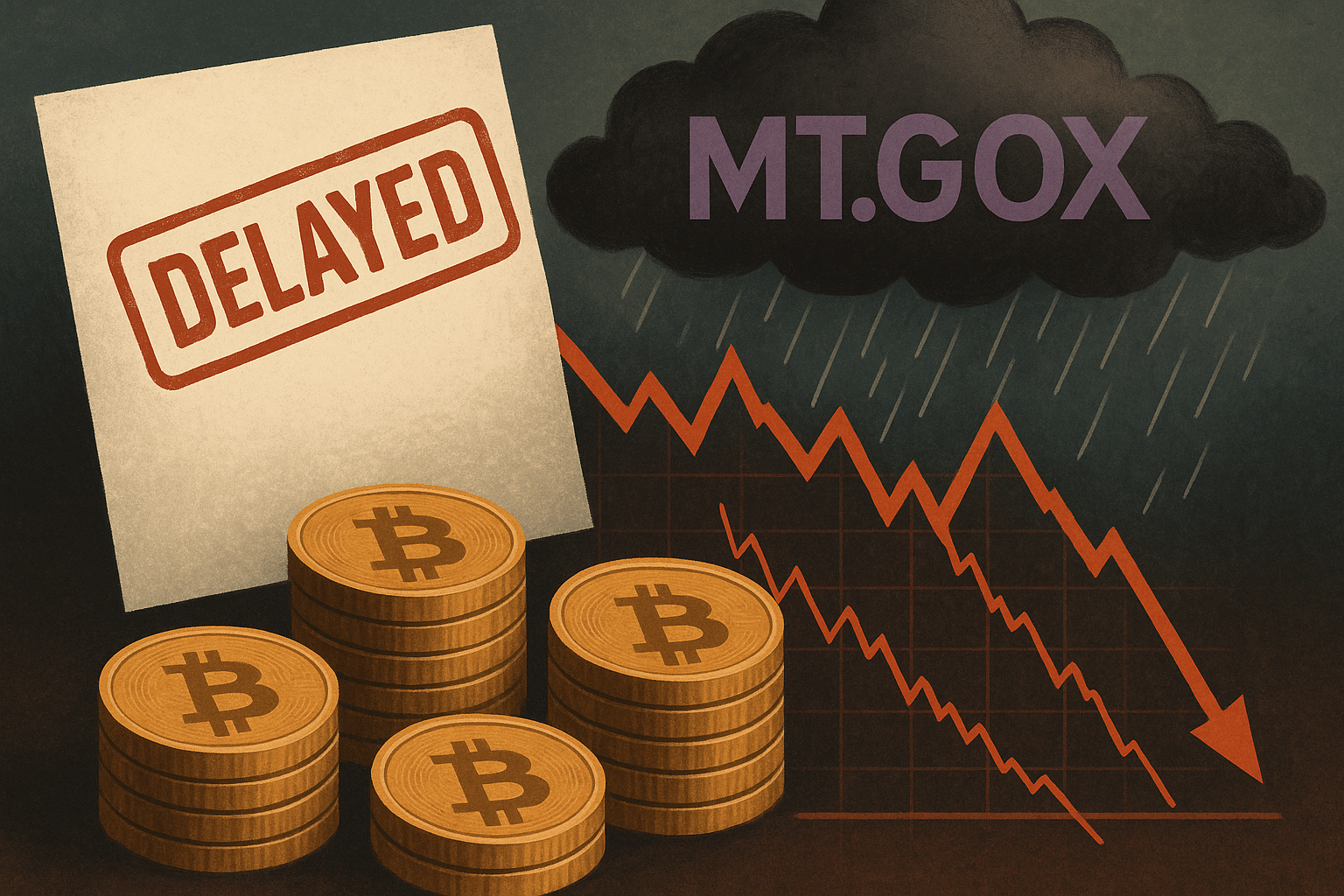
  • Mt. Gox delays Bitcoin repayments again as creditors await full settlement

    Mt. Gox delays Bitcoin repayments again as creditors await full settlement

    Mt. Gox delays Bitcoin repayments again as creditors await full settlement

    • Mt. Gox extends Bitcoin repayment deadline to Oct 2026 amid ongoing administrative hurdles.
    • Once the top Bitcoin exchange, Mt. Gox’s collapse in 2014 led to the loss of 850,000 BTC.
    • Arkham data shows holdings now down 75% to 34,690 BTC.

    Mt. Gox, once the world’s largest Bitcoin exchange, has delayed repayments to its creditors until October 2026 — extending a saga that began more than a decade ago.

    The announcement, made just days before its previous deadline of October 31, 2025, reflects ongoing administrative and technical challenges in finalising payments.

    While many creditors who submitted paperwork have received partial repayments, a significant number are still waiting for their funds.

    The Tokyo District Court approved the extension after the trustee cited the need for additional time to process remaining claims and complete settlements efficiently.

    Delayed Bitcoin repayments extended to 2026

    According to the latest notice, the Mt. Gox rehabilitation trustee confirmed that most base, early lump-sum, and intermediate repayments have been processed for creditors who completed the required steps.

    However, repayments for others remain pending.

    The trustee explained that it was “desirable to make the repayments to such rehabilitation creditors to the extent reasonably practicable,” leading the court to approve a new deadline of October 31, 2026.

    This marks another chapter in one of the cryptocurrency industry’s longest-running recovery efforts.

    Mt. Gox, which once handled over 70% of the world’s Bitcoin trading volume, collapsed in 2014 after a massive hack led to the loss of approximately 850,000 BTC.

    The company subsequently filed for bankruptcy in Japan.

    How the Mt. Gox collapse reshaped Bitcoin history

    When Mt. Gox failed, the exchange’s bankruptcy shook investor confidence in digital assets and exposed vulnerabilities in early crypto infrastructure.

    About 200,000 BTC were later recovered, but 650,000 BTC remain missing.

    The recovery process transitioned into a court-supervised civil rehabilitation in Japan, during which a trustee began redistributing recovered Bitcoin and Bitcoin Cash (BCH) in 2024.

    At the time of its collapse, Mt. Gox’s influence was unmatched.

    The incident not only caused a sharp decline in Bitcoin prices but also prompted tighter regulatory oversight in key markets.

    In the years since, it has become a landmark case in crypto regulation, bankruptcy law, and investor protection — shaping how global exchanges handle custody and insurance.

    Market impact and sell-off concerns

    With repayments scheduled to continue into 2026, traders and analysts have debated whether the eventual release of thousands of Bitcoin could trigger selling pressure.

    Historically, such fears have surfaced each time Mt. Gox announced repayment progress.

    However, recent on-chain data suggests that these effects may be limited.

    According to Arkham Intelligence, Mt. Gox currently holds 34,690 BTC worth nearly $4 billion, down from about 142,000 BTC in mid-2024 — a decline of more than 75%.

    Analysts tracking these wallets have noted that even large movements from the exchange have had only short-term effects on Bitcoin’s market price, indicating that most creditors are choosing to hold rather than sell immediately.

    What’s next for creditors and the crypto market

    The trustee’s revised timeline means that full repayments could now take another year, extending the wait for thousands of claimants worldwide.

    For many early Bitcoin investors, the repayments represent not only financial recovery but also closure on one of crypto’s most notorious events.

    Still, the Mt. Gox story continues to serve as a cautionary tale for digital asset investors.

    It underscores the importance of secure custody, transparent operations, and regulatory compliance — principles that have since become standard practice across global crypto exchanges.

    Source link

  • Magic Eden’s ME token soars 35%, reclaims $0.60 amid ‘big week ahead’ hype

    Magic Eden’s ME token soars 35%, reclaims $0.60 amid ‘big week ahead’ hype

    Magic Eden Token

    • Magic Eden price soared more than 35% amid a breakout above the key resistance of $0.50.
    • Trading volume jumped 1,280% to over $129 million to signal buying pressure.
    • “A big week” ahead and other potential catalysts could boost ME bulls.

    Magic Eden’s native token, ME, has experienced a significant price surge in the past 24 hours.

    Prices rose to intraday highs above $0.60 for the first time since the October 11 crash, with bulls’ gains coming amid a retest of a key technical barrier.

    As the altcoins rank among the top gainers in the 500 largest cryptocurrencies by market cap, buyers are likely to hold the crucial level and target a new leg up.

    But what could help ME price in the short term?

    Magic Eden among top gainers as price pumps 35%

    Per CoinMarketCap data, Magic Eden’s ME token is one of the standout performers in the cryptocurrency arena today.

    The token’s 35% uptick in the past 24 hours has come amid a robust trading volume of $129 million – the metric is up 1,280% in the past 24 hours.

    This performance has not only outpaced the broader market but also dwarfed top performers such as Pi Network, Virtuals Protocol and Zcash.

    ZEC hovered around $270 on October 24, but was near $350 at the time of writing.

    On the technical front, ME broke above the critical hurdle at $0.50, reaching intraday highs of $0.60.

    While the altcoin is well off its all-time peak above $13.24, bulls have bounced off the all-time low of $0.23.

    ME could retest $0.55 or $0.50 before seizing on an uptick across the market to target the psychological $1 mark.

    RSI at 60 suggests bulls have more room to aim for gains.

    Magic Eden price chart by TradingView

    What could help Magic Eden price higher?

    Several factors appear to have converged to ignite this pump.

    Notably, the official Magic Eden X account issued a cryptic yet bullish proclamation early this morning: “Big week ahead.”

    This post, which garnered over 300 likes and widespread speculation within the community, hinted at impending announcements or developments that could further bolster the platform’s growth.

    Such communications from project leads often serve as potent catalysts, drawing in retail traders and amplifying social sentiment.

    ME gains also follow the community cheering of the recent acquisition of Dynamic by Fireblocks, which the platforms announced on October 23.

    As a key user of Dynamic’s developer platform, Magic Eden could benefit significantly from this integration.

    Dynamic powers over 50 million on-chain accounts for industry leaders, including Kraken, Ondo Finance, Magic Eden and zerohash.

    Magic Eden’s seamless user onboarding and embedded wallet functionalities for NFT trading across chains.

    The deal merges Fireblocks’ institutional-grade custody with Dynamic’s agile tools, creating what executives describe as the “first complete custody-to-consumer stack” for on-chain finance.

    Overlaying these platform-specific tailwinds is a broader crypto market rebound.

    While gains in October 2025 remain muted as the macroeconomic environment hit risk-on sentiment, Bitcoin’s climb to $116,000 and Ethereum’s break to $4,200 has bulls excited.

    The big week for crypto includes a potential rally ahead of a Federal Reserve rate cut, the impact of the US-China trade deal and SEC approval for exchange-traded funds.

    The macroeconomic lift could spill over to altcoins like Magic Eden.

    Source link

  • Cryptocurrency is as ‘property’ under Indian law, rules Madras High Court

    Cryptocurrency is as ‘property’ under Indian law, rules Madras High Court

    Madras High Court rules cryptocurrency is a “property”

    • Madras High Court confirms crypto can be owned and held in trust.
    • WazirX has been barred from redistributing investors’ unaffected XRP holdings.
    • Ruling strengthens investor rights and Web3 governance in India.

    In a landmark ruling that could reshape cryptocurrency in India, the Madras High Court has declared that cryptocurrencies qualify as property under Indian law.

    The Court’s decision, delivered by Justice N. Anand Venkatesh, affirms that cryptocurrencies can be owned, held in trust, and protected as legal property — a major step in clarifying the legal status of digital assets in the country.

    Cryptocurrency in India now recognised as property

    The case arose from a petition by an investor whose 3,532.30 XRP coins were frozen after a cyberattack on WazirX, one of India’s largest cryptocurrency exchanges.

    In July 2024, the platform suffered a $234 million hack involving Ethereum and ERC-20 tokens.

    While the investor’s XRP holdings were not part of the stolen assets, WazirX sought to redistribute all users’ funds under its so-called “socialisation of losses” plan.

    Justice Venkatesh firmly rejected the proposal, ruling that each investor’s digital holdings are individual property and cannot be diluted or redistributed to cover exchange losses.

    He emphasised that cryptocurrencies, though intangible, possess all the essential attributes of property — they are identifiable, transferable, and exclusively controlled through private keys.

    “It is not a tangible property nor is it a currency,” the judge observed. “However, it is a property, which is capable of being enjoyed and possessed in a beneficial form.”

    This interpretation grants digital asset holders stronger legal standing, ensuring that their cryptocurrencies are recognised as assets protected under Indian law.

    Jurisdiction and investor protection

    The Court also settled questions over jurisdiction, dismissing WazirX’s argument that Singaporean arbitration rules applied because its parent company, Zettai Pte Ltd, is based in Singapore.

    Justice Venkatesh cited the Supreme Court’s earlier decision in PASL Wind Solutions Pvt Ltd v. GE Power Conversion India Pvt Ltd (2021), noting that Indian courts have authority over assets located within India.

    Because the investor’s transactions originated from Chennai and involved an Indian bank account, the Court confirmed that the case fell squarely under Indian jurisdiction.

    The court further highlighted that Zanmai Labs Pvt Ltd, which operates WazirX in India, is registered with the Financial Intelligence Unit (FIU) — unlike its foreign parent company or Binance.

    This distinction reinforced that Indian exchanges operating domestically are subject to Indian oversight and accountability, particularly in protecting user assets and maintaining transparent custodial practices.

    Strengthening Web3 governance

    Justice Venkatesh’s decision went beyond individual relief to call for higher standards of corporate governance in the Web3 and crypto sectors.

    He urged exchanges to maintain separate client funds, conduct independent audits, and uphold robust KYC and anti-money laundering controls.

    These measures, the Court noted, are vital for building trust in the digital economy and protecting consumers from future mishandling of assets.

    Legal experts hailed the judgment as a milestone in developing “crypto-jurisprudence” in India.

    Vikram Subburaj, CEO of Indian exchange Giottus, described it as a foundational moment that signals to all market participants — exchanges, users, and regulators — that the digital asset space will be held to strong standards of governance and protection.

    A foundation for India’s crypto future

    The Court’s ruling not only protects the rights of individual investors but also strengthens the broader regulatory framework around digital assets.

    By recognising cryptocurrency as property, the judgment fills a crucial legal gap in a country where tax enforcement on crypto remains strict, but investor protections have lagged.

    As Justice Venkatesh wrote, courts now serve as the “central stage where the future of digital value is debated.”

    Through this ruling, the Madras High Court has given India a clearer picture of ownership, responsibility, and trust in the age of decentralisation.

    With cryptocurrency in India now firmly recognised as property under Indian law, the decision marks a turning point for the country’s digital asset ecosystem — affirming that in India, crypto holdings are not just speculative instruments but protected assets under the law.

    Source link

  • Bitplanet becomes South Korea’s first listed firm to buy Bitcoin (BTC)

    Bitplanet becomes South Korea’s first listed firm to buy Bitcoin (BTC)

    Bitplanet becomes South Korea’s first listed firm to buy Bitcoin

    • Bitplanet bought 93 BTC in Korea’s first regulated corporate purchase.
    • The firm plans daily Bitcoin buys to reach a 10,000 BTC treasury.
    • Backed by major investors, Bitplanet leads Korea’s Bitcoin adoption.

    Bitplanet has made history in South Korea’s financial landscape by becoming the nation’s first publicly traded company to purchase Bitcoin (BTC) through a regulated domestic exchange.

    The KOSDAQ-listed technology firm recently acquired 92.67 BTC — worth approximately $10.9 million — marking a new chapter in the country’s corporate embrace of digital assets.

    Korea’s first regulated corporate Bitcoin buy

    The BTC acquisition positions Bitplanet as a pioneer in compliant Bitcoin adoption within Asia’s evolving financial ecosystem.

    It is the first time a listed company has acquired Bitcoin through a licensed exchange within the country’s regulated financial infrastructure.

    Executed entirely under the supervision of South Korea’s Financial Intelligence Unit (FIU), the transaction signals growing confidence among institutional investors that Bitcoin can serve as a legitimate, strategic treasury asset.

    The Seoul-based company described the move as a deliberate, rules-based initiative rather than a speculative trade.

    Co-CEO Paul Lee explained that the purchase marks the start of a disciplined, long-term accumulation plan designed to reduce timing risks while positioning Bitcoin as a strategic treasury reserve.

    The transaction was executed fully in compliance with domestic financial laws, a milestone that could encourage other listed companies to follow suit.

    Notably, the timing of Bitplanet’s move coincided with a strong rally in Bitcoin prices, which recently climbed above $115,000 amid optimism about US Federal Reserve rate cuts and increasing exchange-traded fund (ETF) inflows.

    By choosing this moment to make its first acquisition, Bitplanet demonstrated not only market awareness but also confidence in Bitcoin’s long-term role as a corporate asset.

    From its IT roots to a Bitcoin treasury company

    Founded in 1997 as SGA Co., Ltd., Bitplanet has deep roots in IT, cybersecurity, and education technology services.

    The company rebranded in September 2025 to reflect a broader shift toward blockchain and Bitcoin-focused ventures.

    Its pivot follows the full $50 million acquisition of SGA earlier in the year and the completion of a $40 million fundraising round to support its new treasury strategy.

    This strategic transformation underscores Bitplanet’s vision of becoming South Korea’s first institutional-grade Bitcoin treasury company.

    The firm has developed a comprehensive infrastructure for compliant digital asset management, including regulated custody solutions, secure storage, and real-time audit systems that meet government and financial oversight standards.

    Bitplanet’s management says it intends to accumulate Bitcoin daily through licensed domestic exchanges, aiming to build a reserve of up to 10,000 BTC over time.

    This steady, methodical approach minimises exposure to market volatility and mirrors similar strategies employed by firms such as Japan’s Metaplanet, one of Bitplanet’s key backers.

    Backed by global Bitcoin advocates

    Bitplanet’s Bitcoin strategy is supported by a global network of digital asset investors.

    The firm’s backers include Simon Gerovich of Metaplanet, AsiaStrategy, Sora Ventures, UTXO Management, KCGI, Kingsway Capital, and ParaFi Capital — groups known for advancing institutional Bitcoin adoption worldwide.

    Their involvement signals strong confidence in Bitplanet’s compliance-focused model and its potential to establish a new standard for Bitcoin treasury management in Asia.

    Industry observers believe the company’s regulated approach could pave the way for broader corporate participation in South Korea’s growing digital asset market.

    The BTC purchase also aligns with the country’s forthcoming Digital Asset Basic Act, scheduled to take effect by 2027, which will formalise the rules for cryptocurrency custody and corporate holdings.

    By moving early, Bitplanet positions itself to benefit from the regulatory clarity that this law is expected to bring.


    Source link

  • What next for Avantis price after the 73% recovery?

    What next for Avantis price after the 73% recovery?

    What next for Avantis price after the 73% recovery?

    • Avantis whale activity remains weak despite strong short-term price gains.
    • Technical breakout hints at reversal, but confirmation needs $1.00 break.
    • TVL surge and new listings boost adoption amid rising volatility.

    After a steep correction that erased much of its September gains, the Avantis price has staged an impressive rebound, rising 73% over the past week and 31.9% in the last 24 hours.

    The AVNT token is now trading around $0.86, still nearly 59% below its September peak of $2.66.

    While the recovery has rekindled investor optimism, the question remains — can this rally hold, or is it merely a temporary reprieve in a larger downtrend?

    Whales are still on the sidelines

    Despite the sharp recovery, large investors appear hesitant to jump back in.

    On the daily chart, the Chaikin Money Flow (CMF), a key indicator of whale participation, remains below zero, showing that major wallets are not yet accumulating AVNT.

    Avantis price chart
    Source: TradingView

    Historically, the Avantis price has moved in tandem with whale inflows; its September surge to an all-time high coincided with CMF turning positive.

    Since the indicator slipped below zero on September 26, the market has seen sustained selling pressure.

    While CMF has slightly improved in recent sessions, the momentum is weak.

    The lack of significant whale support casts doubt on the rally’s durability.

    For a genuine reversal to take hold, CMF needs to cross decisively into positive territory, confirming renewed institutional confidence.

    Technical patterns hint at a possible shift

    From a technical standpoint, Avantis appears to be trying to flip its bearish script.

    The token recently broke out of a falling wedge pattern on the 12-hour chart, a formation often associated with a trend reversal.

    The Relative Strength Index (RSI) sits at 52.1, and the MACD histogram has turned slightly positive at +0.0088 — both signs of growing bullish momentum.

    However, beneath these signals lies a warning.

    Between October 10 and 21, the Avantis chart formed a hidden bearish divergence, where prices made lower highs while RSI posted higher highs.

    This pattern can foreshadow weakening upside pressure.

    A close above $1.00 would invalidate this bearish setup, confirming stronger buying interest.

    Until then, traders remain cautious, especially with key support anchored around $0.57.

    Rising TVL and platform growth fuel optimism

    Fundamentally, Avantis’ ecosystem continues to show progress.

    The project’s Total Value Locked (TVL) recently surpassed $111 million, up more than 430% in a month.

    Much of this growth stems from its synthetic asset trading platform on Base Chain, which has attracted new liquidity and users.

    The development of composable yield products is also boosting engagement, as AVNT’s staking and governance features tie directly to network revenue.

    This rise in TVL not only reflects increasing adoption but also suggests stronger underlying demand for the AVNT token.

    The platform’s expansion reinforces its long-term utility case, even as short-term market sentiment fluctuates.

    Exchange listings have added liquidity — but also volatility

    AVNT’s recent listings on Binance, Upbit, and Coinbase have dramatically increased liquidity, with daily trading volume now exceeding $307 million — roughly 2.4 times its market capitalisation.

    Such high turnover indicates speculative enthusiasm, but it also underscores the market’s instability.

    Following the listings in September, AVNT soared by nearly 400% before correcting by 60% in the weeks that followed.

    The current rebound, though encouraging, remains fragile unless sustained by organic demand rather than short-term trading.

    Avantis price outlook

    In the short term, all eyes are on whether the Avantis price can maintain momentum above the $1.00 resistance.

    Breaking this level would signal the start of a broader trend reversal and could open the path toward $1.32 and potentially $2.66 — the previous all-time high.

    Failure to hold above $0.57, however, could invite renewed selling and a retest of lower levels near $0.46.

    Source link

  • Crypto wrap: Bitcoin, Ethereum, BNB, Solana, and XRP muted after CPI report

    Crypto wrap: Bitcoin, Ethereum, BNB, Solana, and XRP muted after CPI report

    Bitcoin Price

    • Cryptocurrencies including Bitcoin, Ethereum, BNB, Solana, and XRP traded higher and then pared gains.
    • Sentiment improved with the release of the US Consumer Price Index (CPI) report, but prices failed to rally.
    • Analysts say the CPI data makes a Federal Reserve rate cut on October 29 “highly probable”.

    Major cryptocurrencies including Bitcoin, Ethereum, BNB, Solana, and XRP have maintained steady prices despite Wall Street’s robust reaction to a key economic data release. 

    As such, the cryptocurrency market was largely muted on Friday October 24, 2025, with an initial price spike following the release of the US Consumer Price Index (CPI) report failing to flip into notable gains. 

    While several coins traded in the green, the subdued action meant the global crypto market capitalization, per CoinGecko, remained at $3.81 trillion.

    Sentiment was still largely negative as the Fear & Greed index hovered at 32 and was in fear territory.

    Meanwhile, global daily trading volume slipped to $153 billion.

    Bitcoin, Ethereum prices as investors react to CPI data

    The Bureau of Labor Statistics released the US CPI inflation report for September on Friday.

    Data showed inflation was cooler than expected, with headline CPI at 0.3% and core inflation at 0.2%.

    Meanwhile, both year-over-year measures for headline and core came in at 3%.

    Economist Mohamed El-Erian commented on what the data says:

    “This report makes a Federal Reserve rate cut next week highly probable. What happens beyond that, however, will depend on subsequent data, primarily confirmation of a softening labor market and continued disinflation.”

    Stocks however, soared amid the report and a host of other bullish factors.

    Bitcoin traded to highs of $111,842 before quickly retreating to $110,500.

    Ethereum on the other hand, rose slightly to near $4,000 before revisiting $3,870 and settling just above $3,900.

    Despite the cooling inflation data, analysts see a 99% likelihood of a Federal Reserve rate cut on October 29.

    This will feed into risk asset appeal and both BTC and ETH could rally past key supply walls around $115k and $4,250.

    BNB steady after Changpeng Zhao pardon

    BNB, the native token of Binance, has maintained its price at $1,106, with negligible movement post-CPI.

    The token is benefiting from Binance’s dominance in spot trading, and the news of President Donald Trump’s pardon of founder Changpeng Zhao buoyed the broader market.

    BNB price moved from lows of $1,048 to near $1,150 on October 24 before settling near the psychological $1,000 mark.

    Solana and XRP steady but below key levels

    Both Solana and XRP held steady at $190 and $2.49, respectively.

    Network activity, partnerships and acquisitions have complemented sentiment built around spot ETF anticipation and treasury strategy moves.

    However, SOL and XRP are below the key buy zones of $200 and $3.00, respectively.

    Confidence could skyrocket if bulls take out bears at these levels.

    News that Ripple is one of the crypto titans bankrolling donations for Trump’s White House ballroom project see XRP get further limelight.


    Source link

  • Aster price risks dip below $1 despite major buyback plan

    Aster price risks dip below $1 despite major buyback plan

    Aster Bearish Price Outlook

    • The ASTER token is teetering near a critical support level of $1.03-$1.00.
    • A potential drop below $1 risks triggering further declines to $0.90.
    • The outlook is despite a buyback plan the Aster team announced on Friday.

    Aster DEX, a decentralized exchange backed by YZi Labs and linked to Binance co-founder Changpeng Zhao, has unveiled a significant buyback initiative to bolster its native token, ASTER.

    Announced earlier today, the plan proposes allocating 70-80% of Season 3 fees toward ASTER buybacks, contingent on market conditions.

    However, despite this bold move, market data and technical outlook suggest that ASTER faces substantial risks of dipping below the critical $1 psychological support level.

    Aster team plans major token buyback

    The ASTER token is currently trading at $1.06, just in the red.

    However, the DEX token faces notable selling pressure as has been seen in the past week and month.

    On Friday, the cryptocurrency failed to climb despite earlier gains.

    Intraday upticks saw the altcoin’s price reject in the $1.12 and $1.15 region, with gains and the subsequent selling pressure coming amid a major ASTER buyback announcement.

    Why is ASTER price down today?

    Aster fell amid negative news on Thursday. Today, the token’s price action reflects a fragile market, with technical indicators pointing to potential downside risks.

    Notably, Aster has lost over 55% of its value since the peak of $2.42 reached in September.

    The rally that saw the exchange platform challenge and even surpass Hyperliquid in volume has dissipated, and the altcoin’s 24-hour trading volume, while robust, has dropped below $800 million.

    Market sentiment is further strained amid overall crypto action.

    On Friday, following high anticipation, the Bureau of Labor Statistics released the Consumer Price Index inflation for September.

    After an initial uptick alongside stocks, Bitcoin and Ethereum as well as most cryptocurrencies showed subdued action.

    The US CPI report, which indicated cooling inflation, failed to inspire sustained bullish momentum across the crypto sector.

    While the Dow Jones Industrial Average had spiked by over 530 points as of writing, Bitcoin failed to rally above $111,000, and ETH pared gains from near $4,000.

    Aster price signalled a similar outlook despite the team’s buyback announcement.

    Is ASTER set to dump below $1?

    Technical indicators highlight that the current price is at a critical support zone.

    A downturn below $1.03 means bears could strengthen in the $0.93-$0.97 region. ASTER could drop to lows of $0.90.

    Meanwhile, robust resistance lies in the $1.12-$1.15 zone, with a break to above $1.24 potentially triggering an upward momentum toward $1.52 and then $1.60.

    Aster price chart by TraddingView

    In any case, ASTER’s ability to hold above $1 is crucial for this bullish outlook.

    The buyback plan’s execution and broader market stabilization will be key for buyers.

    The token’s institutional backing and multi-chain architecture may also offer a foundation for recovery.

    However, the overall crypto market outlook suggests uncertainty could deter short-term holders.


    Source link