Data from Cointelegraph Markets Pro and TradingView captured another day of gloom for BTC bulls as the largest cryptocurrency slipped back under $43,000.
In a classic move, BTC/USD reacted unfavorably to a resurgent dollar, with the U.S. dollar currency index (DXY) returning above 100 for the first time since May 2020.
U.S. dollar currency index (DXY) 1-week candle chart. Source: TradingView
While some considered the DXY event a temporary show of strength, its impact on crypto markets was clear to see, exacerbating an already wavering recovery from months of downside.
Huge risk-off shift in TradFi in the last few hours… Dollar index >100 for the first time since May 2020
US equities puking in pre-hours… crypto down, but not as much as it should be all things considered
“Now the bullish chart is getting confirmation, which tells me we are closer to the end of this bull leg on DXY,” popular analyst Aksel Kibar told Twitter followers as a part of his comments.
For Cointelegraph contributor Michaël van de Poppe, the area between spot price and $40,000 was crucial to hold to preserve Bitcoin’s uptrend.
— Michaël van de Poppe (@CryptoMichNL) April 8, 2022
Beyond the dollar, Bitcoin was also struggling against another resurgent currency just weeks after hitting all-time highs against it.
The Russian ruble, fresh off record lows against all major world currencies, returned with a vengeance over the week, on April 8 beating its 2022 best in USD terms.
BTC/RUB traded at 3.46 million at the time of writing, its lowest since Feb. 27 and 34% below its record.
ETH/USD traded flat at $3,220, limiting weekly losses after some impressive levels were reclaimed.
A notable weak performer on the daily chart was Terra (LUNA), down 6% at the time of writing, despite the buzz behind its issuer’s stablecoin backing plans.
Near Protocol (NEAR), also planning to release an algorithmic stablecoin, saw considerable upside over the past 24 hours after raising $350 million.
The views and opinions expressed here are solely those of the author and do not necessarily reflect the views of Cointelegraph.com. Every investment and trading move involves risk, you should conduct your own research when making a decision.
As we start a brand-new month, the crypto market has looked quite good in recent weeks. Investor sentiment is now very positive, and we are starting to see most coins recover the losses at the beginning of the year. So, April is shaping up as a good buyer’s market, and here is why:
Most coins have bullish outlooks in the near and medium-term
The fears surrounding the conflict in Eastern Europe and fed rate hikes are now priced in.
Investors are ending the wait-and-see attitude and jumping back into the market.
With these factors in mind, we thought it would be great to create a list of possible altcoins that you can consider this April. Here it is:
Hedera (HBAR)
Hedera (HBAR) was one of the top-performing coins in the last two weeks of March. But we have seen a sharp fall ever since. This could suggest that the coin has in fact gone through the correction you would expect after a major rally.
Downside risks are therefore relatively low compared to other coins. For this reason, HBAR is a decent buy for April, and with improved sentiment in the market, it’s only a matter of time before it resumes its bull run.
Waves (WAVES)
Just like HBAR, Waves (WAVES) has also seen a substantial correction after an unprecedented rally. The coin has in fact lost around 46% over the last 7 days. Although this is not always a good sign, it’s still an expected outcome given the kind of rally we saw with WAVES.
Nexo (NEXO)
The good thing about Nexo (NEXO) is the fact that it’s been quite steady in recent weeks. Although the coin has surged upwards, it appears to be consolidating gains, and we have not seen any major sharp fall. This could suggest that there is more potential for more positive gains.
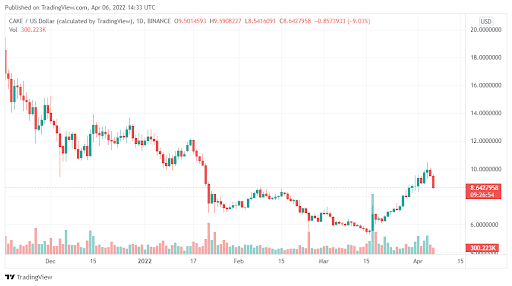
PancakeSwap (CAKE) has shown remarkable strength heading into April. The coin added nearly 60% of its value in the last two weeks or so. If this rise continues, CAKE could in fact flip a crucial overhead resistance zone into support. This will be a huge deal. Here are some of the details:
CAKE has faced major resistance around $11 as it looks to maintain its upward trend.
The coin has been rejected severally at that price and has since fallen sharply
CAKE is likely going to try and target $11 in the coming days.
Data Source: TradingView
PancakeSwap (CAKE) – Can $11 become support?
If bulls are able to transform the $11 resistance into support, then CAKE has the potential of seeing a major bullish breakout. The DEX coin has tried severally to break past this zone over the last few days but has been rejected firmly.
As a result, CAKE has fallen sharply in fact, it was down nearly 13% over the last 24 hours. We expect CAKE bulls to try and retest the $11 mark in the days ahead. If indeed they are successful in smashing past it, then we could see the token hit $15 in the near term.
This will be a gain of nearly 90% from its current price. But if $11 becomes a bridge too far for the coin, CAKE will likely fall back to $8.32 or thereabout before the next bull run.
Should you buy CAKE now?
Well, as a rule, you don’t want to buy any coin when it’s very close to resistance. The downside risks are just very high. A good play here will be to wait and see if the $11 is breached.
If this happens, then you can buy in and ride the wave. Also, if CAKE is rejected at $11 again, wait for the pullback and enter at $6 or thereabout.
PancakeSwap (CAKE) has shown remarkable strength heading into April. The coin added nearly 60% of its value in the last two weeks or so. If this rise continues, CAKE could in fact flip a crucial overhead resistance zone into support. This will be a huge deal. Here are some of the details:
CAKE has faced major resistance around $11 as it looks to maintain its upward trend.
The coin has been rejected severally at that price and has since fallen sharply
CAKE is likely going to try and target $11 in the coming days.
Data Source: TradingView
PancakeSwap (CAKE) – Can $11 become support?
If bulls are able to transform the $11 resistance into support, then CAKE has the potential of seeing a major bullish breakout. The DEX coin has tried severally to break past this zone over the last few days but has been rejected firmly.
As a result, CAKE has fallen sharply in fact, it was down nearly 13% over the last 24 hours. We expect CAKE bulls to try and retest the $11 mark in the days ahead. If indeed they are successful in smashing past it, then we could see the token hit $15 in the near term.
This will be a gain of nearly 90% from its current price. But if $11 becomes a bridge too far for the coin, CAKE will likely fall back to $8.32 or thereabout before the next bull run.
Should you buy CAKE now?
Well, as a rule, you don’t want to buy any coin when it’s very close to resistance. The downside risks are just very high. A good play here will be to wait and see if the $11 is breached.
If this happens, then you can buy in and ride the wave. Also, if CAKE is rejected at $11 again, wait for the pullback and enter at $6 or thereabout.
Aminhossein “Amin” Rad runs an over-the-counter trading desk in Dubai, United Arab Emirates. Searching for a business after dropping out of university, he started to style himself as a Bitcoin broker in 2016. Starting with his first deal after five months of wading through scammers and tire-kickers, Rad went on to found Crypto Desk, a business-to-business exchange that now deals millions of dollars of private crypto transactions among its 2,500 clients every day.
But why do people use OTC desks when centralized exchanges offer lower fees, and what dangers come with the business? Rad spills the beans on a sector of the crypto world that flies under the radar for most retail traders.
Dubai OTC trader Amin is Rad by name and nature.
The devil is in the deal-tails
The crypto asset industry has its share of rampant unethical behavior that is encouraged by anonymity and a lack of regulation or enforcement. Having come across all types of scams over his years in the industry, Rad differentiates between what he calls soft scams and hard scams. The former are things such as indirect and impersonal rug-pulls, while the latter are more direct and targeted.
He says most buyers see “shitcoins and memecoins as a joke or a game,” and relatively few experience much emotional trauma when the game ends and prices take a nosedive. However, getting scammed is far from a joke when a serious investor is looking to invest a portion of their hard-earned wealth into the crypto market or cashing out to buy real estate.
“The psychological effects of hard scams are much more deteriorating” in part because they are direct, playing on the mark’s trust rather than greed, and the money is not always an amount that the victim can afford to lose. Rad goes on to explain the common scams.
Amin Rad, CEO of Crypto Desk, is at home in his office in downtown Dubai. Photo by Elias Ahonen.
Third-party scam
A third-party scam involves a cybercriminal who finds a buyer and seller, introduces themselves as a broker, and offers an attractive deal to both. Rad explains that after building trust and “playing mind games,” the scammer will convince both the buyer and seller to meet in person for the exchange, with perhaps the buyer arriving at the seller’s office with cash.
Between these transacting parties will be a broker, or, more commonly at least, what appears to be a chain of brokers. The buyer will share their address with the broker, who will instead forward their own address to the seller. The seller then “transfers the coins to the address without thinking twice because the cash is right in front of him, and the coins will arrive in the cybercriminal’s wallet,” Rad explains. With a suitcase of money on the table, chaos will ensue as the BTC fails to arrive.
“Huge volumes of money can disappear in a second — even professional people who get scammed once can sometimes get distracted and lose focus, only to fall victim again.”
Fake crypto coin scam
A fake crypto coin scam involves the scammer sending a different, usually worthless cryptocurrency to the buyer who mistakes it for the real thing. This could be as simple as sending Bitcoin Cash or Ethereum Classic instead of BTC or ETH. Often, it involves the creation of an entirely new token that looks like the real thing when it arrives in the buyer’s MetaMask wallet. This is easily done because “Ethereum is an open platform, and anyone can create any coin they want, like USDTx in place of USDT,” Rad stresses. To be sure, one should check the smart contract — don’t trust, verify.
OpenSea offers on an NFT listed for 121.95 ETH — note the currency! Screenshot by Elias Ahonen
A variant of this has been seen on NFT marketplace OpenSea, where buyers can bid in Ether or stablecoins USDC or Dai, both of which are worth $1 each. As the Dai symbol can be mistaken for that of Ether’s, an inexperienced or tired user might accept a bid of 79 Dai on their 80-ETH NFT, only to realize too late that they are down by a quarter of a million dollars. While it can be argued whether such a transaction is a scam in the legal sense since there is no direct misrepresentation, those making such offers in bad faith are surely bankrupt in terms of morality.
Transfer recall scam
A transfer recall scam works by way of chargebacks, where a dishonest buyer of a cryptocurrency sends funds to the seller, receives cryptocurrency, and goes on to file a fraudulent complaint with their bank or payment provider, alleging that they themselves have fallen victim to a scam.
“Some banks immediately return the money,” Rad says. “This is actually one of the most difficult types of scams to follow up on” because neither banks nor the police are likely to understand much about cryptocurrency.
“Let’s say this case goes to court — you will end up having to pay the government to hire a specialist to make sure that you transferred cryptocurrency to that guy. It is very difficult unless you have powerful lawyers and are willing to spend a lot of money,” Rad describes.
Wallet import scam
A wallet import scam happens when a seller of cryptocurrency says that they cannot send directly to the buyer’s wallet by way of a public address but insists that the Bitcoin must be imported. “They import a watch-only address to your wallet,” Rad says, referring to a setting that allows the wallet to mirror an address it does not control.
“If you are not experienced, you will open your wallet and think, ‘Ooh, I have 100 Bitcoins here in my wallet,’ and you will hand over the cash, but later on, when you try to sell the Bitcoins, you understand that the coins are not transferable.”
In order to pull off this scam successfully, the scammer must generally know which Bitcoin wallet the unwitting buyer is using. “You should never tell anyone what wallet you’re using. It’s none of their business. If the cryptocurrency is sent correctly, it will be received correctly,” Rad warns, using the analogy that you do not need to know whether someone is using an iPhone or Nokia in order to call them.
Of course, you should never allow anyone to see your seed phrases or private keys or hand them your wallet for any reason, he adds.
In addition to avoiding scams, Rad recommends that anyone conducting OTC trades should take care to obtain and verify the identity of the other party and, regardless of regulations, sign an agreement stating that they have exchanged cryptocurrency and fiat with each other.
The workings of an OTC desk
Now in his mid-20s, Rad was born to a Middle Eastern family and grew up in Dubai, UAE. In 2012, he enrolled in an electrical engineering program at the American University of Sharjah, just north of Dubai. After studying in Sharjah for three years, he was not entirely satisfied with his prospects and dreamed of moving to America, receiving acceptances to continue his electrical engineering studies at both Stanford and the University of Texas at Austin. Despite what would appear to be a solid opportunity, Rad felt a deeper call to start a business back home in the UAE and decided not to move to the United States. He decided to drop out, as he saw no future in engineering.
“I wanted to get into the technology business, but I didn’t know what to start with,” Rad recalls. It was around then that he heard Bitcoin and blockchain being discussed in his friend circles. “I got curious, so I independently went on to learn about this technology — blockchain and decentralization,” he explains.
“There was no example in this region that I could follow — all the blockchain entrepreneurs were in China and the USA. There was no one here who was doing blockchain entrepreneurship.”
Soon he found an opportunity: There was money to be made by brokering Bitcoin deals. Rad started to seek out contacts who were interested in buying or selling cryptocurrency and connecting them. “A lot of them were non-serious, and a lot of them were scammers,” he recalls, adding that filtering serious traders from time-wasters was a drain. Introducing himself as a broker and getting business through word of mouth, he also used online platforms like LocalBitcoins to find business. Often, he would pass referral fees to those introducing new clients.
“It took five months until I made my first deal. For five months, I kept encountering non-serious people and scammers — a lot of scammers.”
Rad explains that the margins on OTC transactions were higher in the early days, with 2%–3% being common in 2016 and 2017. “Now, there are more competitors in the market,” and rates have gone down, while volume has risen. Exact percentages change constantly according to market demand, but “the golden number is half a percent” for high-volume deals, while lower-volume retail traders can expect to pay double or triple. While he describes $1-million and $2-million transactions as common, “anything over $1 million is considered high volume,” Rad says.
Business was informal at first, and Rad came up with the Crypto Desk name in 2018. The company received a crypto trading license in early 2021, which he says makes the business easier and safer “because we can work in a regulated space instead of a gray one.”
More than margins have changed since the early days. “At the moment, most deals on the OTC market are in USDT,” Amin states, which is a departure from the past when most people looked to buy or sell specific quantities of Bitcoin. USDT is easy to exchange into any cryptocurrency on both centralized and decentralized exchanges or back into fiat. While USDC and Dai appear to be held in higher regard in DeFi and NFT circles, “most people who use USDT are not so familiar with blockchain, and are afraid to change to another stablecoin,” Rad admits. USDT was the first stablecoin, after all.
Journey’s scribe Elias Ahonen visits Crypto Desk in Dubai’s downtown and just happens to have a copy of his book Blockland on hand!
As Crypto Desk deals only in UAE dirhams, whose exchange rate has been pegged at 3.6725 dirhams to the U.S. dollar since 1997, exchanging USD stablecoins and AED is a relatively straightforward process with little exchange risk.
“My daily turnover is $4 million–$5 million, but that comes from several different transactions,” Rad clarifies, adding that all of his clients are based in the UAE. He explains that there is a natural balance to the business, with UAE locals tending to be buyers looking to allocate money into the crypto sphere, while those from abroad are most often looking to sell cryptocurrency “in order to purchase real estate, cars, and pay their living expense in the UAE,” Rad explains.
“In my opinion, the UAE will be the center of blockchain in the world.”
In the future, Rad foresees his localized model thriving around the world. Though the market is now controlled largely by big players, Rad believes that “local exchanges have better knowledge of the local market’s needs and regulations.”
So, what about the mythical buyer who is looking for $100 million in cryptocurrency?
“They exist. I can facilitate up to $30 million per day, but I don’t find them,” he says, adding that $4 million–$6 million is the maximum he regularly sees from any single client. When a large order comes in, it falls onto Rad to figure out if the deal is real, a process he says takes only two or three minutes.
“When I see them, I understand: Are they a $100-million person or not?” Rad says with marked confidence. For him, conversation is a better marker of seriousness than appearance. “Most scammers have branded items, and most serious people try to keep a low profile,” he concludes.
Near Protocol (NEAR) has rallied by almost 30% after announcing on April 6 that it had raised $350 million in a funding round led by Tiger Global, a New York-based hedge fund.
NEAR price eyes 100% price rally
NEAR’s price reached over $19.75, just about 2.5% below its all-time high. However, many analysts agreed with the potential for the NEAR/USD pair to reclaim its best level to date, and even rise above it in the coming weeks.
NEAR/USD daily price chart. Source: TradingView
Adoption remained the key focus behind the bullish predictions. For instance, Zoran Cole, the founder of the popular Telegram group Crypto Insiders highlighted that Near Protocol will announce the launch of its own native algorithmic stablecoin called USN as early as April 20.
The stablecoin will reportedly use a Terra-like native token burn mechanism to maintain the U.S. dollar peg, effectively reducing NEAR supply.
Additionally, as Cole asserted in his investment thesis, Near will offer stakers an annual percentage yield of around 20%, thus incentivizing DeFi capital rotation toward its pools and boosting NEAR’s demand simultaneously.
“This will lead to a comparison of Near to Terra as the narrative for attractive stablecoin yields proliferates,” he noted, adding:
“Terra currently has a market capitalization of approximately $40 billion while Near sits at $10 billion. The catalysts above will strengthen Near’s fundamentals in both the short and long term and likely cause its market capitalization to appreciate by 100% at minimum over the next few months.”
Slim Trady, a pseudonymous market analyst, also expects NEAR to reach new all-time highs, noting that there is “no substantial resistance left” on the coin’s chart that could cap its upside moves.
— Slim Trady – non giver of ICP (@TradySlim) April 7, 2022
NEAR Coinbase listing near?
Despite being in the top-20 crypto assets by market capitalization, NEAR remains listed only on a few crypto exchanges, including Binance, Huobi, KuCoin, and Upbit, limiting its exposure, especially in voluminous markets like the U.S.
But Kole noted that Coinbase, one of the leading U.S.-based crypto exchanges, will list NEAR on its platform “in the next couple of months,” noting that it would help boost the coin’s retail visibility.
“This also paves the way for Near NFTs to be integrated into Coinbase’s upcoming NFT marketplace.
FTX, a crypto exchange headed by Sam Bankman-Fried, could also list NEAR pairs given its investment arm FTX Ventures being one of the backers in Near Protocol’s latest $350 million funding rebound.
Price levels to watch
From technical perspective, NEAR now eyes a run-up toward its current record high above $20.50.
NEAR/USD daily price chart. Source: TradingView
A decisive break above the level, which coincides with the 1.0 FIb line of the Fibonacci retracement graph, drawn from $20.78-swing high to nearly $6-swing low, could have NEAR eye $29.70 as its next upside target.
Conversely, a pullback risks putting NEAR’s price en route below its interim support near $17.55, with the next downside target at around $15.
The views and opinions expressed here are solely those of the author and do not necessarily reflect the views of Cointelegraph.com. Every investment and trading move involves risk, you should conduct your own research when making a decision.
The Golden City is losing its shine as one of the largest United States-based cryptocurrency exchanges closes its San Francisco-based headquarters.
Kraken CEO, Jesse Powell retweeted that Kraken will close its global headquarters on 548 Market Street, in the center of San Francisco. In the retweet shared by a San Francisco-based political commentator, Richie Greenberg, the decision cites that:
“We shut down Kraken’s global headquarters on Market Street in San Francisco after numerous employees were attacked, harassed and robbed on their way to and from the office.”
Cointelegraph reached out to the Kraken team for comment and will update if and when they reply.
A poor advertisement for living in California’s financial center, the tweet also states that “San Francisco is not safe,” and crime is “dramatically underreported.”
The Twitter community was quick to respond to the Kraken news, sharing dark anecdotes of working in San Francisco.
I worked at Market St for few months, it is crazy, it turns into skid row after 6pm. I’m from Europe and never seen anything like it. Still have flashbacks of the things I witnessed. Just tried to look away and not get stabbed. Remember walking in the smell of skunk and pee.
The living situation is so dire that rhere are applications that track human waste around San Francisco, Snap Crap is among the most popular. The applications help San Franciscans navigate the city without puting their foot in it.
A San Francisco poop map. Source: arcgis.com
The Twitter and Reddit community comments shone a light on how soaring rental prices have made homelessness more common, while crime is “rampant.” The average rent is now roughly $3,000 a month, while the San Francisco Chronicle estimates that there are more than 18,000 homeless people in the city.
A report in 2020 revealed that San Francisco and the surrounding zone, the Bay Area, boasted the highest concentrations of crypto investments. In light of Kraken’s decision, and the social crises in San Francisco, the hold on crypto and the future of finance may falter.
As Cardano (ADA) prices fall back towards the psychological one dollar level, more and more investors are finding themselves with unrealized losses by holding on to the digital asset.
Cardano’s ADA token has had a bearish week. The price has fallen 11.4% since Monday resulting in more holders being in the red. More significantly, ADA is now 64.7% below its September 2 all-time high of $3.09 and is in danger of falling below a dollar over the next few days should the trend continue.
According to IntoTheBlock’s “in/out of the money” indicator, more than two-thirds, or 67% of ADA holders, are underwater. A quarter of Cardano investors are in the green, and 9% of them are at a breakeven point.
The indicator identifies the average cost at which the tokens were purchased and compares it to the current price, which was $1.09 at the time of writing.
The analytics provider reported that 3.41 million ADA addresses are in the red compared to just 1.25 million in the green.
In/Out of the Money: IntoTheBlock
A related metric is the amount of time the token has been held. The vast majority, or 76% of ADA holders, have held it for between one and 12 months. Just 11% of Cardano investors have held the token for more than a year, and those are the ones that are still in profit.
From a technical standpoint, ADA has turned bearish and could quite quickly revisit its 2022 and yearly low point of around $0.80, which occurred in mid-March. This would plunge even more investors into the red unless they sell at a loss.
The slide in prices could be tied to the network not living up to high expectations set around the launch of smart contracts. In terms of the numbers of decentralized applications (DApps), Cardano is still something of a wasteland with DeFi Llama reporting that there are just ten DeFi protocols running on the network with a combined total value locked of around $233 million.
Cardano co-founder Charles Hoskinson however believes that many Cardano dApps are waiting for the Vasil hard fork in June to launch. The “Basho” phase of the Cardano upgrade roadmap will focus on scalability and smart contracts with new technology called Hydra to boost network throughput even further.
In terms of other fundamenta Cardano is looking relatively strong. Network demand surged to record capacity earlier this year when the much-hyped SundaeSwap decentralized exchange was launched.
Santiment reported that Cardano was the most developed crypto project on GitHub in 2021, and Cardano NFT bonds were unveiled this week, providing another investment vehicle on the network.
However, unless there is a significant turnaround in trading sentiment, the ADA selloff may start to accelerate, putting more holders deeper underwater.
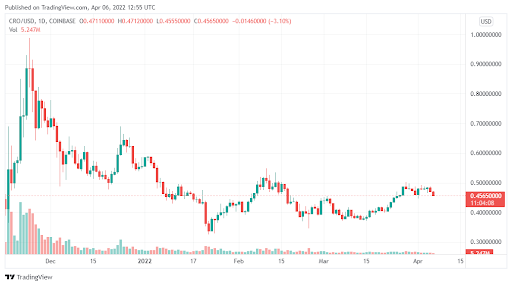
Cronos (CRO) has continued to struggle to maintain its recent uptick in price. There were hopes that finally, the coin would manage to cross past $0.5, but despite bulls pushing it to the limit, CRO failed. The coin is now staring at a possibility of a major correction. Here is what to know:
The chart shows a serious RSI divergence that could suggest a pullback is imminent.
CRO was also rejected at $0.5 as upward momentum fizzled out
The coin has lost around 6% over the last 24 hours, with more to come.
Data Source: Tradingview
Cronos (CRO) – Why a 15% is plausible
After a steady rise over the last two weeks, off-late CRO has been displaying several bearish technical signals. First, it seems the coin’s upside at the moment is capped at $0.48. In fact, CRO has tried to break above the $0.5 mark five times and has failed.
It is clear that the coin has no upward momentum right now, and the only way is down. The RSI divergence also suggests that a pullback is going to happen at any time. We expect CRO to retreat towards $0.43 in the days ahead as it tries to generate demand.
If bulls are not able to push the price back up again, CRO will bottom at around $0.41 or thereabout. However, if the coin can somehow manage to break the $0.5 barrier, then this analysis will become null and void. We do not see this happening though in the days ahead.
Why CRO has struggled past $0.5
So far, the $0.5 mark has proved to be the most difficult overhead resistance for CRO. It is likely that this is basically a psychological barrier.
Since the coin has failed so many times before to smash past it, most traders would rather take a profit at around $0.5 instead of facing any serious upside risks.
Scott Melker, veteran trader and pocaster, is convinced that major layer-1 protocols should be part of everyone’s investment portfolio. Instead of picking individual crypto projects, such as NFTs or blockchain games, Melker thinks it makes more sense to bet on the blockchain infrastructure on which these projects are built.
“Any of these small projects could absolutely go nuts. But you’re going to have trouble choosing what they are. You should just own the layer-1 and the infrastructure that they’re all built on,” he said in an exclusive interview with Cointelegraph.
“You may not own a Bored Ape, but Ethereum holders have certainly benefited from the success of Bored Apes!” he pointed out.
Talking about his portfolio construction, Melker revealed that about 65% of his assets are currently in crypto. Besides Bitcoin (BTC), which makes up the bulk of his long-term holdings, Melker is extremely bullish on Ethereum (ETH).
“Nothing is going to kill Ethereum. I believe Ethereum is here to stay. I believe it’s an extremely important asset and one that everybody should have exposure to,” he said.
Melker believes that the upcoming Merge, which should complete Ethereum’s transition to proof-of-stake, will be a massive boost for the asset’s price.
“This is a massively bullish event for Ethereum. (…) I think it will be a better chain, more usable after this happens,” he said. “We will eventually see Ethereum at $20 thousand, $30 thousand, $40 thousand.”