Author: BTCLFGTEAM

  • BTC starts 2022 all over again — 5 things to know in Bitcoin this week

    BTC starts 2022 all over again — 5 things to know in Bitcoin this week

    Bitcoin (BTC) starts a new week and a new quarter as if it were starting the new year — at just over $46,000.

    In what will seem like some serious deja-vu for hodlers, BTC/USD is at practically the same level it was on Jan. 1, 2022.

    Price action has been quiet — too quiet, perhaps — in recent days, but behind the declining volatility, there are signs that the market is busy deciding future direction.

    From macro to on-chain, there are in fact plenty of cues to keep an eye on in April, amid a backdrop of Bitcoin — at least so far — retaining its yearly open price as support.

    Cointelegraph takes a look at five of these factors as they pertain to BTC price performance over the coming week.

    Inflation meets fresh money printing

    There has been much talk of the end of the post-COVID “easy money” period and the impact it’ll have on risk assets such as Bitcoin.

    As the United States Federal Reserve pledges to reduce its record high balance sheet and keep raising key rates, commentators have sounded the alarm over what could be a shockwave hitting investment into crypto.

    So far, however, there is little sign that a fundamental shift is underway, while in Asia this week, it seems like the opposite is true.

    As highlighted by markets commentator Holger Zschaepitz, Japan’s central bank, the Bank of Japan (BoJ), has in fact added to its balance sheet but printing even more liquidity.

    The BoJ already had the largest balance sheet relative to GDP, and that trend is only increasing, now at 136% of GDP.

    For Zschaepitz, this is not only a surprise, but could be “the biggest monetary experiment in history.”

    “In comparison, the ECB and the Fed look like amateurs,” he argued.

    Central bank balance sheet annotated chart. Source: Holger Zschaepitz/ Twitter

    If more printing means more good times for risk assets, meanwhile, not everyone is even convinced that the long-vaunted balance sheet reductions will last. Central banks, they claim, will soon have no choice but to restart liquidity injections.

    “There is no government, ever, that resisted the temptation to print money in order to pay its bills and placate its citizens. The government will never voluntarily go bankrupt. This is axiomatic. I challenge you to contradict me with evidence,” Arthur Hayes, ex-CEO of derivatives giant BitMEX, wrote in a blog post in March.

    “Therefore, if your time horizon is in the years, it’s time. If you mess with the bull, you get the horns. Remember: it’s not gold or Bitcoin that is increasing in price, it’s a decrease in value of the fiat currency in which they are priced.”

    The contrasting view, as signaled by last week’s yield curve inversion, pits rate hikes against the now high risk of a recession in the U.S. — a combination that should pressure Bitcoin and stocks alike.

    Spot bulls aim for $50,000

    The lack of volatility is the main talking point among Bitcoin traders and analysts as Monday gets underway.

    Some classic but brief excitement around the weekly close faded within hours, with bears still failing to take the yearly open away as support, data from Cointelegraph Markets Pro and TradingView shows.

    BTC/USD 1-week candle chart (Bitstamp). Source: TradingView

    With that, BTC/USD is in exactly the same place as it was three months ago, but short-term price signals are already seeing some calling for continuation higher.

    Among them is popular analyst TechDev, who highlighted Bitcoin’s first “volatility squeeze” since January playing out on the 12-hour chart.

    TechDev used indicators including the Bollinger Bands volatility measure, which is now seeing BTC/USD surfing the middle of the channel with a skew to the upside.

    As Cointelegraph reported, the odds are already on for an attack on the $50,000 mark, which will be Bitcoin’s first this year.

    April itself, meanwhile, has much to live up to — in and of itself, this month has historically been “good” for Bitcoin.

    Buyers usher coins out of exchanges in March

    It’s no secret that a lot of Bitcoin has been leaving exchanges this year, but the latest data shows just how the supply squeeze is playing out.

    According to on-chain analytics firm Glassnode, last month saw exchange outflows unlike many others — exchanges are down by the equivalent of almost 100,000 BTC.

    Historically, there have only been two occasions in Bitcoin’s lifespan when outflows surpass the 100,000 BTC mark, making March’s among the highest.

    “Aggregate exchange outflows of this magnitude have only been seen on a handful of occasions through history, with most being after the March 2020 liquidity crisis,” Glassnode added in Twitter comments alongside an annotated chart.

    Bitcoin exchange net position change annotated chart. Source: Glassnode/ Twitter

    Should investors be recreating the bottom-buying behavior from after the COVID-19 crash, the implications should be clear, but may take a while to play out. In 2020, while BTC/USD rebounded after dropping 60% in days, it wasn’t until Q4 that price performance really began to change.

    Fellow analytics platform CryptoQuant, which tracks the balances of 21 major exchanges, meanwhile shows that overall BTC stocks are now at their lowest since Aug. 1, 2018 — 2.303 million BTC.

    A meandering downtrend in 2022 gathered pace in March, which saw a total of 77,000 BTC withdrawn to private wallets.

    Bitcoin exchange reserves chart. Source: CryptoQuant

    Never mind the altseason

    An unusual event has occurred when it comes to Bitcoin’s relationship with altcoins — combined open interest and volume on altcoin derivatives markets has surpassed that of Bitcoin for the first time in over a year.

    The move was noticed by crypto analytics platform Coinalyze, which openly suggested that the much-fabled “altseason” may now be here.

    “Could mean altseason, money flows into alts now,” founder Gabriel Dodan told Cointelegraph in private comments.

    Such a perspective chimes with data showing considerable inflows into altcoins last week, which one commentator argued showed risk appetite among investors increasing.

    Taking the limelight away from BTC may not be a dampener on performance per se, Dodan meanwhile added, thanks to volatility similarly draining away.

    “On the other hand that makes BTC pretty stable because it is not over leveraged; it’s a good floor for BTC,” he explained.

    Hash rate hits new all-time high

    Hot on the heels of record difficulty for the Bitcoin network, hash rate has hit new all-time highs.

    Related: Top 5 cryptocurrencies to watch this week: BTC, VET, THETA, RUNE, AAVE

    In what shows miners’ belief in the long-term profitability of participating in the network, hash rate is now at 223 exahashes per second (EH/s), according to data resource MiningPoolStats.

    Bitcoin hash rate chart (screenshot). Source: MiningPoolStats

    While only an estimate of the processing power dedicated by miners, hash rate has never been higher, and according to proponents, will continue to grow regardless of external attempts to “reign in” Bitcoin.

    “Bitcoin mining is pretty much the most anti fragile system designed by man,” Francis Pouliot, CEO of payment processor Bull Bitcoin, argued in a well-known blog post about Bitcoin hash rate and energy consumption last year.

    “Any attack on Bitcoin is guaranteed to make Bitcoin stronger, which itself implies a higher price, a higher hashrate, and higher energy consumption.”

    The topic of Bitcoin versus energy remains highly controversial, with multiple popular figures taking pains to explain what they see as a logical fallacy — that Bitcoin uses “too much.” Bitcoin does not waste energy, they contend, but merely converts it into something more useful as the most sound money ever created.

    Hash rate, regardless of the narrative, meanwhile continues to grow, underscoring the basic bullish premise for investing in Bitcoin.

    The views and opinions expressed here are solely those of the author and do not necessarily reflect the views of Cointelegraph.com. Every investment and trading move involves risk, you should conduct your own research when making a decision.

  • Top 5 cryptocurrencies to watch this week: BTC, VET, THETA, RUNE, AAVE

    Top 5 cryptocurrencies to watch this week: BTC, VET, THETA, RUNE, AAVE

    Bitcoin (BTC) is attempting to hold above its closest support level and traders are watching to see if the price can remain strong and close above the 2022 yearly open price at $46,200 for the second week in a row.

    April has historically been the best performing month of the year for the S&P 500, according to Sam Stovall, chief investment strategist at CFRA. If history repeats itself and the close correlation between the U.S. equity markets and Bitcoin continues, it could bode well for the crypto markets in the near term.

    Crypto market data daily view. Source: Coin360

    Another sentiment booster could be that the 19th million Bitcoin entered circulation on April 1. For the remaining 2 million Bitcoin, the crypto markets will have to wait for a long time because the last Bitcoin is expected to be mined by 2140. This could shift focus on how only a small quantity of Bitcoin is left to be mined and its growing demand could lead to scarcity and boost prices higher.

    Could Bitcoin hold above its critical support and if it does, will altcoins rally? Let’s study the charts of the top-5 cryptocurrencies that may extend their recovery in the short term.

    BTC/USDT

    Bitcoin is witnessing a tough tussle between the bulls and the bears near the important level at $45,400. The bears tried to pull and sustain the price below this level but the bulls held their ground. This suggests that the bulls are attempting to flip the level into support.

    BTC/USDT daily chart. Source: TradingView

    The upsloping 20-day exponential moving average ($44,333) and the relative strength index (RSI) in positive territory indicate the path of least resistance is to the upside. The critical level to watch on the upside is the 200-day simple moving average ($48,276).

    If bulls thrust the price above this barrier, the BTC/USDT pair is likely to pick up momentum. The rally could face minor resistance at the psychological level at $50,000 but if this level is crossed, the next stop could be $52,000.

    Contrary to this assumption, if the price turns down from the current level or the overhead resistance, the bears will again try to pull the pair below $45,400 and the 20-day EMA. If that happens, the pair could drop to the 50-day SMA ($41,615).

    BTC/USDT 4-hour chart. Source: TradingView

    The 4-hour chart shows that the price has been correcting since hitting the resistance line of the ascending channel. Recovery attempts by the bulls are facing stiff resistance at the downtrend line. If bulls push and sustain the price above the downtrend line, the pair could rise to the resistance line of the channel.

    A break and close above the channel could signal the resumption of the uptrend. Alternatively, if the price turns down from the downtrend line, the bears will attempt to sink the pair to $44,000. If this level cracks, the decline may extend to $42,594.

    VET/USDT

    VeChain (VET) surged above the overhead resistance at $0.07 on March 27 but the bears stalled the recovery at the 200-day SMA ($0.09). A minor positive is that the bulls have not allowed the price to slide below the breakout level at $0.07.

    VET/USDT daily chart. Source: TradingView

    If the price turns up from the current level, the bulls will make one more attempt to clear the overhead hurdle at the 200-day SMA. If they manage to do that, it will suggest a possible change in trend. The VET/USDT pair could then rally to $0.10 and later to $0.13.

    The rising 20-day EMA ($0.06) and the RSI in the positive territory indicate advantage to buyers. This bullish view will invalidate if the price turns down and breaks below the 20-day EMA. Such a move could pull the pair to the 50-day SMA ($0.05).

    VET/USDT 4-hour chart. Source: TradingView

    The 20-EMA has flattened out and the RSI is near the midpoint on the 4-hour chart, indicating a balance between supply and demand. If the price breaks above $0.08, the bulls will attempt to propel the pair above $0.09. If they do that, the pair could extend its up-move.

    Conversely, if the price turns down and breaks below the 50-SMA, the pair could drop to the critical level at $0.07. If bulls flip this level into support, the pair will again try to rise above $0.09 but if the support at $0.07 cracks, the bears may be back in the game.

    THETA/USDT

    Theta Network’s THETA token has been range-bound between $2.50 and $4.40 for the past several weeks. The bulls attempted to push the price above the overhead resistance but failed. This suggests that the bears continue to defend the level aggressively.

    THETA/USDT daily chart. Source: TradingView

    If the price does not break below $3.80, it will suggest that traders are not closing their positions in a hurry as they expect the up-move to continue. The upsloping 20-day EMA ($3.54) and the RSI near the overbought zone indicate that the path of least resistance is to the upside.

    If buyers drive the price above the overhead zone between $4.40 and the 200-day SMA ($4.77), it will signal the start of a possible uptrend. The THETA/USDT pair could then pick up momentum and rally to $6.

    Contrary to this assumption, if the price slides below the 20-day EMA, the next stop could be the 50-day SMA ($3.17). Such a move will suggest that the pair may remain range-bound for a few more days.

    THETA/USDT 4-hour chart. Source: TradingView

    The 4-hour chart shows that the bears have repeatedly thwarted attempts by the bulls to thrust the price above the overhead resistance at $4.40. The 20-EMA has flattened out and the RSI is near the midpoint, indicating a balance between supply and demand.

    If the price slips below the 50-SMA, the short-term advantage could tilt in favor of the sellers. The price could then drop to $3.50. On the other hand, the bulls will gain the upper hand if the price breaks and sustains above the overhead resistance.

    Related: Trezor investigates potential data breach as users cite phishing attacks

    RUNE/USDT

    THORChain (RUNE) has been trading inside a large descending triangle pattern for several months. The sharp rally of the past few days pushed the price to the downtrend line of the triangle where the bears are mounting a strong resistance.

    RUNE/USDT daily chart. Source: TradingView

    If the price turns down from the current level, the RUNE/USDT pair could drop to the 20-day EMA ($9.75). This is an important level to watch out for because if the price rebounds off the 20-day EMA, it will suggest that the sentiment remains positive and traders are buying on dips.

    That may enhance the prospects of a break above the downtrend line. If that happens, the bearish triangle setup will invalidate, which could be a bullish sign. The pair may then rally to $17.

    This bullish view will be negated in the short term if the price turns down and breaks below the 20-day EMA. That could pull the pair down to the 200-day SMA ($7.88).

    RUNE/USDT 4-hour chart. Source: TradingView

    The 4-hour chart shows that the pair is facing strong resistance near $13. A minor positive is that the bulls have not allowed the price to dip and sustain below $11. Therefore, this becomes an important level to keep an eye on.

    If the price breaks below this support, the pair could drop to the next major support at $10. Conversely, if the price rebounds off $11, the buyers will again try to resume the uptrend by driving the pair above the overhead resistance.

    AAVE/USDT

    Aave (AAVE) broke out of the downtrend line on March 29 which indicated a potential change in trend. The bears tried to stall the recovery at the 200-day EMA ($226) but the bulls did not give up much ground.

    AAVE/USDT daily chart. Source: TradingView

    The buying resumed on April 1 and the AAVE/USDT pair broke above the 200-day SMA. If the price sustains above the 200-day SMA, it will signal the start of a new up-move.

    If bulls drive the price above $262, the rally may extend to the psychological level at $300. The bears may mount a stiff resistance at this level but if bulls overcome this barrier, the up-move could reach $350.

    This bullish view will invalidate in the short term if the price turns down and plummets below the 200-day SMA. The bears could then pull the price to the 20-day EMA ($187).

    AAVE/USDT 4-hour chart. Source: TradingView

    The 4-hour chart shows that the bulls are buying the dips to the 20-EMA. If bulls push the price above $261.20, the uptrend could resume. This rally could face resistance in the overhead zone between $283 and $300.

    The RSI is showing signs of a negative divergence, indicating that the bullish momentum may be weakening. If the price turns down and breaks below the 20-EMA, it will suggest that the short-term bulls may be booking profits. That could sink the pair to the 50-SMA.

    The views and opinions expressed here are solely those of the author and do not necessarily reflect the views of Cointelegraph. Every investment and trading move involves risk, you should conduct your own research when making a decision.

  • 6 Questions for Chen Li of Youbi Capital

    6 Questions for Chen Li of Youbi Capital

    We ask the buidlers in the blockchain and cryptocurrency sector for their thoughts on the industry… and throw in a few random zingers to keep them on their toes!


    This week, our 6 Questions go to Chen Li, the co-founder and CEO of Youbi Capital, a venture capital firm investing in blockchain technologies and disruptive decentralized applications.


    Chen Li is the co-founder and CEO of Youbi Capital. He has a Ph.D. in chemistry and worked as a scientist for Regeneron Pharmaceuticals, where he won two awards for his contributions to developing groundbreaking antibody drugs. In 2015, he was introduced to Bitcoin mining by his roommate in college, then jointly founded Youbi Capital in 2017. Chen built the foundation of Youbi’s thesis in blockchain infrastructure and led investments in Algorand, Avalanche, Polkadot, Flow, Kadena, Chainlink, Debank and others. He was also an advisor to JP Morgan’s blockchain team.


    1 — What is the main hurdle to mass adoption of blockchain technology?

    The main hurdle to mass adoption of blockchain technology now is still its infrastructure, specifically, scalability and security of layer 1s. We all saw that the watershed moment for Axie Infinity was not the play-to-earn movement that started in early 2020 but the migration of the game from Ethereum to Ronin in mid 2021, which led to an explosion of players and revenue growth right away. 

    But Axie was just one application, and can therefore be easily accommodated on a dedicated chain, while for the DeFi protocols — which are highly composable and already interconnected — we still don’t have a layer 1 for the entire set of DeFi protocols to migrate over without starting to jam its traffic. Solana might be the closest to achieving this goal, but it is not horizontally scalable for mass adoption. 

    There is still a lot to do to lay a solid foundation for the blockchain application.

    2 — What will happen to Bitcoin and Ethereum over the next 10 years?

    Bitcoin has successfully extended the consensus on its asset as a decentralized store of value for everyone from individuals to a large group of institutions in this cycle. It is only a matter of time before it is universally accepted. Furthermore, under the global inflation backdrop, Bitcoin might also have the chance to become a broadly used currency in international settlements. There has been a lot of speculation on the Bitcoin value proposition broken down to its usage in different categories.

    In terms of technology, the community has intentionally kept Bitcoin’s progress at a slow pace to avoid introducing any uncertainty. While I believe that is the right strategy for its use cases, Bitcoin will still be limited in supporting smart contracts over the next 10 years.

    Ethereum, on the other hand, is going through much faster reiteration by transitioning to proof-of-stake and potentially sharding in the near future. All EVM-supporting chains are also in the Ethereum ecosystem, contributing value to the base layer. Due to the strong network effect, the Ethereum ecosystem will likely remain as a dominant force in the DeFi space throughout the next 10 years.

    3 — When you tell people you’re in the blockchain industry, how do they react?

    I remember when I first talked to outsiders about Bitcoin in 2015 — they either fell silent and gave me awkward looks like I was trying to talk them into some kind of scam, or in some cases, enthusiastically challenged me on whether Bitcoin had any value. Bitcoin mining was more of a business that people could understand, but it was extremely rare to find someone that was open-minded about the cryptocurrency itself. 

    Now, people are becoming more and more knowledgeable and engaged about blockchain technology and crypto. I am often not the only person they know in the industry. I used to be asked lots of basic questions about blockchain. But now, people who aren’t blockchain professionals sometimes share their perspectives first once they know I am in the industry. 

    They have much more diverse perspectives on the blockchain industry now. Besides holding crypto in their portfolio, several people are NFT collectors or even landowners in blockchain games. They see blockchain as a technology to issue and transact NFT assets as well as infrastructure for the Metaverse, but are more attracted to NFTs and Metaverses. That is why I am very confident that the Metaverse will be the entry point to the Web3 era.

    4 — Who makes sense to you, and who makes no sense whatsoever?

    Whoever is building a product then tells a story makes sense to me and who just tells a story or builds a product for imaginary demand makes no sense whatsoever.

    There are lots of great products that are carefully designed and reiterated to fit the needs of the users. For example, Binance has a very efficient feedback loop, from customer service to management. As a result, it is able to reiterate its product in the right way and engage a new trend in the market. The Binance team makes sense to me. Polygon, Debank and The Graph are all excellent examples of products with strong product-market fit. All these teams make sense to me and I see lots of potential in the adoption of their product.

    5 — List your favorite sports teams, and choose the single most memorable moment from watching them.

    My favorite sports teams were the Chicago Bulls and Denver Broncos. The most memorable moment was Michael Jordan’s final shot with the Bulls that won them the sixth championship.

    6 — Other than the present day, in what time and in what country would you like to have lived?

    I wish I had lived in Shanghai, China from 2012 to 2015. That was the first crypto market cycle that I missed. The two major events in that time frame were the growth of Bitcoin mining and the fundraising and initial community-building of Ethereum. They both happened during that time in China. 

    Plus, China is my home country. I love the food and people.

    A wish for the young, ambitious blockchain community:

    I wish that everyone in the community can survive the ups and downs, holding tight to their crypto assets.

  • Can Bitcoin seal its best weekly close of 2022? BTC price sits at $46.5K

    Can Bitcoin seal its best weekly close of 2022? BTC price sits at $46.5K

    Bitcoin (BTC) bulls had everything to play for on April 3 as the first weekly close of the month looked set to be above the all-important $46,000.

    BTC/USD 1-hour candle chart (Bitstamp). Source: TradingView

    Anything could happen in final hours of Sunday

    Data from Cointelegraph Markets Pro and TradingView painted an interesting picture Sunday, as commentators waited for some classic end-of-week volatility.

    BTC/USD had delivered few surprises over the weekend, with an overnight dip to near $45,500 the worst that hodlers had to confront.

    Now, the odds were on for a potential second weekly close above the 2022 yearly open of $46,200. 

    At around $46,500 at the time of writing, Bitcoin had plenty of potential, but even a moderate last-minute pullback could make the weekly chart look quite different.

    Add another $500, by contrast, and the weekly close would be Bitcoin’s highest of the y

    “Bitcoin still holding crucial level here, so continuation seems likely to be happening if we remain above $45K,” Cointelegraph contributor Michaël van de Poppe stated Saturday on the broader picture beyond the weekly close.

    Van de Poppe, like others, was eyeing a challenge of $50,000 in the coming week based on recent strength.

    “Riskier” altcoins’ appeal gets boost

    Data covering inflows into crypto markets meanwhile showed renewed appetite for altcoins over the past week.

    Related: Solana jumps past key selloff junction: SOL price eyes $150 in April

    As noted by Yann Allemann and Jan Happel, co-founders of on-chain analytics firm Glassnode, those altcoin inflows had increased in step with diminishing upside on BTC.

    Total inflows last week were nearly $200 million, with Bitcoin reponsible for around half the tally.

    Risk appetite in the short term thus contradicted forecasts of a risk asset rout engendered by macro factors, something analysts nonetheless had tipped to become a feature in Q2.

  • Can Bitcoin seal its best weekly close of 2022? BTC price sits at $46.5K

    Can Bitcoin seal its best weekly close of 2022? BTC price sits at $46.5K

    Bitcoin (BTC) bulls had everything to play for on April 3 as the first weekly close of the month looked set to be above the all-important $46,000.

    BTC/USD 1-hour candle chart (Bitstamp). Source: TradingView

    Anything could happen in final hours of Sunday

    Data from Cointelegraph Markets Pro and TradingView painted an interesting picture Sunday, as commentators waited for some classic end-of-week volatility.

    BTC/USD had delivered few surprises over the weekend, with an overnight dip to near $45,500 the worst that hodlers had to confront.

    Now, the odds were on for a potential second weekly close above the 2022 yearly open of $46,200. 

    At around $46,500 at the time of writing, Bitcoin had plenty of potential, but even a moderate last-minute pullback could make the weekly chart look quite different.

    Add another $500, by contrast, and the weekly close would be Bitcoin’s highest of the y

    “Bitcoin still holding crucial level here, so continuation seems likely to be happening if we remain above $45K,” Cointelegraph contributor Michaël van de Poppe stated Saturday on the broader picture beyond the weekly close.

    Van de Poppe, like others, was eyeing a challenge of $50,000 in the coming week based on recent strength.

    “Riskier” altcoins’ appeal gets boost

    Data covering inflows into crypto markets meanwhile showed renewed appetite for altcoins over the past week.

    Related: Solana jumps past key selloff junction: SOL price eyes $150 in April

    As noted by Yann Allemann and Jan Happel, co-founders of on-chain analytics firm Glassnode, those altcoin inflows had increased in step with diminishing upside on BTC.

    Total inflows last week were nearly $200 million, with Bitcoin reponsible for around half the tally.

    Risk appetite in the short term thus contradicted forecasts of a risk asset rout engendered by macro factors, something analysts nonetheless had tipped to become a feature in Q2.

  • Trezor investigates potential data breach as users cite phishing attacks

    Trezor investigates potential data breach as users cite phishing attacks

    Cryptocurrency hardware wallet provider Trezor has begun investigating a possible data breach that may have compromised users’ email addresses and other personal information. 

    Earlier today, on Apr. 3, several users from the Crypto Twitter community warned about an ongoing email phishing campaign specifically targeting Trezor users via their registered email addresses.

    In the ongoing attack, several Trezor users have been contacted by unauthorized actors posing as the company — with the ultimate intention to steal funds by misleading unwary investors. As part of the attack, users received an email about downloading an app from the ‘trezor.us’ domain, which is different from the official Trezor domain name, ‘trezor.io.’

    Trezor initially suspected that the compromised email addresses belong to a list of users who opted-in for newsletters, which was hosted on an American email marketing service provider Mailchimp. 

    While Trezor attempts to identify the root cause of the situation with an official investigation, users are advised not to click on links coming from unofficial sources until further notice.

    Related: BlockFi confirms unauthorized access to client data hosted on Hubspot

    On Mar. 19, New Jersey-based crypto financial institution BlockFi proactively confirmed a data breach to warn investors about the possibility of phishing attacks.

    As Cointelegraph reported, hackers gained access to BlockFi’s client data that was hosted on Hubspot, a client relationship management platform. According to BlockFi:

    “Hubspot has confirmed that an unauthorized third-party gained access to certain BlockFi client data housed on their platform.”

    While specifics on the breached data are yet to be identified and revealed, BlockFi reassured users by highlighting that personal data — including passwords, government-issued IDs and social security numbers — “were never stored on Hubspot.”

  • Axie Infinity hacked for $612M, OpenSea expands support to Solana, EU’s unhosted wallet regulations cause a stir: Hodler’s Digest, March 27-April 2

    Axie Infinity hacked for $612M, OpenSea expands support to Solana, EU’s unhosted wallet regulations cause a stir: Hodler’s Digest, March 27-April 2

    Coming every Saturday, Hodler’s Digest will help you track every single important news story that happened this week. The best (and worst) quotes, adoption and regulation highlights, leading coins, predictions and much more — a week on Cointelegraph in one link.

    Top Stories This Week

    Crypto industry fires back after EU vote to block ‘unhosted’ wallets

    The cryptocurrency industry has fired back at the European Parliament, the legislative arm of the European Union, voting in favor of stringent crypto regulations relating to ”unhosted” private wallets. 

    The guidelines would require crypto service providers to verify the identity of every individual using an unhosted wallet that interacts with them, while any transaction greater than 1,000 euros would need to be reported to authorities. 

    “Imagine if the EU required your bank to report you to the authorities every time you paid your rent merely because the transaction was over 1,000 euros,” Coinbase CEO Brian Armstrong wrote on Twitter. “Or if you sent money to your cousin to help with groceries, the EU required your bank to collect and verify private information about your cousin before allowing you to send the funds.”

    Axie Infinity’s Ronin bridge hacked for over $600M

    Axie Infinity’s Ronin Bridge was the victim of a hefty hack worth around $612 million earlier this week, with 173,600 Ether and 25.5 million USD Coin being stolen from the platform. 

    Ronin developers stated that the attacker used hacked private keys to forge fake withdrawals, draining the funds from the Ronin Bridge in just two transactions. 

    In a statement on Wednesday, the developers stated that they were “working with law enforcement officials, forensic cryptographers and our investors to make sure that all funds are recovered or reimbursed. All of the AXS, RON and SLP [tokens] on Ronin are safe right now.”

    Terra smash-buys $139M Bitcoin, wallet reaches 31,000 BTC

    As part of the Bitcoin buying spree led by Terraform Labs founder Do Kwon, the Terra wallet belonging to Luna Foundation Guard approached $1.5 billion in BTC following another huge $139 million purchase this week. 

    Terra has been snapping up BTC aggressively since late January to build reserves to back its TerraUSD (UST) stablecoin, with Kwon also outlining earlier this month that Terra plans to accumulate a whopping $10 billion worth of BTC. 

    Terraform Labs is on track to overtake Tesla as the second-largest holder of Bitcoin soon, with MicroStrategy also in its sights, according to data from Bitcoin Treasuries.

    OpenSea set to integrate Solana in April, further expanding the NFT ecosystem

    Top NFT marketplace OpenSea announced a long-awaited integration with the Solana blockchain on Wednesday. The expanded support, expected to go live in April, adds to OpenSea’s existing support of Ethereum, layer-2 Polygon and Klaytn. 

    It appears the move has been well received, with OpenSea’s 16-second teaser video on Twitter pulling 615,500 views, 8,964 retweets and 21,700 likes within 18 hours of posting. 

    Alluding to the vast number of tweets and media publications commenting on the potential for a Solana launch, OpenSea cheerfully referred to the announcement as the “best-kept secret in Web3.”

    MetaMask rolls out Apple Pay integration and other iOS updates

    ConsenSys-owned MetaMask revealed important updates for iPhone and Apple Pay users on Tuesday that enable them to purchase cryptocurrency directly through the app via debit or credit cards, removing the hassle of sending Ether from an outside source to add funds.

    Notably, the move is said to lower gas fees, and MetaMask is utilizing two payment gateways, Wyre and Transak, to support debit card and credit card purchases. Users are now able to deposit a maximum of $400 daily into their wallets via the new service. 

    “We wanted to expand the way in which users can convert crypto within the app itself and not have to leave it,” James Beck, director of communications and content at ConsenSys, told Cointelegraph.

    Winners and Losers

    At the end of the week, Bitcoin (BTC) is at $45,119, Ether (ETH) at $3,275 and XRP at $0.81 The total market cap is at $2.07 trillion, according to CoinMarketCap.

    Among the biggest 100 cryptocurrencies, the top three altcoin gainers of the week are STEPN (GMT) at 325.60%, Zilliqa (ZIL) at 303.89% and SKALE Network (SKL) at 82.33%  The top three altcoin losers of the week are Axie Infinity (AXS) at -13.23%, Zcash (ZEC) at -8.16% and Helium (HNT) at -7.54%.

    For more info on crypto prices, make sure to read Cointelegraph’s market analysis.

    Most Memorable Quotations

    “I’m sort of betting that the long-term scenario of Bitcoin going up and the reserves being strong enough to withstand UST demand drops is the more likely scenario.”

    Do Kwon, founder and CEO of Terraform Labs

    “New York can issue $2 billion of debt and buy $2 billion worth of Bitcoin — the Bitcoin is yielding 50% or more, the debt costs 2% or less.”

    Michael Saylor, CEO of MicroStrategy

    “Dictators aren’t really going to like Bitcoin because they can’t control it.”

    Alex Gladstein, chief strategy officer at the Human Rights Foundation

    “Ethereum is like New York City: it is vast, expensive and congested in certain areas. However, it also features the richest application ecosystem, with over 500 apps that command a total value of over $100 billion — more than 10x larger than any other competing network.”

    Grayscale, digital asset manager

    “Nothing is growing as fast as cryptocurrency.”

    Karim Khanjeza, member of parliament of Kyrgyzstan

    “Web3 takes the concept of democratization to a whole new level, whereby data/information cannot only be made openly shareable but can be made openly unfalsifiable.”

    Shubham Gupta, Indian Administrative Service officer

    “I’d put the chance of Bitcoin ever moving to PoS at exactly 0%. There is no appetite among Bitcoiners to destroy the security of the protocol by making such a move.”

    Chris Bendiksen, Bitcoin researcher at CoinShares

    “People should have the freedom to choose other money. If the government is going to abuse our cash, we should have the freedom to use other, higher quality cash.”

    Pierre Poilievre, Canadian Conservative Party candidate for prime minister

    Prediction of the Week 

    VanEck says Bitcoin could hit $4.8M if it became the global reserve asset

    U.S. investment giant VanEck has come up with a lofty prediction concerning Bitcoin — and one that has very little chance of coming to fruition in the foreseeable future. The firm suggested this week that 1 BTC could be worth $4.8 million if it becomes the world’s reserve currency. 

    The extremely optimistic estimation was part of a report by VanEck’s head of active EM debt management, Eric Fine, and chief economist Natalia Gurushina, who outlined a thought experiment comparing the price implications for gold and Bitcoin after being adopted as reserve currencies. 

    VanEck’s analysis found that the implied price for BTC ranged from $1.3 million to $4.8 million. But they ultimately concluded that the Chinese yuan is the most likely currency to become a global reserve asset if the U.S. dollar crumbles moving forward.

    FUD of the Week 

    Crypto-skeptic gamers review bomb Storybook Brawl after FTX buys it

    A bunch of angry gamers review-bombed Storybook Brawl on Steam over fears of potential NFT and blockchain integrations, following crypto exchange FTX US acquiring its developer, Good Luck Games. 

    FTX US announced the acquisition on Friday and, at the time of reporting, 600 out of 761 reviews were negative, with most of them commenting about how good the game was until it sold out to a crypto firm. 

    “Good Luck Games was acquired by FTX, a cryptocurrency company, as a way to ‘help crypto make inroads with gamers.’ I want no part of that and I don‘t want crypto ‘making inroads’ in things I‘m interested in. Uninstalled,” wrote Steam user “King Bear,” who has clocked more than 60 hours in the game.

    With inflation going through the roof, Sudan’s central bank cautions citizens against using crypto

    The Central Bank of Sudan (CBOS) has warned local citizens about dealing with cryptocurrencies over risks such as “financial crimes, electronic piracy and the risk of losing their value.”

    The warning came amid reports that crypto is gaining traction in Sudan at a time when the African nation is dealing with three-digit inflation following a 2021 military coup. 

    The CBOS also cited legal risks, as cryptocurrencies are not classified as money “or even private money and property” under Sudanese law. The central bank admitted that it has been noticing an uptick in crypto promotions on social media recently.

    Greenpeace, Ripple co-founder campaigning to change Bitcoin code

    Greenpeace has teamed up with Ripple co-founder and executive chairman Chris Larsen to launch a new campaign aimed at changing Bitcoin’s mining practices to an environmentally sustainable model. 

    The campaign is called “Change the Code, Not the Climate,” and Greenpeace in particular cited concerns that the energy required to mine Bitcoin comes mostly from fossil fuels. 

    “If only 30 people — the key miners, exchanges and core developers who build and contribute to Bitcoin’s code — agreed to reinvent proof-of-work mining or move to a low-energy protocol, Bitcoin would stop polluting the planet,” the campaign notes.

    Bitcoin enthusiasts were less than pleased with the new campaign, with several prominent industry leaders arguing that the Bitcoin network would never abandon proof-of-work.

    Best Cointelegraph Features

    Crypto critics: Can FUD ever be useful?

    “Anyone who says that David Gerard personally stopped their crypto getting into Wikipedia is a fuckwit,” says editor, Wikimedia spokesman and professional crypto hater David Gerard in his typically no-nonsense fashion.

    The Bitcoin shitcoin machine: Mining BTC with biogas

    A Bitcoin mining facility in Slovakia converts human and animal waste into Bitcoin hash rate, securing the network while mining Bitcoin.

    Planet of the Bored Apes: BAYC’s success morphs into ecosystem

    The success of the “Bored Ape Yacht Club” collection sparked the creation of an NFT universe powered by its proprietary ApeCoin token.

  • Solana jumps past key selloff junction: SOL price eyes $150 in April

    Solana jumps past key selloff junction: SOL price eyes $150 in April

    Solana (SOL) jumped past a critical resistance level that had limited its recovery attempts during the November 2021-March 2022 price correction multiple times, thus raising hopes of more upside in April.

    Solana flips key resistance to support

    To recap, SOL’s price underwent extreme pullbacks upon testing its multi-month downward sloping trendline in recent history.

    For instance, the SOL/USD pair dropped by 60% two months after retracing from the said resistance level in December 2021. Similarly, it had fallen by over 40% in a similar retracement move led by a selloff near the trendline in November 2021.

    SOL/USD daily price chart. Source: TradingView

    But Solana flipped the resistance trendline as support (S/R flip) after breaking above it on March 30, accompanied by a rise in trading volume that showed traders’ conviction in the breakout move. In doing so, SOL’s price rallied by 25% to reach $135, bringing the psychological resistance level of $150 within reach.

    Why is SOL (technically) bullish?

    From a technical perspective, SOL’s breakout move above its falling trendline resistance coincided with a bullish crossover between its two key moving averages: the 20-day exponential moving average (20-day EMA; the green wave) and the 50-day EMA (the red wave).

    Dubbed the golden cross, the technical indicator occurs when an asset’s short-term moving average jumps above its long-term moving average. Traditional analysts consider this crossover as a buying signal.

    SOL/USD daily price chart featuring ‘Golden Cross.’ Source: TradingView

    For instance, the 20-50 EMA crossover in August 2020 may have assisted in pushing SOL’s price upward by more than 650% to over $267, in addition to other fundamental and technical catalysts. As such, the golden cross boosts SOL’s likelihood of continuing its rally, as well as its breakout above the falling trendline resistance.

    RSI divergence

    The upside prospects increase further if a technical fractal highlighted by Delphi Digital is to be believed.

    The crypto research firm highlighted a correlation between SOL’s price and the combination of its two technical indicators: the S/R flip and relative strength index (RSI) divergence.

    Notably, the first time Solana’s RSI jumped above 70, an “overbought” area, after a strong price uptrend — that had it also break above the descending trendline support of that period — SOL tended to continue rallying despite its RSI consolidating lower or sideways. 

    Solana daily price chart featuring S/R flip and RSI divergence. Source: Delphi Digital

    For instance, SOL rallied 378% after the first time its RSI broke above 70 in August 2021. Similarly, the period of an overbought RSI during May-June 2021 also coincided with Solana’s 268% upside move. The fractals appeared similar to how SOL has been performing lately, suggested Delphi Digital.

    Related: Opera integrates Bitcoin, Solana, Polygon and five other blockchains

    Therefore, SOL/USD could continues its uptrend when using Fibonacci retracement levels, drawn between $261-swing high to $77.50-swing low, suggesting $147-$150 as the interim upside target.

    SOL/USD daily price chart. Source: TradingView

    Conversely, a pullback upon or ahead of testing the $147-$150 price range can result in SOL retesting the $120 as its interim support, with a possible slide toward the 20- and 50-day EMAs.

    The views and opinions expressed here are solely those of the author and do not necessarily reflect the views of Cointelegraph.com. Every investment and trading move involves risk, you should conduct your own research when making a decision.

  • AVAX traders anticipate a new ATH even as Avalanche DApp use slows

    AVAX traders anticipate a new ATH even as Avalanche DApp use slows

    Avalanche (AVAX) jumped 43.8% between March 14 and March 31 to a $97.50 daily close, which is the highest level since Jan. 5. This layer-1 scaling solution uses a proof-of-stake model and has amassed $9 billion in total value locked (TVL) deposited on the network’s smart contracts.

    AVAX token/USD at FTX. Source: TradingView

    Subnet adoption propels the recent price rally

    Some analysts attribute the rally to Avalanche’s incentive program to accelerate the adoption of subnets which was announced on March 9. According to the Avalanche Foundation, subnets enable functions that are only possible with “network-level control and open experimentation.”

    The program will allocate up to four million AVAX, worth roughly $340 million, to fund decentralized applications focused on gaming, non-fungible tokens (NFTs) and financial applications (DeFi).

    Wes Cowan, managing director of DeFi at Valkyrie Investments, added that “Avalanche’s subnet with KYC infrastructure, will be a massive step forward for institutional adoption.”

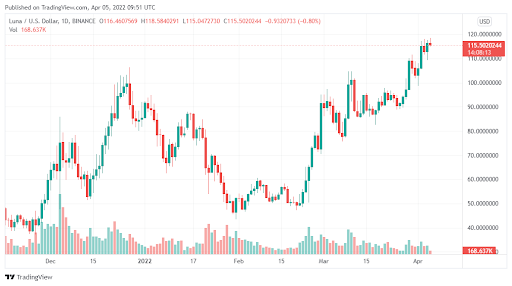
    Even with the good news, AVAX price is still 33% below its $147 all-time high and the token holds a $26.3 billion market capitalization. As a comparison, the market cap of Terra (LUNA) stands at $38.1 billion, and Solana (SOL) has a $43.8 billion total value.

    Avalanche is also Ethereum Virtual Machine (EVM) compatible and it is not plagued by the $15 average transaction fees and network congestion that impact the Ethereum network.

    Related: Traders predict $3,800 Ethereum, but multiple data points suggest otherwise

    The use of Avalanche’s smart contracts is in decline

    Avalanche’s primary DApp metric started to display weakness in March after the network‘s TVL dropped below 94 million AVAX.

    Avalanche Total Value Locked, AVAX. Source: DefiLlama

    The chart above shows how Avalanche‘s DApp deposits peaked at 132.9 million AVAX on March 14, but drastically declined to the lowest level since Jan. 3. In dollar terms, the current $9 billion TVL is 24% below its $12.2 billion all-time high in December 2021.

    Meanwhile, Terra’s TVL increased by 116% between January and March 2022, reaching $19.8 billion. Similarly, Waves’ smart contract deposits increased from $730 million to $4.5 billion in the same period.

    To confirm whether the TVL drop in Avalanche is troublesome, one should analyze DApp usage metrics. Some DApps, such as games and collectibles, do not require large deposits so the TVL metric is irrelevant in those cases.

    Avalanche DApps 30-day data. Source: DappRadar

    As shown by DappRadar, on April 1 the number of Avalanche network addresses interacting with decentralized applications declined by 16% versus the previous month. In comparison, the Solana network faced a 6% user increase, while Ethereum declined by 11%.

    Even though Avalanche’s TVL has been hit the hardest compared to similar smart contract platforms, there is solid network use in the decentralized finance (DeFi) segment.

    The above data suggest that Avalanche is losing ground versus competing chains. Given that AVAX rallied 43.8% in 17 days, some holders might feel uncomfortable if the decentralized application network continues to post weak TVL and DApp usage data.

    The views and opinions expressed here are solely those of the author and do not necessarily reflect the views of Cointelegraph. Every investment and trading move involves risk. You should conduct your own research when making a decision.

  • Astar (ASTR) price doubles as the network prepares to add 15 new projects in April

    Astar (ASTR) price doubles as the network prepares to add 15 new projects in April

    Following the successful completion of its initial parachain auctions, the Polkadot (DOT) ecosystem has begun to gain traction with the cryptocurrency community as the first chains begin to come online and integrate with Ethereum (ETH). 

    Astar (ASTR) is one such Polkadot-based project that finished off the month of March on a hot streak after the multi-chain smart contract platform attracted the attention of retail and institutional crypto investors.

    Data from Cointelegraph Markets Pro and TradingView shows that after hitting a low of $0.107 on March 22, the price of ASTR has climbed 104% to a daily high at $0.208 on April 1 as demand for the token increased 20-fold.

    ASTR/USDT 4-hour chart. Source: TradingView

    Three reasons for the rally include the completion of a $22 million funding round, the expansion of the Astar ecosystem through protocol launches and partnerships, and an increase in users and total value locked on the Astar network.

    Institutional investors pile in

    The development that helped kickstart the progress Astar has made in 2022 was the successful completion of a $22 million fundraising round on Jan. 28.

    Participants of the fundraiser included Polychain, Alameda Research, Alchemy Ventures, Crypto.com Capital and Digital Finance Group, along with multiple angel investors such as Dr. Gavin Wood, Richard Ma and Keisuke Honda.

    The fundraise followed the mainnet launch of Astar on Jan. 17 and will be used to help develop the Astar ecosystem to support both Ethereum Virtual Machine (EVM) and WebAssembly, allowing developers to deploy existing Solidity contracts as well as Polkadot native smart contracts.

    The Astar ecosystem expands

    In the months since launching its mainnet, Astar has seen multiple projects launch on its network and is anticipating the addition of even more in April.

    The project is referring to the month of April as “Astar Season” because it has plans to launch at least 15 new projects on the network as part of its push to attract new users.

    Upcoming launches include decentralized finance (DeFi) protocols such as Avault and Alnari Finance, the gaming protocol Astar Farms and the AstridDAO and ADAO decentralized autonomous organizations (DAOs).

    Astar has also recently revealed a new partnership with Oasys, a layer-one blockchain built for game developers.

    Related: Web3: Onboarding the next billion users — The road ahead

    Network TVL soars

    A third factor propelling the momentum for Astar has been the inflow of new users to the ecosystem, which now has more than 100,000 unique wallet addresses.

    As a result of the inflow of new users and the launch of multiple projects on the network, the total value locked on Astar hit a new all-time high of $1.16 billion on April 1, according to data from Defi Llama.

    Total value locked on the Astar Network. Source: Defi Llama

    The recent growth has given Astar the largest TVL of all the Polkadot parachains and helped it to become the eighth-ranked EVM-compatible chain by TVL.

    The views and opinions expressed here are solely those of the author and do not necessarily reflect the views of Cointelegraph.com. Every investment and trading move involves risk, you should conduct your own research when making a decision.