The leader in news and information on cryptocurrency, digital assets and the future of money, CoinDesk is a media outlet that strives for the highest journalistic standards and abides by a strict set of editorial policies. CoinDesk is an independent operating subsidiary of Digital Currency Group, which invests in cryptocurrencies and blockchain startups. As part of their compensation, certain CoinDesk employees, including editorial employees, may receive exposure to DCG equity in the form of stock appreciation rights, which vest over a multi-year period. CoinDesk journalists are not allowed to purchase stock outright in DCG.
On Friday, Do Kwon, founder and CEO of Terraform Labs (TFL), which develops the blockchain ecosystem consisting of Terra Luna (LUNA) and the TerraUSD stablecoin (UST), announced that TFL had donated 12 million LUNA ($1.1 billion at the time of publication) to the Luna Foundation Guard (LFG). LFG launched in January to grow the Terra ecosystem and improve the sustainability of its stablecoins. Kwon noted the funds, denominated in LUNA, will be burned to mint UST to grow the LFG’s reserves:
“We will keep growing reserves until it becomes mathematically impossible for idiots to claim de-peg risk for UST.”
UST is an algorithmic stablecoin with a theoretical exchange rate of 1:1 with the U.S. dollar, and is in part maintained by swapping of/for LUNA tokens when its market value deviates from its peg. The burning of $1 in UST results in the minting of $1 in LUNA and vice versa.
However, due to a high demand for UST on decentralized finance, or DeFi, platforms like Curve Finance, this results in unbalanced pools for swapping stablecoins. For example, as more and more crypto enthusiasts swap their USD Coin and Tether (USDT) for UST, the pool’s reserves will deplete, thereby causing price volatility as supply lags behind demand. Two days prior, TFG had already voted on burning the 4.2 million LUNA left in its treasury to protect UST’s peg. According to TFG:
“LFG will swap the [new] LUNA to UST (swap=burn) and sell the UST to the Curve pool. The proceeds will go back to LFG reserves to purchase BTC.”
Thanks to Terra’s flagship Anchor Protocol, UST is a very popular coin among crypto enthusiasts, which promises up to 20% annual yield on UST savings deposits. However, due to an imbalance of depositors and lenders paying interest, the Anchor Protocol’s reserve (for paying the promised yield) is still on the decline at time of publication, although it recently experienced a massive capital infusion.
If there is any confusion left at this point, we will keep growing reserves until it becomes mathematically impossible for idiots to claim depeg risk for $UST$UST is mighty https://t.co/6xCDPWJUTX
The decentralized finance (DeFi) sector has been sitting in the backseat since whipping up a frenzy in the summer of 2020 through the first quarter of 2021. Currently, investors are debating whether the crypto sector is in a bull or bear market, meaning, it’s a good time to check in on the state of DeFi and identify which protocols might be setting new trends.
Here’s a look at the top-ranking DeFi protocols and a review of the strategies used by users of these protocols.
Stablecoins are the foundation of DeFi
Stablecoin-related DeFi protocols are the cornerstone of the DeFi ecosystem and Curve is till the go-to protocol when it comes to staking stalbecoins.
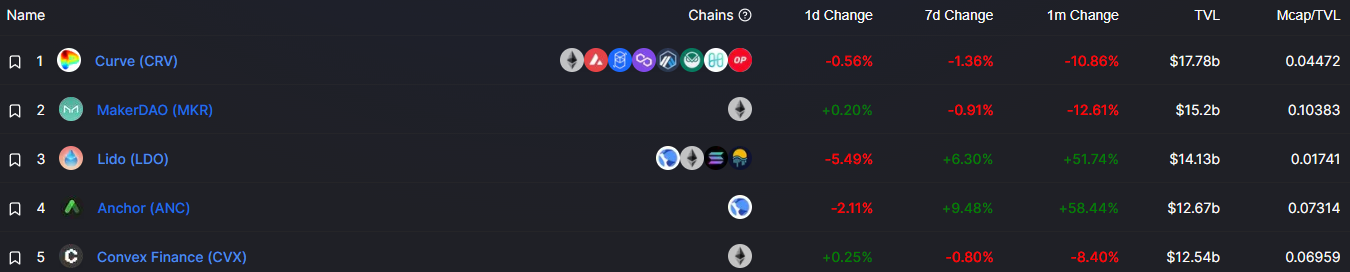
Top 5 protocols by total value locked. Source: Defi Llama
Data from Defi Llama shows four out of the top five protocols in terms of total value locked (TVL) are connected to the creation and management of stablecoins.
It’s important to note that while these protocols have emerged on top when it comes to TVL, the value of their native tokens for the most part are significantly down from their 2021 all-time highs.
The main takeaway is that engaging with the stablecoin aspect of the DeFi market through staking and farming has offered steady yields while also earning the governance tokens for these platforms as an added bonus to help mitigate the drop in token values.
As it stands now, stablecoins play an integral role in the overall healthy functioning of DeFi which continues to expand as newer protocols like Frax Share and Neutrino climb the TVL ranks amidst the increasing number of interconnected blockchain networks.
Lending and borrowing is at the core of DeFi’s value proposition
Lending platforms are another key component of the DeFi ecosystem and one of the key features that investors can interact with even during a bear market. AAVE and Compound are the current leaders with respective TVLs at $12.09 billion and $6.65 billion.
Like other stablecoin protocols, AAVE and Compound saw the value of their native tokens peak in 2021 and both have been in a prolonged downturn for months.
AAVE/USDT vs. COMP/USDT 1-day chart. Source: TradingView
AAVE’s TVL growth outpaced Compound largely due to its cross-chain integration of Polygon and Avalanche, which increased the number of supported assets and allowed users to avoid the high gas fees on the Ethereum network.
Long-term crypto hodlers who are risk averse can benefit from simply lending their tokens for a modest yield.
Aave vs. Compound stablecoin yields. Source: DeFi Prime
The growing popularity of liquid staking is also adding new utility to decentralized finance. Liquid staking protocols like Lido Finance, which originally launched as an Ethereum staking solution but has since expanded support to Terra (LUNA), Solana (SOL), Kusama (KSM) and Polygon (MATIC).
Data from Defi Llama shows the TVL on Lido reaching a new all-time high of $14.96 billion on March 10 as the addition of new assets continues to attract more value to the protocol.
Total value locked on Lido. Source: DeFi Llama.
On Lido, users can stake Ether and Solana and receive stETH or stSOL, which can then be used as collateral on AAVE to borrow stablecoins. Those assets can then be used for trading or yield farming purposes, thus increasing the overall yield earned from the original staked asset.
Want more information about trading and investing in crypto markets?
The views and opinions expressed here are solely those of the author and do not necessarily reflect the views of Cointelegraph.com. Every investment and trading move involves risk, you should conduct your own research when making a decision.
The leader in news and information on cryptocurrency, digital assets and the future of money, CoinDesk is a media outlet that strives for the highest journalistic standards and abides by a strict set of editorial policies. CoinDesk is an independent operating subsidiary of Digital Currency Group, which invests in cryptocurrencies and blockchain startups. As part of their compensation, certain CoinDesk employees, including editorial employees, may receive exposure to DCG equity in the form of stock appreciation rights, which vest over a multi-year period. CoinDesk journalists are not allowed to purchase stock outright in DCG.
Ether (ETH), the world’s second-largest cryptocurrency by market capitalization, is down 20% over the past 30 days, compared with a 12% drop in BTC over the same period. The underperformance of ETH and several other alternative cryptocurrencies (altcoins), which are more volatile than BTC, indicates a lower appetite for risk among crypto investors.
“To non-Cosmos people, this looks like a mess. To Cosmos people, this was a near miss,” Manian said. “This was an opportunity to dive in and see what was actually going on, what was built and how this thing was actually supposed to work, and I think most people’s response has been, ‘Oh, this was 95% there.‘”
Recently, Argo and privately held Gem Mining both said the curtailing of operations to support community needs for extra power lowered their production in February, among other reasons. Meanwhile, seasonal energy curtailment programs in Quebec, Canada, also hampered the monthly bitcoin production for Canadian miner Bitfarms (BITF). “As planned, seasonal energy curtailment programs at our farms in Quebec affected production in February, but to a lesser extent than in January,” said CEO of Bitfarms, Emiliano Grodzki, in a statement.
“Es difícil” mover miles de millones de dólares en cripto, señaló Redbord. Es posible que algunos oligarcas recurran a las criptomonedas, pero quizá no sea su primera opción. Redbord, quien trabajó en el Departamento del Tesoro de EE.UU. antes de incorporarse a TRM, dijo que cripto podría formar parte de la estrategia para evadir sanciones, pero agregó que los oligarcas ya tienen un complejo conjunto de herramientas a las que podrían recurrir en primer lugar para preservar su riqueza, incluyendo el uso de empresas ficticias y la compra de arte de lujo.
The leader in news and information on cryptocurrency, digital assets and the future of money, CoinDesk is a media outlet that strives for the highest journalistic standards and abides by a strict set of editorial policies. CoinDesk is an independent operating subsidiary of Digital Currency Group, which invests in cryptocurrencies and blockchain startups. As part of their compensation, certain CoinDesk employees, including editorial employees, may receive exposure to DCG equity in the form of stock appreciation rights, which vest over a multi-year period. CoinDesk journalists are not allowed to purchase stock outright in DCG.