Author: BTCLFGTEAM

  • Bitcoin’s sub-$40K range trading and mixed data reflect traders’ uncertainty

    Bitcoin’s sub-$40K range trading and mixed data reflect traders’ uncertainty

    The phrase “hindsight is 20/20” is a perfect expression for financial markets because every price chart pattern and analysis is obvious after the movement has occurred.

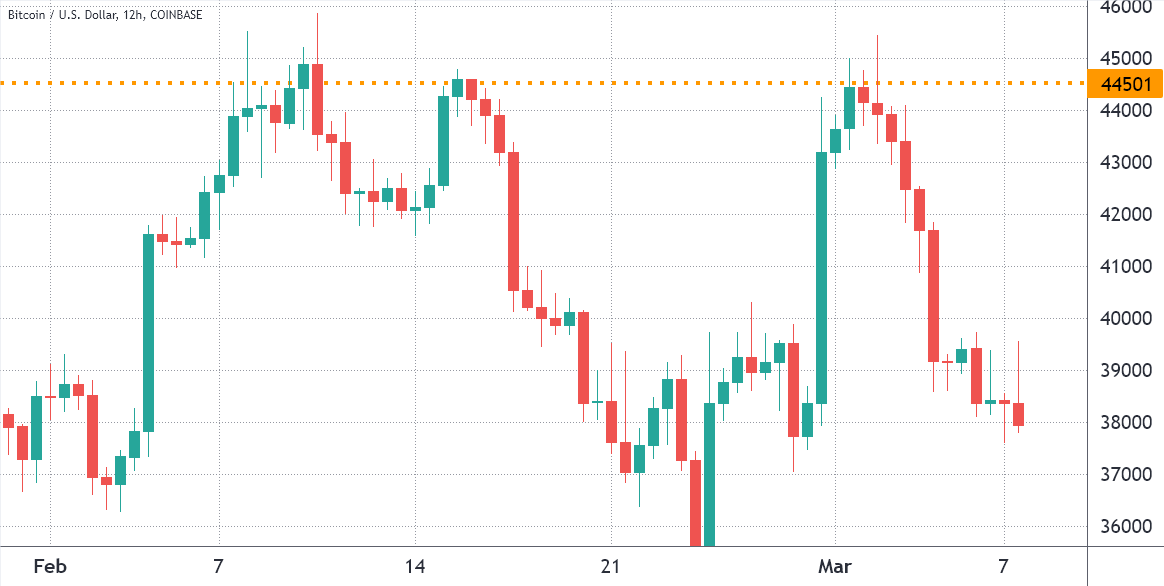
    For example, traders playing the Feb. 28 pump that took Bitcoin (BTC) above $43,000 should have known that the price would face some resistance. Considering that the market had previously rejected at $44,500 on multiple instances, calling for a retest below $40,000 made perfect sense, right?

    Bitcoin/USD at Coinbase. Source: TradingView

    This is a common fallacy, known as “post hoc” in which one event is said to be the cause of a later event merely because it had occurred earlier. The truth is, one will always find analysts and pundits calling for continuation and rejection after a significant price move.

    Meanwhile, on March 2, Cointelegraph reported that Bitcoin “could force a $34K retest.” The analysis cited an “ailing momentum” because Russia had just announced its invasion of Ukraine.

    In the past seven days, the aggregate market capitalization performance of the cryptocurrency market showed an 11.5% retrace to $1.76 trillion and this move erased the gains from the previous week. Large cap assets like Bitcoin, Ether (ETH) and Terra (LUNA) were equally impacted, reflecting nearly 12% losses in the period.

    Weekly winners and losers among the top-80 coins. Source: Nomics

    Only two tokens were able to present positive performances over the past seven days. WAVES rallied for the second consecutive week as the network upgrade to become Ethereum Virtual Machine (EVM)-compatible advanced. The transition is scheduled to start in the spring and the new consensus mechanism will provide a “smoother transition to Waves 2.0.”

    THORChain (RUNE) jumped after completing its Terra (LUNA) ecosystem integration, enabling the blockchain to support all Cosmos-based projects. ThorChain users now have more trading and staking options available, including TerraUSD (UST) stablecoin.

    Funding rates flipped positive

    Perpetual contracts, also known as inverse swaps, have an embedded rate usually charged every eight hours. Perpetual futures are retail traders’ preferred derivatives because their price tends to track regular spot markets perfectly.

    Exchanges use this fee to avoid exchange risk imbalances. A positive funding rate indicates that longs (buyers) demand more leverage. However, the opposite situation occurs when shorts (sellers) require additional leverage, causing the funding rate to turn negative.

    Accumulated perpetual futures funding rate on March 7. Source: Coinglass

    Notice how the accumulated seven-day funding rate flipped positive in all of the top four coins. This data indicates slightly higher demand from longs (buyers) but is not yet significant. For example, Bitcoin’s positive 0.10% weekly rate equals 0.4% per month, which is not eventful for traders building futures’ positions.

    Typically, when there’s an imbalance caused by excessive optimism, the rate can easily surpass 4.6% per month.

    Options data is pricing in a potential price crash

    Currently, there is not any clear direction in the market, but the 25% delta options skew is a telling sign whenever market makers overcharge for upside or downside protection.

    If professional traders fear a Bitcoin price crash, the skew indicator will move above 10%. On the other hand, generalized excitement reflects a negative 10% skew.

    Bitcoin 30-day options 25% delta skew: Source: Laevitas.ch

    As displayed above, the skew indicator held 10% until March 4, but slightly reduced to 7% or 8% during the week. Despite this, the indicator shows that pro traders are pricing higher odds for a market crash.

    There are mixed feelings coming from retail traders’ futures data, which shows a shift moving away from a slightly negative sentiment versus options market makers pricing in a higher risk of a further crash.

    Some might say that the third failure to break the $44,500 resistance was the nail in the coffin because Bitcoin failed to display strength during a period of global macroeconomic uncertainty and strong commodities demand.

    On the other hand, the crypto sector’s current $1.76 trillion market capitalization can hardly be deemed unsuccessful, so there’s still hope for buyers.

    The views and opinions expressed here are solely those of the author and do not necessarily reflect the views of Cointelegraph. Every investment and trading move involves risk. You should conduct your own research when making a decision.


  • Ukrainian Deputy Minister Reiterates Call for Crypto Exchanges to Block Russian Users

    Ukrainian Deputy Minister Reiterates Call for Crypto Exchanges to Block Russian Users

    Last year, the Ukrainian government launched concerted efforts to attract a local crypto industry that was part of a push to further digitize the economy. In September, the Parliament passed a law legalizing and regulating bitcoin. The country has low taxes, crypto-friendly regulations and a highly educated and young workforce.

  • As Gold Nears Record, Bitcoin Doesn’t Shine So Brightly

    As Gold Nears Record, Bitcoin Doesn’t Shine So Brightly

    The leader in news and information on cryptocurrency, digital assets and the future of money, CoinDesk is a media outlet that strives for the highest journalistic standards and abides by a strict set of editorial policies. CoinDesk is an independent operating subsidiary of Digital Currency Group, which invests in cryptocurrencies and blockchain startups. As part of their compensation, certain CoinDesk employees, including editorial employees, may receive exposure to DCG equity in the form of stock appreciation rights, which vest over a multi-year period. CoinDesk journalists are not allowed to purchase stock outright in DCG.

    @2022 CoinDesk

  • How HAL and Aldrin are helping to keep crypto assets secure during bear markets

    How HAL and Aldrin are helping to keep crypto assets secure during bear markets

    Crypto bear markets are known for their downturns and their liquidations for investors who are trading with leverage. On top of that, decentralized finance, or DeFi, projects can become targeted by hacks or suffer rug pulls, leading to enormous losses for investors of their tokens. Now new software seeks to alert investors in real-time about potential risks to their positions. 

    Users and executives from two such services, HAL and Aldrin, explain. HAL is a Web3 data infrastructure tool allowing companies or traders to track, monitor and trigger data. HAL recently launched simple API notifications on Avalanche (AVAX), which seeks to enable users on the blockchain to automate notifications of risky positions. Meanwhile, Aldrin is the first fully-audited decentralized exchange, or DEX, on Solana (SOL). 

    Marco De Rossi, the co-founder of HAL, explained that users can notify anyone on any channel of suspicious DeFi activities on an address with wallet monitoring. “We already have hundreds of Avalanche users playing with Pangolin (PNG), Sushiswap (SUSHI), Aave (AAVE) and also wallet monitoring and much more. In addition, TraderJoe is soon coming, as well as the top 10 Avalanche ecosystem apps in general,” says Rossi.

    Meanwhile, a HAL user, who wished to remain anonymous, told Cointelegraph:

    “I use AAVE, and HAL directly integrated with them, allowing me to be notified if my position there becomes at risk; without me refreshing their dashboard, I can then take action quickly.”

    The anonymous user added that: “I may also want to be the first to know when something new comes up, and for this, HAL allows me to follow every new smart contract deployed by a developer I follow, that way, I can start my research faster and stay up to date.”

    Regarding the price volatility of tokens, Hisham Khan, founder and CEO of Aldrin, explained that it could be very difficult to execute trades manually and get a reasonably decent price. “If you’re exposed to smaller or even mid-market cap tokens, the downside when Bitcoin or Ethereum breaks certain support levels is insane; you can lose 70% gain within 48 hours,said Khan.

    He raised the example of rebalancing a portfolio of 25 tokens taking up to 30 minutes if done manually, but allegedly only seconds if done via Aldrin’s rebalancing feature. “The automation features provided by Aldrin such as the Rebalancer and auto-rebalance when providing liquidity in pools saves me a lot of time,” commented an Aldrin user, who wished to remain anonymous. 

    Like all DEXs, Aldrin faces potential security risks. But according to Khan, Aldrin has been fully audited and would thus have greater strength to combat those risks. He added:

    “There is always the risk of impermanent loss risk that liquidity providers are exposed to. The projected returns […] could be false or scams if the underlying token is not under Aldrin pools […] but this is made clear as a disclaimer to the users.”

  • Market Wrap: Bitcoin Stabilizes Ahead of Biden’s Executive Order on Crypto

    Market Wrap: Bitcoin Stabilizes Ahead of Biden’s Executive Order on Crypto

    Most short-term bitcoin holders are at a loss, having a cost basis of around $46,400, according to data compiled by Glassnode. Long-term holders, however, have an estimated break-even point of about $39,200, which, if broken, could yield further downside toward $24,000.

  • Crypto Still Isn’t Helping Russian Oligarchs Evade Sanctions

    Crypto Still Isn’t Helping Russian Oligarchs Evade Sanctions

    But what if we look to individuals, such as, say, the dozens of Russian oligarchs who now find themselves on the Treasury Department’s Office of Foreign Asset Control’s Specially Designated Nationals list? Surely, they will be turning to crypto to evade sanctions; ri–no, wait, it seems that they, too, are not using crypto in any appreciable scale at this time.

  • Si vivieras en Cuba bajo un embargo económico, entenderías Bitcoin

    Si vivieras en Cuba bajo un embargo económico, entenderías Bitcoin

    Los cubanos no tienen Visa ni Mastercard, pero cuentan con PayWithMoon, plataforma que les permite cargar una tarjeta prepaga virtual con bitcoin (BTC). No pueden usar bancos, pero encontraron en bitcoin un banco que no requiere intermediarios y que funciona entre individuos. No son aceptados por Stripe, la omnipresente red de pagos por internet, pero pueden hacer transferencias en segundos a través de Lightning Network.

  • Crypto.com Tells Loan Customers in ‘Excluded’ Countries to Repay by March 15

    Crypto.com Tells Loan Customers in ‘Excluded’ Countries to Repay by March 15

    “Please be informed that Lending is no longer supported in your jurisdiction. For this reason, we are required to cancel your current loans,” the exchange told two customers, one French, one German, via emails reviewed by CoinDesk. Neither had lending accounts open with the company, they said.

  • ‘Minimum Viable DAO’ Product Looks to Supercharge Web 3 Governance

    ‘Minimum Viable DAO’ Product Looks to Supercharge Web 3 Governance

    “We don’t care if what you’re doing is forming a proposal, voting, generating fees, defining roles, resetting network variables, forming a partnership with another DAO, or signing a contract,” McCurley explained in an interview. “With our module interface, you can create any specific functionality like that, and MVD will translate it effectively into smart contract operations.”

  • Which Terra-based coins have the most explosive potential? | Find out now on The Market Report live

    Which Terra-based coins have the most explosive potential? | Find out now on The Market Report live

    “The Market Report” with Cointelegraph is live right now. On this week’s show, Cointelegraph’s resident experts discuss which Terra-based coins you should be looking out for in 2022.

    But first, market expert Marcel Pechman carefully examines the Bitcoin (BTC) and Ether (ETH) markets. Are the current market conditions bullish or bearish? What is the outlook for the next few months? Pechman is here to break it down.

    Next up, the main event. Join Cointelegraph analysts Benton Yaun, Jordan Finneseth and Sam Bourgi as they debate which Terra-based coin has the most explosive potential. Will it be Bourgi’s pick of StarTerra, which capitalizes on blockchains’ biggest trends — play-to-earn, nonfungible tokens (NFTs) and staking — basically combining multiple multibillion-dollar industries?

    Bringing his pick to the table next is Yuan with Loop Finance, which aims to launch the world’s first decentralized finance NFT marketplace that will include NFTs linked directly to DeFi protocols such as Anchor Protocol? It will also launch a content creation platform where creators will be rewarded in LOOPR tokens for creating quality crypto content. There is a lot happening with the project, but will it be enough to win the votes of the audience?

    Lastly, we have Finneseth with his pick of Mirror Protocol, which is currently the sixth-ranked protocol by total value locked on Terra, with $594.63 million locked on the protocol. Assets on the protocol “mirror” versions of real-world assets by reflecting the exchange prices on-chain. These assets include Apple, Airbnb, Amazon, Microsoft, PayPal and Tesla stock along with major cryptocurrencies. It seems like a clear winner, but you’ll have to wait and see.

    After the showdown, we’ve got insights from Cointelegraph Markets Pro, a platform for crypto traders who want to stay one step ahead of the market. The analysts use Cointelegraph Markets Pro to identify two altcoins that stood out this week: Anchor Protocol’s ANC and Waves WAVES.

    Do you have a question about a coin or topic not covered here? Don’t worry. Join the YouTube chat room, and write your questions there. The person with the most interesting comment or question will be given a free month of Cointelegraph Markets Pro, worth $100.

    “The Market Report” streams live every Tuesday at 12:00 pm ET (5:00 pm UTC), so be sure to head on over to Cointelegraph’s YouTube page and smash those like and subscribe buttons for all our future videos and updates.