Author: BTCLFGTEAM

  • will Bitcoin price soar past $100K as trade tensions ease?

    will Bitcoin price soar past $100K as trade tensions ease?

    Trump speech looms: can Bitcoin leverage exchange outflows, safe haven status for $100K?

    • Trump acknowledged that the existing 145% US tariff on Chinese imports is ‘too high’.
    • Currently, the US and China are locked in a steep tariff battle.
    • Bitcoin and Ethereum have shown strong performance during periods of dovish monetary policy and reduced inflation.

    US President Donald Trump has signaled a willingness to lower tariffs on Chinese goods.

    The announcement comes amid escalating speculation about how such a policy shift could impact inflation, interest rates, and digital assets like Bitcoin and Ethereum.

    Trump’s comments have already sparked renewed interest among crypto investors, who see a potential rally in the making.

    Speaking in a recent CNBC interview, President Trump acknowledged that the existing 145% US tariff on Chinese imports is “too high” and has effectively crippled bilateral trade.

    “At some point, I’m going to lower them,” he said, adding that China is eager to resume business with the United States.

    Trump’s remarks suggest that trade talks between the two global powers could be back on the table, with hopes of a more balanced economic relationship.

    Currently, the US and China are locked in a steep tariff battle, with Beijing retaliating by imposing a 125% duty on American goods.

    These tit-for-tat tariffs have disrupted global supply chains and contributed to higher prices for consumer goods ranging from electronics to clothing.

    Industry analysts believe that easing these levies could reduce inflationary pressure, thereby influencing the Federal Reserve’s monetary policy, particularly in holding back further interest rate hikes.

    From a crypto market perspective, the implications are significant.

    Historically, digital assets such as Bitcoin and Ethereum have shown strong performance during periods of dovish monetary policy and reduced inflation.

    With tariff reduction on the horizon, crypto investors are betting on a resurgence in prices.

    Bitcoin, for instance, recently dipped below $80,000 but has since bounced back, trading above $94,000 at press time.

    Analysts predict that if sentiment continues to improve, Bitcoin could breach the $100,000 milestone, triggering a broader market rally.

    Beyond Bitcoin, altcoins like Ethereum (ETH), Ripple (XRP), and Solana (SOL) also stand to gain from a more favorable economic environment.

    Reduced trade tension often translates to increased risk appetite, driving more capital into speculative assets like cryptocurrencies.

    Trump’s comments also hint at a broader economic recalibration.

    Lower tariffs could ease operational costs for American businesses and improve consumer sentiment, factors that indirectly feed into the crypto economy by increasing liquidity and investor confidence.

    While a final decision is yet to be made, the mere prospect of US–China trade normalization has already set the tone for a volatile yet potentially bullish phase in the crypto markets.

    As always, traders are advised to keep a close eye on policy shifts that could influence macroeconomic indicators and, by extension, digital asset prices.

    Source link

  • NEAR and PepeX revive the AI narrative

    NEAR and PepeX revive the AI narrative

    Best coins to buy, NEAR, PepeX, AI

    As Bitcoin pursues $100K on enhanced optimism, crypto enthusiasts explore narratives that could fuel the upcoming broad-based rallies.

    Let’s check why investors will watch NEAR and the viral PepeX in the coming sessions.

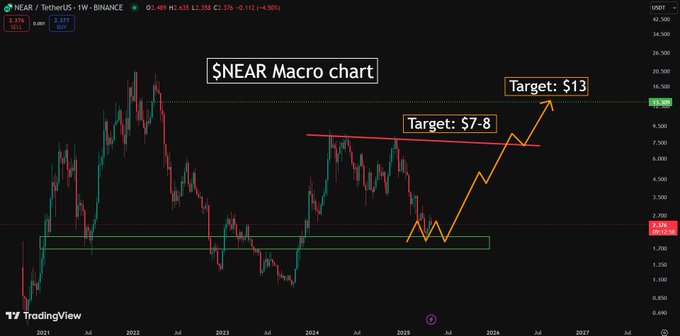
    NEAR, “the Bitcoin of AI tokens,” eyes a potential breakout as a bullish structure aligns with optimistic chatter.

    Meanwhile, PepeX’s advanced tokenization Launchpad grabs investor attention.

    It has nearly $2 million in the ongoing presale.

    NEAR hints at imminent breakouts

    Near Protocol’s native coin exhibits a bullish price structure, suggesting potential upswings.

    The token has secured solid grounds after months of subtle accumulations and consolidations.

    Meanwhile, the expanding ecosystem and continued developments have kept the asset afloat.

    Recently, Near Protocol expanded chain abstraction capabilities to Solana, TON, Aptos, Sui, and Stellar.

    The announcement read:

     This update represents a crucial step in NEAR’s chain abstraction architecture, broadening interoperability across diverse blockchain ecosystems and fostering a more unified development experience. The addition of EdDSA support is particularly valuable for developers working with high-throughput chains like Solana, TON, Aptos, and Sui.

    NEAR trades at $2.35, mirroring the prevailing broad market performance.

    Meanwhile, a solid reversal setup on its price chart drives optimism.

    The favorable candle formations and increasing buying volume after March’s lower low hint at upside trends.

    Analyst Solberg Invest predicts surges to $13, translating to an over 80% uptick from NEAR’s current price.

    Solberg Invest's NEAR chart on X


    Besides price charts, NEAR boasts a solid foundation.

    The $20 million AI fund project supports decentralized AI innovations.

    Moreover, Near Protocol has Deutsche Telekom as its validator.

    NEAR appears ready to shape decentralized technologies (in the long term) as it aims to integrate artificial intelligence tools into the blockchain infrastructure.

    PepeX: AI tokenization and fair launches

    Meme cryptocurrencies are shifting towards accrual innovation and utility, and PepeX appears at the center of this transformation.

    With its AI-powered asset tokenization platform and focus on fair asset launches, PepeX looks to redefine a sector often attacked due to VC-centered tokenomics and insider trading deals.

    The project distributes 95% of the available tokens to the public and only 5% to founders, which they might lose if PepeX fails.

    The fair launch introduces transparency and legitimacy, which appear crucial in the growing cryptocurrency industry.

    Moreover, PepeX’s AI-driven tool allows anyone to create and launch a token without technical expertise.

    The project’s Whitepaper highlights:

    PepeX is a neo-fair-launch platform where creativity and innovation are the only currencies that matter. Transparent, profitable for the community, and not a playground for insiders. No coding, no complex tokenomics – just pure creativity backed by real DeFi.

    PepeX represents a movement toward decentralizing access to digital assets tools.

    Imagine creating and launching your favorite token as simple as posting on social media sites.

    Indeed, meme coins have done more in onboarding individuals into the cryptocurrency world than most specialized marketing campaigns.

    PepeX leverages that while presenting genuine functionality.

    PepeX trades at $0.0268, and analysts predict massive growth after its official launch.

    You can visit here for more details about PepeX.

    Source link

  • Bitcoin dominance rises, Solana prepares a surge as CartelFi surges

    Bitcoin dominance rises, Solana prepares a surge as CartelFi surges

    Bitcoin’s dominance is undeniable with CMC’s altcoin season index substantiating the Bitcoin season at a level of 21. However, meme coins are making a comeback and investors are on the lookout for fresh projects promising hefty returns from little investments. The attention is particularly on new entrants whose foundation is more than just a viral joke. 

    One such meme crypto is CartelFi. It enables investors to earn passive income without compromising on the asset’s upside potential. 

    What’s more, even before the highly anticipated launch in Q3, early adopters are already earning big during its presale. With every 3-day stage, CARTFI token price surges by 5%. By the end of the 90-days period, the project will have transformed several retail investors into crypto millionaires.    

    Bitcoin price analysis: Neutral market sentiment creates hurdle on the path to $100,000

    A surge in institutional demand bolstered the bitcoin price to a two-month high on Friday. However, it has since pulled back as investors remain concerned over US-China trade tensions and the persistent macroeconomic uncertainties. Compared to last week’s greed level of 63, the crypto fear & greed index is at a neutral zone of 53.

    Data released by SoSoValue showed that only one out of the top 12 US BTC spot ETFs recorded daily net inflow on Friday. BlackRock’s IBIT recorded $674.91 million in the day’s net inflows while the other leading ETFs reported zero flows. 

    In the immediate term, the bulls are keen on defending the support at $96,050. Success at bouncing off that support level will avail a chance to break the resistance at $97,797 with the next target being the psychologically crucial zone of $100,000. On the flip side, a further pullback would have the bears eyeing $92,745.


    CartelFi rewards early adopters during the presale and beyond 

    CartelFi hit the ground running, raising over $500,000 in the first 24 hours of its presale. Notably, it has maintained the upside momentum despite the external chaos that have impacted the broader crypto market. 

    Less than 4 weeks into its launch, it has raised over $1.5 million. What started at a token price of $0.0251 is currently at $0.0408; rising by 5% every 72-hours stage.

    In addition to the opportunity to earn hefty cumulative gains during the presale, the project’s attractiveness has been enhanced by its concept of yield farming. Under the current DeFi structure, meme coins “lie idle” in between rallies. To enjoy yields, an investor would have to sell some tokens; missing out on a potential rally.

    CartelFi is solving this inefficiency by having an investor’s preferred meme coins work for them. Subsequently, one enjoys yields of upto 10,000% while still retaining the asset’s speculative upside. 

    Additionally, CartelFi’s programmed scarcity enhances its attractiveness and growth potential. 100% of the fees generated by the platform once users deposit their meme coins are used to buy back and burn CARTFI tokens. This ensures that the total supply remains low; sustaining its upside momentum. Find out how to buy CartelFi here.

    Solana price readies for a rally with a key bullish pattern underway

    Solana price has been hovering around the crucial zone of $150 for over a week after rebounding from the 14-month low hit in early April. While the sentiment in the broader crypto market has improved, investors are still concerned about Trump’s aggressive tariffs and their impact on the economy. 

    Even so, as meme coins make a comeback, Solana is set to benefit big from its positioning in the DeFi space. Subsequently, Solana price may continue to enjoy solid support at $140.

    Indeed, this has become a point of convergence for the 25 and 50-day EMAs; signaling the formation of a bullish golden cross pattern. On the upside, $160 remains a resistance level worth watching. 

    Source link

  • Metaplanet issues $24.8M in bonds to boost Bitcoin holdings past 5,000 BTC

    Metaplanet issues $24.8M in bonds to boost Bitcoin holdings past 5,000 BTC

    • The funds raised will be specifically allocated for further Bitcoin purchases.
    • The bonds were sold in full to EVO FUND.
    • The bonds offer investors the potential for early repayment if certain conditions are met.

    Tokyo-based Metaplanet is taking steps to expand its cryptocurrency portfolio by issuing ¥3.6 billion (approximately $24.8 million) in bonds to fund the acquisition of more Bitcoin (BTC).

    This move comes as the Japanese hotel firm’s Bitcoin holdings surpass the 5,000 BTC mark.

    The bonds, which carry no interest, are set to be redeemed at their par value on October 31, 2025, or earlier, if the bondholder requests repayment.

    The funds raised will be specifically allocated for further Bitcoin purchases, continuing the company’s earlier strategy to increase its digital asset investments.

    The bonds were sold in full to EVO FUND, a move Metaplanet hopes will help support its growing Bitcoin strategy.

    While the bonds carry no interest, they offer investors the potential for early repayment if certain conditions are met.

    Specifically, Metaplanet plans to use capital raised through stock acquisition rights to redeem the bonds.

    This means the company’s ability to repay the bonds hinges on the demand for its equity-linked instruments, highlighting a potential reliance on investor sentiment and market conditions.

    Metaplanet’s recent bond issuance underscores the growing trend of companies integrating Bitcoin into their financial strategies.

    With cryptocurrency markets gaining momentum, the company’s move aligns with the broader trend of corporate adoption of digital assets as a store of value.

    As Metaplanet’s share price recently rose by 8.6%, investors are keeping a close eye on how the company’s Bitcoin purchases will impact its financial performance in the coming years.

    In an era where digital currencies are becoming more mainstream, Metaplanet’s decision to use bonds for Bitcoin acquisition marks a noteworthy step toward integrating cryptocurrency into corporate balance sheets.

    Source link

  • Crypto trading boom lifts Kraken Q1 revenue to $472 million

    Crypto trading boom lifts Kraken Q1 revenue to $472 million

    • EBITDA for the quarter reached $187.4 million, a 17% increase.
    • Trading volume rose 29% amid a 35% rally in Bitcoin prices.
    • Launch of institutional FIX API boosted futures volumes by 250%.

    Kraken, one of the longest-operating cryptocurrency exchanges in the United States, reported a 19% year-on-year increase in revenue for the first quarter of 2025, reaching $472 million.

    The jump in trading activity followed heightened price volatility across the crypto market, largely driven by the return of Donald Trump to the White House and his pro-crypto policies, which included discussions of a national Bitcoin reserve.

    Kraken’s earnings before interest, taxes, depreciation, and amortisation (EBITDA) reached $187.4 million, up 17% from Q1 2024.

    However, despite strong numbers, regulatory pressure, rising competition, and market uncertainty remain key hurdles for the company’s long-term strategy.

    Revenue climbs on market volatility and pro-Bitcoin sentiment

    According to company data, Kraken’s trading volume surged 29% during the January–March period, mirroring the 35% rise in Bitcoin prices — from $69,000 to $94,000 — during the same timeframe.

    The increased volume was partly driven by favourable sentiment following the Trump administration’s commitment to explore Bitcoin as a strategic reserve asset.

    This policy signal helped fuel broader interest in the cryptocurrency sector, with major exchanges, including Kraken, benefiting from the resulting speculative activity.

    The surge in crypto valuations and trading enthusiasm also coincided with rising adoption of advanced features on the Kraken platform.

    The company rolled out a futures-focused FIX API during the quarter, specifically targeting institutional users.

    The product launch led to a 250% increase in monthly futures trading volumes, underscoring the shift towards professional-grade infrastructure.

    NinjaTrader acquisition adds new traders, products to portfolio

    Kraken expanded its offering in March 2025 by acquiring NinjaTrader for $1.5 billion.

    The deal added nearly 2 million traders to its ecosystem and allowed Kraken to diversify beyond cryptocurrencies into broader financial markets.

    With the acquisition, Kraken now offers trading in futures contracts tied to commodities, forex, and equities — a strategic pivot aimed at reducing the platform’s reliance on crypto market cycles.

    The company said its institutional strategy will continue evolving throughout 2025, with further integrations and platform improvements in the pipeline.

    Its diversification into adjacent markets mirrors a trend seen across the industry, as exchanges seek to weather periods of low volatility and attract capital from outside the crypto-native audience.

    Challenges ahead despite strong Q1

    Despite the growth, Kraken still faces key operational and competitive challenges.

    The exchange operates in an increasingly saturated market, with Binance, Coinbase, and several Asia-based players aggressively pursuing global market share.

    Maintaining user growth will likely require continued product innovation and regional expansion.

    The company’s revenue model remains closely tied to trading volume, which makes it vulnerable to market consolidation or prolonged bearish cycles.

    While early 2025 benefited from speculative tailwinds, any cooling of the Bitcoin rally could impact the next quarter’s results.

    Kraken must navigate a fluid regulatory environment.

    While the Trump administration has signalled support for digital assets, regulatory oversight from the Securities and Exchange Commission and other agencies continues to evolve.

    Global compliance requirements may also pose hurdles as Kraken pushes into new geographies, including Asia.

    The company’s blog post dated 1 May 2025 hinted at plans for expanding Kraken Pay and on-chain staking services, offering a potential path to more stable, recurring revenue.

    However, execution risks remain, especially as competition intensifies and regulatory clarity remains inconsistent across jurisdictions.

    Source link

  • US Bitcoin miners brace for bleak Q1 earnings amid tariff

    US Bitcoin miners brace for bleak Q1 earnings amid tariff

    The miner's paradox: why Trump's era isn't golden for US Bitcoin firms

    • Most major US public Bitcoin miners expected to report Q1 losses despite high BTC prices.
    • US tariffs on imported mining rigs raised costs and created strategic uncertainty for miners.
    • The April Bitcoin halving event further pressured revenue by cutting block rewards by 50%.

    Despite entering office with promises to champion the US Bitcoin mining industry, President Donald Trump’s return to the White House hasn’t translated into immediate prosperity for the sector.

    As American crypto miners prepare to release their first quarterly earnings since the administration change, analysts anticipate a challenging period marked by losses, squeezed margins, and operational headwinds, even against the backdrop of Bitcoin hitting record highs earlier in the year.

    The paradox of pain: losses despite high Bitcoin prices

    The prevailing expectation is one of financial strain.

    According to analyst estimates compiled by Bloomberg, seven out of the eight largest publicly traded Bitcoin miners based in the US are projected to report a net loss for the first quarter of 2025.

    This stark outlook contrasts sharply with the significant adjusted net income of $1.1 billion reported collectively by the group in the same period of 2024, now estimated to swing to a loss of $190 million.

    Among the cohort, only CleanSpark Inc. is anticipated by analysts to post a profit.

    This downturn comes despite Bitcoin reaching a record above $109,000 in January and averaging roughly 75% higher in price during the first quarter compared to the previous year.

    Concrete results are already emerging: Riot Platforms Inc., a major player, reported a Q1 loss of $296.4 million on Thursday, a dramatic reversal from its $211 million net income in Q1 2024.

    Competitive squeeze: record difficulty and rising costs

    Several factors are converging to pressure miners’ profitability.

    A primary challenge is the soaring level of competition within the network.

    Mining difficulty, a metric reflecting the total computing power dedicated to securing the Bitcoin blockchain, has repeatedly broken records in recent months.

    This surge in the global “hash rate” means more miners are competing for the same fixed amount of newly issued Bitcoin rewards.

    “This is going to be an interesting quarter for the Bitcoin miners and perhaps a difficult one over the past few months,” commented Brian Dobson, managing director at brokerage firm Clear Street.

    “We will see margin compression and lower revenues from Bitcoin mining due to that higher global difficulty rate.”

    This intense competition is partly a legacy of the late 2024 Bitcoin price surge, fueled by Trump’s pro-crypto stance, which prompted miners to rush orders for more powerful, specialized mining machines (rigs).

    Furthermore, rising energy costs in some key US mining states have added to operational expenses during the same period.

    Growth in international mining operations, including from Russia and China, has also intensified the global hash rate competition, according to Ethan Vera, COO at Luxor Technology.

    Tariff tremors and strategic hesitation

    Compounding the competitive pressure are the direct and indirect impacts of US trade policy.

    The specialized mining rigs essential for operations are mostly manufactured in Asia.

    Tariffs imposed on these machines, some originating from countries like Malaysia, directly increase capital expenditure for US miners.

    Vera noted that potential further tariff hikes “will be very detrimental, return profiles and growth forecasts can be hindered from that,” adding wryly, “With tariffs coming in, I think everyone outside the US will benefit from that.”

    Supply chains faced additional disruption early this year due to heavy border inspections and the US Commerce Department’s blacklisting of an AI affiliate (Xiamen Sophgo Technologies Ltd.) of Bitmain, the largest rig supplier, in January.

    More broadly, the unpredictable nature of tariff policy under the Trump administration is creating strategic paralysis.

    “The management teams are hesitant to develop a multi-year strategy based on what tariffs look like today when they realize that three months from now we could have a very different conversation on what the tariffs would look like,” explained Dobson.

    Capital crunch: shifting financing strategies

    Accessing capital has also become more challenging. Historically, many public miners relied heavily on “at-the-market” (ATM) stock offerings to raise billions for purchasing machines and funding energy-intensive operations.

    However, the retreat in the broader stock market since the post-election highs has made equity financing less attractive.

    Consequently, companies are increasingly turning towards debt instruments. MARA Holdings Inc., Riot Platforms, and CleanSpark have all utilized convertible bonds or credit facilities recently to secure liquidity.

    “I think the big public companies don’t want to sell shares in the current market, this is an expensive way for them to raise capital, whereas the debit instruments are just lower-cost capital,” Vera observed.

    Adding a final layer of difficulty is the impact of the Bitcoin “halving” event that occurred last April.

    This pre-programmed code update slashed the Bitcoin rewards paid to miners for validating transactions by 50%, directly cutting into their primary revenue stream.

    An unintended consequence?

    While President Trump campaigned on making the US a leader in Bitcoin mining, the first quarter under his administration seems defined by miners grappling with the challenging side effects of his broader policies.

    Tariffs are hiking equipment costs and potentially benefiting foreign competitors, while market volatility linked to policy uncertainty has hampered access to equity capital.

    As Vera concluded, “In terms of the tariffs, I don’t think Trump has Bitcoin mining as his number one priority to focus on… The trade war, for him, is the most important thing.”

    Source link

  • VIRTUAL token surges 183% in April amid rising institutional demand

    VIRTUAL token surges 183% in April amid rising institutional demand

    Investment

    • Institutional interest drives the VIRTUAL rally.
    • Chaikin Money Flow signals strong capital inflows.
    • The price pattern shows a bullish formation.

    While most digital assets struggled to maintain direction in April, VIRTUAL emerged as one of the few cryptocurrencies to post sharp gains.

    The token has rallied 183% since April 1, making it the top-performing asset in the crypto space during a month marked by subdued sentiment and low volatility.

    With its price up 22% in the last 24 hours alone, investor attention has turned to the technical indicators, suggesting further upside may be on the horizon.

    The rally comes amid a broader shift in smart capital allocation, as institutional buyers appear to be rotating into mid-cap altcoins with strong momentum and liquidity.

    Institutional interest drives the VIRTUAL rally

    VIRTUAL’s uptrend began on 22 April and has since shown consistent price appreciation.

    One of the most notable developments has been the surge in its Smart Money Index (SMI), which currently stands at 3.07.

    The SMI tracks institutional trading patterns by focusing on price movements during the opening and closing hours of each trading day.

    A rising SMI along with increasing price generally signals accumulation by professional or large investors.

    This correlation suggests that “smart money” is positioning itself for longer-term gains, adding weight to VIRTUAL’s recent momentum.

    On-chain data also shows that the number of whale addresses holding VIRTUAL has risen since mid-April, providing additional evidence of institutional accumulation.

    Chaikin Money Flow signals strong capital inflows

    Further confirming the bullish sentiment is VIRTUAL’s Chaikin Money Flow (CMF) indicator, which remains in positive territory at 0.25 and continues to trend upwards.

    The CMF measures the volume-weighted average of accumulation and distribution over a given period, helping traders assess the strength behind a price move.

    A positive and rising CMF reading reflects strong buying pressure and sustained capital inflows.

    Together with the elevated SMI, this trend reinforces the narrative that VIRTUAL’s current rally is backed by increasing liquidity and investor confidence.

    Analysts tracking short-term trends have also noted heightened activity on VIRTUAL’s decentralised exchange pairs, with total volume crossing $20 million over the past week.

    This points to both retail and institutional participation in the ongoing uptrend.

    Price pattern shows a bullish formation

    Technically, VIRTUAL has been trading within an ascending parallel channel since its breakout on 22 April.

    This formation, defined by consistently higher highs and higher lows within two upward-sloping trendlines, is generally considered a bullish signal.

    As long as the token remains within this pattern, the current trend is likely to continue.

    If momentum persists and demand remains high, VIRTUAL’s price could rise to test the upper resistance level near $2.26.

    That would represent a further 25% increase from current levels.

    However, if profit-taking intensifies and breaks the token’s support at $1.55 (£1.24), the bullish structure may fail.

    In that case, the price could drop towards the $0.96 region, where previous demand re-emerged.

    Short-term sentiment remains bullish

    Despite broader market weakness, sentiment around VIRTUAL remains positive in the short term due to favourable on-chain metrics and increased institutional interest.

    The token’s strong performance in April has sparked discussions around whether it can sustain momentum into May, particularly as altcoin volatility returns.

    Technical indicators currently favour a continuation of the uptrend, though any macroeconomic shock or sudden risk-off sentiment in the crypto sector could pose downside risks.

    Market participants are watching upcoming economic data releases closely, which may influence liquidity across risk assets, including VIRTUAL.

    Source link

  • SUI and SEI rally as Bitcoin tops $96K, breakouts signal 2025 highs

    SUI and SEI rally as Bitcoin tops $96K, breakouts signal 2025 highs

    • The surge in the altcoins comes amid a broader rally triggered by Bitcoin’s new milestone.
    • The daily chart for SUI reveals a bull flag pattern, often considered a continuation signal for uptrends.
    • After dipping below $0.14 earlier this year, the token has reversed its downtrend.

    As Bitcoin pushed past $96,000 this week, it reignited interest across the altcoin market.

    Among the tokens gaining significant traction are SUI and SEI, both of which are showing breakout signals following months of gradual upward movement.

    With bulls regaining control and wider market sentiment turning optimistic, analysts are now closely watching these two tokens to see if they can test their respective highs in 2025.

    Solana, another top-10 cryptocurrency by market cap, has also reclaimed levels above $150, contributing to renewed enthusiasm for smaller tokens like SUI and SEI.

    The current price action suggests growing accumulation among traders as technical patterns hint at continued bullish momentum.

    SUI’s $4 target comes into play

    SUI, the native token of the Layer 1 blockchain developed by Mysten Labs, is showing signs of a breakout from its recent consolidation phase.

    After rising 60% in a short span, the token managed to avoid a correction, instead consolidating within a narrow range for more than a week.

    This range-bound behaviour has now culminated in a bullish breakout, supported by technical indicators.

    The daily chart for SUI reveals a bull flag pattern, often considered a continuation signal for uptrends.

    The price is now approaching resistance near the $4 level, which will be the next major test.

    Source: CoinMarketCap

    Meanwhile, the 50-day moving average has flipped positive, confirming a potential bullish reversal.

    The MACD, though showing some decline in buying volume, remains above the zero line.

    A golden cross—where the 50-day moving average crosses above the 200-day—could also occur in the near term, bolstering the bullish case.

    Despite occasional dips in volume, SUI’s price action suggests investor confidence is still intact.

    If this trend continues, the token could aim for a new all-time high closer to $7 in 2025, especially if Bitcoin remains above its current support levels.

    SEI bulls eye $0.5 breakout

    SEI has also emerged as a strong gainer in the current cycle.

    After dipping below $0.14 earlier this year, the token has reversed its downtrend and is forming a pattern of higher highs and higher lows.

    More notably, it has broken through the bearish Gaussian Channel on the chart—a move typically interpreted as the beginning of a longer-term uptrend.

    Volume indicators, particularly the Chaikin Money Flow (CMF), show a clear uptick in capital inflows into SEI.

    The CMF has moved above zero for the first time in weeks, signalling increased investor interest.

    With resistance levels at $0.32, $0.40, and $0.44 coming into view, SEI appears poised for further gains.

    Source: CoinMarketCap

    A move past the $0.48–$0.50 zone, which marks a significant resistance area, could trigger a fresh leg up.

    If momentum sustains and market conditions remain favourable, SEI may well be on track to approach the $1 mark by mid-2025.

    This would represent a more than 7x gain from its previous lows, making it one of the standout performers of the cycle.

    Technical indicators support further gains

    Both tokens are showing confluence across several key indicators. SUI’s RSI remains in neutral territory, leaving room for more upside.

    SEI, on the other hand, has just crossed into bullish territory, suggesting its rally may still be in its early phase.

    Market watchers are now focusing on the next few days for confirmation of trend continuation.

    While external factors such as macroeconomic sentiment, US regulatory decisions, and Bitcoin volatility will continue to influence prices, the charts for SUI and SEI provide a positive technical outlook in the short-to-medium term.

    Source link

  • Bitcoin steady near $95K, but is market ‘blind’ to economic headwinds?

    Bitcoin steady near $95K, but is market ‘blind’ to economic headwinds?

    Crypto news today: Bitcoin holds $94K despite volatility; analyst warns market ignores risks

    • Bitcoin recovered from an intraday dip to trade near $94,700, down slightly over 24 hours.
    • US stocks also recovered late after falling over 2% early on weak economic data.
    • Altcoins generally underperformed Bitcoin, with the CoinDesk 20 index down 2%.

    Cryptocurrency markets navigated a choppy session on Wednesday, ultimately demonstrating resilience alongside traditional US equities as both asset classes clawed back from earlier declines.

    Despite this recovery, underlying economic concerns and persistent uncertainty surrounding US trade policy kept investors watchful, with some analysts questioning the market’s apparent disregard for potential headwinds.

    Crypto recovers from dip, altcoins lag

    While characterized by volatility, the overall trend for crypto on Wednesday remained one of range-bound trading.

    Shortly after the close of US equity trading, Bitcoin (BTC) was holding steady around $94,700, marking only a marginal 0.4% decline over the preceding 24 hours.

    This modest change, however, belied earlier volatility where the leading cryptocurrency had dipped nearly 2%, mirroring weakness seen in stocks during the initial part of the session.

    While Bitcoin recovered most of its lost ground, many alternative cryptocurrencies (altcoins) failed to keep pace, suggesting a degree of risk aversion within the digital asset space.

    The broader CoinDesk 20 index, which tracks leading cryptocurrencies excluding stablecoins and certain other tokens, slumped 2% over the 24-hour period.

    Notable decliners included litecoin (LTC), Ripple’s XRP, Avalanche (AVAX), and Chainlink (LINK), each shedding roughly 4%.

    Wall Street stages late-day comeback

    This pattern of early weakness followed by a late recovery closely mirrored the action on Wall Street.

    Major US stock indices initially tumbled by 2% or more following the release of less-than-stellar economic news, only to regain substantial ground throughout the trading day.

    The S&P 500 managed to close slightly in positive territory, while the Nasdaq Composite finished with a minor dip of just 0.1%.

    Economic jitters, tariff talk persist

    Despite this market resilience, the underlying economic picture presented cause for concern, contributing to the earlier sell-off.

    Data releases pointed towards potential slowing in the US economy.

    Consumer confidence readings hit multi-year lows, and job opening figures came in below expectations, potentially reflecting the impact of ongoing trade tensions and tariff policies.

    The continuing string of lackluster economic data, however, has not appeared to sway US President Trump from his assertive tariff policies.

    Dismissing potential negative consequences for consumers, Trump remarked early Wednesday: “Somebody said all the shelves are going to be open… Well, maybe the children will have two dolls instead of 30 dolls, and maybe the two dolls will cost a couple of bucks more than they would normally. … They have ships that are loaded up with stuff, much of which we don’t need.”

    These comments underscore the ongoing policy uncertainty contributing to market volatility.

    Analyst flags market ‘blindness’ to deeper risks

    This apparent disconnect between weakening economic signals and relatively buoyant market performance drew sharp commentary from some analysts.

    Jeff Park, head of Alpha Strategies at digital asset investment firm Bitwise, expressed concern about the market’s focus.

    “Hard to fathom how blind the market really is,” Park posted on the social media platform X (formerly Twitter).

    He argued that the market’s fixation on potential near-term Federal Reserve interest rate cuts overlooks more significant fundamental risks related to US economic policy and its global standing.

    “A Fed cut means nothing if U.S. creditworthiness is permanently impaired by the global community as resulted by dollar weaponization,” Park stated, suggesting aggressive policies could undermine trust in the US dollar and, by extension, the notion of a “risk-free” US Treasury asset.

    “That’s the mispricing we are talking about here,” he continued.

    “The myopic focus on whether [we] are getting a fed cut in May/June is completely irrelevant if the notion of the risk-free as we know it is fundamentally challenged forever, which means cost of capital globally is going higher.”

    Mixed fortunes for crypto stocks

    Reflecting the somewhat mixed day, crypto-related equities saw modest movements overall.

    Coinbase (COIN) and MicroStrategy (MSTR) posted slight gains, while Bitcoin miner Hut 8 (HUT) stood out as a notable underperformer, declining 5.7%.

    The day’s trading ultimately highlighted a market grappling with conflicting signals – resilience in price action against a backdrop of concerning economic data and persistent policy uncertainty.

    Source link

  • First 100 days under President Trump: crypto industry faces new challenges and opportunities

    First 100 days under President Trump: crypto industry faces new challenges and opportunities

    • SEC and CFTC leadership reshuffled to favour digital asset regulation.
    • Strategic Bitcoin Reserve created, but without new BTC purchases.
    • WLFI stablecoin launch triggered calls for an ethics investigation.

    The first 100 days of US President Donald Trump’s second term have reshaped the cryptocurrency and blockchain landscape through sweeping policy moves, regulatory changes, and controversial personal involvement.

    From the launch of a new meme coin ahead of the Inauguration Day to the creation of a US Bitcoin reserve, President Trump has pushed an aggressively pro-crypto stance, while simultaneously sparking regulatory concern, geopolitical tension, and significant market volatility.

    A series of tariffs, executive orders, and personnel appointments have created both opportunity and uncertainty across digital asset markets.

    WLFI token launch, SEC shakeup mark start of term

    On 20 January, as Trump took the oath of office, his family’s investment firm World Liberty Financial (WLFI) launched the second phase of its token sale.

    The non-transferable WLFI token was followed by a wave of crypto-friendly appointments.

    Paul Atkins was named as SEC Chair on day one, replacing Gary Gensler, while Brian Quintenz was nominated to lead the CFTC.

    David Sacks, a vocal supporter of crypto, was appointed to chair the President’s Council of Advisors on Science and Technology, positioning him as a central figure in both blockchain and AI policymaking.

    The WLFI token, initially marketed as a patriotic memecoin aligned with Trump’s return to power, gained traction on platforms like X and Telegram.

    The token’s branding heavily featured themes tied to American exceptionalism and conservative values.

    Despite being non-tradable and unavailable on major exchanges, the project drew attention from retail investors hoping for eventual utility.

    WLFI’s promotional material also teased exclusive access perks for top holders, culminating in a controversial event later in the quarter.

    Trade tariffs shake miners, while Bitcoin reserve takes shape

    Just weeks into the new administration, Trump’s economic nationalism began to impact the crypto industry.

    On 1 February, broad tariffs were imposed on Mexico, China, and Canada, citing security and fentanyl concerns.

    Markets dipped in response, with Bitcoin miners particularly affected due to higher import costs for essential hardware.

    The situation escalated on 2 April when Trump introduced a 10% minimum tariff on all countries that tax US goods, branding it “Liberation Day.”

    Meanwhile, on  March 7, the president signed an executive order establishing a Strategic Bitcoin Reserve.

    Though the move was intended to formalise the US’s stake in crypto markets, it disappointed many investors by not initiating fresh purchases.

    $TRUMP token dinner fuels backlash and ethics probe

    Donald Trump’s $TRUMP meme coin surged over 50% in value to reach a $2.7 billion market cap after the project announced that the top 220 token holders would be invited to a black-tie dinner with the former US president on 22 May.

    The event, hosted at his private club in Washington, also includes a VIP White House tour for the top 25 holders.

    According to Chainalysis, Trump and his allies earned nearly $900,000 in trading fees from the token in just two days following the announcement.

    Since its January launch, the token has generated $324.5 million in trading fees through a mechanism that redirects a portion of each transaction to insider wallets.

    The Trump Organisation and affiliates reportedly control around 80% of the token supply, which is locked under a three-year vesting schedule.

    The dinner offer has triggered backlash from lawmakers and watchdogs, with Senators Elizabeth Warren and Adam Schiff calling for a federal ethics probe, alleging it may constitute “pay to play” behaviour.

    Meanwhile, Trump’s broader crypto ventures, including the $MELANIA token and World Liberty Financial, have raised $550 million, with Trump-affiliated entities entitled to 75% of net revenue.

    The shift comes amid weakened regulatory oversight of the crypto sector under Trump’s administration.

    Source link