Author: BTCLFGTEAM

  • Tesla reclaims $1B in Bitcoin holdings even as shares fall sharply

    Tesla reclaims $1B in Bitcoin holdings even as shares fall sharply

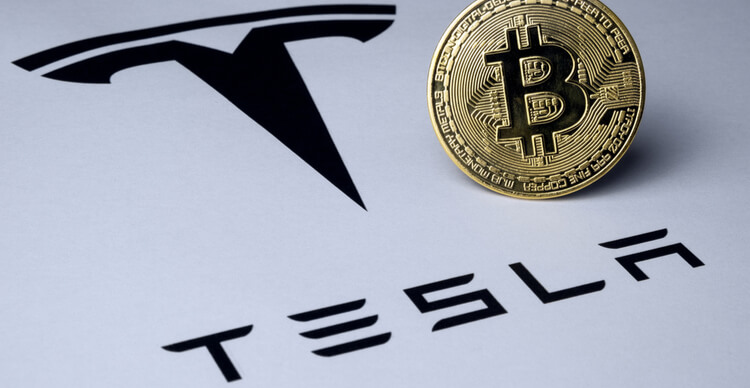
    Bild eines Bitcoins auf einer Papieroberfläche mit dem Tesla-Logo

    • EV sales fell 13%, production down 16%, causing 20% segment decline.
    • Bitcoin holdings valued over $1 billion as BTC hits $93,000.
    • Tesla holds 11,509 BTC with no transactions this quarter.

    Tesla has reaffirmed its strategic bet on Bitcoin despite disappointing quarterly earnings, a plunging stock price, and slowing electric vehicle sales.

    As of March 31, 2025, the company holds 11,509 Bitcoin, currently valued at just over $1 billion after a 6% rise in the cryptocurrency’s price to $93,000.

    This development comes at a time when Tesla is under pressure from shareholders following a 41% decline in its stock price this year and growing scrutiny around CEO Elon Musk’s political involvement.

    Revenue down, deliveries slump

    Tesla’s Q1 2025 revenue reached $19.34 billion, falling short of Wall Street’s projection of $21.37 billion.

    The shortfall is largely tied to the company’s main business—electric vehicles—which saw a 13% drop in deliveries and a 16% dip in production.

    This led to a 20% year-over-year decline in revenue from its core segment.

    Tesla’s declining delivery numbers mirror broader industry challenges, but some of the headwinds are unique to the company.

    Ongoing protests and concerns around Musk’s dual focus—spanning political appointments and social media commentary—have amplified investor unease.

    Despite this, Tesla made no changes to its Bitcoin position during the quarter, signalling a clear intention to maintain it as a long-term asset.

    Bitcoin strategy remains unchanged

    Tesla’s current holding of 11,509 BTC was first acquired in February 2021, with about 75% of it sold off in July 2022.

    The remainder has been left untouched.

    At the end of 2024, this stash was worth approximately $1.076 billion. By the close of Q1 2025, Bitcoin’s 12% decline had reduced the value to around $951 million.

    However, with Bitcoin prices rebounding to $93,000, the portfolio’s worth has climbed back above the $1 billion mark.

    New rules introduced by the Financial Accounting Standards Board (FASB) require companies to mark their digital asset holdings to market value at the end of each quarter.

    Under this regime, Tesla previously recorded a $600 million unrealised gain in Q4 2024 due to Bitcoin’s rally.

    Tesla’s decision not to buy or sell any Bitcoin in Q1 2025 signals a “HODL” stance—mirroring the strategy of other corporate holders like Strategy and Metaplanet, which also treat Bitcoin as a hedge or strategic reserve.

    Musk shifts from DOGE to Tesla

    Elon Musk, whose support for Dogecoin (DOGE) has frequently made headlines, announced plans to scale back his involvement with the meme coin.

    He said his time allocation would shift in May 2025 as DOGE operations become more self-sufficient.

    This renewed focus on Tesla comes as analysts call for urgent strategic moves.

    Dan Ives of Wedbush labelled the company’s situation a “code red,” suggesting that Tesla may need to rethink parts of its financial strategy, including how it handles its Bitcoin holdings, if current challenges continue.

    Meanwhile, BeInCrypto forecasts that crypto markets will remain unstable until mid-May due to global economic uncertainty and trade pressures.

    However, the broader outlook for digital assets, especially Bitcoin, is more bullish for the second half of the year.

    Analysts expect a rebound driven by post-halving effects, institutional buying, and regulatory clarity in the US.

    As Tesla navigates financial turbulence, its firm stance on Bitcoin indicates that the cryptocurrency is now more than just a side bet—it’s part of a calculated strategy.

    Whether that strategy pays off in Q2 and beyond may depend as much on Musk’s leadership as on Bitcoin’s next move.

    Source link

  • Bitcoin gains 12%, mirrors gold as trade war, recession fears mount

    Bitcoin gains 12%, mirrors gold as trade war, recession fears mount

    Bitcoin gains 12%, mirrors gold as trade war, recession fears mount

    • Bitcoin gained 12% in two weeks to April 22, showing resilience amid US-China tariffs.
    • Observers note Bitcoin decoupling from stocks, behaving more like gold (safe haven).
    • US plans for a Strategic Bitcoin Reserve potentially bolster its asset status (Nansen CEO).

    Bitcoin has demonstrated notable strength in recent weeks, seemingly shrugging off the escalating trade tensions between the US and China that have unsettled broader financial markets.

    This resilience, marked by a significant price increase, is fueling observations that the cryptocurrency is increasingly behaving like a traditional safe-haven asset, akin to gold, rather than mirroring the volatility often seen in tech-heavy indices like the Nasdaq.

    Divergence amid trade turmoil

    In the two weeks leading up to April 22, Bitcoin registered a solid 12% price gain.

    This upward movement occurred even as the trade dispute intensified, with the US imposing tariffs reported up to 125% on China, prompting reciprocal measures from Beijing.

    Unlike many other assets sensitive to global trade disruptions, Bitcoin appeared relatively insulated, strengthening the argument for its potential role as a store of value during geopolitical uncertainty.

    Alex Svanevik, CEO of crypto intelligence firm Nansen, highlighted this trend, noting Bitcoin’s apparent “decoupling” from traditional stock markets.

    “Unlike altcoins and major indexes like the S&P 500, Bitcoin has remained relatively stable despite the global trade tensions,” Svanevik observed, according to the analysis.

    However, he cautioned that while resilient to specific trade issues, Bitcoin remains susceptible to broader macroeconomic headwinds, particularly the growing fears of a potential economic recession.

    Bolstering the safe-haven narrative: US reserve plans

    Adding another layer to Bitcoin’s evolving status is the concept of a potential US Strategic Bitcoin Reserve.

    Plans outlined in a presidential executive order suggest the government intends to hold Bitcoin, initially comprising assets seized in criminal investigations.

    More significantly, the order details potential future strategies for acquiring more Bitcoin, possibly funded through tariff revenues or by re-evaluating the Treasury’s gold certificates to generate surplus funds, potentially avoiding the need to sell existing gold reserves.

    Svanevik believes such “regulatory developments will play a significant role in Bitcoin’s growth as a global asset,” potentially enhancing its legitimacy and appeal.

    Recession shadow looms despite crypto gains

    While Bitcoin charts its course, the macroeconomic outlook remains clouded. Concerns about a potential US recession are intensifying, acting as a significant counterweight to bullish sentiment in risk assets.

    A recent report from JPMorgan notably increased its estimated probability of a US recession occurring in 2025 from 40% to 60%.

    The report underscored that existing tariffs, particularly citing the high 145% tariff on China in this context, continue to pose a “significant threat to global growth.”

    Against this backdrop, the Federal Reserve is anticipated to begin easing monetary policy, likely starting in September 2025 with further rate cuts expected through January 2026.

    While monetary easing could stimulate the economy, it might also influence demand dynamics for assets perceived as riskier, potentially including Bitcoin, depending on how investors weigh inflation hedges versus growth prospects.

    Navigating an uncertain future

    Bitcoin’s trajectory appears increasingly shaped by a complex interplay of factors.

    Its resilience during the recent trade friction supports the narrative of it maturing into a gold-like store of value.

    Continued institutional interest and potential government actions like the Strategic Reserve could further solidify this perception.

    However, the looming threat of a broader economic downturn and ongoing regulatory developments, particularly in the US, remain critical variables.

    As global economic anxieties persist, Bitcoin’s ability to maintain its appeal as a hedge against turbulence will be closely watched.

    Source link

  • BTC nears resistance zone as analysts flag potential pullback to $76,600

    BTC nears resistance zone as analysts flag potential pullback to $76,600

    Nvidia's $5.5B China chip charge rattles markets, pulls Bitcoin below $84K

    • Key resistance zone flagged between $86,549 and $88,244.
    • MicroStrategy buys 6,556 BTC worth $555.8 million.
    • $90,000 is seen as a psychological and technical barrier.

    Bitcoin has surged back to near $89,000, inching closer to its all-time high and setting the stage for what could be a significant breakout.

    According to crypto analyst Michael van de Poppe, the flagship cryptocurrency is now approaching a crucial resistance band between $86,549 and $88,244.

    This level has historically been difficult to breach, often leading to temporary corrections.

    However, the current market sentiment, combined with macroeconomic cues like a potential US-China deal, is fuelling speculation about a fresh rally past $90,000.

    In a tweet posted earlier this month, van de Poppe shared a technical chart highlighting Bitcoin’s rebound and its current position near a historical resistance level.

    He suggested that Bitcoin may first dip to retest support at $80,982 before making another attempt at a breakout.

    A further decline to $76,604 is also possible if current support fails to hold, marking a retest of a previous support level that could now act as resistance.

    Bitcoin gains 1.5% as whale accumulation boosts sentiment

    Bitcoin’s rise above $88,500 has been aided by strong accumulation from institutional players.

    Notably, US-based corporate holder MicroStrategy recently acquired 6,556 BTC at a total cost of around $555.8 million.

    The purchase comes amid growing interest in Bitcoin as a hedge against inflation and geopolitical risks, and appears to have given the market a confidence boost.

    According to CoinMarketCap, Bitcoin gained 1.5% in the past 24 hours, adding to its 4.7% weekly gain.

    The surge has also lifted overall crypto market capitalisation past $2.7 trillion.

    Source: CoinMarketCap

    Van de Poppe noted that despite nearing overbought territory, the market may remain bullish if Bitcoin consolidates above $88,000.

    A sustained rally past $90,000 could open up a move towards new highs, while failure to maintain support around $80,000 could send prices lower.

    Analyst warns of pullback to $76,604 if support fails

    Technical indicators show that Bitcoin’s RSI is approaching critical levels, suggesting a temporary correction could occur.

    Still, many traders are watching the $90,000 resistance level as the next major milestone.

    If Bitcoin manages to flip $90,000 into support, it could mark a psychological and technical breakthrough.

    Historically, this kind of pattern has led to rapid price discovery.

    However, if momentum fades, the cryptocurrency may struggle to hold onto gains and revisit lower support zones.

    Van de Poppe outlined that a correction to $76,604 would still be within healthy limits and could act as a springboard for a future rally.

    The price level was previously a key support and remains one to watch in the near term.

    Macro trends could support the Bitcoin push

    On the macroeconomic front, van de Poppe hinted at the potential impact of global events.

    In particular, signs of de-escalation between the US and China could reduce market anxiety, prompting increased risk appetite among investors.

    Geopolitical calm, combined with institutional accumulation and favourable regulatory signals, may set the stage for Bitcoin to finally break through its upper resistance.

    However, short-term volatility should not be ruled out, especially as the asset hovers near historically reactive zones.

    As of 14 April, Bitcoin is trading just above $88,606.

    All eyes are now on whether the world’s largest cryptocurrency can consolidate its gains and surge through $90,000 in the coming sessions.

    Source link

  • Analyst holds $5 target for Pi Network ahead of major token release

    Analyst holds $5 target for Pi Network ahead of major token release

    Pi Network will rise to $5 despite 5.6M token unlock

    • The over $$138.252 million Pi Network token unlock on over the next 30 days may pressure Pi’s price.
    • Whales have moved 41M PI off exchanges, hinting at a rebound.
    • Analysts predict $5 target with market and ecosystem growth.

    Pi Network token has had a rough patch recently, with the Pi Network price dipping 80% from its all-time high to around $0.63 and struggling to gain momentum amid daily token unlocks.

    Despite the immense bearish pressure exerted by the token unlocks, a bold Pi Network price prediction has emerged from analysts, one of whom foresee the PI token climbing to an impressive $5.

    Why the $5 Pi Network price prediction could be realistic

    To start with, Pi Network price today sits at around $0.63 with a sturdy support at $0.60, a zone some experts believe could serve as a springboard for a breakout toward higher valuations.

    Technical analysis reveals a double-bottom pattern with a neckline at $0.7857, hinting at a possible breakout, while price prediction models suggest a climb to $1.83 by May 2025; a 190% jump from today.

    Adding fuel to the optimism, Pi Network founder Nicolas Kokkalis is slated to speak at Consensus 2025, a major crypto event, signaling a boost in credibility for the project amid the latest Pi Network news.

    Notably, Kokkalis’ appearance at Consensus 2025 alongside crypto giants like Eric Trump and Bo Hines coincides with the unlock of 5.6 million tokens, a move that could either weigh on the price or be absorbed by growing demand, depending on market dynamics.

    At the same time, Pi token whale activity is turning heads, with a single investor withdrawing 7.5 million PI token valued at $4.82 million from OKX, part of a broader $48 million accumulation now worth $31 million.

    From a broader perspective, whales have move approximately 41 million Pi tokens from crypto exchanges, signaling at massive accumulation.

    Such large-scale accumulation suggests confidence in the Pi Network value, potentially foreshadowing a price surge as these investors position themselves ahead of key milestones.

    Analysts also point to several drivers that could spur a potential recovery, including an improving cryptocurrency market, clearer Pi Network tokenomics, listings on top-tier exchanges, and broader ecosystem growth; all critical for the Pi Network price prediction to materialize.

    A listing on exchanges like Binance or Coinbase could also ignite investor enthusiasm, pushing the Pi Network price beyond its stubborn resistance at $0.70, a level it has repeatedly failed to breach.

    Beyond that, expanding real-world use cases for the PI token, such as applications or services accepting it, could solidify its utility and bolster long-term value.

    Possible handles that could curtail Pi Network’s rise

    The planned unlock of 219,065,154.07 tokens over the next 30 days and over 1.5 billion tokens over the next year raises concerns about dilution.

    Pi Network token unlocks over the next month

    And to make things worse, 35 billion PI tokens are held by insiders against 65 billion allocated to the community, a factor that could challenge the Pi Network price.

    In addition, the Pi Network open mainnet launch problems, as users struggle to migrate to the mainnet, has limited exchange presence, keeping its market cap at $4.3 billion and its price in a holding pattern.

    Nevertheless, the team has unveiled an elaborate Pi Network tokenomics with a total supply of 100 billion tokens; 65% allocated to community mining rewards, 10% to the foundation, 5% to liquidity, and 20% to the Core Team, and designed to scale with community migration to the mainnet.

    This tokenomics structure aims to ensure fairness and prevent early dumping, tying the network’s progress to the speed of Pioneer adoption, a unique approach that could stabilize the Pi Network value over time.

    In essence, while the 5.6 million tokens unlock poses a near-term risk, the $5 Pi Network price forecast hinges on Pi Network overcoming its challenges and capitalizing on its ecosystem expansion, making the Pi Network mainstream adoption a critical watchpoint.


    Source link

  • Bitcoin eyes $100K? Hayes cites treasury buybacks, weak dollar as catalysts

    Bitcoin eyes $100K? Hayes cites treasury buybacks, weak dollar as catalysts

    Bitcoin eyes $100K? Hayes cites treasury buybacks, weak dollar as catalysts

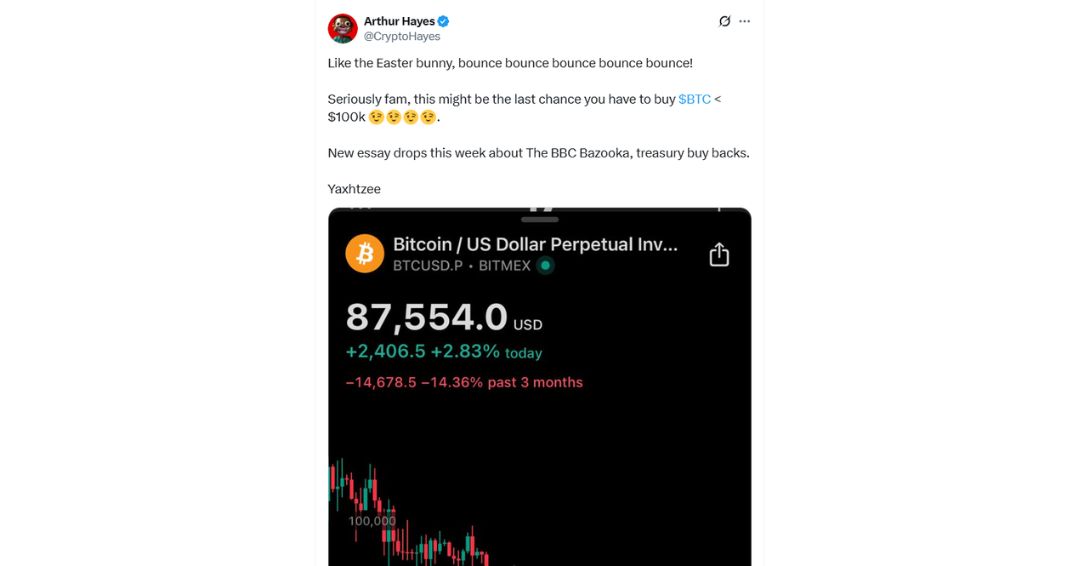
    • Bitcoin surged past $87,700, fueled by a weakening US dollar and potential US Treasury buybacks.
    • Arthur Hayes predicts Treasury buybacks could be a “bazooka,” pushing BTC past $100K (“last chance” below).
    • Weak dollar (lowest since March 2022) and rising gold correlation support Bitcoin’s appeal.

    Bitcoin’s recent climb, momentarily cresting $87,700, is drawing significant attention, with prominent analysts pointing towards macroeconomic shifts and potential government actions as key drivers that could propel the cryptocurrency well beyond the $100,000 threshold.

    The convergence of a weakening US dollar, anticipated US Treasury debt buybacks, and sustained institutional interest is painting an increasingly bullish picture for the digital asset.

    Macro tailwinds: dollar dips, treasury ‘bazooka’ eyed

    A primary factor supporting Bitcoin’s ascent is the declining value of the US dollar, which recently touched lows not seen since March 2022.

    As the dollar weakens, assets like Bitcoin often become more appealing to global investors seeking a hedge against fiat currency devaluation.

    Adding potent fuel to this narrative is the prospect of the US Treasury repurchasing its own debt.

    Arthur Hayes, the influential co-founder of BitMEX and current CIO of Maelstrom, has highlighted this potential move as a significant catalyst.

    He posited that upcoming Treasury buybacks could inject substantial liquidity into the financial system, effectively acting as a “bazooka” for Bitcoin’s price.

    Hayes went so far as to suggest this period might represent the “last chance” for investors to acquire Bitcoin below the $100,000 mark, anticipating that these buybacks could easily push the price past that psychological barrier.

    Technical signals and institutional trust bolster case

    The bullish sentiment finds resonance in technical analysis and continued institutional adoption.

    Ryan Lee, Chief Analyst at Bitget Research, noted that Bitcoin’s price chart recently completed a “descending wedge breakout,” a technical pattern often interpreted as supportive of further upward movement.

    This technical picture is complemented by Bitcoin’s growing correlation with gold, another traditional safe-haven asset, which itself has surged nearly 30% this year.

    Furthermore, global institutional appetite for Bitcoin appears unwavering despite recent price volatility.

    Reports indicate that investment firms, notably from Japan and the UK, have maintained their commitment, channeling capital into the cryptocurrency.

    This sustained institutional inflow signals enduring confidence in Bitcoin’s long-term value proposition.

    Analysts eye six-figure targets amid fiat expansion

    As Bitcoin tests resistance levels nearing $90,000, some analysts are setting their sights considerably higher.

    Jamie Coutts of Real Vision forecasts that expanding fiat money supply (M2) could drive Bitcoin to as high as $132,000 by the end of the year.

    This projection finds company with analysis from economist Timothy Peterson, who, citing historical market patterns, suggests Bitcoin could potentially reach $138,000 within the next three months.

    Political pressures add fuel to the fire

    The intricate macroeconomic picture is further complicated by the political landscape.

    President Donald Trump’s public calls for the removal of Federal Reserve Chair Jerome Powell have intensified market expectations of potential interest rate cuts.

    Such cuts, aimed at stimulating the economy, would likely exert further downward pressure on the US dollar, potentially creating an even more favorable environment for Bitcoin’s price appreciation.

    A note of caution amidst the bullish chorus

    Despite the confluence of positive indicators, some market observers urge caution regarding short-term price action.

    Analyst Michaël van de Poppe warned that weekend rallies can sometimes prove ephemeral and that Bitcoin might face a pullback before decisively conquering key resistance zones.

    The $91,000 level is widely seen as the next significant hurdle.

    Until Bitcoin firmly establishes itself above this mark, the possibility of short-term corrections remains.

    Nonetheless, the combination of weakening fiat dynamics, anticipated liquidity injections via Treasury buybacks, robust institutional support, and supportive technical patterns creates a compelling narrative for Bitcoin’s continued ascent towards, and potentially well beyond, the $100,000 milestone.

    Source link

  • PepeX maintains upside momentum as Bitcoin, Solana dominate the majors

    PepeX maintains upside momentum as Bitcoin, Solana dominate the majors

    PepeX, the first AI-powered memecoin launchpad, kicks off presale

    Bitcoin and Solana have emerged as top performers as crypto majors and meme tokens strive to recover. While investors shift to Bitcoin for its stability, Solana has become a key player in DEX trading.

    At the same time, investors are on the look out for fresh projects with robust growth potential. PepeX, which has emerged as one of the top meme ICOs to watch out for in 2025, offers its holders an irresistible opportunity to rake in hefty gains during its presale and beyond. Its infrastructure seeks to restore transparency, fairness, and accessibility in the meme crypto space.

    Bitcoin heightened dominance paves the way to $90,000

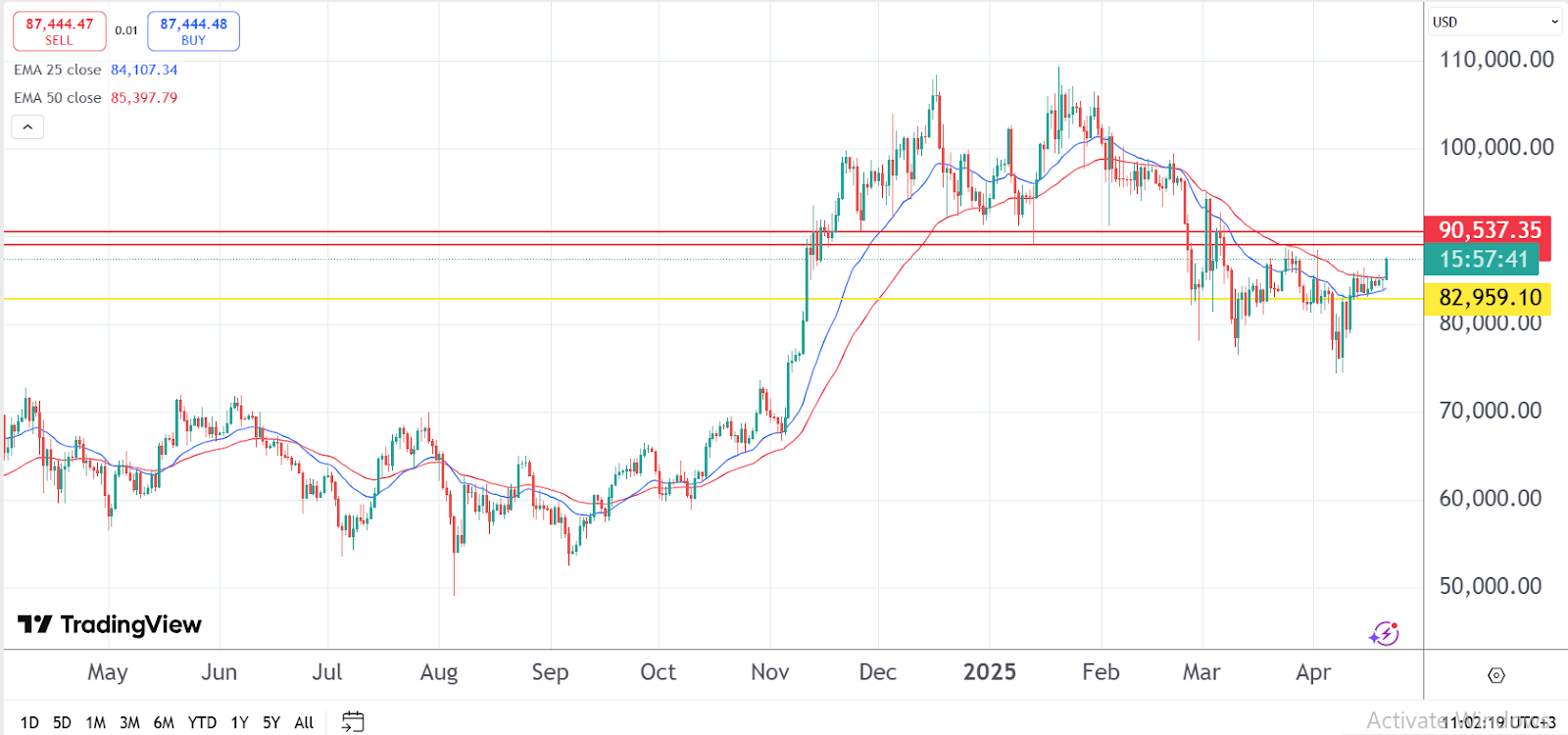
    Bitcoin price began the new week on a high; rallying to a three-week high in early Monday session. Since hitting a five-month low two weeks ago, the crypto major has rebounded by about 17%. At the time of writing, it was trading at $87,488. 

    Despite the persistent economic uncertainties, bulls are optimistic that Bitcoin price will soon retest the crucial zone of $90,000. CoinGecko’s 2025 Q1 crypto industry report showed that despite the drop in investor activity, Bitcoin’s dominance in the cryptocurrency space hit a level last recorded in early 2021 at 59.1%. 

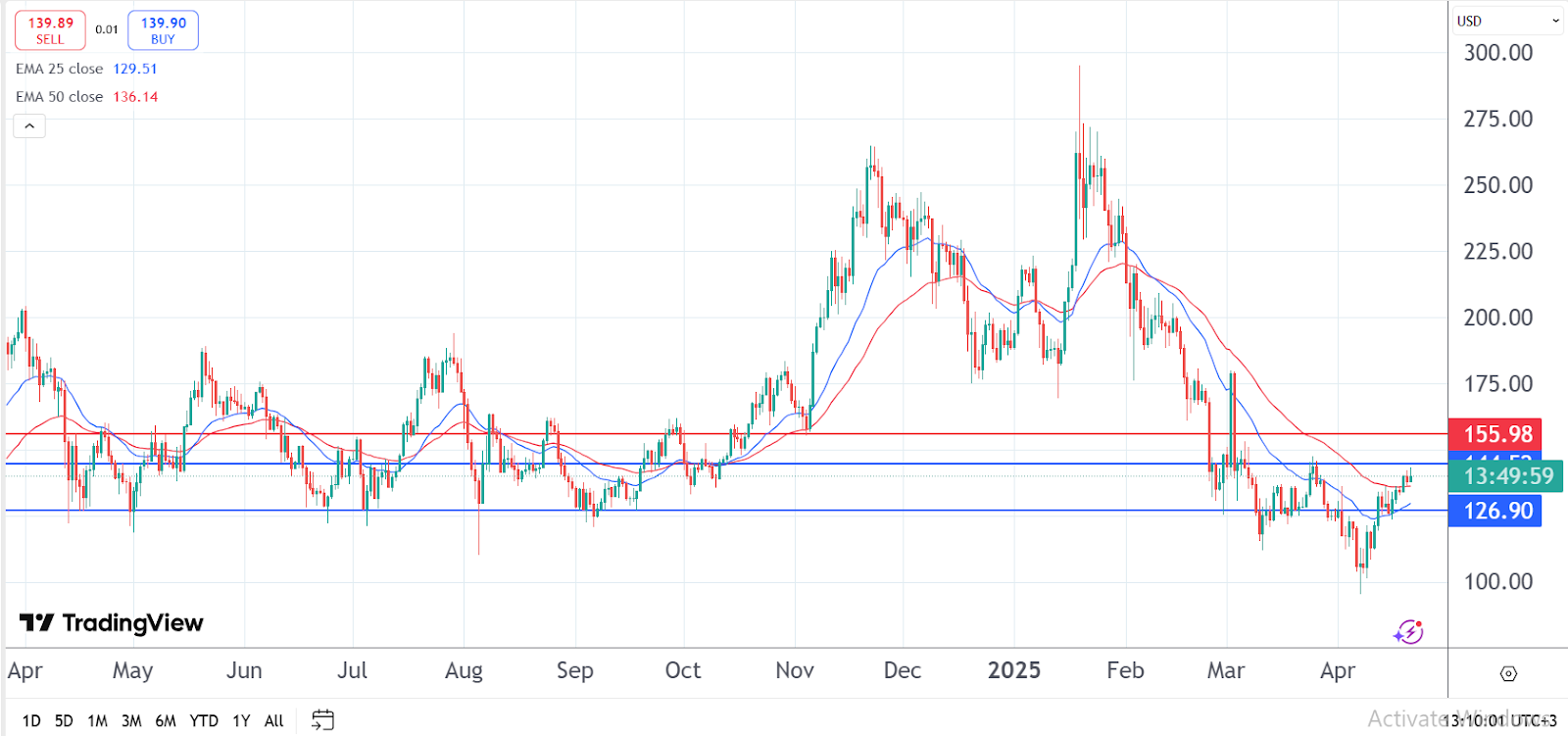
    Having rebounded past the 25 and 50-day EMAs, the bulls have an opportunity to retest the crucial support-turn-resistance zone of $90,000. However, the bulls will need to gather enough momentum to break the immediate-term resistance at $89,075. On the lower side, $82,959 is set to offer steady support to Bitcoin price. 

    Bitcoin Price
    Bitcoin Price

    PepeX maintains upward momentum as it restores integrity in the meme crypto space 

    AI-related cryptocurrencies have captured investors’ attention as they look past the majors for projects with robust growth potential. In the past 24 hours, AI meme market cap rose by 6.5% to $2.34 billion.

    Notably, most of these fresh projects are moving past meme jokes to offer solutions to existing challenges within the crypto space. PepeX is one such crypto. As the world’s first AI-powered tokenization launchpad, it seeks to solve the persistent issues of security, fairness, and transparency. Indeed, it comes at an opportune time and investors are taking note of it. 

    In the recent past, platforms like Pump.fun have allowed pump-and-dump schemes that saw investors lose hefty amounts of money. To solve this issue, PepeX has integrated anti-sniping tools and a bubble map tool to discourage early dumping and any shady launches. Besides, the creators’ holdings are capped at 5% of the total supply, which they could lose to its community should the project fail. 

    This one-of-a-kind infrastructure has attracted the attention of meme coin enthusiasts, enabling it to raise over $1.4 million just four weeks into its presale. In addition to its real-world use case and subsequent growth potential, early adopters have an opportunity to rake in huge gains during the 30-stage presale. 

    With every three-day stage, the token price increases by 5%. What started at $0.02 is currently at $0.0243 and is set to rally further to $0.0823 before the token hits the public shelves in Q3. Read more on how to buy PepeX.

    Solana dominance in DEX trading fuels recovery

    Solana Price Chart
    Solana Price Chart

    In the recent months, altcoins and meme coins have been under selling pressure. However, as the assets find their footing, Solana has emerged as one of the top performers. 

    Notably, its dominance in the decentralized exchange (DEX) space has fueled its recovery. As highlighted by CoinGecko, Solana dominated DEX trades at a rate of 39.6% in Q1’25. 

    A look at its daily chart shows Solana price trading above the 25 and 50-day EMAs. In the short term, I expect $126.90 to be a steady support zone as the bulls strive to break the resistance at $144.50. If successful, the next target will be at $155. 

    Source link

  • Why Bitcoin ETFs face outflows post-recovery

    Why Bitcoin ETFs face outflows post-recovery

    Bitcoin ETFs seeing huge outflows despite BTC price recovery

    • $812M has left Bitcoin ETFs in April despite Bitcoin price recovery post‑tariff pause.
    • Institutions are shifting to bonds and AI/tech funds amid risk‑off sentiment.
    • Regulatory delays and media FUD also fuel cautious ETF positioning.

    Bitcoin ETFs have registered significant fund withdrawals even as spot Bitcoin (BTC) price regained ground following President Trump’s 90‑day suspension of reciprocal tariffs.

    The temporary tariff relief helped stabilize global markets, fueling a Bitcoin price rebound that saw it climb back toward the mid‑$80,000s.

    However, institutional investors have continued to pull money out of spot Bitcoin ETFs, culminating in a dramatic $171.10 million net outflow on April 17, according to Coinglass data.

    The most affected ETFs are Fidelity’s FBTC and ARK Invest’s ARKB, each of which has seen over $113 million in outflows.

    BlackRock’s IBIT, however, continues to enjoy modest inflows with $30.60 million inflows as of April 17, 2025.

    Bitwise’s BITB, VanEck’s HODL, and Grayscale Bitcoin Mini Trust ETF (BTC) have also weathered the storm with $12.8M, $6.7M, $2.4M, and $3.4M inflows respectively.

    Month‑to‑date flows show that more than $800 million departed Bitcoin ETFs in early April, following $767 million in March.

    This extended streak of weekly outflows eclipses even the heaviest withdrawal phases seen since these products debuted in January 2024.

    Why the huge Bitcoin ETFs outflows?

    Notably, this trend underscores a broader risk‑off sentiment among professional investors reluctant to reallocate capital into volatile digital assets.

    Surging US interest rates have rendered government bonds more appealing, prompting capital rotation out of crypto ventures.

    Concurrently, profit‑taking after Bitcoin’s late‑2024 rally motivated holders to crystallize gains, dampening demand for ETF exposure.

    Investors are also contending with fractured regulatory signals, as promised crypto‑friendly legislation remains stalled in Congress.

    Confusion surrounding token unlock schedules for structured Bitcoin products exacerbates fears of sudden supply surges.

    Moreover, strong inflows into AI and tech‑focused exchange‑traded funds have lured momentum‑driven capital away from crypto.

    Persistent media rhetoric around a “Bitcoin ETF exodus” further compounds negative sentiment and amplifies withdrawal pressures.

    Bitcoin miners have also felt the squeeze, with March profitability down 7.4% as average fees and prices cooled although leading miners like Marathon Digital and CleanSpark maintained robust production and expanding hash rates despite shrinking margins.

    Tax‑loss harvesting strategies and quarter‑end portfolio rebalancing have also applied technical selling pressure on ETF shares.

    The interplay of these forces paints a nuanced picture: spot Bitcoin prices can recover while ETF flows simultaneously languish.

    Investors now face a delicate balancing act between capturing crypto’s upside potential and managing exposure to its inherent volatility.

    A weaker US dollar amid shifting Federal Reserve forecasts has provided some tailwind for Bitcoin valuations in recent weeks.

    However, the comparative stability and yield of US Treasuries continue to attract institutional allocations away from high‑beta crypto instruments.

    As the market digests these divergent signals, the tug of war between price recovery and Bitcoin ETFs fund outflows may define next Bitcoin (BTC) maturation phase.

    Source link

  • Binance community vote puts FTT at highest delisting risk

    Binance community vote puts FTT at highest delisting risk

    • Voting ran from April 10 to April 16, 2025.
    • ZEC and JASMY followed with 8.6% of the votes each.
    • Binance says votes won’t be sole factor for delisting.

    FTT, the native token of collapsed exchange FTX, is facing renewed pressure as it topped Binance’s second “Vote to Delist” round with 11.1% of the community votes.

    The vote, which ran from April 10 to April 16, 2025, forms part of Binance’s broader governance programme, allowing users to weigh in on tokens marked with a Monitoring Tag.

    These tokens are deemed to carry greater risk or volatility, prompting deeper internal evaluations by Binance. While voting results alone do not determine delistings, they significantly influence the exchange’s decision-making process.

    The token has seen persistent downward momentum since the beginning of the year, and its association with FTX’s collapse in November 2022 continues to cloud investor confidence.

    At the time of writing, FTT was trading at $0.80, down 4.1% in the past 24 hours, with its latest decline echoing sentiment-driven selloffs seen in the first round of voting.

    Source: CoinMarketCap

    Binance expands governance tools

    Binance’s “Vote to Delist” initiative is aimed at improving transparency and strengthening user participation in governance. It targets assets flagged with Monitoring Tags, typically due to liquidity concerns, regulatory risks, or large price swings.

    Although community sentiment plays a key role, Binance has clarified that delisting decisions are not solely determined by voting outcomes.

    “The voting result will not be the sole deciding factor to determine the final delisting decision,” Binance stated on its Square platform.

    The review process will also consider internal metrics and compliance standards, and any final decision may be delayed depending on procedural requirements.

    FTT’s leading position among 17 tokens included in the second voting round suggests a strong community preference for removal, reinforcing the market’s wariness of its long-term viability.

    Altcoins face price drops, delisting risk

    Other tokens also registered notable levels of concern. Zcash (ZEC) and JasmyCoin (JASMY) each received 8.6% of the votes, reflecting increasing user doubt despite their historical popularity.

    GoPlus Security (GPS) followed with 8.2%, while PlayDapp (PDA) came in at 7.6%. Voxies (VOXEL), Alpaca Finance (ALPACA), and STP Network (STPT) also featured prominently, with 7.1%, 6.3%, and 5.9% of the votes, respectively.

    Price data shows these tokens have begun to react to the voting results. JASMY and STPT both dropped around 6% over the past 24 hours, with several other coins showing more modest declines.

    For instance, VOXEL, PDA, and ALPACA all posted red candles, suggesting investor anxiety may extend beyond FTT.

    Also included on the list were Flamingo Finance (FLM) with 4.3%, ARK (5.8%), Biswap (BSW) with 5.5%, and MovieBloc (MBL) at 4.2%.

    Smaller vote shares were seen for Wing Finance (WING) at 3.8%, Ardor (ARDR) at 3.6%, and Perpetual Protocol (PERP) at 3.4%. NKN and LTO Network closed the list with 3.2% and 2.9% of the votes, respectively.

    Market awaits Binance decision on FTT

    While Binance’s final delisting decisions are pending, the data signals a clear community trend away from tokens viewed as unstable or compromised.

    Market participants are expected to monitor Binance’s review process closely, particularly for tokens like FTT and JASMY, which continue to attract regulatory and public scrutiny.

    The exchange has not announced a firm delisting timeline and reiterated that internal reviews are still in progress.

    However, the market impact has already materialised, with sharp short-term price declines and trading volumes showing volatility across the affected tokens.

    With this round of votes concluded, Binance’s next steps could set a precedent for how much influence community feedback will hold in shaping the platform’s asset offerings moving forward.

    Source link

  • Crypto market decline accelerates in Q1 with $633.5B in losses

    Crypto market decline accelerates in Q1 with $633.5B in losses

    • Bitcoin’s market share rose to 59.1% despite falling 11.8%.
    • Ethereum’s 2024 gains wiped out in Q1 2025.
    • DeFi TVL fell 27.5% across multichain platforms.

    The global cryptocurrency market started 2025 with optimism, fuelled by expectations of favourable policy shifts under Donald Trump’s presidency and a strong rally across meme coins.

    But those hopes have since been dashed. According to CoinGecko’s latest quarterly report, crypto’s total market capitalisation fell 18.6% in Q1 2025, wiping out $633.5 billion in value.

    Trading volumes also took a hit. The report shows that average daily trading volume fell 27.3% compared to the previous quarter. Spot trading on centralised exchanges declined 16.3%, a drop that was partly attributed to the Bybit hack earlier this year.

    Despite signs of strength in early January, recession concerns and fragmented investor interest led to a broad sell-off across digital assets.

    Bitcoin outperforms altcoins but still falls 11.8%

    Bitcoin retained its dominance over the broader market in Q1, accounting for 59.1% of the total crypto market cap — its highest level since 2021.

    This shift highlights how investors have treated Bitcoin as a relatively more stable asset compared to altcoins during uncertain periods.

    However, Bitcoin itself was not immune to losses. It declined 11.8% during the quarter and underperformed traditional safe havens like gold and US Treasury bonds.

    The report also noted that Trump’s newly imposed tariffs triggered volatility in the bond market, impacting yields — a key metric closely linked to digital asset flows.

    Ethereum saw an even sharper reversal. It gave up all of its 2024 gains, returning to levels last seen before its Shanghai upgrade. The report attributed this trend to declining decentralised finance (DeFi) activity and persistent concerns around gas fees and scalability.

    DeFi TVL and Solana activity decline sharply

    Multichain DeFi protocols suffered significantly, with total value locked (TVL) falling 27.5% over the three-month period.

    Solana, which led the decentralised exchange (DEX) trading space during the meme coin frenzy in January, saw its own TVL drop by more than 20%.

    CoinGecko’s data indicates that market excitement around Trump-themed tokens, particularly the TRUMP coin on Solana, sparked a temporary spike in transaction volumes. However, this activity failed to sustain investor interest beyond January.

    The LIBRA scandal, which emerged shortly after, added further pressure on altcoin sentiment and liquidity.

    Despite these setbacks, Bitcoin exchange-traded funds (ETFs) recorded $1 billion in fresh inflows in Q1.

    But the total assets under management (AUM) across these ETFs still fell by nearly $9 billion due to declining prices, highlighting the gap between investment inflows and market returns.

    Structural concerns deepen

    While some data points suggested limited resilience, nearly every positive trend in the report was accompanied by a downside risk.

    The report shows that centralised exchanges, stablecoin volumes, and DeFi applications all registered lower activity in February and March. Many projects lost traction as macroeconomic concerns mounted and investor caution grew.

    CoinGecko noted that the first quarter of 2025 represents one of the most challenging periods for crypto since the FTX collapse in late 2022.

    The report reflects broader market concerns that the crypto sector, despite structural improvements in infrastructure and compliance, remains deeply vulnerable to global economic shocks.

    As recession fears take hold and regulatory uncertainties continue to loom in major markets, the path forward for crypto in the coming months remains highly uncertain.

    Although Bitcoin’s rising market share signals a flight to perceived safety, the broader market may need more than optimism and meme coin rallies to recover from this quarter’s losses.

    Source link

  • Colorado sees just 80 crypto tax payments in 3 years

    Colorado sees just 80 crypto tax payments in 3 years

    Bitcoin ETFs seeing huge outflows despite BTC price recovery

    • PayPal converts crypto into US dollars before funds reach the state.
    • Bitcoin’s rising value discourages users from spending it on taxes.
    • Stablecoins may become the preferred method for future payments.

    Since 2022, the State of Colorado has collected over $11 billion in income tax. Yet of that, only $57,211 has come from cryptocurrency payments. That is just 0.0005% of the total.

    When Colorado became the first US state to accept crypto tax payments under Governor Jared Polis, the move was presented as a breakthrough for digital finance adoption.

    But nearly two years later, figures provided to Colorado Newsline by the Department of Revenue suggest that uptake has remained negligible.

    The data shows that while crypto ownership is rising across the United States, its use for tax obligations is far from mainstream.

    Colorado residents can use PayPal’s Cryptocurrency Hub to pay in Bitcoin or other digital assets, which are instantly converted into US dollars before reaching the state treasury.

    Despite the infrastructure being in place, only a handful of residents have opted in—and their reasons are more financial than technical.

    Fewer than 80 payments

    In 2022, only eight crypto-based tax payments were made in Colorado, totalling $16,426. That figure rose modestly in 2023 to 22 payments, amounting to $23,241.

    In 2024, the number of transactions increased to 48, but the total paid declined to $17,544. Altogether, fewer than 80 payments have been recorded, with total crypto contributions stuck below $60,000.

    None of this crypto is held by the state. All payments are instantly converted to fiat via PayPal’s system, meaning the Department of Revenue never touches digital assets directly.

    That distinction matters: while Colorado is technically accepting crypto, it is functionally no different from accepting a card payment in dollars.

    Store of value

    Despite the small number of transactions, crypto ownership in the United States remains high. Around 20% of American voters have held or used crypto at some point.

    But for most, coins like Bitcoin are not used to pay for goods or services—they are held as long-term investments.

    That investment mindset is reinforced by Bitcoin’s performance. Since the start of Colorado’s crypto tax pilot in September 2022, the price of Bitcoin has surged more than 320%.

    In September 2023, it posted a 30% annual gain, followed by another 125% in September 2024. With such returns, many holders are reluctant to spend their coins on tax bills, especially if doing so could trigger capital gains tax.

    Stablecoin future

    Colorado is not the only place experimenting with crypto-based public payments. Utah also allows tax payments via PayPal’s system. Detroit is planning to introduce the same model later this year.

    Louisiana already accepts crypto payments for services and fines through Bead Pay.

    Even so, experts remain sceptical about the long-term viability of using major cryptocurrencies for this purpose. Store-of-value assets like Bitcoin and Ethereum are ill-suited to everyday transactions, especially in volatile markets.

    Industry voices suggest that stablecoins—digital tokens pegged to fiat currencies—may be the better fit for tax payments going forward.

    Adoption remains symbolic

    The Colorado example illustrates that offering crypto payments does not guarantee adoption. Many residents are unaware of the option, and even those who are often have little incentive to use it.

    For now, crypto tax payment infrastructure may serve more as a political or technological signal than a practical alternative.

    Still, the systems put in place could pave the way for broader adoption as the digital asset landscape matures. Whether that shift will be led by stablecoins, central bank digital currencies, or other innovations remains to be seen.

    Source link