Author: BTCLFGTEAM

  • Ethereum ETFs inflows surge as Bitcoin ETFs see major outflows

    Ethereum ETFs inflows surge as Bitcoin ETFs see major outflows

    Ethereum ETFs inflows surge while Bitcoin ETFs see major outflows
    • Ethereum ETFs inflows are outdoing Bitcoin ETF inflows.
    • BlackRock’s iShares Ethereum Trust (ETHA) ETF leads with a $89.51M inflow on Dec 23, 2024.
    • This Market shift may signal an altcoin season in 2025.

    In a surprising turn of events in the cryptocurrency market, Ethereum spot ETFs have been experiencing significant inflows, overshadowing the outflows noted in Bitcoin ETFs.

    On December 23, 2024, Ethereum ETFs recorded a net inflow of $130.8 million, with BlackRock’s iShares Ethereum Trust (ETHA) ETF leading with $89.50 million and Fidelity’s Ethereum ETF (FETH) adding $46.40 million according to Coinglass data. In stark contrast, Bitcoin ETFs saw outflows totalling $226.50 million on the same day.

    This trend has been consistent over recent weeks. For instance, on December 12, Ethereum spot ETFs had a cumulative net inflow of $273.70 million, continuing their streak of 14 consecutive days with positive inflows. BlackRock’s ETHA ETF alone saw a single-day net inflow of $202.30 million, while Grayscale’s Ethereum ETF (ETH) contributed $73.20 million.

    Ethereum ETFs inflows
    Source: Coinglass
    Bitcoin ETFs inflows
    Source: Coinglass

    The shift signals a possible start of an altcoin season

    Bitcoin ETFs, despite having higher trading volumes, have been facing outflows, suggesting a possible shift in investor sentiment towards Ethereum.

    Market analysts speculate that this could signal the onset of an ‘altcoin season’, where investors might be diversifying their portfolios beyond Bitcoin, with ETH leading the pack.

    This shift in investment flow is particularly notable as it comes at a time when Bitcoin has been dominating headlines with its price performance, reaching over $108,000 earlier in December.

    The underlying reasons for this trend might include Ethereum’s growing ecosystem, particularly in decentralized finance (DeFi) and non-fungible tokens (NFTs), which could be attracting investors looking for dynamic growth opportunities.

    Additionally, the regulatory environment under the incoming administration might be perceived as more favourable for Ethereum, given its broader use-case applications beyond just being a store of value like Bitcoin.

    This development raises questions about the future direction of crypto investments. While Bitcoin has long been the bellwether of the crypto market, Ethereum’s recent performance in the ETF space might hint at a rebalancing of investor interest, potentially leading to more balanced growth across different cryptocurrencies in 2025.

    Source link

  • Avalon Labs raises $10m in series A round

    Avalon Labs raises $10m in series A round

    Japan’s Metaplanet buys $7M Bitcoin

    Avalon Labs, the issuer of Bitcoin (BTC)-backed stablecoin USDa, has secured $10 million in a Series A financing round that attracted several venture capital firms.

    “We are known for many things but today is not about us. The team from Avalon Finance is honored to announce the closing of our 10M Series A Round,” the platform posted on X.

    Venture capital firm Framework Ventures led the funding round, which attracted the participation of UXTO Management, Prestoby Framework Ventures and Kenetic Capital.

    In an announcement, the Avalon Labs team said the project will use the funding support to expand its BTC decentralized finance ecosystem.

    In this case, Avalon’s aim is to evolve Bitcoin from being just a digital store of value to a robust financial instrument.

    “We are pioneering the future of Bitcoin-backed financial solutions, creating the first comprehensive ecosystem that unlocks the true potential of the world’s leading cryptocurrency” the Avalon team wrote.

    Avalon’s USDa stablecoin allows users to tap into DeFi on Bitcoin by collateralizing it. The platform’s borrowing rate is fixed at 8%, which allows USDa holders to access liquidity while keeping their BTC positions.

    USDa, Avalon’s flagship collateralized debt position (CDP), ranks as the second-largest CDP per data from DeFiLlama. Its TVL hit $700 million in early December and its competitors include MakerDAO’s DAI and Liquity


    Source link

  • La Rosa Holdings to allow real estate agents to receive commissions in crypto

    La Rosa Holdings to allow real estate agents to receive commissions in crypto

    La Rosa Holdings to allow real estate agents to receive commissions in crypto
    • La Rosa agents can now receive commissions in cryptocurrency with a 2% fee.
    • The initiative aims to streamline transactions and meet the demand for crypto payments.
    • La Rosa reported a 155% revenue growth, hitting $51.7M in the first nine months of 2024.

    La Rosa Holdings Corp. (NASDAQ: LRHC), a leading technology-integrated real estate company, has announced a groundbreaking initiative to enable its network of over 3,000 real estate agents in the United States to receive commissions in cryptocurrency. This positions La Rosa as a pioneer in integrating blockchain technology into the real estate sector.

    Real estate agents will have the option to receive payouts in digital assets, including Bitcoin (BTC), under a 2% fee structure. The plan addresses the growing demand for alternative payment options and reflects the company’s commitment to innovation.

    By leveraging blockchain technology, La Rosa aims to streamline transactions, enhance security, and reduce associated fees.

    In a press release announcing the initiative, Alex Santos, the Chief Technology Officer of La Rosa said, “Our intention to introduce cryptocurrency payments represents a natural evolution in our commitment to innovation and broker empowerment. Blockchain technology has the potential to simplify real estate transactions while offering agents and clients unmatched flexibility.”

    Joe La Rosa, the company’s CEO, emphasized that cryptocurrency payments could lead to faster, more secure transactions while offering agents the potential to benefit from digital asset appreciation.

    “This initiative not only positions La Rosa at the forefront of technological innovation in real estate but also creates new opportunities for our agents,” said La Rosa. “We are proud to empower our network with cutting-edge solutions while meeting the growing demand for alternative payment methods.”

    La Rosa Holdings, which operates 25 corporate offices across the US and Puerto Rico, has seen remarkable growth, with a 188% year-over-year revenue increase in the first nine months of 2024, reaching $51.7 million. The company’s flexible business model offers agents a choice between a 100% commission plan and a revenue-sharing model.

    By integrating cryptocurrency payment options, La Rosa Holdings continues to lead the charge in redefining real estate transactions, ensuring its agents remain competitive in a rapidly evolving marketplace.

    Source link

  • What happened in crypto this week

    What happened in crypto this week

    Bitcoin all-time high

    It’s been another busy week in the crypto market: Bitcoin tops $107,000, FTX is to begin customer repayments in early 2025, CyberKongz receives “concerning rhetoric” in Wells notice from the SEC, US lawmakers cancel vote to renominate SEC Commissioner Caroline Crenshaw, and Injective and Sonic partner to build first cross-chain AI agent hub.

    Bitcoin tops $107,000 for the first time

    Earlier this week, Bitcoin reached new heights, topping above $107,000. At the same time, the defunct crypto exchange Mt. Gox moved around 1,620 Bitcoin to an unknown wallet. The value of the Bitcoin transfer stood at over $172.5 million.

    The Bitcoin movement followed a transfer made two weeks ago by Mt. Gox. Then, the platform moved 24,000 Bitcoin to unknown wallets. According to Arkham, the bankrupt exchange transferred 1,619.6 Bitcoin in two transfers: one of 1,427.9 and the other of 191.7 to two new addresses.

    Before hitting $107,000, Bitcoin reached $106,000 following news that President-elect Donald Trump is considering plans to create a US Bitcoin strategic reserve. Investors believe Bitcoin reaching $120,000 by the end of 2024 is achievable.

    FTX to begin crypto repayments in early 2025

    Collapsed crypto exchange FTX has announced that it will start its customer distribution in early January. Its court-approved Chapter 11 bankruptcy reorganization will be effective on January 3, 2025.

    FTX is to work with crypto custodian BitGo and crypto exchange Kraken to distribute assets to retail and institutional investors. In November, it was reported that FTX was to start distributions by March 2025.

    FTX collapsed in November 2022, with five of the top executives jailed or sentenced to time served. This includes former CEO Sam Bankman-Fried who was sentenced to 25 years in prison in March.

    CyberKongz receives Wells notice from the SEC

    CyberKongz, a non-fungible token (NFT) platform, received a Wells notice from the US Securities and Exchange Commission (SEC).

    In a post on X, CyberKongz said that they have “been suffering in silence for the last two years, ever since we first received contact from the SEC,” adding that it had received some “concerning rhetoric” that an ERC-20 token can’t be issued with a blockchain game without being registered as a security.

    By issuing a Wells notice, the SEC believes there may be securities law violations and is preparing to take action against the platform. One of the issues the SEC has with CyberKongz is the “sale” of its Genesis Kongz NFTs in April 2021; however, CyberKongz said this was a contract migration and not a sale.

    Earlier this year, crypto exchange Coinbase received a Wells notice from the SEC followed by OpenSea, an NFT marketplace, and blockchain gaming platform Immutable.

    US lawmakers cancel vote to renominate SEC Commissioner Caroline Crenshaw

    A US Senate vote to renominate Democrat Caroline Crenshaw for a second term at the US Securities and Exchange Commission (SEC) was canceled this week.

    The original vote was scheduled for December 11; however, Sherrod Brown, the Senate Banking Committee Chair, postponed it within minutes of starting, due to issues between the Democrats and Republicans.

    Brown later released a statement saying that corporate special interests are running a “disgusting smear campaign against Caroline Crenshaw.”

    Yet, with Congress stopping on December 20 for the holidays, Crenshaw was not renominated before President-elect Donald Trump’s administration re-enters the White House in January.

    Following the news of Crenshaw’s reappointment, Brian Armstrong, CEO of Coinbase, took to X to say: “She tried to block the Bitcoin ETFs, and was worse than Gensler on some issues (which I didn’t think was possible).”

    Injective and Sonic partner to build the first cross-chain AI agent hub

    Injective and Sonic are working together to create the first cross-chain artificial intelligence (AI) agent platform.

    The two crypto platforms said the new AI agent hub will leverage Sonic’s HyperGrid technology to integrate Solana and Injective ecosystems. The Smart Agent Hub will also leverage the Inter-Blockchain Communication Protocol (IBC), an open-source protocol enabling blockchain interoperability.

    According to Injective Labs, the AI agent hub will offer developers the tools to create, deploy, and monetize AI agents across the decentralized ecosystem.

    Source link

  • Court gives Coinbase the green light to delist Wrapped Bitcoin (WBTC)

    Court gives Coinbase the green light to delist Wrapped Bitcoin (WBTC)

    Court gives Coinbase the green light to delist Wrapped Bitcoin (WBTC)
    • A US federal judge has allowed Coinbase to delist WBTC despite BiT Global’s objections.
    • Judge Martínez-Olguín denied BiT Global’s TRO, citing lack of evidence of harm.
    • Despite the delisting and Coinbase launching cbBTC, WBTC dominates the wrapped digital assets market with an 85% share.

    In a pivotal legal decision, a California federal judge has ruled in favour of cryptocurrency exchange Coinbase, allowing it to proceed with the planned delisting of Wrapped Bitcoin (WBTC).

    The ruling, delivered by Judge Araceli Martínez-Olguín of the US District Court for the Northern District of California, came after a contentious legal battle initiated by BiT Global, a digital asset custodian partly owned by Tron founder Justin Sun.

    The BiT Global lawsuit against Coinbase for WBTC delisting

    The dispute began in November 2024 when Coinbase announced its intention to delist WBTC, citing concerns over its association with Justin Sun.

    Sun, a controversial figure in the crypto space, has faced allegations of fraud and market manipulation.

    BiT Global responded by filing a $1 billion lawsuit against Coinbase on antitrust grounds, seeking a temporary restraining order (TRO) to halt the delisting. The firm argued that the move would destabilize WBTC’s market and cause substantial financial harm to investors.

    Temporary restraining order (TRO) declined

    During a virtual hearing on December 18, Judge Martínez-Olguín denied BiT Global’s request for a TRO, ruling that the company failed to provide sufficient evidence of imminent and irreparable harm. She noted that BiT Global’s delay in filing the lawsuit after Coinbase’s initial announcement weakened its case.

    In its defence, Coinbase pointed to BiT Global’s refusal to disclose ownership details and concerns about Sun’s influence over the token’s integrity.

    While the court left open the possibility for BiT Global to present stronger evidence in the future, the decision effectively cleared the path for Coinbase to delist WBTC as planned on December 19.

    Notably, WBTC’s delisting comes amid Coinbase’s recent launch of its own wrapped bitcoin token, cbBTC, raising questions about competitive motives.

    Despite the controversy, WBTC continues to dominate the wrapped bitcoin market, holding 85% of the Ethereum network’s market share.

    Source link

  • El Salvador to ‘confine’ its Bitcoin activities in $1.4bn loan deal with the IMF

    El Salvador to ‘confine’ its Bitcoin activities in $1.4bn loan deal with the IMF

    • The IMF said “potential risks” of El Salvador’s Bitcoin project will be “diminished significantly”
    • A Bitcoin podcaster questioned the true cost of the IMF’s monetary assistance to El Salvador
    • El Salvador will receive additional funding from other major banks in a financial package totaling over $3.5 billion

    El Salvador will receive a $1.4 billion loan from the International Monetary Fund (IMF) over the next 40 months as it “confines” its Bitcoin-related activities.

    The IMF is to loan the amount to the Central American country under the Extended Fund Facility (EFF) so it can support the government’s economic reforms.

    “The potential risks of the Bitcoin project will be diminished significantly in line with Fund policies,” the IMF said in a statement.

    The IMF said that acceptance of Bitcoin by the private sector will be made voluntary while engagement in “Bitcoin-related economic activities and transactions in and purchases of Bitcoin will be confined.”

    Taxes will only be paid in US dollars, the IMF noted, adding that El Salvador’s government participation in its Chivo crypto wallet “will be gradually unwound.”

    “Transparency, regulation, and supervision of digital assets will be enhanced to safeguard financial stability, consumer and investor protection, and financial integrity,” the IMF said.

    Juan, a Bitcoin podcaster, said on X that it’s like “watching a chess game where every move is calculated for economic recovery,” adding “yet it also raises questions about the true cost of such ‘assistance.’”

    Changing plans

    Earlier this month, it was reported that El Salvador was reducing its Bitcoin ambitious to secure the IMF loan.

    As well as making the acceptance of Bitcoin voluntary, the government would also reduce its budget deficit by 3.5% of GDP over three years through spending cuts and tax rises while boosting reserves from $11 billion to $15 billion.

    El Salvador is expected to receive additional funding support from the World Bank, the Inter-American Development Bank, and other regional development banks. In total, the overall financial package will reach over $3.5 billion.

    El Salvador began accepting Bitcoin as legal tender in 2021, making it the first to do so.

    Following El Salvador’s adoption, the IMF sent a statement in November 2021 “recommend[ing] narrowing the scope of the Bitcoin law” while “strengthening the regulation and supervision of the new payment system.”

    This was again called for in January 2022 when the IMF advised El Salvador to reconsider its decision on Bitcoin as the country’s legal tender. More recently, the IMF recommended El Salvador limit the public’s exposure to Bitcoin.


    Source link

  • Bitfinex: Bitcoin could hit $200k by mid-2025 with mild price corrections

    Bitfinex: Bitcoin could hit $200k by mid-2025 with mild price corrections

    Bitcoin green
    • Bitfinex analysts believe Bitcoin could reach between $140,000 – $200,000 by mid-2025
    • “Consistent buying pressure” with ETFs will see future Bitcoin price correction “shorter in duration”
    • If Bitcoin follows the 2021 cycle, it has the potential to reach $339,000

    Bitcoin could surge to $200,000 under “favorable conditions,” according to a new report from Bitfinex analysts.

    In its Bitfinex Alpha report, published on December 16, analysts noted that Bitcoin has achieved unprecedented milestones in 2024, surpassing a $2 trillion market capitalization and reaching a new all-time high of above $100,000.

    The analysts added that Bitcoin exchange-traded funds (ETFs) have emerged as a dominant force, with US spot ETF inflows reaching $35.5 billion.

    “Looking ahead, we believe the current run-up to over $100,000 has captured a significant portion of Bitcoin’s price appreciation for this cycle,” the analysts wrote. “Our minimum price target for Bitcoin remains at $140,000 – $200,000 around mid-2025.”

    Bullish movement post-halving

    Looking to 2025, the analysts believe that any corrections will “remain mild, thanks to institutional inflows.” They also point out that as 2024 was a halving year for Bitcoin, “historically the following year post halving has been bullish.”

    “In previous cycles, once Bitcoin entered price discovery following a halving, corrections before mean reversion to new ATHs were relatively contained,” the analysts wrote. “In the 2017 cycle, the maximum correction was 33.2 percent, while the 2020 cycle saw a slightly smaller correction of 27.1 percent.”

    According to Bitfinex, Bitcoin’s current bull cycle, which started in mid-to-late 2023, the asset’s corrections have been smaller since the launch of Bitcoin ETFs in January. Analysts believe that with “consistent buying pressure,” future corrections will be “limited and potentially shorter in duration.”

    Bitcoin at $339,000?

    Bitfinex predicts Bitcoin’s price could peak at $339,000, if it follows the pattern of the 2021 cycle; however, if it follows the 2017 cycle with diminishing returns, Bitcoin could hit around $290,000 by 2026.

    At the time of publishing, Bitcoin is trading under $104,000, according to data from CoinMarketCap. Yesterday, the crypto asset reached a new all-time high of above $108,000.

    Market sentiment has surged since President-elect Donald Trump won the US election in November. Since then, Trump has appointment several pro-crypto candidates in the run up to his administration entering the White House in January.

    Earlier this month, Trump named pro-crypto Paul Atkins as the next Chair of the US Securities and Exchange Commission (SEC). He’ll take over from current Chair Gary Gensler who’s stepping down on January 20.

    Trump also has Tesla CEO Elon Musk and entrepreneur Vivek Ramaswamy leading the Department of Government Efficiency (DOGE) to “dismantle government bureaucracy.” Meanwhile, David Sacks will be the lead policy advisor on artificial intelligence and crypto.

    Source link

  • US lawmakers cancel vote to renominate SEC Commissioner Caroline Crenshaw

    US lawmakers cancel vote to renominate SEC Commissioner Caroline Crenshaw

    former sec chair bitcoin etf approval is inevitable
    • The original vote was scheduled for December 11, but was postponed by Sherrod Brown, the Senate Banking Committee Chair
    • Congress is due to stop on December 20, so it’s unlikely that Crenshaw will be renominated before President-elect Donald Trump enters the White House
    • The crypto industry has openly opposed the renomination of Crenshaw

    A US Senate vote to renominate Democrat Caroline Crenshaw for a second term at the US Securities and Exchange Commission (SEC) has been canceled.

    In an update, the US Senate Committee on Banking, Housing, and Urban Affairs said the scheduled vote on the nomination of Crenshaw to the SEC and Gordon Ito to the Financial Stability Oversight Council had been canceled.

    The original vote was scheduled for December 11; however, Sherrod Brown, the Senate Banking Committee Chair, postponed it within minutes of starting, due to issues between the Democrats and Republicans.

    At the time, Brown later released a statement saying that corporate special interests are running a “disgusting smear campaign against Caroline Crenshaw.”

    Yet, with Congress due to stop on December 20 for the holidays, it means Crenshaw is unlikely to be renominated before President-elect Donald Trump’s administration re-enters the White House in January.

    Crenshaw’s term officially ended in June.

    Opposition to Crenshaw

    The crypto industry has been openly opposed to the reappointment of Crenshaw.

    In a letter to Brown and Senate Banking Committee Ranking Member Tim Scott, the Blockchain Association and the DeFi Education Fund argued that Crenshaw’s actions have undermined Congress’s mandate to establish clear regulatory policies for the crypto industry.

    Following the news of Crenshaw’s reappointment, Brian Armstrong, CEO of Coinbase, took to X to say: “She tried to block the Bitcoin ETFs, and was worse than Gensler on some issues (which I didn’t think was possible).”

    With Crenshaw’s renomination vote canceled, the SEC could have a Republican majority leading it for the time being.

    The SEC can make up to five commissioners, but no more than three can form the same political party. Current SEC chair Gary Gensler, a Democrat, is stepping down on January 20, and SEC Commissioner Jaime Lizárraga, also a Democrat, will step down on January 17.

    Last week, Trump nominated pro-crypto Paul Atkins, a Republican, as chair of the SEC.

    Including Gensler and Lizárraga, the three remaining SEC commissioners are Republicans Hester Peirce and Mark Uyeda.

    Source link

  • Bitcoin holds above $107 despite $172m Mt. Gox BTC transfer

    Bitcoin holds above $107 despite $172m Mt. Gox BTC transfer

    • Mt. Gox moved over $172 million in BTC to new wallet addresses.
    • The price of Bitcoin held strong despite bankrupt crypto exchange’s wallet activity.

    Bankrupt crypto exchange Mt.Gox has notably transferred about 1,620 Bitcoin to new unknown addresses. The value of the Bitcoin transfer stood at over $172.5 million, and was sent to new addresses.

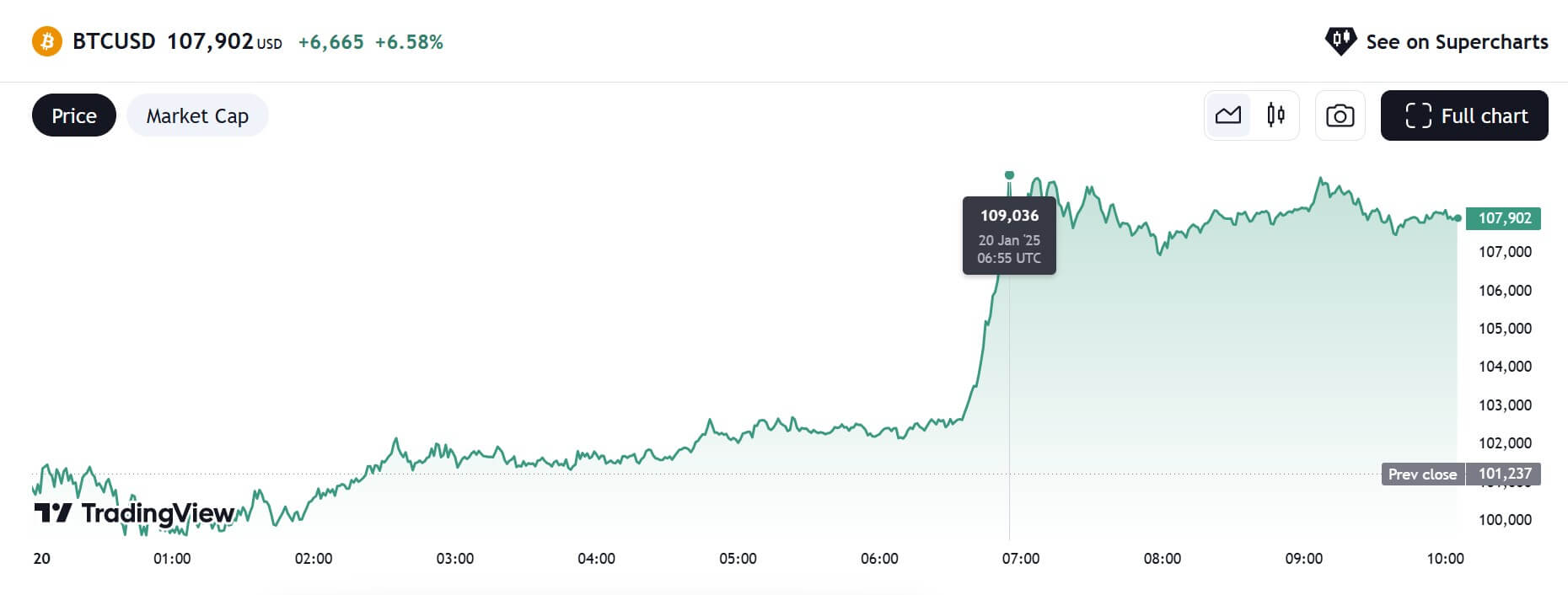
    The transfers happened as BTC price hovered around $107,380, having hit new all-time highs above $107,822. Unlike in the past Mt. Gox transactions of the flagship cryptocurrency, the latest movement hasn’t seen BTC react violently lower. Dormant whales have also woken up, as Arkham Intelligence pointed out in a post on X.

    Mt.Gox Bitcoin transfers

    Two weeks ago, the crypto exchange Mt. Gox made another Bitcoin transfer of 24,000 BTC to unknown wallets. According to Arkham, the bankrupt exchange transferred 1,619.6 BTC in two chunks, one of 1427.9 BTC and the other of 191.7 bitcoin to two new addresses.

    Recently, the blockchain security and intelligence platform showed that Mt. Gox’s latest wallet activity also included the transfer of 1427.9 Bitcoin to an address starting with “1DeY. It then transferred 108 BTC and 191.7 BTC through several addresses before the coins ended in the wallet that currently holds 300 Bitcoin.

    In November, Mt. Gox transfered $2.2 billion Bitcoin to unknown wallets amid repayment plans. On December 5, Mt. Gox made another Bitcoin transfer. It moved 24,000 BTC worth $2.5 billion a time when BTC was trading at $ 100,000, an all-time high at the time.

    Arkham notes the exchange has 36,085 Bitcoin holdings estimated to be worth $3.86 billion. The deadline for creditor repayment will be October 31, 2025.

    Despite downside pressure, Bitcoin has recovered from previous Mt. Gox dumps to hit new all-time highs above $100.

    The bullish market sentiment is down to multiple catalysts. It includes greater institutional demand for spot Bitcoin ETFs, US election that has a pro-crypto administration in place and the exit of SEC’s Gary Gensler. New pro-crypto picks for the SEC and CFTC will help the push for regularity clarity.

    There’s also the buying spree by MicroStrategy and several other companies, including Boyaa Interactive, Metaplanet and the miner industry led by Marathon, Riot and Semler Scientific, are hodling BTC. The companies have adopted the Bitcoin treasury strategy that has seen MicroStrategy become the world’s largest corporate holder of BTC.


    Source link

  • MicroStrategy acquires 15,350 Bitcoin, now holds 439,000 BTC valued at over $45B

    MicroStrategy acquires 15,350 Bitcoin, now holds 439,000 BTC valued at over $45B

    • MicroStrategy bought its latest Bitcoin between December 9, 2024, and December 15, 2024
    • Last week, the company purchased 21,550 Bitcoin for $2.1 billion and the week before it bought 15,400 Bitcoin for $1.4 billion
    • The Bitcoin buying spree comes as MicroStrategy will be added to the Nasdaq-100 Index on December 23

    MicroStrategy has acquired an extra 15,350 Bitcoin worth around $1.5 billion in cash, pushing its total holdings to 439,000.

    In an 8-K filing to the US Securities and Exchange Commission (SEC), MicroStrategy, a major Bitcoin holder, bought the crypto asset between December 9, 2024, and December 15, 2024, at an average price of $100,386 per Bitcoin.

    With the latest Bitcoin addition, MicroStrategy and its subsidiaries now hold 439,000 Bitcoin, valued at $45 billion. In a post on X, Michael Saylor, MicroStrategy’s CEO, said the Bitcoin was bought for $27.1 billion or an average price of $61,725 per Bitcoin.

    Saylor also noted that MicroStrategy’s year-to-date Bitcoin Yield is 72.4% while its quarter-to-date Bitcoin Yield is 46.4%.

    This is the latest purchase from MicroStrategy. Last week, the company purchased a further 21,550 Bitcoin between December 2, 2024, and December 8, 2024, for around $2.1 billion at an average price of $98,783 per Bitcoin. This followed a purchase of 15,400 Bitcoin for $1.4 billion the week before.

    Joining the Nasdaq-100 Index

    The continued push to buy more Bitcoin comes as MicroStrategy will be added to the Nasdaq-100 Index on December 23.

    In an announcement on December 13 from Nasdaq, it said three companies will be added to its Index: Palantir Technologies Inc., MicroStrategy Incorporated, and Axon Enterprise, Inc.

    Following the news, crypto analyst Will Clemente wrote on X: “Now that MSTR is getting added to the Nasdaq, every large pension fund, sovereign wealth fund, and individual retirement account in the world is going to have Bitcoin exposure.”

    The news has also rallied MicroStrategy’s stock price, pushing it up 3%, according to CNBC.


    Source link