Shiba Inu (SHIB) prices soared on April 12 upon its debut on Robinhood, a U.S.-based commission-free trading platform.
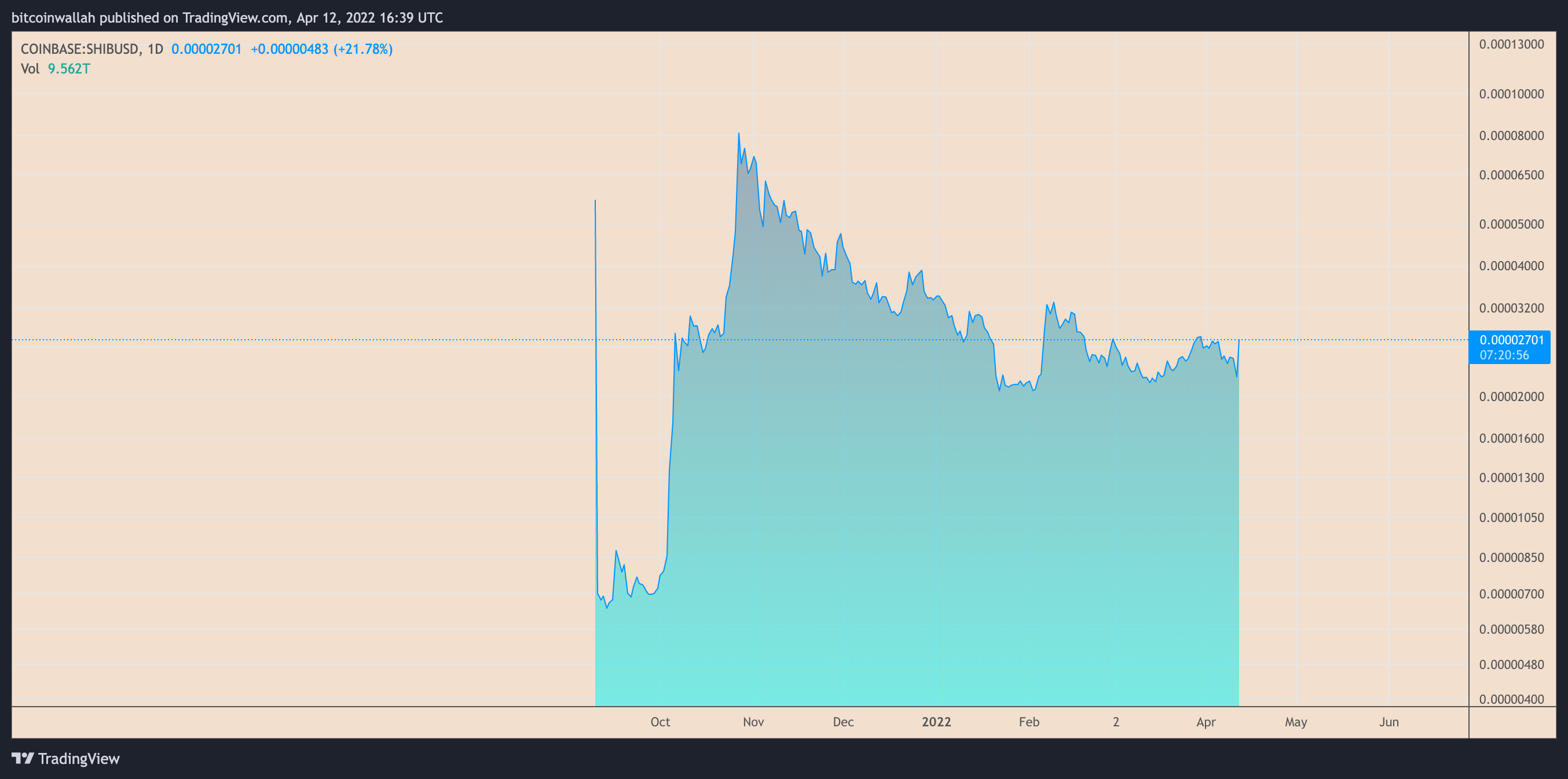
SHIB price climbed by more than 35% to 0.00003, its highest level in almost two months, before paring some gains. Nonetheless, SHIB was still on track to log its best daily performance since Feb. 6 when it rallied by nearly 27%.
SHIB/USD daily price chart. Source: TradingView
Strong crypto revenues precede SHIB’s listing
Robinhood emerged as a go-to avenue for everyday investors since the pandemic’s start in March 2020. Last year, the retail brokerage added 10 million funded accounts to its platform, with more than half of the new sign-ups coming from first-time investors.
Still, it reported a net loss of $423 million in its fourth-quarter earnings of 2021, noting that its main source of revenue (payments for order flow) made $263 million compared to $267 million in the same quarter of the previous year.
Meanwhile, revenues from cryptocurrency trading surged over 300% in the same period, putting Robinhood on course to introduce more crypto-related services in 2022, including a wallet and the addition of more altcoins and meme tokens to its brokerage platform.
David Gokhstein, the founder of Gokhshtein Media, said the addition of SHIB to Robinhood is “a great thing” for the crypto space, noting that the cryptocurrency could help drive more users to other top coins like Bitcoin (BTC) and Ether (ETH).
With the $SHIB listing on Robinhood, I’m watching the other meme tokens To see if they move.
The events that led up to Shiba Inu’s massive intraday rally also include a period of strong accumulation, data from IntoTheBlock shows.
The analytics platform noted the address holding SHIB for more than a year increased their balance in the past 30 days. As a result, these “hodlers” now has control over 2.82% of the net SHIB supply in circulation.
Diamond Hands win$SHIB Hodlers remain unfazed and accumulated during the past weeks and it’s paying off with today’s Robinhood announcement
Notably, SHIB has been consolidating inside a so-called symmetrical triangle since late December 2021. It formed the pattern after falling by nearly 70% decline from its October 2021 high of $0.00008894.
As a general technical trading rule, SHIB should now break below its triangle to resume its bearish trend.
If SHIB falls below the triangle’s lower trendline, its next downside target comes to be at length equal to the maximum distance between the pattern’s upper and lower trendline, when measured from the breakout point.
This bearish scenario puts the target for Shiba Inu below $0.00001200, down over 50% from today’s price.
The views and opinions expressed here are solely those of the author and do not necessarily reflect the views of Cointelegraph.com. Every investment and trading move involves risk, you should conduct your own research when making a decision.
Ethereum developer Virgil Griffith took a plea deal after breaking sanctions against North Korea and was formally sentenced earlier today— the final chapter in a two-year journey as bizarre as it is shocking.
Journalist Ethan Lou, author of Once a Bitcoin Miner, attended the infamous event in North Korea at which Griffith spoke. He was asked to submit a statement for Griffith’s sentencing, although that statement was ultimately not filed with the court. Here he tells the inside story of what happened.
Pyongyang, April 18, 2019
Virgil Griffith had been on North Korean soil for only a few hours when he casually told fellow travelers and their local guides that his trip was unsanctioned. Unique in the world, the United States bans its citizens from going to North Korea without explicit permission.
Griffith, an American in Singapore working for the Ethereum Foundation, had sought such permission unsuccessfully, he recounted at the round dinner table at Pyongyang’s riverside Pothonggang Hotel. Griffith had made his case the best he could on why he should go to that Pyongyang cryptocurrency conference in 2019 but was denied. And so, he decided to go anyway, he told people at the table.
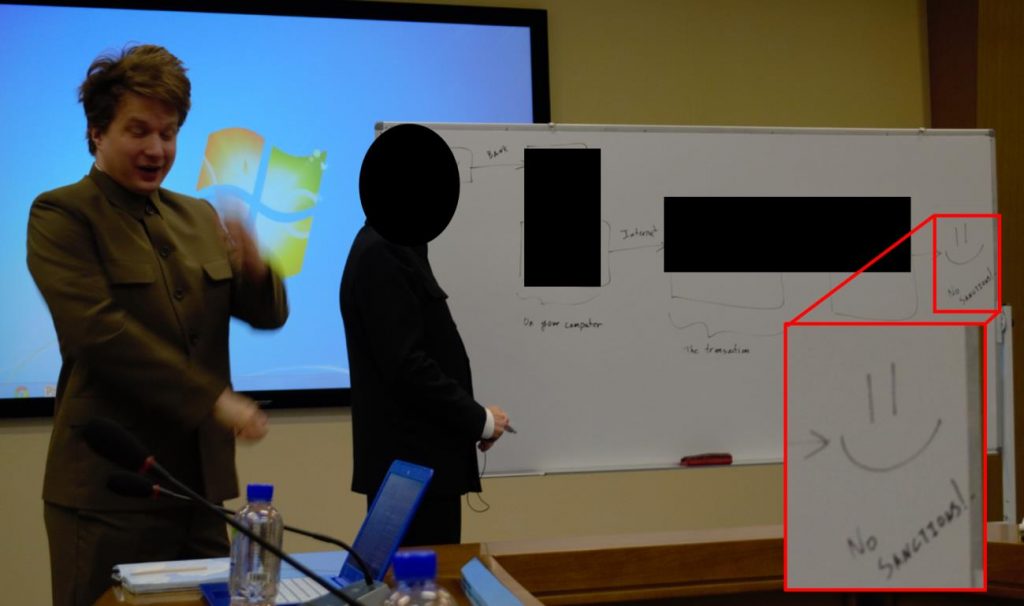
An image submitted by prosecutors in a New York court shows Virgil Griffith explaining cryptocurrency in North Korea in April 2019. The words “No Sanctions!” are highlighted in a detail box. Source: U.S. Department of Justice
Up and at them
Four days later, in a building shaped like an atom, Griffith told a crowd of North Koreans how they could harness blockchain in negotiations with the United States. At the time, bilateral talks had been bogged down by the question of which measure should be unwound first: the United States’ economic sanctions or North Korea’s nuclear program.
Griffith said both could happen simultaneously through a smart contract tied to a North Korean missile.
“If all the news reports say that sanctions on North Korea have been lifted, the missile will deactivate.”
Then, when explaining how smart contracts work, Griffith used the idea to “shave my cat” as an example. His presentations were mostly speculative, farfetched and based on publicly available information. It’s unclear how serious he was — he certainly had not taken the U.S. government’s opposition to his trip seriously.
Unsanctioned
Griffith believed in being forthright, even if it was uncomfortable. Almost immediately after returning to Singapore, Griffith went to the local U.S. embassy to talk about the trip with a special agent. Perhaps, in some way, he thought he was doing his government a favor by telling them all about the cloistered kingdom. Griffith did not expect that meeting to ripple throughout the U.S. government, but Special Agent Brandon Cavanaugh of the Federal Bureau of Investigation’s counterintelligence unit in New York was soon brought into the fold, and then the circle grew to three lawyers from the Justice Department plus Treasury Department attorneys. On Thanksgiving of 2019, Griffith was arrested in Los Angeles.
Accused of helping North Korea bypass sanctions by teaching it about blockchain, Griffith ultimately accepted a plea deal for 63 months in prison and was sentenced in April 2022.
It was the final chapter in a two-year journey as confusing as it was shocking — the story of how an adventuresome utopian and his North Korean trip had come to disturb the merciless forces of geopolitics and national security.
Griffith, through his lawyers, did not respond to an interview request, but documents filed with the court paint a vivid picture of the days following the trip and the decisions and moves made then — a crucial, illuminating period during which FBI agents as much went after Griffith as he fell into their lap.
“Day 6. At the conference. From inside the building looking out. This monument here is of a pen and then there’s an atom on top, symbolizing science and writing and stuff.” Source: Ethan Lou on Twitter
Internet Man of Mystery
Griffith was born in Birmingham, Alabama in 1983. He has unruly hair that would later make the North Korean restaurant servers describe his head as “big.” In 2008, a little before Bitcoin first came into the world, Griffith, a hacker, was profiled by The New York Times Magazine and dubbed the “Internet Man of Mystery.”
He once suspended his doctorate studies to participate in the reality show King of the Nerds. He was also taken to court after planning to publicly unveil security flaws in campus identity cards, a matter later privately settled. In Griffith’s words, he is someone who likes to poke the proverbial bear. He once told his parents, “I regularly roll grenades into the room, and someone needs to really jump on it.” A friend described him as viewing life as a video game.
In May 2019, about a month after Griffith met the State Department agent in Singapore, the FBI reached out. Griffith was visiting friends in Puerto Rico, a U.S. territory that had become a bit of a crypto hub, where he had rented a small apartment. The FBI told Griffith it wanted a meeting.
Griffith agreed immediately. He had little sense of any danger to himself. He did not hire a lawyer and traveled to New York at his own expense. Among the FBI employees he would meet was Special Agent Cavanaugh.
“Day 4. We went up some really high tower. Virgil called North Korea a ‘Wes Anderson movie.’ I thought that was very clever.” Source: Ethan Lou on Twitter
Plead the Fifth
Griffith showed the agents photographs of himself in North Korea and provided to the FBI propaganda he had taken home as souvenirs, including newspapers and other literature. Visually, Pyongyang had been eye-opening for Griffith, with the pastel colors of its apartment buildings evoking, in his view, a Wes Anderson movie.
North Korea’s insular culture fascinated Griffith so much that he got a tailored Mao-style suit. Much of the country’s literature was also unintentionally funny. One newspaper headline Griffith saw in North Korea read, unironically, “Institute for women set up under the care of great men.” A coffee-table book he brought back used the Comic Sans font. Griffith treasured his North Korean souvenirs to such an extent that he sent them to the nonprofit Internet Archive to be digitized.
However, what the government saw in the material Griffith brought from North Korea was starkly different. Michael Krouse, a Justice Department lawyer and former U.S. Marine, would later take note of Griffith’s Mao suit and, together with his colleagues, observe that Griffith dressed in a “North Korean military-style uniform.”
For Special Agent Cavanaugh, the gist of his takeaway from that May meeting was that Griffith knew that going to North Korea to teach blockchain was illegal but did so anyway, intended to do so again, and wanted to make a symbolic cryptocurrency transfer between North and South Korea. Cavanaugh was not going to let that go.
The North Korean suit was not a good look, either in a fashion sense or in court. Source: U.S. Department of Justice
Better get a lawyer, son
On Nov. 12, Griffith was on a business trip in Northern California. The FBI reached out again, and Griffith and Cavanaugh once more found themselves in the same room, this time at the FBI’s San Francisco field office. Griffith had gotten a little spooked from his last meeting, but he again did not hire a lawyer. And this time, Griffith also gave the FBI permission to search his phone.
Griffith’s decisions may seem baffling. Before one of those FBI meetings, he talked about it with his friend Eric Corley, an editor for a hacker magazine, for whom he once wrote. In his recollections, Corley said he tried to dissuade Griffith from going: “I kept warning him it was a trap.”
But Griffith “insisted” on going to the FBI and “telling the truth” without a lawyer, Corley said. The presentation Griffith had given in North Korea amounted to no more than publicly available information, he thought. He did not believe he had done anything wrong. Shortly after that meeting, Griffith “was convinced they totally got where he was coming from,” Corley said. He called Griffith’s sentiment “ironic.”
Day 3. We took a look at where the conference was held. This is the very room in which Virgil Griffith spoke to the North Koreans. We, eight foreigners, would be seated around that circular table. They called us a “delegation.” 20/15 pic.twitter.com/T94mxrldKA
North Korea, accused of rampant human rights violations and pursuing nuclear weapons against the international order, has long been under a blanket of economic sanctions, often led by the United States. Those sanctions punish North Korea economically by barring it from international trade, which the U.S. is able to do because it effectively controls the global financial infrastructure. Cryptocurrency is theoretically a way for North Korea to get around that. After all, the country has already been accused of hacking and stealing hundreds of millions of dollars in cryptocurrency. Griffith’s visit had set off all manner of red flags within the U.S. government.
After Griffith’s San Francisco meeting with the FBI, Justice Department officials in New York worked hard to build a case against him. It was not without its challenges, and the matter came to a head a little after midday on Nov. 18. Another Justice Department lawyer, Kyle Wirshba — a Harvard Law School graduate with a gentle voice — learned that the Department of the Treasury had issues with the case. The department’s Office of Foreign Assets Control said it was “a gray area” because it might not be illegal if Griffith’s presentation in North Korea was general information and not tailored for the audience.
Did the Justice Department know the specific nature of Griffith’s presentation? That information became urgent and vital. If the matter went to trial, a Treasury Department expert would need to testify to support the charges. That afternoon, Wirshba posed that question to the FBI’s Special Agent Cavanaugh. He also wrote to his fellow lawyer Krouse, telling him about another government official: “So, of course, the deputy chief has problems.”
COUNTDOWN TO SENTENCING: Virgil Griffith Pled Guilty To North Korea Sanctions Violation Conspiracy, Now Asks For 24 Months While US Probation Recommends 63 Months; Vitalik Buterin Urges Mercy – Inner City Press story: https://t.co/JF5hUuZJ0bpic.twitter.com/o5PKFaBO63
Around this time, the Justice Department faced another issue: The gravity of the matter had finally dawned on Griffith. He knew that he had told the FBI that North Korean attendees left the conference with a better understanding of cryptocurrency than when they arrived, that he had acknowledged that his talk amounted to a “non-zero tech transfer,” and that Cavanaugh, perhaps, did not really believe him when he said he only talked about publicly available information. Around this time, Griffith hired a lawyer.
So, if Griffith were no longer going to cooperate with the authorities, perhaps he would run? The FBI deemed Griffith a flight risk and needed to arrest him quickly. The bureau told Griffith not to leave the country, but Griffith was under no obligation to comply. And without the Treasury Department’s support, there was no justification to detain him. The case no longer appeared so easy.
On Nov. 18, the same day that Wirshba learned of the Treasury Department’s concerns, a busy afternoon unfolded at the Justice Department. By 8:00 pm, it had bugged a lawyer from the Treasury’s Office of Foreign Assets Control too many times. In an email to his colleagues that night, Cavanaugh said: “DOJ asked us to hang on reaching out to the OFAC. Apparently, one or more people have already reached out […] and he’s becoming frustrated. Just wanted you to be aware of the sensitivity.”
Don’t skip town
Depending on your perspective, the Justice Department either thought too little or too much of Griffith. As he was based in Singapore, he had not made arrangements to be in the United States beyond that business trip to Northern California. He also knew unequivocally by then that the law was after him. But Griffith complied with the FBI’s request that he not leave the country.
He stayed with friends in Los Angeles and also decided to spend Thanksgiving with his parents and sister’s family in Baltimore. He told the authorities of those travel plans and sent his itinerary through his lawyer to ensure they knew where he was and that he was not trying to run away.
Griffith still believed in doing the right thing and that it was important to have demonstrated that he tried to follow the rules. He believed in the integrity of the justice system, that everyone gets what they deserve and that the innocent have nothing to fear. A question would arise in the coming days: Was Griffith some sort of scheming mastermind? A traitor bent on undermining his own country? The days following North Korea show that the answer is complicated.
Virgil Griffith is paying heavily for his mistakes.
Despite all the damning accusations against him, Griffith had a certain honesty — a naivety perhaps reinforced by his involvement in the cryptocurrency space, where the law was lax and the only moral compass people had to guide them was their own. Deep in that world, Griffith had simply been too far removed from the wider world with its own values and rules, agendas, intricacies and rigidity.
Two days after that frantic day on Nov. 18, following another flurry of emails and a conference call, the Justice Department prevailed. The prosecutor, Wirshba, had gone to bat with the Office of Foreign Assets Control during the call, and in the view of his colleague Krouse, that conversation went well — “thanks to Kyle’s advocacy.” The OFAC said that, if requested at trial, it would provide a witness to testify that Griffith had broken the law.
The FBI has disclosed that agents from other investigations accessed Twitter, Facebook data in Virgil Griffith/North Korea crypto case because *default setting* in Palantir is to allow all FBI agents access to everything from all cases. That’s quite amazing. pic.twitter.com/DP7Kq3NGce
About a week later, on Thanksgiving morning, Griffith was arrested while boarding a flight from Los Angeles to Baltimore, based on a formal complaint from Special Agent Cavanaugh in New York — sworn just one day after Wirshba resolved the Treasury Department’s concerns. The complaint was eight pages and more than 2,000 words, but where it discussed the facts of what happened in North Korea, it contained not even a single piece of information from sources other than Griffith. It was just the man’s own words over the past seven months that had been weaponized against him.
From there, a new chapter in Griffith’s life began. Even when he was later released on bail for a period, he had to abide by strict conditions. Griffith was eventually held in New York’s infamous Metropolitan Detention Center, an unpleasant preview of the future that loomed for him. At that moment at the airport on Thanksgiving of 2019, when the law took him away under the dull and steely sky, Griffith had just experienced his last day of freedom, though he did not yet know it.
Lou writes about the North Korea affair in-depth in his new book,Once a Bitcoin Miner: Scandal and Turmoil in the Cryptocurrency Wild West. Check out Magazine’s Journeys in Blockchain profile of him below.
“The Market Report” with Cointelegraph is live right now. On this week’s show, Cointelegraph’s resident experts discuss the worst mistakes you should avoid making in crypto.
But first, market expert Marcel Pechman carefully examines the Bitcoin (BTC) and Ether (ETH) markets. Are the current market conditions bullish or bearish? What is the outlook for the next few months? Pechman is here to break it down.
Next up: the main event. Join Cointelegraph analysts Benton Yaun, Jordan Finneseth and Sam Bourgi as they talk about the worst crypto mistakes to avoid making in 2022. First up, we have Bourgi, who thinks investors should avoid “analysis paralysis.” In other words, don’t overanalyze. Make decisions based on firm conviction. Don’t just look at the price of a coin or token you’re interested in; look into its market capitalization, tokenomics, community size, etc. Lastly, he suggests not trading too much, as hodling always beats trading.
Yuan is next with his three mistakes to avoid. First, he thinks you should take profits you’ve already made and avoid “moon boy fever” instead of waiting for your positions to go higher. Second, understand market cycles. And lastly, he explains how to spot and avoid decentralized finance (DeFi) rug pulls.
In the third spot, we’ve got Finneseth, who explains the three mistakes he thinks you should avoid making, starting with hodl culture turning into token attachment. Take your profits before you miss the chance and have to wait, sometimes multiple years, before getting another opportunity. In other words, don’t get too attached to a particular coin or token, as nothing keeps going up forever. Next, he suggests you set your sell targets before you buy a coin so that you’re already prepared and have profit goals in mind. His last suggestion is to be mindful of the latest major trends and learn to play them to your advantage. But be careful: Fast-moving trends tend to flame out just as quickly as they ignite.
After the showdown, we’ve got insights from Cointelegraph Markets Pro, a platform for crypto traders who want to stay one step ahead of the market. The analysts use Cointelegraph Markets Pro to identify two altcoins that stood out this week: Zilliqa (ZIL) and Parsiq (PRQ).
Do you have a question about a coin or topic not covered here? Don’t worry. Join the YouTube chat room, and write your questions there. The person with the most interesting comment or question will be given a free month of Cointelegraph Markets Pro, worth $100.
The Market Report streams live every Tuesday at 12:00 pm ET (4:00 pm UTC), so be sure to head on over to Cointelegraph’s YouTube page and smash those like and subscribe buttons for all our future videos and updates.
This article does not contain investment advice or recommendations. Every investment and trading move involves risk, and readers should conduct their own research when making a decision.
The views, thoughts and opinions expressed here and during the show are the analysts’ alone and do not necessarily reflect or represent the views and opinions of Cointelegraph.
Voyager Innovations, the firm behind the Philippines’ top digital payments app Paymaya, has announced it has achieved unicorn status after a recent round of funding, surpassing a $1 billion valuation.
Voyager Innovation announced Tuesday that the new $210 million capital boosted its valuation to $1.4 billion. The company highlighted that the new funds will be used to develop crypto offerings that it recently added to its flagship digital payments app PayMaya.
According to the news release, the recent financing round was led by SIG Venture Capital. It included well-known firms such as KKR, First Pacific Co., Tencent Holdings Limited and PLDT Inc., the Philippines’ largest telecom provider.
As reported by Cointelegraph, PayMaya recently introduced crypto services into the app, allowing consumers to buy, sell, and earn crypto using it. The money will be used to develop the crypto offerings further. PayMaya also recently obtained a Virtual Asset Services Provider (VASP) license from the Philippine Central Bank. The firm will also invest the cash in PayMaya-branded digital bank services, such as savings and credit.
According to Voyager, most of the Philippine population is “underserved” in terms of internet and digital finance. It aims to take advantage of this by extending its market reach. As of March 31, PayMaya has over 47 million users.
Over the past two years, Philippine’s digital economy has increased, thanks largely to Voyager and its rival Mynt. According to a study by Google, Temasek, and Bain & Co., the Philippines ‘ digital economy increased 94% from 2020 to 2021 and it is projected to reach $40 billion by 2025.
The expansion of internet commerce in the country will likely increase cryptocurrency adoption. The Philippines does not have any regulations restricting the trade of digital currencies currently. However, the central bank has repeatedly warned investors about the risks in the nascent market.
A new study has revealed staggering growth in crypto adoption across Nigeria, fueled by limited access to affordable fiat-based financial services in Africa.
Crypto exchange KuCoin’s “Into the Cryptoverse Report” highlights that many Nigerian citizens have started using cryptocurrencies as a viable alternative to store and transfer assets.
According to the report, 35% of the Nigerian population aged 18 to 60 — or 33.4 million people — have owned or traded cryptocurrencies during the last six months. Out of those people, nearly 17.36 million (or 52% of Nigerian crypto investors) have allocated over half of their assets to cryptocurrencies.
One of the main reasons why investors across the globe seek to diversify traditional assets into cryptocurrencies is to counter rising fiat inflation. For example, a selection of United Kingdom investors was surveyed last month, and the majority considered tokens to be safer and more secure than traditional investments such as gold, oil, stocks and real estate.
The KuCoin report further highlights peer-to-peer trading as the most popular method among Nigerian investors to convert fiat into crypto assets. Doubling down on the crypto adoption spree, roughly 23.38 million Nigerians, or 70% of existing crypto investors, will increase their cryptocurrency investments over the next six months.
The value of the naira, the nation’s fiat currency, has fallen by over 209% in the past six years, which stands as one of the key drivers for local investors to eye deflationary assets such as Bitcoin (BTC).
The report also shows that while a majority of Nigerian crypto investors began their hodling journey many years ago, 26% began investing in cryptocurrencies just six months back — owing to the 2021 bull run, which saw BTC prices briefly cross the $69,000 mark.
In October 2021, Nigerian President Muhammadu Buhari introduced the country’s central bank digital currency, the eNaira. Numerous governments across the globe intend to use CBDCs as a digitized fiat replacement, primarily aimed at reducing operational costs and speeding up cross-border payments.
Earlier in April, a study released by crypto exchange Gemini confirmed a massive rise in global crypto investors in 2021.
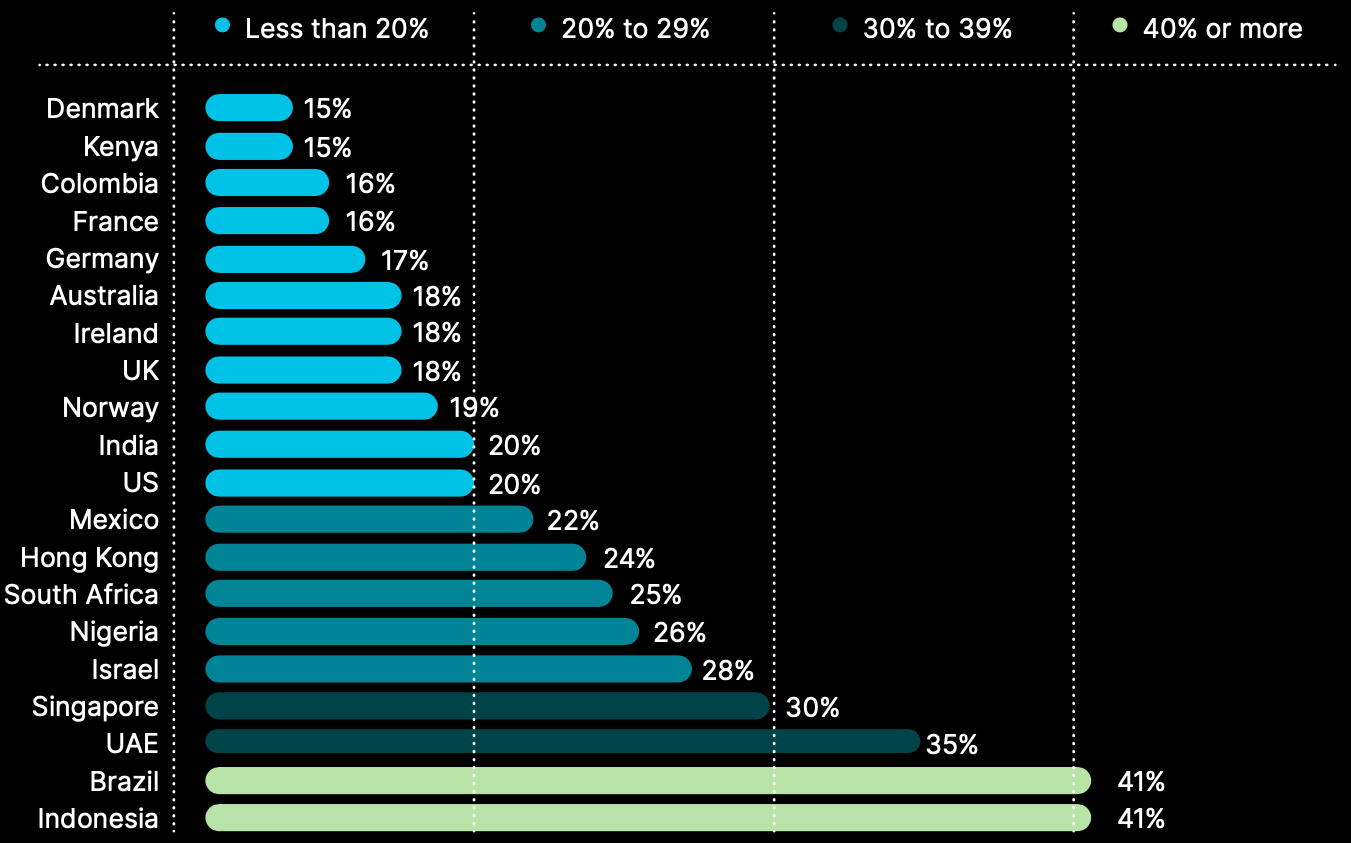
As Cointelegraph reported, India, Brazil and Hong Kong witnessed the highest crypto adoption, with more than 50% of respondents acknowledging investing in cryptocurrencies.
Cryptocurrency ownership by country. Source: Gemini
Gemini’s report also found that Indonesia and Brazil are leading the world i the share of cryptocurrency investors among the general population.
America’s largest crypto exchange, Coinbase, announced a long list of tokens it could potentially list in the second quarter of 2022 in an effort to increase transparency.
An April 12 blog post from the exchange includes a list of tokens under consideration, but notes that other tokens may be under consideration but not specifically mentioned. Among those on their radar are 45 ERC-20 tokens on the Ethereum (ETH) network, and five SPL tokens on the Solana (SOL) network.
Some of the tokens with a relatively large market cap are Binance USD (BUSD), which is the third-largest stablecoin on the market, and one of the largest DAO projects BitDAO (BIT) which boats a market cap of just over $1 billion at the time of writing according to CoinGecko data.
The exchange stated that its new approach toward token listings will also provide “as much information symmetry as possible.” Information symmetry promotes efficiency and fairness within a market.
It also reduces the chances for a pump and dump scenario on listing day as the retail trading frenzy can be mitigated by advanced knowledge of a listing. While it is far more common on other centralized and decentralized exchanges, Coinbase has had its share of such price action on coins it lists. In 2020, OMG Network (OMG) pumped 200% within 15 minutes of being listed on Coinbase and crashed moments later.
Crypto projects are aware of the attention a Coinbase listing, or even just the potential one can bring. The relatively small decentralized finance (DeFi) data tokenizer Big Data Protocol (BDP) with a $3.3 million market cap according to CoinGecko tweeted delight today that Coinbase was giving it looks at potentially being listed.
However, while the increased transparency may be a boon for investors and projects, the seasoned crypto trader from Twitter account @12yearoldwithcc believes the potential listings are lackluster. The account tweeted today that “Coinbase is in their flop era.”
Other investors may not even have noticed Coinbase’s new transparency efforts yet as many are focused on the exchange’s intention to produce a series of three films about the Bored Ape Yacht Club (BAYC) nonfungible token (NFT) collection.
Some in the crypto community are perplexed by the $10,000 deal Coinbase has offered BAYC holders for the rights to use their ape in the films, with some even warning that they should not accept it.
In all, it has already been a turbulent week for the exchange as it launched trading services in India for the first time on April 8 but abruptly suspended buy order services under pressure from local payment service regulators on April 11.
Protocols in the Cosmos ecosystem have seen a significant amount of growth in 2022 due to the intensifying focus on blockchain interoperability and compatibility with the Ethereum network.
One protocol that has seen a buildup in momentum since the middle of March is Kava, a project that is developing a co-chain architecture for the Cosmos and Ethereum network.
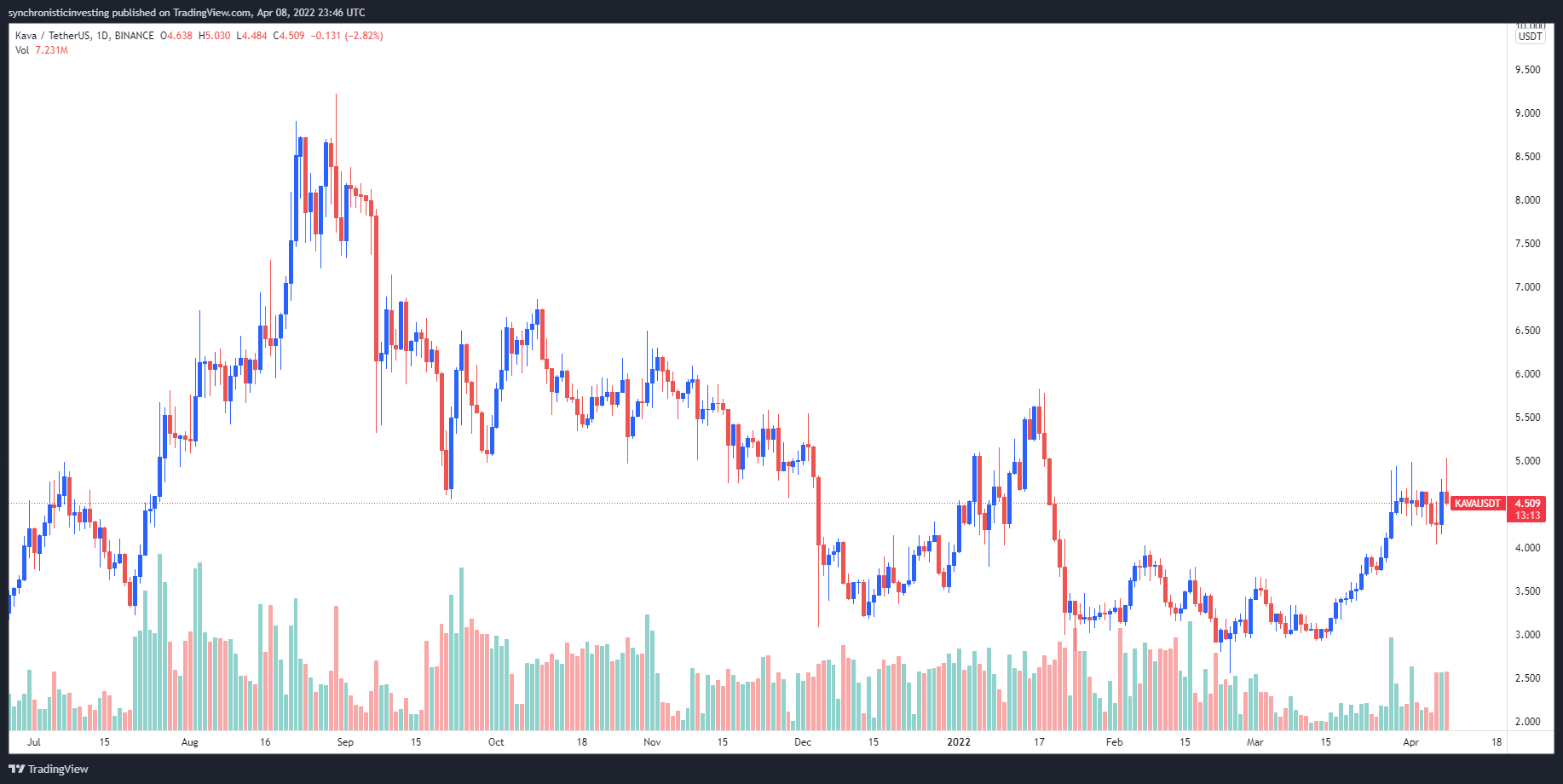
Data from Cointelegraph Markets Pro and TradingView shows that the price of Kava’s native token KAVA has climbed 72.3% after hitting a low of $2.92 on March 13 to establish a daily high of $5.03 on April 8.
KAVA/USDT 1-day chart. Source: TradingView
Three reasons for the increase in price and momentum for KAVA include the Ethereum Co-Chain beta launch, the launch of a $750 million developer incentive program and a series of partnerships and protocol launches that have expanded the size of the Kava ecosystem.
Ethereum Co-chain beta launch
One of the most anticipated developments to come out of the Kava ecosystem was the successful completion of the alpha phase of the Ethereum Co-chain launch.
The Ethereum Co-Chain enables support for Ethereum Virtual Machine (EVM) smart contracts while the Cosmos Co-Chain enables support for the Tendermint consensus engine and the Inter Blockchain Communication Protocol (IBC). A translator module connects the co-chains and allows for seamless interoperability between the networks.
The mainnet launch of the Ethereum Co-Chain is expected to take place on May 10.
Kava launches a $750 million developer incentive program
A second reason for the building strength of KAVA was the March 3 launch of Kava Rise, a $750 million developer incentive program designed to help onboard developers from decentralized finance (DeFi), gaming and nonfungible projects into the Kava community.
Kava Rise is an on-chain incentive mechanism that will distribute 62.5% of all block rewards to developers who are building on Kava’s Ethereum and Cosmos Co-Chains as part of the protocol’s effort to become a builder-owned network. The remaining 37.5% of block rewards will be distributed to stakers.
The incentive program is expected to go live with the Kava 10 upgrade, which will also include the launch of the Cosmos and Ethereum Co-Chains on the Kava mainnet.
A third factor helping to boost the demand for KAVA has been the addition of new partnerships and protocols for the Kava network.
Some of the newest protocols to launch on the Kava co-chain architecture include the NFT marketplace OpenBiSea, the decentralized finance launchpad DexPad and the DeFi piggy bank WePiggy.
Other recent launches on Kava include the multichain DeFi lending protocol ForTube, the Ruby Protocol that brings the first algorithmic stablecoin to the Kava Ethereum Virtual Machine (EVM) and an Ethereum Co-Chain integration with the Ren protocol.
VORTECS™ data from Cointelegraph Markets Pro began to detect a bullish outlook for KAVA on April 1, prior to the recent price rise.
The VORTECS™ Score, exclusive to Cointelegraph, is an algorithmic comparison of historical and current market conditions derived from a combination of data points including market sentiment, trading volume, recent price movements and Twitter activity.
As seen in the chart above, the VORTECS™ Score for KAVA began to pick up on April 1, around 94 hours before the price increased 25% over the next three days.
The views and opinions expressed here are solely those of the author and do not necessarily reflect the views of Cointelegraph.com. Every investment and trading move involves risk, you should conduct your own research when making a decision.
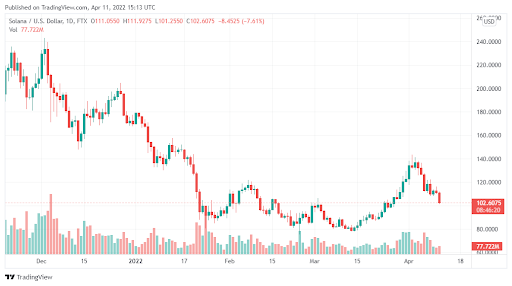
Solana (SOL) has struggled to report any gains after trading in losses over the last three sessions in a row. The coin now looks very weak, and unless something drastic happens, it’s headed for further decline. Here are some highlights:
SOL has fallen sharply in the last 24 hours, dropping by almost 10%.
The coin still remains above a crucial $100 support zone
But this is unlikely to hold in the coming days
Data Source: Tradingview
Solana (SOL) – How far can it fall
After surging at the end of March, SOL slowed sharply in April. The coin has fallen from its $140 highs and is now just above the $100 mark. SOL even managed to push below its lowest price in March of $107. This could suggest that we are on the brink of a trend reversal that could see more losses follow.
In fact, if bulls lose the crucial psychological support zone of $100, then the only way for SOL will be downwards. The $100 and the $93 support zones have proved very strong in the past. While there may be some resilience in the days ahead, the $100 will be lost, and bulls will try to consolidate at $93.
But if $93 is also lost, SOL will enter an intense downward spiral that could bottom at $77 before any leg up. This will represent a loss of nearly 30% from its current price and almost a 100% decline from its highest price in March.
Is it good to own Solana?
Solana is a big project, and if you don’t have it yet, this would be a nice time to buy it. However, because there is a significant downside risk, you may want to wait for a week or so.
Based on current indicators on the chart, SOL is likely to bottom. When that happens, you can buy and hold SOL for the future.
Bitcoin (BTC) and most major altcoins have broken key support levels to start the week on a weak note. The crypto markets seem to be following the U.S. equity markets lower which are being pulled down as investors reduce exposure to risky assets because of rising rates.
Arthur Hayes, ex-CEO of derivatives giant BitMEX, said that with rates moving higher and the Fed tapering its asset purchases, the equity markets could witness a meltdown. If that happens, Hayes expects the crypto markets to continue lower and Bitcoin to drop to $30,000 and Ether (ETH) to $2,500 by June of this year.
Ark Invest founder Cathie Wood said in an interview with CNBC that decentralized finance applications are attracting huge interest from investors. The legacy banking industry is feeling the heat because they are not only losing the lending and saving business to DeFi but also losing talent to the crypto industry.
Although the long-term remains positive, could Bitcoin and altcoins weaken further in the near term? Let’s study the charts of the top-10 cryptocurrencies to find out.
BTC/USDT
The bulls held Bitcoin above the 50-day simple moving average ($41,908) for the past few days but could not push the price above the 20-day exponential moving average ($43,576). This suggests that bears are selling on rallies.
BTC/USDT daily chart. Source: TradingView
The selling picked up momentum today and the bears have pulled the price below the 50-day SMA. There is a minor support at the psychological level at $40,000 but if it cracks, the BTC/USDT pair could plummet to the support line of the ascending channel. The bulls are likely to defend this level with all their might.
The downsloping 20-day EMA and the RSI in the negative territory indicate that bears are back in the driver’s seat. This negative view will be invalidated in the short term if the price turns up and breaks above the 20-day EMA. The pair could then rise to $45,400.
ETH/USDT
Ether traded near the 20-day EMA ($3,198) for the past few days but the weak bounce off it suggested a lack of aggressive buying by the bulls. That may have emboldened the bears who have accelerated their selling today.
ETH/USDT daily chart. Source: TradingView
The bears will now try to pull the price to the 50-day SMA ($2,940). If the price rebounds off this support, the ETH/USDT pair could consolidate between the 50-day SMA and the 200-day SMA ($3,489) for a few days.
Alternatively, if the price breaks below the 50-day SMA, the selling could accelerate and the pair could drop to $2,800. A break below this support could result in a decline to the trend line. The bulls are expected to defend this level aggressively.
BNB/USDT
Binance Coin (BNB) turned down from the overhead resistance at $445 on April 8 and broke below the 20-day EMA ($422). This suggests that bears are selling on rallies to $445.
BNB/USDT daily chart. Source: TradingView
The buyers tried to push the price back above the 20-day EMA in the past two days but could not sustain the higher levels. This renewed the selling and the BNB/USDT pair has dropped to the 50-day SMA ($400).
A strong rebound off the current level will suggest that bulls are accumulating on dips. The buyers will have to push and sustain the price back above the 20-day EMA to enhance the prospects for a retest at $445.
Conversely, if the price breaks below the 50-day SMA, it will suggest that buying has dried up. That could pull the pair down to the strong support at $350.
SOL/USDT
Solana (SOL) turned down from the overhead resistance at $122 on April 8 and plunged below the 20-day EMA ($112). The bulls pushed the price back above the 20-day EMA on April 10 but could not sustain the higher levels. This suggests that bears are selling on rallies.
SOL/USDT daily chart. Source: TradingView
The selling picked up momentum today and the bears have pulled the price below the support at $106. The SOL/USDT pair could now drop to the 50-day SMA ($98) which is likely to act as a strong support.
If the price rebounds off the 50-day SMA and breaks above the 20-day EMA, it will suggest strong demand at lower levels. On the other hand, a break and close below the 50-day SMA could open the doors for a further downside to $81.
XRP/USDT
Ripple (XRP) had been trading above the $0.75 level for the past few days but the failure to push the price back above the moving averages may have attracted further selling by the bears.
XRP/USDT daily chart. Source: TradingView
The 20-day EMA ($0.79) has turned down and the RSI is near 34, indicating that sellers are in control. The next stop is likely to be $0.69. A strong rebound off this level will suggest that bulls are defending this level with vigor. That could keep the XRP/USDT pair range-bound between $0.69 and $0.91 for a few days.
However, if the price breaks below $0.69, the selling could intensify further and the pair could drop to the next major support at $0.60.
ADA/USDT
Cardano (ADA) made several attempts to rise back above the 20-day EMA ($1.06) in the past few days but the bears did not relent. The selling intensified today and the bears have pulled the price below the 50-day SMA ($0.96).
ADA/USDT daily chart. Source: TradingView
If the price sustains below the 50-day SMA, the ADA/USDT pair could drop to the critical support at $0.74. The bears are expected to defend this level with all their might. A strong bounce off it could suggest that the pair may consolidate inside a large range between $0.74 and $1.26 for a few days.
Contrary to this assumption, if the price turns up from the current level and rises above the 20-day EMA, it will suggest strong buying at lower levels. That could limit the trading range between the 50-day SMA and $1.26.
LUNA/USDT
Terra’s LUNA token plunged and closed below the 20-day EMA ($99) on April 8. The bulls tried a recovery on April 9 but could not challenge the 20-day EMA. This may have attracted further selling and the bears have pulled the price below the 50-day SMA ($90).
LUNA/USDT daily chart. Source: TradingView
The 20-day EMA has turned down and the RSI has dipped into the negative zone, suggesting that the momentum has turned in favor of the bears. If the price sustains below the 50-day SMA, the possibility of a drop to $75 increases. If this level also cracks, the next stop could be the strong support at the 200-day SMA ($65).
On the contrary, if the price turns up from the current level and rises above the 50-day SMA, it will suggest strong demand at lower levels. The bulls will then again attempt to push the price above the 20-day EMA.
The bulls failed to sustain Avalanche (AVAX) above the 20-day EMA ($86) on April 8, suggesting that the bears are defending this level. This may have led to further selling and the price dipped below the 50-day SMA ($82) on April 10.
AVAX/USDT daily chart. Source: TradingView
The 20-day EMA has turned down and the RSI is in the negative territory, indicating that bears have the upper hand. The sellers will attempt to pull the price to the next strong support at $65.
If the price rebounds off this level, it will suggest that the AVAX/USDT pair could oscillate between $65 and $99 for a few more days.
Alternatively, if the price turns up from the current level, the bulls will again try to push the pair above the 20-day EMA and challenge the overhead resistance at $99.
DOT/USDT
The bulls defended the 50-day SMA ($19) from April 8 to 10 but the failure to push Polkadot (DOT) above the 20-day EMA ($20) may have attracted selling. That has pulled the price below the strong support at $19.
DOT/USDT daily chart. Source: TradingView
The 20-day EMA has started to turn down and the RSI is in the negative territory, indicating that bears have the upper hand. The DOT/USDT pair could now drop to $16, which is likely to act as a strong support.
If the price rebounds off this level, the pair could remain stuck between $16 and $21 for a few more days. The next trending move is likely to start on a break below $16 or a rally above the overhead hurdle at $21.
DOGE/USDT
Dogecoin (DOGE) attempted a rally on April 10 but the long wick on the candlestick shows that bears sold at higher levels. The bears will now try to sink and sustain the price below the 20-day EMA ($0.14).
DOGE/USDT daily chart. Source: TradingView
If that happens, the DOGE/USDT pair could slide to the 50-day SMA ($0.13). Such a move will suggest that the pair could remain stuck inside the large range between $0.17 and $0.10 for the next few days.
The flattening 20-day EMA and the RSI near the midpoint also suggest a consolidation in the near term. If the price rebounds off the current level, the bulls will again try to push the pair to $0.17. A break and close above the 200-day SMA ($0.18) could indicate the start of a potential new uptrend.
The views and opinions expressed here are solely those of the author and do not necessarily reflect the views of Cointelegraph. Every investment and trading move involves risk. You should conduct your own research when making a decision.
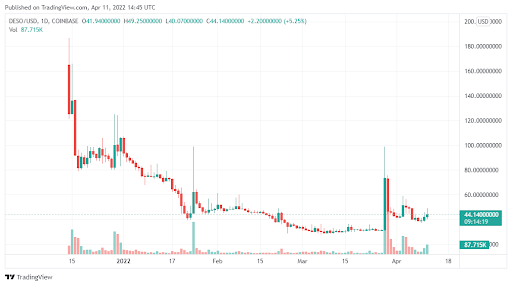
The broader crypto market has started the new week the same way it ended last week. Most coins have continued to report losses. But in the middle of all this, Decentralized Social (DESO) appears to be holding steady in fact; the coin is relatively bullish compared to the rest of the market. Here is what you need to know:
DESO has surged by nearly 10% over the last 24 hours, outperforming the market.
The coin also remains well above a crucial support zone of $37.5
But massive whale holdings open DESO to wild volatility
Data Source: Tradingview
Decentralized Social (DESO) – The price action
As noted above, DESO has managed to outperform the whole market by a mile. As most coins see single-digit drops today, DESO has surged by over 10% over the last 24 hours alone. The coin has now gained nearly 70% from its lowest point in 2022 and looks to keep going.
Besides, DESO remains above the crucial support zone of $37.50. As long as bulls keep the price action above this, then we could see DESO thrust towards $54 in the near term. The biggest risk factor, however, is massive whale accumulation for this coin.
This makes it prone to wild volatility if big wallets decide to sell. In fact, a scenario where DESO loses the $37.5 support is possible. This could bring massive sell-off pressure and push the price downwards.
Is DESO a profitable asset?
Well, it is and it depends on how you want to play the current setup. DESO may still add at least 20% of its value before it corrects, so there is a short-term play here. This will however depend on whether whales decide to sell or not.
Also, DESO is fairly decent as a long-term asset. We believe the coin has the potential to touch $100 by the end of 2022, which will be a 100% return.