Category: TRENDING

  • Bitcoin battles for weekly close above $42K as LFG buys 4,130 more BTC

    Bitcoin battles for weekly close above $42K as LFG buys 4,130 more BTC

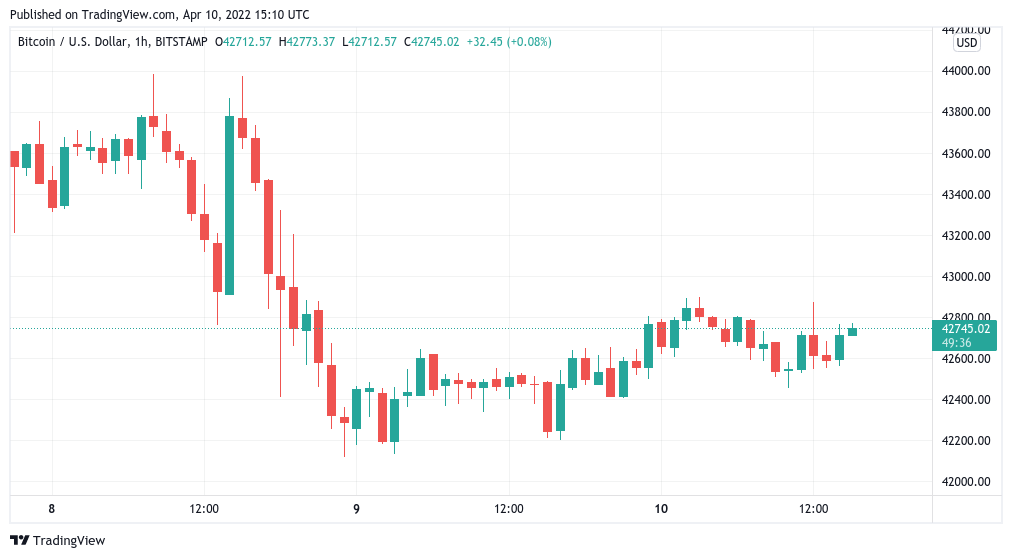
    Bitcoin (BTC) prepared for its lowest weekly close of the month so far on April 10 after a week of disappointing losses.

    BTC/USD 1-hour candle chart (Bitstamp). Source: TradingView

    Trader: BTC “giving people a second chance”

    Data from Cointelegraph Markets Pro and TradingView showed BTC/USD circling $42,700 Sunday with a matter of hours to go until the conclusion of the weekly candle.

    The pair had fallen into the end of Wall Street trading Friday, while the weekend provided some nervous calm as $42,000 support remained intact.

    For popular trader and analyst Rekt Capital, there was still cause for optimism despite the past seven days seeing losses of nearly 10%.

    Rekt Capital highlighted three key moving averages currently being tested as support, noting that historically, bouncing off them had preceded “strong bullish momentum.”

    “Technically speaking, anything above ~$38000 is a macro Higher Low for BTC,” he had said Saturday.

    Macro pressure had formed the backdrop to the gloomy mood throughout the week, as Cointelegraph reported, and concerns over U.S. dollar strength remained on the day.

    “The moment the DXY is topped out (which could be soon), the next bull run will start. And that one is going to be an epic one,” Cointelegraph contributor Michaël van de Poppe forecast, likewise adopting a more hopeful perspective.

    In what was becoming a perennial source of optimism, Blockchain protocol Terra continued its BTC buys Sunday, with associated nonprofit the Luna Foundation Guard (LFG) adding 4,130 BTC to its wallet.

    According to on-chain monitoring resource BitInfoCharts, the given wallet was the 19th largest in existence with a balance of 39,897.98 BTC ($1.7 billion).

    LFG Bitcoin wallet data summary (screenshot). Source: BitInfoCharts

    Dogecoin cleans up among major altcoins

    Altcoins were similarly flat on the day, with the top-ten cryptocurrencies by market cap moving no more than 1% up or down.

    Related: Monero defies crypto market slump with 10% XMR price rally — what’s next?

    Compared to the same time last week, it was Terra’s LUNA and Solana (SOL) vying for worst performer, both nursing losses of around 18%.

    DOGE/USD 1-hour candle chart (Binance). Source: TradingView

    Immediately outside the top ten, however, Dogecoin (DOGE) outperformed the rest once again, gaining 8.3% in 24 hours.

    DOGE/USD reached $0.158, marking its highest since April 6 on the back of continued publicity from Tesla CEO Elon Musk. Among Musk’s suggestions over the weekend was Twitter, shares of which he purchased en masse last week, accepting payments in DOGE.

    The views and opinions expressed here are solely those of the author and do not necessarily reflect the views of Cointelegraph.com. Every investment and trading move involves risk, you should conduct your own research when making a decision.

  • 6 Questions for Michelle Legge of Koinly

    6 Questions for Michelle Legge of Koinly

    We ask the buidlers in the blockchain and cryptocurrency sector for their thoughts on the industry… and throw in a few random zingers to keep them on their toes!


    This week, our 6 Questions go to Michelle Legge, head of crypto tax education at Koinly — a cryptocurrency tax calculator and portfolio tracker for traders, investors and accountants.

    Alongside her work at Koinly, Michelle is passionate about closing the financial literacy gap for women. Before crossing into the crypto space, she looked after consumer education for an Australian fintech startup, where she launched a world-first gender-pay-gap insurance product. 

    Today, Michelle is back in her homeland of South Africa, living the digital nomad life and managing a remote team of content and social media wizards from plant-based cafes across Cape Town. As for her crypto curiosity, Michelle is cautiously optimistic, betting on altcoins with unconventional use cases. Blame it on her day job, but while Michelle knows that crypto is the future, crypto tax appears to be the dark side of the moon. Helping crypto investors to be tax-strategic seems a worthy cause in light of ever-tightening regulations.


    1 — From smart contracts to DApps, NFTs and DeFi, we have seen so many of the next “killer apps” for crypto, but none have really taken off quite yet. What will stick?

    Projects that attract the warm embrace of Joe Public are the ones that stick. We’ve gotten a lot closer to a retail use case with DeFi’s many yield farming products, and that shows no signs of slowing down. But will it go fully mainstream? Possibly, in time — provided the space doesn’t get taxed into oblivion. On the other hand, NFTs have seen massive adoption from all walks of life, creating a sense that this blockchain use case has cracked a very tough nut. 

    While the NFT arena might be dominated by the glitz and glam of the celebrity art scene today, I imagine NFTs will come into their own in a rather mundane way. If the public can interface with “the blockchain” via pictures, then it’s logical to assume that anything we’re used to seeing on paper will go the way of a digitized, ownable NFT. What could this look like at the most basic level? Share certificates, graduation diplomas, medical records, insurance policies, birth certificates, passports, etc. 

    The creation, distribution and management of proof-of-ownership NFT administration could spawn an industry of its own, much like it already has in the gaming industry. However, for NFTs to work like this, we need to remember that the NFT art we’re just getting our heads around is a taxable asset. That’s fine when we’re thinking about art, music, movies and domain names, but no one wants to face a tax bill for erroneously “profiting” from the “disposal” of a health insurance policy. It will need to be clear to all, the taxman included, that NFTs used in this way have a zero-dollar value.

    2 — If the world is getting a new currency, will it be led by CBDCs, a permissionless blockchain like Bitcoin, or a permissioned chain such as Diem?

    It pains me to say, but central bank digital currencies are waiting in the wings. Everything we’ve seen, from Biden’s executive order to the much-hyped inflation curse throttling the global economy, tells us that governments are hungry for CBDCs. Even without the regulation headlines, we need only consider the power and control that CBDCs offer. Rishi Sunak’s Britcoin appears in the works, with disturbing undercurrents of programmability — leaning into the likes of China’s social credit system. CBDCs will be, but unlike the disruptive and empowering future presented by Bitcoin and friends, CBDCs seem a different blockchain beast altogether.

    3 — Which is sillier: $500,000 Bitcoin or $0 Bitcoin? Why?

    Don’t call me negative, but I work in crypto tax. It’s my opinion that the bulk of the Bitcoin “mooning” happened behind the curtains, in the good old days when governments and tax agencies were none the wiser. Can stratospheric growth happen under the iron fist of rampant regulations and scrutiny? I fear not.

    4 — Tell us about a hidden talent, and give us a link to prove it!

    A talent so hidden it might not even exist? I guess I don’t have “bedroom DJ” in my Twitter bio for nothing, but if being good at Spotify playlists makes me gifted, then so be it. “Le Crush” is the name of my pet playlist, and a homage to my heady nights (perhaps seven in total?) steering the decks in Melbourne’s noughties club scene.

    5 — What talent do you lack and wish you had? How would you use it if you had it?

    Is it because women are coded for multitasking, or because we live in a high-octane, caffeine-fuelled society? Either way, the talent I lack is the laser-beam focus of a border collie and its tennis ball.

    If focus is the house, then the foundation is Buffett’s famous “Say no to almost everything.” The key, it would appear, is to limit open tabs to five max — a great step down from the 39 currently calling my attention. Hyperfocus in a crazy world? I think it’s a talent, or rather a superpower, that most of us wish for.

    6 — What’s the silliest conspiracy theory out there… and which one makes you pause for a moment?

    This question — and its loaded gun — is just the kind of thing to get a woman canceled! The fact is, I’m rather a reasonable conspiracy theorist, but there’s a spot for a tinfoil hat in my closet, nonetheless. 

    I think, like many people drawn to cryptocurrency, our sort comes bearing gifts of distrust — and who could blame us? Some of the rabbit hole’s biggest targets — let’s mention Big Pharma here — do have priors. It’s right to question everything, and it’s good to remember that no chapter on WWII is complete without an entry on the Reich Ministry of Public Enlightenment and Propaganda. I will say this though: A flat earth could be a great solution to the rising tides, right?

    A wish for the young, ambitious blockchain community:

    To the women of blockchain, we need your voices. Be the reason and balance that keeps us moving in the right direction.

  • Monero defies crypto market slump with 10% XMR price rally — what’s next?

    Monero defies crypto market slump with 10% XMR price rally — what’s next?

    Privacy-focused cryptocurrency Monero (XMR) rallied by nearly 9.5% in the past week compared with the crypto market’s decline of 8.5% in the same period. What’s more, the XMR/USD pair has broken above a strong, multi-month resistance trendline, hinting at more upside ahead.

    XMR price action 

    XMR’s price was down by a modest 0.87% on April 10 from its two-month-high of $245 established a day before. However, the cryptocurrency still outperformed its top rivals, including Bitcoin (BTC) and Ether (ETH), on a weekly timeframe.

    Speculations about entities using Monero to bypass sanctions could have boosted its appeal among investors. Meanwhile, The American research group Brookings warned last month that Monero, the first in the line of privacy coins, could be “used as part of a sanctions-evasion scheme.”

    “As a result of the difficulties in tracking and tracing the individuals involved in privacy coin transactions,” Brookings explained.

    “The IRS has offered payments of $625,000 to those that can crack the privacy protections of Monero, Zcash, and other such cryptocurrencies.”

    Monero’s market capitalization has risen by almost 85% to $4.30 billion since February. While technical indicators suggest that it could grow further in the second quarter.

    XMR market cap since February. Source: CoinMarketCap

    Technical breakout in play

    This week, XMR broke above a downward sloping trendline that had been capping its upside attempts since May 2021.

    Interestingly, the trendline constitutes what appears to be a bull flag pattern, in combination with a parallel lower trendline acting as support. A basic tenet of bull flags is that they send the price in the direction of its previous uptrend (called “flagpole”) after it decisively breaks to the upside.

    XMR/USD weekly price chart featuring ‘bull flag’ breakout. Source: TradingView

    As a rule, bull flag’s upside target is typically the sum of the breakout point and the flagpole’s height. That puts XMR en route to almost $480, up almost 110% from today’s price near $235.

    On longer timeframes, however, independent market analyst Don Yakka argues that XMR price could reach as high as $10,000 if a classic “cup-and-handle” pattern plays out.

    XMR/USD daily price chart featuring cup-and-handle pattern. Source: Don Yakka/TradingView

    Cup-and-handles are bullish continuation patterns with the “cup” representing a U-shaped price trend, including a period of strong correction followed by an equally decisive recovery, and the “handle” resembling a consolidation indicator, such as a “flag” or a “pennant.”

    Related: Top coins to buy in a bear market? | Find out now on The Market Report live

    A cup-and-handle pattern resolves after the price breaks above its resistance level. The breakout target is measured after calculating the pattern’s maximum height and adding it to the breakout point.

    Nevertheless, privacy coins like Monero continue to face downside risks due to increasing regulatory pressure from multiple governments around the world.

    The views and opinions expressed here are solely those of the author and do not necessarily reflect the views of Cointelegraph.com. Every investment and trading move involves risk, you should conduct your own research when making a decision.

  • Inside the blockchain developers’ mind: Building truly free-to-use DApps

    Inside the blockchain developers’ mind: Building truly free-to-use DApps

    Cointelegraph is following the development of an entirely new blockchain from inception to mainnet and beyond through its series, Inside the Blockchain Developer’s Mind, written by Andrew Levine of Koinos Group.

    In myprevious article, I explained from first principles what was needed to build a truly free-to-use social decentralized application (DApp) and how Koinos is that solution. In that article, I explained that to deliver a truly free-to-use DApp, it must be possible for someone other than the end-user to provide the network resources (“mana” in the case of Koinos) required to run a given smart contract.

    Blockchain mana

    Now that we understand why Koinos is designed the way it is (to support free-to-use experiences), I’m going to explain in more detail how this works. One of the innovative features of Koinos is its novel fee-less mechanism, called “mana,” which allows KOIN holders to use the blockchain for free without having to pre-stake their tokens or even think about what they’re doing. It’s the core technology that allows people to use the blockchain for free.

    Koinos is designed around the idea that from the moment someone acquires KOIN, they should be able to perform actions on the network while Koinos incrementally and temporarily locks small amounts of their tokens, effectively “charging” them in opportunity cost instead of an explicit fee. Mana is how the system quantifies that opportunity cost so that users can exchange time (opportunity cost) for network resources, thereby replacing the need for a token-based fee like Ethereum’s gas model.

    Related: Inside the blockchain developers’ mind: How to build the next big social DApp

    Game-like experience

    This creates a fun, game-like user experience for the blockchain, but what about decentralized applications on the blockchain? As the native currency of the Koinos blockchain, only KOIN will have the mana that users will need to freely use the blockchain. But if KOIN is the only token with mana, then won’t users have to acquire the token to use any Koinos DApps and wouldn’t this feel a lot like a fee? Yes, it would.

    While the user experience is certainly superior to a real fee, since the user will only have to make that purchase once, it does still create friction in the DApp user’s experience. From our work on Steem, we saw that this requirement, when combined with the requirement to purchase usernames and consciously stake a large number of tokens, were major barriers to adoption. That’s why we designed Koinos from the ground up to solve this problem while solving several other important problems, like poor upgradeability and limited programming language support, along the way.

    Related: Inside the blockchain developer’s mind: What is a testnet?

    Mana sponsorships

    To solve the problem of allowing people to use DApps without first having to acquire any token whatsoever, Koinos allows smart contract developers to specify who will pay the mana when the smart contract is run (“Payer/Payee Semantics”). That could be the user, the developer or someone else entirely — like a large stakeholder — who wants to help the DApp succeed.

    This unlocks a new capability we call “mana sponsorships,” which simply means that any account can “sponsor” the mana needed to run a contract. A developer can use this capability to set themselves as the mana provider for the contract. Then, when someone tries to use their DApp, they can do so without first having to acquire KOIN.

    This allows for yet another leap forward in user experience when compared to other platforms and may be sufficient for many decentralized applications, but our mission is not to simply create a user experience that is better than other platforms — it is to accelerate decentralization through accessibility.

    DApp mana

    While mana sponsorships enable developers to provide the mana needed by users without diminishing the developer’s token balance, developers are still required to acquire KOIN. When the usage of their DApp is low, this amount of KOIN might be trivial, but as usage goes up, and as the price of KOIN goes up, this requirement could quickly become burdensome. What is possibly most important is that enterprising developers have to believe that their application will see widespread adoption (otherwise, they would have no motivation to build it) and so the prospect of having to spend a fortune on KOIN might turn them off to even building the application in the first place.

    This is where “DApp mana” comes into play and completes the frictionless user experience, thereby maximizing accessibility. While the KOIN token is the only cryptocurrency that contains the mana used by the Koinos system as payment for network resources (i.e., the “base” mana), DApps can use this exact same code to create their own mana on their own token.

    Unparalleled composability

    This demonstrates the unparalleled composability of Koinos. Because the entire Koinos system is written as smart contracts, any part of the system (like the mana subsystem) can be copied by DApp developers and leveraged within their application.

    DApp developers can use the mana in a small KOIN stash to bootstrap their initial user base or subsidize a certain amount of “freemium” usage of their DApp, but then require that users exchange their KOIN for a dedicated cryptocurrency (their “DApp token”) with its own mana that will be consumed down when using the DApp, thereby allowing them to continue using the DApp for free.

    This allows for the frictionless onboarding of users while creating an economically sustainable path that turns users into stakeholders and gives the DApp developer the KOIN they need to support their growing demand for Koinos network resources.

    This is a very organic and scalable mechanism because the developer does not need to try to predict how much KOIN they will need, and purchase that KOIN before they even have any users. In addition, large stakeholders can support burgeoning DApps without overcommitting resources. They can commit only the amount of mana they feel is necessary to bootstrap the application and get it to the point where it is acquiring the necessary mana organically from its users and new stakeholders.

    Related: Inside the blockchain developers’ mind: What is the ultimate scaling solution?

    At Koinos Group, it’s never enough to just solve a single problem. We’re always looking for ways that we can solve a problem while unlocking additional capabilities that make the blockchain even more powerful. The system I have described in this article emerges entirely from the simple Payer/Payee semantics already running on the Harbinger testnet. Not only do they allow for free-to-use DApps, but they also create an organic path for developers to acquire the additional mana they will need to support their DApp’s growth while giving large stakeholders a way to invest in growth and value creation without sacrificing any of their token holdings. That’s a win-win-win.

    This article does not contain investment advice or recommendations. Every investment and trading move involves risk and readers should conduct their own research when making a decision.

    The views, thoughts and opinions expressed here are the author’s alone and do not necessarily reflect or represent the views and opinions of Cointelegraph.

    Andrew Levine is the CEO of Koinos Group, a team of industry veterans accelerating decentralization through accessible blockchain technology. Their foundational product is Koinos, a fee-less and infinitely upgradeable blockchain with universal language support.

  • Starbucks joins NFT party, UK government seeks stablecoin regulations and Crypto Twitter rallies behind cancer fighter, Hodler’s Digest: Apr. 3-9

    Starbucks joins NFT party, UK government seeks stablecoin regulations and Crypto Twitter rallies behind cancer fighter, Hodler’s Digest: Apr. 3-9

    Coming every Saturday, Hodler’s Digest will help you track every single important news story that happened this week. The best (and worst) quotes, adoption and regulation highlights, leading coins, predictions and much more — a week on Cointelegraph in one link.

    Top Stories This Week

    Starbucks announces NFT initiative as union-busting controversy continues

    Nonfungible tokens continue making headlines, with coffee giant Starbucks having recently signaled its intent on joining the NFT party. “Sometime before the end of this calendar year, we are going to be in the NFT business,” said Starbucks CEO Howard Schultz via a Partner Open Forum on Monday. 

    The NFT talk surfaced in tandem with a rising interest in unionization led by workers of the chain’s U.S. stores. One of the folks heading up the union movement, Laila Dalton, was let go from Starbucks shortly after the NFT announcement. Comments from Schultz show he is not in favor of unions.

    UK government moves forward with regulatory framework on stablecoins for payments

    The U.K.’s HM Treasury expressed interest in crypto regulation on a number of fronts. Included in the mix was the recognition of the potential for stablecoins as commonplace payment vehicles, with the aim of fitting the asset type into current regulatory guidelines.  

    “It’s my ambition to make the U.K. a global hub for crypto-asset technology, and the measures we’ve outlined today will help to ensure firms can invest, innovate and scale up in this country,” HM Treasury Chancellor Rishi Sunak noted. 

    Economic Secretary to the Treasury John Glen said: “If crypto technologies are going to be a big part of the future, then we, the U.K., want to be in — and in on the ground floor.”

    Crypto Twitter unites to raise funds for community member’s cancer treatment

    Part of the crypto industry since mid-2021, pseudonymous Twitter user “Yopi” is a cancer fighter. After trying chemotherapy, doctors told Yopi he needed stem cell treatment upon the return of the cancer. The treatment cost for Yopi: $50,000. 

    Yopi posted a tweet explaining the situation, which was met with significant response from the crypto community. He ended up receiving about $74,000 in crypto assets, as of the time of Cointelegraph’s reporting.

    ProShares files with SEC for Short Bitcoin Strategy ETF

    Tuesday saw a filing for a different type of Bitcoin exchange-traded fund (ETF) from ProShares — one that would allow investors to bet against BTC futures. ProShares has filed with the U.S. Securities and Exchange Commission (SEC) for its Short Bitcoin Strategy ETF. Essentially, shares of the ETF would profit when Bitcoin futures go down in price instead of up. These so-called inverse ETFs, which are designed to perform the opposite of the benchmark in which they track, are relatively common in the futures market. 

    ProShares’ Bitcoin Strategy ETF, based on Bitcoin futures, was listed in October 2021 after the SEC approved the product. The newly filed ProShares Short Bitcoin Strategy ETF has a June listing goal, although a decision from the SEC could see this being delayed.

    Blockstream and Block Inc to build solar Bitcoin mining facility powered by Tesla technology

    A new collaboration between crypto storage company Blockstream and Jack Dorsey’s Block (formerly Square) will see the development of a fully solar-powered, open-source BTC mining facility. 

    According to the announcement, the mining facility will be outfitted with a 3.8 megawatt Tesla solar PV (photovoltaic) array and 12 MWh (megawatt hour) lithium-ion battery Tesla Megapack. With this mining facility, the companies intend to investigate the feasibility of operating a zero-emission energy BTC mine. 

    The collaboration will also see the development of a publicly accessible dashboard, which will display key metrics including the power output, total number of mined BTC, storage performance, expenses and return on investment, to name a few.

    Winners and Losers

    At the end of the week, Bitcoin (BTC) is at $42,388.53, Ether (ETH) at $3,207.75 and XRP at $0.76. The total market cap is at $1.96 trillion, according to CoinMarketCap.

    Among the biggest 100 cryptocurrencies, the top three altcoin gainers of the week are Mina (MINA) at 17.56%, NEAR Protocol (NEAR) at 16.07% and Convex Finance (CVX) at 10.06%. 

    The top three altcoin losers of the week are Waves (WAVES) at -50.60%, Zilliqa (ZIL) at -37.08% and Axie Infinity (AXS) at -29.43%.

    For more info on crypto prices, make sure to read Cointelegraph’s market analysis.

    Most Memorable Quotations

    “Under the global inflation backdrop, Bitcoin has the chance to become a broadly used currency in international settlement.”

    Chen Li, CEO and co-founder of Youbi Capital

    “While it is clear that the energy requirements of global Bitcoin mining have grown significantly since 2017, recent literature indicates a wide range of estimates for 2020 (47 TWh to 125 TWh) due to data gaps and differences in modelling approaches.”

    The Intergovernmental Panel on Climate Change (IPCC)

    “There’s no reason to treat the crypto market differently just because different technology is used.”

    Gary Gensler, chair of the U.S. Securities and Exchange Commission

    “Just imagine where we could be in five years, where virtually everyone in the Western world will have a smartphone wallet on their smartphone and they‘ll likely be able to transact with every restaurant in the world.”

    Anthony Scaramucci, founder and managing partner of Skybridge Capital

    “The scarcity and pristine nature of Bitcoin as collateral may well be returning to the foreground once again.”

    Glassnode

    “El Salvador is an independent democracy and we respect its right to self-govern, but the United States must have a plan in place to protect our financial systems from the risks of this decision, which appears to be a careless gamble rather than a thoughtful embrace of innovation.”

    Norma Torres, U.S. representative, on El Salvador making Bitcoin legal tender

    “If people have an itch to contribute something or to do a side project in this space, I would say, ‘Throw your heart into it,’ because you’re going to get feedback and connections and insights and experiences from it that you just wouldn’t have dreamt of.”

    MTC, founder of Sats Ledger

    Prediction of the Week 

    Why the Bitcoin ‘mid-halving’ price slump will play out differently this time

    Roughly every four years, Bitcoin’s mining payout per block cuts in half. Called the Bitcoin halving, this event has coincided with four-year price cycles, including bull and bear periods. This four-year cycle could be over, however, according to multiple industry participants. 

    The Santiment blog’s pseudonymous author “Alerzio” noted April 11 as a potential signal of changing times. BTC maintaining price action north of $50,000 per coin before or around that date may be evidence of a cycle that differs from previous four-year periods, Alerzio wrote. April 11 is the midpoint between the most recent BTC halving and the next one.

    FUD of the Week 

    Aussie crypto ‘finfluencers’ face tough new legal restrictions

    The Australian Securities and Investments Commission (ASIC) recently waved a red flag pertaining to influencers involved in finance. ASIC essentially warned influencers, both solo and companies employing influencers, of using language that might be seen as financial promotion. The warning from ASIC mentions finance as opposed to crypto specifically, but crypto is often grouped into the category of finance. 

    “If you present factual information in a way that conveys a recommendation that someone should (or should not) invest in that product or class of products, you could breach the law by providing unlicensed financial product advice,” the ASIC information sheet states. 

    Some comments of opposition regarding the move in part relate to the lack of clarity regarding what counts as financial influence.

    Shopify facing another lawsuit from crypto holders over Ledger data breach

    A collection of Ledger hardware wallet users have brought a legal case against Ledger, Shopify and TaskUs. In short, the case alleges that the defendants did not take appropriate steps to prevent the leak of a significant number of Ledger buyers’ personal data in 2020. 

    The complaint alleges that Ledger and Shopify misled customers by advertising the “unmatched security” of their products – promises that are at odds with the current leak. The plaintiffs also claimed that Shopify and TaskUs were aware of the leak for over a week before alerting customers. Shopify was in charge of Ledger’s online store at the time of the leak, and TaskUs is a third-party data consultant responsible for handling customer service, as delegated by Shopify, according to the legal complaint.   

    The group of Ledger users behind the legal complaint seeks certain damages, as well as disclosure of what data was actually leaked.

    EU bans providing ‘high-value crypto-asset services’ to Russia

    In an attempt to further suppress Russian nationals from using cryptocurrencies to safeguard assets amid the war in Ukraine, the Council of the European Union announced its intent to prohibit “providing high-value crypto-asset services” to the country.

    Some of the other restrictive measures proposed by the European Commission this Friday include banning transactions and freezing assets connected to four Russian banks as well as a “prohibition on providing advice on trusts to wealthy Russians.”

    Just a day before the Council’s announcement, Russian Prime Minister Mikhail Mishustin claimed that Russian entities and individuals hold more than $130 billion in crypto assets — an amount that nearly equals Russia’s total gold holdings, which is valued at roughly $140 billion as of March 2022.

    Best Cointelegraph Features

    Are CBDCs kryptonite for crypto?

    “A CBDC is an authoritarian government’s dream and represents a giant step backward for consumer privacy.”

    What Elon Musk’s investment could mean for Twitter’s crypto plans

    Tesla CEO Elon Musk recently bought a 9.2% stake in Twitter, making him the largest stakeholder in the social media firm.

    Unhosted is unwelcome: EU’s attack on noncustodial wallets is part of a larger trend

    Regulators on both sides of the Atlantic seem to be nervous about people transacting with their wallets.
  • Kyber Network (KNC) soars after integrating with Uniswap v3 and Avalanche Rush Phase 2

    Kyber Network (KNC) soars after integrating with Uniswap v3 and Avalanche Rush Phase 2

    The outlook for projects in the decentralized finance (DeFi) sector has begun to improve in recent months as a combination of global events have highlighted the benefits of holding funds outside of the traditional financial systems.

    One project that has rallied over the past few months is Kyber Network (KNC), a multi-chain cryptocurrency trading and liquidity hub that aims to offer users the best trading rates.

    Data from Cointelegraph Markets Pro and TradingView shows that after bouncing off a low of $2.83 on April 6, the price of KNC jumped 55.4% to hit an all-time high of $4.04 on April 8 amid a 253% spike in its 24-hour trading volume.

    KNC/USDT 1-day chart. Source: TradingView

    Three reasons for the building momentum of KNC include the integration of support for ten separate blockchain networks, the launch of a liquidity mining program with Avalanche (AVAX) and an expanding list of partnerships and protocol integrations that expand the reach of the Kyber Network.

    Kyber Network adds multi-chain support

    One of the biggest factors providing a boost to Kyber Network is the protocol’s push to integrate with the top chains across the cryptocurrency ecosystem.

    KyberSwap, the main decentralized exchange interface on the network, now offers trading across ten separate networks, including Ethereum (ETH), Avalanche, Polygon (MATIC), BNB Smart Chain (BSC), Aurora, Arbitrum, Fantom (FTM), Oasis (ROSE), Velas (VLX) and Cronos (CRO).

    Interoperability has become one of the main themes driving growth not just in DeFi, but in all sectors of the crypto economy because the ability to send assets and data across multiple chains is a necessary feature in the future of DeFi, the NFT sector the Metaverse.

    As more chains come online, the ability to access them through one protocol is a desirable feature that many crypto and DeFi investors will come to expect.

    KNC joins Avalanche Rush Phase 2

    Another significant development that has helped attract increased attention and trading activity on the Kyber Network is the project’s partnership with the Avalanche Network and the Avalanche Rush Phase 2 liquidity mining program.

    The liquidity incentive program kicked off on March 21 and it includes a total of $1 million in rewards for liquidity providers.

    Avalanche is one of the fastest-growing Ethereum Virtual Machine (EVM) compatible networks in the cryptocurrency ecosystem and it has helped to attract more users and liquidity to the Kyber Network users by offering a low-fee alternative to Ethereum.

    New partnerships and protocol integrations

    A third reason for the building momentum behind KNC is the continued addition of new partnerships and major protocol integrations that are helping to spread the reach of the network.

    On April 7, it was announced that KyberSwap integrated with Uniswap v3 on the Ethereum and Polygon network, bringing the most active decentralized exchange into the KyberSwap ecosystem.

    The project has also revealed a new partnership with the Bondex professional network and Kyber Ventures, the investment arm of the Kyber Network, established a working relationship with Pegacy, a popular NFT racing game.

    VORTECS™ data from Cointelegraph Markets Pro began to detect a bullish outlook for KNC on April 6, prior to the recent price rise.

    The VORTECS™ Score, exclusive to Cointelegraph, is an algorithmic comparison of historical and current market conditions derived from a combination of data points including market sentiment, trading volume, recent price movements and Twitter activity.

    VORTECS™ Score (green) vs. KNC price. Source: Cointelegraph Markets Pro

    As seen in the chart above, the VORTECS™ Score for KNC spiked into the green on April 6 and hit a high of 75 around nine hours before the price increased 55.4% over the next two days.

    The views and opinions expressed here are solely those of the author and do not necessarily reflect the views of Cointelegraph.com. Every investment and trading move involves risk, you should conduct your own research when making a decision.

  • CEEK VR gains 100%+ as push toward virtual reality and Metaverse development intensifies

    CEEK VR gains 100%+ as push toward virtual reality and Metaverse development intensifies

    Nonfungible tokens (NFTs), decentralized finance (DeFi) and the Metaverse are three of the hottest trending topics in the cryptocurrency ecosystem and each is helping the world slowly move toward the mass adoption of blockchain technology. 

    One project looking to capitalize on these trends is CEEK VR (CEEK), a entertainment and creator-focused platform aiming to use virtual worlds to connect music artists, athletes and digital content creators with their fans.

    Data from Cointelegraph Markets Pro and TradingView shows that since trading at a low of $0.289 on March 15, the price of CEEK has gained 123% to hit a daily high of $0.646 on April 7 as its 24-hour trading volume spiked 178% to $90 million.

    CEEK/USDT 4-hour chart. Source: TradingView

    Three reasons for the climbing price of CEEK include being featured in the gift lounge at the Grammy awards, deeper integration with the BNB Smart Chain (BSC) and several new cryptocurrency exchange listings.

    Major partnerships and a booth at the Grammy’s

    CEEK hosted a booth in the gift lounge at the 2022 Grammy and this may have provided a new level of exposure for the project since a number of influencers and music fans would have visited the pop up.

    Hosting the booth was made possible through CEEK VR’s partnership with Universal Music, which grants the protocol the rights to live performances for many popular artists including Lady Gaga, Bon Jovi, U2, Sting and Ziggy Marley.

    The project is also partnered with Meta Oculus, Apple and Microsoft, which are three of the biggest names working on the development of virtual reality (VR) technology. In future, this partnership could expand access to VR headsets beyond the protocol’s native CEEK VR headset.

    Integration with BNB Smart Chain

    A second factor helping attract more attention to CEEK has been its integration with the BNB Smart Chain ecosystem and the recent addition of cross-chain support in late 2021.

    CEEK originally launched on the Ethereum (ETH) network but the high-cost of conducting transactions on the network was hampering adoption, especially in terms of making micropayments for streaming content usage, tracking and artist payments.

    Since launching support for the BSC, CEEK has been selected for the BNB Chain MBVIV Incubation Program which provides the protocol with a series of incubation events, mentorship and community support.

    New exchange listings

    A third development backing CEEK’s rally is new exchange listings on Huobi Global and KuCoin.

    While trading for CEEK doesn’t begin until April 8 on both platforms, the announcements have led to a spike in demand for the token because users tend to accumulate tokens before any significant exchange listing.

    The views and opinions expressed here are solely those of the author and do not necessarily reflect the views of Cointelegraph.com. Every investment and trading move involves risk, you should conduct your own research when making a decision.

  • Solana v Waves – Which one to buy the dip?

    Solana v Waves – Which one to buy the dip?

    Solana has much better news now and makes for a better buy.

    • Solana seems to have recovered from the negativity that followed its 2021 network outages. 

    • Waves has been hit by rumors of it being a Ponzi scheme when the market is yet to emerge from the bear trend fully. 

    • Solana has better prospects than Waves in the short term. 

    Solana (SOL/USD) is a smart platform blockchain that has grown in popularity for its high speed and low transaction speeds. Before the cryptocurrency correction of the last two days, Solana had started outpacing most of the other top 10 cryptocurrencies in gains. This is an indicator that investors are getting more confident in Solana’s future growth after a series of network outages towards the end of 2021. Given the heavy investments that are going into Solana NFTs, Solana’s growth prospects look good. 

    Waves (WAVES/USD), on its part, is also a smart contracts platform that has grown in popularity for its use cases in DeFi. A few weeks back, Waves outperformed most cryptocurrencies by a huge margin. Following the sanctions, this followed speculation that it was a Russian project and that Russians would use it to transact and protect against wealth erosion. However, Waves has dropped harder than average in the last few days as fast as it gained. This follows rumors that it could be a Ponzi scheme. 

    Which one to buy the dip

    While Solana and Waves are high-potential cryptocurrencies and will recover from this dip, Solana has better prospects. One of the reasons why Solana has better odds is that it has a much bigger ecosystem of projects building on top of it. Solana also has a lot more hype, especially among institutional investors, which could play well in its favor as bulls return to the market.

    Waves is a much smaller chain and aren’t as well-known as Solana. Besides, after the recent rumors of it being a Ponzi, Waves could take longer to gain traction since the market is highly volatile.

    Summary 

    Both Solana and Waves are high-potential smart contract blockchains. However, following a negative rumor about Waves, Solana could be a better buy in the short term. This makes SOL a better buy in the current cryptocurrency market dip.

  • Solana risks 35% price crash with SOL price chart ‘megaphone’ pattern

    Solana risks 35% price crash with SOL price chart ‘megaphone’ pattern

    Solana (SOL) risks crashing 35% in the coming days as it comes closer to painting a so-called “megaphone” pattern.

    SOL price “megaphone” pattern

    In detail, megaphone setups consist of a minimum of lower lows and two higher highs and form during a period of high market volatility. But generally, these patterns consist of five consecutive swings, with the final one typically acting as a breakout signal.

    SOL has been sketching a similar pattern since the beginning of 2022, with the coin undergoing a pullback after testing the megaphone’s upper trendline near $140 as resistance — the fourth wing.

    As a result of the pattern, the Solana token could extend its decline to test the megaphone’s lower trendline as support near $65, about 35% below today’s price. 

    Could SOL crash further?

    If this scenario plays out, SOL could crash further after forming the fifth swing on its prevailing megaphone structure. While finding a perfect downside target in case of a breakout is tricky, traders typically select it by measuring the distance between the two trendlines from the point the lower one breaks and book profits when the price reaches 50-60% of that distance.

    SOL/USD weekly price chart featuring ‘megaphone’ breakout scenario. Source: TradingView

    A bearish breakout risks putting SOL’s price en route to nearly $40 in the coming weeks.

    A pullback scenario

    On the other hand, SOL’s bearish megaphone setup could fall short of achieving its breakout target as its price holds above a flurry of concrete support levels.

    These levels include SOL’s 50-week exponential moving average (50-week EMA; the red wave) and an upward sloping trendline (the black line) that have served as accumulation zones for traders, as shown in the chart below.

    As a result, an early pullback from 50-week EMA could invalidate the megaphone scenario.

    SOL/USD weekly price chart featuring 50-week EMA and rising trendline support. Source: TradingView

    Suppose the price falls below the 50-week EMA, only to seek a bounce from rising trendline support. In that case, it could confirm the presence of a “rising wedge” or “bear flag” setup in conjugation with the megaphone pattern’s upper trendline — again a bearish setup.

    SOL/USD weekly price chart featuring bear flag/rising wedge scenario. Source: TradingView

    The rising wedge’s downside target appears to be near $60 after measuring the maximum distance between its upper and lower trendline (about $40) and subtracting it from the potential breakout point near $100.

    Related: Profit taking and Bitcoin consolidation give bears an opportunity to take control

    Meanwhile, the bear flag’s downside target is near $30 after calculating the height of its previous uptrend (about $60) and subtracting it from the potential breakout point near $90.

    The views and opinions expressed here are solely those of the author and do not necessarily reflect the views of Cointelegraph.com. Every investment and trading move involves risk, you should conduct your own research when making a decision.

  • Altcoin Roundup: Interoperability push puts attention back on Polkadot

    Altcoin Roundup: Interoperability push puts attention back on Polkadot

    The Polkadot ecosystem sorely underperformed compared to other layer-1 networks in 2021, while the slow roll-out of parachain auctions and mainnet launches left the network playing catch-up in 2021.

    It appears that this trend came to an end in mid-March when numerous projects in the Polkadot ecosystem saw their prices climb higher after users began to engage with networks that expanded their offerings and made a push toward Ethereum Virtual Machine (EVM) compatibility.

    DOT, GLMR, ACA, ASTR, SAITO, CFG and KYL in USDT pairs. Source: TradingView

    Here’s a look at six top moving protocols in the Polkadot ecosystem that are helping to establish a presence in the cryptocurrency market.

    Interoperability is the key

    Interoperability has been one of the driving themes of the cryptocurrency market for the past year, and Moonbeam (GMLR) and Astar (ASTR) are two Polkadot parachains focused on bringing multichain compatibility with Ethereum other networks.

    Moonbeam is a smart contract parachain aiming to make it easier to use Ethereum developer tools to build or redeploy Solidity projects in Polkadot’s substrate-based environment.

    It was the first parachain to go live on the Polkadot mainnet and plans to bring on-chain governance, staking and cross-chain integration to the base Ethereum feature set.

    Astar is a decentralized application (DApp) hub that supports a variety of standards including Ethereum, WebAssembly (WASM) and layer-2 solutions like zk-Rollups. The goal of the protocol is to become a multichain smart contract platform capable of supporting multiple blockchain networks and virtual machines.

    Since its launch in late January, the Astar network has seen the total value locked on the protocol hit a high of $1.47 billion, and the metric currently sits at $1.31 billion, according to data from DefiLlama.

    Total value locked on Astar. Source: DefiLlama

    Moonbeam and Astar provide an important service to the Polkadot ecosystem as the Polkadot Relay Chain does not support smart contracts.

    Polkadot’s DeFi ecosystem is still in its infancy

    The decentralized finance (DeFi) ecosystem on Polkadot has started to gain traction, thanks to new developments from Acala and Centrifuge.

    Acala has filled an important role in Polkadot’s DeFi ecosystem by bringing the network its first native stablecoin — aUSD.

    Stablecoins have become a fundamental piece of the underlying DeFi infrastructure and the addition of aUSD brings a decentralized stablecoin to market that is collateralized by Polkadot (DOT), DOT derivatives and eventually, by cross-chain assets like Bitcoin (BTC) or Ether (ETH).

    With Acala and aUSD, the Polkadot ecosystem has now joined the likes of Terra, Frax Share and Curve Finance in the ongoing “stablecoin wars” that have become a dominant theme in the evolution of DeFi.

    Centrifuge is a decentralized asset financing protocol designed to bridge the real world with DeFi through the tokenization of assets like invoices, real estate and royalties.

    The main objectives of the protocol are to help users generate profits that are not tied to cryptocurrency assets, lower the cost of capital for small mid-size enterprises and provide investors with a stable source of income.

    With Centrifuge, companies are able to use tokenized real assets as collateral to access financing on the DApp lending protocol Tinlake.

    Acala and Centrifuge are taking part in the $250 million “aUSD Ecosystem Fund” that was launched on March 23, shortly before the Polkadot ecosystem began to trend higher.

    Web3 pivot catalyzes growth

    Web3 is another buzzword trending across the crypto ecosystem, and the term is really just a fancy term for the integration of blockchain technology with the internet.

    Saito and Kylin are two protocols in the Polkadot ecosystem that are focused on facilitating the evolution of Web3 through scalability and data management.

    Saito is a blockchain network designed to process Terabytes of data by paying rewards to nodes in the peer-to-peer (P2P) network, instead of using miners or staking, as its method of delivering a permissionless and scalable network.

    This functionality is needed to one day power decentralized versions of popular sites that currently hold a monopoly in Web2, like Twitter, Facebook and Amazon.

    As for data management in the Polkadot ecosystem, Kylin has led the charge by providing a decentralized data infrastructure solution known as DeData for Web3. The Kylin ecosystem consists of a data oracle, data analytics and a data marketplace.

    Kylin data analytics is a set of tools designed for data warehouses that extract meaningful data findings, patterns and interpretation, all while implementing low-cost commercialization functionalities for the public.

    The Kylin data oracle is an advanced decentralized data feeding protocol that is capable of processing any type of data on- and off-chain in a validated way.

    Want more information about trading and investing in crypto markets?

    The views and opinions expressed here are solely those of the author and do not necessarily reflect the views of Cointelegraph.com. Every investment and trading move involves risk, you should conduct your own research when making a decision.