Category: TRENDING

  • Kraken shuts down global headquarters as ‘San Francisco is not safe’

    Kraken shuts down global headquarters as ‘San Francisco is not safe’

    The Golden City is losing its shine as one of the largest United States-based cryptocurrency exchanges closes its San Francisco-based headquarters. 

    Kraken CEO, Jesse Powell retweeted that Kraken will close its global headquarters on 548 Market Street, in the center of San Francisco. In the retweet shared by a San Francisco-based political commentator, Richie Greenberg, the decision cites that:

    “We shut down Kraken’s global headquarters on Market Street in San Francisco after numerous employees were attacked, harassed and robbed on their way to and from the office.”

    Cointelegraph reached out to the Kraken team for comment and will update if and when they reply. 

    A poor advertisement for living in California’s financial center, the tweet also states that “San Francisco is not safe,” and crime is “dramatically underreported.”

    U.S.-based cryptocurrency exchange Coinbase will also close its San Francisco headquarters in 2022, however, no mention of crime or homelessness was made. Instead, Coinbase followed the lead of its competitor Binance in becoming a fully remote, global company.

    The Twitter community was quick to respond to the Kraken news, sharing dark anecdotes of working in San Francisco.

    The living situation is so dire that rhere are applications that track human waste around San Francisco, Snap Crap is among the most popular. The applications help San Franciscans navigate the city without puting their foot in it.

    A San Francisco poop map. Source: arcgis.com

    The Twitter and Reddit community comments shone a light on how soaring rental prices have made homelessness more common, while crime is “rampant.” The average rent is now roughly $3,000 a month, while the San Francisco Chronicle estimates that there are more than 18,000 homeless people in the city.

    Related: Bolt to enable Bitcoin and NFT access via Wyre acquisition

    A report in 2020 revealed that San Francisco and the surrounding zone, the Bay Area, boasted the highest concentrations of crypto investments. In light of Kraken’s decision, and the social crises in San Francisco, the hold on crypto and the future of finance may falter.

    Other US cities and states have made clear their intentions to attract crypto capital: Texas, for example, hosts pro-Bitcoin Senator Ted Cruz,  (BTC) while Web3 and crypto payments have been lauded by the mayor of Austin.

  • 67% of Cardano holders underwater and most bought less than 1 year ago

    67% of Cardano holders underwater and most bought less than 1 year ago

    As Cardano (ADA) prices fall back towards the psychological one dollar level, more and more investors are finding themselves with unrealized losses by holding on to the digital asset.

    Cardano’s ADA token has had a bearish week. The price has fallen 11.4% since Monday resulting in more holders being in the red. More significantly, ADA is now 64.7% below its September 2 all-time high of $3.09 and is in danger of falling below a dollar over the next few days should the trend continue.

    According to IntoTheBlock’s “in/out of the money” indicator, more than two-thirds, or 67% of ADA holders, are underwater. A quarter of Cardano investors are in the green, and 9% of them are at a breakeven point.

    The indicator identifies the average cost at which the tokens were purchased and compares it to the current price, which was $1.09 at the time of writing.

    The analytics provider reported that 3.41 million ADA addresses are in the red compared to just 1.25 million in the green.

    In/Out of the Money: IntoTheBlock

    A related metric is the amount of time the token has been held. The vast majority, or 76% of ADA holders, have held it for between one and 12 months. Just 11% of Cardano investors have held the token for more than a year, and those are the ones that are still in profit.

    From a technical standpoint, ADA has turned bearish and could quite quickly revisit its 2022 and yearly low point of around $0.80, which occurred in mid-March. This would plunge even more investors into the red unless they sell at a loss.

    The slide in prices could be tied to the network not living up to high expectations set around the launch of smart contracts.  In terms of the numbers of decentralized applications (DApps), Cardano is still something of a wasteland with DeFi Llama reporting that there are just ten DeFi protocols running on the network with a combined total value locked of around $233 million.

    Cardano co-founder Charles Hoskinson however believes that many Cardano dApps are waiting for the Vasil hard fork in June to launch. The “Basho” phase of the Cardano upgrade roadmap will focus on scalability and smart contracts with new technology called Hydra to boost network throughput even further.

    Related: Cardano Foundation and the University of Zurich expand academic blockchain research

    In terms of other fundamenta Cardano is looking relatively strong. Network demand surged to record capacity earlier this year when the much-hyped SundaeSwap decentralized exchange was launched.

    Santiment reported that Cardano was the most developed crypto project on GitHub in 2021, and Cardano NFT bonds were unveiled this week, providing another investment vehicle on the network.

    However, unless there is a significant turnaround in trading sentiment, the ADA selloff may start to accelerate, putting more holders deeper underwater.

  • Cronos (CRO) could see a 15% correction in the coming days

    Cronos (CRO) could see a 15% correction in the coming days

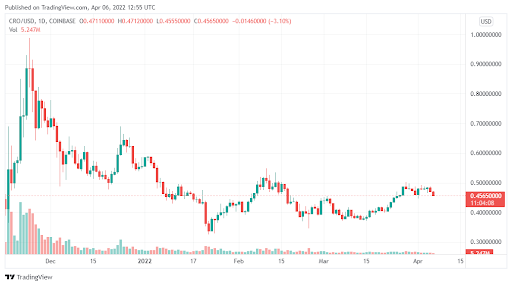
    Cronos (CRO) has continued to struggle to maintain its recent uptick in price. There were hopes that finally, the coin would manage to cross past $0.5, but despite bulls pushing it to the limit, CRO failed. The coin is now staring at a possibility of a major correction. Here is what to know:

    • The chart shows a serious RSI divergence that could suggest a pullback is imminent.

    • CRO was also rejected at $0.5 as upward momentum fizzled out

    • The coin has lost around 6% over the last 24 hours, with more to come.

    Data Source: Tradingview 

    Cronos (CRO) – Why a 15% is plausible

    After a steady rise over the last two weeks, off-late CRO has been displaying several bearish technical signals. First, it seems the coin’s upside at the moment is capped at $0.48. In fact, CRO has tried to break above the $0.5 mark five times and has failed. 

    It is clear that the coin has no upward momentum right now, and the only way is down. The RSI divergence also suggests that a pullback is going to happen at any time. We expect CRO to retreat towards $0.43 in the days ahead as it tries to generate demand. 

    If bulls are not able to push the price back up again, CRO will bottom at around $0.41 or thereabout. However, if the coin can somehow manage to break the $0.5 barrier, then this analysis will become null and void. We do not see this happening though in the days ahead.

    Why CRO has struggled past $0.5

    So far, the $0.5 mark has proved to be the most difficult overhead resistance for CRO. It is likely that this is basically a psychological barrier. 

    Since the coin has failed so many times before to smash past it, most traders would rather take a profit at around $0.5 instead of facing any serious upside risks.

  • ‘People should invest in all of the major layer-1s,’ says a veteran trader

    ‘People should invest in all of the major layer-1s,’ says a veteran trader

    Scott Melker, veteran trader and pocaster, is convinced that major layer-1 protocols should be part of everyone’s investment portfolio. Instead of picking individual crypto projects, such as NFTs or blockchain games, Melker thinks it makes more sense to bet on the blockchain infrastructure on which these projects are built. 

    “Any of these small projects could absolutely go nuts. But you’re going to have trouble choosing what they are. You should just own the layer-1 and the infrastructure that they’re all built on,” he said in an exclusive interview with Cointelegraph. 

    “You may not own a Bored Ape, but Ethereum holders have certainly benefited from the success of Bored Apes!” he pointed out. 

    Talking about his portfolio construction, Melker revealed that about 65% of his assets are currently in crypto. Besides Bitcoin (BTC), which makes up the bulk of his long-term holdings, Melker is extremely bullish on Ethereum (ETH).

    “Nothing is going to kill Ethereum. I believe Ethereum is here to stay. I believe it’s an extremely important asset and one that everybody should have exposure to,” he said.

    Melker believes that the upcoming Merge, which should complete Ethereum’s transition to proof-of-stake, will be a massive boost for the asset’s price.

    “This is a massively bullish event for Ethereum. (…) I think it will be a better chain, more usable after this happens,” he said. “We will eventually see Ethereum at $20 thousand, $30 thousand, $40 thousand.” 

    Watch the full interview on our YouTube channel and don’t forget to subscribe!

  • The race for semiconductors: Are crypto miners taking the lion’s share?

    The race for semiconductors: Are crypto miners taking the lion’s share?

    Over the last couple of years, the world has been grappling with the lack of semiconductors, which are the substances that conduct electricity between metals and isolates. The most famous semiconductor is silicon. 

    If correlating this concept to electronic devices, then the key semiconductors are processors and other microcircuits that are present in almost all devices that people use every day, from smartphones to cars. 

    In 2021, semiconductors hit a world record in terms of sales. Electronics production also boomed, with hundreds of millions of complex semiconductors being devoured by gaming consoles. The number of GPUs produced grew to unseen levels, with major manufacturers like Nvidia seeing all-time highs in terms of production.

    Despite all this, electronics prices skyrocketed and manufacturers of related goods were struggling to find semiconductors. 

    Crypto miners: Guilty or innocent? 

    It has become customary to not only mention but to blame cryptocurrency miners for the global shortage of GPU cards and semiconductors. To their credit, miners would buy up huge swaths of graphics processing units, sometimes emptying whole stores at once.

    Some countries that are feeling the shortage of cards acutely are already fighting against cryptocurrency mining.

    At the same time, the manufacturers, themselves, do not take such a definite position. AMD CEO Lisa Su said in June 2021 that miners are far from guilty for the lack and even complete absence of certain GPU cards. She said that their influence on the market is generally minimal and does not exceed 5%–10% of the total demand. 

    Andy Long, CEO of White Rock Management, a digital asset technology company situated in Switzerland, agreed with Su that mining isn’t entirely to blame:

    “GPUs are still in high demand to power Ethereum and other altcoin mining. Nvidia’s published estimate for the percentage of traditional GPUs going to miners is in the single digits, but the true figure is likely higher than that — somewhere around 20%.”

    Another important factor behind the shortage of GPU cards is the COVID-19 pandemic. The supply chain showed that due to the many employees who began to work at home, the number of buyers increased so much that graphics processors — a crucial component in home computers — simply disappeared from sale.

    However, the situation with miners’ appetite for GPU cards began to change noticeably at the beginning of this year. 

    Firstly, the change is due to Ethereum (ETHswitching to the proof-of-stake (PoS) protocol, which is slated to take place in the summer of 2022. 

    Currently, the Ethereum blockchain is maintained by miners solving cryptographic puzzles and subsequently receiving a reward, the value of which is calculated according to the hash rate of each individual GPU.

    This is called proof-of-work (PoW). As soon as Ethereum switches to the new protocol, miners will no longer be needed as crypto holders will validate block transactions based on the number of tokens they stake.

    Since GPU cards will no longer be needed for Ether mining, once Ethereum 2.0 goes into effect, the demand for them will reduce drastically. 

    This shift in demand is already very noticeable. In the first two months of 2022, Nvidia’s GPU card sales are down by 75% compared to 2021 as large mining companies that used to purchase such cards have stopped buying. This also means that Nvidia will be forced to redirect GPU cards to the gaming sector and cut prices. 

    There are other reasons for the price decrease. Since April of this year, the United States has reduced import tariffs on the supply of goods from China by 25%. America is one of the main players in the GPU market, where companies such as Nvidia, AMD and Intel operate, so the tariff cuts have led to lower prices for GPU cards.

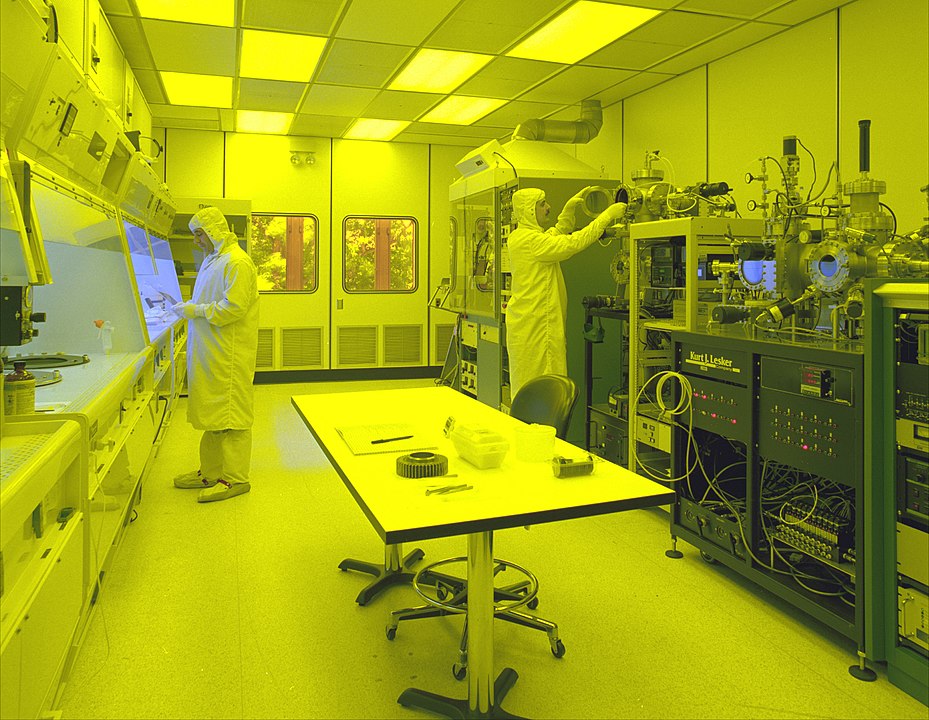
    Clean room at NASA’s Glenn Research Center. Such clean rooms are essential for semiconductor wafer fabrication.

    Buyers’ interest in the cards is also declining against the backdrop of a gradual return of people to offices after two years of remote work and the need to have a modern computer at home to comfortably perform work duties.

    “Dedicated mining cards are also a larger part of the picture now,” said Long, “These are cards without video output that are solely for data processing. We first saw these in 2017 with the launch of dedicated Pascal architecture cards such as the P106 and P104. Now the Nvidia CMP range explicitly targets the miners — with some dedicated high-end SKUs only available to those willing to place orders in the tens of millions of dollars. The shortage in dedicated gaming cards is as much to do with simple supply and demand for the core purpose of gaming — and also “HPC” type applications where people use gaming cards for rendering and AI tasks.”

    The deficit is not over

    The solution to the problem of the shortage of GPU cards sounds simple: Producers need to make more cards to meet the demand. However, in practice, this is not the case. One of the problems is the supply of silicon wafers, which are used to produce the chips. In 2019, the demand for wafers was rather low, but in 2020, after the whole world went into quarantine, the demand for computers, tablets, TVs and other equipment that requires chips rose sharply. The demand for wafers has increased so much that Sumco Corp, the second-largest manufacturer of wafers, said that its production is booked until 2026.

    Samsung’s Xian, China 300mm wafer facility, May 2014. Source: iTers News 

    However, the production of processors, GPU cards and memory cards requires more than just silicon wafers. After the start of war actions in Ukraine, world manufacturers of semiconductors faced a shortage of neon, which is necessary for the operation of the laser systems used to create the chips. The problem is that the two Russian companies, Ingas and Krion, produce 45%–54% of the world’s supply of neon-containing gas mixtures. How global manufacturers will look for a way out of this situation is not yet clear.

    In March 2022, some experts believed that the semiconductor shortage could end in 2023. In particular, the head of Micron Technology, one of the biggest producers of computer memory and computer data storage, believes that starting this year, manufacturers will be able to build up a significant stock of chips as well as arrange supplies. In 2023, there will be no such problems and global companies will largely be able to reach the level of production that they had before the pandemic. 

    But the situation in Ukraine can stop this recovery and redouble the deficit of chips, forcing the price to rise with renewed vigor. Recently, Intel has claimed that it has stockpiled and continues to monitor supply disruptions while trying to find alternative sources of neon. Samsung stated that some factories may face shortages, the Dutch ASML, which produces scanners for printing chips that are used by TSMC and Samsung, didn’t hide their concerns and said that over the next two years, producers could face a shortage of major machinery equipment. 

    So what will happen to semiconductors in the nearest future, and therefore to equipment? The GPU market could likely recover from the COVID-19 pandemic and the declining demand from miners, but global events are once again putting manufacturers to the test with the lack of components for the production of equipment. Of course, it is worth believing that the business will find the raw materials and build new supply chains, but no one can predict how soon this can happen. In any case, the shortage of semiconductors seems to continue, and GPU card prices will go up again, but in this case, the miners will have had nothing to do with it.

  • Decentralized social media: The next big thing in crypto?

    Decentralized social media: The next big thing in crypto?

    NFTs and the Metaverse are the hottest topics in the cryptocurrency ecosystem right now, but the next big thing might just be decentralized social media. Like decentralized finance, decentralized social media platforms don’t have a centralized governing body and may, someday, provide viable alternatives to established platforms like Twitter, Instagram, Facebook and TikTok. The technology is currently evolving just beyond the embryonic stage of development.

    Yung Beef, or YB — who serves as content lead and community manager at Subsocial — says that centralized social media platforms are unfair to community members and content creators. “It seems pretty obvious that centralized social networks are susceptible to lots of shady stuff, with the mystery algorithms controlling what people see, people getting shadowbanned or banned outright for whatever reason, etc. And it just gets worse when you factor in that a lot of people earn their livelihood on these platforms and their food bill is totally at the whim of the central authority.”

    According to Subsocial, the centralized social media industry is plagued by global censorship, a lack of customization, unfair monetization, algorithm dictatorship and a monopoly on network effects. 

    Stani Kulechov, the CEO of Aave and a decentralized social media developer, believes that content creators should have a permissionless, censorship-resistant distribution channel with their audience. He tells Magazine that “At least the people that are posting the content, creating the content, consuming it, sharing it — they would definitely benefit from decentralized social media.”

    Kulechov made headlines in and outside of the cryptocurrency community last summer when he hinted that crypto giant Aave was considering building “Twitter on Ethereum.”

    Michael Marra, founder and CEO of Entre — a social media application that runs on the DeSo blockchain — believes that decentralized social media is really about “giving the power back to the people.” According to him, one of the problems with centralized platforms is censorship, while another is monetization, but more on both of those later.

    How does it all work?

    Centralized and decentralized social media platforms both utilize some type of social graph — a model of a social network that maps everyone on a platform and how they’re related — and allow users to communicate with each other on a front-end platform. Traditional social media platforms are totally self-contained, and the host company controls the data servers. Twitter owns and controls all its content — all your content. The same is true with Instagram, Facebook, TikTok, etc. Decentralized social media platforms live on public blockchains, and for the most part, anyone, anywhere, can operate a node, access the back end, create an app and curate a feed. 

    According to its website, “DeSo is a new layer-1 blockchain built from the ground up to scale decentralized social applications to one billion users.” The blockchain is open-source, with the code and all the data stored directly on-chain. There are over 200 apps deployed on Deso, and users who create a profile in any app can easily take that profile and their community of followers along with them to any app on the blockchain.

    Entre, short for “entrepreneur,” is a social Web3 application that runs on DeSo. On Entre, the self-employed, the traditionally employed and any other professional can post Twitter-like content and carry out business transactions. They can conduct meetings, host virtual events and hire staff members, with the app functioning like a decentralized, digitally monetizable alternative to LinkedIn, Zoom and Google Calendar — all jammed together into a single product.

    While Entre runs on a social blockchain, the Aave-backed Lens Protocol is deployed on Polygon. Kulechov says that Lens is ”actually a decentralized social graph.”

    According to Kulechov, when a user of an app on the protocol creates a profile, that profile is tokenized as an NFT. Whenever someone follows a profile, they create a relationship on-chain that can’t be arbitrarily broken by the platform or by anyone else, as those relationships are also tokenized as NFTs that can be viewed in a digital wallet like MetaMask or on the web on OpenSea.

    Subsocial doesn’t consider itself a decentralized social network, rather a platform for building social networks. It allows users to create profiles and customize personal “Spaces” and claims to have serverless public timelines, roles and permissions, user governance, moderation, Spaces for DAOs, and a treasury. The platform runs on the Polkadot and Kusama blockchains, and it recently built its first app, a decentralized Reddit–Medium hybrid.

    According to YB, Subsocial plans to remove the profiles in the future. To save space, all content uploaded onto Subsocial (pics, videos and text) is hosted on the InterPlanetary File System, with an IPFS content identifier uploaded to the blockchain. Each IPFS node is hosted by one or more people, and those node operators are in control of what they host on their servers.

    While developers at Lens Protocol, Entre and Subsocial build out the next generation of decentralized, Web3 social platforms and apps, other platforms such as Theta and Audius are integrating social media tools into decentralized video and audio streaming services. Theta is a peer-to-peer network operating on its own blockchain, with users sharing bandwidth to relay video to one another. On its website, YouTube co-founder Steve Chen is quoted as saying the project can bring “improved video delivery at lower costs.” Like on YouTube, brands and creators can stream content as followers comment in real time.

    Audius, meanwhile, is a decentralized audio streaming platform that runs on Solana and hopes to afford everyone the freedom to distribute, monetize and stream any audio content. Artists can easily upload musical clips to the platform, while fans can listen to original compositions and mixes, curate libraries, and repost, follow, like and share content. It offers the same amount of fun but without middlemen throwing trivial ads your way and then taking a hefty cut from content creators. 

    What about the bad guys?

    If creators are expected to monitor their own content on a completely decentralized platform like Subsocial, how can the distribution of illegal content and disinformation be controlled? Social media moderation has been a controversial topic for years, and platforms like Facebook and Twitter haven’t always done a good job both filtering out dangerous content and maintaining a commitment to open dialogue. 

    YB explains to Magazine that Subsocial is censorship-resistant, while Kulechov says that Lens Protocol “is built completely to be agnostic in the sense that it’s a technical solution, basically to build social media applications.” Entre’s Marra says:

    “If it is open, that means anything kind of goes. You can control it to some degree.”

    Marra believes that blockchains can be built to facilitate the community’s ability to report things. Community members, especially those with higher authority — like those with lots of followers or a good reputation — can signal that a bad actor is posting dubious content. The offender’s content should then go way down in the feed. Marra argues that blockchain verification will also prevent a lot of “this stuff,” saying “You will instantly know that this person is not legit.” 

    According to Kulechov, moderation is all about creating choices for everyone. Lens Protocol has a common social graph where all user information is actively linked, and unlike traditional social media, that social graph is decentralized. Kulechov believes that decentralizing the social graph so that everyone has access to it provides more opportunities to moderate more humanely.

    This accessible interconnectivity affords developers opportunities to create algorithms focused on content moderation. It essentially puts the front ends of the protocol, the applications, into a position where they compete to offer accessibility to accurate, appropriate information. Kulechov says:

    “Maybe the right type of content moderation might be community-led, where the community’s site people announce themselves and moderate or select the algorithms.”

    Subsocial has three levels of moderation. To start, every post is made in a Space. “Think of Spaces like a subreddit, a Facebook group, a Twitter profile or a blog,” YB says. Each Space has at least one owner who can moderate its content. Also, each IPFS node is hosted by at least one community member. Those operators can control what they host on their servers. Lastly, anyone can build a front-end social application on the platform. A front end connected to one of the Subsocial blockchains can read all the content on the chain. The operator can control what is distributed on the front end.

    Still, if a front-end operator and a group of bad actors were determined to disseminate misinformation or illegal content, YB says it could be shut down with an on-chain vote. “[That] would be a big deal and likely a big hassle, but it also would be pointless, as those people could just make another Space right away and continue on.” YB argues that people use the internet to coordinate violence and share illegal content all the time — it’s just hidden, which it still would be, as large social networks built on Subsocial wouldn’t show that stuff.

    One thing to note, however, is that centralized social media platforms with the power to shut down a creator or community with the click of a button have struggled for years to contain the distribution of illegal content and misinformation.

    As such, even though relying on the community to moderate itself is egalitarian and sounds good in theory, it may not prove effective in practice. Self-moderation on censorship-resistant platforms would likely require fully engaged community members. That may not always be the case in the Web3 environment, as active members of communities need to be present in significant enough numbers to monitor bad actors on any given decentralized network. For example, a recent analysis ranking community engagement in DAOs showed mixed results.

    How might a censorship-resistant platform respond when an extraordinarily large community goes off the rails? Considering the massive amount of disinformation that could be generated by an organized, well-funded army of bots, could a universally adopted, decentralized network moderate a community of thousands of such propagandists?

    Show me the money — all the money

    Equitable monetization for community members and content creators is one of the key features of the decentralized social media ecosystem. Juxtaposed against unbalanced monetization schemes in traditional social media, decentralized social earning could be a game changer for content creators and magnetize universal adoption efforts.

    YB tells Magazine, “Personally, I think the monetization stuff will be much more attractive to content creators than any censorship resistance. YouTube, for example, takes 45% of ad revenue, which is pretty insane.” He adds further, ”I’m really interested to see what happens with the tips. I hope we see the emergence of a micro-tipping economy, since it will be so easy. Scrolling through the timeline and see a joke that brightens your morning? Why not tip them $0.50 in a second or two?”

    Lens Protocol is taking a hands-off approach to monetization. “We wanted to touch monetization as little as possible and give a lot of space for our developers to come and solve that,” Kulechov says. Lens is currently building a very basic monetization function around content collection and amplification. Whenever creators post music, text, audio or video, followers can then collect that content as NFTs. There are different collection modules, and followers can mint the NFTs themselves. If those followers then amplify that content, the creator collects mirror fees, which is like monetizing a retweet on Twitter.

    On the DeSo blockchain, the DESO token can be used to purchase creator coins. BitClout, Diamond and CloutFeed are Twitter-like applications that allow followers who support a particular creator to invest in their coin, exponentially increasing its value. Although not recommended, the coins can be converted back to DESO and actively traded or cashed out for fiat. Entre, according to Marra, isn’t “into creator coins” and is more focused on allowing creators to earn DESO through tipping when they livestream.

    Entre users can also sell tickets to in-person or virtual events and charge for private one-on-one services like consulting and coaching. The app offers a Slack- and Discord-like community feature where membership fees can be charged and users can offer services like graphic design. Currently, DESO is the only cryptocurrency accepted on the app, but Marra intends to offer multiple tokens in the future.

    Theta has been in the monetization game for some time and offers crypto rewards for creators, fans and hosts. The platform has two tokens: THETA and TFUEL. Owners of THETA, its native token, can participate in governance and earn more THETA by staking or running a node. TFUEL is essentially a utility token for the platform and can be earned by community members for watching streams on Theta.tv or hosting Guardian and Edge Nodes. They can spend TFUEL on real-world merchandise in the TFUEL Shop or use it to buy subscriptions to paid content.

    Audius, meanwhile, uses its AUDIO token to help artists monetize their work and fans support them. Community members can earn AUDIO for uploads, invites, going mobile, linking social media accounts and sustaining listening streaks. Fans can send AUDIO directly to artists.

    Decentralized social media certainly has the potential to tip the equity and privacy scales in favor of users and content creators. It could reshape the social media industry and redefine an era of digital free speech in the Web3 era. But in order to achieve that, it may still need to find an elusive solution to content moderation, and it will need to achieve universal adoption. Thought leaders in the space have their eyes toward the future, with Kulechov saying: 

    “Adoption is gonna be a long game, for sure. It might take years to adopt. It’s basically one application at a time.” 

  • What to do after getting rich from crypto: Community answers the ultimate question

    What to do after getting rich from crypto: Community answers the ultimate question

    When traders get enough money for life from their Bitcoin (BTC), Ethereum (ETH), Dogecoin (DOGE), or any crypto trading plays, what comes next? Crypto-savvy Reddit users shared their best ideas in a lively subreddit.

    A user who goes by the tag u/LifeReboot shared how a stroke of luck led to less satisfaction than expected. Because of this, LifeReboot asked the crypto community about their thoughts on what to do next after making enough profit for the rest of their lives.

    In a reply, user Adamant27 sent some congratulations and compared life to video games. “you passed a quest called financial stability and independence, but this game called Life has much more quests,” wrote Adamant27. The user encouraged LifeReboot to take on some “bigger quests” like personal development and spiritual enlightenment.

    Exploring the world is the answer for Reddit user Snowboarding_kook. In a reply, the Redditor wrote that there’s “nothing better than travel.”

    Snippet from the Reddit thread. Source: Reddit

    On the other hand, Redditor Feodal_lord believes that disappearing and living without contact with other people is a good idea. The user wrote: “if I had made enough money for my whole life, I would say fuck to society and live my life in isolation.”

    Because the creator of the thread didn’t “sound like the greedy crypto maniac,” user Goonzoo suggested launching a crypto project. “Make it unique and let it work as a foundation. […] Maybe it can fill your life in some way,” they wrote.

    Related: Answering a morbid question: What happens to your Bitcoin when you die?

    The Forbes crypto and blockchain list shows that crypto billionaires increased by 60% within a year. At the moment, the list includes 19 crypto billionaires including Binance CEO Changpeng Zhao, FTX CEO Sam Bankman-Fried and Coinbase CEO Brian Armstrong. Newcomers to the list include FTX co-founder Gary Wang and Alchemy founders Nikil Viswanathan and Joseph Lau. 

  • WAVES price crashes 50% in one week — watch these support levels next

    WAVES price crashes 50% in one week — watch these support levels next

    Waves (WAVES) lost around half its value in April so far and risks further correction due to weakening technical and fundamental factors.

    WAVES price risks another 30% decline 

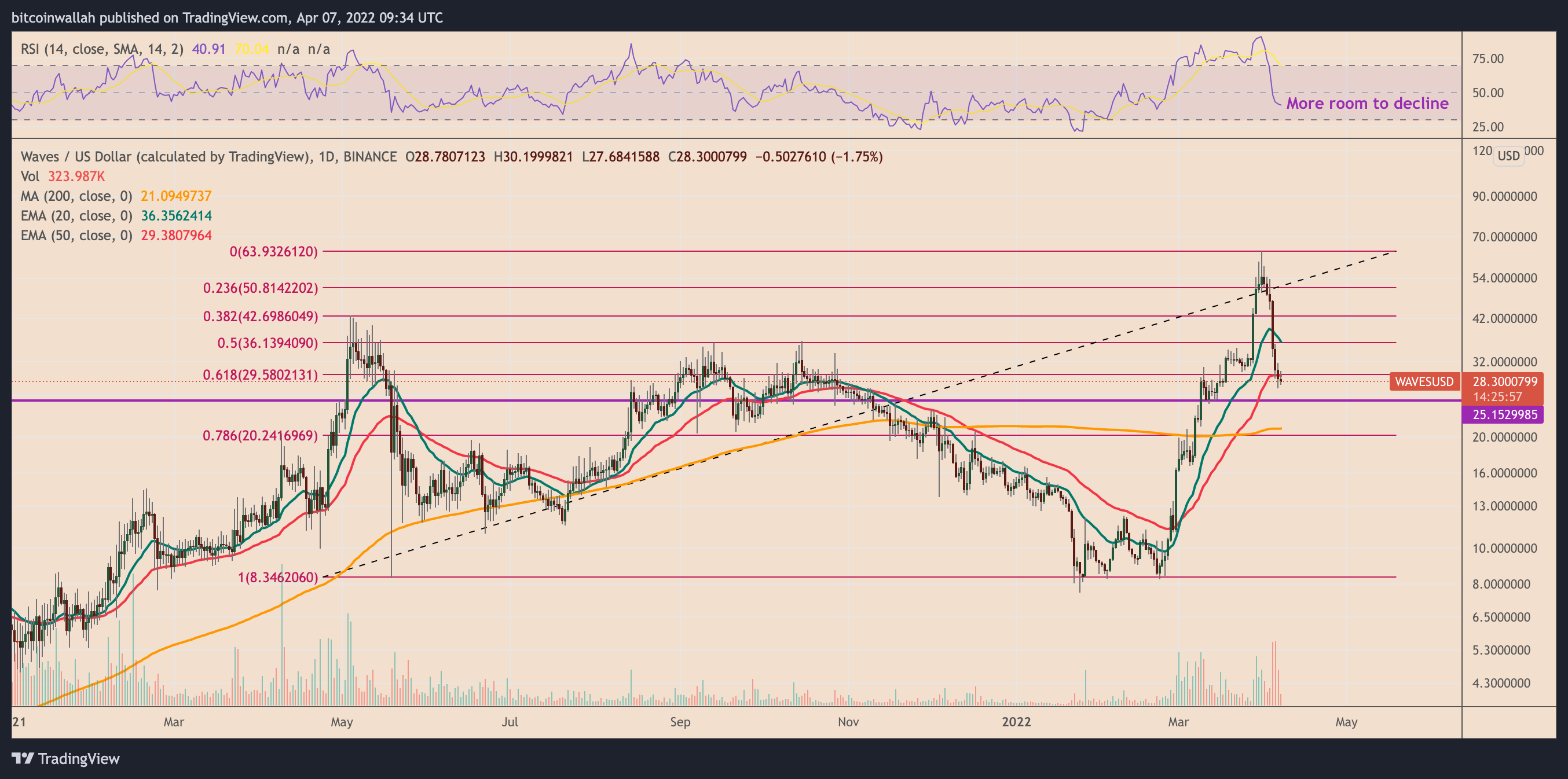
    WAVES dropped from nearly $64 on March 31 to around $27.50 on April 7 — down by over 55%. As it fell, the WAVES/USD pair also broke below a key support confluence, hinting further correction.

    Notably, the confluence comprises WAVES’ 50-day exponential moving average (50-day EMA; the red wave) and the 61.8% Fib line of the Fibonacci retracement graph — drawn from $64-swing high to $8.34-swing low.

    Now broken, they suggest that WAVES’ path of least resistance is to the downside, with $25 acting as interim support due to its historical relevance as a price floor in October 2021 and March 2022.

    WAVES/USD daily price chart. Source: TradingView

    Additionally, WAVES’ daily relative strength index (RSI) also shows room for a further decline, being only 11 points away from slipping below the “oversold” threshold of 30.

    Meanwhile, breaking below $25 would risk crashing WAVES’ price to its 200-day simple moving average (200-day SMA; the orange wave) near $20, coinciding with the 0.786 Fib line, about 30% lower than today’s price.

    The bearish setup emerged amid allegations that equaled the Waves Platform with a “Ponzi,” namely a Twitter thread penned by 0xHamZ, who accused Waves’ team of artificially inflating the price by more than 650% from February to March.

    Meanwhile, Neutrino USD, a “stablecoin” backed by WAVES reserves, also lost its U.S. dollar peg following 0xHamZ’s accusations, further dampening market sentiment.

    Related: Bitcoin slides below $44K in April first as trader warns ‘something is off’ with BTC

    Jolyon Horsfall, the co-CEO of NFT prediction platform SparkWorld, noted that the Waves Platform founder, Sasha Ivanov, “will need to step up if the token is to be revived and the project re-aligned on its ambitious path.” He warned:

    “For the time being, the dumping is expected to continue, and the WAVES price may fall to its 30-day low of $21.”

    Bull flag retest?

    However, WAVES shows some signs of defying bearish predictions while keeping its long-term uptrend intact.

    Notably, the ongoing correction brings WAVES closer to testing another double-layered support zone, defined by its 20-week EMA (the green wave) and the upper trendline of its previous “bull flag” setup, as shown in the chart below.

    WAVES/USD weekly price chart. Source: TradingView

    A bounce from this weekly support confluence could see WAVES rally to test its “bull flag” target near $70.

    The views and opinions expressed here are solely those of the author and do not necessarily reflect the views of Cointelegraph.com. Every investment and trading move involves risk, you should conduct your own research when making a decision.

  • Ethereum traders eye the 61.8% Fib level if ETH fails to hold the $3.2K support

    Ethereum traders eye the 61.8% Fib level if ETH fails to hold the $3.2K support

    The cryptocurrency market is nearly completely red on April 6 after hawkish comments from multiple members of the Federal Reserve highlighted their opinion that aggressively raising interest rates and cutting bond purchases would need to happen in order to combat inflation. Members did concede that this would result in negative pressure being placed on financial markets and this seems to be exactly what happened on April 6. 

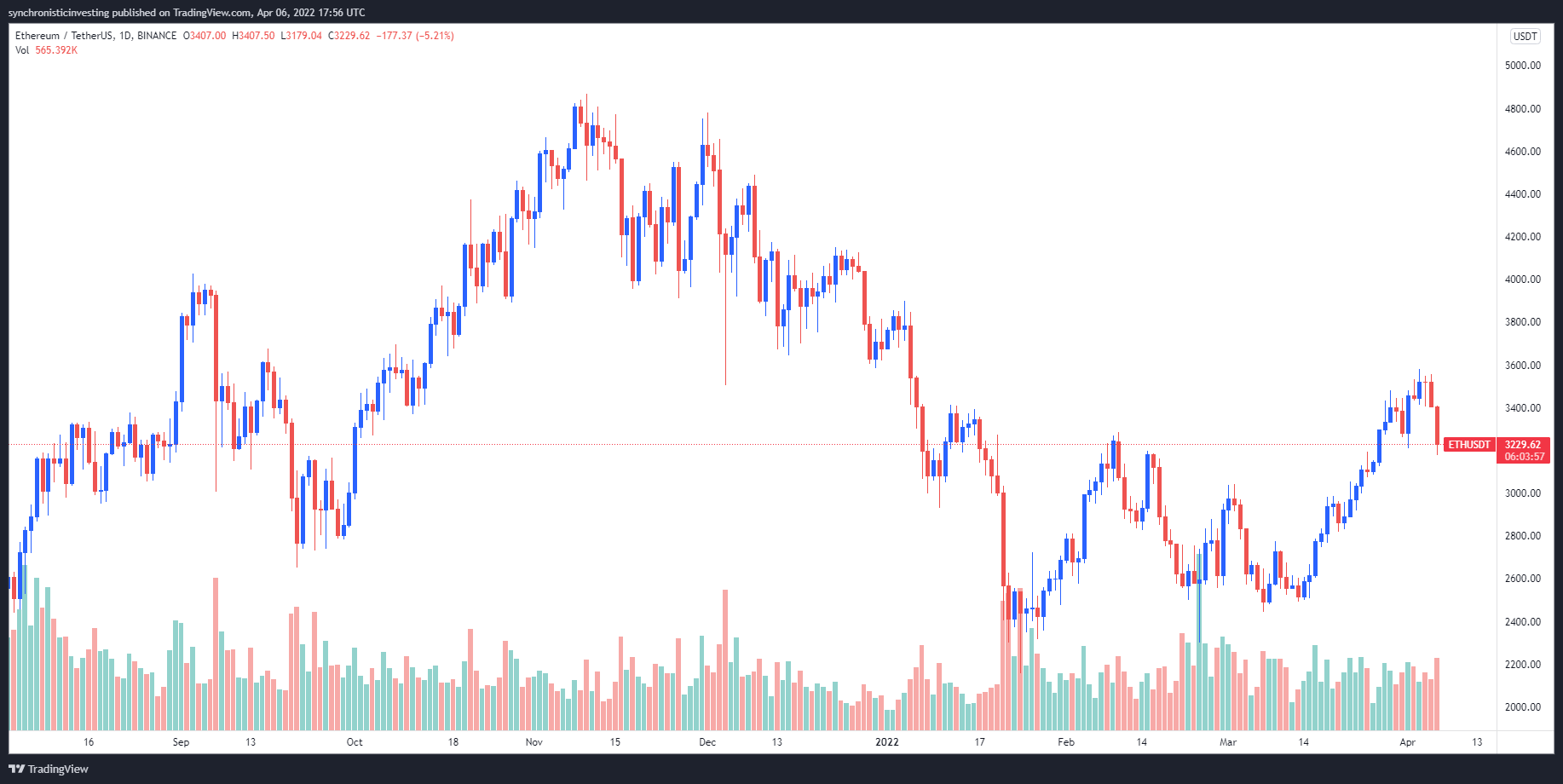
    Data from Cointelegraph Markets Pro and TradingView shows that the downward move for Ether (ETH) accelerated on April 6 and dropped the top altcoin to a low of $3,178 before the sell-off subsided and the price recovered to $3,200.

    ETH/USDT 1-day chart. Source: TradingView

    Here’s what several analysts are saying about this latest pullback for Ether and what levels of support to keep an eye on in case of a further move to the downside.

    Ether could dip to $2,600

    The outlook for Ether following a rejection of the monthly resistance at $3,400 was discussed by market analyst and pseudonymous Twitter user Rekt Capital, who posted the following chart noting that if this were to happen, “Ether could revisit $3,000” as indicated by the black line on the chart.

    ETH/USD 1-month chart. Source: Twitter

    Rekt Capital said,

    “But September 2021 has shown that when black gets retested on a dip — downside wicks occur. So if Ether does dip to black, it could wick into the green higher low.”

    Based on the chart provided, this would result in a potential drop to $2,602.

    Will the $3,200 support hold?

    A word of reassurance for concerned Ether holders was offered by crypto trader and pseudonymous Twitter user CryptoBatUSDT, who posted the following chart highlighting a retest of an important support level.

    ETH/USDT 6-hour chart. Source: Twitter

    CryptoBatUSDT said,

    “The market structure is still bullish, currently in both the Range (Eq) and a Swing Low (HL) zone. Unless this level is lost, I will look to open a long position in these regions.”

    Related: Bitcoin price drops to $43.5K, but data and BTC’s market structure project strength

    Price is still between the 200-MA and 200-EMA

    Further insight into the support for Ethereum at this current price level was provided by crypto trader and pseudonymous Twitter user Don Yakka, who posted the following chart noting the importance of the 200-day moving average (MA) and exponential moving average (EMA).

    ETH/USDT 1-day chart. Source: Twitter

    Don Yakka said,

    “Very similar to BTC chart, the 200MA is resistance and the 200EMA is support, as long as 200EMA holds on [the] daily, I would not panic.”

    The overall cryptocurrency market cap now stands at $2.003 trillion and Bitcoin’s dominance rate is 41.5%.

    The views and opinions expressed here are solely those of the author and do not necessarily reflect the views of Cointelegraph.com. Every investment and trading move involves risk, you should conduct your own research when making a decision.

  • UST staking goes live on Binance as Anchor reserves fall

    UST staking goes live on Binance as Anchor reserves fall

    On Wednesday, centralized cryptocurrency exchange Binance launched its new TerraUSD (UST) staking program. Although Binance did not name the underlying decentralized finance protocol responsible for the staking rewards, Do Kwon — Terra Luna’s (LUNA) co-founder — attributed the origins of the high yield to Terra’s flagship Anchor protocol. 

    Terra’s (Luna) ecosystem consists of its algorithmic stablecoin UST and governance/equilibrium token LUNA. The Anchor protocol alleges that it operates as a “crypto savings account,” allowing users to deposit their UST and earn up to 20% APY. The savings rate is funded via a combination of borrowers paying interest on UST loans and staking income from their collateral.

    At the time of publication, there is a continued imbalance between borrowers and lenders, with 12.4 billion UST worth of deposits relying on income generated by just 3.47 billion UST of loans. Anchor must tap into its reserves to pay out its promised APY when this occurs. According to data from an unofficial tracking resource called Terra.engineer, Anchor has less than 340 million UST remaining in its reserves, compared to approximately 450 million UST last month. Despite the declining reserve count, the Terra development team is using initiatives such as injecting more reserve capital and launching more income-generating methods to maintain protocol. 

    Earlier in the day, data from Luna Foundation Guard’s (LFG) official Bitcoin (BTC) address shows that the entity purchased another 5,040 BTC ($222 million), bringing its total stack to 35,768 BTC ($1.577 billion). LFG launched in January to grow the Terra ecosystem and improve the sustainability of its stablecoins. Earlier, Do Kwon said he wanted to build a decentralized foreign exchange, or forex, reserve for UST, utilizing both LUNA and BTC. LFG plans to expand its BTC reserves to $10 billion, with additional purchases after that based on how much UST is minted.