Category: TRENDING

  • Price analysis 4/6: BTC, ETH, BNB, SOL, XRP, ADA, LUNA, AVAX, DOT, DOGE

    Price analysis 4/6: BTC, ETH, BNB, SOL, XRP, ADA, LUNA, AVAX, DOT, DOGE

    Bitcoin (BTC), the entire crypto sector and the S&P 500 index are correcting on April 6, which highlights the tight correlation between the two sectors.

    Despite the weakness, institutional investors do not seem to be halting their purchases, suggesting that they remain bullish in the long term. Terra used the dip to buy an additional 5,040 Bitcoin, which takes its total holding to 35,768 Bitcoin. 

    Terra was not alone in this venture. MicroStrategy, the treasury with the largest Bitcoin reserves, also increased its holdings by 4,197 Bitcoin through its subsidiary MacroStrategy. After the latest purchase, the business intelligence firm holds 129,218 Bitcoin.

    Daily cryptocurrency market performance. Source: Coin360

    Another sign of strong appetite for Bitcoin is seen in the inflows to the two Canadian Bitcoin exchange-traded funds. According to Glassnode data, the funds boosted their holdings to an all-time high of 69,052 Bitcoin, an increase of 6,594 since January.

    Could Bitcoin and altcoins enter a deeper correction or will lower levels attract buying? Let’s study the charts of the top-10 cryptocurrencies to find out.

    BTC/USDT

    After staying in a tight range between the 200-day simple moving average ($48,240) and $45,000 for the past few days, the bears made their move and have pulled the price below the 20-day exponential moving average ($44,567).

    BTC/USDT daily chart. Source: TradingView

    The relative strength index (RSI) has dipped to the midpoint and the 20-day EMA is flattening out. This suggests that the bullish momentum could be weakening. If the price rebounds off the 50-day SMA ($41,752), the bulls will again attempt to push the BTC/USDT pair above the 200-day SMA.

    Conversely, if the bears sink the price below the 50-day SMA, it will signal that the pair could extend its stay inside the ascending channel. The pair could then gradually drop toward the strong support at $37,000.

    ETH/USDT

    The failure of the bulls to sustain the price of Ether (ETH) above the 200-day SMA ($3,487) may have resulted in profit-booking by short-term traders. That has pulled the price to the critical support at the 20-day EMA ($3,223).

    ETH/USDT daily chart. Source: TradingView

    If the price rebounds off the 20-day EMA, it will suggest that bulls are buying on dips. The bulls will then make another attempt to push and sustain the price above the 200-day SMA. If they succeed, the ETH/USDT pair could start its northward march toward $4,150 where the bears are expected to mount a strong defense.

    Contrary to this assumption, if the bears sink the price below the 20-day EMA, the selling could pick up momentum and the pair may drop to the 50-day SMA ($2,907).

    BNB/USDT

    Binance Coin (BNB) once again failed to break above the 200-day SMA ($468) on April 5. The long wick on the day’s candlestick showed that the bears are defending the 200-day SMA with all their might.

    BNB/USDT daily chart. Source: TradingView

    The BNB/USDT pair has dipped to the 20-day EMA ($424). The bears will now attempt to sink and sustain the price below the 20-day EMA. If they succeed, the pair could extend its decline to the 50-day SMA ($398). A strong rebound off this level will suggest that the pair may remain range-bound between the 200-day SMA and the 50-day SMA.

    Conversely, if the price rebounds off the 20-day EMA, the bulls will attempt to drive the pair above the 200-day SMA and challenge the resistance at $500.

    SOL/USDT

    Solana’s (SOL) recovery stalled on April 2 and the price has dipped below the breakout level at $122. The bulls are expected to defend the 20-day EMA ($113) with vigor.

    SOL/USDT daily chart. Source: TradingView

    A strong bounce off the 20-day EMA will suggest that the sentiment remains positive and traders are buying on dips. The bulls will then attempt to push the price above the overhead hurdle at the 200-day SMA ($149).

    Alternatively, a break and close below the 20-day EMA will suggest that the bullish momentum has weakened. The pair could then drop to the 50-day SMA ($96). A strong rebound off this level could keep the pair stuck between the 50-day SMA and the 200-day SMA.

    XRP/USDT

    Ripple (XRP) turned down and slipped below the 20-day EMA ($0.81) on April 5. The selling continued today and the price broke below the 50-day SMA ($0.78).

    XRP/USDT daily chart. Source: TradingView

    The RSI has dropped into the negative territory and the 20-day EMA has started to slope down, suggesting that bears have a slight edge. If the price sustains below the 50-day SMA, the XRP/USDT pair could drop to $0.70. This is an important level for the bulls to defend because if it gives way, the decline could extend to $0.60.

    On the contrary, if the price turns up from the current level and rises above the 20-day EMA, the bulls will attempt to propel the pair above the 200-day SMA ($0.89).

    ADA/USDT

    The failure of the bears to propel Cardano (ADA) above the overhead resistance at $1.26 may have tempted short-term traders to book profits. That has pulled the price below the 20-day EMA ($1.09).

    ADA/USDT daily chart. Source: TradingView

    If the price breaks below the 20-day EMA, the pair could drop to the 50-day SMA ($0.96). The bulls are likely to defend this level aggressively but if the bears overpower them, the ADA/USDT pair could drop to the strong support at $0.74. A strong rebound off this level will suggest that the pair may consolidate between $0.74 and $1.26 for some more time.

    Alternatively, if the price rises from the current level, the bulls will again attempt to drive the pair above the overhead resistance. If they succeed, the ADA/USDT pair could rally to the 200-day SMA ($1.47).

    LUNA/USDT

    Terra’s LUNA token had been in a strong uptrend but the Doji candlestick pattern on April 5 cautioned that the bullish momentum could be weakening. The negative divergence on the RSI also suggested that the bulls may be losing their grip.

    LUNA/USDT daily chart. Source: TradingView

    The uncertainty of the Doji candlestick pattern resolved to the downside today. The bears will now try and pull the price to the 20-day EMA ($102). This is an important level for the bulls to defend because a strong rebound off it will suggest that the sentiment remains bullish and traders are buying on dips.

    Conversely, if the price breaks below the 20-day EMA, the selling could intensify as traders rush to the exit. That may sink the LUNA/USDT pair to the 50-day SMA ($86).

    Related: Bitcoin slides below $44K in April first as trader warns ‘something is off’ with BTC

    AVAX/USDT

    The bulls purchased the dip to the 20-day EMA ($89) on April 4 but they could not push Avalanche (AVAX) above the overhead resistance at $98. This suggests that bears continue to defend the overhead resistance aggressively.

    AVAX/USDT daily chart. Source: TradingView

    The 20-day EMA is flattening out and the RSI has dropped into the negative zone, indicating that bears have a slight edge. If the price breaks below the 50-day SMA ($82), the AVAX/USDT pair could drop to the next major support at $65. A bounce off this level will suggest that the pair may remain range-bound between $65 and $98 for a few more days.

    Conversely, if the price turns up from the current level, the bulls will make another attempt to climb above the overhead zone between $98 and $100.

    DOT/USDT

    Polkadot (DOT) rebounded off the 20-day EMA ($21) on April 4 but the bulls could not overcome the barrier at $23. This may have tempted short-term traders to book profits.

    DOT/USDT daily chart. Source: TradingView

    The DOT/USDT pair has plunged below the 20-day EMA today and the RSI has entered the negative territory. This suggests that the bulls are losing their grip. The next stop could be the 50-day SMA ($19). The bulls are likely to defend this level with vigor but if the support cracks, the decline could extend to $16.

    Alternatively, a strong rebound off the 50-day SMA could suggest that the pair may consolidate between $19 and $23 for a few days. The bulls will have to push and sustain the price above $23 to signal the start of a potential new uptrend.

    DOGE/USDT

    Dogecoin (DOGE) soared above the overhead resistance at $0.17 on April 5 but the bulls could not clear the hurdle at the 200-day SMA ($0.18). This may have attracted profit-booking by the short-term bulls and selling by the aggressive bears, resulting in the sharp reversal today.

    DOGE/USDT daily chart. Source: TradingView

    The DOGE/USDT pair is likely to retest the 20-day EMA ($0.14). If the price rebounds off this level, it will suggest that bulls continue to buy on dips. The buyers will then again try to clear the overhead hurdle at the 200-day SMA.

    This positive view will invalidate if the price continues lower and breaks below the 20-day EMA. Such a move could open the doors for a possible drop to $0.12. The pair could then remain stuck between $0.10 and $0.18 for a few more days.

    The views and opinions expressed here are solely those of the author and do not necessarily reflect the views of Cointelegraph. Every investment and trading move involves risk. You should conduct your own research when making a decision.

    Market data is provided by HitBTC exchange.
  • Report: DApp daily users surge to 2.4M in Q1 2022 despite headwinds

    Report: DApp daily users surge to 2.4M in Q1 2022 despite headwinds

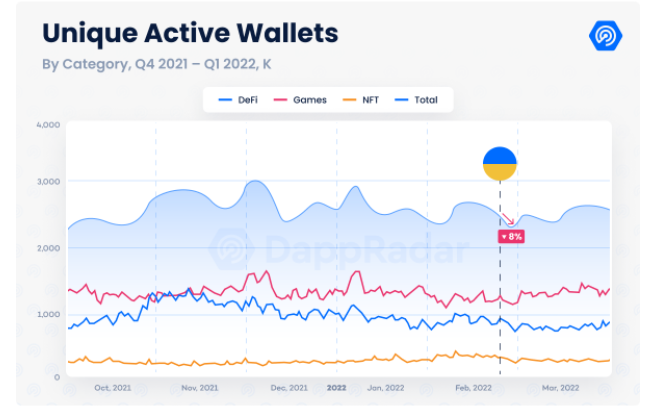
    According to a new industry report published by DappRadar, the number of users engaging in decentralized applications, or DApps, every day surged 396% year over year to 2.4 million. This is only 5.8% below the same user activity level witnessed in Q4 2021.

    The overall growth was impressive, considering that during the quarter, the cryptocurrency sector saw a short-lived bear market, as well as experiencing $1.19 billion in decentralized finance, or DeFi, hacks, and exploits.

    Two of the worst affected token bridge protocols were that of Ronin and Wormhole. Last month, Axie Infinity’s Ronin bridge was breached for over $600 million after an attacker used hacked private keys to forge fake withdrawals. Meanwhile, the Wormhole protocol lost $321 million via a minting exploit in February. Though, in a rather heroic move, venture capital firm Jump Crypto dug into its own wallets and replenished the lost funds. 

    In addition, the staff at DappRadar wrote:

    “The first quarter of 2022 had its ups and downs but was tainted by the war in Ukraine. This was one of the biggest events since the 2008 Global Financial Crisis that shook world markets and had a negative effect on the industry.”

    Number of Unique Active Wallets Interacting with DApps | Source: DappRadar

    Gaming DApps accounted for over 50% of all user activity in Q1 2022. Simultaneously, nonfungible tokens, or NFTs, generated $12 billion in trades despite warnings of a bubble. In terms of DeFi total value locked, Ethereum (ETH) once again held the top spot with $127 billion, followed by Terra Luna (LUNA) at $29 billion and BNB Chain at $13 billion.

  • Are CBDCs kryptonite for crypto?

    Are CBDCs kryptonite for crypto?

    Central bank digital currencies — digital currencies backed by a central bank — have received renewed interest with the United States President Joe Biden’s Executive Order on Ensuring Responsible Development of Digital Assets. Proponents of CBDCs argue that widespread adoption will promote financial inclusion, expand public access to safe money, improve the efficiency of payments and more.

    But their rationale remains tenuous. Many analysts and practitioners increasingly view CBDCs as fundamentally at odds with the purpose of cryptocurrency, which is to provide a secure, decentralized peer-to-peer mechanism for transferring funds. And the hypothetical benefits of CBDCs remain hypothetical — no evidence exists yet that suggests any advantages over other examples of distributed ledger technologies in financial services, especially given the new risks they pose.

    The status of CBDCs worldwide

    Nine countries have already developed their own CBDCs, and the U.S. has joined a list of over 100 countries exploring issuing one. Most CBDCs take a hybrid approach whereby “The central bank issues the CBDC to banks and other and other payment service providers, which in turn distribute the CBDC to users throughout the economy and provide them with account-related services,” according to a recent report by the Hoover Institution.

    There are other types, according to leading experts at the Bank for International Settlements — which consists of stakeholders from major central banks. These include a synthetic CBDC, where the consumer has a claim on an intermediary, with the central bank only keeping track of wholesale accounts; and a direct CBDC, where the consumer has a claim on the central bank, with it handling all the retail.

    Anti CBDC
    Bitcoiners have launched a campaign against CBDCs, warning that they allow the government to control what you spend money on.

    Some scholars have underscored that DLT has a role to play in helping central banks become more efficient and secure, but such technology should be introduced with “a ‘minimally invasive’ CBDC design — one that upgrades money to current needs without disrupting the proven two-tier architecture of the monetary system,” according to Raphael Auer, head of the BIS Innovation Hub Eurosystem Centre, and Rainer Böhme, a professor at the University of Innsbruck.

    The fact that central banks are interested in digital currencies is not surprising. As countries look to rebound from nearly two years of lockdowns and other restrictions on mobility, coupled with rising inflation, central banks have been feeling the pressure to promote employment and manage price levels u20 their “dual mandate.” Across the world, central banks have bought a significant amount of bonds, thereby expanding the money supply and arguably further contributing to inflation. For example, the Federal Reserve has expanded the U.S. money supply from roughly $4 trillion to over $20 trillion over the past two years, but we are only now seeing the resulting inflationary effects.

    Evaluating the potential benefits

    In a 2020 report, the BIS outlined a handful of potential benefits brought up by proponents of CBDCs: financial inclusion, cross-border payments, financial resilience and stability, increased efficiency of fiscal transfers, and privacy. But cryptocurrency fulfills all of these aims better than government-backed currencies.

    Let’s take a look at these potential benefits one by one.

    Financial inclusion: The expansion of decentralized finance and emergence of nonfungible tokens are already changing the economic landscape. Thousands of content creators have sold NFTs and joined the DeFi community, removing intermediaries and allowing revenues to go directly to the creators.

    “We’re entering a ‘Web2.5 era’ where content creators have benefited from the rise of social media, but what they create is owned by centralized groups,” Avery Akkineni, president of VaynerNFT, tells Magazine. “Now they are starting to own the end-to-end process, and we’ve seen some of these creators become wildly successful. […] That is inspiring a new generation of creators.”

    Furthermore, existing financial institutions have already expanded access to credit by lowering the barriers to adoption. My research from 2021 found that the expansion of mobile banking in the U.S. since 2014 has been concentrated among those who are younger, single or a part of minority groups.

    Even if these patterns were not true, it’s unclear how CBDCs expand financial inclusion.

    CBDC proponents cite numerous advantages, but anything a digital dollar can do, crypto can do better.

    Cross-border payments and efficiency of fiscal transfers: While financial transactions across borders are already possible, they are time-intensive and costly. However, several Web3 companies enabling cross-border transactions have emerged, including Ripple.

    Financial resilience and stability: Resilience is integral to cushion against unanticipated shocks to the system. The 2007–2008 financial crisis in the U.S. and many developed countries was arguably driven by a concentration of risky, securitized assets. In the run-up to the crisis, the number of mortgages increased rapidly, but many new homeowners were not financially prepared to pay their mortgages — a pattern that was, at least partially, influenced by the Federal Reserve through its impact on interest rates and failure to attend to the warning signs.

    The financial crisis could have been avoided if these warning signs had been taken more seriously. The United States’ 2011 Financial Crisis Inquiry Report reads: “The prime example is the Federal Reserve’s pivotal failure to stem the flow of toxic mortgages, which it could have done by setting prudent mortgage-lending standards. The Federal Reserve was the one entity empowered to do so and it did not.”

    Central banks are making analogous claims to those made in the run-up to the financial crisis when they play down the risks of CBDCs, especially the possible monopolization of the financial system by the central bank, and talk only about their benefits. “A core instrument by which central banks carry out their public policy objectives is providing the safest form of money to banks, businesses and the public — central bank money,” according to the BIS.

    CBDCs
    CBDCs are designed to attack crypto and shore up the power of central banks, according to critics.

    Charles Calomiris, Henry Kaufman professor of financial institutions at Columbia Business School, tells Magazine that CBDCs seem more like a power grab than useful financial technology.

    “CBDC is the latest attempt to expand their power at our expense by self-interested central bankers, which have done more in developed countries to expand their power at the expense of democracy over the past two decades than any other instrument of government.”

    The architectural design of CBDCs matters. If they are designed so that they, even if not explicitly stated, can replace private commercial and retail banking, as the Peoples’ Bank of China has suggested, then central banks will have yet another mechanism for creating money that has no collateral or underlying asset value. Such an approach would have grave inflationary implications.

    Last year, several economists published research on CBDCs and bank runs, finding that large-scale intermediation by central banks could lead to them becoming monopolies. Since central banks’ contracts with investment banks tend to be rigid, they have the potential to deter bank runs. Consumers “internalize this feature ex-ante, and the central bank arises as a deposit monopolist, attracting all deposits away from the commercial banking sector,” according to the research’s authors.

    A nail in the coffin for privacy

    Even though public documents from central bankers talk about privacy as a feature of CBDCs, no explanation exists for how this will work. In contrast, the BIS reported that “Full anonymity is not plausible. […] For a CBDC and its system, payments data will exist, and a key national policy question will be deciding who can access which parts of it and under what circumstances.”

    Such a rollout could mean that every central bank would be able to identify each user. Today, a bank cannot tell who is using a euro versus a dollar bill, but “The key difference with the CBDC is the central bank will have absolute control [over] the rules and regulations that will determine the use of that expression of central bank liability, and also, we will have the technology to enforce that,” said Agustin Carstens, general manager of the BIS, during a 2020 panel discussion.

    US CBDC
    The U.S. is looking into a digital dollar, but will it be in keeping with the principles that make America what it is? Source: Pexels

    There is little doubt that illicit transactions occur with cryptocurrency, but illicit transactions have always taken place, whether a thousand years ago with gold or today with cash. The question is how to create a framework that preserves privacy and counters illicit activity.

    If central banks can track every transaction, what is to stop them from shutting down people’s access to finance, travel and their livelihoods? Furthermore, what would stop central banks from coordinating, as outlined in the BIS’ 2020 report?

    “CBDCs don’t just threaten but fully infringe upon our financial autonomy, stripping away our most basic rights and freedoms as enumerated by our forefathers,” Eric Waisanen, co-founder of Hydro.Finance and host of the Secret Code Podcast, tells Magazine. In contrast, “DeFi provides freedom from the alleged protection that strips us of our ability to participate,” Waisanen continues.

    The future of money and DeFi

    The future of finance lies in decentralization. While we have traditionally known and interacted with large, centralized institutions, we have seen a widespread preference for and adoption of decentralized technologies arise from technological advances coupled with a recognition of the ills of centralization.

    But DLT, and blockchain more generally, is only a tool. It still needs good governance and proper stewarding. The emergence of CBDCs is likely to centralize the “creation” and flow of finance even further by granting central banks even more authority to issue tokens rather than buy and sell bonds on a somewhat “open” market.

    “A CBDC is an authoritarian government’s dream and represents a giant step backward for consumer privacy,” says Paul Watkins, managing director at Patomak Global Partners.

    Many architectures for CBDCs have been proposed. There is widespread enthusiasm for the use of DLT in central banking, but not for retail CBDCs that simultaneously can create money without collateral and require individuals to share personally identifiable information. It is important to seriously consider the architecture of a CBDC when thinking about design; otherwise, CBDCs will be launched in competition with the growing move and appetite for decentralization.

  • Are CBDCs kryptonite for crypto?

    Are CBDCs kryptonite for crypto?

    Central bank digital currencies — digital currencies backed by a central bank — have received renewed interest with the United States President Joe Biden’s Executive Order on Ensuring Responsible Development of Digital Assets. Proponents of CBDCs argue that widespread adoption will promote financial inclusion, expand public access to safe money, improve the efficiency of payments and more.

    But their rationale remains tenuous. Many analysts and practitioners increasingly view CBDCs as fundamentally at odds with the purpose of cryptocurrency, which is to provide a secure, decentralized peer-to-peer mechanism for transferring funds. And the hypothetical benefits of CBDCs remain hypothetical — no evidence exists yet that suggests any advantages over other examples of distributed ledger technologies in financial services, especially given the new risks they pose.

    The status of CBDCs worldwide

    Nine countries have already developed their own CBDCs, and the U.S. has joined a list of over 100 countries exploring issuing one. Most CBDCs take a hybrid approach whereby “The central bank issues the CBDC to banks and other and other payment service providers, which in turn distribute the CBDC to users throughout the economy and provide them with account-related services,” according to a recent report by the Hoover Institution.

    There are other types, according to leading experts at the Bank for International Settlements — which consists of stakeholders from major central banks. These include a synthetic CBDC, where the consumer has a claim on an intermediary, with the central bank only keeping track of wholesale accounts; and a direct CBDC, where the consumer has a claim on the central bank, with it handling all the retail.

    Anti CBDC
    Bitcoiners have launched a campaign against CBDCs, warning that they allow the government to control what you spend money on.

    Some scholars have underscored that DLT has a role to play in helping central banks become more efficient and secure, but such technology should be introduced with “a ‘minimally invasive’ CBDC design — one that upgrades money to current needs without disrupting the proven two-tier architecture of the monetary system,” according to Raphael Auer, head of the BIS Innovation Hub Eurosystem Centre, and Rainer Böhme, a professor at the University of Innsbruck.

    The fact that central banks are interested in digital currencies is not surprising. As countries look to rebound from nearly two years of lockdowns and other restrictions on mobility, coupled with rising inflation, central banks have been feeling the pressure to promote employment and manage price levels u20 their “dual mandate.” Across the world, central banks have bought a significant amount of bonds, thereby expanding the money supply and arguably further contributing to inflation. For example, the Federal Reserve has expanded the U.S. money supply from roughly $4 trillion to over $20 trillion over the past two years, but we are only now seeing the resulting inflationary effects.

    Evaluating the potential benefits

    In a 2020 report, the BIS outlined a handful of potential benefits brought up by proponents of CBDCs: financial inclusion, cross-border payments, financial resilience and stability, increased efficiency of fiscal transfers, and privacy. But cryptocurrency fulfills all of these aims better than government-backed currencies.

    Let’s take a look at these potential benefits one by one.

    Financial inclusion: The expansion of decentralized finance and emergence of nonfungible tokens are already changing the economic landscape. Thousands of content creators have sold NFTs and joined the DeFi community, removing intermediaries and allowing revenues to go directly to the creators.

    “We’re entering a ‘Web2.5 era’ where content creators have benefited from the rise of social media, but what they create is owned by centralized groups,” Avery Akkineni, president of VaynerNFT, tells Magazine. “Now they are starting to own the end-to-end process, and we’ve seen some of these creators become wildly successful. […] That is inspiring a new generation of creators.”

    Furthermore, existing financial institutions have already expanded access to credit by lowering the barriers to adoption. My research from 2021 found that the expansion of mobile banking in the U.S. since 2014 has been concentrated among those who are younger, single or a part of minority groups.

    Even if these patterns were not true, it’s unclear how CBDCs expand financial inclusion.

    CBDC proponents cite numerous advantages, but anything a digital dollar can do, crypto can do better.

    Cross-border payments and efficiency of fiscal transfers: While financial transactions across borders are already possible, they are time-intensive and costly. However, several Web3 companies enabling cross-border transactions have emerged, including Ripple.

    Financial resilience and stability: Resilience is integral to cushion against unanticipated shocks to the system. The 2007–2008 financial crisis in the U.S. and many developed countries was arguably driven by a concentration of risky, securitized assets. In the run-up to the crisis, the number of mortgages increased rapidly, but many new homeowners were not financially prepared to pay their mortgages — a pattern that was, at least partially, influenced by the Federal Reserve through its impact on interest rates and failure to attend to the warning signs.

    The financial crisis could have been avoided if these warning signs had been taken more seriously. The United States’ 2011 Financial Crisis Inquiry Report reads: “The prime example is the Federal Reserve’s pivotal failure to stem the flow of toxic mortgages, which it could have done by setting prudent mortgage-lending standards. The Federal Reserve was the one entity empowered to do so and it did not.”

    Central banks are making analogous claims to those made in the run-up to the financial crisis when they play down the risks of CBDCs, especially the possible monopolization of the financial system by the central bank, and talk only about their benefits. “A core instrument by which central banks carry out their public policy objectives is providing the safest form of money to banks, businesses and the public — central bank money,” according to the BIS.

    CBDCs
    CBDCs are designed to attack crypto and shore up the power of central banks, according to critics.

    Charles Calomiris, Henry Kaufman professor of financial institutions at Columbia Business School, tells Magazine that CBDCs seem more like a power grab than useful financial technology.

    “CBDC is the latest attempt to expand their power at our expense by self-interested central bankers, which have done more in developed countries to expand their power at the expense of democracy over the past two decades than any other instrument of government.”

    The architectural design of CBDCs matters. If they are designed so that they, even if not explicitly stated, can replace private commercial and retail banking, as the Peoples’ Bank of China has suggested, then central banks will have yet another mechanism for creating money that has no collateral or underlying asset value. Such an approach would have grave inflationary implications.

    Last year, several economists published research on CBDCs and bank runs, finding that large-scale intermediation by central banks could lead to them becoming monopolies. Since central banks’ contracts with investment banks tend to be rigid, they have the potential to deter bank runs. Consumers “internalize this feature ex-ante, and the central bank arises as a deposit monopolist, attracting all deposits away from the commercial banking sector,” according to the research’s authors.

    A nail in the coffin for privacy

    Even though public documents from central bankers talk about privacy as a feature of CBDCs, no explanation exists for how this will work. In contrast, the BIS reported that “Full anonymity is not plausible. […] For a CBDC and its system, payments data will exist, and a key national policy question will be deciding who can access which parts of it and under what circumstances.”

    Such a rollout could mean that every central bank would be able to identify each user. Today, a bank cannot tell who is using a euro versus a dollar bill, but “The key difference with the CBDC is the central bank will have absolute control [over] the rules and regulations that will determine the use of that expression of central bank liability, and also, we will have the technology to enforce that,” said Agustin Carstens, general manager of the BIS, during a 2020 panel discussion.

    US CBDC
    The U.S. is looking into a digital dollar, but will it be in keeping with the principles that make America what it is? Source: Pexels

    There is little doubt that illicit transactions occur with cryptocurrency, but illicit transactions have always taken place, whether a thousand years ago with gold or today with cash. The question is how to create a framework that preserves privacy and counters illicit activity.

    If central banks can track every transaction, what is to stop them from shutting down people’s access to finance, travel and their livelihoods? Furthermore, what would stop central banks from coordinating, as outlined in the BIS’ 2020 report?

    “CBDCs don’t just threaten but fully infringe upon our financial autonomy, stripping away our most basic rights and freedoms as enumerated by our forefathers,” Eric Waisanen, co-founder of Hydro.Finance and host of the Secret Code Podcast, tells Magazine. In contrast, “DeFi provides freedom from the alleged protection that strips us of our ability to participate,” Waisanen continues.

    The future of money and DeFi

    The future of finance lies in decentralization. While we have traditionally known and interacted with large, centralized institutions, we have seen a widespread preference for and adoption of decentralized technologies arise from technological advances coupled with a recognition of the ills of centralization.

    But DLT, and blockchain more generally, is only a tool. It still needs good governance and proper stewarding. The emergence of CBDCs is likely to centralize the “creation” and flow of finance even further by granting central banks even more authority to issue tokens rather than buy and sell bonds on a somewhat “open” market.

    “A CBDC is an authoritarian government’s dream and represents a giant step backward for consumer privacy,” says Paul Watkins, managing director at Patomak Global Partners.

    Many architectures for CBDCs have been proposed. There is widespread enthusiasm for the use of DLT in central banking, but not for retail CBDCs that simultaneously can create money without collateral and require individuals to share personally identifiable information. It is important to seriously consider the architecture of a CBDC when thinking about design; otherwise, CBDCs will be launched in competition with the growing move and appetite for decentralization.

  • Litecoin price risks 20% drop as LTC whale activity spikes to monthly highs

    Litecoin price risks 20% drop as LTC whale activity spikes to monthly highs

    The daily transactions involving the richest Litecoin (LTC) addresses — “whales” that hold 10,000 to 1 million LTC — have jumped to their highest levels since December 2021.

    Litecoin selloff ahead?

    On-chain analytics platform Santiment detected a total of 3,458 LTC transactions worth over $100,000 on April 5, calling it “an indicator of mid-term price direction shifts.”

    Meanwhile, Litecoin’s price continued its correction move on April 6, down 13% from recent highs of $135 on March 30.

    Litecoin daily whale transactions in 2022. Source: Santiment

    Whales are an influential cluster of investors since they hold a comparatively large amount of coins, whose movements can intentionally or unintentionally move markets in either direction.

    Santiment’s chart revealed little about whether Litecoin whales purchased, sold, or merely transferred their LTC holdings to other addresses. However, it showed that spikes in daily whale transactions have been preceding price declines in the Litecoin market this year, raising the possibility of LTC’s price falling in the coming weeks.

    LTC price technicals

    Over the last ten days, Litecoin has experienced modest selloffs upon twice testing its 20-week exponential moving average (20-week EMA; the green wave) near $133.

    LTC/USD weekly price chart. Source: TradingView

    LTC’s price declined by nearly 7.5% week-to-date to drop below $120. Its path of least resistance looks skewed toward the downside, with its 200-week simple moving average (200-week SMA; the orange wave) near $100 acting as the next pullback target — around 20% below current prices.

    Related: Crypto billionaires increase by 60% in a year: Who made Forbes annual list?

    The given level also coincides with the lower horizontal support that constitutes a descending triangle pattern, raising LTC’s chances of a rebound here toward the channel’s upper falling resistance above $200 in Q2.

    Litcoin hodlers holding

    Additionally, the monthly position change of Litecoin’s long-term investors — or “hodlers” — shows LTC accumulation (green) during its price declines in 2021, suggesting that investors are currently betting on the price to rise in the future. 

    Litecoin holder net position change. Source: Glassnode

    Meanwhile, Rekt Capital, an independent market analyst, expects an early rebound in LTC/USD, citing a “falling wedge” — a bullish reversal pattern that starts wide at the top but contracts as prices move lower.

    LTC/USD daily candle price chart

    “LTC now pulling back for a post-breakout retest of the Falling Wedge top,” he noted in reference to the chart above, adding:

    “This Falling Wedge diagonal is confluent with the green Range Low area ($116-$125). LTC will be looking to hammer out a base in this area.”

    The views and opinions expressed here are solely those of the author and do not necessarily reflect the views of Cointelegraph.com. Every investment and trading move involves risk, you should conduct your own research when making a decision.

  • Female investors led crypto market growth in 2021, says new report

    Female investors led crypto market growth in 2021, says new report

    The crypto market is maturing and is no longer driven by speculation, according to a new report from BTC Markets (BTCM). According to the report by the Australian cryptocurrency exchange, the crypto market’s growth in 2021 was driven by utility.

    The BTCM Investor Study Report 2021 is an in-depth analysis of data from the BTCM exchange for the year 2021, divided by demographics (age, gender, investor type) to anonymously examine and analyze cryptocurrency investment habits among its 325,000 customers.

    As per the report, “crypto queens” or rather female investors on the platform have grown at a faster rate than their male counterparts. Female investors surged by 126% in comparison to male investors, who increased by 83%.

    According to the report, the most significant influx of new clients for BTCM in 2021 came from Australia’s “mature wealth accumulators,” who are 45 to 59 years old and have a 79% increase year over year. The trend is encouraging, according to BTC Markets CEO Caroline Bowler, owing to the cautious risk appetite of this age group as they start to prepare for retirement. She added:

    “They bring a wealth of experience in traditional investment markets and their decision to invest in crypto is not driven by the fear of missing out (FOMO) but on strategic research and information.”

    BTC Markets also revealed that Bitcoin (BTC) and Ethereum (ETH) continued to be the most traded tokens on the BTCM platform in 2021, while Tether (USDT) emerged as a new entrant in the top five traded cryptocurrencies. The average value of trades executed on the platform increased by 48%, with daily orders increasing by 42%. Additionally, the average volume of trades executed on the platform rose by 118%. According to BTC Markets, the significant growth is due to a greater number of investors recognizing the utility of cryptocurrencies.

    Related: Almost half of Germans to invest in crypto: Report

    Although individual investors account for the bulk of users on the BTCM platform, sole traders (196%), companies (79%) and self-managed super funds (SMSFs) (74%) performed better than retail (66%) in 2021. Per the report, the size of the SMSF investment grew significantly, with initial deposits now in the hundreds of thousands rather than tens of thousands, and the average portfolio sizes for companies rose by 61%.

  • Terra LFG outdoes MicroStrategy with 5K BTC buy after Bitcoin price dips under $45K

    Terra LFG outdoes MicroStrategy with 5K BTC buy after Bitcoin price dips under $45K

    Terra, the Blockchain outfit using Bitcoin (BTC) to back its new US dollar stablecoin, has bought over 5,000 BTC.

    Wallet data confirms that on April 6, Terra added another 5,040 BTC to its balance, which now totals 35,768 BTC.

    Terra buys the dip… again

    The move comes after a multi-day lull in buying activity by the Blockchain protocol.

    This week, co-founder Do Kwon nonetheless told Twitter followers that the scheme was “just getting started,” while a mainstream media interview set out plans for “perpetual” BTC buys.

    Terra, Kwon explained, wants to build a “decentralized Forex reserve” with Bitcoin as its collateral. The stablecoin, TerraUSD (UST), will have both BTC and Terra’s native LUNA token as its backing.

    Initially planned to include $3 billion in Bitcoin reserves, that number will expand to $10 billion, Kwon said last month, with additional BTC purchases thereafter depending on how much UST is minted.

    The nonprofit organization attached to Terra, the Luna Foundation Guard (LFG), is the entity attached to the BTC wallet involved in collateralizing UST. The latest addition means that it remains the 29th largest BTC wallet.

    LFG Bitcoin wallet (screenshot). Source: BitInfoCharts

    While Kwon told the media that such large buy-ins were “not a corporate treasury decision,” the LFG wallet balance is already on the way to competing with the largest such treasury, that of MicroStrategy. The latter also added to its BTC reserves this week, buying around 4,000 coins for a total of 129,218 BTC.

    For comparison, should Terra complete the remainder of its $10 billion allocation at the current BTC/USD spot price of $45,270, it would be able to purchase approximately another 184,800 BTC.

    Kwon, in turn, is already tipped to become the world’s biggest Bitcoin whale.

    Spot price shrugs off a tired narrative

    Bitcoin price action, meanwhile, has failed to continue reacting to largescale commitments either from Terra or MicroStrategy.

    Related: Bitcoin retail FOMO spiked most since 2017, but BTC price may still be ‘doomed’ — analyst

    After failing to crack the 200-day moving average near $48,000, BTC/USD dipped overnight to also threaten a loss of the newly-breached yearly opening price of $46,200, data from Cointelegraph Markets Pro and TradingView shows.

    Such a loss could mean the return of the trading range in which it lingered throughout 2022 until last week’s breakout.

    Nonetheless, reactions to Kwon remained positive.

    “Luna StableKwon just added about 4000 BTC to stack. This will eventually have the effect of a halving,” popular Twitter account @CivEkonom argued.

    BTC/USD 1-hour candle chart (Bitstamp). Source: TradingView

    The views and opinions expressed here are solely those of the author and do not necessarily reflect the views of Cointelegraph.com. Every investment and trading move involves risk, you should conduct your own research when making a decision.

  • Ecosystem expansion and $45M funding round boost Boba Network (BOBA) price by 30%

    Ecosystem expansion and $45M funding round boost Boba Network (BOBA) price by 30%

    The institutional adoption of cryptocurrencies has been gaining momentum over the past couple of years due to venture capitalists and money managers looking to the crypto market as the next investment class that will offer the greatest return. 

    The Boba Network (BOBA) is the most recent protocol to benefit from institutional interest and the long search for an Ethereum (ETH) layer-two scaling solution capable of low-cost transactions and fast processing times.

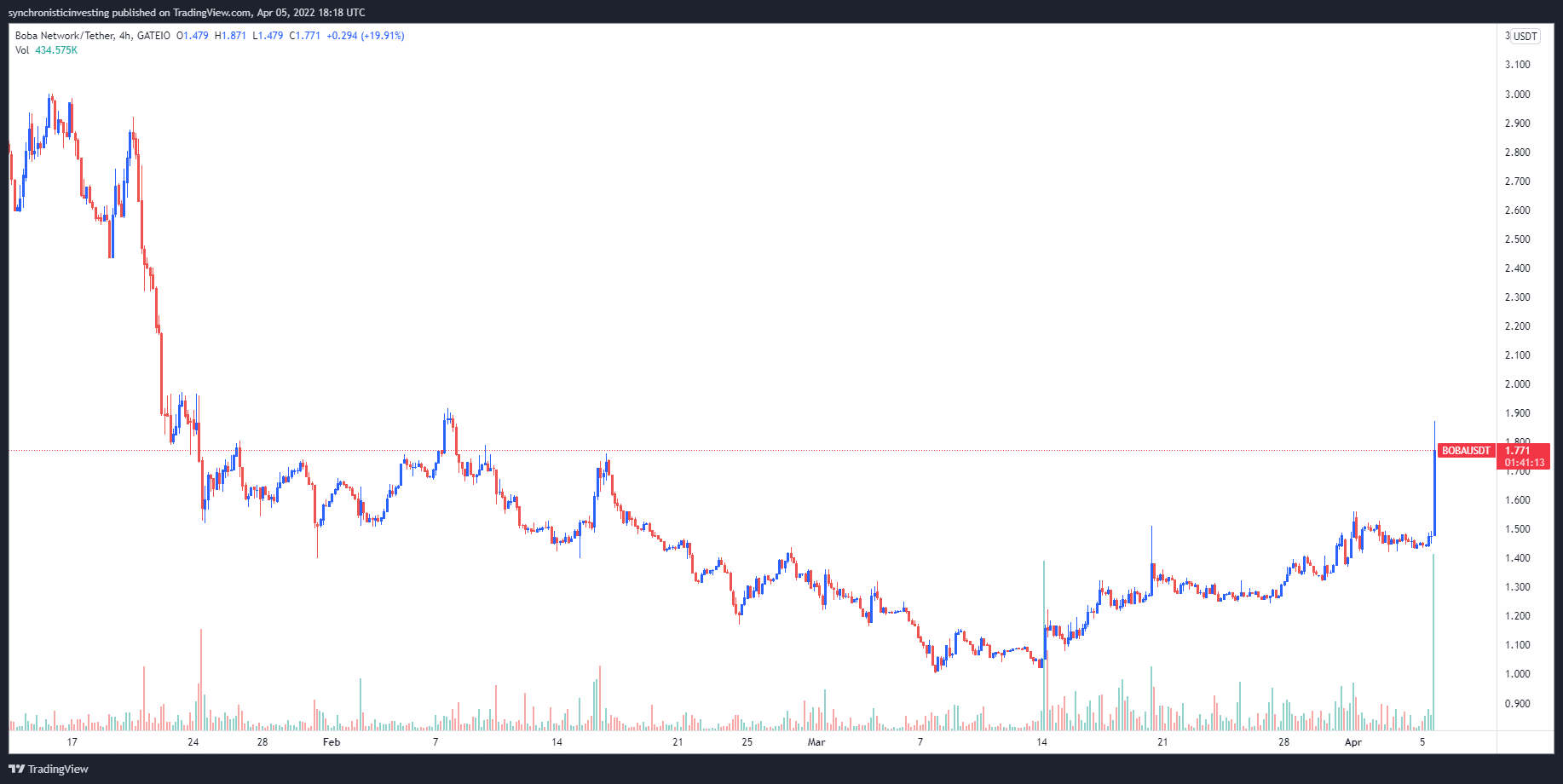
    Data from Cointelegraph Markets Pro and TradingView shows that BOBA has gained 50.71% over the past week and a half after climbing from a low of $1.24 on March 27 to a daily high at $1.873 on April 5.

    BOBA/USDT 4-hour chart. Source: TradingView

    Three reasons for the climbing price of BOBA include the completion of a $45 million Series A funding round, the launch of the WAGMI v2 incentives program and the expansion of the launch of new protocols on the network.

    Boba gets a boost from a $45 million funding round

    The most recent development providing a boost to the Boba Network was the successful completion of a $45 million Series A funding round, which was announced on April 5.

    Nearly 400 participants participated in the fundraiser including the venture capitalist firms Infinite Capital, Hypersphere, 10X Capital, Hack VC and Dreamers VC. More crypto-focused projects like The Graph, FEI Labs, Crypto.com and Huobi also participated in the funding round.

    The Boba Network currently has a $1.5 billion valuation and the team plans to use the funds to help make cryptocurrencies more accessible to the general public, overcome the computational limitations of Ethereum and provide blockchain developers with the tools needed to build new products.

    WAGMI v2 incentive program

    Another factor helping to bring increased activity and attention to the Boba Network was the launch of the WAGMI v2 incentive program, which is designed to help improve BOBA liquidity mining, grow the ecosystem and attract developers.

    WAGMI offers rewards to active users in the Boba Network ecosystem as a way to help increase the overall transaction count on the network as well as offering application-specific reward pools meant to bring more attention to the best DApps on the network.

    This second round of WAGMI began on April 1 and will run through the end of the month and includes up to $3 million worth of BOBA as rewards. Two million dollars of the amount is reserved for liquidity providers and there is a $1 million bonus incentive if the total monthly trading volume on OolongSwap reaches $25 million.

    Related: Ethereum L2 Boba Network valued at $1.5B following Series A

    Ecosystem growth boosts TVL

    A third factor helping to boost the valuation of the Boba Network has been its expanding ecosystem of protocols and DApps.

    This includes nonfungible token projects like Tapioca Town and Turing Town, decentralized finance protocols Symbiosis and Boba Brewery and integrations with the Pocket Network and The Graph.

    Unique Boba bridge users. Source: Dune Analytics

    According to data from Dune Analytics, 5,089 unique wallets have now interacted with the Boba Bridge, which currently has a total value locked at $712 million.

    The views and opinions expressed here are solely those of the author and do not necessarily reflect the views of Cointelegraph.com. Every investment and trading move involves risk, you should conduct your own research when making a decision.

  • Dogelon Mars (ELON) remains highly vulnerable despite the recent rally

    Dogelon Mars (ELON) remains highly vulnerable despite the recent rally

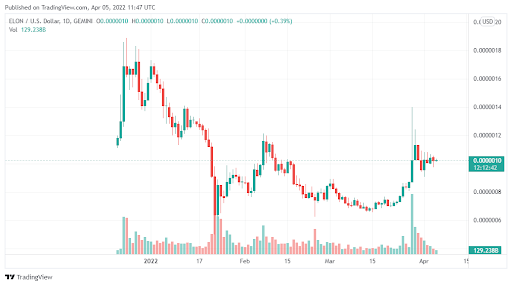
    Over the last two weeks, Dogelon Mars (ELON) has reported a sharp recovery from March lows. The coin, like many others in the market, is riding an upward wave of improved investor sentiment. But it seems like ELON is very vulnerable to a major sell-off. Here are the facts:

    • After that strong rally over the last two weeks, ELON has now firmly stagnated

    • The meme coin has since lost nearly 30% of its value from its highest price in March.

    • It is likely the downtrend will continue in the weeks ahead.

    Data Source: Tradingview 

    Dogelon Mars (ELON) – What to expect

    We knew that it was a matter of time before the ELON rally lost a bit of steam. But it seems the meme coin is reversing faster than expected. After surging to $0.0000014, ELON was trading at its highest level this year, and it had managed to smash past several key resistance zones.

    But the recent pullback is worrying. For instance, the meme coin has fallen about 30% from its March highs. More worryingly, it has dropped below $0.0000012, an important support zone that bulls couldn’t hold.

    At the moment, it looks like the price is consolidating with very modest losses in the last 24 hours. If bulls are able to find enough demand, $0.0000012 will be the next target. Failure to cross over that price will mean another pullback will be likely.

    How to play Dogelon Mars (ELON)?

    Meme coins are very tricky because they can swing up and down very fast. But for ELON, there is a short-term play here. So far, the coin has fallen below $0.0000012. 

    If somehow bulls can take the price above that, then you should consider buying. ELON will add at least 35% of its value above that resistance before any pullbacks. But for now, there is just too much risk to buy right away.

  • Quantstamp (QSP) could rally to $0.1 – Here is how this will happen

    Quantstamp (QSP) could rally to $0.1 – Here is how this will happen

    As trade volume for Quantstamp (QSP) fell sharply over the last two days, the price action has somewhat slowed. It seems like the coin is trying to consolidate the gains made over the last week before trying to rise again. But how far can it really go? Well, we’ll discuss this further but first, here are the latest developments:

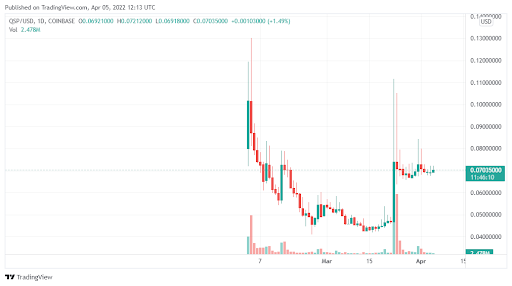
    • QSP is up nearly 83% from its lowest price in 2022.

    • The coin is also trading well above its 25- and 50-day moving averages

    • Despite this, Quantstamp is still facing major resistance before breaking to $0.1

    Data Source: Tradingview 

    Quantstamp (QSP) – The road to $0.1

    The biggest threat for QSP bulls is the fact that the coin has actually rallied after hitting its lows this year. In fact, the price is almost double its lowest level in 2022 and as such, QSP may be ready for a correction. Despite this, other indicators appear bullish. 

    For instance, QSP is now trading above its 25- and 50-day SMAs. This indicates an important bullish alignment. Also, the coin has consolidated gains in recent days, something that suggests people are not selling. What remains now is for bulls to try and smash the $0.078 resistance zone. 

    QSP is still a bit further away from that. However, if the price action pushes above that zone, then $0.1 will be the next stop. As a result, QSP could offer an upswing of about 45% from its current price.

    Quantstamp (QSP) – Should you go short or long?

    As a long-term asset, Quantstamp is actually a very decent buy. The coin has incredible underlying fundamentals and should be perfect. But there is also a very good short-term play here that can lead to very good gains. 

    $0.078 is the key, and If QSP manages to smash that, then there is enough upside to deliver at least 30% in additional gains.