Decentraland (MANA) is one of the biggest metaverse projects in crypto right now. But it is not alone in fact, many new projects have been coming up, and they are far cheaper and less risky. But why would you even be considering getting an alternative to MANA? Well, here are some facts:
Decentraland appears to have very limited upside potential.
Investors are always looking for new, more exciting projects.
There is a lot of room on the metaverse for a lot of coins to shine.
With that in mind, we decided to come up with a list of MANA alternatives that have immense potential. Here they are:
Genesis Worlds (GENESIS)
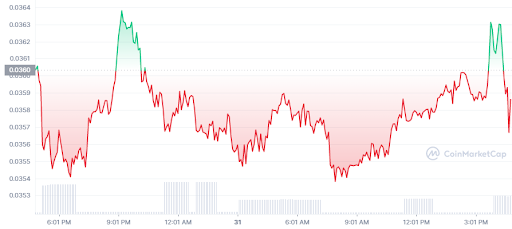
Genesis Worlds (GENESIS) dubs itself as the 100-year metaverse. Its concept is largely based on how Decentraland works. In essence, users get to buy virtual real estate and other virtual items that are backed by NFTs.
Data Source: Coinmarketcap.com
However, Genesis offers a more immersive virtual experience and is also adding social and gaming elements into its metaverse. What makes this project so exciting is the fact that it still has a market cap of around $1.4 million. The potential for growth is huge.
Terra Virtua (TVK)
Terra Virtua (TVK) is a blockchain project which is planning to combine NFTs and virtual reality fully. The aim of this project is to give users a way to interact with digital collectibles in an immersive experience within the metaverse. There will also be a virtual marketplace within the metaverse where users can sell and buy NFTs.
CEEK VR (CEEK)
CEEK VR (CEEK) is music and entertainment-centered virtual universe where artists can monetize their content within the metaverse. The aim is to promote virtual performances and concerts as well as celeb-inspired virtual communities. CEEK is a highly undervalued project with so much potential for growth.
Volatility is back in full force in the cryptocurrency market and the price of Bitcoin (BTC) has undergone several $1,000 swings over the past few days and select altcoins have seen their prices surge to new highs after major announcements.
The big winners on March 31 include protocols that focus on interoperability between the major blockchain networks as well as projects that are looking to release major updates in the near future.
Data from Cointelegraph Markets Pro and TradingView shows that the biggest gainers over the past 24-hours were SKALE Network (SKL), IOST and Celer Network (CELR).
SKALE Network prepares to launch v2.0
The SKALE Network is an Ethereum (ETH) native multichain scaling network focused on helping to run Solidity smart contracts at a greater speed for a fraction of the cost compared to operating on the Ethereum mainnet.
Data from Cointelegraph Markets Pro and TradingView shows that the price of SKL blasted 141% from a low of $0.1374 on March 25 to an intraday high of $0.3322 on March 31 amidst a 100% spike in its 24-hour trading volume.
SKL/USDT 1-day chart. Source: TradingView
The sudden surge in interest for SKL comes ahead of the launch of SKALE v2.0 and an increase in project exposure at a recent NFTLA networking event hosted by Blockdaemon.
IOST announces EVM-compatibility
IOST is a decentralized blockchain network that implements a “proof-of-believability” consensus protocol to achieve higher processing speeds than competing networks.
VORTECS™ data from Cointelegraph Markets Pro began to detect a bullish outlook for IOST on March 26, prior to the recent price rise.
The VORTECS™ Score, exclusive to Cointelegraph, is an algorithmic comparison of historical and current market conditions derived from a combination of data points including market sentiment, trading volume, recent price movements and Twitter activity.
As seen in the chart above, the VORTECS™ Score for IOST began to pick up on March 26, around two hours before the price began to increase 112% over the next five days.
The increase in demand for IOST came after the protocol revealed Project Entroverse, which will bring Ethereum Virtual Machine (EVM) compatibility to the IOST network and allow assets and applications to migrate between the two networks with ease.
The Celer Network is a layer-two scaling solution that employs off-chain transaction handling as a way to help increase processing speeds and decrease transaction costs.
VORTECS™ data from Cointelegraph Markets Pro began to detect a bullish outlook for CELR on March 29, prior to the recent price rise.
As seen in the chart above, the VORTECS™ Score for CELR climbed into the green on March 29 and hit a high of 82 around nine hours before the price increased by 41.48% over the next day.
The move higher for CELR follows the revelation that the network was chosen to become the official interoperability layer of the BSC Application Sidechain (BAS) on the BNB Smart Chain (BSC).
The overall cryptocurrency market cap now stands at $2.097 trillion and Bitcoin’s dominance rate is 41.7%.
The views and opinions expressed here are solely those of the author and do not necessarily reflect the views of Cointelegraph.com. Every investment and trading move involves risk, you should conduct your own research when making a decision.
On Thursday, USD Coin (USDC) operator Circle announced that it had selected financial institution BNY Mellon as the custodian of its USDC reserves. Founded in 1784, BNY Mellon is one of the oldest banks in America and possesses over $46.7 trillion in assets under custody or administration worldwide. It serves as a single point of contact for clients looking to manage their investments. With the new partnership, BNY Mellon said it will also explore the possibility of using digital cash for settlement purposes. Roman Regelman, CEO of asset servicing and head of digital at BNY Mellon, gave the following remarks:
“We are at a point in the evolution of our industry where the digitization of assets presents new and exciting opportunities to a broad range of market participants. As a custodian for USDC reserves, our role supports the broader marketplace and brings value to clients, founded on our role at the intersection of trust and innovation.”
Meanwhile, Jeremy Allaire, co-founder and CEO at Circle, added:
“As we continue to see exponential growth in USDC, the opportunity to work with BNY Mellon is one way we build bridges between traditional financial services and emerging digital asset markets without sacrificing trust.”
USDC is one of the fastest-growing dollar digital currencies globally with over $52 billion in circulation as of March 2022. As previously reported by Cointelegraph, the total supply of stablecoins hit $180 billion last month. The U.S. is one of the most regulatory-friendly countries regarding stablecoins, with Fed Governor Waller previously voicing skepticism as to the adoption of a central bank digital currency, saying that it would potentially stifle innovation in the private stablecoin sector.
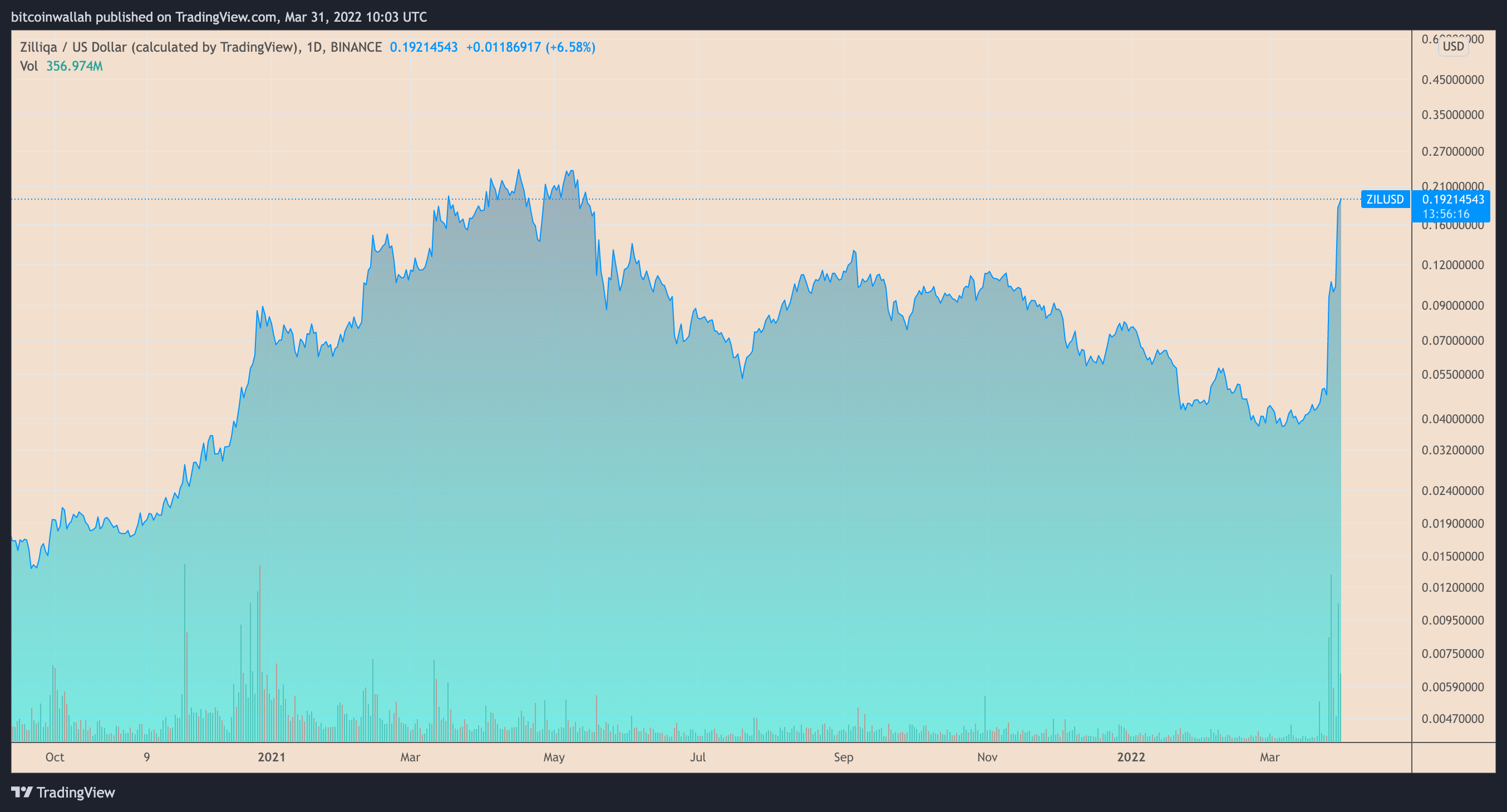
Zilliqa (ZIL) continues its supersonic bull run this week after reports that it will officially launch a so-called metaverse-as-a-service (MaaS) platform in April.
ZIL rallied nearly 25% in one day to $0.22 a token by Wednesday, its best level since May 13, 2021.
Its strong move came as a part of a rebound rally that started March 26 when it was trading for as low as $0.047. As a result, its net gains in the past six days came out to be more than 350%.
ZIL/USD daily price chart. Source: TradingView
Metaverse FOMO
Traders started flocking to the Zilliqa market a day after it announced the launch of Metapolis, a MaaS platform built on Nvidia Omniverse, during a VIP event coming April 2 in Miami.
The metaverse concept and the companies trying to build it attracted nearly $3 billion in funding in 2021 compared to $2.33 billion in the year before that, according to data intelligence firm Dealroom.
Investments into Metaverse startups in the recent years. Source: Dealroom
Notably, metaverse developers have been building everything from virtual events to host fashion shows to all-and-all marketplaces that sell physical goods in the real world, as well as digital ones accompanied by nonfungible tokens (NFT). In November 2021, Facebook’s parent company also changed its name to Meta Platforms Inc. to show its new focus on applications in a virtual universe.
Zilliqa shared its plans to tap the booming sector via Metapolis, revealing that it had already “amassed $2 million in pre-launch revenues from its client pipeline,” including Agora, a digital art platform that would host a virtual award event on the Zilliqa metaverse.
ZIL, which serves as a utility token inside the Zilliqa ecosystem to execute smart contracts and cover transaction fees, appears to be benefiting from the metaverse hype. Nonetheless, from a technical perspective, the coin has rallied too much, too quickly to sustain its profits near the local highs.
ZIL selloff ahead?
Zilliqa has become an “overbought” asset on both its daily and weekly period charts, according to its relative strength index (RSI) readings above the threshold of 70, as of March 31.
ZIL/USD weekly price chart. Source: TradingView
ZIL experienced a selloff upon nearing its interim resistance level of $0.235, also the 1.0 Fib line of the Fibonacci retracement graph — drawn from $0.235-swing high to the $0.037-swing low.
As such, the ZIL/USD pair dropped by over 12% to test the 0.786 Fib line near $0.193 as interim support, and eyed further downside momentum with its RSI still above ’70.’
90 RSI and at resistance, if you own this, probably not a bad time to take profit pic.twitter.com/slyUrEsG1C
— Don’t Follow ShardETH B If You Hate Money $ (@ShardiB2) March 30, 2022
Meanwhile, ZIL appeared to have been trading inside a giant symmetrical triangle since August 2020, confirmed by at least two reactive highs on its upper falling trendline and two reactive lows on its lower rising trendline.
On March 31, the Zilliqa token retested the triangle’s upper trendline (around $0.19) for a potential pullback move toward the lower trendline (below $0.08). That amounts to at least a 55% price drop in the coming weekly sessions if the pattern pans out as expected.
Conversely, a decisive break above the resistance confluence, including the triangle’s upper trendline and two Fibonacci levels, could have ZIL eye $0.35 next, coinciding with the 1.618 Fib line.
The views and opinions expressed here are solely those of the author and do not necessarily reflect the views of Cointelegraph.com. Every investment and trading move involves risk, you should conduct your own research when making a decision.
Several metaverse cryptocurrencies have been bullish as the crypto market traded sideways this week and one of the coins namely Dotmoovs (MOOV) has rallied by more than 228% today.
At press time $MOOV was trading at $0.02192 up 228.72% having hit a daily high of $0.02528. It has a trading volume of $6,725,055 and a market cap of $7,997,493.
This article explains the factors behind the current surge of Dotmovoovs (MOOV) price.
What Is Dotmoovs (MOOV)?
Before taking a deep dive into the current bullish trend, it’s important we first explain what Dotmoovs (MOOV) coin is.
Dotmoovs (MOOV) is the native cryptocurrency of Dotmoovs, a peer-to-peer sports competition platform with an Artificial Intelligence (AI) algorithm that offers incredible Metaverse competitions and rewards winners using MOOV tokens.
By using AI technology, Dotmoovs provides a play-to-Earn metaverse for users to participate in. At the moment, the platform has two types of sports: Dance with robust AI as the judge and freestyle football with an AI-powered referee to make judgments during competition.
Dotmoovs also has a marketplace where users can purchase and collect NFTs.
Why is Dotmoovs (MOOV) price rising?
The main reason for the current surge of MOOV price is the hype around the upcoming release of the Dance Section.
Dance section release
Once the Dance Section is launched, Dotmoovs’ users will be able to hold dance competitions and challenges within the app. It can be compared to TikTok and it will probably make Dotmoovs market valuation shoot to the moon.
Today, on a video released on Telegram, CEO & COO of @dotmoovs addressed the Dance release date on the app
According to Dotmoovs’ team, the Dance feature will be launched during International Dance Day on the 29th of April this year.
With the current bullish trend, it is clear that the market is extremely excited about the release of the upcoming launch of the Dotmoons Dance section.
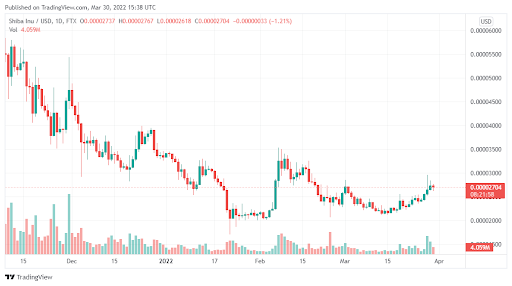
Shiba Inu (SHIB) has enjoyed a period of rallying as the broader market saw gains in the last week or so. But even as bulls try to get the coin up and up, they have had to face several major resistance zones in the process. But SHIB could swing up by 20% in the near term. Here are the latest facts on the price action:
Bullish run for SHIB is facing major resistance at $0.0000273
The coin has tested that price in the last few days but has failed to overcome
SHIB could rise by another 20% if indeed that zone is breached in the coming days.
Data Source: Tradingview
Shiba Inu (SHIB) – Price analysis and prediction
After showing a lot of weakness at the start of March, Shiba Inu and most meme coins have all rallied. The coin has now managed to pair up some of the losses made this year and is already above its 20- and 50-day exponential moving averages.
Despite the recent uptrend, SHIB has faced major resistance at $0.0000273. Bulls have tested the price several times in the last two trading sessions but so far it has not been breached.
However, looking at other momentum indicators, it is likely that the overhead resistance will break. When this happens, SHIB could surge by over 20%. But if bulls somehow fail to get over that price, the token could fall back to $0.0000231.
Is Shiba Inu (SHIB) ideal for buying?
There is a short-term play here with the $0.0000273 resistance. If the price action goes above that, you can expect a swing of at least 20%, so it will be a good time to buy.
As for long-term investors, it would be best to wait for a significant pullback before you buy. You do not want to be buying close to resistance.
Please be aware that some of the links on this site will direct you to the websites of third parties, some of whom are marketing affiliates and/or business partners of this site and/or its owners, operators and affiliates. We may receive financial compensation from these third parties. Notwithstanding any such relationship, no responsibility is accepted for the conduct of any third party nor the content or functionality of their websites or applications. A hyperlink to or positive reference to or review of a broker or exchange should not be understood to be an endorsement of that broker or exchange’s products or services.
Risk Warning: Investing in digital currencies, stocks, shares and other securities, commodities, currencies and other derivative investment products (e.g. contracts for difference (“CFDs”) is speculative and carries a high level of risk. Each investment is unique and involves unique risks.
CFDs and other derivatives are complex instruments and come with a high risk of losing money rapidly due to leverage. You should consider whether you understand how an investment works and whether you can afford to take the high risk of losing your money.
Cryptocurrencies can fluctuate widely in prices and are, therefore, not appropriate for all investors. Trading cryptocurrencies is not supervised by any EU regulatory framework. Past performance does not guarantee future results. Any trading history presented is less than 5 years old unless otherwise stated and may not suffice as a basis for investment decisions. Your capital is at risk.
When trading in stocks your capital is at risk.
Past performance is not an indication of future results. Trading history presented is less than 5 years old unless otherwise stated and may not suffice as a basis for investment decisions. Prices may go down as well as up, prices can fluctuate widely, you may be exposed to currency exchange rate fluctuations and you may lose all of or more than the amount you invest. Investing is not suitable for everyone; ensure that you have fully understood the risks and legalities involved. If you are unsure, seek independent financial, legal, tax and/or accounting advice. This website does not provide investment, financial, legal, tax or accounting advice. Some links are affiliate links. For more information please read our full risk warning and disclaimer.
There has been a lot of talk about the crypto rally over the last two weeks or so. Many coins have posted gains in double digits, while others like Zilliqa have hogged the headlines with their massive uptrends. Why has the crypto market surged anyway? Here are some reasons:
Uncertainty around the fed rate hike appears to have died out.
Investors are flocking into crypto as a bet against growing inflation.
The downtrend at the start of 2022 has provided the perfect dip to buy in.
Well, with all the factors above, a few coins appear to have really rallied, and yet they haven’t gotten a lot of attention. Here they are:
Aave (AAVE)
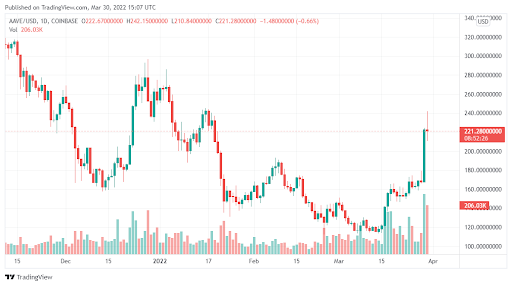
As one of the leading DeFi protocols in the world, Aave (AAVE) has always had a positive long-term outlook. But the last two months have been quite volatile for the coin. It had bottomed to new yearly lows in 2022, and there was very little hope of any rebound.
Data Source: Tradingview
Despite this, AAVE has rebounded sharply and in fact, the coin has posted gains of nearly 50% over the last 7 days. This is one of the best weeks for AAVE this year.
Chiliz (CHZ)
The story of Chiliz (CHZ) is also filled with surprising turns. Like many altcoins, it was routed during the start of the year and failed to find any serious upward momentum. But just out of nowhere, the coin started to shoot up and has maintained that uptrend ever since. CHZ has gained over 50% in the past week alone.
STEPN (GMT)
We were expecting STEPN (GMT) to see gains in the last few days. But so far, the bullish breakout has been astonishing. The coin has delivered 80% in gains in just a day and is already up by a whopping 180% over the last 7 days. It is one of the top performers in crypto now.
When Solana (SOL) was launched, it was seen as the most serious alternative for Ethereum. Ever since the blockchain has seen massive growth and continues to attract a host of top projects as well. But why is Solana highly rated by developers around the world? Here are the main reasons:
The chain offers high scalability for DAPPs.
The overall gas fees are way lower compared to other blockchains.
Solana also runs various incentives designed to bring in as many developers as possible.
For investors looking for promising projects built on the Solana blockchain, we have a list of three here below that you can check out:
Serum (SRM)
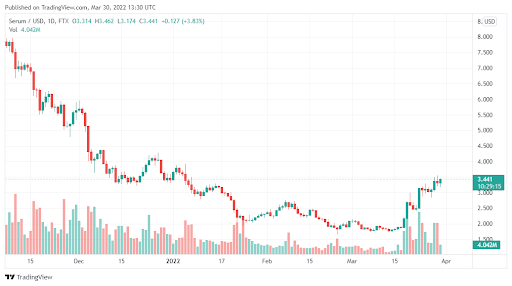
Serum (SRM) is the main DEX for the Solana network. It is designed to reflect all the attributes of the blockchain, including better speeds, security, and low fees. Serum is however more than just an exchange.
Data Source: Tradingview
It’s an integrated DeFi protocol as well that allows it to offer additional services like staking and others. So far, the Serum DEX has a market cap of around $453 million. There is more room for Serum to surge in the long term.
Star Atlas (ATLAS)
Play-to-earn is seen as one of the most promising subsectors of the blockchain industry. We have seen these games go on to report massive gains in 2021, and this trend is likely to continue.
Solana has also attracted its fair share of Play-to-earn, and Star Atlas (ATLAS) is one of the most notable ones. The game is developed by the Unreal engine and is set in an immersive virtual universe.
Raydium (RAY)
Raydium (RAY) is a liquidity provider that works using an automated market maker protocol. The goal for Raydium is to provide liquidity for the Serum DEX, but there are plans to expand it further. RAY is currently on a market cap of $350 million.
The play-to-earn space of the blockchain ecosystem has seen immense growth over the last few months. In fact, Axie Infinity, which is one of the main projects in play-to-earn, saw massive gains in 2021. Here is why play-to-earn will continue to grow:
There is increased integration of blockchain gaming with the metaverse
Play-to-earn has also seen increased NFT integration as well.
We are likely to see increased institutional capital towards play-to-earn.
So, if you want solid Axie Infinity alternatives, here are the top 3 coins that you consider in the meantime.
Splinterlands (SPS)
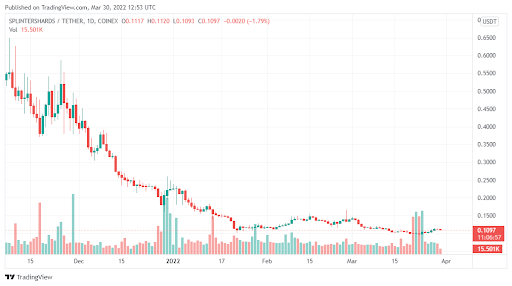
Splinterlands (SPS) is largely a collectible card game that involves rapid battles between users as well. In essence, players will get the chance to build a unique collection of cards, each backed by NFTs. They will then try to battle each other in a wide range of skill-based games where winners earn rewards.
Data Source: Tradingview
It is also possible to buy and sell collectibles within the Splinterlands universe. The native and governance token for the game is called Splintershards, and its current market cap is around $65 million. This suggests it has the potential to go further.
Battle of Guardians (BGS)
Developed by Unreal Engine, Battle of Guardians (BGS) is a multiplayer NFT powered fighting game. It has multi chain capabilities as well since users can access it either via the Binance Smart Chain or Solana. The game offers a truly immersive experience and is one of the most exciting play-to-earn projects in the market right now.
CryptoKitties (WCK)
CryptoKitties (WCK) is a blockchain based game that lets users collect and breed cute digital kitties. All these kitties are backed by NFTs as well. The game has a dedicated catalogue where players can also view and buy kitties that they want. CryptoKitties was released in 2017, and while it was slower to hit the ground running compared to Axie, it has since managed to gain a huge following.
 Data Source: Coinmarketcap.com