Category: TRENDING

  • Dogecoin signals bottoming out as DOGE rebounds 30% in two weeks — What’s next?

    Dogecoin signals bottoming out as DOGE rebounds 30% in two weeks — What’s next?

    A brutal correction witnessed in the Dogecoin (DOGE) market between May 2021 and February 2022, which saw the price dropping by almost 85%, appears to have come to a halt this month.

    DOGE/USD rebounds 30% in two weeks

    DOGE experienced strong dip-buying when its price crashed to levels around $0.10 two weeks ago, resulting in a 30% rebound move to $0.14 as of March 27. Meanwhile, the coin’s upside retracement originated at a support level that constitutes a “falling wedge” setup, signaling an extended bullish reversal in the weekly sessions ahead.

    In detail, a falling wedge pattern occurs when the price trends lower while fluctuating between two downward sloping, converging trendlines. In a perfect scenario, the setup results into the price breaking out of the descending range to the upside, rising by as much as the maximum distance between wedge’s upper and lower trendlines. 

    DOGE/USD weekly price chart featuring ‘falling wedge’ pattern. Source: TradingView

    DOGE’s rebound from the wedge’s lower trendline two weeks ago opens up its possibilities to continue the move upside toward the upper trendline — near $0.18. As such, breaking above the upper trendline further exposes Dogecoin’s price rise toward $0.37, up more than 150% from today’s price.

    DOGE risks

    Veteran investor Tom Bulkowski sees a falling wedge as a “poor performer” when it comes to predicting bullish chart patterns, noting that their “breakeven failure is high and the average price is low.” He cites a study of 800 trades that shows that the possibility of a falling wedge breakout meeting its bullish target is near 62%.

    Additionally, Dogecoin’s track of record of showing a period of highly positive correlation with Bitcoin (BTC) — at 0.94 against the perfect score of 1 as of March 27 — could also limit its bullish bias if the latter drops due to ongoing macroeconomic and geopolitical pressures.

    The correlation coefficient between DOGE/USD and BTC/USD. Source: TradingView

    Related: Bitcoin sellers keep BTC price action in check amid $45K ‘fakeout’ warning

    Mice McGlone, the senior commodity strategist at Bloomberg Intelligence, noted that Bitcoin could drop to as low as $30,000 due to its strong correlation with the U.S. stock market. Nonetheless, he maintained that BTC’s price should recover from its bearish slump to target $100,000 in the long term.

    DOGE price levels to watch out next

    Dogecoin’s latest rebound move now eyes a quick run-up towards the $0.15-0.19 area, a range encapsulating three psychological resistance levels: the 20-day exponential moving average (20-day EMA; the green wave), the 50-day EMA (the red wave), and the 0.618 Fib line (near $0.19) of the Fibonacci retracement graph — all shown in the chart below.

    DOGE/USD daily price chart. Source: TradingView

    A strong pullback, accompanied by a rise in volume, from the said resistance area could have DOGE test the 0.786 Fib line near $0.10 as its interim downside target. Conversely, a decisive move above the range could result in an extended upside momentum towards $0.24, with an eye on $0.30 and $0.37 (also the falling wedge target).

    Conversely, a decisive move above the range could result in an extended upside momentum toward $0.24, with an eye on $0.30 and $0.37 (also the falling wedge target).

    The views and opinions expressed here are solely those of the author and do not necessarily reflect the views of Cointelegraph.com. Every investment and trading move involves risk, you should conduct your own research when making a decision.

  • What is a cryptocurrency mixer and how does it work?

    What is a cryptocurrency mixer and how does it work?

    The rapid expansion of cryptocurrencies and the development of crypto infrastructure and vulnerabilities like crypto mixers or tumblers have been a source of concern for government agencies in charge of financial security.

    Many people use crypto mixers to keep their cryptocurrency transactions private by mixing potentially identifiable cryptocurrency funds with vast sums of other funds. These services are often used to anonymize fund transfers between services and do not require Know Your Customer (KYC) checks.

    As a result, the risk of employing crypto mixers to launder money or conceal earnings is pretty considerable. Mixers and online gambling sites have the most severe money laundering issues, as they process the vast majority of dirty currencies. Mixers, for example, have consistently processed about a quarter of all incoming illicit Bitcoin (BTC) each year, while the proportion laundered through exchanges and gambling has remained relatively steady (66 to 72%).

    There are two types of Bitcoin mixers: namely centralized and decentralized mixers. Companies that receive Bitcoin and send back different BTC for a fee are known as centralized mixers, providing a simple solution for tumbling Bitcoin. 

    Decentralized mixers use protocols like CoinJoin to obfuscate transactions using either a completely coordinated or peer-to-peer (P2P) approach. Essentially, the protocol allows a big group of users to pool an amount of BTC and then redistribute it such that everyone receives one Bitcoin. Still, no one can know who received what or where it originated from.

    Other types of coin mixers include obfuscation-based and zero-knowledge-based mixers. Obfuscation-based mixers, often called decoy-based mixers, employ ways to conceal a user’s transaction graph. An adversary with sufficient resources, on the other hand, can recreate the transaction graph using a variety of ways. 

    On the contrary, zero-knowledge-based mixers rely heavily on advanced cryptographic techniques like zero-knowledge proofs to fully erase the transaction graph. The most significant disadvantage of this strategy is that it necessitates extensive cryptography, which may limit scalability.

  • Kava (KAVA) could hit $40 in the near time – Reason to Buy?

    Kava (KAVA) could hit $40 in the near time – Reason to Buy?

    The crypto market, in general, has steadied after a very volatile period during the start of 2022. Analysts are now focusing on long-term outlooks, and one coin that has grabbed the attention of everyone is Kava (KAVA). Could it actually hit $40 by year-end? Here is what you need to know:

    • Short term volatility has put a lot of pressure on KAVA

    • Hitting $40 will mean that the coin needs to grow 10X from its current price

    • While this looks farfetched, it is not entirely impossible

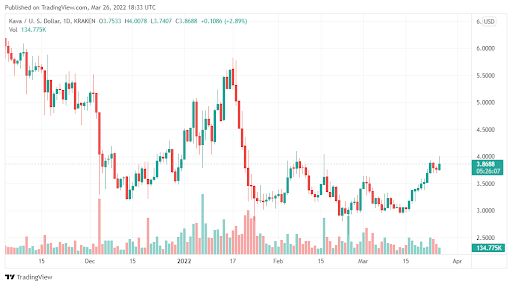
    Data Source: Tradingview 

    Kava (KAVA) – The road to $40?

    At the moment, KAVA is trading at around $3.89. Based on the performance of the crypto market over the last three months, it’s hard to imagine that KAVA could grow 10x before the year is out. But it’s actually not that hard to imagine. 

    There are several reasons for this. First, Kava is adding EVM support. The move will make it interoperable with ERC 20 tokens. This is likely going to push more DeFi projects into the network. Also, EVM support means that apps already built for Ethereum can be deployed on Kava. 

    In addition to this, it seems like the sentiment in the market is actually looking better than it did three months ago. Investors have started to price in the economic and geopolitical factors at play. As the broader market surges, KAVA could still follow. Despite this, we still think there are so many downside risks that will make the $40 dream very hard to achieve.

    Is Kava (KAVA) worth the risk?

    Kava is a great project and has been for the last few months. It has simply suffered from the general trend in the market. But its long-term value still remains very high. The fact that it’s adding more interoperability into its system is a big deal. Even if it doesn’t hit $40, it could still offer 3x or 4x growth.

  • Terra (LUNA) Staring at possible correction – Here is what to expect next

    Terra (LUNA) Staring at possible correction – Here is what to expect next

    After seeing gains over the past few trading sessions, Terra (LUNA) has stagnated and is starting to pull back. We have also seen the price action hover around a very tight range. We may see a small correction in LUNA in the near term. Here are some of the facts:

    • After surging for a few days, it is likely investors will take profit.

    • Failure to clear above $90 at the start of trading Monday could suggest weakness.

    • The relative Strength Index also shows a bearish outlook in the days ahead.

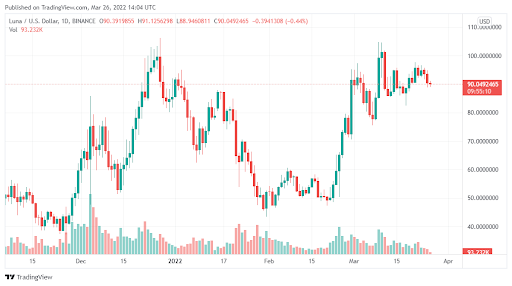
    Data Source: Tradingview 

    How far can Terra (LUNA) drop?

    We are not looking at a huge drop here. In fact, in the last 24 hours, the stablecoin platform had lost around 1%, but more will come. The key will be to look at the $90 mark. This had always proved to be a key support zone for LUNA. 

    If at the start of trading on Monday the coin is well below that, then we could see a wipeout of at least 15% before the end of the week. Besides, there is a trend in this volatile market over the last few months to note.

    You see, in most cases, bullish momentum is driven by short-term speculative traders. It is likely they will lock profit at $90. This is going to trigger a mini sell-off that could push LUNA further towards $75.

    Is Terra (LUNA) worth your time?

    Well, the fact that Terra (LUNA) is among the top 10 crypto assets in the market means that you should give it your attention. But it doesn’t seem like there is any serious upside momentum right now. 

    A good play will be to wait for the correction to come through in the coming days and then buy at $75 or thereabout. But short sellers can also play the short-term decline for a profit.

  • Yuga Labs fetches $450M in funding, Charles Hoskinson’s prediction falls short and spot BTC ETFs incoming? Hodler’s Digest, March 20-26

    Yuga Labs fetches $450M in funding, Charles Hoskinson’s prediction falls short and spot BTC ETFs incoming? Hodler’s Digest, March 20-26

    Coming every Saturday, Hodler’s Digest will help you track every single important news story that happened this week. The best (and worst) quotes, adoption and regulation highlights, leading coins, predictions and much more — a week on Cointelegraph in one link.

    Top Stories This Week

    NFT creator Yuga Labs raises $450M, bringing company valuation to $4B

    The creators of the wildly popular Bored Ape Yacht Club NFTs, Yuga Labs, raised $450 million in seed funding at a $4 billion valuation. Unsurprisingly, top venture capital firm and cash cow Andreessen Horowitz (a16z) led the round. 

    Yuga Labs, which also recently launched ApeCoin and announced an upcoming metaverse platform, intends to use the funds to increase its employee base, attract more creative, engineering and operations talent, as well as support joint ventures and partnerships.

    Yuga Labs has been stacking wins over the past 12 months, with CEO Nicole Muniz emphasizing that “there‘s a lot to come” given the “new economy” of intellectual properties in the company’s roster. Yuga Labs recently bought the IP of CryptoPunks and Meebits from Larva Labs and plans to give full commercial rights to NFT holders.

    Charles Hoskinson cheekily admits: ‘I was wrong’ about DApp rollout

    In a bit of self-aware humor, Cardano founder Charles Hoskinson pointed out that his prediction about there being “thousands of assets and DApps” on the network by 2021 fell short significantly. 

    He made the comments on Twitter but appeared to misremember his own words, as he had predicted back in July 2020 that, by 2021, there would be “hundreds of assets and thousands of DApps” on Cardano. 

    The number of assets appears to have exceeded expectations thanks to NFT minting platforms; however, DeFi Llama lists a mere seven DApps on the blockchain, accounting for a total of $315.72 million total value locked (TVL).

    SEC could approve spot Bitcoin ETFs as early as 2023 — Bloomberg analysts

    Bloomberg’s highly clued-in ETF analysts Eric Balchunas and James Seyffart have suggested that a proposed rule change within the U.S. Securities and Exchange Commission (SEC) could result in the regulator approving a BTC spot ETF by mid-2023. 

    Balchunas stated on Thursday that crypto platforms could fall under the SEC’s regulatory framework if the commission were to approve the amendment to the Exchange Act proposed in January, which would change the definition of “exchange.” The move would enable crypto platforms “trading any type of security” to be included under the act. 

    “Once crypto exchanges are compliant, the SEC’s primary reason for denying spot Bitcoin ETFs would no longer be valid, likely clearing the way for approval,” said the analysts in a joint statement.

    Stargate Finance attracts $1.9B in six days

    Cross-chain protocol Stargate Finance has attracted more than $1.9 billion worth of TVL in less than a week since launching. 

    The platform’s rapidly growing TVL is most likely a result of the cap of 26% APY offered for farming stablecoin deposits. Stargate Finance touts itself as a protocol that enables users to transact native assets across various chains. Users can also stake assets in pools to receive Stargate token (STG) rewards. 

    Alameda Research CEO Sam Trabucco announced that the firm had heavily backed the project, snapping up all available Stargate tokens that had been auctioned off during Stargate’s launch on March 17.

    Crypto users in Africa grew by 2,500% in 2021: Report

    Crypto use in Africa surged a mammoth 2,500% in 2021, according to a report from crypto exchange KuCoin. 

    The report cited interesting data, such as “more than 88.5% of cryptocurrency transactions made by Africans” being cross-border transfers. It argued that the low fees mean that “users pay less than 0.01% of the overall amount of the transaction transferred in cryptocurrencies.”

    Johnny Lyu, CEO of KuCoin, told Cointelegraph that “the adoption of digital assets in Africa will continue to grow exponentially,” adding that “African countries have the highest crypto adoption rate in the world, outperforming even the biggest regions, such as the United States, Europe and Asia.”

    Winners and Losers

    At the end of the week, Bitcoin (BTC) is at $44,118, Ether (ETH) at $3,136 and XRP at $0.83. The total market cap is at $2 trillion, according to CoinMarketCap.

    Among the biggest 100 cryptocurrencies, the top three altcoin gainers of the week are Ethereum Classic (ETC) at 79.59%, Loopring (LRC) at 57.71% and Bitcoin Gold (BTG) at 53.40%.

    The top three altcoin losers of the week are ApeCoin (APE) at 8.09%, UNUS SED LEO (LEO) at 2.85% and Maker (MKR) at 2.02%.

    For more info on crypto prices, make sure to read Cointelegraph’s market analysis.

    Most Memorable Quotations

    “Never in my wildest dreams would I have thought that the US Government would be afraid of what we are doing here.”

    Nayib Bukele, president of El Salvador

    “Avoiding scams should always stem from a common history with the requestor — i.e., to determine if they are who they claim they are — to ask for a common reference. (Yesterday, this type of question was the first I asked this scammer, and the response almost confirmed that he’s not John.)”

    Felix Crisan, long-time Bitcoiner

    “Remember when I predicted thousands of assets and DApps on Cardano? Well I was wrong, there are now millions of native assets issued and DApps are now in the hundreds. #SlowAndSteady.”

    Charles Hoskinson, co-founder of Cardano

    “You will continue seeing us take that approach as we try to shepherd companies into Web3. A lot of this is driven by ‘how do we accelerate the adoption of Web3?’ because one of the bigger risks as we see it, is that if people don‘t move into the space quickly enough then inadvertently we will perhaps also create another kind of elite.”

    Yat Siu, co-founder and chairman of Animoca Brands

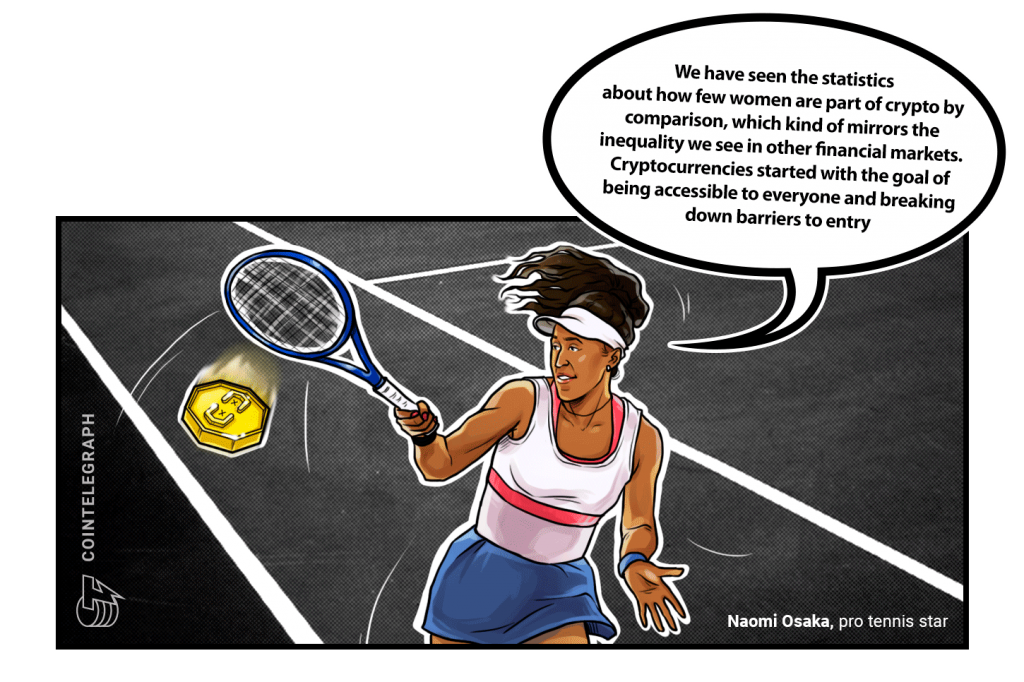
    “We have seen the statistics about how few women are part of crypto by comparison, which kind of mirrors the inequality we see in other financial markets. […] Cryptocurrencies started with the goal of being accessible to everyone and breaking down barriers to entry.”

    Naomi Osaka, pro tennis star

    “Take a look at the way in which cars, mobile phones and consumer electronics took off on the continent. Africa is a continent where lightning-fast progression and adoption is common.”

    Nourou, founder of Bitcoin Senegal

    “If you want to be a pioneer on the virtual frontier of innovation, Australia is open for business. As the Minister for the digital economy and the Minister for financial services, I am backing you.”

    Jane Hume, Australian Senator

    “You can’t solicit funds for a business opportunity, abandon that business and abscond with money investors provided you. Our team here at IRS-CI and our partners at HSI closely track cryptocurrency transactions in an effort to uncover alleged schemes like this one.”

    Thomas Fattorusso, special agent-in-charge at IRS Criminal Investigation

    Prediction of the Week 

    Internet Computer eyes 50% move as ICP enters ‘falling wedge’ breakout territory

    With the price of Internet Computer (ICP) on a surge of late, Cointelegraph’s Yashu Gola has read the charts and outlined a bullish scenario in which ICP reaches the $27 region by next month. The move would mark a hefty 50% gain since it was priced at around $17.75 on Tuesday. 

    Gola pointed to a “convincing falling wedge breakout in action” backed by an increase in trading volumes and continual price inclines. 

    “In a ‘perfect’ scenario, breaking out of a falling wedge pattern — to the upside — can see a subsequent price rally by as much as the maximum distance between the wedge’s upper and lower trendline. That may put ICP en route to over $27 — by almost 50% — sometime by April,” Gola said.

    FUD of the Week 

    Thailand SEC bans crypto payments, seeks disclosure of system failure from exchanges

    Thailand’s Securities and Exchange Commission has banned crypto payments after discussing its implications with the Bank of Thailand (BOT) via a joint study. Some of the risks highlighted by the SEC include a lot of common critiques of crypto, including price volatility, cyber theft, money laundering and personal data leakage. 

    Businesses found in non-compliance with the new crypto laws will be subject to legal actions including temporary suspension or cancellation of the services. 

    “[Crypto payments] may affect the stability of the financial system and overall economic system including risks to people and businesses,” the joint study conducted by the BOT and SEC concluded.

    Li Finance protocol loses $600,000 in latest DeFi exploit

    The Li Finance swap aggregator protocol was the victim of a smart contract exploit that resulted in the loss of $600,000 worth of tokens, including USD Coin (USDC), Polygon (MATIC), Rocket Pool (RPL), and Gnosis (GNO), to name a few. 

    During the early hours of the morning of March 20, the hacker was able to extract varying amounts of 10 different tokens from wallets that had given “infinite approval” to the Li Finance protocol. The team found out about the hack an eye-watering 12 hours later and shut down all swapping functions on the platform in order to prevent any further losses. 

    The team said that the attacker swapped the stolen tokens for a total of about 205 Ether (ETH) valued at roughly $600,000.

    DeFiance Capital founder loses $1.6M in hot wallet hack

    The founder of crypto investment firm DeFiance Capital, pseudonymously known as  “Arthur_0x,” lost a whopping $1.6 million worth of NFTs and crypto via a hot wallet hack. 

    After asking the community to help blacklist the hacker’s wallet, many people also jumped in to help retrieve some of the stolen assets. An NFT proponent going by the pseudonym “Cirrus” even went as far as to buy two of the stolen Azuki NFTs and return them to the founder at cost.  

    Cirrus told Cointelegraph on Tuesday that he “found out they were hacked, and instead of selling them for profit like the other folks who got some of [Arthur_0x’s NFTs], decided I’d sell them back to him at cost to help him out.”

    Best Cointelegraph Features

    Powers On… Biden accepts blockchain technology, recognizes its benefits and pushes for adoption

    Powers On… is a monthly opinion column from Marc Powers, who spent much of his 40-year legal career working with complex securities-related cases in the United States after a stint with the SEC. He is now an adjunct professor at Florida International University College of Law, where he teaches a course on “Blockchain & the Law.”

    DEXs and KYC: A match made in hell or a real possibility?

    Decentralized exchanges must figure out how to up their Know Your Customer compliance before the regulation wave hits.

    The metaverse will change the paradigm of content creation

    The metaverse is a new frontier for business, and creators will be the first to benefit from showcasing products and services to followers.

  • Loopring (LRC) price surges by 50% after GameStop NFT marketplace integration

    Loopring (LRC) price surges by 50% after GameStop NFT marketplace integration

    Filling multiple needs within the cryptocurrency community is one way a project can set itself apart from the competition and new attract users and liquidity to its ecosystem. 

    Loopring aims to do exactly this by aiming to offer a EVM-based solution with low fees where DeFi and NFT developers and investors can transact. The layer-two (L2) scaling solution utilizes zk-Rollups to provide fast, low-cost transactions and the project has been gaining traction throughout the month of March.

    Data from Cointelegraph Markets Pro and TradingView shows that the price of LRC gained 57% between March 21 and March 23 as its price increased from $0.78 to $1.23 amidst a spike in its 24-hour trading volume to $2.75 billion.

    LRC/USDT 4-hour chart. Source: TradingView

    Three developments that have helped spark the reversal in price for LRC include the beta launch of the GameStop NFT marketplace on the Loopring network, the inflow of new users and a rapidly expanding NFT ecosystem.

    GameStop selects Loopring for its upcoming NFT Marketplace

    The most significant recent development that helped to drive the  increase in demand for LRC was the March 23 announcement that GameStop has integrated the beta version of its NFT marketplace with the Loopring network.

    GameStop reports that it chose Loopring to host its NFT marketplace due to the network’s ability to mint NFTs for a fraction of the cost required on Ethereum, with the average fee being less than $1.

    Beta users can begin exploring the marketplace now and deposit funds in preparation for the platform’s full lauch which is expected to take place in the near future.

    Surging user growth

    A second factor putting wind in the sails of LRC has been the surge in new users in the Loopring ecosystem as evidenced by the record-high number of wallets joining the netw.

    Total number of Loopring wallets. Source: Dune Analytics

    According to data from Dune Analytics, the wallet count of the Loopring network has increased from 6,498 on Oct. 30, 2021 to an all-time high of 27,092 on March 25 as the GameStop announcement helped initiate a new of wave users.

    The recent release of the Loopring Smart Wallet, which includes the ability to mint NFTs and retrieve a lost account via social recovery and Guardians, has also helped in the process of onboarding new users and wallets in the ecosystem.

    Related: GameStop stock up on rumors of Microsoft NFT game partnership

    An expanding ecosystem

    A third factor helping to boost the outlook of LRC is the overall growth of its ecosystem which includes a NFT community that has already seen more than 1 million NFTs minted.

    Further evidence of its growth can be found looking at the daily volume traded on Loopring, which experienced a significant spike in activity following the March 23 GameStop announcement.

    Loopring volume traded per pair per day. Source: Dune Analytics

    VORTECS™ data from Cointelegraph Markets Pro began to detect a bullish outlook for LRC on March 20, prior to the recent price rise.

    The VORTECS™ Score, exclusive to Cointelegraph, is an algorithmic comparison of historical and current market conditions derived from a combination of data points including market sentiment, trading volume, recent price movements and Twitter activity.

    VORTECS™ Score (green) vs. LRC price. Source: Cointelegraph Markets Pro

    As seen in the chart above, the VORTECS™ Score for LRC climbed into the green zone on March 19 and proceeded to hit a high of 88 on March 20, around 40 hours before the price increased 57% over the next two days.

    The views and opinions expressed here are solely those of the author and do not necessarily reflect the views of Cointelegraph.com. Every investment and trading move involves risk, you should conduct your own research when making a decision.

  • Cryptocurrency vs. Stocks: Key differences explained

    Cryptocurrency vs. Stocks: Key differences explained

    Both the crypto and the stock markets are volatile and subject to external influences. However, there are also differences between them.

    When we’re talking about cryptocurrency vs. stocks, there is a big difference in how they are traded. Cryptocurrency can be bought at a cryptocurrency exchange, whereas you can buy stocks at the stock exchange. Of course, there are differences in the exchanges and opening hours, as previously described. 

    Normally, the crypto market is more volatile than the stock market. However, the stock market is also subject to volatility due to interest rate changes and uncertain situations like war, inflation rate and monetary policy changes. But, what about trading costs in cryptocurrency vs. stocks? 

    Basically, transaction fees do not apply to the crypto market, as it is decentralized. However, you do pay a gas fee to reward the miners and validators who secure transactions on the network. 

    On the stock market, transaction costs like brokerage fee apply, but you can often trade free of charge within certain platforms like eToro that do not charge any commission for trading stocks.

  • Bitcoin sellers keep BTC price action in check amid $45K ‘fakeout’ warning

    Bitcoin sellers keep BTC price action in check amid $45K ‘fakeout’ warning

    Bitcoin (BTC) took a breather from its latest upside on March 26 after predicted resistance kicked in just under the yearly open.

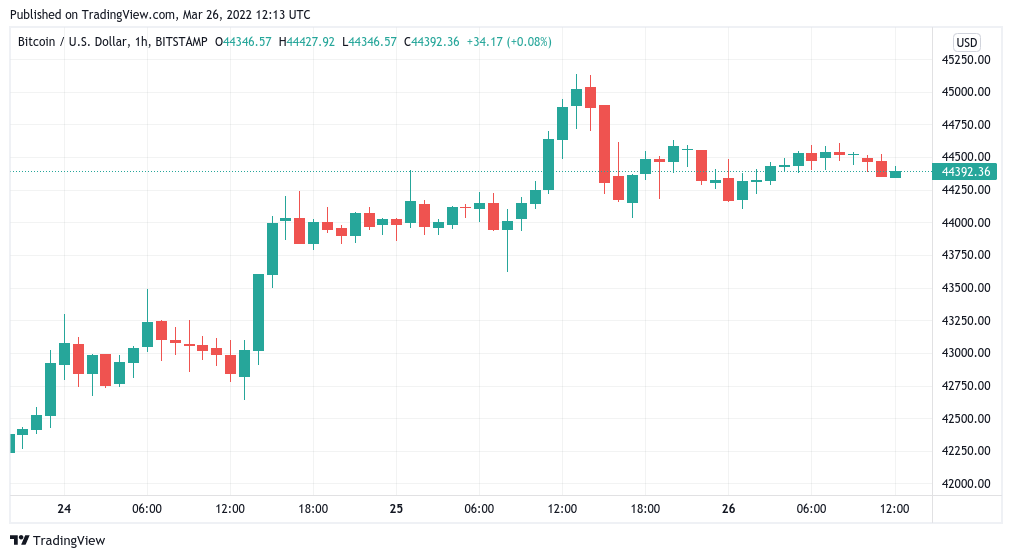
    BTC/USD 1-hour candle chart (Bitstamp). Source: TradingView

    Bitcoin fakeouts: Third time’s the charm?

    Data from Cointelegraph Markets Pro and TradingView showed BTC/USD lingering around $44,500 Saturday, preserving the lion’s share of the week’s progress.

    Traders had sounded the alarm on a possible retracement after a large sell wall appeared on major exchange Bitfinex. In the event, sell-side pressure prevailed, halting bulls’ advance at just above $45,000.

    “Still waiting to see how price trades around yearly open. The prev times I targeted it we came up short but got very close although this time looks better for BTC. Almost there,” popular trader Pentoshi summarized.

    Fellow Twitter user B C Richfield meanwhile highlighted the need to crack the current local high of $45,135, after two “fakeouts” on lower timeframes. A failure to do so, he argued prior to the high occurring, would be bad news.

    Another topic of debate from the week, that of Blockchain protocol Terra’s multibillion-dollar Bitcoin buy-in, continued, executives adding roughly another 3,000 BTC to a wallet now containing 24,954 BTC ($1.1 billion).

    Media attention and excitement increased in step, with analytics firm Messari highlighting “increased usage and fundamentals” as driving the price of Terra’s LUNA token while other smart contract tokens traded down.

    LUNA/USD was nonetheless in the same position it traded at last weekend at the time of writing, while both Bitcoin and largest altcoin Ether (ETH) were up over 6% during the same period. 

    Fees remain a bargain

    For all the focus on a turnaround coming from within the crypto industry, however, for the mainstream, Bitcoin remained firmly under the radar.

    Related: After years of doubts and concerns, it is finally Bitcoin’s time to shine

    In addition to Google Trends data showing an ongoing lull, analyst Benjamin Cowen noted that Bitcoin’s low transaction fees underscored a lack of activity.

    “To some degree, Bitcoin transaction fees tell you what you need to know,” he said.

    “Clearly the tourists are gone at the moment. But they will return. They always do.”

    Bitcoin total transaction fees chart. Source: Blockchain

    The views and opinions expressed here are solely those of the author and do not necessarily reflect the views of Cointelegraph.com. Every investment and trading move involves risk, you should conduct your own research when making a decision.

  • White House office seeks public opinion on crypto-climate implications

    White House office seeks public opinion on crypto-climate implications

    The Office of Science and Technology Policy (OSTP), an Executive Office of the President of the United States, commenced a study to identify the scope for offsetting energy use and climate changes related to digital assets. 

    On March 9, United States President Joe Biden signed an executive order, directing various federal agencies to examine implications of digital assets on six key areas — consumer and investor protection, financial stability, financial inclusion, responsible innovation, the United States’ global financial leadership and combating illicit financial activity.

    As a part of the initiative, the OSTP invited the general public and other stakeholders to share their viewpoints on various factors that contribute to the energy use and climate impacts of all types of digital assets and cryptocurrencies.

    President Biden’s executive order requires OSTP to submit a report on digital assets to identify factors that negatively or positively affect energy and climate concerns. According to the official notice:

    “In particular, this Right for Information (RFI) seeks comments on the protocols, hardware, resources, economics, and other factors that shape the energy use and climate impacts of all types of digital assets.”

    In addition, OSTP seeks public opinion on the potential benefits of digital assets in addressing the rising energy and climate concerns. According to the notice, the federal government will use the findings of the study to dictate future developments or industry trajectories related to digital assets.

    The general public and organizations are invited to submit comments on or before 5:00 p.m. ET on May 9, 2022.

    Related: Secretary Yellen recognizes ‘benefits of crypto’ despite lingering skepticism

    The U.S. Secretary of the Treasury Janet Yellen, who has historically shared anti-crypto sentiments, recently acknowledged the “significant role” played by cryptocurrencies:

    “There are benefits from crypto, and we recognize that innovations in the payments system can be a healthy thing.”

  • Coinbase to track off-platform crypto transfers in Canada, Singapore, Japan

    Coinbase to track off-platform crypto transfers in Canada, Singapore, Japan

    Citing compliance with local jurisdictions, crypto exchange Coinbase announced to soon collect additional information from users based in Canada, Singapore and Japan. 

    Effective from April 1, Coinbase users from Canada, Singapore and Japan will be required to provide additional information while sending cryptocurrencies to a different (non-Coinbase) platform. 

    However, while Singaporean and Japanese investors will be required to share additional information about the recipient for every single off-platform transaction, Canadians sending less than $801 (1,000 CAD) will be exempted from this requirement.

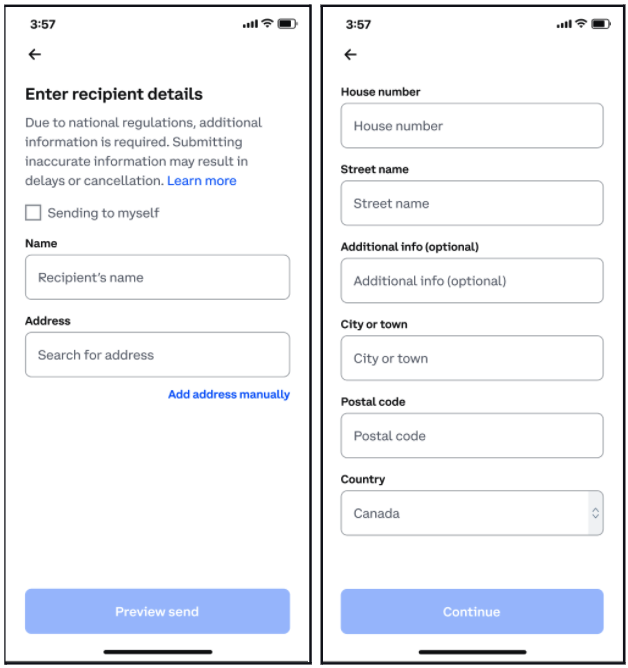
    Screenshot of Coinbase requesting recipient information from Canadian users. Source: Coinbase

    As shown in the above screenshot, Canadian users will need to share the full name and residential address of the recipient. 

    Moreover, Canadian users — that suffice the above two conditions — will lawfully require to provide the recipient’s (self) information even while transferring funds between their own crypto wallets.

    On the other hand, both Japanese and Singaporean regulations will require Coinbase to collect information about the recipients from local investors for every single off-platform transaction with no minimum threshold.

    Screenshot of Coinbase requesting recipient information from Singaporean users. Source: Coinbase

    Similar to Canadian users, investors from Japan will need to disclose information including the recipient’s name and full address and the name of the crypto exchange handling the wallet.

    Singapore users will not require to provide the recipient’s residential address but will require only the recipient’s name and country of residence. The lack of any required information will bar the user from sending cryptocurrencies out of the Coinbase platform for the jurisdictions in question.

    Coinbase users that no longer reside in these jurisdictions will need to update their country of registration in order to gain exemption from the soon-to-be-implemented rule.

    Related: Thailand SEC bans crypto payments, seeks disclosure of system failure from exchanges

    For many jurisdictions, the road to mainstream crypto adoption is paved by stringent regulations under the pretext of investor protection. Starting April 2022, the Thailand Securities and Exchange Commission (SEC) announced a ban on crypto payments throughout the country.

    Complementing this law, the SEC also proposed a new rule, which if implemented, will require Thai-based crypto businesses — brokers, exchanges and dealers — to disclose service quality and IT usage information.

    As Cointelegraph reported, a joint study between the Thai SEC and Bank of Thailand (BOT) concluded that:

    “[Crypto payments] may affect the stability of the financial system and overall economic system including risks to people and businesses.”