Category: TRENDING

  • RUNE rally: A closer look at THORChain’s new synthetic assets

    RUNE rally: A closer look at THORChain’s new synthetic assets

    THORChain (RUNE) has appreciated nearly 41% in the past seven days, according to the data from Cointelegraph Markets Pro, and its recent price action is even leading the entire crypto market in the first quarter of 2021. Its mainnet launch, which was originally slated last year, is one of the main factors that led to its recent price surge. But, the other factor that provided added momentum is the integration of synthetic assets to its network. Why was this such a huge deal, and what are its implications for THORChain going forward?

    THORChain is often compared to Uniswap since it provides users a way for traders to swap different tokens. The only difference is THORChain lets users trade layer-1 coins in a decentralized manner, whereas Uniswap is limited to only the tokens that are of the ERC-20 standard. Users can essentially swap their Bitcoin (BTC) for Ether (ETH) on THORChain without using a centralized exchange, and it claims to have processed more than 1.64 million transactions since inception.

    The addition of synthetic assets to THORChain is expected to grow the network usage. Synthetic assets are, of course, virtually tokenized derivatives wherein it mimics the value of another asset. Synthetic assets, or synths, track real-world assets like stocks, commodities or even cryptocurrencies and traders use them for various reasons such as taking advantage of lower fees, performing faster transactions and access to 24/7 trading, among others.

    THORChain synths under the hood

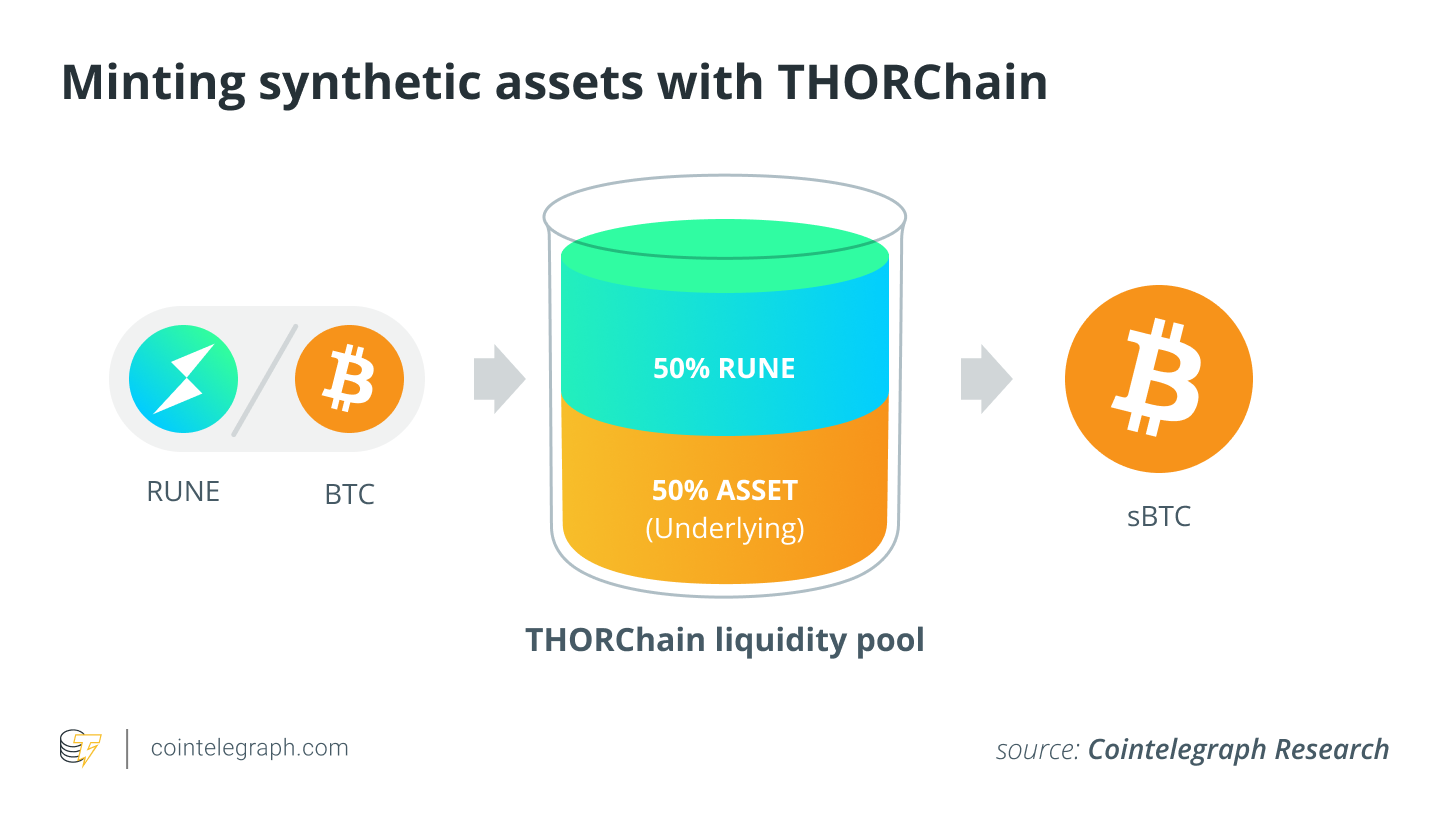
    THORChain allows users to mint synthetic versions of cryptocurrencies ranging from BTC to Aave (AAVE). To do this, users add either RUNE or the actual crypto asset to a THORChain liquidity pool. THORChain’s synths are pretty different from other synthetic assets, as synths from THORChain are not backed solely by the underlying asset and don’t require a high collateralization ratio.

    For instance, Terra (LUNA) Mirror protocol, another platform for minting synths, has a 150% collateralization ratio. A THORChain synth, on the other hand, is backed by a liquidity pool that contains 50% of RUNE and 50% of the underlying asset. This is done through collateralization via pool ownership.

    No impermanent loss

    One of the main advantages boasted by THORChain is it removes impermanent loss, achieved by its protocol structure. THORChain maintains a reserve pool of RUNE tokens that it extracts from to pay block rewards for node operators and liquidity providers. It is also the same pool from which the system draws out the tokens needed to offset any difference in the synthetic asset’s exact value to that of the actual asset upon redemption, preventing impermanent loss.

    Liquidity providers will have linear impermanent loss protection for 100 days, meaning that it incurs 1% protection daily until it reaches a full 100% coverage. At the time of writing, the reserve holds nearly $1 billion worth of RUNE, though it was actually past the billion-dollar mark a few months ago. The reserve is depleted from such token outflows but is replenished by network fees such as transfer fees and outbound fees (the gas cost of each chain multiplied by three).

    How synths benefit users

    Aside from the trading advantages mentioned earlier, THORChain synths are also cheaper to exchange than layer-1 assets while having a 50% reduction in swap fees when swapping asset to synth, synth to asset or synth to synth. But, perhaps its main selling point on offer is an uncomplicated and more lucrative way to yield farm. THORChain also has in its pipeline the capability for synth holders to earn a return by simply locking their assets in a vault. This makes the process approachable to newer participants, as they would no longer need to understand the concept of liquidity pools and the risks of impermanent loss.

    THORChain has also integrated with Terra, catalyzing RUNE’s initial March rally. Lending and borrowing are also coming to the THORChain ecosystem by June 17. This is why many have been bullish to even call an $11.50 target for RUNE. Can RUNE maintain its rally going to the second quarter?

    Cointelegraph’s Market Insights Newsletter shares our knowledge on the fundamentals that move the digital asset market. The newsletter dives into the latest data on social media sentiment, on-chain metrics and derivatives.

    We also review the industry’s most important news, including mergers and acquisitions, changes in the regulatory landscape, and enterprise blockchain integrations. Sign up now to be the first to receive these insights. All past editions of Market Insights are also available on Cointelegraph.com.

  • Terra price signal that preceded an 80% LUNA rally is back

    Terra price signal that preceded an 80% LUNA rally is back

    A technical setup that preceded an 80% price rally in the Terra (LUNA) market in August 2021 has appeared again.

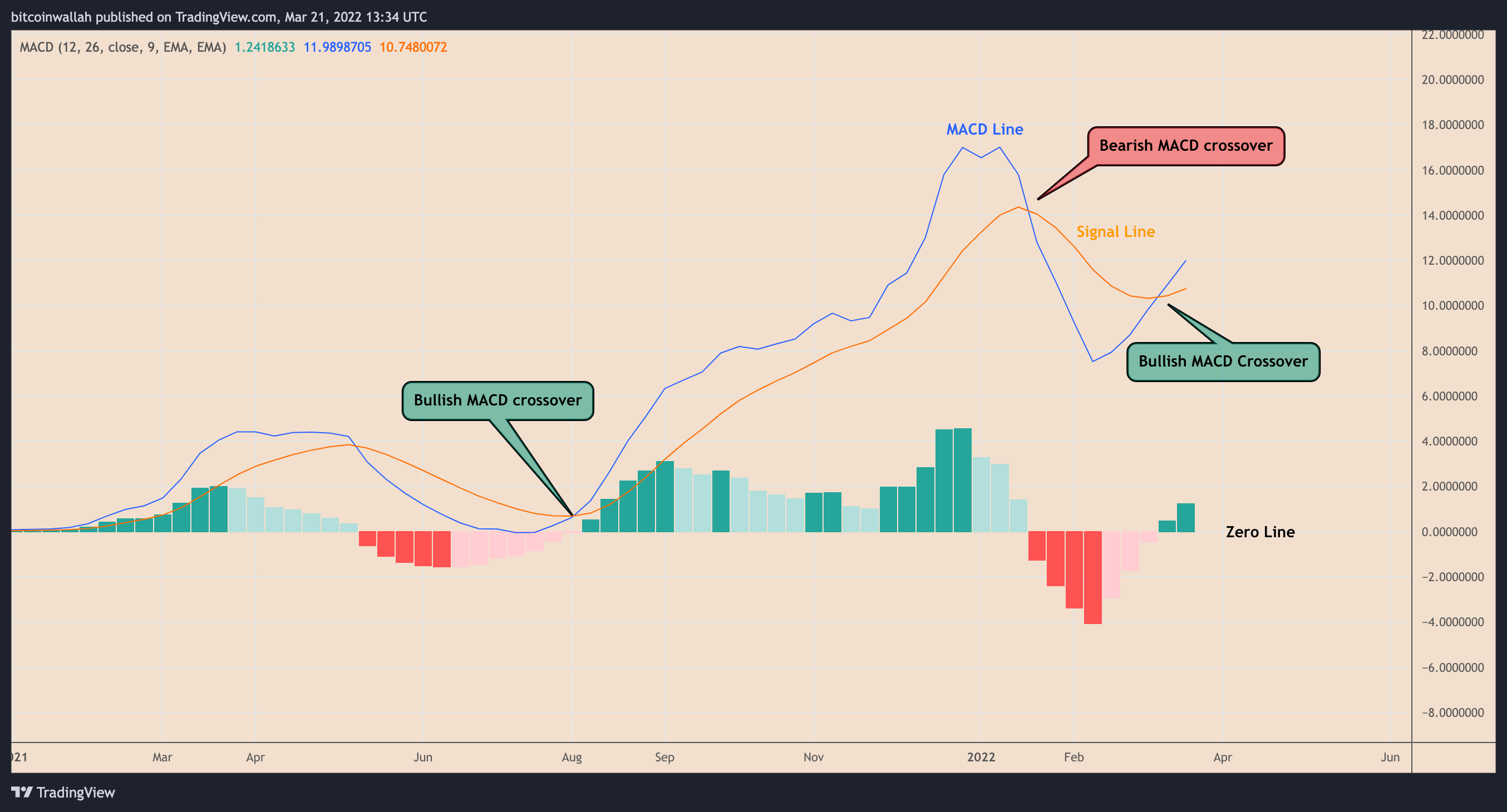
    LUNA paints bullish MACD crossover

    The technical setup involves a so-called “signal line crossover” between LUNA’s weekly MACD line — equal to the difference between the token’s 12-week and 26-week moving averages (MA) — and the nine-week MA called the signal line, plotted above the zero line, as shown in the chart below.

    LUNA/USD weekly MACD illustration. Source: TradingView

    Together, these lines represent the moving average convergence divergence (MACD), a momentum oscillator to determine a market’s direction and momentum.

    So, if the MACD line crosses above the signal line, markets interpret it as a bullish MACD crossover. Conversely, a bearish MACD crossover occurs when the MACD line falls below the signal line.

    LUNA’s weekly MACD line closed above its signal line earlier this month, raising speculations about a strong bullish momentum ahead. For instance, independent market analysts Argonauts cited a similar bullish crossover from August 2021 that occurred before the token’s 80% price rally — from $12 to $102.

    Bearish divergence detected

    The MACD-based bullish outlook in the Terra market also stems from LUNA’s incredible price performance in the last 30 days.

    Notably, LUNA’s price has surged by nearly 90% after bottoming out at $47.25 on Feb. 20, now eyeing a run-up above $100.

    Nonetheless, LUNA’s strong upside move accompanies a decreasing momentum, as illustrated by its weekly relative strength index (RSI), and weakening trading volumes, suggesting bullish exhaustion is close.

    LUNA/USD weekly price chart featuring price-momentum bearish divergence. Source: TradingView

    Therefore, a pullback from levels near $100 could have LUNA retest its previous resistance-turned-support levels near $75.50 and $50, coinciding with the 0.236 and 0.5 Fib lines, respectively, of the Fibonacci retracement graph attached below. 

    LUNA/USD weekly price chart featuring Fibonacci retracement support/resistance levels. Source: TradingView

    Double-top risks of LUNA’s price 

    LUNA’s close above its previous record high of around $106 could have it enter unchartered territory with a Fibonacci retracement graph drawn from a $102 swing high to a $45.50 swing low, suggesting an extended upside move toward $138.

    LUNA/USD weekly price chart. Source: TradingView

    Related: ‘We’re already buying’: Terra founder plans to obtain $10B BTC for reserves

    On the other hand, a pullback move from levels near $100 could also trigger the classic double-top setup, which entails two high points in the market, signifying an impending bearish reversal signal. LUNA could paint one in the coming weeks, as shown in the chart below.

    LUNA/USD weekly price chart featuring “double top” setup. Source: TradingView 

    In a “perfect” double top scenario, the Terra token could risk crashing by more than 50% to $44 on the next pullback, followed by a breakout move toward $19.50, also coinciding with LUNA’s 50-week exponential moving average (the red wave). 

    The views and opinions expressed here are solely those of the author and do not necessarily reflect the views of Cointelegraph.com. Every investment and trading move involves risk, you should conduct your own research when making a decision.

  • SushiSwap community proposes Swiss legal structure to limit DAO liability

    SushiSwap community proposes Swiss legal structure to limit DAO liability

    SushiSwap (SUSHI), a community-led suite of decentralized finance (DeFi) tools, plans to implement a legal structure aimed at mitigating risks for token holders and members of the Sushi protocol. 

    Sushi’s new legal structure will be based on a community-approved proposal from Mar. 20 that cited the need for an association or foundation to help provide legal clarity and administrative support for SushiDAO.

    According to the proposer and a member of the SushiSwap community, Tangle, the intended foundation will play a key role in limiting the liability for contributors and, as a result, drive Sushi’s future growth.

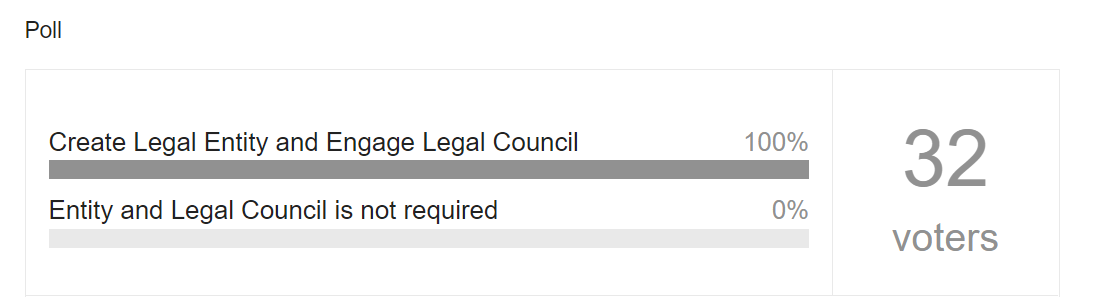
    Considering the possibility of risk mitigation and liability limitation via legal clarity for holders and contributors, the proposal received a 100% vote for the implementation of the legal structure.

    Sushi Legal Structure proposal’s voting results. Source: Sushi forum

    Tangle estimates an upfront expense of up to $100,000 and a recurring cost of $10,000 to set up the foundation:

    “There are several jurisdictions which can be contemplated for forming a DAO entity, but Swiss Association law is currently the leading solution.”

    Estimated budget for foundation. Source: Sushi forum

    In order to build the foundation, the Sushi community will implement a four-step process, which includes determining and establishing the members, token distribution and transfer along with the draft articles of the foundation. 

    The proposal also includes the need for service entities including “DevCo services entity and any other core contributor entities.” Individuals residing in crypto-friendly jurisdictions will be considered ideal candidates for being a member of the foundation.

    Adding to the discussion, community members highlighted the importance of defining the foundation’s use and what it owns:

    “It’s definitely a must, it’s really the time for Sushi to update itself and to have a legal shield ready for all contributors.”

    Related: Dogecoin Foundation registers name and logos as trademarked within in the EU

    As smaller crypto communities slowly seep into the mainstream, foundations play a crucial role in dictating the future roadmap and relevance of the project. In an attempt to sieve imitators, the Dogecoin Foundation registered “Doge,” “Dogecoin,” and its associated logos as trademarks in the European Union.

    As Cointelegraph reported, the Dogecoin Foundation faced numerous issues with the misuse of its name and imagery. According to ex-director Ross Nicoll, several parties were registering trademarks for Dogecoin, and “in the summer of 2021, there was a potential lawsuit against the developers from someone who claimed we were responsible for their funds.”

  • 6 Questions for John deVadoss of Neo and the Global Blockchain Business Council

    6 Questions for John deVadoss of Neo and the Global Blockchain Business Council

    We ask the buidlers in the blockchain and cryptocurrency sector for their thoughts on the industry… and throw in a few random zingers to keep them on their toes!


    This week, our 6 Questions go to John deVadoss, the head of development at Neo — an open-source blockchain development platform — and a governing board member at the Global Blockchain Business Council, an industry association for the blockchain technology ecosystem.

    I am proud to say that I build the best developer tools in the blockchain industry for N3. I also build the tools for the Token Taxonomy Framework as part of the Global Blockchain Business Council, where I serve as a governing board member. In addition, I serve as co-chair of IEEE Blockchain.

    Previously, I was a co-founder of the InterWork Alliance, which is now part of the GBBC. Earlier, I was a general manager at Microsoft for close to two decades, during which I built out the architecture for .NET v1, Visual Studio Tools, the Microsoft Application Platform, Microsoft Digital (which I scaled to billion-dollar P&L) and more. I led the early service-oriented architecture and cloud architecture incubation initiatives for Microsoft, which led to Azure.


    1 — Which people do you find most inspiring, most interesting and most fun in this space?

    This is a wonderful question. I find the young men and women in our community and industry the most inspiring. The young people I meet with and have the opportunity to work with possess boundless energy and enthusiasm, and they are not willing to take no for an answer. They come in without any constraints, without any baggage of what can or cannot be accomplished, and without any preconceived notions of what should or should not be. They have no chip on their shoulder, nor do they have any sense of privilege or lack thereof. They just want to build — and I get tremendous energy (selfishly speaking) from working with them.

    2 — What does decentralization mean to you, and why is it important?

    Decentralization is first and foremost about the sovereignty of the individual. Individual sovereignty, whether from a natural-rights perspective (bestowed by God, nature or reason) or a legal-rights perspective (and as enshrined in the charter of the UN and subsequent international treaties), implies individual autonomy.

    When understood as the capacity to decide for oneself and pursue a course of action in one’s life, individual autonomy implies individual self-governance. And self-governance is what decentralization means to me, and it’s why this is so important. In practical terms, this may be an asymptotic pursuit; however, the pursuit of self-governance at the individual level is our mission as a community and an industry.

    3 — Do you subscribe to the idea of Bitcoin as a means of payment, as a store of value, as both… or as neither?

    Bitcoin is a store of value. You can choose to use Bitcoin as a means of payment; however, you will live to regret it.

    Compared with other stores of value, Bitcoin empowers you to own your keys and obviates the counterparty risks typically associated with other stores of value, including gold and silver. (Remember, your assets may not really be your assets if they happen to be someone else’s liabilities.)

    With that baseline view, it is important to understand that Bitcoin is also a protocol — a set of rules, constraints, and schemas used to transfer value and settle with finality within the Bitcoin network. And it’s all accomplished in a secure, tamper-proof, uncensorable, fully transparent manner.

    4 — What’s the unlikeliest-to-happen thing on your bucket list?

    Perhaps, the unlikeliest-to-happen thing on my bucket list is becoming a rice farmer.

    I harbor aspirations — visions, perhaps — that I will play a role in taking agriculture back to first principles. Never say never.

    5 — What’s the most interesting place you’ve ever visited, and why?

    The Oracle of Delphi is probably the most interesting place I have ever visited.

    Why? Because the Oracle could not tell you anything upfront. You had to ask the question and frame it so that the Oracle could respond with a yes or no. The principle that it is up to us, up to you and me, to frame and ask the question is something that I find humbling and elevating.

    In today’s world, we rely more and more on “experts,” both human and machine. I believe that the parable of the Oracle of Delphi teaches us how to work with “experts.”

    6 — If you didn’t need sleep, what would you do with the extra time?

    If I did not need sleep, I would write more. There is so much to write and so little time.

    I want to write about economics, about philosophy, about anthropology, about biology, about psychology, about math, about cognition, about astronomy, about history and more. It is all there in my mind; I can visualize the ideas and sometimes even the words themselves, and yet, I need the time to transcribe them onto paper.

    A wish for the young, ambitious blockchain community:

    Build! Your future is yours to build!

  • Top 5 cryptocurrencies to watch this week: BTC, LUNA, AVAX, ETC, EGLD

    Top 5 cryptocurrencies to watch this week: BTC, LUNA, AVAX, ETC, EGLD

    Bitcoin (BTC) rose above $42,000 on March 19 but the bulls continue to face a strong challenge from the bears at higher levels. 

    Although Bitcoin’s price has recovered from $37,578 on March 13, Cointelegraph market analyst Marcel Pechman highlighted that the long-to-short net ratio of top traders across three major exchanges shows that professional traders have not been buying aggressively.

    But while Bitcoin struggles at higher levels, select altcoins are showing strength. Twitter account BTCFuel anticipates that altcoins could be entering “the final leg up of the hype phase” and may peak in the Summer.

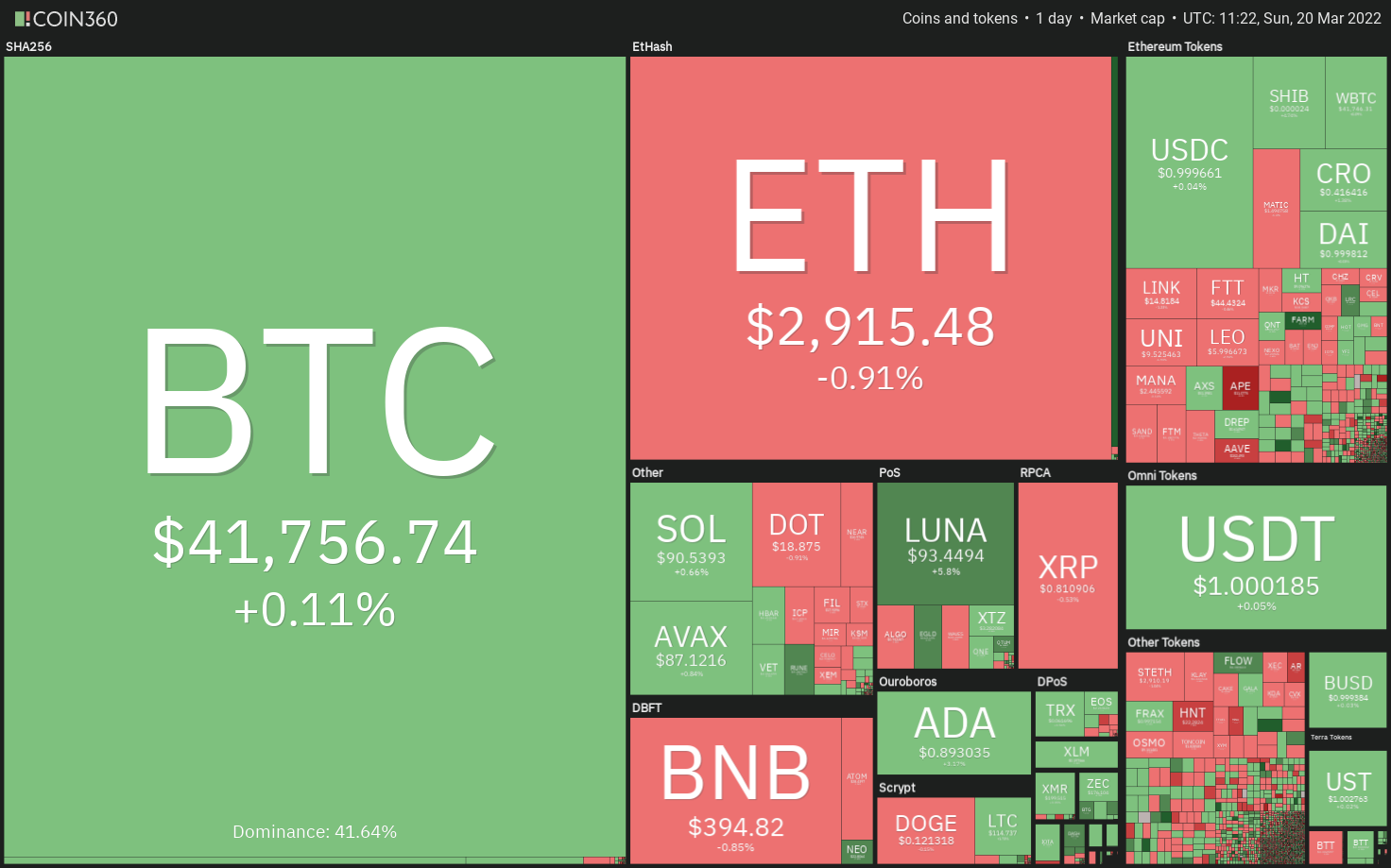
    Crypto market data daily view. Source: Coin360

    Glassnode data shows that investors have withdrawn roughly 550,000 Ether (ETH) from centralized exchanges year-to-date. Due to the outflows, the exchanges’ net Ether balance has plummeted from 31.68 million Ether in June 2020 to 21.72 million Ether.

    Could Bitcoin hold above the psychological level at $40,000 and will that shift focus to altcoins? Let’s study the charts of the most notable five cryptocurrencies to find out.

    BTC/USDT

    Bitcoin is facing resistance near $42,594 which suggests that traders are cautious at higher levels. The price could now slide to the moving averages, which is an important support to keep an eye on.

    BTC/USDT daily chart. Source: TradingView

    If the price rebounds off the moving averages, it will suggest that the bulls are not waiting for a deeper correction to buy. That could improve the prospects of a break and close above the overhead resistance. If that happens, the BTC/USDT pair could rally to $45,400 and later to the resistance line of the ascending channel.

    Contrary to this assumption, if the price turns down and breaks below the moving averages, the pair could slide toward $37,000. A bounce off this support will suggest that the pair may remain range-bound between $37,000 and $42,594 for a few days.

    The bears will have to pull and sustain the price below the support line of the channel to signal the resumption of the downtrend.

    BTC/USDT 4-hour chart. Source: TradingView

    The 4-hour chart shows that bears are defending the overhead resistance at $42,594. If the price rebounds off the 20-exponential moving average, the bulls will attempt to push the pair above the overhead resistance. If they manage to do that, the pair could rally toward $45,400.

    Conversely, if the price slips below the 20-EMA, it will suggest that the short-term traders may be selling near the overhead resistance. That could open the doors for a possible drop to the 50-simple moving average. If this support cracks, the decline could extend to $37,000.

    LUNA/USDT

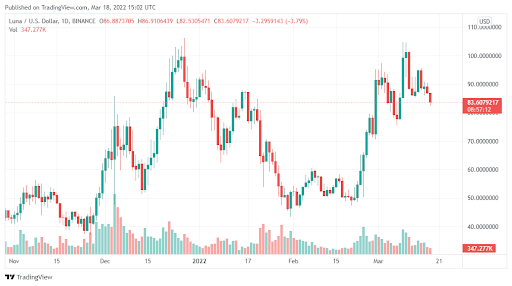
    Terra’s LUNA token rebounded off the 20-day EMA ($86) on March 18, indicating strong buying at lower levels. Both moving averages are sloping up and the relative strength index (RSI) is in the positive territory, indicating an advantage to buyers.

    LUNA/USDT daily chart. Source: TradingView

    If buyers drive and sustain the price above $96, the LUNA/USDT pair could challenge the all-time high at $105. A break and close above this resistance will suggest the resumption of the uptrend. The pair could first rally to $115 and then to $125.

    Alternatively, if the price turns down from $96, the pair could again drop to the 20-day EMA. A break and close below this support will suggest that the bullish momentum is weakening. The pair could then slide to the strong support zone at $75 to $70.

    LUNA/USDT 4-hour chart. Source: TradingView

    The pair has been consolidating between $85 and $96. Although the bears had pulled the price below $85, they could not sustain the lower levels. This indicates strong buying on dips. Both moving averages are crisscrossing each other, suggesting a range-bound action in the near term.

    If the price rises above $96, the advantage will shift in favor of buyers and the pair could then rally to $105.

    Conversely, if the price turns down from $96, the pair could drop to the moving averages and then to $85. The bears will have to pull and sustain the price below the $85 to $82 support zone to signal the start of a deeper correction.

    AVAX/USDT

    Avalanche (AVAX) broke and closed above the downtrend line of the descending channel on March 18, indicating a possible change in trend. However, the bears have other plans and are currently attempting to pull the price back below the breakout level.

    AVAX/USDT daily chart. Source: TradingView

    If the price turns down from the current level but rebounds off the downtrend line of the channel, it will suggest that the breakout is valid. That increases the possibility of a rally to the psychological level at $100. The rising 20-day EMA ($78) and the RSI in the positive zone indicate advantage to buyers.

    Conversely, if the price re-enters the channel and breaks below the moving averages, it will indicate that the recent breakout was likely a bull trap. That may catch several buyers off guard, resulting in a possible decline below the uptrend line.

    AVAX/USDT 4-hour chart. Source: TradingView

    The 4-hour chart shows that the rise above the channel had pushed the RSI into the overbought territory. This may have resulted in profit-booking from short-term traders. The pair could now drop to the 20-EMA, which is likely to act as a strong support.

    If the price rebounds off this level, it will suggest that the sentiment has turned bullish and traders are buying on dips. That will increase the likelihood of the continuation of the up-move.

    On the contrary, a break and close into the channel will suggest that the bullish momentum has weakened. That could pull the pair down to the 50-SMA.

    Related: 3 times in March that savvy crypto traders bought breaking news for the price of a rumor

    ETC/USDT

    Ethereum Classic (ETC) picked up momentum after it broke and closed above the downtrend line. Strong buying has pushed the price near the stiff overhead resistance at $38. The bears are likely to defend this level with vigor.

    ETC/USDT daily chart. Source: TradingView

    If the price turns down from the current level, the ETC/USDT pair could drop to $32. The 20-day EMA ($28) has started to turn up and the RSI is in the overbought zone, putting the advantage with the buyers.

    If the price does not give up much ground from the current level or rebounds strongly off $32, the bulls will again try to clear the overhead hurdle at $38. If they succeed, the pair could rally to $45 and thereafter to $50.

    Alternatively, if the price turns down and breaks below $32, the next stop could be the 20-day EMA. A break and close below this level will suggest that bears are back in the game.

    ETC/USDT 4-hour chart. Source: TradingView

    The 4-hour chart shows that the pair embarked on a vertical rally after breaking out of the downtrend line. This pushed the RSI deep into the overbought territory. Such overbought levels are usually followed by sharp declines.

    The pair could drop to the 38.2% Fibonacci retracement level at $33 and later to the 50% retracement level at $32. The bulls are likely to defend this zone aggressively. If the price rebounds off this support zone, the buyers will attempt to drive the pair above the overhead resistance and resume the uptrend.

    The bullish momentum may weaken on a break and close below $32. The pair could then drop to the 61.8% Fibonacci retracement level at $30.

    EGLD/USDT

    Elrond (EGLD) broke and closed above the moving averages on March 15, indicating that bulls are attempting a comeback. The bears have been attempting to pull the price back below the moving averages but the bulls have thwarted their efforts.

    EGLD/USDT daily chart. Source: TradingView

    The 20-day EMA ($151) has started to turn up gradually and the RSI has risen into the positive territory. This suggests that the path of least resistance is to the upside. If buyers push the price above $169, the EGLD/USDT pair could extend its up-move to the psychological level at $200. The bears are expected to mount a strong defense at this level.

    This positive view will invalidate if the price turns down and plummets below the 20-day EMA. Such a move will suggest that the recent break above the 50-day SMA ($155) may have been a bear market rally. The pair could then again drop to $125.

    EGLD/USDT 4-hour chart. Source: TradingView

    The bulls pushed the price above the overhead resistance at $160 but the bears quickly pulled the price down and attempted to trap the aggressive bulls. Although the price broke below the 20-EMA, the bears did not build upon this advantage. This indicates strong buying at lower levels.

    The bulls have again pushed the price back above $160 and are trying to resume the up-move. The bullish momentum could pick up on a break and close above $169. This positive view will be negated if the price turns down and breaks below $152.

    The views and opinions expressed here are solely those of the author and do not necessarily reflect the views of Cointelegraph. Every investment and trading move involves risk, you should conduct your own research when making a decision.

  • PoW avoids EU ban, two DeFi protocols suffer a combined $11M hack and BAYC does an ApeCoin airdrop: Hodler’s Digest, March 13-19

    PoW avoids EU ban, two DeFi protocols suffer a combined $11M hack and BAYC does an ApeCoin airdrop: Hodler’s Digest, March 13-19

    Coming every Saturday, Hodler’s Digest will help you track every single important news story that happened this week. The best (and worst) quotes, adoption and regulation highlights, leading coins, predictions and much more — a week on Cointelegraph in one link.

    Top Stories This Week

    Ukraine’s president signs law establishing regulatory framework for crypto

    Crypto regulation has received approval from Ukrainian president Volodymyr Zelenskyy. The bill, titled “On Virtual Assets,” was signed by the president, opening the door to government oversight of the domestic cryptocurrency industry.

    Ukraine’s Ministry of Digital Transformation said: “The signing of this law by the president is another important step towards bringing the crypto sector out of the shadows and launching a legal market for virtual assets in Ukraine.”

    Among other details, the bill specifies that Ukraine’s National Securities and Stock Market Commission will govern the industry on multiple levels, such as digital asset-related licensing.

    European Parliament votes against PoW ban, providing huge relief to the crypto industry

    A significant European Union (EU) regulatory bill known as Markets in Crypto Assets (MiCA) has moved forward, leaving behind wording that essentially would have barred proof-of-work (PoW) crypto assets in the region.  

    An extensive bill pertaining to crypto regulation in the EU, MiCA had two drafts up for debate — one version that would essentially ban PoW mining and related cryptocurrencies, and another that hosted more favorable language concerning the technology. Long story short, the European Parliament’s Committee on Economic and Monetary Affairs voted for the option that did not ban PoW. The bill will now proceed through further approval processes.

    It’s official: Binance secures a license to operate in Dubai

    It was a busy week for cryptocurrency exchanges, which earned regulatory approvals in multiple jurisdictions. Binance secured licensing in Dubai and Bahrain. FTX also received a Dubai license.

    Thanks to the Virtual Asset Service Provider (VASP) license it secured in the region, Binance can now establish an office in Dubai, among other rights newly afforded by the license. Additionally, Binance received a virtual asset exchange (VAX) license in Dubai. FTX also unveiled that it received Dubai’s VAX this week.

    ApeCoin announcement surges BAYC floor price to near-ATH before correction

    Owners of Bored Ape Yacht Club (BAYC) NFTs stand to receive a considerable sum of ApeCoin (APE) — a new governance and utility token for the project. APE is an ERC-20 token.  

    If they do so within 90 days of March 17 (12:30 pm UTC time), BAYC owners can claim 10,000 APE, which totaled $72,000 in value at the time of Cointelegraph’s coverage in the article linked above. FTX, Gemini and other exchanges plan on listing APE.  

    Trading volume and pricing for BAYC NFTs saw turbulence surrounding the APE token news. Among other reported details, the token will have a supply of 1 billion.

    Diem team members raise $200M to launch blockchain derived from it

    Avery Ching and Mo Shaikh, two former Meta crypto division leads, are building a layer-1 blockchain with some of its roots based on Move — the Diem project’s programming language. Known as Aptos, the project led by Ching and Shaikh recently announced securing $200 million worth of funding, with names such as Coinbase Ventures and Andreessen Horowitz contributing. Aptos aims for its mainnet to go live in the latter half of 2022. 

    Publicized earlier in 2022, Facebook-turned-Meta’s stablecoin Diem essentially saw an end to its journey, with Silvergate Capital Corporation buying the project’s nuts and bolts (intellectual property, etc.) from Meta.

    Winners and Losers

    At the end of the week, Bitcoin (BTC) is at $41,727, Ether (ETH) at $2,936 and XRP at $0.79. The total market cap is at $1.87 trillion, according to CoinMarketCap.

    Among the biggest 100 cryptocurrencies, the top three altcoin gainers of the week are ApeCoin (APE) at 1,338.31%, Aave (AAVE) at 38.53% and THORChain (RUNE) at 37.67%. 

    The top three altcoin losers of the week are Anchor Protocol (ANC) at -19.20%, Stacks (STX) at -9.20% and Kadena (KDA) at -9.18%.

    For more info on crypto prices, make sure to read Cointelegraph’s market analysis.

    Most Memorable Quotations

    “If you are an avid crypto trader like me, I am sure that the thought of who will inherit your crypto has come to mind.” 

    Jeetu Kataria, CEO of Digital Financial Exchange (DIFX)

    “Orange pill your neighbor, your favorite shop, bar, cinema, start sharing your sats. It’s easy for them to learn from a known face like yours. Be that little pebble that you throw in the lake, and it will create ripples that coming generations will benefit.”

    Paco de la India, Bitcoiner and runner

    “Our hope is that when the government does this study [as established by the executive order], […] the conclusion they will reach is we will not compete against China — an authoritarian dictatorship — by also acting like an authoritarian dictatorship. Instead we will empower our private sector to come up with competitive solutions.”

    Jake Chervinsky, head of policy for the Blockchain Association, regarding a United States central bank digital currency

    “The creator is where the power begins, and that’s where the power should stay.”

    Darryl McDaniels, founding member of Run-DMC

    “My office has received numerous tips from crypto and blockchain firms that SEC Chair @GaryGensler’s information reporting ‘requests’ to the crypto community are overburdensome, don’t feel particularly… voluntary… and are stifling innovation.”

    Tom Emmer, United States congressman

    “There is no doubt that blockchain gaming is a revolutionary concept, but at the moment, I don’t think it will be enough to support me financially by itself. […] I think I will have enough courage to leave my job to pursue blockchain gaming once the P2E ecosystem has become mature and sustainable.”

    Jesus Dawal Jr., Filipino gamer

    “With proper research and understanding, regulators will find a much easier time regulating DeFi and preventing malicious behaviors compared to the legacy financial infrastructure.”

    Eric Chen, co-founder and CEO of Injective Labs

    “You should never define any technology by its worst uses. […] There’s more to crypto than ransomware, just like there’s more to money than money laundering.”

    Ritchie Torres, United States representative

    Prediction of the Week 

    Bitcoin faces new ‘milestone’ in 2022 as new forecast predicts BTC price ‘in the millions’

    This past week, crypto’s largest asset, Bitcoin, traded both below $38,000 and above $41,000 inside the seven-day period, according to Cointelegraph’s BTC price index

    Based on global conditions, Bloomberg Intelligence’s Mike McGlone and former BitMEX brass Arthur Hayes both see Bitcoin ultimately coming out on top. 

    McGlone sees the current landscape as one that may help BTC along. “Facing the #FederalReserve, inflation and war, 2022 may be primed for risk-asset reversion and mark another milestone in #Bitcoin’s maturation,” McGlone tweeted. 

    Meanwhile, Hayes sees Bitcoin taking on a value of more than $1 million per coin based on the events currently unfolding, although he noted a decade-long time horizon with BTC suffering downward price action first.

    FUD of the Week 

    Blockchain forensics firm finds millions in sanctioned crypto wallet

    Blockchain analytics outfit Elliptic has come across a crypto wallet that could be of particular interest that could potentially be connected to prominent sanctioned Russians. The wallet’s contents total millions of dollars in value, although further specifics were not given. 

    “It’s not proving out realistic that oligarchs can completely bypass sanctions by moving all their wealth into crypto,” Tom Robinson, Elliptic’s co-founder, told Bloomberg. “Crypto is highly traceable. Crypto can and will be used for sanctions evasion, but it’s not the silver bullet.”

    Millions of crypto addresses have been traced to crime associated with Russia, with hundreds of digital asset services facilitating anonymous crypto swapping via the Russian ruble, based on Elliptic’s sleuthing.

    RBI seemingly wants to ban cryptocurrencies, but not for the reasons you might think

    India’s central bank, the Reserve Bank of India (RBI), expressed a desire to ban crypto assets, as per a statement published this week. The RBI fears that crypto adoption could undermine the usage and dominance of the rupee, India’s national currency, and cause other issues. 

    “Historically, private currencies have resulted in instability and therefore, have evolved into fiat currencies over centuries,” the RBI said in the statement. “The retrograde step back to private currencies cannot be taken simply because technology allows it […] without considering the dislocation it causes to society’s legal, social and economic fabric of society.”

    Unlucky: Agave and Hundred Finance DeFi protocols exploited for $11M

    Decentralized finance (DeFi) solutions Hundred Finance and Agave were exploited for $11 million by an attacker who managed to exploit a wrapped Ether (WETH) contract function on Gnosis Chain, a stable payments platform. Put simply, the attacker was able to drain more funds by continually borrowing against the same collateral they were posting. 

    The $11 million sum was stolen via a number of different crypto assets, including the aforementioned wETH, but also wrapped BTC (WBTC), Chainlink (LINK) and USD Coin (USDC). Agave and Hundred Finance both halted their protocols in tandem amid the investigation.

    Best Cointelegraph Features

    You don’t need to be angry about NFTs

    If you’ve never been angry about JPEGs you don’t need to be angry about JPEGs people can own.

    ‘We don’t like our money’: The story of the CFA and Bitcoin in Africa

    African crypto experts and entrepreneurs explain why the CFA franc is an uncomfortable currency and why Bitcoin is making waves as a replacement.

    Russia’s central bank goes to war: Is cryptocurrency a friend or foe?

    Policymakers in Moscow are scrambling to rethink their approach to digital currency as one of several means of protecting the increasingly isolated economy.
  • 3 times in March that savvy crypto traders bought breaking news for the price of a rumor

    3 times in March that savvy crypto traders bought breaking news for the price of a rumor

    As an old saying goes: Buy the rumor, sell the news.

    As a digital-native asset class, the prices of cryptocurrencies are clearly susceptible to market-moving news developments that instantly spread on the internet. Staying on top of bullish announcements can help crypto traders reap huge gains, but navigating the crypto news landscape can be daunting.

    Two major roadblocks get in the way: the abundance of potentially relevant information and the difficulty of making sure one is always among the first to learn the news that really matters. Extensive research shows that three types of crypto-related developments move digital asset prices most consistently: listings, staking announcements and big partnerships. This insight somewhat narrows down the scope of the developments that will most interest traders.

    Now, what is the best way for crypto folks to ensure that they get to the potentially consequential stories before the rest of the pack? There is no shortage of technological solutions, from carefully curating one’s list of Twitter alerts to various crypto data terminals.

    The subscribers of Cointelegraph’s proprietary data intelligence platform, Markets Pro, have it easy. They get access to NewsQuakes™ — a machine learning service that constantly monitors thousands of primary sources and automatically notifies the Cointelegraph Markets Pro community within minutes or even seconds of publication.
    Here are three examples of how Cointelegraph Markets Pro subscribers could have capitalized on the power of NewsQuakes™ in March.

    ANC: Staking program announcement kicks off a rally

    ANC price (white), March 2–8. Source: Cointelegraph Markets Pro

    Staking announcements can be powerful market movers, especially when a staking program for an asset launches on a major platform and comes with attractive terms. Anchor Protocol’s launch on Binance Staking with up to 40% annual percentage yield on ANC fit the bill perfectly.

    The announcement, delivered to Cointelegraph Markets Pro subscribers as a near-instant NewsQuake™, was sourced from Binance’s Twitter account. The token was trading at $3.79 when the news hit, picking up steam quickly thereafter. Eighteen hours later, ANC’s price reached $4.90 and then pushed even higher to breach the $6.00 mark by March 5.

    SNX: A double-barreled listing announcement

    SNX price (white), March 5 – 12. Source: Cointelegraph Markets Pro

    Another fateful tweet put huge upside pressure on the price of Synthetix Network Token (SNX). The news concerned SNX’s listing on Binance.US. Interestingly, there were two Twitter announcements of the upcoming listing, but apparently, the first one (the first NewsQuake™ symbol in the chart on March 8) did not produce much of a splash. However, the news of the actual launch of SNX trading (the red circle in the chart) made SNX’s price spike from $3.98 to $4.77 within 23 hours — an increase of 19.8%.

    SAND: A big partnership spells big gains

    SAND price (white), March 11 – 18. Source: Cointelegraph Markets Pro

    Partnership announcements tend to show up a bit less frequently among the most consequential NewsQuakes™ when compared with listing and staking news. Sometimes, however, there are partnership deals whose price-boosting effects eclipse those of most other NewsQuakes™. A rule of thumb is that if you have heard of a non-crypto entity that is partnering with a crypto project, the associated token’s price is likely to go up.

    Banking giant HSBC is certainly an institution familiar to most traders. Its move into the Metaverse, facilitated by The Sandbox, was something that stood to trigger a massive upside for the SAND token. Sure enough, SAND’s price shot up almost vertically minutes after the Cointelegraph Markets Pro crowd was alerted to the news, spiking from $2.85 to $3.28 (a 15% increase) in just 18 hours.

    Cointelegraph is a publisher of financial information, not an investment adviser. We do not provide personalized or individualized investment advice. Cryptocurrencies are volatile investments and carry significant risk including the risk of permanent and total loss. Past performance is not indicative of future results. Figures and charts are correct at the time of writing or as otherwise specified. Live-tested strategies are not recommendations. Consult your financial adviser before making financial decisions.

  • Seedify.Fund (SFUND) remains largely unchanged despite launching brand new ecosystem features

    Seedify.Fund (SFUND) remains largely unchanged despite launching brand new ecosystem features

    Seedify.Fund (SFUND) has remained largely unchanged even as the project announced major new features on its ecosystem. The coin which has acted as an incubator for metaverse and GameFi projects, is hoping to transform its ecosystem in the near future. Here is what you should know:

    • The new updates will see greater integrations of NFTs into Seedify.Fund projects.

    • The project is also expanding yield farming and staking

    • New incentives will roll out to bring more projects on the platform.

    Data Source: Tradingview 

    Seedify.Fund (SFUND) – price remains largely unchanged

    It doesn’t seem like many investors were upbeat about this latest news from Seedify.Fund (SFUND). At the time of writing, the token was trading at $4.30, down by around 2% for the day. But there is no arguing that this is a very interesting project. 

    In recent months, talk about GameFi and the metaverse has been gathering steam. The metaverse in particular is seen as a very integral part of the future of crypto. Seedify.Fund (SFUND) is trying to provide a launchpad that will see such metaverse projects come to life. 

    Despite this, the coin still remains relatively small, with a market cap of around $105 million. It is likely that the recent news will have no big impact on the price action. Nonetheless, Seedify.Fund (SFUND) will still continue to remain resilient in the near term.

    Is Seedify.Fund (SFUND) worth it?

    If you are looking for exposure in the metaverse and GameFi tokens, there are probably a lot of options you can go for. However, what makes Seedify.Fund (SFUND) unique is that it acts as an incubator and launchpad for these other coins. 

    This puts it at the very center of the metaverse and GameFi revolution. The fact that it remains a small microcap coin also means that it has so much to offer in the long run. It is therefore worth looking at.

  • Mina (MINA) stages stunning recovery after days in the red – Can the momentum hold?

    Mina (MINA) stages stunning recovery after days in the red – Can the momentum hold?

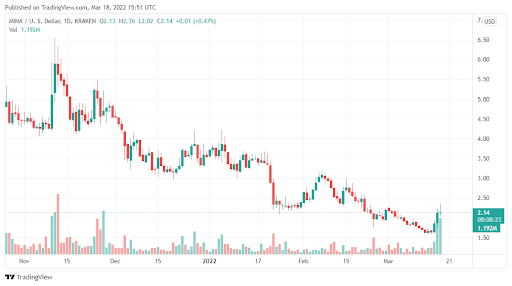
    Mina (MINA) has staged a stunning recovery over the last two trading days. The surge was largely triggered by news that big-name investors were pouring money into the project. At one point the coin managed to go above monthly highs before retreating. But can this momentum hold? We’ll discuss it below but first, here are some pointers:

    • Mina (MINA) has reported double-digit gains for the last two days.

    • The coin was trading at $2.08, up around 18% in 24 hours.

    • We expect this surge to continue well into the weekend.

    Data Source: Tradingview 

    Mina (MINA) – gauging the momentum?

    Mina (MINA) had not been doing that well. Like most coins in the market, it was largely exposed to the headwinds in crypto. As such, it had spent a lot of days in the red. But what we saw over the last two days has been nothing short of a crucial reversal. 

    The coin has surged by double figures in both days. At one point, it even rose above $2.35, the highest it has been since February. Also, Mina (MINA) has gained over 40% compared to the lowest price recorded in March. 

    We expect this bullish run to continue well into the weekend. After all, Mina (MINA) is now well over its 25- and 50-day simple moving averages. The RSI reading also shows positive momentum heading into the weekend. 

    What is Mina (MINA)?

    Mina (MINA) is an innovative blockchain project that is planning to create distributed payment systems. It is a relatively unique project that looks very underpriced. We are also starting to see big-name investors coming into MINA. 

    This can only be a good sign about the future prospect of this coin. If you are looking for something to buy and unlock long-term gains, there is no reason why you shouldn’t check out Mina (MINA).

  • Metaverse and NFT integration: Top 3 coins to consider

    Metaverse and NFT integration: Top 3 coins to consider

    The metaverse is seen as the hottest trend in crypto right now. The big tech giants of our time are pouring money into this idea. In the coming years, the metaverse will be a reality. But we are also seeing NFT and metaverse integration as well. Here is why this makes sense:

    • NFTs provide the basis for owning metaverse items

    • The NFTs are also used to bring more utility and value into the metaverse.

    • NFTs are also important in creating multiple revenue verticals in the metaverse.

    Well, in case you are searching for crypto projects that integrate NFTs and the metaverse together, here are the top 3 coins to consider.

    Terra Virtua (TVK)

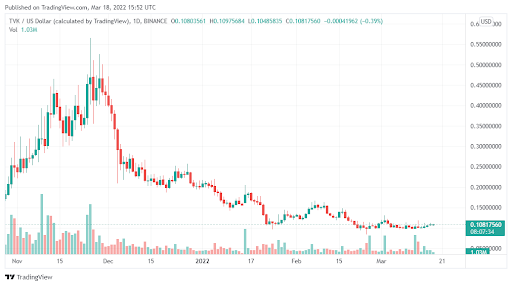
    Terra Virtua (TVK) is an upcoming metaverse project that is looking to transform how people interact with digital collectibles. The project uses augmented and virtual reality to create an immersive digital experience. 

    Data Source: Tradingview 

    This is where people can buy and sell NFTs, engage in social and gaming activities and so much more. The official governance and utility token of Terra Virtua is known as Kolect (TVK). At press time, the coin was trading at $0.107 with a market cap of $75 million.

    Axie Infinity (AXS)

    Axie Infinity (AXS) is not a new name per se in the metaverse sector. In fact, this project started like a play-to-earn game but has since tried to bring other metaverse-related features into its ecosystem. It was one of the hottest projects to buy in 2021. While much of that growth has stagnated, the future is still bright for AXS.

    Wilder World (WILD)

    Wilder World (WILD) is a 5D gaming universe that looks to deliver immersive and action-packed gaming experiences for all users. The project also lets users buy digital items, including condos, cars, and so much more. All these things are backed by NFTs as well. The native token WILD is trading at $1.18.