If you use an Ethereum Name Service address (or something similar) or if you have a non-fungible token (NFT) linked to your Twitter profile picture, you are broadcasting your data to the world and, whether consciously or not, making a statement about yourself. If you curate and showcase your NFTs, collect proof of attendance protocol (POAP) mementos, brag about your trades and investments to fellow degens (with the block explorer receipts to match) or donate to causes you care about from your crypto wallet, then you are using your wallet in this manner.
The leader in news and information on cryptocurrency, digital assets and the future of money, CoinDesk is a media outlet that strives for the highest journalistic standards and abides by a strict set of editorial policies. CoinDesk is an independent operating subsidiary of Digital Currency Group, which invests in cryptocurrencies and blockchain startups. As part of their compensation, certain CoinDesk employees, including editorial employees, may receive exposure to DCG equity in the form of stock appreciation rights, which vest over a multi-year period. CoinDesk journalists are not allowed to purchase stock outright in DCG.
A self-made millionaire by 16, Jonathan Manzi is no ordinary entrepreneur. Now 31, the past 15 years have seen him start an energy drink business but shutter it once he realized that there wasn‘t enough of the required kava-plant ingredient in the world to feed his ambitions of competing against Gatorade.
Becoming the youngest bar owner in San Francisco at 22, Manzi went on to create a robotic FedEx-like printing office with his company INK and later launch Beyond Protocol, a blockchain that styles itself as the “internet” for the Internet of Things (IoT).
Whether it’s a biometric suit that records the vital signs of Cage The Elephant’s lead singer or an electric vehicle charging system spreading across Slovenia, Manzi the magnificent continues to create opportunities for machines and devices to talk and interact via blockchain as they emerge from the old internet.
Teenage millionaire
Manzi grew up in a small town in Massachusetts “near Salem, where the witch trials happened many years ago.” His first foray into business came about while in high school in 2007 when he started an internet marketing company called Vintage Network based on ad serving technology. He says the challenge and joy of problem-solving “got me working 20 hour days to continue to build it.” Solving problems was not the only reward, as Manzi found himself a millionaire at a mere 16 years of age.
Of such wealth at a young age, Manzi explains that he largely compartmentalized his success, buying only a used BMW in order to go snowboarding in New Hampshire.
Biometric suit records the vital signs of Cage The Elephant’s lead singer. Source: Beyond Protocol via Twitter
“There was a kind of a sense of ‘I‘m doing something different versus others, but I hope you know I still feel very connected to the others,” he explains of his experience of trying to live a normal teenage life as an internet millionaire. Eventually, he found ‘his people’ — entrepreneurs and hacker-types.
“We had a $5 million in revenue by the time I finished high school”
As he finished secondary education with a multi-million dollar business, Manzi felt that he had pigeonholed himself in “this kind of niche internet marketing world.” Wanting to move beyond its limits, he applied to Stanford believing that it was “where all the innovation was happening.” Predictably enough, he was accepted.
As Manzi started his management science and engineering and philosophy degree in 2009 in the depths of the Great Recession, he sold his stake in Vintage Network as it faced turbulence due to businesses cutting their marketing spend. He soon also decided to drop out of university because though he enjoyed the academic environment, he felt he “could probably read those books and do it on a different schedule” while continuing on his entrepreneurial journey.
The journey continues
One of the projects he dreamed up was an energy drink created with kava, a fruit indigenous to the South Pacific, which he says lowers the stress hormones in athletes, a claim supported by research Manzi participated in at Stanford’s Human Performance Lab.
However, Manzi discovered a roadblock after one of his schoolmates traveled to Tonga on a kava buying mission only to find out that the supply chain was limited in such a way that “if we were to have the success of Gatorade, it would be impossible nearly impossible to consistently supply” enough kava to keep stores stocked. To further complicate matters, the plant and its sale are heavily regulated in many countries.
Next, Manzi looked to get involved with a printing kiosk business in Slovenia which aimed to replace print shops. He worked with the company’s founder Denis Benic to bring the firm to Silicon Valley with Manzi taking a CEO role. Still, after spending three months in the capital Ljubljana trying to get the expansion deal through, the board rejected his plan.
Despite this, he’d convinced Benic, who soon left Slovenia, to live in Manzi’s apartment while building a new business called Ink, “an automated FedEx office,” together. “In the meantime, I bought a bar in San Francisco and I was the youngest bar owner at 22,” Manzi recalls of the few months before Benic arrived.
Manzi the magnificent is highly inventive.
Manzi knew about and “philosophically celebrated” Bitcoin since 2012, having previously followed the “libertarian” eGold project while he was in high school. Despite this, he did not see it as an attractive investment and instead “backed into” blockchain technology through the cybersecurity needs of HP printers related to his printing business, in which he worked to make enterprise printers less hackable through a system of validating nodes and hardware signatures. Soon, he began to believe that blockchain was the answer to “the number one issue in Internet of Things (IoT) and will be over the next decade,” that is, the question of how exactly interconnected devices will be able to best talk to each other in a reliable way.
“Getting into blockchain was an exercise in finding a solution for HP’s cybersecurity problems and getting immersed in things like provenance and supply chain management.”
The problem, according to Manzi, is that “TCP/IP protocol — the internet — did a fantastic job connecting nodes and servers but it never anticipated a moment like this,” he says, explaining that everything from satellites in the sky to smart pills that track vitals inside someone‘s body needs to be able to identify themselves. “You have the information superhighway, but you don’t identify the cars on it,” Manzi says of the current internet — but with blockchain integration, each unit can become connected.
Beyond Protocol
In 2018, Manzi co-founded Beyond Protocol to serve as a way for devices to better connect and communicate. He explains the Beyond Protocol thesis as a “blockchain providing a structure and a platform for IoT to achieve its full potential,” emphasizing that it is very natural for these two technologies to function together with blockchain effectively providing the environment in which the “things” of the internet can function.
“Devices now, for the first time, can kind of open up and start talking to each other because of the technology that blockchain provides.”
So far, the protocol shows promise as demonstrated through some interesting applications that Manzi has spearheaded. Earlier this year, the company partnered with Vanderbilt University to create a biometric suit that can track a person’s vital signs and, by extension, mental health. The suit, made using 3D printers and containing various sensors that communicate with one another on Beyond Protocol, was tested on stage by lead singer of the band Cage the Elephant Matt Schultz as part of his campaign to raise awareness for mental health. Though it looks like a cross between medieval chainmail and a futuristic spacesuit, Schultz is able to jump on stage without hindrance.
Matthew Ray Shultz, frontman of CTE, which won Best Rock Alum at the 2020 Grammys, dons a 3D printed suit produced in collaboration with @beyondprotocol1 that measures his biometric information, and allows developers to build apps on top of it pic.twitter.com/9OOssJSakq
“It‘s a good way to illustrate how blockchain can be used with data coming off of devices,” Manzi says. He goes on to explain the cybersecurity value of using blockchain to validate the signatures of individual devices to protect against hacking.
Further, he adds that blockchain integration allows for the entire dataset to be cross-validated in such a way that knows which devices have accessed which data and, by extension, which has had access to specific pieces of information. This allows for a higher capacity in privacy protection, at least in theory, because such an arrangement can ensure that unauthorized components can not and have not gained access to specific data. This, however, can represent a double-edged sword because it is conceivable that the full tracking data could end up in the wrong hands after it is uploaded onto a computer.
The true purpose of the suit comes from the data which, when collected and combined, can result in the building of customized applications to benefit the wearer. “Developers can come in and say to Matt, ‘here are some different applications that I can build based on your vitals,’” Manzi explains.
“Let‘s say he‘s getting a little agitated. The biometric suit could trigger a vibrating pulse to the wrist area to suggest that he, for example, calms his breathing down,” Manzi explains regarding the suit‘s function.
Functions like these carry potential benefits in areas including mental health, with Manzi adding that performers face immense stress while on tour and the ability to track stress levels can be beneficial — doubly so for someone like Schultz who has a history of battling depression and is now active in promoting good mental health.
Another recent proof of concept can be found in Manzi’s co-founder Benic’s native Slovenia, where Beyond Protocol has partnered with the European Union Commission to set up an eBike charging station outside Parliament in Ljubljana.
(1/3) Beyond Protocol’s technology has been selected to power European Union green initiative. Alongside partners, Beyond Protocol has deployed an eBike solar powered station in Slovenia, with a systems architecture built from blockchain technology. The station is located in… pic.twitter.com/RLvG32IB8O
What makes these bikes special is that they are more than mere electrical devices that blindly charge when plugged in but, instead, are “individuals” that can independently communicate with the charger.
“The bike to identify itself with hardware and when it goes up to a charger, say “Hey, this is ___ type of bike therefore I need ___ type of charging — it should happen at ___ charging rate and here are my billing details.”
“This bike charging concept is currently being scaled out to electric vehicle charging stations in Slovenia. We started looking at the electric vehicle infrastructure in Europe and we determined that we can develop these charging stations where the cars can pull up to them and seamlessly pay for electricity,” Manzi explains. Each car is given a unique identity with which the driver can connect their Stripe account as one connects to a wireless speaker.
When the car connects to an electric charging port, it identifies the charging station’s wallet address via Bluetooth and pays automatically for the electricity it receives. Validation is the key word — the integrated Beyond Protocol blockchain allows the machines to seamlessly recognize each other and transact without fear of imposters.
This means that stealing your credit card would not be enough for an identity thief to buy gas at the pumps — they’d need to steal your car, too.
Though Manzi initially considered having payments settle in Beyond Protocol’s native token BP, he came to the conclusion that initial adoption would be more seamless when allowing for fiat payments through Stripe, where, for example, a credit card can be used as a source of funding instead of crypto.
Despite the initial lack of utilization, Manzi sees future use cases for the BP token “as like a natural resource for this new economy of devices waking up and starting to communicate with each other in all these new ways that can’t necessarily even be imagined right now.” He says that is likely to include a role interacting between cars and charging stations in practice.
“It allows us to do what we do great, and that‘s provide the car with the identity and the charging station the identity and allow them to transfer value.”
The leader in news and information on cryptocurrency, digital assets and the future of money, CoinDesk is a media outlet that strives for the highest journalistic standards and abides by a strict set of editorial policies. CoinDesk is an independent operating subsidiary of Digital Currency Group, which invests in cryptocurrencies and blockchain startups. As part of their compensation, certain CoinDesk employees, including editorial employees, may receive exposure to DCG equity in the form of stock appreciation rights, which vest over a multi-year period. CoinDesk journalists are not allowed to purchase stock outright in DCG.
The spread between the six-month ether and bitcoin implied volatilities fell to a two-year low of 13%, perhaps indicating that the cryptocurrencies’ fortunes are more strongly tied to each other than before. Implied volatility refers to investors’ expectations for price turbulence over a specific period.
A digital asset’s price rally rarely comes out of the blue. Before the token’s market value explodes, some collateral forces come into motion. The asset can suddenly attract abnormally high online attention, its trading volume can go up dramatically, or some market-moving information can go public that triggers the first two examples. Mastering the art of crypto trading means learning to see those subtle cues early on.
Spiking trading volume is one of the signs that something interesting might be brewing around a crypto asset. Often, trading volume simply follows a price trend, with the coin entering a virtuous circle where its rallying price attracts more traders, boosting the volume accordingly. In other cases, abnormally high volume points to robust liquidity and rising investor interest, which can underpin further waves of appreciation.
One of the ways to get alerted to potentially informative trading volume pumps is the Unusual Trading Volume bar on the dashboard of Cointelegraph Markets Pro, Cointelegraph’s subscription-based data intelligence platform.
Last week, four out of the 10 tokens that showed the greatest increase in week-to-week trading volume flashed weekly volume highs before their prices peaked. Here’s how traders could have profitably put this information to work.
RUNE: Big news boosts both trading volume and price
RUNE price (blue) vs. trading volume (purple), Feb. 25 – March 4. Source: TradingView/The TIE
THORChain’s RUNE had a big week, with a Terra integration and upcoming mainnet launch exerting huge upside pressure on the token’s price. The breakthrough moment came on March 1 when RUNE took off from around $3.70 and breached $5.80 in less than a day. Trading volume spiked alongside the price, with the highest volume of the week coming after the first price peak. Traders who took heed of the volume dynamics were in for a continued rally, as the token’s price remained up, breaching the $6 mark on March 4.
FUN: Two trading volume pumps amid a rolling rally
FUN price (blue) vs. trading volume (purple), Feb. 25 – March 4. Source: TradingView/The TIE
The price of Funfair’s FUNToken (FUN) steadily went up throughout the entire week, with two trading volume spikes reassuring traders that strong fundamentals fueled the token’s appreciation. The first came on Feb. 28 and preceded a local price peak at $0.0103 registered on March 1. Two days later, an even larger trading volume wave hit, foreshadowing the week’s price high of $0.0105.
WAVES: Volume spikes following price pump, anticipates even bigger one
WAVES price (blue) vs. trading volume (purple), Feb. 25 – March 4. Source: TradingView/The TIE
WAVES added upward of 80% to its value over last week, thanks to the Waves platform’s ongoing transition to version 2.0, a bullish partnership with Allbridge that will ensure cross-chain interoperability, and the news of the launch of Waves Labs, a $150 million fund that will support the project’s growth in the United States market. On March 1, the token’s price soared from around $13 to over $19 in less than a day, triggering a corresponding pump in trading volume. Even as the wave of liquidity subsided, the price action remained robust, with the token’s valuation going further up to its weekly high at $20.86.
KNC: Strong price momentum following trading volume spike
KNC price (blue) vs. trading volume (purple), Feb. 25 – March 4. Source: TradingView/The TIE
Kyber Network Crystal (KNC), the utility and governance token of Kyber Network, massively rallied on Feb. 28, dragging the token’s trading volume with it. The volume peaked against a price of $2.51, but the feast carried on as the price continued to soar all the way up to $2.91.
Cointelegraph Markets Pro’s Unusual Trading Volume panel, March 10. Source: Cointelegraph Markets Pro
In addition to the raw data on trading volume outliers available on the Cointelegraph Markets Pro dashboard, the trading volume metric is one of the core components of the VORTECS™ Score. An algorithmic tool for comparing historical and present market conditions around digital assets, the VORTECS™ Score can be used to identify historically bullish or bearish setups around each digital asset it tracks, alerting traders to the coins with the most favorable outlooks.
Cointelegraph is a publisher of financial information, not an investment adviser. We do not provide personalized or individualized investment advice. Cryptocurrencies are volatile investments and carry significant risk including the risk of permanent and total loss. Past performance is not indicative of future results. Figures and charts are correct at the time of writing or as otherwise specified. Live-tested strategies are not recommendations. Consult your financial adviser before making financial decisions.
The leader in news and information on cryptocurrency, digital assets and the future of money, CoinDesk is a media outlet that strives for the highest journalistic standards and abides by a strict set of editorial policies. CoinDesk is an independent operating subsidiary of Digital Currency Group, which invests in cryptocurrencies and blockchain startups. As part of their compensation, certain CoinDesk employees, including editorial employees, may receive exposure to DCG equity in the form of stock appreciation rights, which vest over a multi-year period. CoinDesk journalists are not allowed to purchase stock outright in DCG.
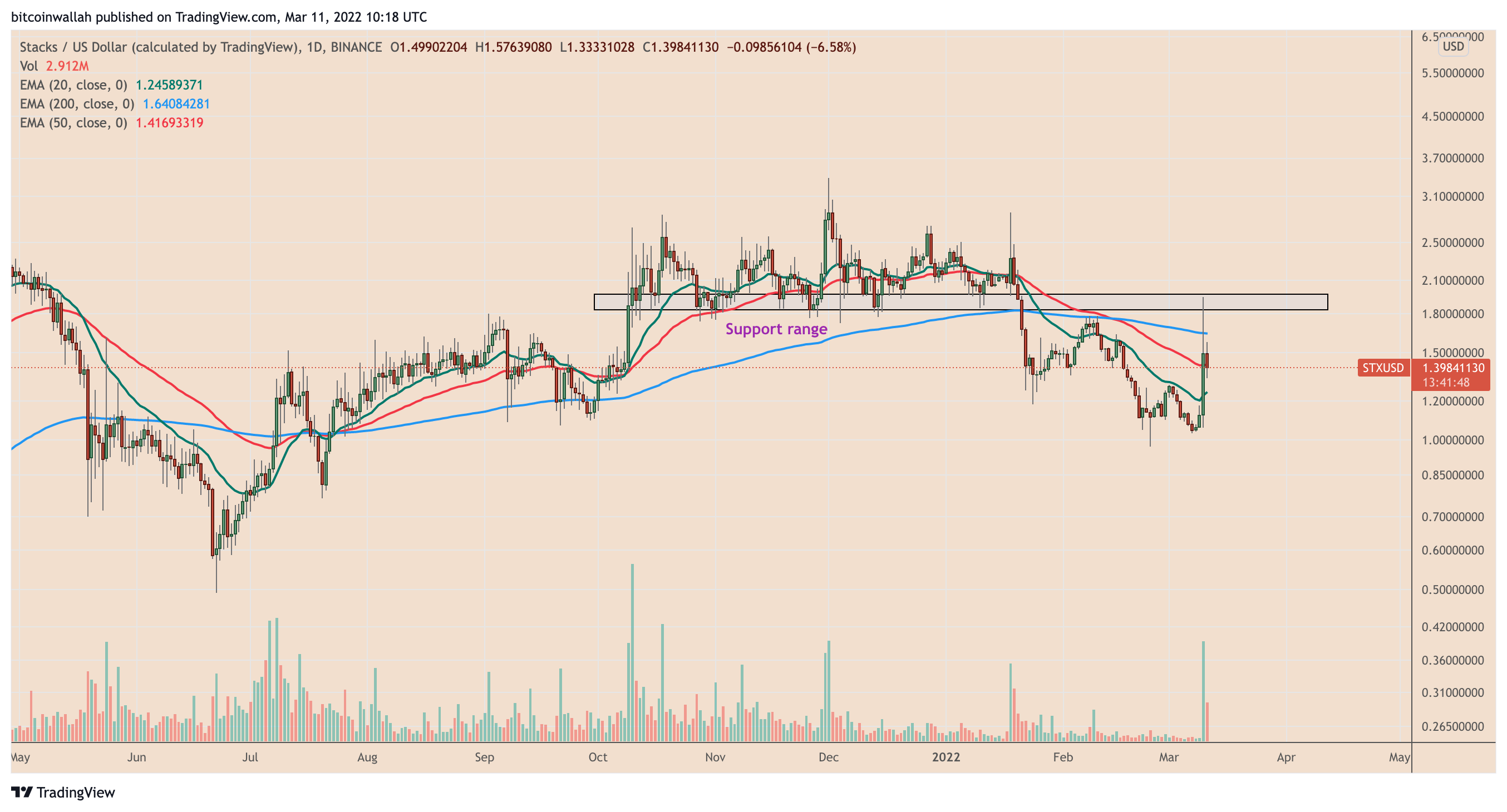
Stacks (STX) pared a considerable portion of the gains it made on March 10 as the euphoria surrounding its $165 million pledge to support Bitcoin (BTC) projects showed signs of fading.
STX’s price dropped by over 30% to reach a level as low as $1.33 on Friday when measured from its week-to-date high of $1.94. The selloff, in part, appeared technical as the $1.94-top fell in the same range that served as solid support between October 2021 and January 2022, only to flip later to become a resistance area.
STX/USD daily price chart. Source: TradingView
It also appears that traders spotted selling opportunities due to STX’s long wick candlestick on March 10. Stacks rallied by as much as 73% into the day while forming a disproportionally long bullish wick on the daily chart that hinted at upside exhaustion.
What pushed STX higher?
The rally in the STX market on March 10 coincided with the launch of “Bitcoin Odyssey,” a $165 million fund to develop Web3, decentralized finance (DeFi), and nonfungible token (NFT) projects on the Bitcoin blockchain by harnessing Stacks’ open-source network for Bitcoin-based smart contracts.
Notably, STX serves as a utility token inside the Stacks ecosystem to pay for network activity and contract execution. STX owners can also stake their holdings on the Stacks network via “Stacking” to support its blockchain’s consensus mechanism. In return, they earn BTC rewards.
It appears traders flocked to purchase STX en masse, anticipating a rise in its demand after the Bitcoin Odessey’s launch. For instance, cryptocurrency exchange OKcoin, the main backer behind the $160-million-fund, promoted the Stacks token for its bullish outlook, saying it is “not a bad time to get in on” Stacks.
All-time high ahead?
Interestingly, STX’s ongoing price rally appeared at a confluence of two key support levels, with at least one suggesting that the Stacks token is heading to a new all-time high next.
This confluence comprises an upward sloping trendline that has acted as an accumulation point for traders since early 2020 and the 0.5 Fib line (near $1.50) of the Fibonacci retracement graph made from $0.04-swing low to $2.82-swing high.
STX/USD weekly price chart. Source: TradingView
STX now looks to close above its two interim exponential moving averages (EMA) — the 20-week (green) and the 50-week (red) EMAs — following its rebound from the dual-support area. A successful breakout may have the Stacks token retest another upward sloping trendline that has served as a resistance level since 2020.
Conversely, a pullback from the 20-50 EMA resistances could have STX break below its ascending trendline support toward 0.786 Fib line near $0.63.
The views and opinions expressed here are solely those of the author and do not necessarily reflect the views of Cointelegraph.com. Every investment and trading move involves risk, you should conduct your own research when making a decision.
The leader in news and information on cryptocurrency, digital assets and the future of money, CoinDesk is a media outlet that strives for the highest journalistic standards and abides by a strict set of editorial policies. CoinDesk is an independent operating subsidiary of Digital Currency Group, which invests in cryptocurrencies and blockchain startups. As part of their compensation, certain CoinDesk employees, including editorial employees, may receive exposure to DCG equity in the form of stock appreciation rights, which vest over a multi-year period. CoinDesk journalists are not allowed to purchase stock outright in DCG.
The leader in news and information on cryptocurrency, digital assets and the future of money, CoinDesk is a media outlet that strives for the highest journalistic standards and abides by a strict set of editorial policies. CoinDesk is an independent operating subsidiary of Digital Currency Group, which invests in cryptocurrencies and blockchain startups. As part of their compensation, certain CoinDesk employees, including editorial employees, may receive exposure to DCG equity in the form of stock appreciation rights, which vest over a multi-year period. CoinDesk journalists are not allowed to purchase stock outright in DCG.