The leader in news and information on cryptocurrency, digital assets and the future of money, CoinDesk is a media outlet that strives for the highest journalistic standards and abides by a strict set of editorial policies. CoinDesk is an independent operating subsidiary of Digital Currency Group, which invests in cryptocurrencies and blockchain startups. As part of their compensation, certain CoinDesk employees, including editorial employees, may receive exposure to DCG equity in the form of stock appreciation rights, which vest over a multi-year period. CoinDesk journalists are not allowed to purchase stock outright in DCG.
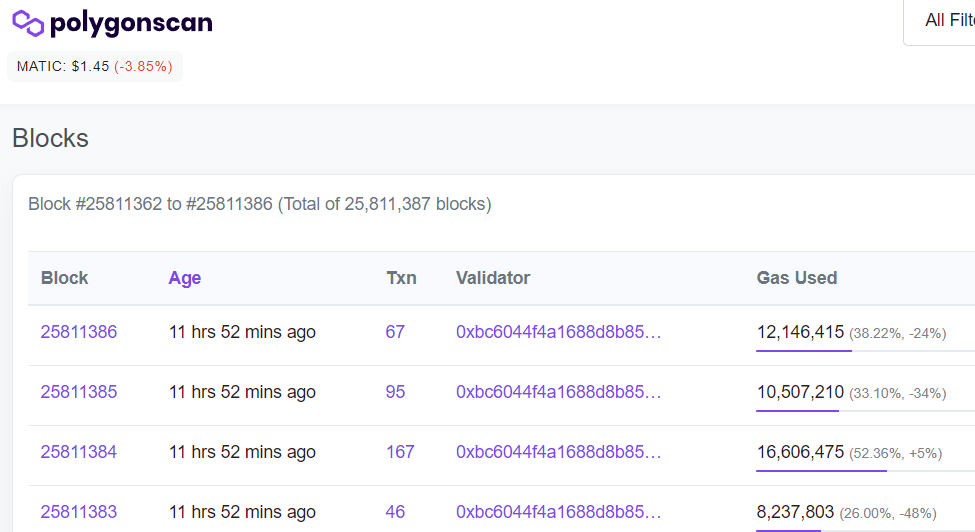
Layer-2 Ethereum scaling solution Polygon has not produced a new block for over 11 hours, with developers attributing the issue to a technical upgrade on the network.
On March 10 at 4:20 pm UTC, Polygon (MATIC) network developers notified users on the project’s forum that there would likely be downtime starting at about 5:50 pm UTC due to maintenance required on one of the network’s three layers. A recent upgrade is thought to have caused an error in the network’s ability to achieve consensus.
“We suspect there may have been a bug in the upgrade which affected consensus and caused different Heimdall validators to be on different versions of the chain, thereby not reaching 2/3 consensus.”
As expected, the outage began at about 5:54 pm UTC.
The Polygon team issued an update at about 1:30 am UTC explaining that it was still working to fix the error and that a hotfix was deployed to help continue making blocks. That hotfix does not appear to have taken effect as of the time of writing.
The team also assured users that all funds and data on-chain are safe.
A network outage on Polygon has lasted for 11 hours.
Polygon users apparently understood the outage was expected, but by the sixth hour, rumblings began to appear among the community. Most users have pointed out concerns at the extended amount of time for the outage.
So uhhhhh…..Polygons been down for 6 hours and counting….
Others have noted that their profession or crypto business has been negatively affected by the outage. Twitter user @Miklos211 said:
“I’m literally unable to work thanks to that, could you please send us a time where we can expect the network to be back on?”
The Polygon network consists of three layers that each serves a unique role. Smart contracts run on the Ethereum (ETH) layer and the Bor layer helps produce blocks. The third Heimdall layer is where the problem lies.
Heimdall is a set of proof-of-stake (PoS) nodes that help the network reach consensus. With the Heimdall issue, Polygon cannot reach network consensus.
In related news, Polygon recently partnered with the multichain music nonfungible tokens (NFT) marketplace TokenTraxx to support the marketplace in the Polygon ecosystem. TokenTraxx will allow musicians to tokenize their work and sell it as NFTs.
The price of Brent crude, a key measure of global oil supply, was selling near $110 per barrel, well off its high of $130 earlier this week but well over its range just a month ago. In the U.S., inflation accelerated in February to a fresh four-decade high, signaling supply and demand imbalances were little improved amid soaring gas prices. The Consumer Price Index rose 7.9% over the past 12 months, the fastest since 1982, the U.S. Labor Department’s Bureau of Labor Statistics reported Thursday.
At the point that OnlyFans made the 500 ETH donation, the DAO was stalled at about half of the 1,000 ETH reserve amount, a representative said. The OnlyFans donation pushed the amount over the top, and from that point on, more donations began to pile in.
In a letter to District Judge Kevin Castel of the Southern District of New York, Buterin detailed his seven-year friendship with Griffith, who he met in 2013 and began collaborating with on research in 2016. In 2018, Griffith formally joined Ethereum as a developer after Buterin said he “convinced him to agree.”
The firm has also launched BessemerDAO, a Web 3 community for founders, creators and operators. BessemerDAO is meant to connect members of the crypto community for idea sharing, business development and tokenomics. The effort won’t be decentralized at first with Bessemer partners making decisions for the DAO, but the firm plans for the effort to become decentralized over time.
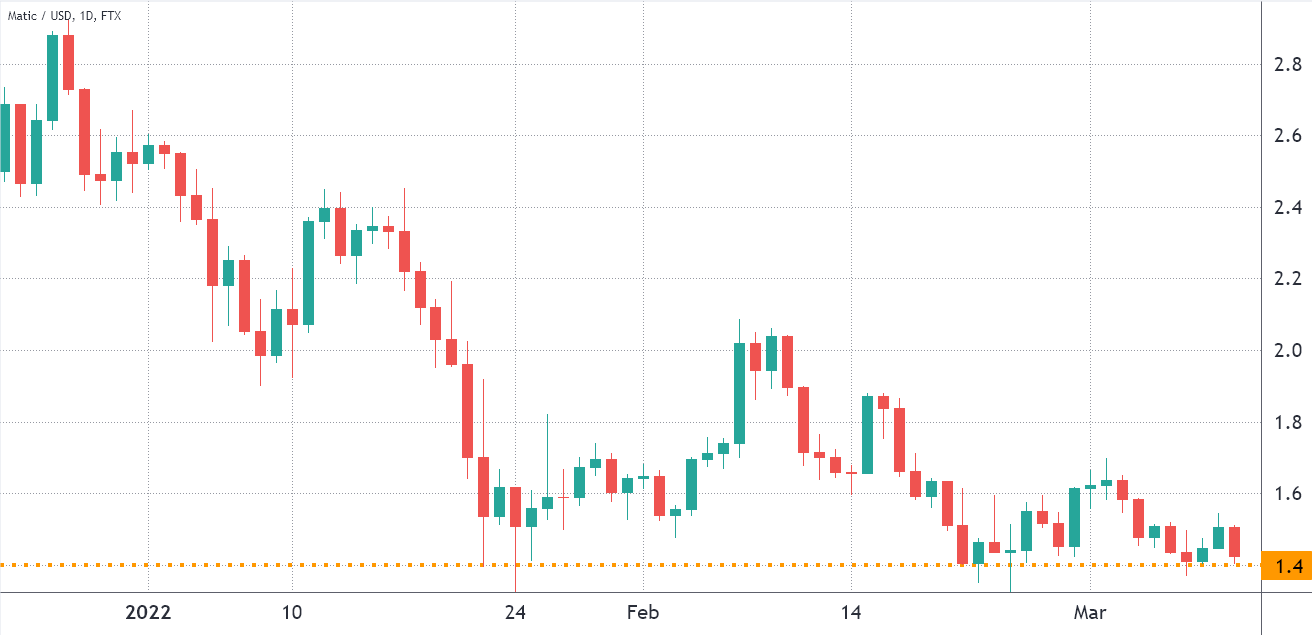
After a devastating 50% correction between Dec. 25 and Jan. 25, Polygon (MATIC) has been struggling to sustain the $1.40 support. While some argue this top-15 coin has merely adjusted after a 16,200% gain in 2021, others point to competing scaling solutions growth.
MATIC token/USD at FTX. Source: TradingView
Either way, MATIC remains 50.8% below its all-time high at an $11 billion market capitalization. Currently, the market cap of Terra (LUNA) stands at $37 billion, Solana (SOL) is above $26 billion and Avalanche (AVAX) is at a $19 billion market value.
A positive note is that Polygon raised $450 million on Feb. 7, and the funding round was backed by some of blockchain’s most considerable venture funds, including Sequoia Capital.
Polygon offers scaling and infrastructure support to Ethereum Virtual Machine-based (EVM) decentralized applications (DApps). Besides, it is not plagued by the high transaction fees and network congestion that impact the Ethereum network.
However, as proof-of-stake layer-1 networks emerged and offered low-cost smart contract capabilities, it vastly increased the competition for Ethereum network decentralized finance (DeFi), nonfungible token minting, marketplaces, crypto games, gambling and social applications.
In comparison, Terra’s total value locked increased by 340% between July and December 2021, reaching $12.6 billion. Similarly, Avalanche’s smart contracts deposits increased from $185 million to $11.11 billion in the same period.
The use of Polygon’s scaling solution is declining
Polygon’s primary DApp metric started to display weakness in August 2021 after the network‘s TVL dropped below 4 billion MATIC.
Polygon Total Value Locked, MATIC. Source: DefiLlama
The chart above shows how Polygon‘s DApp deposits peaked at 7.4 billion MATIC in July 2021, then drastically declined over the next couple of months. In dollar terms, the current $3.5 billion TVL is the lowest number since May 2021. These figures represent less than 5% of the aggregate TVL (excluding Ethereum), according to DefiLlama data.
Another positive is that on March 9, Ankr, a multi-chain toolkit for blockchain infrastructure, enabled a token bridge between Ethereum and Polygon. The first release will allow the aMATICb liquid staking token to be sent and stored. This enables users to earn additional layers of rewards on DeFi platforms.
To confirm whether the TVL drop in Polygon is troublesome, one should analyze DApp usage metrics. Some DApps, such as games and collectibles, do not require large deposits, so the TVL metric is irrelevant in those cases.
As shown by DappRadar, on March 10 the number of Polygon network addresses interacting with decentralized applications grew by 5% versus the previous month. Even though Polygon’s TVL has been hit the hardest compared to similar smart contract platforms, there is solid network use in the gaming sector, as measured by Crazy Defense Heroes’ 199,260 active addresses in the last 30 days.
On Nov. 16, Polygon launched its zk-STARK-powered Miden Virtual Machine, a zero-knowledge Scalable Transparent ARgument of Knowledge. Polygon has also committed over $1 billion for developing complex DeFi applications that need sensitive information redacted on digitized assets, reducing their size for fast verification by blockchain participants.
The above data suggest that Polygon is holding its ground versus competing chains, and those holders might not worry too much about MATIC’s 50% price correction. Polygon’s ecosystem continues to flourish, and the fact that it offers much demanded layer-2 scaling solutions for multiple industries can be viewed as a bullish factor.
The views and opinions expressed here are solely those of the author and do not necessarily reflect the views of Cointelegraph. Every investment and trading move involves risk. You should conduct your own research when making a decision.
The Labor Department said crypto presents “significant risks and challenges to participants’ retirement accounts, including significant risks of fraud, theft and loss.” It highlighted as reasons speculation and volatility, challenges to making informed investment choices, custodial and record-keeping concerns, the lack of reliability of cryptocurrency valuations and an evolving regulatory environment.
The leader in news and information on cryptocurrency, digital assets and the future of money, CoinDesk is a media outlet that strives for the highest journalistic standards and abides by a strict set of editorial policies. CoinDesk is an independent operating subsidiary of Digital Currency Group, which invests in cryptocurrencies and blockchain startups. As part of their compensation, certain CoinDesk employees, including editorial employees, may receive exposure to DCG equity in the form of stock appreciation rights, which vest over a multi-year period. CoinDesk journalists are not allowed to purchase stock outright in DCG.
According to a recent report curated by NonFungible, players of the monster-battle nonfungible tokens, or NFTs, game Axie Infinity transacted nearly $3.5 billion worth of NFTs in 2021. This accounts for almost two-thirds of all NFTs transacted in the entire blockchain gaming industry in 2021. In second and third place were sports highlights marketplace NBA Top Shot with $827 million and community gaming platform Loot with $242 million, respectively.
Created by Vietnamese video game developer Sky Mavis in 2018, the game contains creatures called “Axies” that players collect and use to complete daily quests, duel other players, etc. Every Axie is an NFT minted on the Ethereum (ETH) blockchain. Completing tasks with Axies rewards players with Smooth Love Potions (SLPs), which can be sold for cash on cryptocurrency exchanges, thereby generating a stream of income for players. On the whole, Axie Infinity accounted for 19% of the estimated $17 billion in total NFT transactions last year.
Last November, Axie Infinity surged significantly in popularity, especially among gamers in developing countries, where one can potentially earn more playing Axie Infinity than working minimum wage jobs. However, players have complained to its developers that their earnings have fallen in light of SLP falling in price by 67.5% in the past year.
Although, the price decline can be partly attributed to the rising token inflation due to more and more players joining and playing the game. At the time of publication, there are nearly 2.7 million monthly Axie players, compared to just north of 1 million last March. But from July 2021 to now, the circulating supply of SLP increased from 541.7 million to 5.13 billion.
Overall, blockchain gaming enthusiasts bought and sold $5.18 billion worth of NFTs last year, spread across 20,986,532 sales. In addition, there were a total of 112 blockchain games and 1.88 million active wallets. Based on analysis by NonFungible, these statistics accounted for 2.18% of the world’s total gaming market in 2021.