Category: TRENDING

  • Impermanent loss challenges the claim that DeFi is the ‘future of France’

    Impermanent loss challenges the claim that DeFi is the ‘future of France’

    Impermanent loss is one of the most recognized risks that investors have to contend with when providing liquidity to an automated market maker (AMM) in the decentralized finance (DeFi) sector. Although it is not an actual loss incurred from the liquidity provider’s (LP) position — rather an opportunity cost that occurs when compared with simply buying and holding the same assets — the possibility of getting less value back at withdrawal is enough to keep many investors away from DeFi.

    Impermanent loss is driven by the volatility between the two assets in the equal-ratio pool — the more one asset moves up or down relative to the other asset, the more impermanent loss is incurred. Providing liquidity to stablecoins, or simply avoiding volatile asset pairs, is an easy way to reduce impermanent loss. However, the yields from these strategies might not be as attractive.

    So, the question is: Are there ways to participate in a high-yield LP pool and at the same time reduce as much impermanent loss as possible?

    Fortunately for retail investors, the answer is yes, as new innovations continue to solve the existing problems in the DeFi world, providing many ways for traders to avoid impermanent loss.

    Uneven liquidity pools help reduce impermanent loss

    When talking about impermanent loss, people often refer to the traditional 50%/50% equal-ratio two-asset pool — i.e., investors have to provide liquidity to two assets at the same value. As DeFi protocols evolve, uneven liquidity pools have come into the picture to help reduce impermanent loss.

    As shown in the graph below, the downside magnitude from an equal-ratio pool is much larger than an uneven pool. Given the same relative price change — e.g., Ether (ETH) increases or decreases by 10% relative to USD Coin (USDC) — the more uneven the ratio of the two assets, the less the impermanent loss.

    Impermanent loss from even and uneven liquidity pools. Source: Elaine Hu

    DeFi protocols such as Balancer have made uneven liquidity pools available since as early as the beginning of 2021. Investors can explore a variety of uneven pools to seek out the best option.

    Multi-asset liquidity pools are a step forward

    In addition to uneven liquidity pools, multi-asset liquidity pools can also help reduce impermanent loss. By simply adding more assets to the pool, the diversification effects come into play. For example, given the same price movement in Wrapped Bitcoin (WBTC), the USDC-WBTC-USDT equal-ratio tri-pool has a lower impermanent loss than the USDC-WBTC equal-ratio pool, as shown below.

    Two-asset vs. three-asset liquidity pool. Source: Topaze.blue/Bancor

    Similar to the two-asset liquidity pool, the more correlated the assets are in the multi-asset pool, the more the impermanent loss, and vice versa. The 3D graphs below display the impermanent loss in a tri-pool given different levels of the price change of Token 1 and Token 2 relative to the stablecoin, assuming one stablecoin is in the pool.

    When the relative price change of Token 1 to the stablecoin (294%) is very close to the relative price change of Token 2 (291%), the impermanent loss is also low (-4%).

    Simulation of impermanent loss from a tri-pool. Source: Elaine Hu

    When the relative price change of Token 1 to stablecoin (483%) is very different and far away from the relative price change of Token 2 to stablecoin (8%), the impermanent loss becomes noticeably larger (-50%).

    Simulation of impermanent loss from a tri-pool. Source: Elaine Hu

    Single-sided liquidity pools are the best option

    Although the uneven liquidity pool and multi-asset pool both help reduce impermanent loss from the LP position, they do not eliminate it completely. If investors do not want to worry about impermanent loss at all, there are also other DeFi protocols that allow investors to provide only one side of the liquidity through a single-sided liquidity pool.

    One might wonder where the risk of impermanent loss is transferred if investors do not bear the risk. One solution provided by Tokemak is to use the protocol’s native token, TOKE, to absorb this risk. Investors only need to supply liquidity such as Ether to one side, and TOKE holders will provide TOKE on the other side to pair up with Ether to create the ETH-TOKE pool. Any impermanent loss caused by the price movements in Ether relative to TOKE will be absorbed by the TOKE holder. In return, TOKE holders take all swap fees from the LP pool.

    Since TOKE holders also have the power to vote for the next five pools the liquidity will be directed to, they also get bribed by protocols who want them to vote for their liquidity pools. In the end, TOKE holders bear the impermanent loss from the pool and are compensated by the swap fees and bribe rewards in TOKE.

    Another solution is to separate risks into different tranches so that risk-averse investors are protected from impermanent loss and that risk-seeking investors who bear the risk will be compensated with a high-yield product. Protocols such as Ondo offer a senior fixed tranche where impermanent loss is mitigated and a variable tranche where impermanent loss is absorbed but higher yields are offered.

    Automated LP manager can reduce investors’ headaches

    If all of the above seems too complicated, investors can still stick to the most common 50%/50% equal-ratio pool and use an automated LP manager to actively manage and dynamically rebalance the LP position. This is especially useful in Uniswap v3, where investors need to specify a range to which they want to provide concentrated liquidity.

    Automated LP managers conduct rebalancing strategies to help investors maximize LP fees and minimize impermanent loss by charging a management fee. There are two main strategies: passive rebalancing and active rebalancing. The difference is that the active rebalancing method swaps tokens to achieve the amount required at the time of rebalancing, whereas passive rebalancing does not and only swaps gradually when the pre-set price of the token is hit (similar to a limit order).

    In a volatile market where prices are constantly moving sideways, a passive rebalancing strategy works well because it doesn’t need to rebalance frequently and pay large amounts of swap fees. But in a trending market where price continues to move in one direction, active rebalancing works better because the passive rebalancing strategy could miss the boat and sit outside the LP range for a long time and fail to collect any LP fees.

    To choose the right automated LP manager, investors need to find the one that suits their risk appetite. There are passive rebalancing strategies such as Charm Finance that aim to earn a stable return by using a wide LP range to reduce impermanent loss. There are also passive managers such as Visor Finance that use a very narrow LP range to earn high LP fees, but are also exposed to more potential impermanent loss. Investors need to select automated LP managers based on not only their risk appetite but also their long-term investment goals.

    Although traditional equal-ratio LP profits could be eroded by impermanent loss when the underlying tokens move in very different directions, there are alternative products and strategies available for investors to reduce or completely avoid impermanent loss. Investors just need to find the right trade-off between risk and return to find the best-suited LP strategy.

    The views and opinions expressed here are solely those of the author and do not necessarily reflect the views of Cointelegraph.com. Every investment and trading move involves risk, you should conduct your own research when making a decision.

  • Opensea phishing scandal reveals a security need across the NFT landscape

    Opensea phishing scandal reveals a security need across the NFT landscape

    Despite the ongoing volatility plaguing the digital asset sector, one niche that has undoubtedly continued to flourish is the nonfungible token (NFT) market. This is made evident by the fact that a growing number of mainstream mover and shakers including the likes of Coca-Cola, Adidas, the New York Stock Exchange (NYSE) and McDonalds, among many others, have made their way into the burgeoning Metaverse ecosystem in recent months.

    Also, owing to the fact that over the course of 2021 alone, global NFT sales topped out at $40 billion, many analysts expect this trend to continue into the future. For example, American investment bank Jefferies recently raised its market-cap forecast for the NFT sector to over $35 billion for 2022 and to over $80 billion for 2025 — a projection that was also echoed by JP Morgan.

    However, as with any market growing at such an exponential rate, issues related to security have to be expected as well. In this regard, prominent nonfungible token (NFT) marketplace OpenSea recently fell victim to a phishing attack that took place just hours after the platform announced its week-long planned upgrade to delist all inactive NFTs.

    Diving into the matter

    On Feb 18, OpenSea revealed that it was going to initiate a smart contract upgrade, requiring all of its users to transfer their listed NFTs from the Ethereum blockchain to a new smart contract. Owing to the upgrade, users who failed to facilitate the above said migration stood at a risk of losing their old and inactive listings.

    That said, due to the small migration deadline provided by OpenSea, hackers were presented with a potent window of opportunity. Within hours of the announcement, it was revealed that nefarious third party individuals have initiated a sophisticated phishing campaign, stealing NFTs from many users that were stored on the platform before they could be migrated over to the new smart contract.

    Providing a technical breakdown of the matter, Neeraj Murarka, chief technical officer and cofounder of Bluezelle, a blockchain for GameFi ecosystem, told Cointelegraph that at the time of the incident, OpenSea was making use of a protocol called Wyvern, a standard tech module that most NFT web apps make use of since it allows for the management, storage, and transfer of these tokens within users’ wallets.

    Because the smart contract with Wyvern allowed users to work with the NFTs stored in their “wallets,” the hacker was able to send out emails to Opensea clients masquerading as a representative for the platform, encouraging them to sign “blind” transactions. Murarka further added:

    “Metaphorically, this was like signing a blank check. Normally, this is okay if the payee is the intended recipient. Keep in mind that an email can be sent by anyone, but be made to appear to be sent by someone else. In this case, the payee appears to be a single hacker who was able to use these signed transactions to transfer out and effectively steal the NFTs from these users.”

    Also, in an interesting twist of events, following the incident the hacker apparently returned some of the stolen NFTs to their rightful owners, with further efforts being made to return other lost assets. Providing his take on the entire matter, Alexander Klus, founder of Creaton, a Web3 content creation platform, told Cointelegraph that the phishing email campaign used a malicious signing transaction to approve all holdings to be able to be drained at any time. “We need better signing standards (EIP-712) so people can actually see what they are doing when approving a transaction.”

    Lastly, Lior Yaffe, cofounder and director of Jelurida, a blockchain software company, pointed out that the episode was a direct result of the confusion surrounding OpenSea’s poorly planned smart contract upgrade, as well as the platform’s transaction approval architecture.

    NFT marketplaces need to step up their security game

    In Murarka’s view, web apps making use of the Wyvern smart contract system should be augmented with usability improvements to ensure that users don’t fall for such phishing attacks time and time again, adding:

    “Very clear warnings should be made to educate the user about phishing attacks and driving home the fact that emails will never be sent, soliciting the user to take any steps. Web apps like OpenSea should adopt a strict protocol to never communicate with users via email apart from maybe just registration data.”

    That said, he did concede that even if OpenSea were to adopt the safest security/privacy protocols and standards, it is still up to its users to educate themselves about these risks. “Unfortunately, the web app itself is often held responsible, even though it was the user that was phished. Who is responsible? The answer is unclear,” he noted.

    A similar sentiment is shared by Jessie Chan, chief of staff at ParallelChain Lab, a decentralized blockchain ecosystem, who told Cointelegraph that regardless of how the entire attack was orchestrated, the issue not entirely dependant on OpenSea’s existing security protocols but also on user awareness against phishing. The question remains whether the marketplace operator should have been able to provide sufficient information to its users to keep them informed of how to deal with such scenarios.

    Another possibility to mitigate any potential phishing events is by having all interactions between users and their web apps being driven solely via the use of a dedicated mobile/desktop interface. “If all interactions required the use of a desktop app, such attacks could be bypassed completely.”

    Providing his take on the subject, Yaffe noted that the main problem — which lies at the heart of this whole issue — is the basic architecture of most NFT marketplaces, enabling users to simply sign a carte blanche approval for a third-party contract to use their private wallet without setting a spending limit:

    “Since the OpenSea team did not really figure out the source of the phishing operation, it might as well happen again next time they attempt to make a change to their architecture.”

    What can be done?

    Murarka noted that the best way to eliminate the possibility of these attacks is if people start making use of hardware wallets. This is because most software wallets as well as other custodial storage solutions are too vulnerable in their general design and operational outlook. He further elaborated: “Much like Bitcoin, Ethereum, etc, NFTs themselves should be moved to hardware wallet accounts instead of leaving them on a centralized platform,” adding:

    “Users need to be super aware of the risks of responding to and acting upon emails they receive. Emails can be faked very easily, and users need to be proactive about the safety of their crypto assets.”

    Another thing NFT owners need to remember is that they should only be visiting web apps that employ high-quality security protocols, checking that the accessed marketplaces utilize the HTTPS mechanism (at the very least) while being able to clearly see a lock symbol on the top left of their browser window — which correctly points to the intended company — while visiting any webpage.

    Yaffe believes that users should be careful with contract approvals and keep an accurate track of the contracts they have greenlighted in the past. “Users should revoke unnecessary or unsafe approvals. If possible users should specify a reasonable spending limit for every contract approval,” he concludes.

    Related: Cointelegraph partners with Nitro Network to bring digital mining and decentralized internet to the masses

    Lastly, Chan believes that in an ideal scenario, users should keep their wallets on a dedicated platform that they don’t use to read email or browse the web, adding that any such avenues are subject to all manners of third party attacks. He further stated:

    “This is inconvenient, but when dealing with assets of great value and where there is no recourse in the event of theft, extreme care is justified. And, as with all financial transactions, they should be very careful in deciding who to deal with, since the counterparties can also steal your assets and disappear.”

    Therefore, while moving into a future driven by NFTs and other similar novel digital offerings, it remains to be seen how platforms operating within this space continue to evolve and mature, especially as a growing amount of capital keeps making its way into the NFT market.

  • US Virginia Senate allows state banks to offer crypto custody services

    US Virginia Senate allows state banks to offer crypto custody services

    The Senate of Virginia in the United States unanimously approved a bill amendment request that now allows traditional banks operating in the Commonwealth of Virginia to provide virtual currency custody services. 

    Delegate Christopher T. Head introduced the bill, House Bill No. 263, back in January 2022, seeking an amendment to allow eligible banks to offer crypto custody services:

    “A bank may provide its customers with virtual currency custody services so long as the bank has 26 adequate protocols in place to effectively manage risks and comply with applicable laws.”

    The bill passed Senate with a sweeping 39-0 vote and is waiting to be signed into law by Governor of Virginia Glenn Youngkin. Banks that intend to offer this service to clients will need to adhere to three specific requirements mentioned in the bill: implement effective risk management systems, possess adequate insurance coverage and launch an oversight program to address risks associated with cryptocurrencies.

    However, the Senate will require the banks’ customers to retain direct control of their public and private keys associated with their virtual currency, adding:

    “Acting in a fiduciary capacity, the bank shall require customers to transfer their virtual currencies to the control of the bank by creating new private keys to be held by the bank.”

    Other states such as Wyoming have also recently seen an introduction of legislation for a state-issued stablecoin.

    Related: US lawmaker pushes for state-level regulations on stablecoins at hearing on digital assets

    Just last month, the House Committee on Financial Services had a discussion about whether regulations on stablecoins and digital assets should be addressed at the state or federal level.

    In this regard, North Carolina Representative and ranking committee member Patrick McHenry asked the committee to consider state-level regulatory frameworks in lieu of a comprehensive federal law on stablecoins.

    Jean Nellie Liang speaking at Feb. 8 House Committee on Financial Services hearing

    Quoting a report from the President’s Working Group on Financial Markets, Jean Nellie Liang, undersecretary for domestic finance at the Department of Treasury, said that U.S. dollar-pegged stablecoin issuers — both state and federally chartered banks — should be held to the same standards as insured depository institutions.

  • REN price gains 65% after Catalog launch brings a cross-chain DEX to its blockchain

    REN price gains 65% after Catalog launch brings a cross-chain DEX to its blockchain

    Decentralized finance projects like Ren pumped in 2021, only to finish the year right back where they started as high fees on Ethereum (ETH) led to decreased activity for many protocols and DeFi took a backseat to more popular sectors like nonfungible tokens (NFTs). 

    Now, it appears as though that downtrend is in the process of reversing course after recent global events highlighted the benefits of DeFi and holding assets outside the traditional financial system. This week REN price climbed 69% from a low of $0.247 on Feb. 24 to a daily high of $0.418 on March 3.

    REN/USDT 4-hour chart. Source: TradingView

    Three reasons for the potential price reversal in REN are the launch of its first layer-one application Catalog, the launch of VarenX on Polygon and several new partnerships and integrations for REN and the Ren Virtual Machine (RenVM).

    Catalog launches

    The biggest development to come out of the REN project lately was the release of Catalog, the first application built on the Ren blockchain.

    Catalog is a “Metaversal” exchange according to Ren and is designed to be a secure cross-chain decentralized exchange (DEX) with built-in liquidity mechanisms that allow users to swap assets across popular networks at a minimal cost.

    The liquidity mechanism for Catalog will tap into native asset pools as well as liquidity across third-party DEXes, meaning that Ren will be able to support a wide array of projects without worrying about liquidity constraints.

    Other features of Catalog include zero gas fees and low, flat-rate trading fees, the ability to earn passive income on crypto held in a Catalog account without needing to stake or participate in liquidity pools and future plans to add the ability to link a bank account for easy deposits and withdrawals.

    VarenX launches on Polygon

    A second development boosting the momentum for REN was the integration of its VarenX DeFi hub on the Polygon network.

    Up to this point, VarenX has only operated on the Ethereum network, making it difficult for VarenX to gain traction.

    The low fee nature of Polygon has enabled VarenX to offer gasless transactions through its “FreeWei” feature which fronts the gas costs for users, allowing them to conduct cross-chain for free.

    Related: REN price at risk of 50% drop after a bearish trading pattern shows up

    Partnerships and integrations

    A third factor helping to boost the outlook for Ren has been a series of partnerships and integrations that have helped to strengthen its cross-chain ties.

    Most recently, Ren partnered with Kava to join the Kava Pioneer program, which will see the RenVM deployed on the Kava Network Ethereum co-chain on March 8.

    Other notable developments include a partnership with DappBack, a renBTC integration with Vesta Finance and the listing of REN on the Voyager app and exchange.

    VORTECS™ data from Cointelegraph Markets Pro began to detect a bullish outlook for REN on Feb. 25, prior to the recent price rise.

    The VORTECS™ Score, exclusive to Cointelegraph, is an algorithmic comparison of historical and current market conditions derived from a combination of data points including market sentiment, trading volume, recent price movements and Twitter activity.

    VORTECS™ Score (green) vs. REN price. Source: Cointelegraph Markets Pro

    As seen in the chart above, the VORTECS™ Score for REN climbed into the green zone on Feb. 25 and reached a high of 81 around 56 hours before the price increased 35.8% over the next three days.

    The views and opinions expressed here are solely those of the author and do not necessarily reflect the views of Cointelegraph.com. Every investment and trading move involves risk, you should conduct your own research when making a decision.
  • Convex Finance Bug Causes CVX Token to Sink on Forced Token Unlock

    Convex Finance Bug Causes CVX Token to Sink on Forced Token Unlock

    The leader in news and information on cryptocurrency, digital assets and the future of money, CoinDesk is a media outlet that strives for the highest journalistic standards and abides by a strict set of editorial policies. CoinDesk is an independent operating subsidiary of Digital Currency Group, which invests in cryptocurrencies and blockchain startups. As part of their compensation, certain CoinDesk employees, including editorial employees, may receive exposure to DCG equity in the form of stock appreciation rights, which vest over a multi-year period. CoinDesk journalists are not allowed to purchase stock outright in DCG.

    @2022 CoinDesk

  • Altcoin Roundup: JunoSwap, Solidly and VVS Finance give DeFi a much-needed refresh

    Altcoin Roundup: JunoSwap, Solidly and VVS Finance give DeFi a much-needed refresh

    Decentralized finance (DeFi) was the talk of the town in early 2021, but it has since taken a back seat to more appealing sectors like nonfungible tokens (NFTs), memecoins and blockchain gaming. 

    Now that cross-chain bridges and interoperability have allowed for the easier migration of assets to competing chains, a new class of DeFi protocols is arising to challenge those left from 2021.

    Here’s a look at three DeFi projects that have launched on some of the up-and-coming layer-1 blockchain networks, catching the eye of the crypto community.

    VVS Finance

    VVS Finance is the largest DeFi protocol on the Cronos network, a project that emerged out of the Crypto.com ecosystem which has since been fully rebranded to Cronos (CRO).

    The goal of VVS Finance is to offer instant swaps with low fees, low slippage and attractive yields for liquidity providers (LPs).

    As a reward for providing liquidity, two-thirds of swap fees collected on the exchange are distributed to the LPs of the respective pools and LP tokens can also be locked in the protocol’s Crystal Farms to earn VVS rewards.

    VVS holders also have the ability to single stake their tokens in the “Glitter Mines,” where they can currently auto-compound for 65.78%. Future plans include the addition of VVS rewards for those who swap tokens through the exchange.

    According to data from DefiLlama, the current TVL for VVS finance is $1.35 billion, accounting for more than half of the $2.37 billion in value locked on the Chronos network.

    Total value locked on VVS Finance. Source: DefiLlama

    The steady rise in TVL on VVS has come as the protocol has added support for new assets including Dogecoin (DOGE), Shiba Inu (SHIBA), TrueUSD (TUSD) and Cardano (ADA).

    Solidly

    Solidly is a decentralized exchange (DEX) on the Fantom network and it claims to offer “low fees, near-zero slippage on correlated assets and a strong focus on secondary markets for tokenized locks as NFTs.”

    In simpler terms, Solidly is designed to function as an interface for swapping stablecoins and other crypto assets.

    The DEX is the latest creation by Andre Cronje, DeFi architect and founder of Yearn.finance. It was launched in January 2022 with the goal of offering fair and balanced access to decentralized finance.

    The protocol’s focus on stablecoins has thrust it into the Curve Wars debate with its own twist. This comes at the time when Solidly Wars have broken out among the Fantom DeFi community, with the Solidex protocol currently accounting for 33.74% of all Solidly emissions.

    Despite launching just a little over a month ago, the total value locked (TVL) on the protocol recently hit a high of $2.19 billion and saw more than $317 million in volume on March 3 as the wider crypto market experienced a sell-off.

    Total liquidity and 24-hour trading volume on Solidly. Source: Solidly

    SOLID, the native token, holders can stake their tokens on the network for varying lock-up periods ranging from one week to four years. They are also able to receive vested equity nonfungible tokens (veNFT) that represent the staked assets and confer voting rights.

    Liquidity providers are also rewarded with veNFTs and earn between 40% and 100% based on their own ve-token balance. Fees generated from activity on the Solidly exchange are distributed to veNFT token holders.

    Related: Crypto adds efficiency to global trade and financing, says Bequant exec

    Juno

    Juno is a decentralized, public and permissionless network for cross-chain smart contracts that is part of the Cosmos ecosystem. While it is not necessarily a DeFi-specific protocol, Juno has enabled the creation of multiple decentralized applications (DApps) and DeFi protocols like Junoswap with others currently in development.

    The protocol was created by a group of developers, validators and delegators within the Cosmos ecosystem to become a kind of sister hub to the Cosmos Hub, which can help “preserve the neutrality of the Hub by offloading smart contract usage/congestion to a designated contract zone.”

    Juno is also home to CosmWasm, a program that enables WebAssembly (WASM) virtual machines in the Cosmos SDK. The addition of WASM allows software to be written in many different coding languages, making it so that developers don’t need to learn a new language just to build on Cosmos.

    Activity for the JUNO token saw a noticeable uptick near the end of December 2021, climbing from a price of $7.70 on Dec. 20 to a record-high of $45.85 on March 3.

    JUNO/USD 1-day chart. Source: CoinGecko

    Alongside interest in the cross-chain smart contract capabilities of Juno, investors have also been attracted to the protocol for several high-profile airdrops that have been distributed to JUNO holders and stakers such as the GovDrop for Neta (NETA) and Marble DAO.

    Want more information about trading and investing in crypto markets?

    The views and opinions expressed here are solely those of the author and do not necessarily reflect the views of Cointelegraph.com. Every investment and trading move involves risk, you should conduct your own research when making a decision.

  • Market Wrap: Cryptos Slide; Analysts Expect a Volatility Spike

    Market Wrap: Cryptos Slide; Analysts Expect a Volatility Spike

    “We added to our longer-term options position, selling the volatility spike post-invasion,” QCP Capital, a crypto trading firm, wrote in a Telegram chat, referring to Russia’s invasion of Ukraine. The firm has been tactically accumulating a long volatility position, “expecting outsized volatility” going into the U.S. Federal Reserve meeting March 16-17.

  • Bitcoin Rally Evaporates as Price Tumbles Below $40K Friday Afternoon

    Bitcoin Rally Evaporates as Price Tumbles Below $40K Friday Afternoon

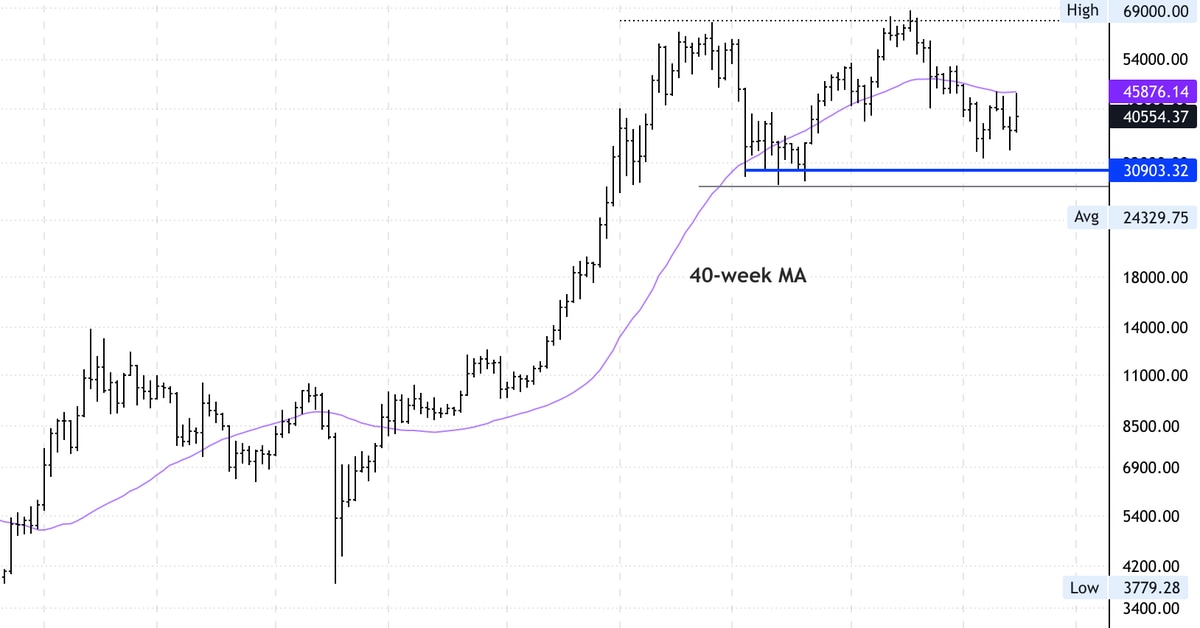
    It’s been quite the round trip for bitcoin this week, with the bulls encouraged by a dramatic move higher from midday Monday that carried the price from $38,000 to above $45,000 early Wednesday. The divergence from struggling stocks didn’t last long, though, and bitcoin’s hasty retreat has picked up steam this afternoon.

  • Bitcoin Extends Pullback Toward $37K-$40K Support Zone

    Bitcoin Extends Pullback Toward $37K-$40K Support Zone

    The leader in news and information on cryptocurrency, digital assets and the future of money, CoinDesk is a media outlet that strives for the highest journalistic standards and abides by a strict set of editorial policies. CoinDesk is an independent operating subsidiary of Digital Currency Group, which invests in cryptocurrencies and blockchain startups. As part of their compensation, certain CoinDesk employees, including editorial employees, may receive exposure to DCG equity in the form of stock appreciation rights, which vest over a multi-year period. CoinDesk journalists are not allowed to purchase stock outright in DCG.

    @2022 CoinDesk

  • Mickey Mantle Baseball Card NFT Sells for $471K in OpenSea Auction

    Mickey Mantle Baseball Card NFT Sells for $471K in OpenSea Auction

    The leader in news and information on cryptocurrency, digital assets and the future of money, CoinDesk is a media outlet that strives for the highest journalistic standards and abides by a strict set of editorial policies. CoinDesk is an independent operating subsidiary of Digital Currency Group, which invests in cryptocurrencies and blockchain startups. As part of their compensation, certain CoinDesk employees, including editorial employees, may receive exposure to DCG equity in the form of stock appreciation rights, which vest over a multi-year period. CoinDesk journalists are not allowed to purchase stock outright in DCG.

    @2022 CoinDesk