Tag: Activity

  • Silk Road crypto activity resurfaces as dormant Bitcoin wallets move again

    Silk Road crypto activity resurfaces as dormant Bitcoin wallets move again

    Silk Road crypto activity resurfaces as dormant Bitcoin wallets move again

    • Silk Road-tagged wallets sent $3.14 million in Bitcoin across 176 transfers this week.
    • The transactions are the most significant Silk Road-linked activity in five years.
    • The wallets sent funds to a new address beginning with bc1qn.

    Silk Road-linked cryptocurrency activity has resurfaced, drawing attention to long-quiet Bitcoin wallets connected to the darknet marketplace.

    The movement comes less than a year after US President Donald Trump granted a full pardon to Silk Road founder Ross Ulbricht.

    While the pardon focused global attention on Ulbricht’s legal case, blockchain analysts are now tracking renewed activity that marks the highest level of transfers in years.

    The latest movement, recorded on Tuesday, is raising fresh questions about dormant coin reserves linked to the marketplace and how much Bitcoin remains undiscovered or untouched across older blockchain addresses.

    Silk Road wallets show renewed Bitcoin flows

    Silk Road-tagged wallets transferred about $3.14 million worth of Bitcoin BTC $92,626, according to Arkham. The activity involved 176 transactions, making it the most significant movement from these addresses in five years.

    Earlier this year, the same wallets carried out only three small test transactions, suggesting that substantial activity had been paused.

    The transfers this week were sent to an unknown cryptocurrency wallet with the address prefix bc1qn.

    The primary Silk Road-associated wallets still hold about $38.4 million in Bitcoin.

    The newly created address holds only the transferred $3.14 million.

    Pardon puts focus back on historic Silk Road funds

    Interest in the wallets has intensified since January, when Trump issued a full pardon to Ulbricht.

    Before the pardon, Ulbricht had been serving a double life sentence without parole for creating and operating Silk Road, which allowed anonymous trading of illicit goods using Bitcoin.

    The pardon also sparked new activity around the Free Ross campaign.

    Supporters have contributed about $270,000 in Bitcoin donations since the announcement, based on on-chain data.

    Unseized Bitcoin linked to Ulbricht gains attention

    Alongside the renewed transfers, discussions have shifted to older cryptocurrency holdings believed to be connected to Ulbricht but never seized by authorities.

    The US government previously confiscated at least $3.36 billion in Bitcoin from Silk Road, marking one of the largest recoveries in the history of digital asset enforcement.

    Yet blockchain analysts tracking historical movements have identified additional reserves that remain untouched.

    Coinbase exchange director Conor Grogan highlighted that 430 BTC, worth about $47 million, has not moved for more than 13 years.

    These tokens are held in wallets thought to be linked to Ulbricht.

    Dormant Bitcoin wallets remain a focal point

    Another Silk Road-tagged wallet likely controlled by Ulbricht contains about $8.3 million in Bitcoin.

    This wallet has seen only three small test transactions over the past 10 months and has otherwise remained inactive for 14 years, according to Arkham.

    The transfers observed this week have therefore shifted attention back to dormant Bitcoin reserves that could hold substantial amounts.

    Experts monitoring historical blockchain activity note that movements involving older darknet-linked wallets often prompt speculation about ownership, recovery efforts, or changes in operational control.

    The recent activity does not clarify why these wallets began moving again or who controls the receiving address.

    However, the timing, extended periods of inactivity, and historical significance of the addresses have made the transfers notable within the crypto community.

    As blockchain analysis tools improve and more historical data becomes searchable, renewed activity from legacy darknet sources continues to shape conversations about unseized assets and the long-term movement patterns of early Bitcoin holdings.
    Source link

  • Glassnode report reveals Bitcoin’s growing stability amid ETF activity and RWA expansion

    Glassnode report reveals Bitcoin’s growing stability amid ETF activity and RWA expansion

    Glassnode report reveals Bitcoin’s growing stability amid ETF activity and RWA expansion

    • Bitcoin’s 2025 cycle shows rising institutional flows, lower volatility, and deeper liquidity.
    • Tokenized real-world assets surge to $24 billion, boosting institutional adoption and on-chain activity.
    • ETFs reshape Bitcoin liquidity as stablecoins remain key rails in a more mature digital asset market.

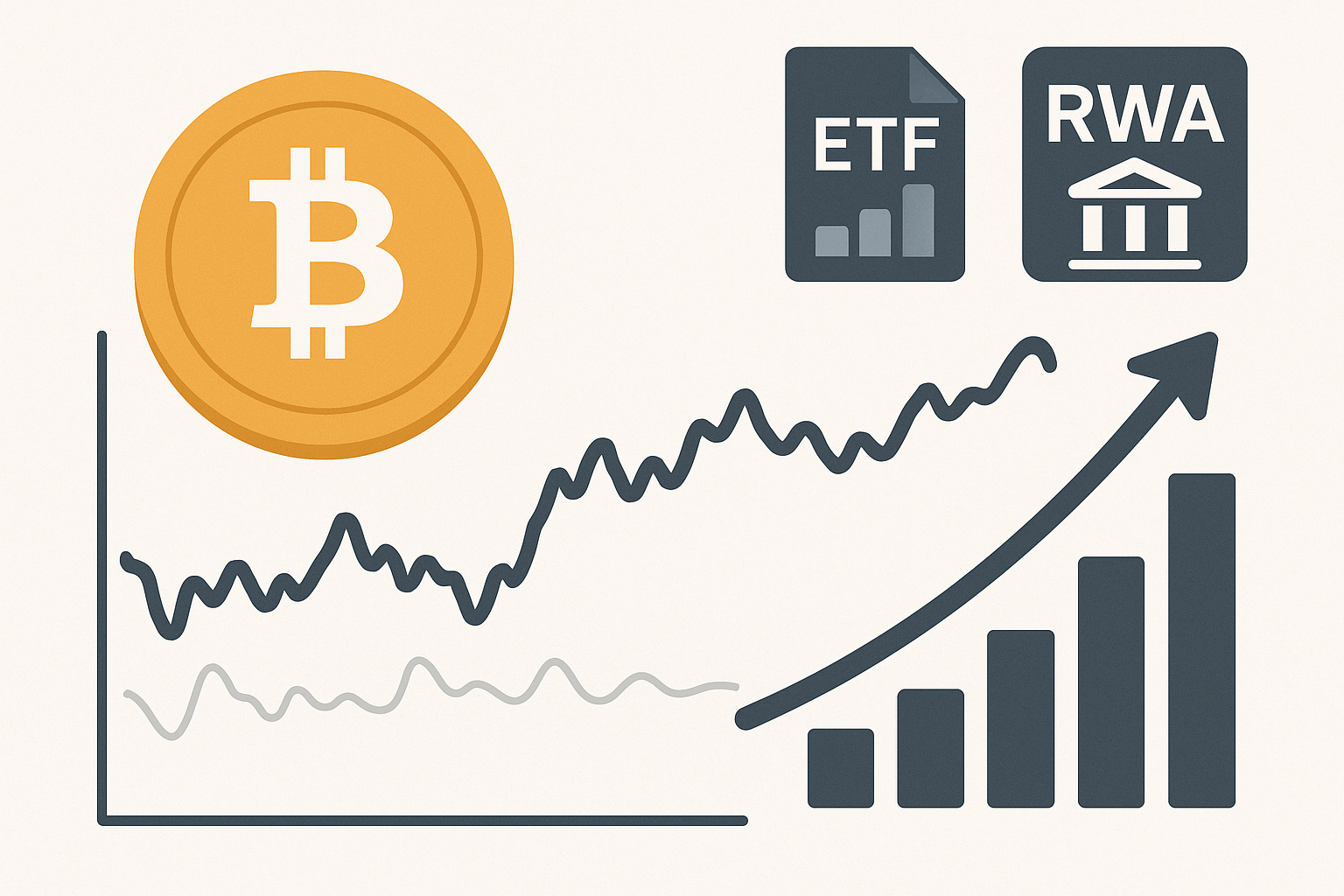
    Bitcoin’s latest cycle is developing under a very different market structure, with data from Glassnode and Fasanara Capital pointing to deeper institutional participation, rapid growth in tokenized real-world assets, and a notable drop in volatility.

    Their Q4 Digital Assets Report highlights how Bitcoin’s behaviour has shifted as regulated investment channels expand, and liquidity becomes more stable across spot, derivatives, and on-chain markets.

    The findings show how ETF flows, settlement activity, and broader adoption of tokenised instruments are shaping a more mature phase in the digital asset ecosystem.

    These structural changes are defining how capital moves through Bitcoin in 2025.

    Institutional flows reshape the cycle

    The report estimated that Bitcoin has absorbed around $732 billion in new capital during this cycle.

    This has occurred alongside a clear decline in one-year realised volatility, which has fallen by nearly half.

    Glassnode linked this trend to increased depth across major markets and a larger share of trading driven by institutional strategies.

    Glassnode also reported that Bitcoin settled approximately $6.9 trillion over the past 90 days.

    This puts Bitcoin in a range comparable to payment networks such as Visa and Mastercard.

    Even with more trading moving into ETF and brokerage channels, the report found that Bitcoin and stablecoins still dominate value transfer on public blockchains.

    ETF channels deepen liquidity

    ETF-linked demand has reshaped how investment enters and exits Bitcoin.

    Instead of relying mainly on on-chain movement or exchange activity, a greater share of flows now passes through regulated investment vehicles.

    According to the report, this shift has encouraged smoother liquidity conditions and fewer sharp price changes in spot markets.

    Traditional market makers and arbitrage firms have increased their presence due to ETF participation.

    Their involvement has tightened spreads and reduced disruption during periods of heightened selling pressure.

    This development reflects a broader alignment between digital asset markets and established financial infrastructure.

    Tokenized RWAs accelerate

    Tokenized real-world assets have expanded from $7 billion to $24 billion within one year.

    Glassnode stated that this rise reflects stronger institutional demand, including interest from pension funds, hedge funds, and corporations that want on-chain exposure to familiar financial instruments.

    Tokenized funds have gained momentum as asset managers test new distribution models and investors seek simplified access to traditional assets.

    Platforms involved in tokenised RWAs have strengthened custody, settlement, and compliance systems.

    This foundation has encouraged consistent inflows throughout 2025, supporting a growing segment of the market that links traditional assets with blockchain settlement rails.

    Stablecoin role strengthens

    Glassnode described the market structure as larger and more stable than in previous cycles.

    The data indicated deeper liquidity across spot, derivatives, and on-chain channels, which has contributed to a more measured trading environment.

    Reduced volatility has become a defining feature of the cycle, shaped by institutional trading strategies that tend to use steady allocation models.

    Stablecoins continue to serve as key connectors between traditional and digital financial systems.

    The report stated that stablecoin settlement demand remains substantial across centralised and decentralised platforms.

    Glassnode characterised the dual-rail system created by stablecoins and traditional infrastructure as a permanent part of the ecosystem, supporting both institutional flows and retail trading activity.

    Analysts referenced in the report expect institutional participation to expand as tokenised funds gain broader acceptance.

    Glassnode presented this phase as a turning point marked by heavier institutional flows, rising tokenisation, and reduced volatility.

    These factors suggest that Bitcoin and the wider digital asset sector are moving into a more structurally mature environment in 2025.

    Source link

  • XRP price stalls under $3.00 as investor activity slows

    XRP price stalls under $3.00 as investor activity slows

    XRP price stalls under $3.00 as investor activity slows

    • The coin has failed to break past $3.00 for two consecutive weeks.
    • Capital outflows are outweighing inflows, weakening momentum.
    • A drop to $2.74 is likely if selling continues.

    XRP is struggling to break through the $3.00 mark, with repeated attempts over the past two weeks falling short. The altcoin has been unable to sustain momentum, weighed down by weak investor support and shrinking inflows.

    At the time of writing, XRP trades at $2.87, remaining below the $2.95 resistance zone. Market data shows reduced activity from both new and existing participants, leaving the cryptocurrency in a consolidation phase.

    XRP price
    Source: CoinMarketCap

    With capital outflows overwhelming inflows, XRP’s price trend continues to depend heavily on investor sentiment and whether demand can rebound in the short term.

    New addresses drop to two-month low

    Network metrics highlight a key reason behind XRP’s stagnation. The number of new addresses created, tracked by first-time transactions, has dropped near a two-month low.

    This decline indicates falling interest from fresh participants, limiting the inflow of new capital into the network.

    Without new investors joining, XRP faces reduced demand pressure, making it harder to generate the buying volume needed for a sustained rally.

    Existing holders have not provided enough momentum either, resulting in weaker overall support for the asset.

    Capital outflows weigh on XRP

    Broader capital trends underline the same weakness. The Chaikin Money Flow (CMF), which monitors inflows and outflows of capital, has fallen to a nine-month low.

    This signals that selling activity is exceeding buying interest, a bearish indication for XRP’s short-term performance.

    The shrinking capital pool highlights how outflows are amplifying the recent downtrend.

    With reduced liquidity entering the market, XRP has struggled to establish firm support levels, leaving it vulnerable to further price drops.

    Over the past fortnight, the coin has failed to hold gains above $2.95, signalling that sellers remain dominant. The weakness in volume reflects the lack of confidence that has plagued XRP’s attempts to stage a breakout since mid-August.

    Trading patterns show limited upside moves being sold off quickly, reinforcing the difficulty of sustaining momentum and deepening investor caution.

    Market watchers note that persistent selling pressure could delay any meaningful recovery attempts for weeks.

    XRP price trend remains under pressure

    Currently, XRP remains capped below the $2.95 resistance level. A continued lack of buying activity could push the price down toward $2.74, where consolidation is more likely.

    On the other hand, if sentiment shifts and XRP reclaims $2.95 as support, it could attempt to retest higher thresholds.

    Breaking past $3.07 and later $3.12 would provide confirmation of renewed bullish momentum, invalidating the present bearish thesis.

    The coming sessions will be critical in determining whether investor confidence returns to provide the inflows needed for XRP to move past $3.00, or if the coin continues to trade under pressure from weak demand.

    The data on addresses and capital flows suggests that until stronger participation emerges, XRP’s price will remain constrained within its current range.

    Source link

  • Chainlink price forecast as key metrics point to increased onchain activity

    Chainlink price forecast as key metrics point to increased onchain activity

    Chainlink Price Outlook

    • Chainlink price broke to highs $26 before correcting slightly.
    • LINK is surging amid a spike in onchain activity.
    • Partnerships and adoption trends remain bullish for Chainlink.

    Chainlink (LINK) broke above $26 for the first time in months on Monday, surging amid a notable spike in onchain activity.

    As LINK pares gains amid broader profit taking, analysts are saying the recent explosion of key network metrics could allow bulls to breach the supply wall at $30 as they target the all-time high of $52 seen over four years ago.

    Chainlink sees significant surge in onchain activity

    According to Santiment, Chainlink’s onchain activity has witnessed a significant spike in the past week.

    For instance, on Sunday, August 17, a total of 9,813 unique LINK addresses executed at least one transaction, while the next day saw more than 9,625 new LINK wallets.

    Per the onchain analytics provider, both metrics represent the blockchain network’s highest levels for the year.

    “Onchain activity has been even more impressive than the price,” Santiment analysts noted.

    Partnerships and LINK reserve

    Recently, Visa’s head of crypto, Cuy Sheffield, explained via Visa’s Tokenized podcast, that Chainlink is a major pull for institutional entry into crypto.

    Apart from Visa, Chainlink has partnered with ANZ, China AMC, and Fidelity International to bring cross-chain, cross-border settlements to tokenized assets across Australia and Hong Kong.

    A Mastercard partnership is also huge for LINK.

    Chainlink Data Streams is another solution seeing huge integration. Data Streams are now live for U.S. equities and exchange-traded funds such as AAPL, NVDA and CRCL.

    Chainlink also recently partnered with Intercontinental Exchange, the parent company of the New York Stock Exchange.

    “Using ICE’s Consolidated Feed data as an input into Chainlink’s derived FX and precious metals rates onchain via Chainlink’s institutional-grade infrastructure is a watershed moment in the evolution of global markets,” said Fernando Vazquez, president of capital markets at Chainlink Labs. “This collaboration signals a pivotal shift towards a unified, globally accessible onchain financial system, with hundreds of trillions in assets on a clear path to tokenization.”

    Chainlink Reserve, an effort launched to support Chainlink’s traction in the DeFi and TradFi ecosystems, is also a major boost.

    As well as being geared towards establishing Chainlink as a standard solution for global crypto adoption, the program bolsters its tokenized assets growth.

    What’s next for LINK price?

    Chainlink’s price action amid the surge in network activity suggests bulls are confident in LINK.

    Chainlink price chart

    Having broken above $20 and strengthened to $26, Chainlink is showing resilience. While bears have a say on immediate LINK price action, analysts say the altcoin could be on the cusp of a significant breakout.

    While the key metrics indicate that Chainlink’s network growth is outpacing price gains, there are more bulls who are upbeat about.

    A confluence of catalysts such as network integration across decentralized and traditional finance, whale accumulation and macro conditions, is what could propel LINK toward its ATH and into price discovery mode.

    LINK traded at the all-time high above $52 in May 2021, a level bulls may target if market conditions align. Currently, the altcoin is on an uptrend since hitting lows of $16 on Aug. 6.

    Source link

  • Polyhedra’s ZKJ token collapses following ‘abnormal on-chain activity’

    Polyhedra’s ZKJ token collapses following ‘abnormal on-chain activity’

    Polyhedra’s ZKJ token collapses following ‘abnormal on-chain activity’

    • The Polyhedra Network (ZKJ) token has plunged 91% after abnormal on-chain activity.
    • Binance has blamed whale exits and a liquidation cascade for the token crash.
    • The upcoming June 19 token unlock may trigger further price drops.

    The cryptocurrency market has once again been rocked by a dramatic price collapse, this time involving Polyhedra Network’s native token, ZKJ.

    The ZKJ token has suffered an unprecedented decline of over 91% in less than 24 hours, sending shockwaves across exchanges and drawing scrutiny from regulators, investors, and analysts alike.

    ZKJ, which had been trading steadily around $2.00 for over a month, crashed to a record low of $0.2676 on June 15, 2025, wiping out nearly $500 million in market capitalisation.

    ZKJ token crash

    This price crash has raised serious concerns over liquidity risks, tokenomics structure, and the influence of large holders in decentralised finance.

    What caused the sudden Polyhedra Network (ZKJ) price collapse?

    The ZKJ price collapse began early on June 15 when Polyhedra Network posted on X (formerly Twitter) that a wave of “abnormal on-chain transactions” had struck the ZKJ/KOGE trading pair.

    Within hours, the token’s price plummeted by more than 83%, as market participants scrambled to understand what had triggered the meltdown.

    Binance later weighed in, attributing the collapse to a liquidity crisis stemming from large-scale withdrawals involving KOGE, a token closely paired with ZKJ.

    According to the exchange, these withdrawals created a “liquidation cascade” as major wallets began offloading their holdings.

    As KOGE’s USDT pool was drained, traders moved their assets into the ZKJ/USDT pool, which quickly became overloaded.

    This sudden shift overwhelmed the system, accelerating the sell-off and deepening the decline in ZKJ’s value.

    Massive withdrawals and whale activity

    Blockchain data has revealed several wallets that had been actively farming Alpha Points before the crash.

    One wallet alone withdrew more than $3.7 million in KOGE and $530,000 in ZKJ.

    Two other wallets combined pulled out nearly $5 million, further intensifying the downward spiral.

    These actions suggest the involvement of large holders, commonly known as whales, whose exits likely triggered cascading liquidations across leveraged positions.

    As prices tumbled, margin calls were activated, leading to forced liquidations that compounded the selling pressure.

    Although some community members have speculated about foul play, no leading blockchain analytics platform has verified such claims.

    Polyhedra, for its part, insists it is conducting a thorough review and maintains that its core technology remains unaffected.

    Binance has altered its Alpha Points rules for ZKJ and KOGE

    In response to the unfolding situation, Binance announced a major change to its Alpha Points rewards program.

    Starting June 17, trades between Alpha tokens, including ZKJ and KOGE, will no longer count toward Alpha Points calculations.

    This policy shift is aimed at reducing systemic risk and discouraging concentrated trading behaviors that can lead to abrupt market failures.

    Binance’s decision is being viewed as a proactive step to restore market integrity and reduce manipulation.

    Upcoming token unlock adds to the bearish pressure

    Further adding to investor anxiety is the imminent unlock of 15.5 million ZKJ tokens scheduled for June 19.

    Valued at approximately $10 million, this unlock could flood the market with fresh supply at a time when confidence is already severely shaken.

    Given that this represents more than 5% of the current circulating supply, market analysts warn that another sharp drop could occur if holders rush to sell upon unlocking.

    The timing could not be worse for a token already reeling from its steep fall.


    Source link

  • Pi Coin slumps amid renewed migration activity on Pi Network

    Pi Coin slumps amid renewed migration activity on Pi Network

    Pi Coin under pressure amid fresh Pi Network migration prompts

    • Pi Network users are reporting second migration prompts amid unresolved KYC issues.
    • 276M PI tokens are set to unlock in June, raising sell-off concerns.
    • Currently, Pi Coin trades below $0.66 with bearish technical indicators.

    The Pi Network is facing renewed tension as community frustration grows over a fresh wave of migration prompts and persistent Know Your Customer (KYC) issues.

    These developments have surfaced just weeks before a massive PI token unlock, placing additional pressure on the project’s native token, Pi Coin.

    While the network attempts to revive user engagement through new initiatives like gaming and decentralised apps, the market has responded with declining confidence, reflected in the token’s recent price performance.

    Pi Network users are getting fresh migration prompts

    Many Pi Network users have been frustrated by unexpected second migration prompts showing up in their apps.

    For some, this has come as a shock, especially those who believed they had already completed the initial migration phase.

    On the social media platform X, users, including Pi Network miners who have mined for some time now, have voiced strong criticism, accusing the Pi Core Team of poor communication and inconsistent requirements.

    Frustration is particularly high among those stuck in unresolved KYC verification states.

    These users claim they are being asked to migrate their balances again, despite never completing the first migration due to verification delays.

    Notably, the situation has caused confusion across the community, as the Pi Core Team has not yet officially confirmed a second migration phase through any verified channels.

    276 million PI tokens unlock scheduled for June

    Adding to the mounting concerns, a scheduled unlock of 276 million PI tokens in June looms large according to data from PiScan.

    Valued at approximately $176 million, this influx of supply could potentially flood the market.

    With trading volumes currently subdued and investor sentiment fragile, analysts warn that this event might lead to significant downward pressure on the Pi Coin price.

    The Pi Core Team’s silence regarding major bullish developments ahead of this unlock is further worsening sentiment.

    Historically, token unlocks tend to trigger selloffs, especially in markets lacking strong fundamental catalysts.

    With Pi Coin already struggling to maintain critical support levels, the risk of a steep decline is real.

    Pi Coin technical analysis

    Technically, Pi Coin remains entrenched in a bearish trend. It is currently trading around $0.6481, having fallen roughly 22% over the past week.

    On the 4-hour chart, the token is displaying an inverse cup and handle pattern, a classic bearish setup.

    Moreover, Pi is currently trading below its 50-day moving average, reinforcing the negative outlook.

    On the 12-hour chart, a descending wedge pattern has formed.

    Although such patterns can signal a reversal, in this case, the wedge lacks confirmation due to insufficient lower-bound tests.

    Indicators like the Money Flow Index (MFI) and On-Balance Volume (OBV) continue to reflect declining momentum and persistent selling pressure.

    Pi Network price prediction

    Currently, Pi’s fundamentals remain weak, with major concerns surrounding its lack of major exchange listings, unresolved decentralisation issues, and low validator participation.

    The Pi Foundation reportedly controls over 92 billion tokens across more than 2,000 wallets, further raising questions about centralisation.

    In the absence of bullish news and with continued migration confusion, Pi Coin’s short-term outlook remains bleak.

    In the short term, charts show that Pi Coin struggles to break past the $0.66 resistance level.

    According to the tweet from crypto analyst Joe Swanson, if the current support at $0.5547 fails to hold, analysts believe the token could drop toward the psychologically significant $0.40 range.

    To reverse the trend, the network must address user concerns, resolve KYC issues, and deliver tangible utility through real-world applications and wider exchange listings.

    Without a surge in demand, reclaiming previous highs appears unlikely in the near term.

    On a longer horizon, analysis presents two contrasting scenarios.

    If Pi Network gains widespread adoption for payments, DeFi applications, and e-commerce, the token could soar to $1.25 by the end of 2025, as we had previously predicted.

    However, if the project fails to move beyond speculation and hype, its price might remain capped below $1.


    Source link

  • Status (SNT) price up after 35% dev activity rise

    Status (SNT) price up after 35% dev activity rise

    • Status (SNT) price jumpd 38% in the past 24 hours.
    • Gains see the altcoin rank among best gainers today.
    • SNT broke to near $0.030 amid network growth, though potential for profit taking is high.

    Status (SNT), the utility token powering the Status Network, has seen a remarkable price surge.

    According to data from CoinMarketCap, SNT price is up 38% in the past 24 hours and over 60% in the past week. Its performance has overshadowed the plummeting MANTRA.

    Having broken above resistance at $0.023, Status price jumped to near $0.030 before paring some of the gains.

    Despite this, SNT ranks among the top gainers in the top 500 coins by market cap, behind Ardor (ARDR) and Fuel Network (FUEL). The altcoin traded around $0.028 with the daily volume spiking more than 1,200% to suggest massive market activity.

    SNT development activity on the rise

    Status has been making waves in the blockchain space, as evidenced by a 35% growth in development activity, a metric verified by Chain Broker.

    According to the analyst, Status ranked among the top 10 projects for development activity growth in the past month. Its overall activity measure of +35% put SNT alongside heavyweights like Cosmos, and Solana.

    The project’s consistent focus on its mission—delivering private messaging, crypto freedom, and true decentralization—has kept its development efforts robust. A recent update from the official Status account emphasized this commitment.

    Status is a project dedicated to enhancing an open-source messaging platform and mobile interface for Ethereum-based decentralized applications, likely contributing to its recent price momentum.

    Status price forecast: What next for SNT?

    Traders might want to watch the broader market for overall sentiment, with Bitcoin futures suggesting a weakness as China reportedly sells its seized crypto.

    If there’s a sharp retracement, wavering on the part of bulls will impact the rest of the market.

    The crypto fear & greed index also points to caution.

    Technical indicators provide an outlook for SNT’s price trajectory.

    On the daily chart, the Relative Strength Index (RSI) stands at 61 and upslopping, signaling a potential flip into overbought territory.

    Similarly, the Moving Average Convergence Divergence (MACD) reflects bullish momentum. The signal line is above the 50-period mark, while the positive histogram adds to this picture.

    However, the recent 9.65% price increase could signal a potential reversal if bullish momentum builds.

    SNT chart by TradingView

    Derivatives data from CoinGlass highlights market dynamics, showing fluctuations in futures volume and open interest for SNT.

    OI up 89% to over $7.4 million and rising trading activity in futures suggests growing speculative interest. This could amplify price volatility, with a jump in open interest continuing in the short term.

    In this case buyers could push SNT price to $0.05. However, the market continues to seesaw and SNT’s price may have to rely on support near $0.018.


    Source link

  • Litecoin price outlook as on-chain activity spikes

    Litecoin price outlook as on-chain activity spikes

    • Litecoin price was down 3% to trade around $67 on Friday morning.
    • Santiment wrote on X that the altcoin has seen a rapid increase in on-chain movement.
    • LTC is seeing a spike in address activity and whale transactions, with metrics at highest levels since June.

    The total crypto market is down 1.5% in the past 24 hours to $1.3 trillion, with Bitcoin hovering just above $34,000. Meanwhile, most altcoins are struggling to hold onto recent gains. 

    But as market observers and analysts put it, the overall outlook is bullish for crypto ahead of what could be a massive bull market in 2024. Could this be the same scenario for Litecoin price?

    Litecoin price outlook- what’s next for LTC?

    Litecoin’s 24-hour price was down 3%, with recent gains trimmed to about 7% over the past week as it traded around $67.80. The psychological $100 continues to prove a difficult hurdle for bulls, despite there being a burst of on-chain activity.

    While address activity and whales both hit June 2023 levels, there has been the observation of dormant LTC suddenly spiking – “usually indicative of more coins beginning to circulate,” the market intelligence platform Santiment wrote in a post on X.   

    The overall bullish picture for Bitcoin suggests investors could be positioning for a potential uptick in its price. Optimism over factors such as spot Bitcoin ETF approval could help LTC rebound past the main supply wall.

    Yet, with dormant coins on the move again, sell-off pressure could be huge in the short term. In this case, a correction could see Litecoin price retreat further, bears likely targeting key support zones in the $60-50 region.


    Source link