Tag: alltime

  • What is the Bitcoin hash rate? And why is at all-time highs?

    What is the Bitcoin hash rate? And why is at all-time highs?

    Key Takeaways

    • The Bitcoin hash rate is the amount of computing power contributed towards mining
    • It has continued to take new all-time highs
    • This squeezes miners’ profitability, at a time when electricity costs have risen and the Bitcoin price has fallen
    • Overall, a high hash rate implies a healthy and more secure Bitcoin network


    “All-time high” is a phrase I haven’t used in a while when covering the cryptocurrency space. But if you look, there is something that continues to hit higher highs, and that is the Bitcoin hash rate.

    Bitcoin’s hash rate refers to the amount of computing power that is being contributed to the network through mining. And as the chart below shows, its inexorable rise during the pandemic does not seem to be slowing down. But what does this mean, and why is it rising?

    What is the Bitcoin hash rate?

    Gone are the days when anyone could mine on their personal computer. Today, mining is dominated by large mining pools, using specialised computers specifically designed for this purpose.

    The practice of mining actually involves these computers solving complex mathematical puzzles. Once this puzzle is solved, the latest block of transactions can be validated and attached to the blockchain, before the process repeats regarding the next block and the next mathematical puzzle. Once a puzzle is solved and a block validated, the miner responsible for this work gets paid in newly created bitcoins.

    This is all very complicated, but what is important to understand is that Bitcoin is programmed to release a specific number of Bitcoin over time, with the blockchain coded such that a new block is added (validated) every ten minutes.

    But as more computers join the network and the hash rate increases, these puzzles should get solved quicker, meaning quicker block time and more bitcoins released. Right? Well, here is the thing. A difficulty adjustment is coded into Bitcoin – that means that the more computing power that joins the network, the harder it is to solve those puzzles.

    Don’t ask me how this works, because I don’t even come close to understanding what is under the hood of the mythical beast that is the Bitcoin blockchain, but the main point is that as more miners join, the difficulty goes up.

    And as Bitcoin has become more popular (and risen in price), that is exactly what has happened. More miners have joined the network, and today it is a highly advanced process. Ten years ago, when only few miners existed, you and I could have pulled out our laptops and mined to a reasonable degree.

    Why is at all-time highs?

    There are a number of reasons why hash rate continues to surge to new highs. But the bottom line is that the increase in miners causes the hash rate to climb.

    Thus the question really asks why miners are continuing to join, when the price of Bitcoin has been plummeting. There are a couple of potential answers here.

    The first is that during the pandemic bull run, mining equipment was scarce and prices for items such as chips were sky-high. Many miners ordered new mining rigs during the bull run, but only received the equipment recently (or some, not even yet).

    Additionally, as the price of Bitcoin fell, the profitability of mining also decreased, given miners’ revenue is denominated in Bitcoin. New mining equipment has been developed and is selling for a lower price than previously, helping to push the number of miners higher.

    One other theory is the Ethereum Merge. This took place in September, when Ethereum transitioned from Proof-of-Work to Proof-of-Stake, meaning mining on the network ceased. Hence, some of these out-of-work Ethereum miners transitioned across to Bitcoin mining.

    What does a higher hash rate mean?

    The first consequence of an increasing hash rate is obviously greater pressure on miners. More competition and a higher required hash rate squeeze their profitability, especially at a time when electricity costs have risen and revenue (Bitcoin) has fallen.

    The best way to see this is to glance at the share price action throughout 2022 of some of the public mining companies.

    On the positive side, the Bitcoin hash rate is considered a security metric for the network. The higher the hash rate, the more secure the network, so in that context, the all-time high represents a good thing.

    This is why a high hash rate is generally looked upon favourably, as it implies a healthy network. Only problem is, miners are feeling the squeeze.

    Source link

  • Nearly 13 million bitcoins have not moved in over a year, an all-time high

    Nearly 13 million bitcoins have not moved in over a year, an all-time high

    Key Takeaways

    • An all-time high of 12.7 million bitcoins have not moved in over a year
    • That translates to two-thirds of the circulating supply
    • Only 7% of bitcoins have moved in the last month
    • History shows that long-term holders tend to rise as price falls, which may seem counter-intuitive
    • The real story is a little more nuanced, as falling trade volumes in bear markets provide a lurking variable which affects the data


    One of the intriguing things about blockchain is the public availability of all sorts of stats about the network.

    A lot is made of the fixed supply cap of Bitcoin, with the final supply of 21 million bitcoins slated to be hit by 2140. Bulls use this as a case in point as to why the asset is programmed to expand in price, as its scarcity will inevitably squeeze the asset upwards.

    By looking on-chain here at https://coinjournal.net/, we noticed a quirk in this data.

    Long-term holders continue to grow

    Despite the bloodbath that was cryptocurrency in the year 2022, long-term holders have continued to accumulate. Out of the 19.27 million bitcoins currently in circulation, 12.77 million bitcoins have not moved in over a year – an all-time high.

    It’s a pretty significant number. In the following chart, I have plotted these bitcoins against two other categories: firstly, bitcoins that have moved in the last month (traders), and secondly, bitcoins that have not moved in over a month but have moved within the last year (medium-term holders).

    Currently, we have 66% of bitcoins unmoved in over a year – again, an all-time high. The previous high was in September 2020 when the mark hit 63%. Prior to that, the previous high was April 2016 at 60%. 

    A further 27% of bitcoins have not moved in the last month, while the remaining 7% can be seen as traded bitcoins, moving around the blockchain in the last month.

    Why are long term holders growing?

    The obvious question is, why? Why are we seeing long-term holders growing so substantially when the market has been getting pummelled?

    Well, I decided to chart the percentage of long term holders against the bitcoin price. And the result is quite interesting – there definitely seems to be at least a moderate inverse relationship between price and long-term holders. That is, when price falls, long-term holders rise. Hmm.

    But in truth, this makes sense. As the price falls, volumes and interest in the market tend to dry up. With that, comes less trading, and by definition less holders under the one-month threshold.

    While the narrative of long-term holders soaking up increasing amounts of the Bitcoin supply is often painted in a bullish light, I’m not sure that tells the whole story when considering this historical pattern.

    Sure, it is a positive thing that the number of bitcoins that have not moved in more than one year are climbing, as it does show that these long-term holders have tended not to capitulate during the drawdowns.

    But a healthy trading market and high liquidity is associated with a bull market, which is part of the reason we are seeing an inverse relationship here. Look no further than trading volume in 2022, which fell 46% on centralised exchanges compared to the previous year – that’s trillions of dollars of activity no longer present.

    “Trading volumes have cratered across the crypto space. This has pulled down activity and it’s not surprising that the portion of bitcoins traded recently is therefore falling. The analysis of long-term holders is a more nuanced issue than the crude assumption that ‘more bitcoins in long-term wallets is bullish and therefore price will go up’. That is simply not what we have seen historically” said Max Coupland, Director of CoinJournal.

    I’ll continue to monitor all on-chain activity, as the market is certainly showing more life in these early stages of 2023, with softer inflation data giving impetus to the market that we may pivot off high interest rates sooner than previously expected. It will be interesting to keep tabs on the dynamics on-chain, therefore.

    But next time somebody declares it obviously bullish that there are less bitcoins being flung around the markets, perhaps remember that the situation is a little more complex than that.

    If you use our data, then we would appreciate a link back to https://coinjournal.net. Crediting our work with a link helps us to keep providing you with data analysis research.

    Source link

  • Why has the Grayscale Bitcoin Trust discount hit an all-time high?

    Why has the Grayscale Bitcoin Trust discount hit an all-time high?

    Key Takeaways

    • Grayscale is the largest Bitcoin fund in the world
    • Discount to underlying asset (Bitcoin) has reached record levels, breaching 50%
    • Concern about reserves, higher fees and other hurdles explain the discount, which likely won’t close anytime soon


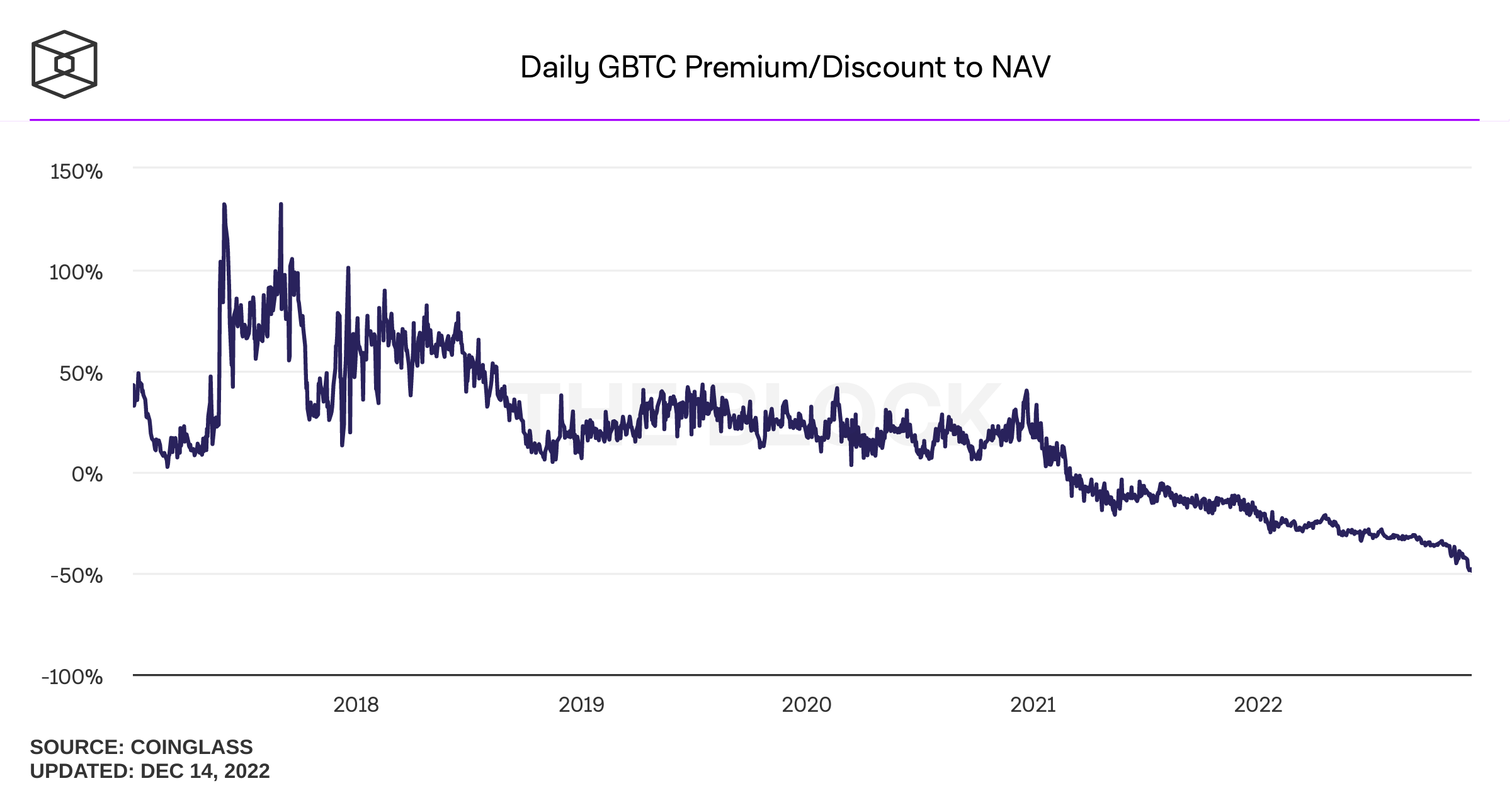
    The discount to net asset value of the Grayscale Bitcoin trust is at all-time highs. The discount briefly pushed past 50%, before pulling back slightly to where it currently sits at 48.8%.  

    This comes off the back of the SEC reaffirming its reasons for denying Grayscale’s application to convert the trust into an exchange-traded fund.

     The Grayscale Bitcoin Trust is the largest Bitcoin fund in the world, but it has rarely traded at the same level as its underlying asset, Bitcoin. The above chart shows that it had, until this year, traded at a premium since its launch compared to Bitcoin.

    This fund allows accredited investors to gain exposure to Bitcoin without worrying about storing or managing their holdings. It previously traded at a premium as demand for shares surged, with institutions wanting Bitcoin exposure. This convenience does come at a fee, however – and a rather hefty one at 2%.

    Demand falls for Grayscale in 2022

    Since March, the Grayscale shares have been trading at a discount to Bitcoin. The fund has $10.7 billion in assets under management, a stark 65% fall in the last year, reflecting the bloodbath in the crypto markets.

    But the discount to Bitcoin means shareholders are getting hit twice as hard.

    “The fact that Grayscale’s Bitcoin Trust is now trading at nearly 50% discount is just awful for holders of GBTC. It really highlights the vast differences in structure quality between different investment vehicles,” Bradley Duke, co-CEO at ETC Group, told CoinDesk last week.  

    A decline in inflows has been borne out of greater competition as many competitive funds have launched, especially in Europe, as well as multiple filings for Bitcoin ETFs in the US. The discount is also because investors have no way to redeem their holdings for Bitcoin in the trust, but all the while are being charged a 2% fee.

    However, these factors have typically been dulled by arbitrage traders taking advantage of the dichotomy in prices. But happenings this year have reduced that, too.

    Concern about Grayscale’s reserves

    Over the last month, concern has swelled in the market that Grayscale’s parent company, Digital Currency Group (DCG) may file for bankruptcy. This is due to the issues surrounding crypto broker Genesis, whose parent company is also DCG.

    Genesis have denied they will imminently file for bankruptcy, but the firm was caught up in the FTX collapse and is currently undergoing restructuring. Genesis halted withdrawals on November 15th.

    This concern has been elevated by questions around Grayscale’s reserves. Namely, whether they are true to their word and are holding all the underlying Bitcoin securely. With many major crypto companies publishing proof of reserves in the aftermath of the FTX crisis in order to assuage customer fear, Gray scale refused.

    “Due to security concerns, we do not make such on-chain wallet information and confirmation data publicly available through a cryptographic Proof-of-Reserve, or other advanced cryptographic accounting procedure,” Grayscale wrote in a statement.

    As I wrote at the time, I really can’t fathom how security concerns are a factor here. The blockchain is built so that this kind of information is available to the public.

    Final thoughts

    All in all, the discount sums up investors’ concern around Grayscale, as well as the extra fees and other hurdles which exist compared to owning the underlying. Arbitrage trades are self-destructive by nature, and hence it is notable that the discount is so large and has persisted for so long.

    Then again, there is risk here, as the same thing which I have been writing about for a while now – a lack of transparency – means that it cannot be known for 100% certainty what is going on behind the scenes. And that is why we are seeing a 50% discount.


    Source link

  • Brandt says Bitcoin to hit $13k before setting a new all-time high

    Brandt says Bitcoin to hit $13k before setting a new all-time high

    Bitcoin is trading above $19k, but Peter Brandt believes it will reach $13k in the near term before setting a new all-time high three years from now.

    Peter Brandt, founder and CEO of proprietary trading firm Factor LLC, told CoinDesk TV in a recent interview that he believes Bitcoin will set a new all-time high in three years.

    However, before it does that, Bitcoin will trade for around $13,000 first. Bitcoin has been underperforming since the start of the year.

    Since reaching the $69k all-time high in November 2021, Bitcoin has lost more than 70% of its value. It has been trading below $20k in recent weeks but has maintained its price around the $18k-$19k level. Brandt said;

    “We [will] just chop between … let’s say $17,000 and $23,000,” said Brandt. “I think we will bottom here at some point in time, maybe early next year, but then I’m not looking for bitcoin really to become exciting again for another couple of years.”

    Peter Brandt is a technical trader that has been around since 1970. According to his predictions, it would take Bitcoin 32 months before it reaches a new all-time high again. 

    There have been talks that the US Federal Reserve will halt its interest rate hiking. However, Brandt doesn’t see that happening and expects a 75-basis point increase on Nov. 2. This would be followed by another 75 bps increase on Dec. 14. He said;

    “I think that the Fed knows that inflation is a killer. The Fed needs to regain its credibility. And to do that, I think the Fed really needs to bring inflation rates back down to at least 4%.”

    The cryptocurrency market has been mirroring other traditional financial markets, including stocks and commodities, in recent months. However, Brandt said he believes Bitcoin’s performance will be unique in the long run. He added that;

    “Bitcoin is going to be correlated with bitcoin eventually.”

    The $13k bottom suggested by Brandt differs from his opinion two months ago. In August, he suggested that Bitcoin could have reached its possible bottom, with BTC trading at around $21k at the time.

    Source link