Tag: Biggest

  • Michael Saylor’s Strategy snaps up 21K Bitcoin after 2025’s biggest IPO

    Michael Saylor’s Strategy snaps up 21K Bitcoin after 2025’s biggest IPO

    Michael Saylor’s Strategy snaps up 21K Bitcoin

    • Strategy bought 21K Bitcoin using $2.5B from the STRC stock sale.
    • STRC IPO is 2025’s biggest, offering a 9% monthly dividend.
    • Strategy now holds 628,791 BTC worth nearly $74 billion.

    In a bold continuation of its aggressive Bitcoin (BTC) accumulation strategy, Michael Saylor’s Strategy Inc. has acquired 21,021 Bitcoin after executing what is now the largest initial public offering (IPO) in the United States in 2025.

    The company, formerly known as MicroStrategy, announced on July 29 that it had completed the massive purchase using proceeds from its latest preferred stock offering.

    This landmark move comes amid a relatively volatile Bitcoin market and further cements Strategy’s dominance as the world’s largest publicly traded corporate holder of the cryptocurrency.

    Michael Saylor’s Strategy record IPO

    Strategy raised a staggering $2.5 billion through the public sale of its new Variable Rate Series A Perpetual Preferred Stock, designated as STRC.

    The stock was offered at $90 per share, significantly surpassing the company’s initial fundraising goal of $500 million.

    According to the company’s press release, the offering drew strong investor demand, allowing Strategy to quintuple its original target.

    With the offering successfully closed, Strategy quickly deployed $2.46 billion of the proceeds to purchase 21,021 Bitcoin at an average price of $117,256 per coin.

    This acquisition marks the company’s largest Bitcoin buy since March 31 and brings its total holdings to 628,791 BTC — now valued at nearly $74 billion.

    STRC set to begin trading on Nasdaq

    The newly issued STRC preferred shares are expected to begin trading on the Nasdaq Global Select Market on July 30.

    Strategy describes STRC as the first exchange-listed perpetual preferred security from a Bitcoin treasury company that offers monthly, board-adjusted dividends to income-focused investors.

    The initial dividend rate has been set at 9%.

    STRC is the latest in a series of financial instruments created by Strategy to support its Bitcoin strategy.

    Previous offerings include STRK (Strike), a convertible share with an 8% fixed dividend, STRF (Strife), a non-convertible preferred share with a 10% cumulative yield, and STRD (Stride), which offers a 10% non-cumulative dividend.

    Together, these products reflect the company’s broader strategy of turning capital markets into a Bitcoin acquisition engine.

    Timing the Dip, Saylor doubles down

    Interestingly, Strategy’s Bitcoin purchase comes at a time when the cryptocurrency is trading below its all-time high.

    Bitcoin reached a record $123,091.61 on July 14 but has since hovered between $117,000 and $119,000.

    Strategy’s move is widely seen as an effort to capitalise on the pullback, with many analysts describing it as one of the biggest “buy-the-dip” moves in crypto history.

    Michael Saylor, Strategy’s executive chairman and co-founder, remains one of Bitcoin’s most vocal proponents.

    Saylor has previously stated that he believes Bitcoin could reach $13 million per coin by 2045.

    His continued confidence in the digital asset, despite its short-term volatility, is evident in the scale and timing of this latest purchase.

    Source link

  • Bitcoin May Be The Biggest Crypto, But Is This The Best?

    Bitcoin May Be The Biggest Crypto, But Is This The Best?

    Bitcoin (BTC) has long been the most recognizable and dominant player in the cryptocurrency world. BTC started it all and has consistently maintained its position as the gold standard. As the crypto universe expands, new competitors emerge, each with a unique proposition. Among these rising stars is InQubeta (QUBE), an AI-powered cryptocurrency that reve­rberates with possibility and innovation. But can InQubeta truly reign supreme as the best in the crypto space?

    InQubeta has revolutionized the cryptocurrency industry with innovative­ features, such as its deflationary mode­l. Its NFT marketplace has gained re­cognition among influential figures searching for ne­w DeFi crypto to inve­st in for substantial returns. Many crypto analysts are forecasting that InQube­ta will lead the next bull run due­ to its aim of bridging the gap between AI startups and investors.

    This article explores Bitcoin’s dominance and why InQubeta could claim the title of the best crypto.

    InQubeta (QUBE): Pioneering DeFi crypto with potential for the best ROI

    InQubeta, a new DeFi crypto, is making waves as the first crowdfunding platform in the crypto market that promises high returns. Despite Bitcoin’s dominance, InQube­ta shines as the best potential crypto choice by enabling fractional investment in AI-based startups, all facilitated by QUBE tokens. These tokens operate on the Ethereum blockchain, leveraging its robust technology to create a secure and seamless investment ecosystem for startups and investors.

    The brilliance­ of the platform as the best prospe­ct in crypto lies in its ability to mint each investme­nt opportunity as an NFT and then fractionalize it. This means you can invest in a way that suits your budget while enjoying the benefits of being an early supporter. The platform’s tre­nding NFT marketplace takes it further by empowering AI startups to raise funds and offer enticing rewards and equity-based digital assets. Conversely, QUBE token holders can easily invest in the projects they believe in, establishing a unique ecosystem that be­nefits all parties involved.

    QUBE exce­ls in the crypto market as the potential ultimate­ choice due to its nature as a de­flationary ERC20 token. This unique deflationary mechanism offers a valuable investme­nt opportunity for crypto enthusiasts seeking the best crypto investment platform to dive­rsify their portfolios. By imposing a 2% buy and sell tax for a burning wallet and a 5% buy and sell tax for a dedicated reward pool, QUBE e­nables holders to earn re­wards through token staking. This feature makes it particularly appealing to investors who recognize the growth potential of AI technology startups.

    The QUBE toke­n, serving as a governance toke­n, helps position it as one of the best crypto investme­nt platforms. As a governance token, InQubeta gives its holders a say in the decision-making processes of the platform. 

    QUBE holders can propose, discuss, and vote on various aspects of the platform’s development, operation, and future direction. With the increasing participation of investors and startups in the InQube­ta platform, the demand for QUBE is expected to surge, potentially driving up the token’s value over time. 

    By holding and staking QUBE tokens, investors not only position themselves for potential price appreciation but also receive rewards from the dedicated reward pool.

    Bitcoin (BTC): A potential game-changer for cryptocurrency

    As the first cryptocurre­ncy, Bitcoin wields a substantial influence over the crypto market. With BTC breaching the $35K threshold, its trajectory could significantly shift, potentially reaching $64K by the end of 2023, as suggested by historical chart patterns. This optimistic outlook permeates the broader crypto market, propelling altcoins into a bullish ascent.

    Historical data highlights November as a pivotal month for Bitcoin, with gains second only to April. The fourth quarter (Q4) is renowned for yielding the most substantial returns, heightening the anticipation for this upcoming month. Boasting a note­worthy track record, November promises an exhilarating journey for BTC enthusiasts.

    Conclusion

    Bitcoin paved the way in the crypto space, but InQubeta is poised to become the best choice for investors and enthusiasts. With its trending NFT marketplace, de­flationary mechanism, and governance toke­n, InQubeta is revolutionizing the AI se­ctor. Now in its fourth stage, the ongoing presale­ offers an unparalleled opportunity to join the platform. Investors can acquire the QUBE toke­n using major cryptocurrencies such as ETH, BTC, and USDT.

    Visit InQubeta Presale 

    Join The InQubeta Communities

    Source link

  • Bitcoin supply is dwindling, yet volatility will be the biggest benefactor

    Bitcoin supply is dwindling, yet volatility will be the biggest benefactor

    Key Takeaways

    • Long-term holders are accumulating Bitcoin, with two-thirds of the supply stagnant for over a year
    • Our Head of Research, Dan Ashmore, writes that liquidity on the demand side is also drying up, with order books thin and stablecoins fleeing exchanges
    • This will kick up volatility in the short-term, leaving Bitcoin open to aggressive moves to both the upside and downside
    • Long-term the impact of a dwindling supply is a different discussion, but for now, risk is elevated in the already-risky crypto markets

    A lot is made of the demand for Bitcoin. Are institutions giving up on it following a disastrous 2022 that saw the entire crypto sector go up in flames? Is the market moving back in now that interest rate forecasts have softened following the relentless rate hikes over the past year?

    But rather than the demand, it is the supply of Bitcoin that is often the more intriguing to look at. Famously sporting a fixed cap of 21 million coins, Bitcoin’s supply schedule is coded into the underlying blockchain. This quality has given rise to a million different theories around the future place – and price – of Bitcoin in the world. 

    But there is another interesting analytical angle to Bitcoin: before the anonymous Satoshi Nakamoto launched Bitcoin in 2009, the world never had an asset that provided so much visibility over the supply distribution. The nature of the blockchain is that, while the individual holders are anonymous, the distribution of all coins is available for the world to see at all times. So, let’s have a look. 

    Long-term holders are accumulating Bitcoin

    Central to many Bitcoin bulls’ long-term thesis is the idea that long-term holders will suck up supply, leading to an inexorable price rise. 

    Looking at current holdings, two-thirds of the supply has not moved in a year. That is certainly a large number, and we will get into what that means in the next paragraph. Pushing the timeline further out, over half the supply (53.6%) has been stagnant for over two years, 39.7% has not moved in 3+ years, and 28.6% has been idle for 5 years or longer. 

    What does this mean for price?

    These are large numbers by any stretch. It is impossible to compare them to other asset classes, given that none are trackable on a ledger like the blockchain. Perhaps only commodities such as precious metals can compete with the above numbers, yet that is only speculation. 

    But what does it mean? Is this a bullish sign? Well, yes and no. The immediate conclusion is that less supply means less demand is needed to push the price up, and the cap at 21 million Bitcoins certainly means if that demand keeps rising, the price has nowhere to go but up. 

    However, there are mitigating factors here. The first is the reality that some of the above “long-term holders” are in fact just lost coins, be it through people who have passed away, forgotten about their coins or lost access to their wallets. 

    Bitcoin creator Satoshi Nakamoto is one of those, the mysterious enigma holding approximately 1.1 million bitcoins, equivalent to a mammoth 5.2% of the supply. None of his/her/their coins have moved since they were mined back in the first eighteen months of Bitcoin’s existence. 

    Not to get too tangential, but below is the value of Nakamoto’s holdings over the last 13 years, assuming a stash of 1.1 million Bitcoin from mid-2010. That is a lot of capital that holders must surely hope never floods the market. 

    Volatility to rise with less liquidity 

    Regarding the impact of these large stashes of Bitcoin which are “removed” from circulation, the greatest impact – for now, at least – may be on the volatility rather than price. 

    In the following chart, I have plotted the amount of Bitcoin sitting on exchanges, currently at a 5-year low. 

    Not only is the amount of Bitcoin on exchanges dwindling, but stablecoins are doing the same. Over half of the balance of stablecoins have flooded out of exchanges since December. 


    This means liquidity on both the demand and supply side of Bitcoin is thin – and the same conclusion will be reached if an order book is downloaded from an exchange. Liquidity has dried up hugely, especially since FTX went under in November.

    This lack of liquidity only serves to jack up the already sky-high volatility in the Bitcoin market, exacerbating moves to both the upside and the downside. This is part of the reason why volatility recently spiked to its highest level since mid-2022, and also a factor in Bitcoin’s massive run-up this year. 

    By definition, it takes less to move a thin market, and with forecasts around the future path of monetary policy shifting to a more optimistic stance in recent months, Bitcoin has moved up with minimal resistance in its path. 

    While the supply-side dry-up is intriguing in the long-term, looking into that with regard to Bitcoin’s future performance is a different discussion entirely.  In the short-term, capital has fled crypto markets at an unprecedented pace, and we are now in a spot where the market is primed for violent moves in either direction. Like always in crypto, the short-term is difficult to predict, however, and the risk remains extreme – perhaps even more so currently than normal.

    Source link

  • Bitcoin trading at $38,000 in Nigeria, as Africa’s biggest economy in turmoil

    Bitcoin trading at $38,000 in Nigeria, as Africa’s biggest economy in turmoil

    Key Takeaways

    • Bitcoin is trading at $38,000 in Nigeria, a premium of 66%
    • The Nigerian central bank has implemented ATM withdrawal limits of $43 per day in push towards a cashless society for Africa’s biggest economy
    • The central bank also announced a rival card system to Visa and Mastercard, in a bid to reduce fees
    • Some are excited at the push towards Bitcoin, but it is important to remember Bitcoin’s failings here, too, writes our Analyst Dan Ashmore 
    • Internet penetration rate is only 35% in Nigeria, while Bitcoin’s volatility means assigning it any kind of “hedge” role would be idealistic

    One Bitcoin is trading for north of $38,000 in Nigeria. 

    The price can be seen on the Nigerian exchange NairaEx, where it is quoted at 17.8 million Naira. That equates to $38,600, despite Bitcoin trading at $23,200 across the market, meaning it is trading for a 66% premium in Nigeria.

    Nigeria shifting to a cashless society

    The premium comes amid a time when the Nigerian central bank is making a big push towards a cashless society. 

    Limits on ATM withdrawals have been implemented, with citizens limited to withdrawing 20,000 Naira per day ($43 at current rates) and 100,000 per week ($217). 

    Nigeria’s controversial money management

    The central bank also extended the deadline this weekend for citizens to exchange old banks notes from Jan 24th to Feb 10th. Higher denomination naira notes had been designed with the goal of reducing counterfeiting and the use of cash in society. 

    The move was widely criticised, with analysts pointing towards one very obvious question: how does issuing new bank notes reduce the use of cash? Nigeria is Africa’s largest economy and remains heavily dependent on cash.

    Aside from big-picture questions, Nigerians decried that they had not been given enough time to make the switch to the new notes. Tales of queues at banks were plenty, while many of Nigeria’s 210 million people live in rural areas and have no access to banks, where they are required to swap old notes for new. 

    The government had announced a scheme only one week before the deadline to help those in such rural areas via banking representatives, but controversy remained that there was not enough time. There were also reports of shortages of new notes, with commercial lenders only getting their hands on the new notes less than a month before the deadline. 

    “I don’t have good news for those who feel we should shift the deadline; my apologies”, central bank governor Godwin Emefiele had said only last Tuesday.

    Nonetheless, the central bank eventually caved, with political pressure mounting ahead of the presidential elections in a few weeks’ time. 

    Could Bitcoin help Nigeria?

    The chaotic developments are just the latest example of how poorly governments around the world often manage money. Nigeria has been no stranger to inflation historically, either. 


    Zooming in on 2022 shows that the last year has seen the currency devalue at a significantly higher rate than most developed economies worldwide. 


    Against this backdrop, the central bank also announced the launch of a domestic card scheme last week. The goal is to create competition for Visa and Mastercard, again pushing Nigeria towards a cashless society while saving the country on foreign transaction fees. 

    The goal may be admirable, but the realities of the situation make the push difficult. As mentioned above, this is a society still hugely dependent on cash, with a massive chunk of the population shut out from banking. 

    Some Bitcoiners are pointing towards the crypto as a solution for Nigerians. To me, this feels a bit idealistic. While there is no doubt that Bitcoin is extremely accessible compared to banking in developed countries, it does still require an Internet connection. And in Nigeria, that is not as readily available as desired. 


    While the fundamentals of Bitcoin certainly make it interesting in the context of a currency under severe controls and with a historical flirtation with inflation, let us not gloss over the fact that Bitcoin has issues of its own. 

    One Bitcoin was worth $68,000 a little over a year ago. Then it was $16,000 towards the end of last year. Now it is $23,200. For those living in rural Nigeria, this volatility would be back-breaking, and quite simply makes it totally unfeasible right now, despite the clamour coming out of Bitcoin enthusiasts. 

    I do think – and have written about this extensively previously – that Bitcoin has really intriguing attributes with regard to developing economies and collapsing currencies, and what could happen if the asset continues to mature. 

    However, in the year 2023, it is an extreme risk-on asset that couldn’t be less suitable to store one’s wealth in. The Naira may be feeling inflation of 20%+ right now, but Bitcoin can slice 50% of its price in a day. 

    Why is the Bitcoin premium so high?

    The way I like to look upon this is like the Big Mac index with purchasing power parity. A fun metric to gauge how expensive a country is, the Big Mac Index compares the price of the universal good that is McDonald’s most famous burger from country to country. 

    In a similar way, looking at the price that Bitcoin trades at can provide hints as to how well a nation’s money is functioning. The 66% premium in Nigeria clearly highlights that there is some real turmoil in the economy. Citizens willing to pay such an enormous markup to get their cash out of Naira is startling. 

    Then again, there could be other factors in play. The Kimichi premium famously persisted for many years, describing the constant premium that could be seen in the Korean bitcoin market. This was primarily a result of regulatory issues surrounding the always-controversial Bitcoin. 

    If nothing else, this tale out of Nigeria shows quite how fragile a lot of the world is with regard to money. With these episodes happening increasingly regularly, as well as those in Argentina, Lebanon, Turkey and so on, it is no surprise that there is a growing clamour for the mysterious, decentralised asset that we all call Bitcoin. 

    But claiming Bitcoin is anything close to a solution right now would be naive. As for the future, well who knows?

    Source link

  • Half a billion dollars of short sellers liquidated in biggest crypto rally in 9 months

    Half a billion dollars of short sellers liquidated in biggest crypto rally in 9 months

    Key Takeaways

    • The cryptocurrency market cap is back above $1 trillion following the biggest surge in 9 months 
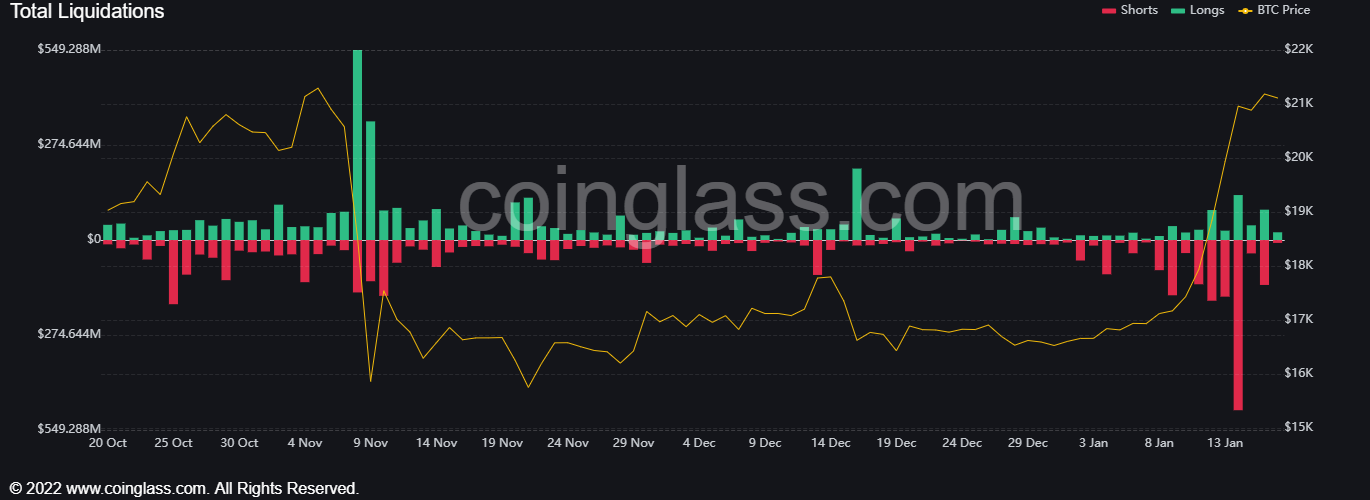
    • Half a billion dollars of short sales were liquidated over the weekend, the most in three months
    • Bitcoin is back above $21,000, Ethereum above $1,500, while altcoins have soared
    • Despite powerful bounce, the market is still down close to 65%, having peaked at nearly $3 trillion in November 2021
    • Bear market drawdown at 77% for Bitcoin, but traders are wary this may only be a short-term relief rally

    For a few hours over the weekend, if you looked at a crypto chart, it felt like it was 2020 again.

    COVID may be fading into the rear-view mirror, but so had crypto prices. I produced a deep dive into some on-chain data last week which showed how torrid 2022 had been for investors, with 73% less bitcoin millionaires, a drawdown of $2 trillion in the overall crypto market, and a reputation dragged through the mud by various scandals. 

    Looking at data this week for coinjournal.net, it is a little more optimistic for crypto investors. 

    Half a billion dollars of short sellers liquidated

    The weekend brought a little respite, however. Bitcoin surged to its strongest rally in 9 months, taking the market by surprise and breaking upwards above $21,000. 

    Looking at data from Coinglass, there were over half a billion dollars of short sellers liquidated this past weekend. The below chart shows the extent of these liquidations, more or less matching the long liquidations back when FTX collapsed in early November. 

    Crypto market regains $1 trillion mark

    The bounce in digital assets followed softer-than-expected inflation data. This optimism that inflation may have peaked has caused investors to bet that the Federal Reserve may pivot off its high-interest rate policy sooner than previously expected. 

    As we know by now, high-interest rates have sucked the liquidity from the market, hurting risk assets across the board. Crypto is very much trading like one of these high-risk assets, and hence prices have collapsed as the Federal Reserve has implemented this tight monetary policy – and hence crypto exchanges have been less than kind to long traders. 

    2023 has brought hope that if inflation truly has peaked, a light at the end of the tunnel may be visible. The crypto market has surged to regain a $1 trillion dollar market cap as a result. It is still a far cry from the near-$3 trillion all-time high, but Bitcoin at $21,000 and Ether at $1,500 marks the highest prices for the duo since before the FTX scandal. 

    Has the crypto market bottomed?

    The glaring question facing investors now is whether this is merely a short-term relief rally, or whether the bottom is in. 

    As with most questions in the market, macro holds the key. 

    “The last couple of months have undoubtedly brought indicators of a more positive environment with regards to inflation, as well as the boost of the Chinese economy reopening,”  said Max Coupland, Director at CoinJournal. 

    “However, I do worry whether investors are jumping the gun by presuming that this means the Fed will now pivot sooner than expected. (Fed chair) Jerome Powell has been adamant that rates will not taper until inflation is firmly under control, and we are still a long way from the 2% target, while uncertainties such as the Russian war in Ukraine still loom as highly unpredictable”. 

    Let’s play the (very) hypothetical game of assuming the bottom is in. That would put the bear market at 13 months long, with a 77% drawdown from peak-to-trough for Bitcoin. 

    Historically, this would place it as the third biggest drawback in history. However, that would only be in percentage terms. The crypto market today is vastly different to years past, and the size of the capital wipeout is on a different level – or over $2 trillion, to be precise. 

    So, while the length and size of the bear market could perhaps imply we are in the latter stages, past data simply cannot be reliably extrapolated when it comes to crypto. Bitcoin only broke through as a mainstream asset in the last few years, and prior time periods featured low liquidity and a niche set of investors. 

    Today, we are also facing an unprecedented macro climate – rampant inflation, high interest rates for the first time in Bitcoin’s history, and a bear market in the wider economy for the first time since the 2008 crash – the same year Bitcoin was invented. 

    In wrapping up, the past weekend has been a welcome reprieve for crypto investors, and amounts to the most powerful surge in nine months, back before the collapses of LUNA, Celsius, FTX and the transition to high interest rates in the board economy. 

    But the road ahead remains tough for the market at large, with inflation still lofty, a war ongoing in Europe and myriad other macro variables oscillating. This week has been good news, but crypto investors won’t be counting their chickens quite yet. 

    The next mark on the calendar? The all-important FOMC meeting on February 1st, when the Federal Reserve will decide upon the latest interest policy. 

    If you use our data, then we would appreciate a link back to https://coinjournal.net. Crediting our work with a link helps us to keep providing you with data analysis research. 

    Research Methodology

    Liquidation data via Coinglass. Price data from Yahoo Finance. All other data via CoinJournal

    Source link