Tag: Billion

  • Crypto Black Friday explained: How $19.5 billion vanished in hours

    Crypto Black Friday explained: How $19.5 billion vanished in hours

    Crypto Black Friday explained: how $19.5bn vanished in hours

    • Bitcoin plunged 8.4% as liquidity collapsed across exchanges.
    • Oracle glitches triggered cross-liquidations and temporary de-pegs.
    • The crash exposed major vulnerabilities in crypto infrastructure.

    On 10–11 October 2025, the cryptocurrency market experienced one of its sharpest collapses in years — an event the community has dubbed Crypto Black Friday.

    In just a few hours, more than $19.5 billion in leveraged positions were wiped out, sending Bitcoin down by 8.4% and shaking investor confidence worldwide.

    What began as a reaction to the US’s 100% tariff announcement on Chinese goods quickly revealed much deeper cracks in the system — showing how automated trading, thin liquidity, and structural weaknesses combined to trigger a chain reaction across exchanges.

    What triggered the sell-off?

    The first signs of the crash appeared after President Trump confirmed steep new tariffs on Chinese imports, fuelling fears of higher inflation and tighter Federal Reserve policy.

    Traders rushed to unwind risky positions, leading to rapid liquidations in Bitcoin (BTC), Ethereum (ETH), Wrapped Beacon ETH (WBETH), and Binance-Smart-based Solana (BNSOL).

    But geopolitical panic alone doesn’t explain how billions disappeared so quickly. Analysts say technical and structural factors amplified the event.

    Liquidity across exchanges was unusually low, and some Binance users reported frozen accounts during the sell-off.

    High-leverage looped loans and a temporary de-pegging of the USDE stablecoin made matters worse, creating a cascade of forced sales. Binance later confirmed system issues and offered compensation to affected users.

    How technical flaws magnified the collapse

    According to a BeinCrypto report, during the sell-off, CoinGlass — a popular analytics site — faced a sophisticated proxy attack that briefly disabled access to its data and services.

    This interruption added to market confusion just as traders were scrambling for real-time information.

    At the same time, a series of unusually large transactions occurred moments before several oracle updates.

    These oracles — the systems that feed real-world prices into blockchain smart contracts — briefly mispriced certain assets, triggering automatic liquidations across multiple trading pairs.

    The mispricing also caused some stablecoins to lose their peg temporarily, creating brief windows where arbitrage bots and high-frequency traders could profit.

    Within minutes, millions of dollars moved between exchanges as automated systems responded to the volatility, deepening the market crash.

    Was it a coordinated attack?

    Not everyone believes this was an organic crash. Some analysts argue that the patterns of trades and timing of oracle updates suggest deliberate manipulation.

    Data showed that the most extreme de-pegs affected pairs with known update schedules, while large-scale short positions were placed just before liquidation cascades began.

    This has led to speculation that certain market actors may have exploited the structure of the crypto market itself — using automated systems and leverage mechanisms to engineer volatility.

    The idea is that, rather than hacking wallets or stealing funds, attackers could manipulate the market by exploiting predictable behaviours in oracles, exchanges, and algorithms.

    Still, other experts maintain that this was simply an overleveraged market reacting to stress.

    When traders take on too much debt and sentiment shifts suddenly, cascading liquidations can happen without any external interference.

    The synchronised nature of the event across multiple exchanges, however, continues to fuel debate.

    What the crash revealed about crypto markets

    Crypto Black Friday has exposed how fragile the digital asset ecosystem remains despite its growing size.

    With $19.5 billion wiped out in hours, the event showed how quickly risk can spread when systems rely heavily on leverage, automated trading, and opaque liquidity pools.

    Exchanges such as Binance have since launched internal audits and pledged to improve transparency, but experts warn that these are short-term fixes.

    The real challenge lies in redesigning core systems — including how leverage is managed, how oracles feed data, and how liquidity is distributed across markets.

    The incident has renewed calls for better on-chain oversight and global standards for crypto risk management.

    For a trillion-dollar market to mature, analysts say it must balance innovation with stronger safeguards against both systemic shocks and sophisticated manipulation.

    Source link

  • Is 0G price set for breakout to $10 amid $3.3 billion volume surge?

    Is 0G price set for breakout to $10 amid $3.3 billion volume surge?

    0g-token-skyrockets

    • 0G price holds above $5.8 with over 60% in 24-hour gains after its mainnet launch.
    • The listing on Binance helped the price pump to $7.31 and the daily volume 2,800% to over $3.3 billion.
    • 0G price is largely bullish despite potential profit-taking.

    0G, the decentralised AI-focused blockchain created by 0G Labs, surged on Monday following the launch of its mainnet and the rollout of its native token airdrop.

    The token’s debut on Binance fueled strong trading momentum, sending prices to intraday highs of $7.31.

    The sharp rally underscored the heightened investor appetite for projects at the intersection of artificial intelligence and blockchain technology, a theme that has been gaining traction across the digital asset market.

    Market watchers noted that the combination of a high-profile exchange listing and the ongoing wave of enthusiasm for AI-linked platforms helped propel 0G’s early performance.

    0G price holds above $5.8 amid $3.3 billion volume

    As per CoinMarketCap, daily trading activity for the crypto project shot up by over 2,800% to $3.3 billion.

    XRP tops the leaderboard in terms of 24-hour volume for top gainers among the 100 largest coins by market cap, with over $6.9 billion.

    However, 0G’s figure that exceeds $3.3 billion is the second highest.

    Avalanche and Aster, the other outperformers in the leading 100 coins by market, also have significant volumes amid buy pressure with $2.6 billion and $2.1 billion, respectively.

    0G price outlook? Is $10 next?

    Looking ahead, analysts project a largely bullish trajectory for 0G.

    Short-term forecasts suggest a potential consolidation between $5.10 and $7.5 before another leg up beyond the $10.00 mark.

    Bullish scenarios, including AI-blockchain adoption, will be key in both the short term and the longer term.

    Investors may want to check out advancements across Decentralized Physical Infrastructure Networks (DePIN) and overall crypto sentiment.

    Integrations with major AI frameworks or partnerships that include global giants like Alibaba, Nvidia and OpenAI are worth a serious focus.

    The same applies to collaborations with Mira, Pyth Network and oracle and DeFi platform RedStone.

    Regulatory clarity in the broader crypto market and price recovery for Bitcoin, other altcoins, could spark upside momentum for 0G.


    Source link

  • NEAR protocol price surges as AI Tokens jump on Nvidia’s $5 Billion intel bet

    NEAR protocol price surges as AI Tokens jump on Nvidia’s $5 Billion intel bet

    NEAR Surges Amid Nvidia Deal

    • NEAR jumps 11% to $2.98 as Nvidia’s $5B Intel stake sparks AI crypto rally.
    • AI tokens surge with NEAR, TAO, Render and The Graph gaining on chip deal optimism.
    • NEAR eyes $3.6–$4 breakout as AI adoption and bullish charts fuel momentum.

    NEAR Protocol price jumped more than 11% in 24 hours to hit $2.98 amid a broader rally in AI-linked cryptocurrencies.

    The AI token’s uptick aligned with momentum that stemmed from Nvidia’s strategic $5 billion investment in Intel, with Bittensor, Render and The Graph among the top crypto AI gainers.

    Tokens like Aster jumped 500% on Thursday.

    NEAR price retests $2.98 as Nvidia news boosts AI tokens

    NEAR Protocol’s token experienced a sharp uptick, retesting the $2.98 resistance level with an 11% pump.

    This came after the cryptocurrency traded to lows of $2.70 earlier in the week, and the surge aligns with the overall crypto bounce and Nvidia’s announcement of a $5 billion equity stake in Intel.

    This deal, which includes collaborative development of AI-optimized PC and data center chips.

    It’s a move that points to Nvidia’s push to fortify US semiconductor capabilities amid global supply chain tensions.

    The investment arrives at a pivotal moment for Intel, following a $9 billion US government stake via the CHIPS Act and a $2 billion infusion from SoftBank, bolstering Intel’s balance sheet and foundry ambitions without immediate reliance on Nvidia’s manufacturing needs.

    AI tokens surge

    For the AI crypto ecosystem, this move amplifies optimism as the partnership signals the AI chipmaker’s potential to “innovate for customers” as it grows its business.

    NEAR, designed as an AI-native blockchain with sharding technology enabling up to 100,000 transactions per second, stands to benefit if momentum catalyzes price gains.

    The protocol’s Nightshade consensus and tools like Near Tasks for AI agents resonate with Nvidia’s ecosystem, and key integrations may see the altcoin explode further.

    Today’s Nvidia-fueled pump has similarly lifted the AI token sector: TAO climbed 7.7%,RENDER 8%, and The Graph (GRT) 5.9%, per CoinMarketCap data.

    Broader market tailwinds, including Bitcoin’s recovery to above $117,600, have added an uplift to the upswing.

    NEAR’s market cap moved back above $3.7 billion to rank 34th among top cryptocurrencies.

    What’s next for NEAR price?

    NEAR’s trajectory hinges on sustained AI momentum and technical breakouts targeting $3.6.

    Both the RSI and MACD on the daily chart support upside continuation.

    A look at the chart also shows a potential triangle pattern breakout.

    NEAR price chart by TradingView

    While downturn risks include macroeconomic headwinds, such as potential US regulatory scrutiny on AI chips or broader crypto volatility, NEAR has the potential to see levels above $4 in coming weeks.

    The project’s protocol upgrades and global AI adoption trends could allow bulls to target highs of $8.

    On the flip side, primary support could be around $2.62.

    Source link

  • Bitcoin ETFs see first-ever outflow of $751 million as Ethereum funds gain $3.9 billion

    Bitcoin ETFs see first-ever outflow of $751 million as Ethereum funds gain $3.9 billion

    Bitcoin ETFs see first-ever outflow of $751 million as Ethereum funds gain $3.9 billion

    • Bitcoin ETFs saw a $751 million net outflow in August, a first-ever event.
    • Ethereum ETFs absorbed a massive $3.9 billion in net inflows in August.
    • BTC’s price has fallen below key short-term holder cost basis levels.

    A stunning and unprecedented reversal has rattled the very foundations of the cryptocurrency market.

    For the first time since their celebrated launch, the institutional tide that carried Bitcoin to a record high has turned, with spot ETFs bleeding hundreds of millions of dollars in August.

    At the same time, a powerful and quiet current of capital has been flowing into Ethereum, signaling a potential changing of the guard and the beginning of a major rotation story that could define the rest of the year.

    The scale of the divergence is stark. In August, just weeks after they powered the asset to a 124,000 dollar all-time high, Bitcoin spot funds shed a staggering 751 million dollars in net outflows.

    In that same period, Ethereum ETFs quietly absorbed an incredible 3.9 billion dollars, a profound role reversal that suggests institutional investors may be fundamentally rebalancing their crypto exposure.

    Bitcoin’s fragile foundation

    The pain for Bitcoin is not just in the ETF flow data; it’s etched into the blockchain itself. A recent report from the analytics firm Glassnode paints a picture of a market slipping from euphoria into deep fragility.

    The analysis shows Bitcoin’s price has fallen below the cost basis of both 1-month and 3-month holders, a critical development that leaves a huge cohort of recent investors underwater and dramatically increases the risk of a deeper, panic-driven sell-off.

    If the price continues to slide below the six-month cost basis near 107,000 dollars, Glassnode warns, it could accelerate losses toward the crucial 93,000 to 95,000 dollar support zone, a dense cluster of accumulation by long-term holders.

    Prediction markets are echoing this cautious sentiment.

    Traders on Polymarket now assign a 65 percent chance that Bitcoin revisits 100,000 dollars before it retakes 130,000 dollars, a clear sign that the July rally is now seen as overextended and unsustainable without a renewed wave of institutional demand.

    Ethereum: the quiet ballast

    While Bitcoin falters, Ethereum is emerging as a quiet and powerful source of stability. Its ETF inflows have been remarkably consistent, logging positive net subscriptions in 10 of the last 12 months.

    August’s 3.9 billion dollar haul has been the engine behind the token’s impressive 25 percent gain over the past 30 days, a stunning outperformance during a brutal market-wide correction.

    The conviction behind Ethereum’s rise is firm. Polymarket traders see over 90 percent odds of the asset holding above 3,800 dollars into early September, and longer-term bets give it a 71 percent chance of finishing 2025 above the coveted 5,000 dollar mark.

    As Bitcoin’s institutional tide flows out, Ethereum’s steadier bid is becoming the market’s new anchor. The great rotation may be in its early stages, but the signs are unmistakable.

    A new power dynamic is taking shape, and the battle for crypto’s throne is just beginning.

    Source link

  • Michael Saylor’s Strategy upsizes ‘stretch’ preferred stock sale to $2.8 billion

    Michael Saylor’s Strategy upsizes ‘stretch’ preferred stock sale to $2.8 billion

    Michael Saylor's Strategy upsizes 'stretch' preferred stock sale to $2.8 billion

    • Michael Saylor’s Strategy launched and upsized a new preferred stock offering from $500M to $2.8 billion.
    • The ‘Stretch’ security promises a hefty 9% annual payout with no end date and a flexible, adjustable dividend.
    • The deal is the latest in Saylor’s years-long effort to transform Strategy into a financial vehicle to acquire Bitcoin.

    Michael Saylor’s relentless quest to transform his company, Strategy, into a Bitcoin-acquiring financial juggernaut has reached a new level of ambition.

    The firm has launched and then promptly upsized a novel preferred stock offering, raising a staggering $2.8 billion in a deal that further showcases Saylor’s prowess in the capital markets and the insatiable investor appetite for exposure to the booming crypto market.

    As crypto prices continue their upward march, Saylor’s Bitcoin holding company, Strategy, has once again demonstrated its unique ability to tap into market enthusiasm.

    The company priced a new kind of security on Thursday, which it has dubbed “Stretch.” This offering promises buyers a hefty 9% annual payout with no specified end date, an unusual feature in the often-arcane world of preferred stock.

    Initially planned as a $500 million deal, the offering was upsized to $2.8 billion due to overwhelming demand, according to a person familiar with the transaction who asked to remain anonymous.

    This move is the latest, and perhaps most audacious, demonstration of Saylor’s Wall Street wizardry in his years-long effort to pivot a middling software firm, formerly known as MicroStrategy, into a corporate entity singularly obsessed with one goal: raising as much money as possible to acquire as many Bitcoin as possible.

    At last count, the company’s hoard stood at some 600,000 coins, worth approximately $70 billion.

    “This is not the first financial engineering initiative by Strategy,” noted Campbell Harvey, a professor at Duke University. “In any situation where your company is worth far more than fundamental value, you raise money.”

    Since Strategy’s first groundbreaking Bitcoin purchase in 2020, Saylor has employed a diverse range of financial instruments, including selling equity, issuing various types of debt, and layering multiple stacks of preferred shares.

    In doing so, he has not only amassed a colossal Bitcoin treasury but has also inspired a fleet of imitators, spurring a new industry of public companies dedicated to the so-called “treasury strategy” of buying and holding cryptocurrencies.

    The ‘Stretch’ security: a new twist on an old theme

    Many of the previous financial instruments that have fueled Strategy’s rise have proven to be more popular than expected, but even against that backdrop, the demand for “Stretch” was notable.

    The company’s common shares rose 0.5% on Wednesday and are up an impressive 43% for the year.

    The new “Stretch” shares occupy a specific place in Strategy’s complex and unusual capital structure.

    They sit above the company’s common stock and its other preferred shares—which carry creative names like “Strike” and “Stride”—but remain subordinate to its convertible bonds and another preferred stock known as “Strife.”

    A key feature that distinguishes “Stretch” from earlier offerings is its flexible dividend. Unlike a fixed payout, this security allows Strategy to tweak the dividend rate.

    Each month, the firm will set a new payout rate with the aim of keeping the share price near the $100 mark, raising or lowering the dividend as needed to maintain this target. It’s a unique combination of a dynamic pricing model and a trust exercise, and a clear reminder that in the world of financial engineering, Strategy often creates its own rules.

    Diminishing returns? A discount to win over investors

    While this flexibility may appeal to Saylor’s large and dedicated fan base of retail investors, it also introduces a new layer of uncertainty into an already complex capital structure.

    There are some signs that Saylor’s tactics may be facing somewhat diminishing returns, as the value of the company, relative to the Bitcoin it owns, has reportedly gone down.

    In a move to win over investors for its latest offering, Strategy offered the “Stretch” shares at a discount. The shares, which are set to carry an initial dividend of 9%, were sold for $90 each.

    This was at the bottom of the marketed range and represents a discount to their face value of $100, according to the person familiar with the deal.

    Despite the discount, the outsized demand for the deal provides the latest and most powerful sign of both Saylor’s avid following and the continued speculative fervor that is running through the financial markets.

    According to a previous Bloomberg report, major financial institutions including Morgan Stanley, Barclays Plc, Moelis & Co., and TD Securities worked on this landmark deal.

    Source link

  • Early PUMP investors dump 25.5 billion tokens, pocketing nearly $40 million in profit

    Early PUMP investors dump 25.5 billion tokens, pocketing nearly $40 million in profit

    Early PUMP investors dump 25.5B tokens, pocketing nearly $40M profit

    • Two wallets offloaded PUMP worth $141M the previous week.
    • The sales yielded around $39.65 million in profit.
    • The transactions (made to FalconX and CEXs) have raised concerns over Pump.fun’s token distribution.

    As the GENIUS Act fuels the altcoin season narrative, a bold move involving the recently launched PUMP coin has raised eyebrows within the cryptocurrency community.

    According to EmberCN’s July 21 X post, two wallets that participated in Pump.fun’s private placement have offloaded 25.5 billion PUMP tokens, worth approximately $141 million.

    The transaction saw the investors netting combined $39.65 million profits within a week.

    The speed and magnitude of these transfers have stirred widespread debates among crypto enthusiasts, with many questioning Pump.fun’s token distribution structure and the altcoin’s long-term price stability.

    Key investors exit PUMP

    The first wallet D6ar…Lazd secured 25 billion PUMP coins after joining the institutional round with $100 million USDC.

    Notably, this private placement mirrored a public sale as it lacked a lock-up period with the same buying price.

    That’s unusual for institutional investors.

    While the market rallied over the last week, driven by regulatory changes in the United States, this wallet sent 13 billion tokens, worth approximately $71.46 million, to a trading and liquidity platform FalconX.

    Meanwhile, the assets later moved into multiple central exchanges (CEXs).

    The investor dumped at around $0.0055 average price, accumulating $19.5 million returns in less than a week.

    The second wallet walked away with around $20.15 million with a similar approach.

    It received 12.5 billion tokens after committing $50 million USDC to the private sale.

    Meanwhile, the whale moved all the tokens to CEXs, locking in returns at $0.0056 average price per PUMP coin.

    Maximum liquidity without lock-up

    The most noticeable thing is that these private round participants didn’t have lock-up terms.

    Generally, institutional crypto purchases include vesting periods to ensure stability and discourage sudden dumps.

    In Pump.fun’s saga, large-scale investors were free to offload immediately, giving them an edge over retail players who joined later.

    Further, the community criticized for creating an irregular playing ground with equal pricing between private and public offerings.

    PUMP momentum threatened

    The altcoin has remained on investor radar since its July 12 public sale, which sold off within twelve minutes.

    While it demonstrates strength despite early backlash, the substantial dump from early participants darkens PUMP’s short-term outlook.

    The substantial sell-offs will likely impact liquidity, investor confidence, and price actions in the upcoming sessions.

    The derivatives markets data signal a weakening strength according to Coinglass.

    PUMP’s trading volume has plunged 10% to $1.11 billion, whereas a 7% dip in Open Interest indicates fading trader optimism.

    Moreover, the Pump.fun team hasn’t commented on the significant transactions or the project’s private placement structure.

    The lack of transparency could dent PUMP’s sentiments further.

    Enthusiasts will watch how the altcoin reacts to the latest on-chain developments.

    Nonetheless, broad market sentiments remain vital in shaping the altcoin’s trajectory.

    Bulls dominate the digital assets, and with Bitcoin’s declining dominance hinting at an impending altcoins season, massive rallies could absorb PUMP’s anticipated selling pressure.


    Source link

  • Over $1.1 billion shorts obliterated as Bitcoin hits $118k

    Over $1.1 billion shorts obliterated as Bitcoin hits $118k

    Bitcoin Liquidations

    • Bitcoin saw a 5% daily surge that pushed BTC to a new all-time high above $118,000.
    • The sudden gains had shorts wiped out, with over $1.1 billion in short positions liquidated in 24 hours.
    • A trader on HTX was liquidated for $88 million.

    A spark of bullish momentum has seen Bitcoin smash through the $118,000 mark today, setting a new all-time high.

    The sharp move that had BTC moving from off the $110k low has triggered a massive wave of liquidations, which have wiped out over $1 billion in short positions across the cryptocurrency market in the past 24 hours.

    The surge, fueled by institutional demand, regulatory clarity, and macroeconomic shifts, has sent shockwaves through the crypto space, leaving traders and analysts scrambling to predict what’s next for the world’s largest digital asset

    Shorts see red amid $1.2 billion in liquidations

    Bitcoin, the crypto market’s bellwether, surged to a new all-time high of $118,403 on Friday, July 2025.

    Bitcoin price on the 7-day chart by CoinMarketCap

    Robust institutional demand and $1.18 billion in net inflows to Bitcoin spot ETFs on July 10 highlighted this move.

    Macro headwinds, with investors factoring in possible Fed rate cuts, have also added to the upside fuel.

    This rally triggered a massive short squeeze, with over $1.2 billion in crypto liquidations in the past 24 hours, a 140% increase from the prior day.

    The most dramatic fallout from Bitcoin’s surge was the annihilation of short-sellers.

    Over $1.11 billion in short contracts were liquidated in the past 24 hours, with $635 million tied to Bitcoin and $208 million to Ether, affecting 269,681 traders.

    One notable casualty was a single trader on the HTX exchange, whose $88 million short position was wiped out, underscoring the intensity of the market’s upward momentum.

    Whales make moves as Bitcoin surges

    With Bitcoin breaking a new all-time high, large holders were keen to keep hold of their windfalls.

    It included a Binance whale’s “powerful punch” that helped the market higher. CryptoQuant highlighted this in a post on X.

    “Until recently, whales on the US-based Coinbase exchange were driving the market, but today’s surge was driven by a significant move from a major whale on the Binance exchange,” said CryptoQuant’s DanCoinInvestor.

    While others bought BTC, some scrambled to preserve their positions amid massive liquidations.

    According to Lookonchain, a whale who was down by more than $10 million on a 1,135 BTC or $132.65 million short position, opted to deposit more funds to avoid liquidation.

    The whale added the $5.5 million USDC to his position on Hyperliquid with a new liquidation price of $121,080.

    James Wynn, recently in the headlines for major losses, has also seen positions wiped out in the last 24 hours.

    As BTC eyes further gains, analysts are saying the supply-side dynamics are tightening.

    For instance, Glassnode has noted that long-term holders and smaller entities are accumulating Bitcoin faster than its issuance rate.

    This accumulation, coupled with compressed volatility across all timeframes, has set the stage for Bitcoin’s breakout, with analysts eyeing $120,000 as the next psychological target.


    Source link

  • Celsius vs Tether lawsuit moves ahead in US court over $4 billion Bitcoin sale

    Celsius vs Tether lawsuit moves ahead in US court over $4 billion Bitcoin sale

    Celsius vs Tether lawsuit moves ahead in US court over $4 billion Bitcoin sale

    • Celsius claims Tether’s 2022 Bitcoin sale broke contract terms.
    • Over 39,500 BTC were liquidated at $20,656 average price.
    • Claims include breach of contract and fraudulent transfer.

    Celsius Network’s efforts to hold Tether accountable for a $4 billion Bitcoin liquidation just cleared a major hurdle in US court.

    A bankruptcy judge has now allowed Celsius to proceed with legal action against Tether, despite the stablecoin giant’s attempts to halt the case on jurisdictional grounds.

    The lawsuit centres on claims that Tether prematurely and unfairly sold nearly 40,000 BTC during Celsius’s collapse in mid-2022, in breach of a contractual agreement and US bankruptcy laws.

    The ruling could mark a turning point for how global crypto firms are treated in American courts, especially when assets are involved that were managed, sold, or transferred through US-linked systems.

    While the court dismissed some peripheral allegations, it upheld key claims, including breach of contract and fraudulent transfer, allowing Celsius’s case to continue.

    Celsius accuses Tether of early Bitcoin liquidation breach

    The dispute dates back to June 2022, when Celsius was already reeling from the broader crypto market crash. Court filings reveal that Tether had lent money to Celsius and, in return, received collateral in Bitcoin.

    Celsius now alleges that Tether liquidated 39,500 BTC at an average price of $20,656 without providing the contractually required 10-hour notice period.

    The assets, according to Celsius, were liquidated during a time of extreme market volatility, and sold significantly below market value. Celsius claims the early sale resulted in a loss of over $4 billion based on current Bitcoin prices.

    Moreover, the company alleges that Tether later transferred the liquidated BTC to Bitfinex, a platform operated by Tether’s sister company, raising concerns around related-party dealings and asset custody.

    US court rejects Tether’s jurisdictional challenge

    In its defence, Tether had argued that the case should be thrown out because it operates from the British Virgin Islands and Hong Kong. The company said US courts had no jurisdiction over its business.

    However, the judge disagreed, pointing to the fact that Tether used US-based staff, bank accounts, and communication systems in its dealings with Celsius.

    The court ruled that Tether’s actions were sufficiently “domestic” to fall under US legal scrutiny.

    This decision now paves the way for Celsius to pursue several key legal charges including breach of contract, fraudulent transfer, and preferential treatment of certain creditors—allegations that strike at the core of how digital asset lenders and stablecoin issuers operate.

    Broader implications for crypto lending and stablecoin governance

    Legal experts say the outcome of this case could influence the regulatory treatment of stablecoin issuers, particularly in the US.

    If Celsius is able to demonstrate that Tether mismanaged client assets or failed to honour notice periods during market stress, it may prompt calls for stricter oversight on asset liquidation procedures, especially for offshore firms operating through US financial infrastructure.

    The case may also set a precedent for future cross-border lending disputes and clarify whether offshore crypto companies can be held accountable in US bankruptcy proceedings.

    The outcome could therefore impact how other large digital asset firms manage collateral and liquidity risk during market downturns.

    Tether grows market presence amid legal scrutiny

    Despite the ongoing legal challenges, Tether has continued to expand its footprint in the crypto sector. The company recently acquired a majority stake in Twenty One Capital, a firm associated with Strike CEO Jack Mallers.

    This move connects Tether to the third-largest corporate Bitcoin holder globally.

    In another significant development, Tether transferred around 37,230 BTC—currently worth $3.9 billion—to addresses associated with its trading operations.

    The company appears to be consolidating its Bitcoin reserves even as it navigates the legal fallout from the Celsius collapse.

    Meanwhile, speculation continues over Tether’s valuation and a possible initial public offering.

    However, CEO Paolo Ardoino has denied any plans for a public listing, stating that the firm is not preparing for an IPO despite rumoured valuations nearing $500 billion.

    As the Celsius case moves into the next phase, attention will remain on how Tether responds to mounting legal pressure in one of the largest financial disputes in crypto history.

    Source link

  • TRON price forecast as USDT supply surpasses $80 billion

    TRON price forecast as USDT supply surpasses $80 billion

    USDT And TRON Symbols

    • USDT supply on TRON has surpassed $80 billion, accounting for over 50% of circulating USDT.
    • TRX price is currently at $0.27, but could rise to $0.44 in the short term amid bullish momentum. 
    • ETFs, partnerships, and network growth are likely catalysts for TRON price.

    TRON (TRX) price is down on the day, but the blockchain project is making headlines elsewhere as the supply of Tether’s USDT on its blockchain has surpassed $80 billion.

    The native Tron token TRX traded at $0.27 on Friday, June 27, with CoinMarketCap showing the price was down under 1%. Intraday highs for the altcoin range around $0.29, and TRON remains in the top 10 by market cap.

    However, the question might be, what does the USDT milestone mean for TRON’s price?

    USDT supply on TRON hits $80 billion

    As the crypto market eyes gains and stablecoin adoption grows, Glassnode has shared details that reveal a dramatic rise in Tether (USDT) supply on the TRON network.

    Notably, the Tether-issued US dollar-pegged token has surpassed the $80 billion supply mark as of mid-2025.

    This marks a significant leap from earlier years, with the supply growing steadily from negligible amounts in 2020 to over $60 billion by 2024, before accelerating sharply into 2025. As seen in the chart by Glassnode, there’s a steep upward trajectory, reflecting TRON’s increasing role in facilitating stablecoin transactions.

    USDT in circulation currently sits at around $157.4 billion. With more than half of the total circulating USDT at $80 billion is dominance that solidifies TRON’s position as a preferred blockchain for stablecoin settlements, outpacing competitors like Ethereum.

    The network’s efficiency and low transaction costs have likely driven this adoption, with institutional and remittance use cases further fueling demand.

    May 2025 saw a record $684 billion in transfer volume, while 283 million USDT transfers this year highlight explosive user adoption.

    TRON price prediction

    Currently priced at $0.27 with a 24-hour trading volume of $407 million, TRON has shown resilience.

    While price has recently dipped from highs of $0.29, bulls have held above the key support level of $0.20 since early January.

    The surge in USDT supply is a bullish signal, as it boosts network usage and attracts more users to TRON’s ecosystem, including DeFi and payment applications.

    Looking at the price outlook, several catalysts could drive TRX’s price higher.

    The potential launch of TRON-based exchange-traded funds (ETFs) could attract institutional investment, mirroring trends seen with Bitcoin and Ethereum.

    Additionally, strategic partnerships—such as collaborations with major financial institutions or further integration with Tether- might prove huge for TRX.

    Recently, it was announced that Tron is eyeing a public listing via a reverse merger. The deal, which reportedly eyes an IPO with Nasdaq-listed SRM Entertainment, will transform TRON into a treasury company.

    Short-term, TRX might test resistance around $0.30. A breakout above $0.30 will allow bulls to target December 2024 highs above $0.44, which formed TRX’s all-time high. Long term, TRON price will eye a rally to $1.


    Source link

  • US spot Bitcoin ETFs hit $30 billion in combined net inflows since January launch

    US spot Bitcoin ETFs hit $30 billion in combined net inflows since January launch

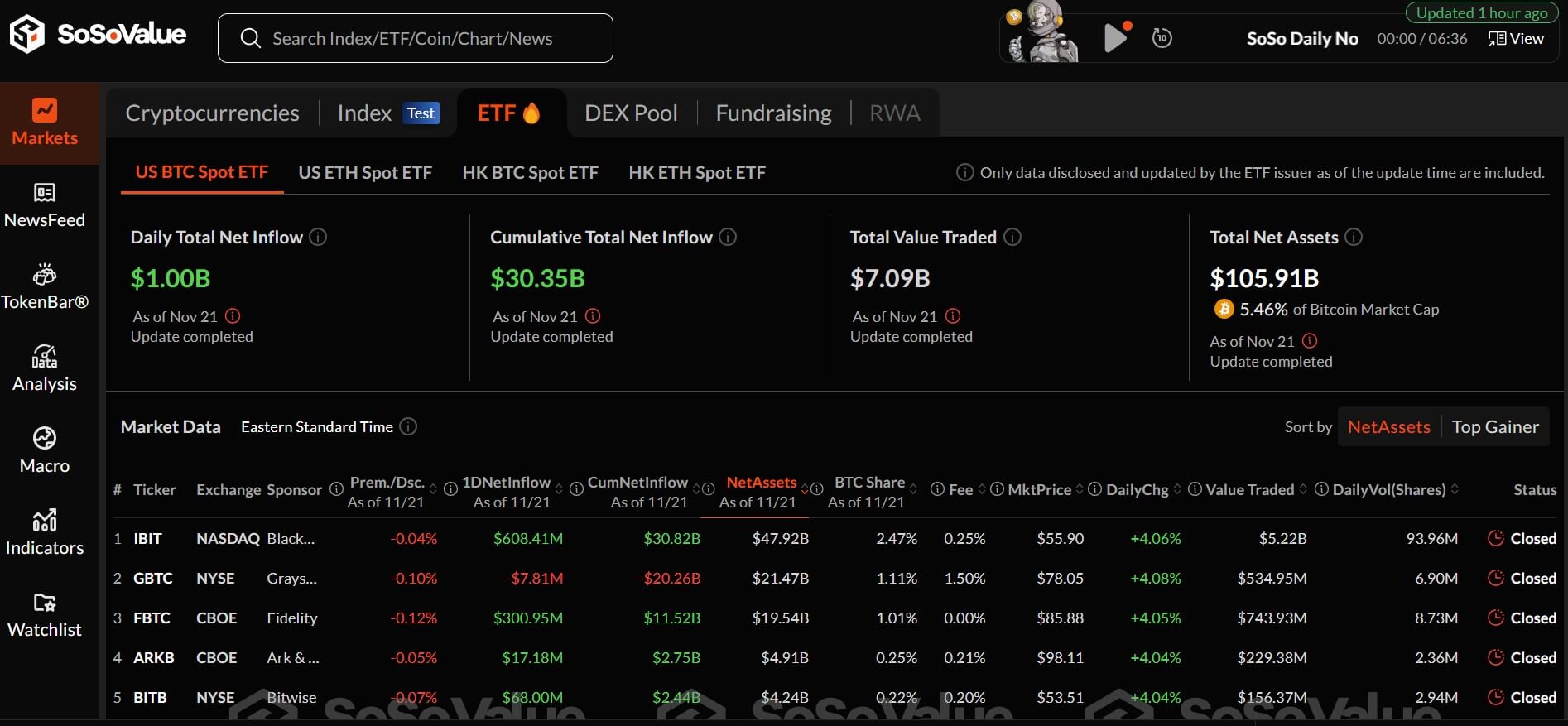
    • BlackRock’s IBIT attracted the most at over $600 million followed by Fidelity’s FBTC with $301 million
    • The 12 spot Bitcoin ETFs have brought in a combined $30.35 billion since launching in January

    US spot Bitcoin exchange-traded funds (ETFs) took in $1 billion in daily total net inflows yesterday as Bitcoin inched closer to the $100k mark.

    BlackRock’s iShares Bitcoin Trust (IBIT) saw the most inflows, attracting $608.41 million, according to SoSoValue data. Fidelity’s FBTC followed with $300.95 million. Bitwise’s Bitcoin ETF brought in $68 million and Ark and 21Shares’ ARKB attracted $17.18 million.

    Grayscale’s GBTC was the only one with negative net flows, recording $7.8 million outflows.

    The 12 spot Bitcoin ETFs have earned a combined $30.35 billion since launching in January following approval from the US Securities and Commission (SEC).

    US Spot Bitcoin value. Source: SoSoValue

    Elevated trade among the spot Bitcoin ETFs followed as Bitcoin climbed to the $100k mark on November 22, continuing its bull run.

    The inflows also come after BlackRock launched its options contracts earlier this week. During trading on day one, BlackRock’s options brought in nearly $2 billion, helping to push Bitcoin to more than $94,000.

    Grayscale announced this week that it was also launching Bitcoin ETF options following BlackRock’s impressive debut and a surge in investor interest.

    As trade continues through spot Bitcoin ETFs, it’s becoming clear that these avenues are one of the main ways for investors to hold Bitcoin. According to Bloomberg analyst Eric Balchunas, US Bitcoin ETFs hit $100 billion in assets, adding on X:

    “They’re now 97% of [the] way to passing Satoshi as [the] biggest holder and 82% of [the] way to passing gold ETFs.”

    Elsewhere, in the market, Ethereum is up by more than 7% over the past week at $3,285, Solana has seen a nearly 20% increase at $253, and XRP has risen close to 60% to $1.44 in the same time, according to CoinMarketCap.


    Source link