Tag: Bitcoins

  • Glassnode report reveals Bitcoin’s growing stability amid ETF activity and RWA expansion

    Glassnode report reveals Bitcoin’s growing stability amid ETF activity and RWA expansion

    Glassnode report reveals Bitcoin’s growing stability amid ETF activity and RWA expansion

    • Bitcoin’s 2025 cycle shows rising institutional flows, lower volatility, and deeper liquidity.
    • Tokenized real-world assets surge to $24 billion, boosting institutional adoption and on-chain activity.
    • ETFs reshape Bitcoin liquidity as stablecoins remain key rails in a more mature digital asset market.

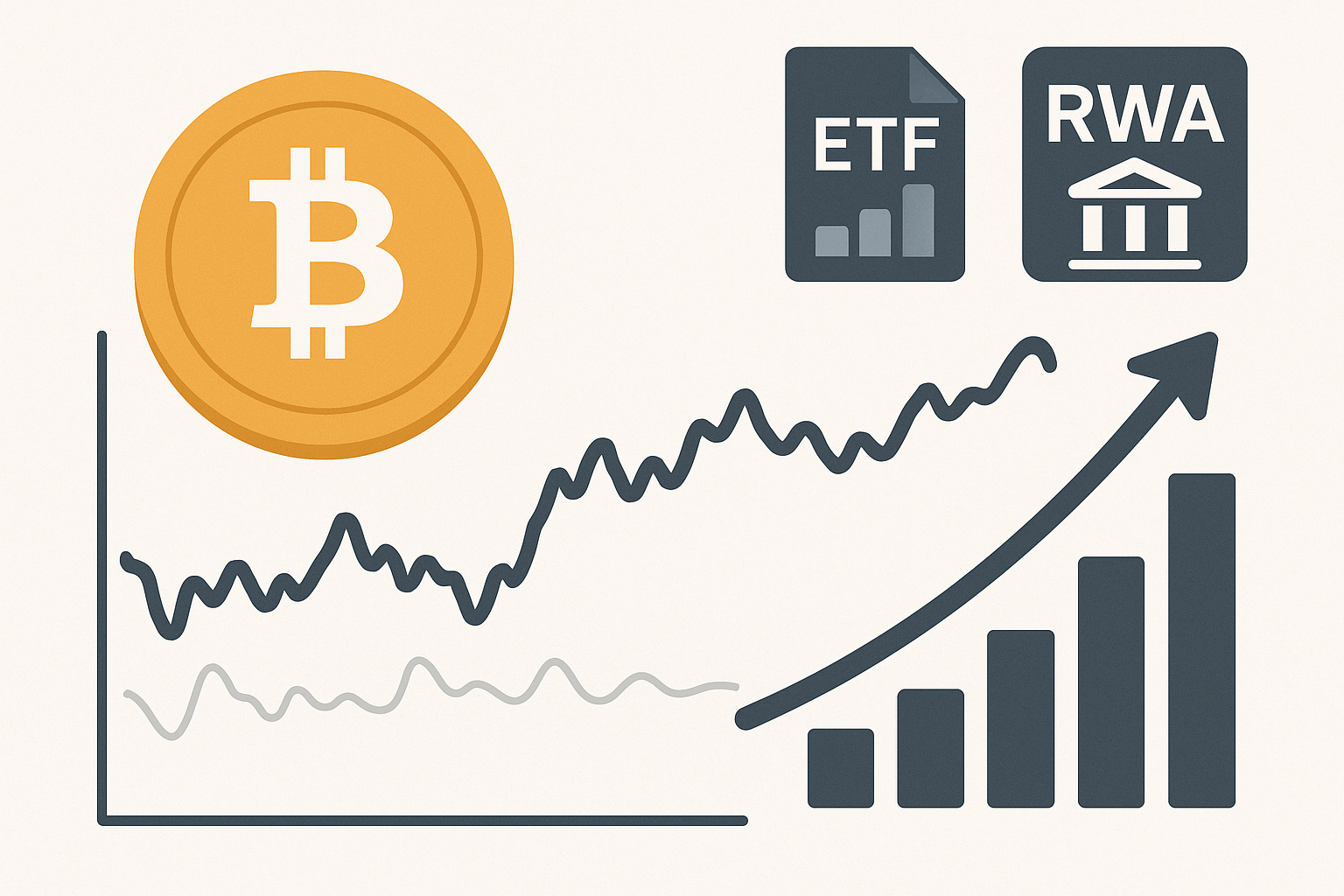
    Bitcoin’s latest cycle is developing under a very different market structure, with data from Glassnode and Fasanara Capital pointing to deeper institutional participation, rapid growth in tokenized real-world assets, and a notable drop in volatility.

    Their Q4 Digital Assets Report highlights how Bitcoin’s behaviour has shifted as regulated investment channels expand, and liquidity becomes more stable across spot, derivatives, and on-chain markets.

    The findings show how ETF flows, settlement activity, and broader adoption of tokenised instruments are shaping a more mature phase in the digital asset ecosystem.

    These structural changes are defining how capital moves through Bitcoin in 2025.

    Institutional flows reshape the cycle

    The report estimated that Bitcoin has absorbed around $732 billion in new capital during this cycle.

    This has occurred alongside a clear decline in one-year realised volatility, which has fallen by nearly half.

    Glassnode linked this trend to increased depth across major markets and a larger share of trading driven by institutional strategies.

    Glassnode also reported that Bitcoin settled approximately $6.9 trillion over the past 90 days.

    This puts Bitcoin in a range comparable to payment networks such as Visa and Mastercard.

    Even with more trading moving into ETF and brokerage channels, the report found that Bitcoin and stablecoins still dominate value transfer on public blockchains.

    ETF channels deepen liquidity

    ETF-linked demand has reshaped how investment enters and exits Bitcoin.

    Instead of relying mainly on on-chain movement or exchange activity, a greater share of flows now passes through regulated investment vehicles.

    According to the report, this shift has encouraged smoother liquidity conditions and fewer sharp price changes in spot markets.

    Traditional market makers and arbitrage firms have increased their presence due to ETF participation.

    Their involvement has tightened spreads and reduced disruption during periods of heightened selling pressure.

    This development reflects a broader alignment between digital asset markets and established financial infrastructure.

    Tokenized RWAs accelerate

    Tokenized real-world assets have expanded from $7 billion to $24 billion within one year.

    Glassnode stated that this rise reflects stronger institutional demand, including interest from pension funds, hedge funds, and corporations that want on-chain exposure to familiar financial instruments.

    Tokenized funds have gained momentum as asset managers test new distribution models and investors seek simplified access to traditional assets.

    Platforms involved in tokenised RWAs have strengthened custody, settlement, and compliance systems.

    This foundation has encouraged consistent inflows throughout 2025, supporting a growing segment of the market that links traditional assets with blockchain settlement rails.

    Stablecoin role strengthens

    Glassnode described the market structure as larger and more stable than in previous cycles.

    The data indicated deeper liquidity across spot, derivatives, and on-chain channels, which has contributed to a more measured trading environment.

    Reduced volatility has become a defining feature of the cycle, shaped by institutional trading strategies that tend to use steady allocation models.

    Stablecoins continue to serve as key connectors between traditional and digital financial systems.

    The report stated that stablecoin settlement demand remains substantial across centralised and decentralised platforms.

    Glassnode characterised the dual-rail system created by stablecoins and traditional infrastructure as a permanent part of the ecosystem, supporting both institutional flows and retail trading activity.

    Analysts referenced in the report expect institutional participation to expand as tokenised funds gain broader acceptance.

    Glassnode presented this phase as a turning point marked by heavier institutional flows, rising tokenisation, and reduced volatility.

    These factors suggest that Bitcoin and the wider digital asset sector are moving into a more structurally mature environment in 2025.

    Source link

  • Bitcoin’s new problem: it’s not leverage, it’s long-term holders cashing out

    • Long-term holders have sold approximately 400,000 Bitcoin ($45B) in the past month.
    • This sell-off is driven by spot markets and fading conviction, not high leverage.
    • Bitcoin fell below the key $100,000 level for the first time since June.

    Bitcoin has once again slipped below the critical $100,000 mark, but the force driving this latest downturn is different and potentially more concerning for the market.

    Unlike the leverage-fueled crash in October, this sell-off is being driven by a quieter, more sustained exodus: long-term holders are cashing out, creating a $45 billion supply glut that is testing the market’s conviction.

    The original cryptocurrency fell as much as 7.4% on Tuesday, marking a more than 20% decline from its record high a month ago.

    While it has since staged a modest recovery, the nature of the selling pressure suggests a fundamental shift in market dynamics.

    From forced liquidations to fading conviction

    The key difference in this downturn is the source of the selling.

    While October’s crash was defined by a cascade of forced liquidations from overleveraged traders, the current slide is being led by a steady drumbeat of selling in the spot market.

    According to Markus Thielen, head of 10x Research, long-time Bitcoin holders have offloaded approximately 400,000 Bitcoin over the past month—an exodus valued at around $45 billion.

    This sustained selling from seasoned investors is creating a market imbalance that new buyers are struggling to absorb.

    This analysis is supported by on-chain data.

    “Over 319,000 Bitcoin has been reactivated in the past month, mainly from coins held for six to twelve months — suggesting significant profit-taking since mid-July,” Vetle Lunde, head of research at K33, told Bloomberg.

    The whale problem: big buyers are disappearing

    With market leverage now relatively muted, attention has turned to the large, long-time holders who are choosing to sell.

    Thielen told Bloomberg that “mega whales”—entities holding between 1,000 and 10,000 Bitcoin—began offloading large volumes earlier this year.

    For a time, institutional players were able to absorb this supply, leading to choppy, sideways price action.

    However, since the October crash, broader demand has faded, and the accumulation by smaller whales (holding 100 to 1,000 Bitcoin) has dropped sharply.

    The result is a growing imbalance between sellers and buyers. “The whales are just not buying,” Thielen said.

    What comes next? A path to further declines

    This sustained selling from long-term holders could have lasting implications.

    Thielen warns that the current unwind could continue well into next spring, drawing parallels to the 2021–2022 bear market, where large holders sold over one million Bitcoin over the course of nearly a year.

    “If this is a similar pace,” he said, “we could see this situation going on for another six months.”

    While not predicting a catastrophic crash, Thielen sees room for further declines as the market consolidates.

    “I am not a believer in the cycle,” Thielen said, “but I would assume that we sort of consolidate and potentially drift even a bit lower from here. $85,000 is my maximum downside target.”

    Source link

  • Bitcoin’s institutional surge widens trillion-dollar gap with altcoins

    Bitcoin’s institutional surge widens trillion-dollar gap with altcoins

    Bitcoin’s institutional surge widens trillion-dollar gap with altcoins

    • A trillion-dollar valuation gap now separates Bitcoin from other tokens.
    • Altcoin market capitalisation could be $800 billion higher, data shows.
    • A US-China trade selloff erased $380 billion from crypto markets.

    Bitcoin’s growing dominance in institutional portfolios has created a near-trillion-dollar gap between the world’s largest cryptocurrency and its altcoin peers, according to new data shared by 10x Research.

    The report attributes this widening divide to a structural shift in investor behaviour, particularly among retail traders in South Korea, who have redirected funds from altcoins to crypto-linked equities and exchange-listed vehicles that hold tokens.

    Retail shift weakens altcoin liquidity

    10x Research found that altcoin market capitalisation could be about $800 billion higher if retail investors—especially in South Korea—had not channelled their funds into crypto-related stocks and other equity markets.

    Altcoins, which typically rely on retail liquidity to sustain upward momentum, have failed to attract enough new capital in this cycle.

    Historically, South Korean traders have been a major force behind the altcoin boom.

    Local exchanges have seen altcoins account for more than 80% of total trading activity, a stark contrast to global platforms where Bitcoin and Ether dominate 50% or more of daily volume.

    But that pattern has shifted sharply this year, leading to a liquidity shortfall for smaller digital assets.

    South Korea’s trading activity declines

    From 5 November through 28 November 2024, the daily average trading volume on South Korean crypto exchanges stood at $9.4 billion, surpassing the $7 billion traded on the Kospi stock market during the same period, according to data from CCData and the Korea Exchange.

    However, since then, 10x Research noted a steep decline in crypto activity, suggesting that retail participation has cooled significantly.

    The report highlights that South Korea’s declining appetite for riskier altcoins has been instrumental in their recent underperformance.

    Retail investors who once drove speculative rallies in coins such as XRP, Cardano, and Solana have turned instead to listed blockchain firms and exchange-traded vehicles offering indirect crypto exposure.

    This shift has contributed to the overall weakness in altcoin prices.

    Market losses deepen amid trade tensions

    A recent selloff in the broader cryptocurrency market, triggered by escalating US-China trade tensions, exacerbated the situation.

    The correction wiped out about $380 billion from total market value, with roughly $131 billion concentrated in altcoins, according to 10x Research’s data.

    While Bitcoin and altcoins both suffered declines, smaller coins bore the brunt as investors sought safety in the more established and liquid assets.

    Bitcoin’s appeal as a hedge within the crypto ecosystem has strengthened, reinforcing its dominance during market stress.

    The selloff underscores a changing market structure where altcoins are increasingly viewed as speculative instruments, while Bitcoin’s perceived institutional legitimacy provides it with greater resilience during downturns.

    As capital concentrates around Bitcoin and select equities, the broader altcoin market faces challenges in regaining lost momentum.

    Source link

  • Crypto wrap: Bitcoin’s sharp fall drags Ethereum, XRP, Solana and BNB lower

    Crypto wrap: Bitcoin’s sharp fall drags Ethereum, XRP, Solana and BNB lower

    Bitcoin Price Dump

    • Bitcoin slides below $104K as crypto sell-off deepens.
    • $1B in crypto liquidations hit traders within 24 hours.
    • Aave, Flare, BCH sink; Jito jumps on a16z investment.

    The cryptocurrency market has extended its unstable week with a broad sell-off, erasing gains from earlier in the period amid Bitcoin’s slump to under $104,000.

    Meanwhile, the global cryptocurrency market capitalization dropped by more than 3% to $3.5 trillion – before a slight recovery as Bitcoin reclaimed the $107,000 level.

    CoinGlass data showed the global crypto liquidations jumped to over $1.04 billion in 24 hours, with longs suffering the most pain.

    Open interest was down 3.8% to $150 billion as Ethereum, XRP, Solana, and BNB all retested, and in some cases, dropped below key levels.

    Bitcoin slumps to $103,598

    Bitcoin led the market’s steep drop on Friday, October 17, 2025. While the sharp decline was not as bloody as the annihilation seen on Oct. 10, the fall to lows of $103,500 marked another big swing for BTC.

    The benchmark digital asset had partially recovered to highs of $106,600 at the time of writing.

    However, the slump injected fresh fears into a market that witnessed a historic $19 billion liquidation event a week prior.

    Notably, Bitcoin’s dump came amid investor jitters across Wall Street following bad loans news from two US regional banks.

    A spooked market reacted lower, and BitMEX co-founder Arthur Hayes shared his view on what that could mean.

    ETH, XRP, SOL and BNB mirror BTC’s woes

    Bitcoin hogged headlines for its sharp drop, with an intraday range of $109,260 and $103,598. However, the rot was widespread and Ethereum, XRP, Solana and BNB all shed a significant portion of recent gains.

    Specifically, Bitcoin’s woes that aligned with major ETF outflows saw Ether price drop to under $3,680.

    This extended the decline below the key support level of $4,000, although bulls hovered near $3,800 at the time of writing.

    Crypto analyst Lark Davis said Ethereum is poised at a make-or-break level.

    Elsewhere, XRP price fell more than 4% to lows of $2.20, well off key support of $2.50 and the psychologically important $3.00.

    Ripple’s acquisition of treasury firm GTreasury and reported $1 billion raise for XRP could be key to bullish sentiment.

    Solana, which traded around $182, had declined nearly 5% as it touched lows of $174 to inject fresh bearish sentiment below the critical $200 mark.

    The market also saw BNB, one of the top performers in the past months, suffer more profit-taking as the price touched lows of $1,024. BNB hit its all-time high of $1,370 on Oct. 13.

    Aave, Flare, Bitcoin Cash among top losers

    As the top altcoins mirrored the BTC downturn, with losses on Wall Street catalyzing the dump, Aave, Aster, Flare and Bitcoin Cash emerged as some of the top losers on the day.

    Notably, AAVE was down 13%, ASTER -10%, FLR -9.7% and BCH traded -8% to lead underperformers among the 100 largest coins by market cap.

    Earlier in the day, Zcash fell below $190 amid a 20% dip before a slight rebound pushed ZEC above $216. The privacy coin’s value was 7% down in the past 24 hours.

    Ethena, ZORA and Jito were among the top gainers, with Jito benefiting from bullish news related to a $50 million investment by a16z.


    Source link

  • Bitcoin’s October slowdown masks underlying strength, analysts say

    Bitcoin’s October slowdown masks underlying strength, analysts say

    Bitcoin's October slowdown masks underlying strength, analysts say

    • Bitcoin is lagging in October, but analysts say its stability signals strength.
    • The “digital gold” is failing to rally alongside gold, which is hitting new highs.
    • One analyst says a massive move, similar to late 2024, “will start very soon.”

    A strange and deceptive calm has settled over the Bitcoin market.

    While its analog cousin, gold, is once again surging to new all-time highs and US stocks are basking in the green, the king of crypto remains stuck in a frustrating holding pattern, stubbornly refusing to join the party.

    But for some of the market’s sharpest observers, this is not a sign of weakness; it is the quiet coiling of a spring, the calm before a powerful and imminent storm.

    The price action has been a familiar and frustrating story for the bulls. Bitcoin has slipped 1.2 percent over the past 24 hours to $111,500, with the rest of the crypto sector seeing even steeper losses.

    But beneath this sluggish surface, a powerful undercurrent of institutional demand and a shifting macroeconomic tide are quietly building a case for a major breakout.

    A prophecy of a powerful move

    Speaking at the Digital Asset Summit in London on Wednesday, Quinn Thompson, the chief investment officer at Lekker Capital, delivered a bold and bullish prophecy.

    He argued that Bitcoin’s current decoupling from gold is a temporary anomaly that is about to violently correct itself.

    “I posit that we will catch up to gold,” he told the audience. 

    “It will start very soon and the move that is about to come in bitcoin and crypto broadly will resemble a November 2024 and an October 2023 type of move.” 

    These were periods of explosive, parabolic growth, and Thompson’s prediction is a clear signal that he believes a similar fire is about to be lit.

    A ‘floor’ of demand, a path to $150,000

    This view is not held in isolation. Matt Mena, a crypto research analyst at 21Shares, voiced a similar outlook, arguing that Bitcoin’s remarkable durability in the face of global uncertainty is a testament to its underlying strength.

    This, he says, is “underscoring how structural demand—anchored by ETF inflows and a more dovish policy outlook—continues to provide a floor.”

    With the speculative leverage recently flushed out of the system and a new era of monetary easing on the horizon, Mena is now projecting that Bitcoin could climb to $150,000 before the end of the year.

    The shadow of the Fed looms large

    The key to unlocking this potential, all agree, lies with the US Federal Reserve. The market’s conviction that the central bank is on a firm path to continue easing its monetary policy is the primary engine of the current “risk-on” mood.

    That conviction was strengthened on Wednesday with the release of the Fed’s Beige Book, which reported growing signs of weakness in the US labor market.

    Fed Chair Jerome Powell himself has acknowledged this “softness,” a clear signal to the market that further rate cuts are very much on the table for the two remaining policy meetings this year.

    For now, Bitcoin waits, a sleeping giant biding its time. But if the analysts are right, it is a slumber that is about to come to a spectacular and explosive end.

    Source link

  • Bitcoin’s rare September gains defy history: Data predicts a 50% Q4 rally to 170,000 dollars

    Bitcoin’s rare September gains defy history: Data predicts a 50% Q4 rally to 170,000 dollars

    Bitcoin’s rare September gains defy history: Data predicts a 50% Q4 rally to 170,000 dollars

    • Bitcoin is on track to close September with a rare positive gain of 4.5 percent.
    • Historically, a green September has preceded an average Q4 rally of over 50 percent.
    • If the pattern holds, Bitcoin could be eyeing the 170,000 dollar region by year-end.

    In a powerful and rare defiance of its own grim history, Bitcoin is on the verge of closing the books on a positive September.

    This is no small feat. The month has long been the cruelest on the crypto calendar, a consistent sea of red that has earned it the ominous nickname “Red September.”

    But this year, a 4.5 percent gain has flipped the script, and in doing so, it may have just lit the fuse for an explosive rally into the final quarter of the year.

    A prophecy written in the charts

    History doesn’t repeat, but it often rhymes. And in the world of Bitcoin, the rhyme of a green September is a powerful and bullish prophecy.

    According to historical data, on the rare occasions that Bitcoin has managed to close September in positive territory—in 2015, 2016, 2023, and 2024—the final quarter of the year has produced spectacular results, with average returns soaring to more than 53 percent.

    In those instances, the fourth quarter returns have ranged from a powerful 45 percent to a stunning 66 percent.

    If that historical pattern were to play out again this year, Bitcoin could be eyeing the 170,000 dollar region before the calendar flips to 2026.

    The data shows that October typically acts as the launchpad for these powerful moves, with an average gain of 21.8 percent, while November continues the ascent.

    This seasonal effect has been particularly profitable in the years following a Bitcoin halving, as a potent cocktail of capital inflows and bullish market positioning combine to push the asset into a fresh phase of price discovery.

    The view from the blockchain: a bullish tide is turning

    This bullish seasonal setup is not just a statistical anomaly; it is being actively confirmed by the deep undercurrents of the blockchain itself.

    Key on-chain metrics are now flashing green, signaling a fundamental and powerful shift in market momentum.

    The Spot Taker Cumulative Volume Delta (CVD), a crucial indicator that tracks the difference between market buy and market sell volumes, has flipped positive on a 90-day basis for the first time since mid-July.

    This is a clear and direct signal that a “Taker Buy Dominant Phase” is underway, a period where buying pressure is now decisively outweighing selling activity.

    At the same time, the Coinbase premium index has been highlighting consistent and aggressive accumulation by US investors throughout the third quarter.

    The powerful alignment of these two key on-chain metrics reinforces the view that a new wave of buying momentum is not just coming—it’s already here.

    The stage is set, the signals are aligning, and the final quarter of the year could once again prove to be a decisive and explosive one for the world’s leading digital asset.

    Source link

  • Bitcoin’s surge to record highs signals potential shift toward stability, says Deutsche Bank

    Bitcoin’s surge to record highs signals potential shift toward stability, says Deutsche Bank

    Bitcoin

    • Bitcoin hit a record high above $123,000, with Deutsche Bank noting a rare drop in volatility alongside the rally.
    • Analyst Marion Laboure sees signs of Bitcoin maturing as an asset, supported by regulatory clarity and institutional adoption.
    • Despite a short-term pullback, broader macro and micro factors point to a more stable, long-term trend for Bitcoin.

    Bitcoin may be entering a new phase of greater price stability, according to a recent analysis by Deutsche Bank.

    The cryptocurrency reached a record high above $123,000 on Monday, marking a roughly 75% gain from its levels in mid-November.

    Deutsche Bank analyst Marion Laboure noted that the sharp appreciation has been accompanied by a historic drop in volatility — an unusual but telling combination.

    “While excitement over the upcoming legislations has spurred Bitcoin’s sharp appreciation, it is notable that Bitcoin’s rise has also been accompanied by a historic decline in volatility levels,” Laboure wrote in a note to clients on Tuesday.

    She suggested this may point to an emerging decoupling of Bitcoin’s spot price from its traditional volatility, hinting at the digital asset’s evolution toward a more stable asset class.

    Laboure cited growing market adoption, clearer regulatory frameworks, and increased institutional involvement as contributing factors to this stabilization trend.

    Together, these dynamics are helping to shift Bitcoin away from the high-churn, speculative cycles that have historically defined its behavior.

    Regulatory and institutional tailwinds

    The record-breaking price movement comes as US lawmakers gathered for the “Crypto Week,” which investors hope will pave the way for a more supportive regulatory environment.

    While crypto legislation has long been a point of debate in Washington, proponents see this week’s discussions as a potential inflection point that could attract greater participation from institutional investors.

    In her analysis, Laboure emphasized the convergence of macro and micro factors currently driving Bitcoin’s performance.

    On the macro side, she pointed to rising geopolitical tensions, shifts in global trade policies including tariffs, and ongoing de-dollarization trends as adding complexity to traditional markets, making Bitcoin more attractive as an alternative asset.

    On the micro level, she highlighted the increasing participation of institutional investors and longer-term holding patterns among market participants.

    These trends, according to Laboure, suggest that Bitcoin’s role in portfolios is maturing.

    Rather than serving solely as a speculative tool, it is gradually being integrated into broader investment strategies.

    Short-term pullback, long-term outlook

    Despite the strong rally, Bitcoin experienced a modest retreat of over 2% in midday trading on Tuesday, falling back to around $117,000.

    However, Laboure cautioned against reading too much into short-term fluctuations, reiterating that broader adoption and regulatory clarity remain key pillars supporting the current trajectory.

    “Volatility remains inherent,” she acknowledged.

    However, the emerging conditions, from legislation and market structure to investor behavior, “suggest Bitcoin’s integration into portfolios is maturing, and potentially signals a more sustainable trend beyond previous instances of short-term market speculation.”

    As institutional interest deepens and the regulatory landscape evolves, analysts like Laboure believe Bitcoin could continue to see upward momentum while exhibiting more stable price behavior — a significant shift for an asset historically defined by extreme swings.

    Source link

  • Bitcoin’s surge to $104K liquidates nearly $400M in short bets

    Bitcoin’s surge to $104K liquidates nearly $400M in short bets

    Crypto news today: Bitcoin pushes past $102K as record ETF flows, trade news fuel rally

    • Bitcoin surged over 3% in 24 hours, topping $104,000 (highest since Jan 31).
    • Nearly $400 million in bearish BTC short positions were liquidated in 24 hours (highest since Nov).
    • The significant short squeeze suggests potential for further upside as bearish pressure eases.

    Bitcoin experienced a powerful upward surge in the last 24 hours, decisively breaking above key psychological levels and catching many bearish traders off guard, leading to substantial liquidations of short positions.

    The rally was underpinned by positive macroeconomic news and continued strong institutional interest in the leading cryptocurrency.

    The price of Bitcoin (BTC) climbed over 3% within a 24-hour period, trading around $102,500 and at one point surpassing the $104,000 mark – its highest level since January 31.

    This bullish momentum was not confined to Bitcoin; the broader cryptocurrency market also rallied significantly.

    The total market capitalization of all cryptocurrencies, excluding Bitcoin, surged by an impressive 10% to reach $1.14 trillion, a peak not seen since March 6, according to data from TradingView.

    Two key catalysts appear to have fueled this sharp upswing.

    Firstly, President Donald Trump announced a comprehensive trade deal had been reached with the United Kingdom, a development that generally boosts risk appetite in global markets.

    Secondly, cumulative inflows into US-listed spot Bitcoin exchange-traded funds (ETFs) reportedly hit a new record high, surpassing $40 billion, signaling sustained and growing institutional demand for direct Bitcoin exposure.

    Bearish bets decimated in short squeeze

    This rapid and strong price appreciation triggered a significant “short squeeze,” where traders who had bet on Bitcoin’s price falling were forced to close their positions at a loss as the market moved against them.

    According to data from Coinglass, nearly $400 million worth of bearish BTC short positions were liquidated over the past 24 hours.

    This represents the highest single-day total for short liquidations since at least November.

    A position is liquidated, or forcibly closed by an exchange, when adverse price movements cause a leveraged trader’s account balance to fall below the required margin level, preventing further losses.

    In contrast, a relatively modest $22 million in bullish long positions were wiped out during the same period.

    Implications of the imbalance: more upside ahead?

    The substantial imbalance between short and long liquidations provides a telling insight into recent market positioning.

    It indicates that leverage was heavily skewed towards the bearish side, meaning many traders were anticipating or positioned for a price decline.

    The rapid unwinding of these short positions, as traders were forced to buy Bitcoin to cover their losses, likely exacerbated the upward price movement.

    Market analysts often view such a significant liquidation of shorts as a potentially bullish signal for the near term.

    It suggests that a considerable amount of selling pressure has been removed from the market, potentially clearing the path for further price gains as the prevailing sentiment shifts and buyers gain more control.

    The combination of positive external catalysts and the internal market dynamics of a short squeeze could set the stage for continued upward momentum for Bitcoin and the broader crypto market.

    Source link

  • CryptoQuant places Bitcoin’s cycle peak at $146,000 as Ethereum enters ‘second bull market’; which undervalued crypto will lead the next bull run?

    CryptoQuant places Bitcoin’s cycle peak at $146,000 as Ethereum enters ‘second bull market’; which undervalued crypto will lead the next bull run?

    The ongoing bull cycle has caused a notable rise in activity in the crypto market. For Bitcoin, CryptoQuant projects a $146,000 cycle high. In the meantime, the firm predicts Ethereum to follow a historical pattern in its MVRV Ratio to enter a second bull market. Despite the positivity in the top two cryptocurrencies, a growing number of investors are rushing into Rexas Finance instead. At just $0.125, many analysts believe this undervalued crypto could lead the next bull market run.

    CryptoQuant Projects $146,000 for Bitcoin Cycle Peak

    According to crypto-analytic outfit, CryptoQuant, Bitcoin’s price cycle could peak at around $146,000. The firm claims to get this projection from the average acquisition cost of Bitcoin across the network—the realized price valuation. With Bitcoin reaching comparable highs in 2021, the realized price has been a decent gauge of market cycle peaks. Meanwhile, several macroeconomic events, institutional adoption’s ongoing upward momentum, and Bitcoin ETF interest might drive BTC above $146,000 this cycle. It is important to note that Bitcoin’s path is rocky. Geopolitical conflicts and unfavorable legislation, among other market elements, could possibly stop Bitcoin from reaching the projected high.

    BTC trades at $95,685 as of this writing, down just 2% over the previous day. Should the crypto market remain favorable, Bitcoin’s ascent might quicken, dragging Ethereum and other altcoins behind it.

    Ethereum Enters ‘Second Bull Market’

    According to a CryptoQuant analyst, Ethereum’s second bull market appears to be in shape. The forecasts show that at $4,000 in Q1 2024, the second bull run will be noticeably more dramatic than the first. The analyst pointed to a similar MVRV Ratio in the Ethereum price chart. During the year’s first quarter, the indicator surged to a really high level as the price surge was in progress. However, the indicator cooled back down in the bearish consolidation that followed the run, returning to the neutral 1 level.

    The MVRV Ratio has once more reversed upward with the most recent increase in cryptocurrencies. Interestingly, the quant on the chart also observed this trend during the previous two bull markets. Both runs comprised two periods in which the Ethereum MVRV Ratio peaked, and a cooldown occurred in between. ETH trades at $3600 as of this writing, a 2% drop over the last day. Analysts project Ethereum may end this period above $10,000. 

    Rexas Finance (RXS): The Undervalued Altcoin Set to Lead the Next Bull Run

    In the heart of Ethereum’s second bull market and Bitcoin’s expected rise, Rexas Finance is an undervalued cryptocurrency that could lead the next altcoin boom. By tokenizing real-world assets (RWAs), Rexas Finance is revolutionizing asset management with liquidity, global access, and fractional ownership. Rexas Finance opens up previously closed markets by turning illiquid assets like real estate, commodities, and art into digital tokens. With a few RXS tokens, a user can acquire fractional ownership of these highly valued assets from anywhere in the world, removing the high entry costs and geographic restrictions commonly seen in traditional sectors. 

    The project’s presale went quickly. Rexas Finance sold 290 million RXS tokens and raised $20.75 million in the first eight presale phases in three months. In Stage 9, the token price is $0.125 and predicted to rise to $0.150. With its fast presale, Rexas Finance is drawing attention. After the presale, RXS will be listed on at least three of the top 10 cryptocurrency exchanges, increasing its liquidity and market exposure. Rexas Finance’s platform offers new and existing users unique value with many features. Regardless of technical ability, anyone may construct digital tokens with the Rexas Token Builder. Rexas Launchpad fosters innovative blockchain ventures, while Rexas GenAI generates unique digital artworks using AI to make NFTs easier to develop. These technologies and Rexas Finance’s focus on security and compliance make it a user-friendly and powerful asset tokenization solution. 

    The Rexas Finance ecosystem encourages transparency and security. The platform’s Certik audit, which verifies smart contracts and code security, increases investor confidence. The project’s recent placement on CoinGecko and CoinMarketCap gives investors easy access to performance information and analysis, boosting its reputation. The project has huge market potential and price potential, enough to lead the next bull cycle. Real estate is worth $379.7 trillion, art and collectibles $65 billion, and financial assets $486 trillion. Rexas Finance plans to enter these massive markets by offering fractional ownership and tokenized access to these assets, giving common investors additional global market possibilities. The presale’s quick growth shows growing interest in tokenized real-world assets, and Rexas Finance is well-positioned to lead the next bull run with lower transaction costs and higher liquidity. 

    Conclusion

    With Bitcoin forecast to reach $146,000 and Ethereum’s second bull market underway, the next major cryptocurrency rise may be imminent. By tokenizing assets, Rexas Finance is becoming a serious challenger. Its speedy presale and rapid crypto growth make it a great investment for those looking to capitalize on the next round.  And what is more? Rexas Finance is running a $1 million giveaway, with the top 20 participants winning $50,000 worth of RXS. Jump on the project now to increase your chance of winning. 

    For more information about Rexas Finance (RXS) visit the links below:

    Website: https://rexas.com

    Win $1 Million Giveaway: https://bit.ly/Rexas1M

    Whitepaper: https://rexas.com/rexas-whitepaper.pdf

    Twitter/X: https://x.com/rexasfinance

    Telegram: https://t.me/rexasfinance

    Source link

  • Bitcoin’s journey to $120,000 could lift Solana to $624 and ignite a rally to $6.50 for this $0.125 SOL competitor

    Bitcoin’s journey to $120,000 could lift Solana to $624 and ignite a rally to $6.50 for this $0.125 SOL competitor

    Bitcoin’s impressive climb towards $120,000 is set to create ripples across the crypto market, with Solana (SOL) projected to surge to $624 according to some analyst forecasts. Amid this rally, Rexas Finance (RXS), a rising competitor to SOL, could offer a golden opportunity for investors. Currently priced at just $0.125, RXS could be primed to ride the market wave, potentially reaching $6.50 as its innovative tokenization solutions gain traction. With its Certik audit and upcoming Tier 1 exchange listings, RXS stands out as a low-cost altcoin with massive growth potential. 

    Rexas Finance (RXS)

    Solana (SOL) competitor Rexas Finance is the user’s gateway to the future of asset management. Rexas Finance enables users to own or tokenize digitally any real-world asset, from real estate to commodities, on a worldwide scale. With Rexas Finance, users can gain a market with endless asset investment opportunities.

    Rexas Token Builder: It is normally used to tokenize their real-world assets and commodities. To make it easy for individuals to get digital ownership and offer access to the global market.

    Rexas Launchpad: This feature helps the asset owners raise funds for their tokenized assets, offering liquidity and new investment options for the crypto users.

    Rexas Estate: The project’s one of the most exciting features is Rexas Estate which enables crypto users to co-own the real-world assets and earn passive income in stablecoins.

    Rexas GenAI & DeFi: It is mainly utilized by artists who can use Rexas GenAI to develop and tokenize digital artworks, while Rexas DeFi allows users to swap digital assets across multiple networks with ease.

    Rexas Treasury: A multi-chain yield optimizer that enables users to earn compound interest on their crypto deposits, which adds one more layer of financial utility to the project.

    Furthermore, Rexas Finance began the presale of the native token RXS on September 8, 2024. The total supply of RXS tokens is 1 billion. Rexas project has raised over $21.7M until now, with 90% of the 9th presale stage over. This event is important for the platform as it allows early investors to engage in what might turn into a revolutionary solution for RWA tokenization.

    Rexas Finance’s $1M Giveaway is live, offering a huge chance for early adopters to join the project’s growth. With a current token price of $0.125 and a projected listing price of $0.20 indicate a good opportunity for investors. Moreover, Rexas Finance has been listed on CoinMarketCap and CoinGecko. Furthermore, Rexas Finance (RXS) has the potential to be listed on Top 3 Tier 1 exchanges. Rexas Finance’s security is validated by a rigorous audit conducted by Certik. 

    About Rexas Finance (RXS)

    Rexas Finance is the users’ gateway to the future of asset management. Rexas allows users to own or tokenize virtually any real-world asset, from real estate and art to commodities and intellectual property worldwide. With Rexas, users gain access to a world where asset liquidity and investment choices are boundless.

    For more information about Rexas Finance (RXS) visit the links below:

    Website: https://rexas.com

    Win $1 Million Giveaway: https://bit.ly/Rexas1M

    Whitepaper: https://rexas.com/rexas-whitepaper.pdf

    Twitter/X: https://x.com/rexasfinance

    Telegram: https://t.me/rexasfinance

    Source link