Tag: calm

  • Bitcoin holds $110k as cautious calm returns to crypto markets

    Bitcoin holds $110k as cautious calm returns to crypto markets

    Bitcoin holds $110k as cautious calm returns to crypto markets

    • Bitcoin is trading steadily around $110,300 as markets consolidate.
    • Traders have largely paused adding new risk after the recent Fed meeting.
    • Bitcoin dominance has risen to approximately 60% of the total crypto market.

    With Bitcoin holding steady above the key $110,000 level as traders consolidate positions and reassess risk following last week’s hawkish signals from the US Federal Reserve, a cautious calm settled over cryptocurrency markets at the start of the week.

    While the market has stabilized after a volatile period, underlying data from the derivatives and credit markets suggests that a “wait-and-see” approach is now the dominant strategy, with investors looking for a fresh catalyst to dictate the next major move.

    As the business week began in Hong Kong, Bitcoin was trading around $110,300, while Ether held near $3,880. Both assets remain down significantly over the past 30 days, by 10% and 14% respectively.

    According to market maker FlowDesk, clients have largely “paused adding new risk” after the Fed meeting, with market activity dominated by short-term trading and portfolio rebalancing.

    Despite the caution, FlowDesk noted that traders showed net buying in tokens with strong underlying fundamentals like BTC, HYPE, and SYRUP, even as Solana-linked assets lagged.

    This deleveraging has left many traders “underexposed if the market rebounds,” suggesting a cleaner market position, the firm wrote.

    Fear lingers in the derivatives market

    While spot markets appear calm, the derivatives space still shows signs of fear. According to CoinGlass data, approximately $155 million in crypto derivatives were liquidated in the past 24 hours.

    The split, with $97 million in long positions and $58 million in shorts being wiped out, points to a moderate flush of overleveraged bullish bets rather than broad panic selling.

    FlowDesk observed “elevated put skew and lingering caution despite calmer volatility,” indicating that traders are still buying downside protection.

    This cautious positioning, dominated by put buying and call selling, could present an opportunity if the market stabilizes.

    “Cheap risk reversals could appeal if spot markets stabilize,” FlowDesk wrote, adding that volatility will likely “drift lower into year-end.”

    Gold holds gains despite hawkish Fed

    In the broader macroeconomic picture, gold is holding onto its recent gains despite headwinds from the Fed.

    The precious metal closed Friday at about $4,003 per ounce, posting a 3.7% gain in October for its third consecutive monthly rise.

    Despite hawkish comments from the Federal Reserve and a stronger dollar that have reduced the odds of a December rate cut, haven demand for gold remains strong.

    Persistent geopolitical tensions and ongoing U.S. fiscal uncertainty have continued to support the metal’s appeal as a stable asset.


    Source link

  • Crypto market calm after Monday’s crash: what’s going on?

    Crypto market calm after Monday’s crash: what’s going on?

    Crypto liquidation exceeds $1.5 billion as volatility deepens

    • Ether fell as much as 9% in a single session on Monday, wiping out $500 million in bets.
    • Bitcoin traded 0.8% lower, with nervous positioning seen in options.
    • $23 billion in Bitcoin and Ether contracts are due to expire on Friday.

    A sharp crash on Monday wiped more than $1.5 billion from leveraged cryptocurrency positions, underscoring how fragile digital asset markets remain.

    The sudden liquidation wave, one of the largest this year, unfolded without a clear catalyst and hit Ether especially hard.

    By Tuesday morning in Asia, the dust had begun to settle, but prices remained under pressure and traders were braced for more turbulence as a record options expiry approached.

    Monday’s crash triggers heavy liquidations

    On Monday, Ether led the declines with losses of up to 9%, sparking the unwinding of nearly $500 million in bullish bets.

    Bitcoin also retreated, falling sharply before stabilising with a smaller 0.8% decline.

    In total, more than $1.5 billion in leveraged positions were forced out across exchanges, making it one of the year’s biggest liquidation events after months of speculative rallies.

    Analysts said the drop showed how quickly leverage combined with thin liquidity can turn into widespread selling.

    Tuesday’s session shows nervous stability

    By Tuesday morning in Asia, the market was calmer, though sentiment remained cautious.

    Ether trimmed its losses to around 0.9%, while Bitcoin also traded 0.8% lower.

    Options activity pointed to traders positioning for further swings rather than stability, with significant bets placed on Bitcoin falling below $95,000 or rising above $140,000 before the month-end.

    The appetite for protection in both directions highlighted just how unsettled sentiment has become.

    Expiring contracts add to pressure

    Deribit data showed that roughly $23 billion of Bitcoin and Ether options contracts are due to expire on Friday, one of the largest expiries ever recorded.

    This event has amplified caution across the market, with traders expecting volatility to dominate in the near term.

    Short-term options have grown in popularity as investors look for cheaper exposure to sudden price moves, turning volatility itself into the trade.

    Meanwhile, crypto treasury firms that earlier drove demand by raising funds to buy tokens have slowed their purchases.

    With share prices falling, these companies have less capacity to raise capital, reducing support for prices and adding to downward pressure.

    Leverage and liquidity risks remain

    Data from Binance shows open interest in perpetual futures has surged over the past few months, with Ether seeing the strongest speculative activity.

    The structure has left the token more exposed to sharp reversals, acting as a higher-beta proxy for digital asset sentiment in periods of stress.

    Bitcoin, by contrast, has shown relatively steadier trading thanks to deeper liquidity and its growing role in institutional portfolios.

    Even so, analysts caution that the higher levels of leverage in the system compared to last year mean the risk of large swings remains.

    With the Federal Reserve cutting interest rates, some expect new inflows to offset selling pressure, but links between Bitcoin and equities suggest macro policy will continue to shape its path.

    Source link

  • Bitcoin calm, altcoins surge: Fed cut ushers in new chapter for crypto markets

    Bitcoin calm, altcoins surge: Fed cut ushers in new chapter for crypto markets

    • Bitcoin steady at $116K as Ethereum, Dogecoin, Solana, and XRP rally strong.
    • XRP and Dogecoin ETFs debut in US, unlocking fresh mainstream investor demand.
    • Fed rate cut sparks hope for a new crypto rally not seen since the 2021 bull run.

    The crypto market woke up to a new monetary landscape after the US Federal Reserve delivered its long-awaited rate cut, lowering borrowing costs by 25 basis points.

    Unlike past years when central bank decisions would send digital assets lurching in one direction, Wednesday’s policy pivot sparked a measured response from market heavyweights, even as traders searched for the next big catalyst.

    Bitcoin steady, altcoins lead gains

    Bitcoin proved its maturity by brushing off early choppiness. The world’s leading crypto hovered just above $116,000 for most of the day, slipping a modest 0.35% in a session marked by tight range-trading and lower-than-average spot volumes.

    For seasoned market watchers, the calm felt telling: Wall Street’s risk radar may be shifting, but Bitcoin continues to march to its own beat.

    Ethereum took the baton and ran with it. The second-largest cryptocurrency jumped 2.5%, breaking through the $4,600 mark in early trade.

    Bulls pointed to optimism that cheaper money will revive DeFi and NFT activity, while a pickup in staking metrics added further tailwind.

    Meme coin faithfuls celebrated a minor breakout as Dogecoin surged 5.5%. Blame it on lighter liquidity, or credit it to the social media machine, either way, DOGE’s run was the day’s standout among retail traders.

    Solana, meanwhile, snapped back 3.9% to trade near $245, with bullish developer news propelling fresh capital into the ecosystem.

    Not to be left out, XRP managed a 1.8% pop, riding a string of solid inflows and a brewing rumor mill over new ETF products.

    Investors will be watching closely: if the Fed signals more cuts ahead, the tide for high-beta risk assets could turn decisively, something crypto bulls haven’t had in their favor since 2021.

    New XRP, DOGE ETFs shine; LayerZero makes waves

    While prices grabbed headlines, the day was just as busy beyond the charts.

    For starters, US investors got their first taste of XRP and Dogecoin ETFs, thanks to listings from REX Shares and Osprey Funds.

    It’s a landmark moment for altcoin access on mainstream platforms, and early volume figures suggest significant pent-up demand among both retail and institutional players.

    Elsewhere, LayerZero, an up-and-comer in the cross-chain arena sealed its $110 million acquisition of Stargate, with overwhelming backing from the Stargate DAO.

    The move was widely interpreted as a signal that decentralized finance is firmly in “consolidate and build” mode as competition heats up just below the major protocols.

    With macro currents swirling and new products landing on the scene, digital assets are poised for a lively finish to September, one in which both the cautious and the bold can find opportunity.

    All eyes are now on the next signals from Washington and Wall Street to see if crypto’s comeback rally truly has legs.

    Source link

  • Don’t be fooled by Bitcoin’s recent calm, volatility is coming: Opinion

    Don’t be fooled by Bitcoin’s recent calm, volatility is coming: Opinion

    Key Takeaways

    • Bitcoin has been tightly range-bound for last month, its 10% fall this week its biggest move since the banking crisis
    • Dan Ashmore, our Head of Research, warns that volatility will return before long
    • Over 50% of stablecoins have left exchanges and orderbooks are thin, he writes, meaning there is less needed to move the price
    • T-bills paying 5% have pulled capital from the space, leaving Bitcoin more open to big price moves
    • Direction will depend on interest rate policy, with economy at crucial juncture

    Bitcoin has pulled back over the last week, the orange coin dipping 10% from just north of $30,000 to $27,200. But the remarkable thing about this price move is how unremarkable it is. 

    Bitcoin has been extremely tightly bound since the banking crisis subsided over the last month, its daily moves notably gentle compared to its usual extreme volatility. This relatively benign 10% move – Bitcoin has printed a 10% candle in seconds before – amounts to the largest move since the banking crisis subsided and Bitcoin propelled upwards as interest rate forecasts softened. 

    In fact, when you plot the average of the last 30 days of price moves, this past month is now close to flat, but history shows that it has never stayed around that placid level for long. 

    We can be particularly certain that volatility will return this time around. That is because one of the key factors in heightened volatility is as prominent as ever in the Bitcoin markets: a lack of liquidity. 

    With less liquidity, there is less money needed to move prices. And right now, liquidity is as thin as it has been in quite a while. 

    Since the exit of Alameda in the aftermath of the disastrous FTX collapse, order books have been shallow. Looking at stablecoin balances on exchanges is another indicator of this. I put together a deep dive recently analysing the extraordinary outflow of stablecoins from exchanges: 45% of the total balance has fled exchanges in the last four months. The updated figure is over 50% of stablecoins gone since December. 

    In a world where interest rates have ballooned at the fastest rate in recent memory, while yields in the crypto space fall, perhaps this is not surprising. T-bills are now paying over 5%, while crypto investors have seen countless blowups in the space – Celsius, Terra and FTX – while sentiment has collapsed and fear flooded the market. 

    When there is a US government-guaranteed investment paying 5.1%, why would anyone hold a stablecoin with the risks that flooded the market over the last year?

    And so, while Bitcoin has been trotting a relatively peaceful path over the past month, the party on the charts will return before long. With thin liquidity comes heightened volatility, meaning if there is a trigger in the market, Bitcoin’s price could very likely move further than what it otherwise would. 

    In fact, looking at the volatility metrics, while it has dipped in the last two weeks, realised volatility was the highest since June 2022 earlier this month. So while the price moves have been cancelling each other out as Bitcoin oscillates within a tight window, counter-intuitively, the volatility is still high. 

    The trillion-dollar question, of course, is which direction will it go.

    I’m not smart enough to predict that with any degree of confidence in the short term, but whichever way it moves, it will depend on macro conditions. Bitcoin continues to hold the stock market’s hand, its correlation with the tech-heavy Nasdaq especially high. 

    With financial markets still so dependent on interest rates, the word of Jerome Powell and the Federal Reserve will remain key. Backing out probabilities from Fed futures, the market seems to be betting that the Fed has perhaps one more hike in it before shutting up show on this period of tight monetary policy. 

    As we saw last month with the banking crisis, this plan could change quickly. It really is a macro climate of unprecedented nature, this mix of high inflation and generationally quick rate hikes, even if coming from such a low base. 

    Risk assets will have their day again, it’s just a question of when. In the short term, it is hard to say, but whichever way the sentiment goes, don’t expect Bitcoin to remain asleep for very long. 

    Source link

  • Its the calm before the storm in crypto markets

    Its the calm before the storm in crypto markets

    Key Takeaways

    • Crypto volatility has come down and extreme on-chain activity subsided in period of relative calm
    • Several concerning developments around Genesis, Gemini and DCG are still ongoing, however
    • Volatility could also spark up once the US inflation data is revealed this week
    • Period is reminiscent of the low drama environment pre-FTX in October 


    After a tumultuous rollercoaster following the shocking demise of FTX, a period of notable serenity has descended upon cryptocurrency markets. 

    With 2022 being a complete and utter bloodbath, it almost feels suspicious that there is even a couple of weeks of low drama in the digital market space. 

    But the metrics show that the last few weeks have been among the quietest of the last couple of years. Given the fear of contagion that transpired out of FTX’s collapse, that is a good thing. 

    Fear still elevated in crypto circles

    Having said that, there is plenty to be concerned about right now. As Coinbase CEO Brian Armstrong stated yesterday when he announced Coinbase was cutting an additional 20% of its workforce, there are likely “more shoes to drop” and there is “still a lot of market fear” out there. 

    Crypto lender Genesis last week laid off 30% of its workforce and is reportedly mulling bankruptcy. Crypto exchange Gemini, founded by the Winklevoss twins, has $900 million of customer assets stuck in limbo with Genesis, its sole lending partner for its Earn product. 

    The twins have demanded Barry Silbert, CEOP of Digital Currency Group (DCG), which owns Genesis, to step down, accusing him of defrauding Gemini Earn customers. 

    DCG fired back, calling it “another desperate and unconstructive publicity stunt from Cameron Winklevoss to deflect blame”. It also affirmed it was “preserving all legal remedies in response to these malicious, false, and defamatory attacks).  

    DCG is also the parent company of the Grayscale Bitcoin Trust, which has seen a massive discount to its net asset value, peaking at 50% in the aftermath of the FTX collapse as investors questioned whether reserves were safe (I wrote about GBTC yesterday).  

    Markets stand firm for now

    For now, while all these episodes play out, the markets are standing firm. Action has been relatively muted, and in fact there has been a tangible return to normal levels for a lot of on-chain activity that went wacky over recent periods. 

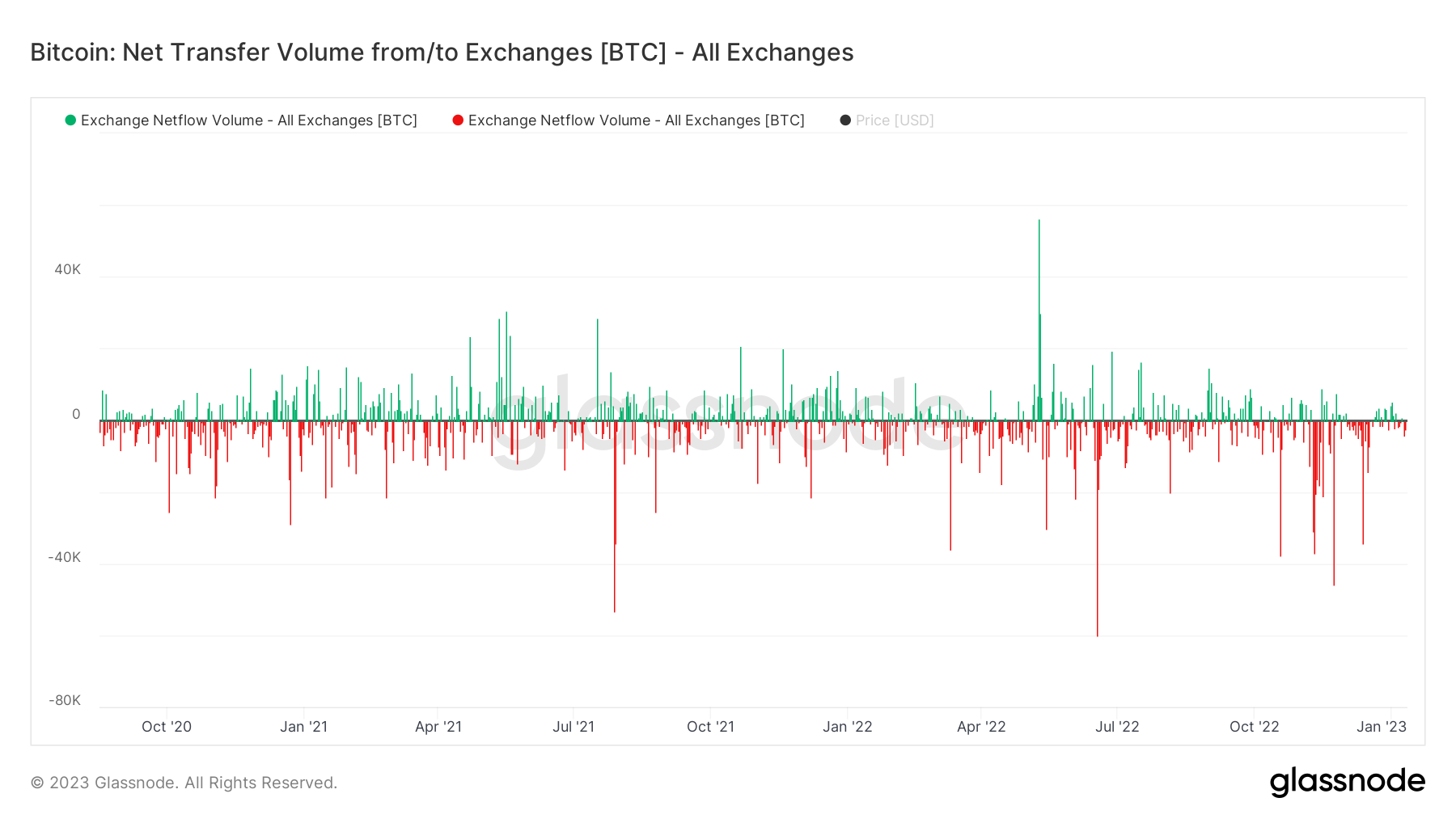
    The below snapshot shows the net transfer volume in and out of exchanges. Since the start of the year, the action has been tepid, having spiked to extreme levels in November and December as first FTX collapsed and then the questions spiked about the health of Binance

    This notion that activity has returned to normal is reinforced when looking a the volatility of Bitcoin. The world’s biggest cryptocurrency has been trading sideways for a while now, and the 30-Day Pearson measure of volatility shows how there was a perceptible drop back down to pre-FTX levels in December. 

    Macro climate looking more optimistic

    It hasn’t just been a respite from within crypto circles. The broader macro environment is looking at least a bit brighter today than it did last month. Inflation is still rampant, but there have been two consecutive readings below expectation, and there is renewed hope that it may have peaked.

    The most recent round of interest rate hikes kicked rates up 50 bps as opposed to 75 bps in the two prior months, and while Fed chair Jerome Powell and other central bank chiefs have affirmed that rates will continue to rise until inflation is conquered, the market has moved cautiously upward after European inflation came in at 9.2%, compared to 10.1% last month.

    Next up is the US CPI reading on Thursday, which will – as always – be a vitally important day in markets. Expect volatility in crypto markets as coins stare at the number to try to assess what Jerome Powell may do with regard to interest rate policy.

    After all, we know by now that crypto is very much holding the stock market’s hand – apart from when, you know, high-profile executives are revealed to be fraudulent (FTX), or top 10 coins cease to exist (LUNA).

    Never a dull moment for long in crypto

    Back in late October, Bitcoin was seemingly locked in crab motion around $20,000. With traders getting impatient, I warned how crypto could be one event away from a nasty downward wick. T

    Three weeks later, FTX collapsed. I never imagined this would happen, and the timing was coincidental, but the premise of the piece reminds me of how I feel now. It’s amazing how short memories are in markets, but we have been here before.

    Crypto won’t stay silent for long, and the asset class is far from out of the woods yet. The aforementioned ongoings around DCG, GBTC, Genesis and Gemini are just a few of the million things that could turn south at any moment.

    There is also the story around Binance chief Changpeng Zhao being under investigation for money laundering offences by the SEC, there is Coinbase laying off 20% of its workforce following a 905 drawdown in its share price, and God knows what will come out of testimonies in the Sam Bankman-Fried court proceedings.

    And then there is macro, where anything could happen to inflation, the Russian war in Ukraine or myriad other variables. It’s been a quiet couple of weeks but don’t worry – the madness will return soon.

    Source link