Tag: control

  • Tether freezes $182M in USDT, highlighting centralized control in stablecoins

    Tether freezes $182M in USDT, highlighting centralized control in stablecoins

    Tether tightens compliance grip as major USDT freeze hits Tron

    • The action was detected by Whale Alert and ranks among the largest single-day USDT freezes.
    • Tether has frozen over $3 billion in assets from more than 7,000 addresses since 2023.
    • Stablecoins now account for the majority of illicit crypto activity tracked by Chainalysis.

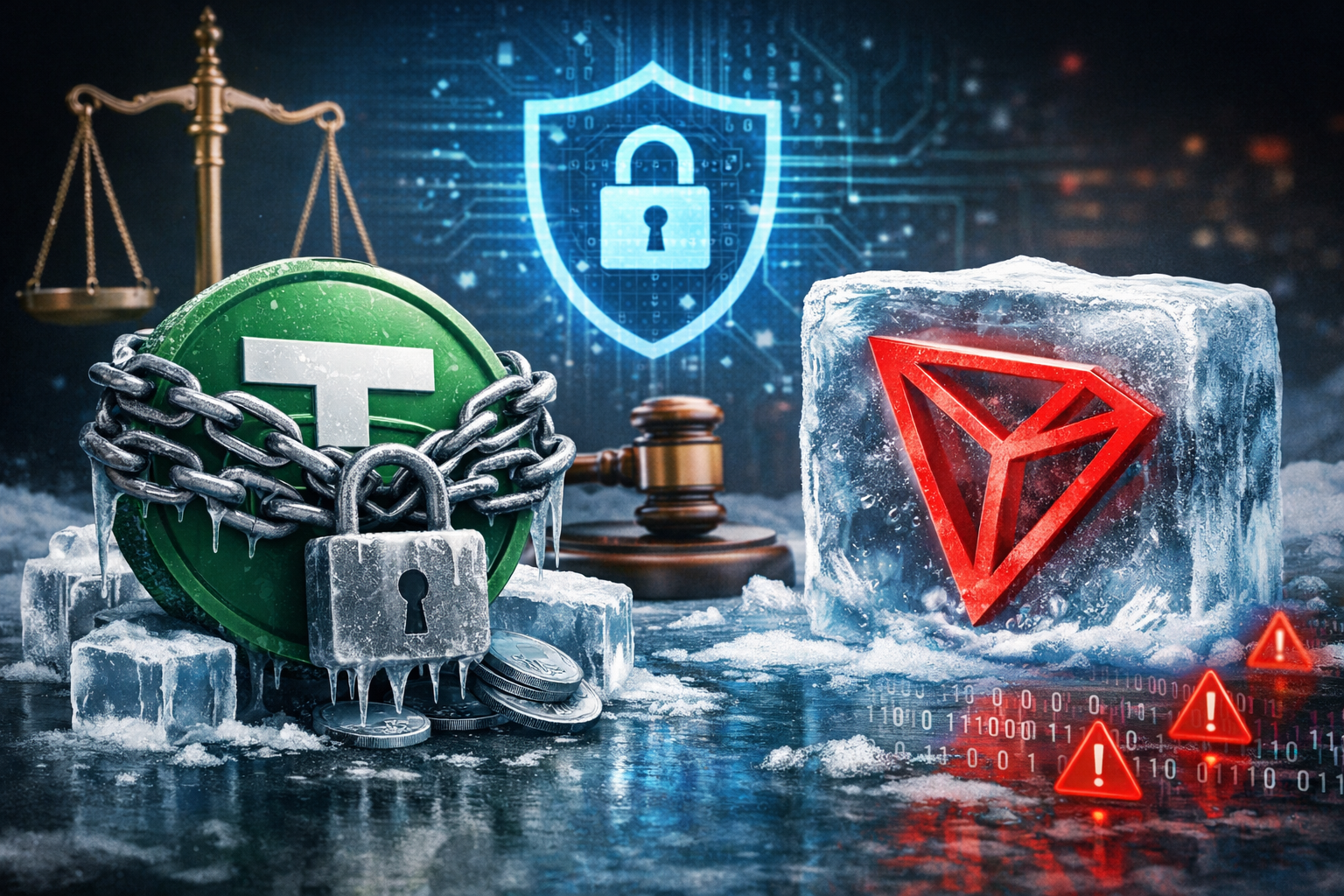
    Tether, the issuer of the world’s largest stablecoin, froze more than $180 million worth of USDT within 24 hours, underscoring the growing role of centralized control and law-enforcement coordination in the stablecoin market.

    The event stands out not only for its size but also for what it reveals about issuer-level control in the crypto economy.

    As regulators scrutinise digital dollars more closely, the mechanics behind this freeze offer insight into how compliance now shapes on-chain liquidity.

    Large-scale freeze on Tron

    On Jan. 11, Tether froze roughly $182 million worth of USDT held across five Tron-based wallets in a single day.

    The action was flagged by on-chain tracker Whale Alert, which showed individual wallet balances ranging from about $12 million to nearly $50 million.

    The timing and concentration of the freezes marked it as one of the largest single-day USDT enforcement events recorded on the Tron network.

    The wallets were not drained or moved.

    Instead, the tokens were locked at the contract level, making them unusable while remaining visible on-chain.

    This approach is consistent with how fiat-backed stablecoins are restricted when issuers respond to external requests.

    Enforcement-linked coordination

    While Tether did not publish a detailed explanation, the freezes appear linked to cooperation with US authorities, including the Department of Justice and the Federal Bureau of Investigation.

    Historically, similar actions have followed investigations tied to scams, hacking incidents, sanctions breaches, or other forms of illegal crypto usage.

    Tether maintains administrative control through special keys embedded in the USDT smart contracts it issues.

    These keys allow the company to halt or freeze tokens at the issuer level.

    Such functionality is central to how stablecoin operators comply with anti-money-laundering rules and legal enforcement demands, particularly when funds are suspected of being linked to criminal activity.

    Scale of past USDT freezes

    Data from analytics firm AMLBot places the Jan. 11 action in a broader context.

    Between 2023 and 2025, Tether froze more than $3 billion in assets spread across over 7,000 addresses.

    That cumulative figure far exceeds comparable actions by other stablecoin issuers, underlining USDT’s dominant role in enforcement-led interventions.

    Tron has become one of the largest settlement layers for USDT, with more than $80 billion in circulation on the network.

    Its low fees and fast settlement times have driven adoption, particularly in emerging markets and high-frequency trading environments.

    At the same time, this scale makes Tron-based USDT a focal point for monitoring illicit flows.

    Centralisation and market implications

    The episode has renewed debate around centralised control in stablecoins.

    Unlike decentralised assets such as Bitcoin, USDT can be paused or frozen by its issuer when legal pressure is applied.

    This structural difference has practical consequences for users who rely on stablecoins as cash equivalents.

    According to Chainalysis, stablecoins accounted for around 84 % of illicit crypto activity by the end of 2025.

    The data reflects how dollar-pegged tokens have become a primary medium in fraud cases and sanctions-related transfers.

    As enforcement actions grow in size and frequency, issuer-controlled stablecoins continue to sit at the intersection of regulatory compliance and decentralised finance.

    Source link

  • Ordswap loses control of its website, urges users to recover keys

    Ordswap loses control of its website, urges users to recover keys

    • Ordswap has experienced a security breach that has led to phishing risks for users’ private keys and assets.
    • An online tool has been introduced for MetaMask users to recover private keys.
    • The incident underscores security concerns in crypto.

    In a recent crypto hack incident, Ordswap, a prominent marketplace for Bitcoin Ordinals, has fallen victim to a significant security breach that has made it lose control of its website. The platform’s website was compromised leading to potential risks for users.

    Ordswap users were met with a distressing situation as the compromised website directed them to a phishing link. This deceptive link aimed to trick users into revealing their private keys and other sensitive information, posing a severe threat to their cryptocurrency assets.

    Recovery tool introduced amid the chaos

    In response to the security breach, Ordswap acted swiftly by providing an online tool designed to assist users who had logged into the platform through MetaMask.

    This tool is meant to aid affected users in recovering their Ordswap private keys, allowing them to securely migrate their assets to other service providers.

    Ordswap blames Netlify for the glitch

    Ordswap placed the blame for the security incident on Netlify, a company specializing in website development and hosting services.

    While the exact nature of the breach and its connection to Netlify remains under investigation, it highlights the vulnerabilities associated with relying on third-party service providers in the digital landscape.

    Attempts to drain users’ crypto wallets

    Users reported encountering a button on the compromised Ordswap website that attempted to drain their crypto wallets.

    This tactic, known as a wallet-draining scam, is increasingly employed by crypto scammers to illicitly siphon off digital assets. It serves as a stark reminder of the risks associated with interacting with cryptocurrency platforms.

    Ordswap affirms user assets unaffected

    Despite the security breach, an Ordswap team member on Discord claimed that user’s private keys and assets remained unaffected. However, users were cautioned that their security could be compromised if they continued to engage with the compromised website.

    This incident underscores the critical importance of user security in the cryptocurrency space. Vigilance and caution are paramount, as phishing attempts and scams continue to target crypto enthusiasts. At the moment, the Ordswap team is actively working to regain control of its website and restore user confidence in the platform.


    Source link

  • Top 10,000 Bitcoin investors control one-third of the supply

    Top 10,000 Bitcoin investors control one-third of the supply

    Key Takeaways

    • Bitcoin is a decentralised asset, yet large amounts are controlled by a select few
    • The top 114 addresses hold nearly 3 million BTC, 15.5% of the total supply
    • The anonymous Satoshi Nakamoto holds 5.2% of the supply
    • MicroStrategy hold 0.68% of the supply


    Whether you love or hate Bitcoin, the world’s first cryptocurrency has thrown the word “decentralised” into the modern vernacular.  

    But while Bitcoin is the closest thing to a decentralised asset out there, it is worth noting that it does possess pressure points. Not central points of failure, but rather large holders who do possess significant amounts of the currency. In some cases, enough to cause a serious stir should those coins ever hit the market all at once.

    Satoshi Nakamoto

    The most obvious of the large holders is anonymous founder Satoshi Nakamoto. Whether one person or a group, Nakamoto possesses approximately 1 million bitcoins from the early days. That is equivalent to about 5.2% of the total supply – a very large number.

    Nobody knows who Nakamoto is, but it is certainly a risk to have this amount of coins in the hands of one person/entity.

     Coinbase even listed this factor as a risk to its business on its S-1 form when it went public in April 2021. Under the risk section, the company outlined “the identification of Satoshi Nakamoto, the pseudonymous person or persons who developed Bitcoin, or the transfer of Satoshi’s Bitcoins” as a risk to Bitcoin and, by extension, Coinbase’s business. 

    While speculating on Nakamoto’s identity is a fool’s game, and these coins could easily be lost forever, it is easy to see how Coinbase listed this as a risk on its filing. The fact is that one entity or person holds 5.2% of the supply, and nobody has any idea who.

    Bitcoin whales

    Looking beyond Nakamoto, there are plenty of wallets which contain a lot of Bitcoin. One study by the National Bureau of Economic Research outlines that the top 10,000 bitcoin investors control one-third of the total supply.

    That figure is an estimate and is “likely an understatement since we cannot rule out that some of the largest addresses are controlled by the same entity”, according to the study. For example, it doesn’t include the aforementioned 5.2% of coins controlled by Nakamoto, as it cannot be known whether Nakamoto is one individual.  

    Seeing as Bitcoin returned the equivalent of 230% compounded annually between 2011 and 2021, and in doing so outperformed every major financial asset class in the world, perhaps it is not surprising that a small group of early adopters control significant amounts of the supply.

    A $2,000 investment in 2010 would have netted you 10,000 bitcoins, which today is worth over $26 million. The select few who got involved in those early days and held onto their stash today hold significant amounts of the supply.

    Today, only 114 addresses contain 10,000 BTC or more (with exchange addresses likely some of those) and those 114 addresses contain nearly 3 million BTC, or 15.5% of the total supply.

    The below table shows quite how much Bitcoin is locked up in a small number of the top addresses.

    Entities that hold large amounts of Bitcoin

    Branching out from individuals, there are also entities which hold massive amounts of Bitcoin.

    The first to spring to mind is Michael Saylor and MicroStrategy, who own 130,000 bitcoins, 0.68% of the total supply. This is the most by any public company and some fear that should this ever hit the market, then the Bitcoin price may be dented downward, such is the quantity of bitcoins that MicroStrategy hold. 

    While MicroStrategy is the public company which holds the most Bitcoin, the private Chinese company Block.one, which developed the cryptocurrency EOS, owns 140,000 bitcoins. This makes it the largest known holding by any one company. 

    Final thoughts

    It is true that Bitcoin’s unique fundamentals make it a uniquely decentralised asset. The way the proof-of-work mechanism functions and the fact that no insiders started with any coins (even Nakamoto had to mine that stash) have helped make this decentralised quality a reality.

    But despite this decentralisation, there do exist several big holders who hold enough coins that the market could be rocked, at least in the short-term, were anything to ever happen that led to those coins hitting the market.

    The scale of Bitcoin’s rise has been so staggering that some of those early casuals who bought in for pennies are now in possession of monster stacks worth millions upon millions. As for Satoshi Nakamoto’s net worth in November 2021 at the Bitcoin all-time high? A cool $70 billion, good for 15th richest person in the world.


    Source link