
Key Takeaways
- First Republic has become the latest bank to collapse in the US
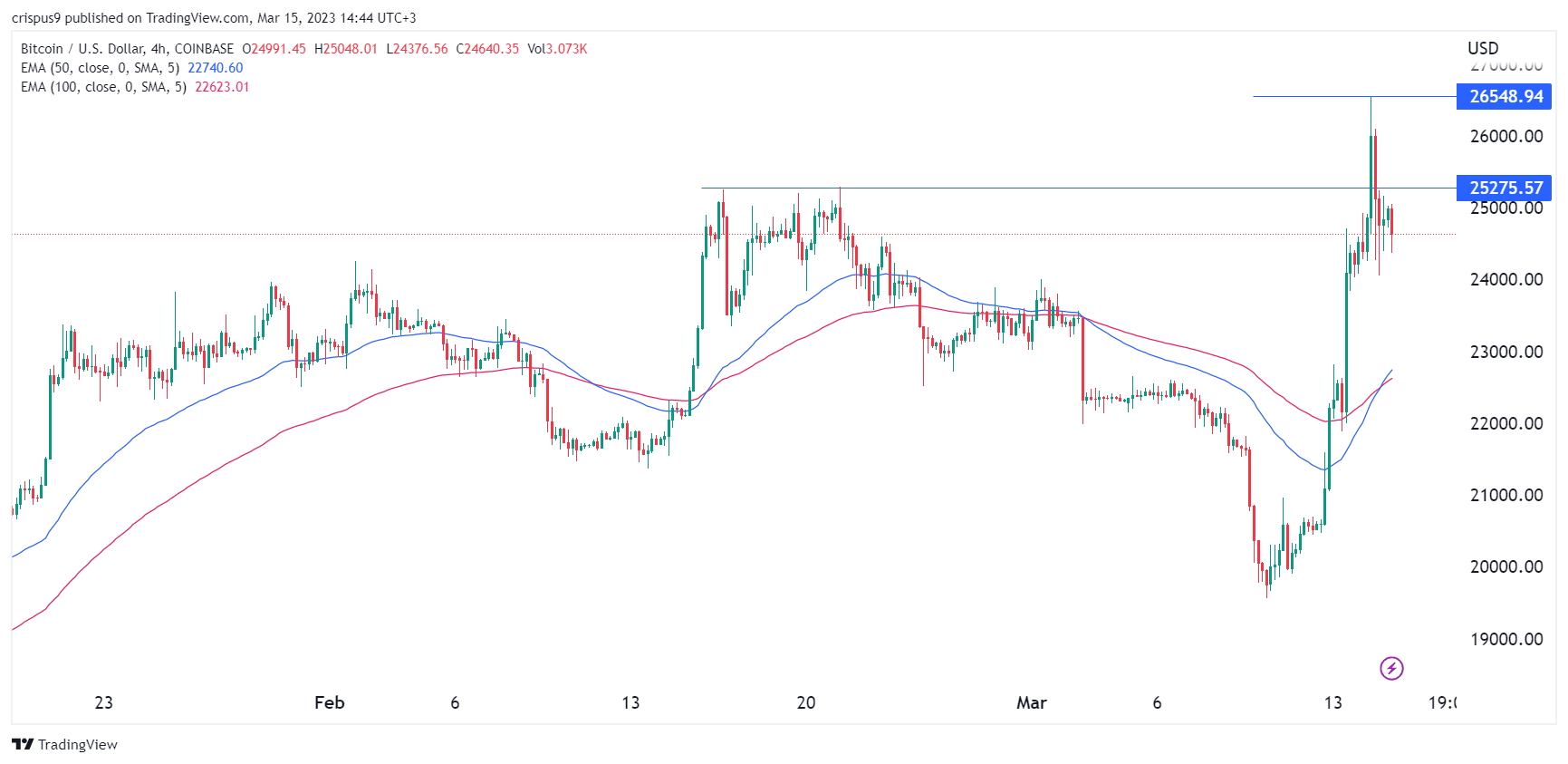
- Bitcoin has bounced this week, as it did in March when SVB fell and the banking crisis was triggered
- Our Head of Research, Dan Ashmore, contends that Bitcoin remains a risk asset, despite claims from enthusiasts that a decoupling is occuring
- Correlation with stock market is still high, he writes, pointing to altered expectations around interest rate policy as the reason Bitcoin has moved upward
There has been chatter amid the market recently (again) that Bitcoin is decoupling from stocks. Something about Bitcoin offering an alternate store of value outside the realm of the fiat world, a proposition that has suddenly become a lot more valuable as the banking turmoil striking the US rages.
Let me start by saying that I don’t think my opinion is very valid here. I can’t predict the future. But I want to look at the numbers because I believe they prove that this theory, that Bitcoin has decoupled, is objectively false.
I wrote a deep dive on Bitcoin’s correlation with stocks in March, when this theory originally surfaced as Silicon Valley Bank collapsed, while Bitcoin raced upwards. The same logic applies now, so let me try summarise it by refreshing the same numbers.
And a quick note – this article is nothing about my beliefs around Bitcoin’s trajectory in the long-term. Whether Bitcoin decouples in future and establishes itself as a store of value akin to gold, uncorrelated to other risk assets, is a debate for another time and not one I will delve into here. I’m purely looking at the price action today and saying that, as of May 2023, Bitcoin is trading like an extreme-risk asset, completely removed from this uncorrelated vision.
Bitcoin’s correlation with the Nasdaq
The natural place to look is tech stocks, being one of the riskier subsectors of the equity universe. The Nasdaq, being a tech-heavy index, is often seen as the benchmark for this sector. So let us chart Bitcoin’s correlation with the Nasdaq over the past couple of years.
Using a 60-Day Pearson measure, the chart shows that the correlation has bounced around a lot over the past couple of years. For the most part, however, it has shown a relatively strong relationship, frequently residing above 0.5.
There were a couple of dips. The first is clearly May/June 2021, when Bitcoin cratered from $63,000 to $31,000 for no apparent reason, before climbing back up into the high sixties later that year.
The second large dip in correlation is in November 2022. This was none other than the FTX collapse, the staggering implosion sending shockwaves through the crypto industry. At the same time, stocks actually advanced significantly as softer inflation data cropped up and optimism increased around the future path of interest rates. Cue the big dip in correlation.
Therefore, there have been two periods of notable, and very large, decorrelations. Both of these occurred as crypto melted down, independently of the stock market. If you look closely over the last year – I have shown the correlation over the last year below – you will see another big deviation in the summer of 2022 when crypto “bank” Celsius shut withdrawals.
And most importantly, the correlation has come back up swiftly every time. Including in March, when Bitcoin outperformed in the aftermath of the banking crisis.
But, did it really outperform in March? The correlation above remained relatively high, certainly nowhere near previous episodes of decorrelation – and a lot more brief. Sure, Bitcoin raced upward further than the Nasdaq post-SVB, but it also fell further prior to the guarantee that deposits backing the second largest stablecoin, USD Coin, were safe. In reality, Bitcoin did what it has been doing – sold off more aggressively and then bounced back stronger. Because, well, it is riskier.
Besides, the elephant in the room is the Federal Reserve. Markets have been moving off expectations of Fed policy all year long, and this was the true cause of the movement in March, as well as this week.
With SVB’s collapse, the market reacted to the announcement of a large liquidity injection by the Fed, as well as the expectation that rates could not be hiked as much in future as a result of the creaking banking system. These are both good things for risk assets and so Bitcoin rose. Again, not because of any potential downfall of the fiat system.
Not to mention, these banking problems were borne out of duration risk management, completely distinct to the banking issues of the GFC in 2008, which were a full-blown insolvency crisis built upon terrible underlying assets (subprime mortgages). Today, the banking crisis is still a crisis, but a regional one borne out of the most aggressive hiking cycle in recent memory, which has seen bank assets dropping in value and deposits pulled to take advantage of those higher rates elsewhere, leading to an unsustainable bank run as confidence evaporates.
We have seen similar developments again this time around, as First Republic Bank fell last week after revealing it saw over $1 billion of withdrawal requests last quarter.
Again, the market reacted to these things breaking by saying: “OK, the Fed cannot hike much more. This is good for risk assets”. Looking at Fed fund probabilities, there is the expectation of a 25 bps hike today (May 3rd) and then….nothing. The market is viewing this as the final hike.
So, it is important to keep track of lurking variables (interest rate policy) when assessing correlations and trying to garner why Bitcoin is moving. For the time being, the numbers are pretty clear, and the conclusion is unequivocal: Bitcoin is trading like a risk asset. Perhaps we don’t even need to look at correlation. Take a glance at the below chart plotting Bitcoin’s returns since the start of 2022 against the Nasdaq. Do you really want to argue that these assets are uncorrelated?
The numbers speak for themselves. Again, this is not speculating about what will happen in future. Tomorrow, Bitcoin could go to $1 million and the Nasdaq could go to zero for all I care. Bitcoin may one day reach that uncorrelated store of value status. But for now, the numbers are clear: it is trading like a risk asset.