Tag: December

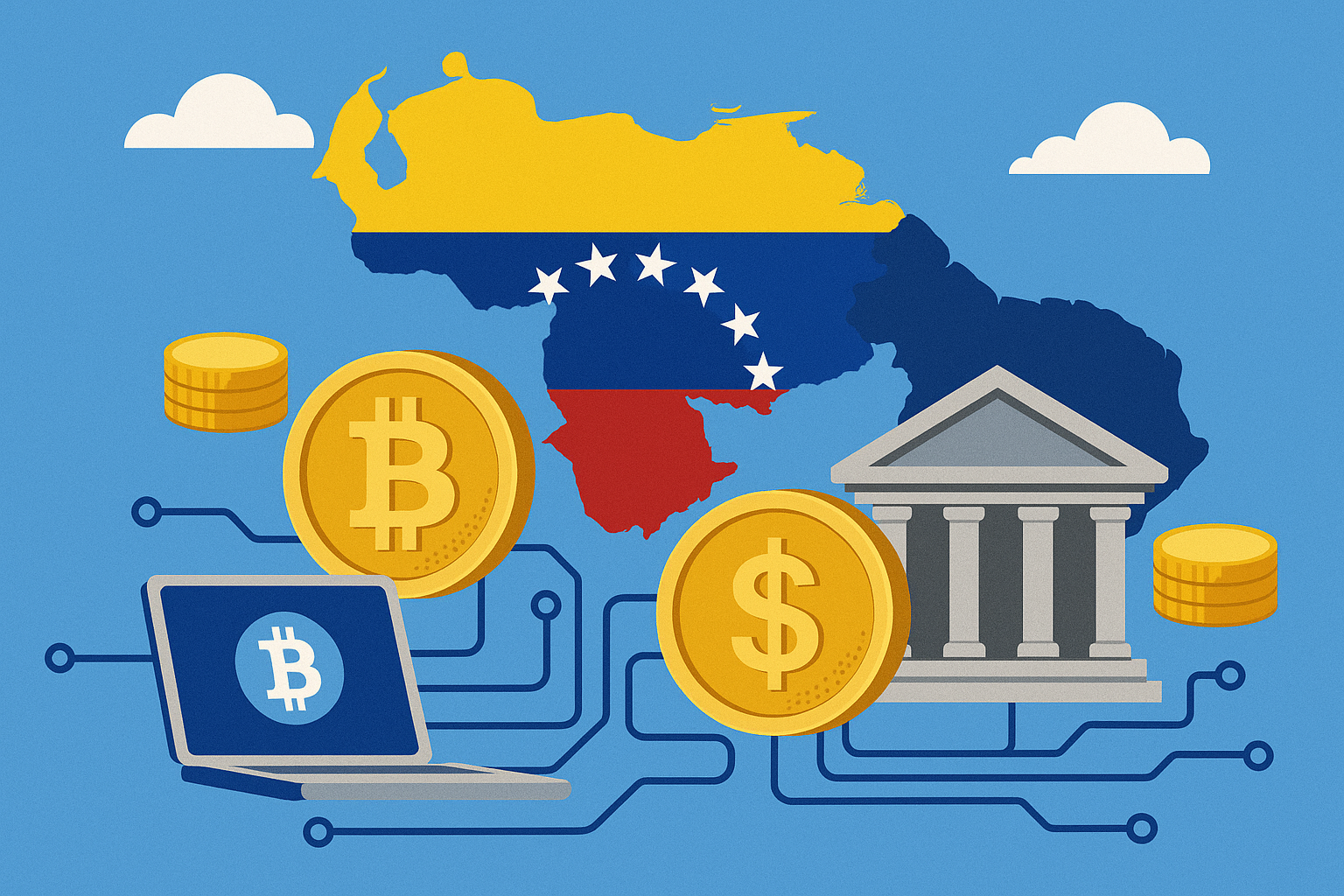
  • Venezuela to integrate Bitcoin and stablecoins into its banking network by December

    Venezuela to integrate Bitcoin and stablecoins into its banking network by December

    Venezuela to integrate Bitcoin and stablecoins into its banking network by 2025

    • Local banks will offer custody, transfers, and crypto-to-fiat exchange services.
    • The bolivar’s sharp depreciation has driven a surge in stablecoin adoption.
    • Conexus currently processes nearly 40% of Venezuela’s electronic payments.

    Venezuela is preparing to merge its struggling traditional banking system with digital currencies as payment giant Conexus plans to integrate Bitcoin and stablecoins into the national banking infrastructure.

    The move, expected to launch in December 2025, marks a significant step in the country’s financial transformation, offering Venezuelans a regulated channel for cryptocurrency use.

    With the bolivar’s persistent depreciation and rising adoption of stablecoins, this development could make Venezuela one of the first nations to formally blend fiat and crypto operations under a unified system.

    The integration also reflects Venezuela’s long-standing struggle with international sanctions that have limited access to global banking.

    By adopting blockchain-based systems, Conexus aims to provide citizens with a more resilient alternative that can facilitate remittances, domestic transfers, and business payments without heavy dependence on foreign intermediaries and unstable local exchange rates.

    The initiative also seeks to improve financial inclusion nationwide, making digital transactions more accessible to individuals and businesses across the country.

    Conexus aims to bridge banks and blockchain

    Conexus, which currently processes nearly 40% of Venezuela’s electronic transactions, is leading this shift by allowing local banks to offer direct crypto services such as custody, transfers, and fiat conversion for Bitcoin and stablecoins.

    The integration seeks to make digital currency access seamless for customers within their regular bank accounts, eliminating the need for external wallets or apps.

    The new infrastructure will be built on blockchain technology to enhance transparency and transaction security.

    According to the company, the system will enable both individuals and businesses to move between digital and traditional currencies safely, reducing reliance on unregulated exchanges.

    Growing reliance on stablecoins amid inflation

    Years of hyperinflation have eroded confidence in the bolivar, pushing Venezuelans to rely heavily on stablecoins like Tether (USDT) as a store of value and medium of exchange.

    From small retailers to freelancers, many now prefer stablecoins to protect earnings from volatility.

    Conexus President Rodolfo Gasparri has highlighted that this surge in stablecoin transactions demonstrates a clear public demand for better integration between crypto and banking systems.

    The company’s upcoming model aims to formalise this reality by providing regulated access to crypto within Venezuela’s financial framework, allowing citizens to transact and save using digital assets with greater confidence.

    Potential blueprint for emerging economies

    The Conexus initiative could reshape not only Venezuela’s financial sector but also set an example for other economies facing currency crises.

    By offering a direct bridge between fiat and digital assets, the model could help millions gain access to stable, low-cost, and transparent financial services.

    Venezuela’s attempt to merge traditional finance with blockchain technology aligns with global trends toward digitalisation of money, particularly in regions where economic instability drives innovation.

    If implemented successfully, this system could serve as a prototype for countries in Latin America and beyond, where inflation and limited banking access continue to affect economic stability.

    Source link

  • Crypto update: Bitcoin tumbles below $111K as Powell dashes December rate cut hopes

    Crypto update: Bitcoin tumbles below $111K as Powell dashes December rate cut hopes

    Crypto update: Bitcoin tumbles below $111K as Powell dashes December rate cut hopes

    • Bitcoin fell below $111,000 after Fed Chair Powell’s hawkish comments.
    • Powell said a December interest rate cut is “not a foregone conclusion.”
    • Major cryptocurrencies like Ethereum, XRP, and Solana also posted losses.

    Bitcoin and the wider cryptocurrency market took a sharp downturn after US Federal Reserve Chair Jerome Powell signaled that a highly anticipated December interest rate cut was not guaranteed, reversing market sentiment that had priced in further easing.

    The hawkish remarks immediately spooked investors, sending Bitcoin below a key support level and triggering a broad sell-off across digital assets.

    While the Fed did deliver an expected quarter-point rate cut, Powell’s commentary on the future path of monetary policy became the dominant driver of the market’s negative reaction.

    Powell pours cold water on December rate cut hopes

    At the conclusion of the Federal Open Market Committee (FOMC) meeting, Powell announced a 0.25% point reduction in the policy rate to a range of 3.75-4.00%.

    However, he quickly tempered market optimism by adopting a cautious stance on future moves, stating a December cut “is not a foregone conclusion.”

    Powell explained that the central bank needs more economic data, particularly after the recent government shutdown obscured key indicators.

    “We may need to slow the pace of policy (rate) adjustments. I hope to obtain more data by December,” he said at the press conference.

    He also revealed a growing divide within the committee.

    “More and more Fed members want to delay rate cuts,” Powell continued, adding, “After two consecutive rate cuts, some members are taking a wait-and-see stance.

    The view that we should wait at least one cycle is spreading.”

    Bitcoin leads broad market plunge

    The market’s reaction to Powell’s unexpected caution was swift and decisive.

    Bitcoin, which had been trading steadily around the $113,000 level before the press conference, broke below its $110,000 support moments after his remarks, hitting an intraday low in the $109,000 range.

    As of Thursday, the token was still struggling around $110,000, down roughly 2% from the previous day.

    The weakness was felt across the entire crypto ecosystem.

    According to CoinMarketCap, other major cryptocurrencies also posted significant losses:

    • Ethereum (ETH) fell 1.93% to $3,899.87.

    • XRP dropped 2.74% to $2.53.

    • Solana (SOL) declined 1.04% to $192.37.

    A silver lining? Fed to end quantitative tightening

    However, Powell’s press conference was not entirely hawkish. He also formally announced the end of the Fed’s asset reduction program, known as Quantitative Tightening (QT), which could increase liquidity in the financial system.

    “We have decided to end QT as of December 1,” Powell stated. He explained that the Fed’s balance sheet had shrunk by $2.2 trillion over three and a half years.

    “We now believe we are close to sufficient reserves,” he said, signaling a shift toward balance sheet normalization.

    With Fed in rearview, all eyes turn to US-China summit

    With the Fed’s immediate policy path now clarified, investors are pivoting their attention to the next major potential catalyst: the US-China summit.

    Following the crypto market plunge, traders are looking to the meeting between US President Donald Trump and Chinese President Xi Jinping as a possible source of positive news that could trigger a rebound.

    The high-stakes meeting is scheduled for Thursday morning at the ‘Naraemaru’ facility at Gimhae Airport Air Force base.

    Source link

  • Least amount of Bitcoin on exchanges since the previous bull market top in December 2017

    Least amount of Bitcoin on exchanges since the previous bull market top in December 2017

    Key Takeaways

    • The balance of Bitcoins on exchanges is in constant decline, now at the lowest point since December 2017 
    • Meanwhile, long-term investors continue to hold, soaking up the supply
    • Coins that have not been touched in 10 years now outnumber those held on exchanges 

    I wrote a piece last week on the exodus of stablecoins from exchanges, with the balance currently the lowest since October 2021, with 45% of the total balance of stablecoins on exchanges flowing out in the last four months. 

    But the glut in liquidity is not limited to stablecoins. The world’s biggest cryptocurrency is also seeing funds flow out. Only 11.8% of the total Bitcoin supply is currently on exchanges – that is the lowest since December 2017. 

    To jot your memory, December 2017 was the previous bull market peak. Bitcoin rose to within a hair of $20,000 before freefalling into a two-year-long bear market which ravaged the entire industry.

    Since January 2020, exchanges’ reserves of Bitcoin have been only going one way: down. It hints at the demand/supply imbalance that so many Bitcoin truthers advocate for, with the much-vaunted hard supply cap of 21 million coins for Bitcoin. 

    If demand keeps rising, they argue, the price can only go up because supply cannot keep up. 

    Central to this thesis is the resilience of long-term holders to keep a firm grasp on their bitcoins. And when assessing whether they have, the answer is a resounding yes. 

    The below chart presents long-term holders against the total exchange balance. In November 2022, the number of bitcoins last active 10+ years ago overtook the number of bitcoins on exchanges. 

    Of course, some of these long-term holders will be lost coins, either via their owner dying or losing their private keys. 

    But the stat is still interesting and speaks to the cohort of (very) early investors in Bitcoin who remain clinging to their coins with all their might. Remember, this includes the anonymous Satoshi Nakamoto, who is estimated to hold over 1 million coins, or 5% of the total supply. 

    Below is the chart displaying the current portion of the Bitcoin supply split out by time held and compared to the exchange balance. 

    The result is interesting, but even more so when considering that the last three years brought both the euphoric highs of Bitcoin at nearly $70,000 during the pandemic and then the bone-crushing fall through 2022, which saw it careen down towards $15,000. 

    In terms of the long-term trajectory of Bitcoin, it’s undoubtedly bullish. Of course, it all depends on whether the demand for additional Bitcoin will hold up. The supply may be getting squeezed, but that is all for nothing if the demand side doesn’t hold up its end of the bargain. 

    And on that note, the last year has been a big blow. Not only has capital flowed out of the space at an alarming rate, but a number of very high-profile scandals (LUNA, Celsius, FTX and so on) have rocked the space. The fear is that these episodes have dented the reputation of the cryptocurrency space and will inhibit the demand for Bitcoin on the intuitional side. Have people been put off moving into the space?

    It’s hard to say. But in looking at long-term holders, their confidence seems resolute. 

    Source link

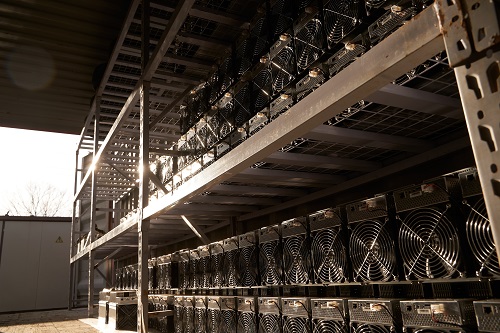
  • Argo’s mining revenue fell nearly 28% in December 2022

    Argo’s mining revenue fell nearly 28% in December 2022

    • Argo Blockchain mined 147 bitcoins in December 2022, down from 198 in November.
    • Mining revenue was $2.49 million, compared to $3.46 million during the previous month.
    • Argo sold its Helios facility to Galaxy Digital for $65 million as it looked to avoid nose-diving into bankruptcy.

    Argo Blockchain, a leading Bitcoin miner that endured a terrible run in 2022 and came close to bankruptcy, has announced it mined 147 BTC only in December.

    The publicly-traded company’s total mined bitcoins for the month were lower than the 198 BTC mined in November — nearly 28% lower than its mining output in November.

    Mining revenue came in at $2.49 million (£2.07 million), down from $3.46 million (£2.94 million) in the previous month.  The firm’s mining margin in December 2022 was 48%, compared to 29% in November.

    As of 31 December, the miner held 141 bitcoins.

    Argo CEO on reduced mining results

    According to details provided in the miner’s operational update published on 11 January, the decline in mining revenue (decreased mined coins) was mainly a result of the reduced mining operations following the winter storm that hit the United States in December.

    Argo, like many other Texas Bitcoin miners, contributed to the stability of Texas’ power grid by cutting power usage during the storm.

    While our mining results for December were lower than anticipated, the primary driver was the winter storm which led us to curtail operations at Helios. We made this decision in order to not only reduce power usage on the grid, but also to prioritise the needs of the local community and safety of our Helios employees, Argo CEO Peter Wall said in a statement.

    Notably, Argo sold its Helios facility for $65 million to Galaxy Digital and also agreed a $35 million loan as it sought to firm its balance sheet. But despite mining fewer BTC in December, and the sale of the Helios facility, Argo’s total hashrate remains around 2.5 exahashes per second (EH/s).

    Source link