Tag: DeFi

  • BTC staking platform Babylon teams up with Aave for Bitcoin-backed DeFi insurance

    BTC staking platform Babylon teams up with Aave for Bitcoin-backed DeFi insurance

    Babylon teams up with Aave for Bitcoin-backed DeFi insurance

    • Babylon and Aave partner to enable native BTC as collateral for DeFi lending.
    • BTC can now back decentralised insurance pools, earning yield if unused.
    • Users retain full control of their Bitcoin while accessing DeFi liquidity.

    In a groundbreaking move for the decentralised finance (DeFi) ecosystem, Bitcoin staking platform Babylon has announced a partnership with Aave, one of the largest decentralised lending protocols.

    The collaboration aims to allow Bitcoin (BTC) holders to use their native, unwrapped BTC as collateral for lending and to participate in a pioneering DeFi insurance model.

    This will reshape how Bitcoin interacts with DeFi, unlocking liquidity while maintaining the security that Bitcoin users expect.

    Native Bitcoin collateral comes to DeFi

    Traditionally, using Bitcoin in DeFi required wrapping it into a tokenised version such as WBTC, which introduced custodial risk and extra steps. Babylon’s partnership with Aave eliminates this barrier by enabling users to deposit their native BTC directly as collateral.

    Through Babylon’s trustless Bitcoin Vaults, BTC can be locked in a time-locked contract on its own blockchain and recognised by Aave’s hub-and-spoke lending architecture.

    This allows users to borrow stablecoins or other crypto assets while keeping full control of their Bitcoin keys.

    The move is expected to significantly expand BTC liquidity in DeFi. Currently, even the largest wrapped Bitcoin initiatives account for less than 1% of Bitcoin’s total market cap.

    Babylon’s own staking product secures over 56,000 BTC, demonstrating strong demand for productive uses of Bitcoin.

    By unlocking native BTC for lending, the partnership could bring a substantial portion of the dormant Bitcoin supply into productive DeFi applications, potentially transforming lending markets.

    DeFi insurance backed by Bitcoin

    Beyond lending, Babylon is preparing to extend its vaults into the insurance sector, a development that could redefine how DeFi protocols manage risk.

    The proposed model allows BTC holders to deposit their Bitcoin into decentralised insurance pools.

    These pools would serve as coverage against protocol hacks and other failures. Depositors earn yield if no claims occur, while the pool provides liquidity for payouts in the event of a validated exploit.

    This approach turns Bitcoin into a foundational asset for DeFi risk management, offering a new avenue for yield generation while safeguarding the ecosystem.

    Babylon co-founder David Tse told CoinDesk that the insurance initiative is still in development, with an official announcement expected in January 2026.

    Testing for the integrated BTC lending and insurance products is scheduled to begin in early 2026, with a broader rollout planned around April of the same year.

    The combination of Babylon’s secure vault design and Aave’s extensive liquidity network creates a framework that prioritises both safety and usability, a balance often missing in cross-chain and custodial solutions.

    Transforming Bitcoin’s role in DeFi

    This partnership addresses longstanding challenges in Bitcoin DeFi adoption.

    By removing the need for wrapped assets and custodial intermediaries, it reduces systemic risk while enabling Bitcoin holders to put their capital to work more efficiently.

    Users can participate in lending and insurance activities without relinquishing control of their Bitcoin, aligning with the core principles of security and decentralisation that have long defined the Bitcoin network.

    Experts in the space view this collaboration as a potential catalyst for broader adoption of BTC in decentralised applications.

    Unlocking even a small fraction of Bitcoin’s supply for lending and insurance could significantly deepen liquidity and reshape market dynamics.

    For the average user, it translates into safer, more streamlined, and more productive ways to generate yield from their holdings.

    Source link

  • SOL price gains momentum as DeFi Dev Corp adds $77M in Solana to treasury

    SOL price gains momentum as DeFi Dev Corp adds $77M in Solana to treasury

    • The company has acquired 407,247 SOL tokens in its latest purchase.
    • DeFi Dev Corp. now holds Solana worth around $371M, 1.83 million coins.
    • On-chain indicators support SOL’s upside trajectory.

    The first Nasdaq-listed firm with a Solana-centric treasury strategy is once again in the spotlight.

    According to the latest press release, DeFi Development Corp. disclosed the purchase of 407,247 SOL assets valued at approximately $77 million.

    The recent accumulation increased the company’s total SOL holdings to 1,831,011 tokens, worth around $371 million.

    Notably, DeFi Dev Corp. utilized the latest fundraising to fund the purchase, and still holds more than $40 million for more Solana buys and supporting treasury operations.

    The bold bet signals the firm’s conviction in Solana’s growth trajectory.

    Solana price displays optimistic performance amid these developments, with on-chain metrics supporting DeFi Dec Corp’s accumulation strategy.

    Long-term holding and staking plans

    DeFi Development Corp. made it clear that it is not after short-term gains.

    The firm confirmed that it will hold the newly purchased Solana long-term and stake the assets across different validators.

    The announcement stated:

    The newly acquired SOL will be held long-term and staked to a variety of validators, including DeFi Dev Corp’s own Solana validators to generate native yield.

    The staking strategy enables the firm to generate native yield while ensuring the security and health of Solana’s blockchain.

    Further, the approach means additional earning opportunities for shareholders as it combines staking incentives and SOL price growth.

    What does it mean for Solana?

    Solana has dominated crypto trends over the past months, with increased adoption in payments, meme coins, DeFi, and NFTs.

    Its scalability and speed have made it a perfect alternative for institutions and developers.

    DeFi Dev Corp’s Solana holdings reflect how markets are increasingly viewing Solana as an asset with potential beyond speculation.

    Furthermore, endorsement by a Nasdaq-listed company legitimizes the altcoin, making it attractive for institutions seeking crypto exposure.

    Solana bullish outlook

    These developments come as the native token traded in the green region.

    SOL gained more than 15% the previous week to $211.

    Bullish sentiments fuel the chain, especially as the community votes for the Alpenglow proposal.

    The proposal seeks to reduce block finality to 150 milliseconds from 12.8 seconds.

    That will turbocharge the blockchain by supporting thousands of transactions per second while ensuring near-zero transaction charges.

    That makes the Ethereum twelve-minute finality glacial.

    Simply, the second-largest blockchain takes minutes to finalize transactions. In Solana, it is instant.

    These narratives echo analysts, who are predicting massive gains for SOL.

    For example, Ali Martinez mapped Solana’s path to $300 in the near-term.

    That would mean a rally of over 40% from the current market price.

    Moreover, prevailing institutional interest sets the stage for significant long-term rallies.

    Proponents believe Solana has what it takes to skyrocket to $1,000 in a full-blown bull market.


    Source link

  • Flare price pumps 25% amid explosive DeFi growth: is a new ATH next?

    Flare price pumps 25% amid explosive DeFi growth: is a new ATH next?

    Flare Price

    • Flare price rose sharply as altcoins continued to steer bullish with Ethereum, XRP and Solana up.
    • The FLR token was up 25% as bulls pushed from lows of $0.02089 to highs of $0.02722.
    • With DeFi and broader market resilience, Flare could target a new all-time.

    The cryptocurrency market continues to trend bullish as top altcoins see gains, but not many can match Flare (FLR)’s explosive 25% outperformance in the past 24 hours.

    FLR’s gains dwarf those of key 24-hour performers Pudgy Penguins, Worldcoin and PancakeSwap.

    The token traded around $0.2702 at the time of writing, with daily volume up 457% to over $98 million.

    Open interest on Coinglass showed a 35% increase to $11.8 million.

    Flare price: is FLR poised for a new peak?

    As Ethereum holds firm above $3,600 and Solana consolidates gains above $200, renewed optimism has emerged around Flare (FLR).

    FLR has surged from intraday lows of $0.02089 to as high as $0.02722, marking one of the strongest performances among major cryptocurrencies.

    The rally has pushed Flare into the 57th spot by market capitalisation, placing it among the top gainers within the 100 largest digital assets.

    With total value locked, transaction volume and overall DeFi growth on the uptick, is this spike in FLR price the beginning of a major flip to a new all-time high?

    Per data from CoinMarketCap, Flare reached the all-time peak of $0.0797 in January 2023.

    Flare price chart by CoinMarketCap

    FLR price is up nearly 50% in the past week and 63% in the past month.

    Much of the enthusiasm and bullish forecasts for Flare are down to the project’s innovative DeFi approach.

    Asset bridging has caught the market’s attention with recent integrations and mega incentives.

    DeFi on Flare gains traction

    Flare’s latest price pump comes in a month where the project unveiled a massive $2.2 billion incentive program for its FAssets.

    The target is explosive growth in Flare’s DeFi share with cross-chain liquidity and TVL.

    Interest has also jumped amid the integration of XRPFi, a DeFi initiative targeted at tapping into XRP on the network.

    This is what Firelight, a key protocol on the Flare network, has introduced to early success.

    As XRPFi takes root, tokens such as stXRP, a liquid staking token that allows users to earn yields while maintaining liquidity across DeFi platforms, are gaining traction.

    Institutional interest is also growing. One such big move is VivoPower.

    The Nasdaq-listed company recently announced a $100 million XRP deployment on Flare with the aim of generating yield.

    “Flare isn’t just for institutional XRP holders like VivoPower, it’s also powering platforms like Uphold that serve millions of everyday users. With Flare’s yield strategies, they can offer simple, opt-in XRP staking — no DeFi expertise required. That’s the kind of simplicity we’re aiming for,” Flare wrote on X

    Momentum across the Flare network has seen its TVL surge triple digits to near $200 million. SparkDEX, Kinetic and Sceptre Liquid are key protocols on the network.


    Source link

  • Bitcoin reclaims $110K; DeFi tokens surge

    Bitcoin reclaims $110K; DeFi tokens surge

    Bitcoin tops $110K for 2nd day; altcoins UNI, AAVE rally on SEC Chair comments

    • Bitcoin (BTC) traded above $110,000 for a second day, up over 1% in 24 hours, buoyed by altcoin rally.
    • DeFi tokens UNI (+24%) and AAVE (+13%) surged following optimistic comments from SEC Chair Paul Atkins.
    • Despite price gains, market sentiment remains cautious, with low funding rates (1.3%) typically seen at bottoms.

    Bitcoin (BTC) revisited the $110,000 level for the second day in a row on Tuesday, seemingly pulled higher by even more substantial gains among various altcoins.

    However, despite this upward movement, a prevailing sense of caution and skepticism among traders suggests that the sustainability of this breakout remains in question.

    Bitcoin was trading just above $110,000 shortly after the close of U.S. stock markets on Tuesday, marking a gain of over 1% in the preceding 24 hours.

    The broader cryptocurrency market, as measured by the CoinDesk 20 index—which tracks the top 20 cryptocurrencies by market capitalization (excluding stablecoins, exchange coins, and memecoins)—had risen by a more significant 3.3% over the same period.

    This broader rally was largely attributed to strong performances from major altcoins such as Ether (ETH), Solana (SOL), and Chainlink (LINK), all of which posted gains in the 5%-7% range.

    The most impressive performances of the day, however, came from decentralized finance (DeFi) tokens Uniswap (UNI) and Aave (AAVE).

    These tokens soared by a remarkable 24% and 13%, respectively.

    This surge was reportedly prompted by optimistic comments regarding DeFi made by Securities and Exchange Commission (SEC) Chair Paul Atkins on Monday, which appeared to inject fresh enthusiasm into the DeFi sector.

    In contrast, the traditional equity markets linked to cryptocurrency showed a more subdued picture, with most crypto stocks trading flat on the day.

    A notable exception was Semler Scientific (SMLR), a company aiming to emulate MicroStrategy’s (MSTR) strategy of accumulating significant Bitcoin holdings.

    Semler Scientific’s shares fell another 10% on Tuesday, with the stock now trading for less than the value of the Bitcoin on its balance sheet, highlighting the risks associated with such strategies.

    Defensive posturing despite proximity to highs

    Despite Bitcoin’s recent gains and its proximity to previous all-time highs, positioning across cryptocurrency markets continues to reflect a largely defensive and cautious sentiment among traders.

    “Funding rates and other leverage proxies point toward a steadily cautious sentiment in the market,” Vetle Lunde, head of research at K33 Research, pointed out in a Tuesday report.

    “The broad risk appetite is remarkably weak, given that BTC is trading close to former all-time highs.”

    This observation suggests that traders are not fully convinced of the rally’s strength and are hesitant to take on excessive risk.

    Lunde further noted that Binance’s BTC perpetual swaps posted negative funding rates on multiple days last week, with the average annualized funding rate now sitting at just 1.3%.

    This level, he explained, is typically associated with local market bottoms rather than tops.

    “Bitcoin does not usually peak in environments with negative funding rates,” Lunde wrote, adding that past instances of such defensive positioning have more often preceded rallies than significant corrections.

    Flows into leveraged Bitcoin ETFs paint a similar picture of cautious engagement.

    The ProShares 2x Bitcoin ETF (BITX) currently holds exposure equivalent to 52,435 BTC, which is well below its December 2023 peak of 76,755 BTC.

    Inflows into such products remain muted.

    According to Lunde, this defensive positioning, paradoxically, leaves room for a potential “healthy rally” in BTC to develop, as it suggests the market is not overly leveraged or euphoric.

    Skepticism greets potential breakout

    However, not all market watchers are convinced that the current price action signals the beginning of a sustainable upward trend.

    Some analysts remain skeptical about the durability of any breakout above the $110,000 level.

    “Is this a true breakout that will continue? In my view, probably not,” said Kirill Kretov, senior automation expert at CoinPanel.

    More likely, it’s part of the same volatility cycle where we see a rally now, followed by a sharp drop triggered by a negative announcement or some other narrative shift.

    According to Kretov, the current market environment favors experienced traders who are adept at navigating volatility-driven market structures.

    From a technical perspective, he identifies Bitcoin’s next key support levels at $105,000 and $100,000.

    These are zones that could be tested if selling pressure re-emerges and the current upward momentum falters.

    The market now watches to see if Bitcoin can consolidate its gains and build a stronger foundation for a continued ascent, or if skepticism will be validated by a retreat from current levels.

    Source link

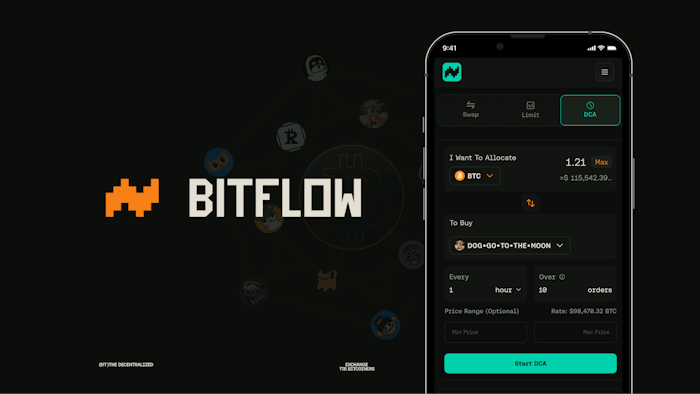
  • Bitflow brings AI-powered DeFi to Stacks with Automated DCA for Bitcoin and Runes

    Bitflow brings AI-powered DeFi to Stacks with Automated DCA for Bitcoin and Runes

    Bitflow brings AI-powered DeFi to Stacks with Automated DCA for Bitcoin and Runes

    • Bitflow launches Automated Dollar-Cost Averaging (DCA) for Bitcoin and Runes investments on Stacks.
    • The AI-powered DCA enables trustless, recurring investments.
    • Future plans include adding yield strategies and cross-layer flows.

    Bitflow, a decentralized exchange built on the Stacks ecosystem, has unveiled Automated Dollar-Cost Averaging (DCA), a groundbreaking feature that introduces AI-driven investment strategies to Bitcoin and its associated assets.

    The automated DCA allows users to automate recurring purchases of Bitcoin (BTC), stablecoins, Stacks’ native STX token, sBTC, and popular Runes tokens like $DOG, all while retaining complete control over their funds.

    Designed to simplify and enhance participation in the growing Bitcoin-native economy, Bitflow’s latest offering marks a significant milestone in decentralized finance (DeFi) on the Stacks Layer 2 network.

    Simplifying Bitcoin DeFi investment with automation

    At the heart of the Automated Dollar-Cost Averaging (DCA) is Bitflow Keepers, an intelligent automation engine that powers the DCA feature. This technology enables trustless, recurring transactions without requiring users to time the market or execute trades manually.

    By supporting a wide range of assets, including SIP-10 tokens and the memecoin sensation $DOG (DOG•GO•TO•THE•MOON), Bitflow ensures that users can diversify their portfolios seamlessly.

    For the first time, DeFi enthusiasts on Stacks can program their investment strategies, transforming Bitcoin into a dynamic, yield-generating asset.

    Particularly, Bitflow’s non-custodial design keeps transactions fully onchain, providing transparency and security while eliminating dependence on third-party intermediaries.

    Dylan Floyd, Bitflow’s Co-Founder and Lead Developer, emphasized the transformative potential of this feature, noting that Bitcoin DeFi is entering a new era of automation, where users can harness advanced tools to grow their holdings efficiently.

    Notably, the Automated DCA feature is the first step in a roadmap aimed at integrating AI-driven automation into DeFi. Upcoming enhancements will include automated yield farming strategies, enabling users to optimize returns on BTC-based assets without constant oversight.

    Plans are also in place for market-triggered swaps, which will allow traders to set conditions for executing transactions based on price movements or volatility, adding a layer of sophistication to Bitcoin trading.

    Additionally, Bitflow intends to improve liquidity by facilitating seamless asset transfers between Bitcoin’s Layer 1 and Stacks’ Layer 2, bridging the gap between the two ecosystems.

    This ambitious agenda underscores Bitflow’s role as a pioneer in the Stacks ecosystem, where it serves as a liquidity hub for trading Bitcoin assets.

    By incorporating Runes and SIP-10 tokens into its decentralized exchange, Bitflow is broadening the scope of Bitcoin-native finance, appealing to both seasoned traders and newcomers looking for efficient ways to engage with the market.

    Source link

  • IoTeX, Bitcoin and Solana surge as Pullix emerges as a unique hybrid DeFi exchange

    IoTeX, Bitcoin and Solana surge as Pullix emerges as a unique hybrid DeFi exchange

    IOTX logo on a mobile phone screen
    • IoTeX’s IOTX token is up 163%, driven by an on-chain metrics surge.
    • Pullix’s ongoing presale raises $1.4M; platform introduces innovative “Trade-to-Earn” model.
    • Solana hits a 19-month peak above $102, surpassing XRP in market cap ranking.

    While IoTeX, Bitcoin, and Solana witnessed considerable gains in the past few weeks, a new hybrid DeFi exchange Pullix is making waves with its PLX token presale.

    Read along as we explore the recent market movements as we head into 2024 and the promising features of Pullix, currently in its presale stage.

    IoTeX: bridging physical and digital realms

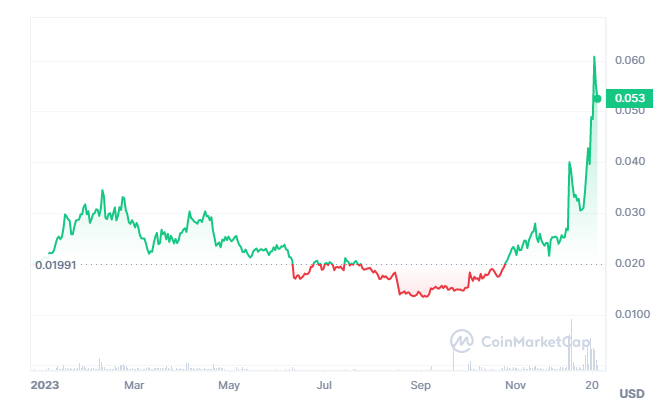
    IoTeX (IOTX), the native token of the IoTeX network, a decentralized platform facilitating machine-to-machine interactions, has experienced a remarkable surge. The token has gained 109.27% in the last month to trade at $0.05255 at the time of writing. It is trading 162.93% higher over the past year, making it among the very few cryptocurrencies to sustain a bullish trend.

    IOTX price chart


    Recent on-chain metrics reveal a surge of over 90% in IoTeX’s native token, IOTX, within the past week. A notable catalyst for this breakout is the platform’s increased activity and adoption, exemplified by processing over 1 million transactions in a single day on December 19th.

    IoTeX’s innovative hardware integration in security and oracle sectors, including products like Ucam home security cameras and Pebble data oracles, is capturing the attention of investors.

    Bitcoin hits $44K

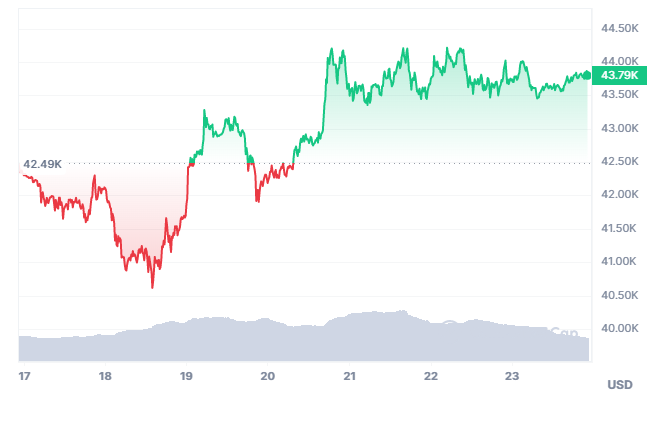
    Bitcoin (BTC), the pioneering cryptocurrency, hit a daily high of $44,075.15 for the first time in over a year. 

    Bitcoin price chart

    While the asset experienced some retracement, the overall trajectory remains positive buoyed by the high anticipations of a spot Bitcoin ETF approval by January 10 and the upcoming Bitcoin halving event. 

    In a review of 2023, Kaiko Research stated that “Bitcoin is set to close the year as one of the best-performing assets, up more than 160% and outperforming all major traditional assets even in risk-adjusted terms,” second only to semiconductor giant Nvidia.

    Solana’s soaring success

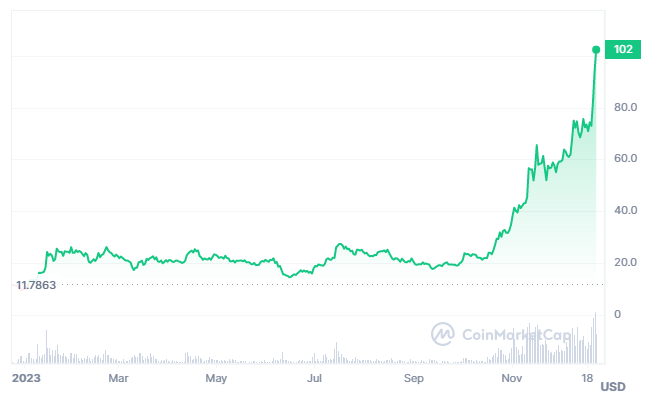
    Solana, a high-performance blockchain platform, has outshone other larger-cap altcoins, reaching a 19-month peak above $102. The SOL token price has surged by 765.76% in the past year joining the likes of IoTeX for a consistent bullish surge throughout the year.

    Solana price chart


    This surge has propelled SOL to surpass XRP as the fifth-largest cryptocurrency. Other notable gainers in the market include Avalanche (AVAX) and Polkadot (DOT), both experiencing significant price increases.

    Pullix: redefining crypto trading with a hybrid approach

    While the larger crypto market surges towards 2024, Pullix, is set to redefine crypto trading with its innovative hybrid exchange. Combining the strengths of centralized and decentralized exchanges, Pullix introduces a unique “Trade-to-Earn” concept through its native token $PLX.

    The PLX token presale has seen substantial interest, raising $1,387,783 with 85.4% of tokens already sold.

    Investors holding PLX tokens enjoy various benefits, including passive income through staking, trading fee discounts of up to 60%, and exclusive rewards derived from the platform’s daily revenue.

    Should you invest in Pullix? Evaluating the prospects

    As Pullix gains momentum in its presale, investors may wonder whether it’s a worthwhile addition to their portfolios. Maybe the platform’s commitment to transparency, a crypto deposit-only system, and no KYC requirements could be a consideration when thinking about whether or not to invest in it.

    In addition, staking PLX offers a chance for users to earn passive income, and the innovative buy-back and burn mechanism creates scarcity, potentially driving up token value.

    However, as with any investment, investors must conduct thorough research, considering the risks and rewards involved especially with the highly volatile cryptocurrency market.


    Source link

  • SYS Labs unveils Rollux Phase 2 with advanced DeFi tools backed by Bitcoin

    SYS Labs unveils Rollux Phase 2 with advanced DeFi tools backed by Bitcoin

    • SYS Labs has unveiled Rollux Phase 2, supercharging DeFi with Bitcoin support.
    • Rollux offers a comprehensive suite of DeFi tools and privacy-focused SuperDapp.
    • Syscoin’s architecture and UTXO Bridge boost Web3 scalability and interoperability.

    SYS Labs, the driving force behind Rollux, has announced the launch of Rollux Phase 2, introducing a powerful suite of decentralized finance (DeFi) tools backed by Bitcoin and Syscoin.

    This development represents a significant leap in the DeFi universe, enhancing the Web3 ecosystem’s performance and inclusivity.

    The Rollux Phase 2

    Rollux Phase 2 signifies a quantum leap in the DeFi universe, marked by innovation and inclusivity. SYS Labs’ commitment to enhancing the Web3 ecosystem, bolstered by Bitcoin’s security and Syscoin’s data availability solution, continues to drive the evolution of blockchain technology and decentralized finance.

    Rollux, an EVM Layer-2 solution, harnesses the strength of Bitcoin’s mining network to optimize Ethereum network applications. It powers SuperDapp, a groundbreaking platform that seamlessly blends AI, messaging, video calls, a non-custodial crypto wallet, and a developer marketplace.

    SuperDapp offers users a secure and private environment for online interactions, enriching the Rollux ecosystem.

    Rollux unveils a comprehensive set of DeFi tools and services in the second phase, addressing the blockchain trilemma – speed, scalability, and affordability.

    With features like a ZK-lite client, cross-chain bridges, decentralized exchanges (DEXs), liquidity protocols, yield aggregators, and a launchpad, Rollux is poised to lay the foundation for a robust Web3 ecosystem.

    Rollux’s strong foundation includes Syscoin’s dual Layer-1 architecture, featuring both a native UTXO chain and an NEVM chain. The newly introduced UTXO Bridge streamlines migration to Rollux’s EVM Layer 2, bridging the gap between UTXO and Layer 2 as per popular demand.

    Rollux has also expanded its suite of Web3 applications and services to include Pegasys DeFi exchange, Luxy NFT Platform, Pali Wallet (available in web and mobile versions), DAOSYS, and Camada, a non-custodial, regulatory-compliant crypto trading platform. The ecosystem is further enriched by Chainge cross-chain aggregated DEX, Agave DeFi lending protocol, Gamma liquidity protocol, Nexter prediction market, GoRollux launchpad, Beefy yield aggregator, and LayerSwap – the first bridge allowing direct and instant transfers from centralized exchanges to blockchains.

    Source link

  • 7 best DeFi crypto tokens to 10x

    7 best DeFi crypto tokens to 10x

    In DeFi, discovering tokens with the potential for significant returns is similar to finding a diamond in the rough. Within the labyrinth of the DeFi market, certain trailblazers are shifting paradigms, holding the promise of exponential financial gains and pioneering shifts in the Web3 ecosystem. 

    Use cases range from platforms reshaping the traditional method of business financing using innovative NFT mechanisms to DeFi projects unravelling the interplay between art, AI, and finance. 

    We spotlight seven DeFi crypto altcoins positioned to soar and perhaps 10x in the upcoming bull run. If you take your time to read through and understand the fundamentals behind each of the tokens in this article you might stumble upon your next best crypto investment.

    Borroe Finance (ROE) is emerging as a standout player in the DeFi market, recognized for its groundbreaking AI-powered funding marketplace tailored for content creators and Web3 enthusiasts. It’s not just another cryptocurrency ICO but a platform changing the game for Web3 business financing. With $ROE tokens operating on the Polygon chain, an Ethereum sidechain, Borroe allows businesses to mint and sell NFTs representing future earnings. 

    For buyers, this means instant cash flow by acquiring discounted invoice NFTs, further tradable on secondary platforms. What sets Borroe apart is its alignment with Web3 principles, championing equitable value distribution and empowering users. This platform promises easy invoice trading, AI-driven risk evaluation, blockchain security, and efficient crypto and fiat transactions.

    Additionally, the tokenomics or “Roenomics” of Borroe has a deflationary nature, ensuring scalability and limited transaction fees. Given these attributes and Borroe’s unique value in bridging traditional funding gaps, it’s no wonder industry experts tag it among the top cryptos to buy now. Experts anticipate $ROE to increase by 350% after the presale. To participate in the presale, visit Borroe.Finance Presale

    InQubeta (QUBE) is quickly emerging as a game-changer in the DeFi tokens space, positioning itself as the world’s first Web3 crowdfunding platform tailored specifically for AI startups. Pioneering the landscape, InQubeta offers fractionalized investment options, with each AI investment venture represented as an NFT. Whether you’re eyeing the next big thing like MidJourney, QUBE grants you the golden ticket. The Ethereum (ERC-20) based QUBE isn’t just a regular altcoin. It’s a deflationary token, ensuring scarcity and value appreciation. Plus, experts anticipate that QUBE’s price will increase by 400% after the presale. 

    Furthermore, QUBE continues to impress as a governance token, it promotes democratic participation. Staking QUBE promises passive income, thanks to its dedicated reward pool, ensuring long-term holders get their fair share.

    To purchase the QUBE token, visit InQubeta Presale

    Domini ($DOMI) is making waves in the DeFi cryptocurrency space, blurring the lines between high-end art and decentralized finance. Positioned on Ethereum’s ERC-20 network, Domini introduces a visionary art marketplace where blockchain technology seamlessly integrates with traditional artistry. This game-changer transforms the elitist blue-chip art domain by tokenizing artworks into unique NFTs, enabling fractional ownership. 

    Consequently, even an average Joe can invest in esteemed artworks, removing antiquated barriers. Every tokenized artwork guarantees unwavering ownership records, strengthening trust and diversifying the art market. A salient feature of Domini? The Domini Marketplace is an original NFT platform allowing stakeholders to trade their art shares or scout for alluring art fragments to beef up their collection. 

    More than just the best coin to invest in, $DOMI provides passive income, courtesy of its 7% buy and sell tax, divided meticulously to fund burn processes, marketing drives, and ensure liquidity. Investing in $DOMI is simple, thanks to the extensive payment gateway that accepts top cryptocurrencies. 

    Stacks (STX) – Bitcoin alternative

    Bitcoin-centric scaling solutions have seen heightened interest, driven by a growing urge to harness Bitcoin beyond mere transfers. Amidst this narrative, Stacks (STX) presents itself as an emerging frontrunner. With its Nakamoto upgrade expected later this year, STX offers potential as the native token of the Bitcoin L2, Stacks. Notably, stackers of STX enjoy passive BTC yield, the rise of which correlates with increased Stacks usage. 

    However, the STX community faced a setback in April 2023 when a critical bug facilitated a skewed representation of the STX stack balance for a particular address, consequently leading to an unauthorized $425k gain. This flaw compromised the security of sBTC. Another challenge is the exploitation of the Proof-of-Transfer (PoX) consensus mechanism by a player, overshadowing its competitors claiming more STX rewards than due. 

    Stacks adopts economic disincentives to synchronize its ecosystem participants; however, the efficacy of this strategy in ensuring a solid BTC bridge and a consistent native price oracle is still under scrutiny. Investors should be discerning given the recent challenges faced by the network and the infancy of Bitcoin scaling solutions. For newcomers and those thinking about the big question of which crypto to buy today for the long-term, considering the evolving landscape of the DeFi market, Stacks indeed offers a promising investment opportunity.

    Render (RNDR) – a popular Metaverse project

    Born from the Ethereum blockchain and OctaneRender fusion, RNDR embodies decentralization in 3D rendering. Render Network, often abbreviated as RNDR, is a remarkable peer-to-peer GPU marketplace that pivots on enabling individuals to allot their idle GPU prowess to the execution of 3D rendering of motion graphics and visuals. 

    What sets it apart? A straightforward ROI in the form of RNDR, the platform’s intrinsic utility token. The elegance of RNDR lies in its optimization of traditional rendering protocols, positioning it as a cornerstone for digital prodigies in the burgeoning metaverse. Amid the digital entertainment era, where 3D visuals are the norm, from the immersive world of online gaming to the mesmerizing crypto metaverse, the demand for advanced rendering – the meticulous transformation of a 3D blueprint into a textured visual treat – is surging. The protocol’s decentralized nature promises scalability beyond comparison, with its robust GPU rendering network capable of massive expansion aligned with evolving project requisites. 

    It’s not just about computational might; RNDR offers users a rich palette of choices, whether outsourcing tasks or harnessing surplus GPU energy, driving operational efficiency through the roof. And remember blockchain security ensures unmatched IP safety, safeguarding the creator’s rights, a rarity in today’s centralized platforms. For crypto novices seeking the next best DeFi coins or thinking about what crypto to invest in, RNDR emerges as a fascinating blend of next-gen tech with vast potential. Making it a top contender in the best crypto to invest list.

    Hedera (HBAR) – a leading altcoin

    Hedera Hashgraph, or HBAR, is a unique entry in the ever-growing DeFi cryptocurrency sector. At its core, Hedera aims to provide a versatile platform, different from typical erc20 tokens, on which individuals can transact or develop applications under the watchful eyes of a conglomerate of businesses. Unlike many decentralized systems on the decentralized cryptocurrency list, it sets itself apart with distinct design choices. While it offers impressive transaction speeds for its HBAR cryptocurrency, it only permits selected nodes to have a say in transaction history. 

    Such a model ensures rapid finality, minimizing the potential for subsequent changes to transaction states. This structure assures businesses, offering them the confidence to act based on this reliable data. Beyond its operational features, Hedera has caught the attention of giants such as LG, IBM, and Boeing, which have integrated as nodes in this system. Founded by Leemon Baird and Mance Harmon and having raised $124 million from its HBAR sales, this network’s prominence in the best crypto-to-invest category continues to rise.

    Lido Dao (LDO) 

    Lido Dao (LDO) stands out as a revolutionary protocol in the cryptocurrency for beginners’ landscape, showcasing innovative solutions to Ethereum’s staking challenges. Born just before Ethereum’s iconic “Merge,” Lido’s Liquid Staking innovation addresses the daunting 32 Ether staking requirement, permitting users to tap into the staked tokens’ locked value. This is achieved through stTokens, acting as placeholders, granting users the flexibility to engage in the Decentralised Finance (DeFi) market and boost their yields. 

    Unlike conventional staking methods, Lido offers the advantage of asset liquidity, ensuring assets can be utilized across various DeFi applications and top crypto coins. Not restricted to Ethereum, Lido has extended its wings to other notable Proof of Stake blockchains, including Polygon and Solana. Governed by its community through the LDO token, Lido stays committed to its mission: simplifying decentralized staking, making it accessible and appealing to a vast audience.

    Conclusion

    As the epoch of decentralization unfolds, Web3 platforms continue to entice, allure, and, more importantly, revolutionize traditional financial constructs. While cryptocurrency trading might seem daunting for beginners, altcoins, like those in this article, paint a promising future picture. Whether the innovation-laden Borroe or the fusion of art and finance in Domini, the DeFi space is brimming with opportunities. 

    However, as with all investments, prudence is key. Let this article guide you in ensuring the best DeFi tokens are in your portfolios. After all, today’s informed choice could be the stepping stone to tomorrow’s financial windfall. Consider the nuances when discovering opportunities such as the coolest NFTs or altcoins that can lead to massive returns.

    Source link