Tag: drops

  • PI coin price drops 10% to key level despite major network news

    PI coin price drops 10% to key level despite major network news

    • Pi Network price has dropped nearly 10% in the past 24 hours.
    • Traders are likely to watch the $0.65-$0.75 range for signs of a breakout or further weakness.
    • Pi Network’s focus on real-world adoption positions it for long-term growth.

    Pi Network’s native token, PI, has experienced a sharp decline over the past 24 hours, falling to a critical support level despite significant ecosystem developments.

    The price drop comes as major cryptocurrencies struggle to hold onto gains.

    In the past 24 hours, PI price has dropped nearly 10% and cut weekly upside to about 14%, with the altcoin hovering near $0.66.

    Despite the expansion of the Pi Ad Network to all ecosystem dApps, Pi Network’s price is under short-term bearish sentiment.

    Tron and Cardano have also struggled, but what does this mean for the PI token?

    Key Pi Network developments

    In the past few days, Pi Network has posted notable network developments.

    It includes a major Chainlink integration that marks a pivotal step for the cryptocurrency, which brings real-time, accurate data for decentralized applications.

    For dApps, the collaboration means fresh potential for DeFi applications, prediction markets, and blockchain games, all of which could drive PI demand.

    It’s the same outlook for DeFi protocols such as lending or staking platforms.

    Meanwhile, the Pi Ad Network’s expansion to all ecosystem dApps introduces a new revenue stream for developers.

    Advertisers must purchase PI to fund campaigns, while developers earn PI through user engagement.

    Initially piloted with five apps in 2024, the Ad Network’s full rollout is expected to accelerate app development and token utility.

    However, these fundamentals aside, PI’s price action reflects market hesitation.

    PI price prediction

    Since hitting highs near $3 in February, PI has been on a steady decline.

    The token has shed significant value, with the current level about 77% of the all-time high.

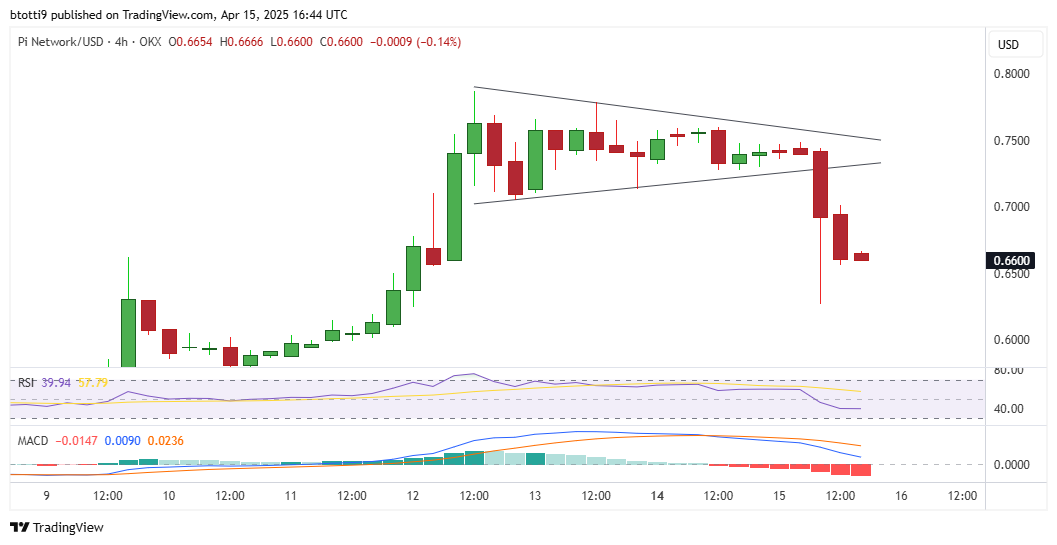
    A look at the four-hour chart reveals a symmetrical triangle pattern, a technical setup often signaling consolidation before a breakout.

    Notably, this can go in either direction, and it’s downward for PI.

    Pi Network chart by TradingView

    The symmetrical triangle breakdown suggests sellers are capitalizing on uncertainty, possibly due to broader market conditions or profit-taking after earlier gains.

    It’s what likely has bears in control, a scenario that could push PI price below key levels.

    As can be seen above, the token is now testing support near $0.65. Other than the symmetrical triangle pattern, the relative strength index and the moving average convergence divergence give sellers an upper hand. The MACD indicates a recent bearish crossover, shifting short-term sentiment after a rejection around $0.75.

    If bulls fail to hold above $0.65, PI could slide toward $0.50.

    However, if bullish momentum builds, PI could break above $0.8 and rally toward $1.20 in the near term.


    Source link

  • Bitcoin drops to $76k after Trump fails to rule out a recession

    Bitcoin drops to $76k after Trump fails to rule out a recession

    Bitcoin dips to $86k

    • Ether dropped 9%, XRP fell 2%, and Dogecoin lost over 8% in 24 hours
    • Investors react to Trump’s comments about a possible recession
    • The US stock market lost more than $1.7 trillion in value

    Crypto prices have fallen across the board, with Bitcoin dropping below $77,000 as investors continued to react to US President Donald Trump’s tariff policies and the Bitcoin reserve plan.

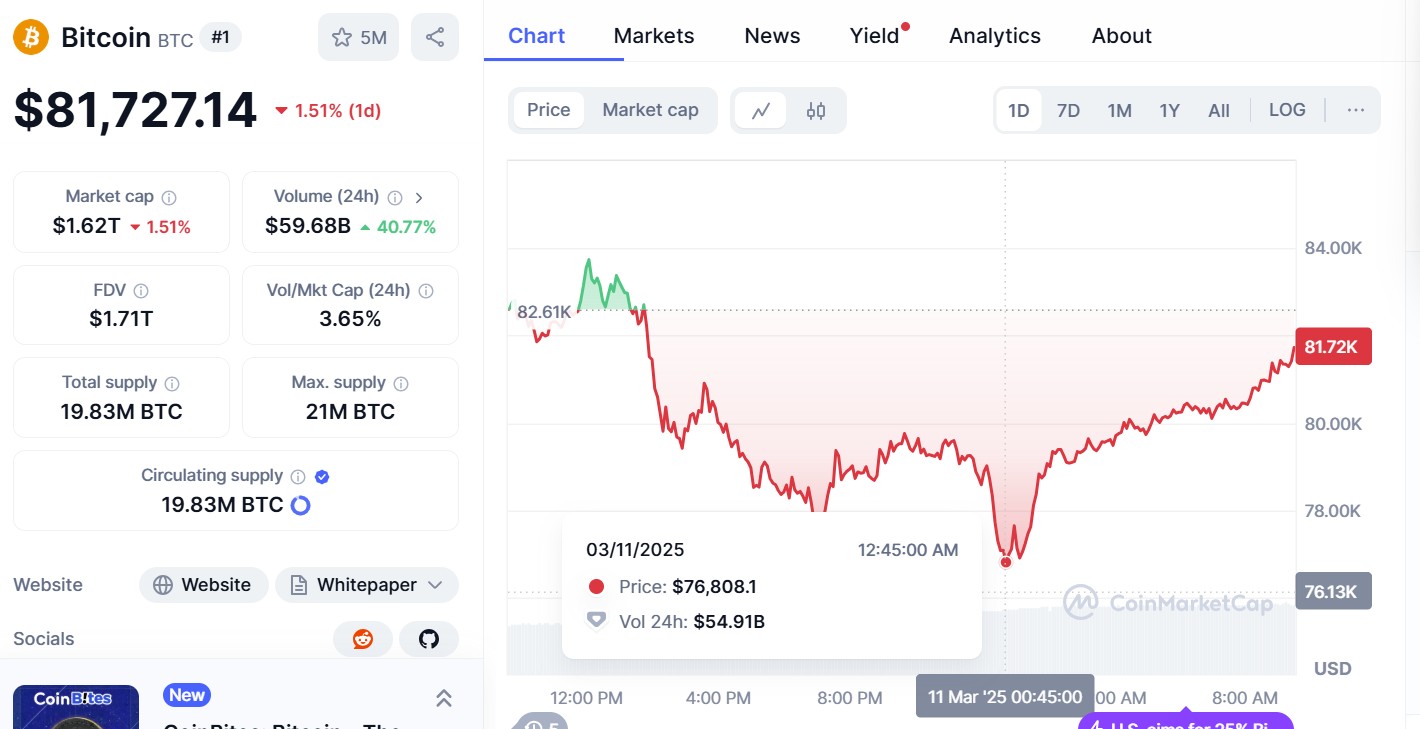
    Bitcoin’s price at $76,000. Source: CoinMarketCap

    In the early hours of Tuesday, March 11, Bitcoin fell to $76,000, a figure not seen since last September. In a post on X, crypto trader Ali said:

    “If #Bitcoin $BTC holds $80,000, the bull case remains strong. Losing this level, however, could put $69,000 in play as the next key support!”

    Bitcoin has risen slightly and is back up around $81,600 at the time of publishing, according to CoinMarketCap. Ether, on the other hand, was down over 9% in 24 hours to $1,920, XRP had fallen more than 2%, at $2.13, and Dogecoin was down over 8.81% to $0.1607.

    The market reacts

    News of the continued market sell-off comes as investors react to Trump’s trade tariffs, the announcement of the US Strategic Bitcoin Reserve, and the possibility of a recession.

    Following Trump’s remarks, the US stock market lost more than $1.7 trillion in value yesterday. Elon Musk’s Tesla saw its shares drop by at least 15% to $222, losing over half its value from its December peak at $479.86. In a post on X, Musk said: “it will be fine long-term.”

    Market conditions haven’t been helped by Trump’s trade tariffs on Canada, China, and Mexico. Last month, it was confirmed that Trump was imposing a 25% trade tariff on Canada and Mexico; however, this has been delayed until April 2. China had a 20% tariff levied against it.

    BitMEX co-founder Arthur Hayes took to X to ask people to be “patient.”

    “$BTC likely bottoms around $70k. 36% correction from $110k ATH, v normal for a bull market,” adding:

    “Traders will try to buy the dip, if you are more risk averse wait for the central banks to ease then deploy more capital. You might not catch the bottom but you also won’t have to mentally suffer through a long period of sideways and potential unrealised losses.”


    Source link

  • Bitcoin drops below $84k as markets react to tariffs

    Bitcoin drops below $84k as markets react to tariffs

    BTC on stack of cryptocurrencies with falling crashing graph in background

    • Bitcoin price fell to lows of $82,131, dipping to levels seen in November 2024.
    • The BTC sell-off happens after Trump’s latest tariffs announcement, including a 25% tarriffs on the EU.
    • Equities also dumped, with the S&P 500 seeing $500 billion wiped off.

    The price of Bitcoin dropped more than 6% in 24 hours to break below $84,000 on Wednesday.

    Notably, Bitcoin price has touched its lowest levels since November 2024, when it rose amid election momentum. According to crypto and stocks trader IncomeSharks, the market is bearish.

    BTC sold-off as the crypto market reacted to trade war sentiment, with this coming on the heels of the latest tariffs announcement by President Donald Trump.

    Having announced that the 25% tariffs on Canada and Mexico and 10% on China will go into effect in April, Trump said he would slap 25% tariffs on the European Union. The news saw the S&P 500 fall, with over $500 billion in market cap wiped off.

    Bitcoin dips amid ETFs outflows

    As equities reacted to the potential trade war, Bitcoin crashed below $84,000. Per data from CoinMarketCap, the price of BTC hit lows of $82,131.

    BTC price also dumped amid massive selling pressure from ETFs. Major issuers Fidelity, Ark and Grayscale all sold. BlackRock, which sent millions of dollars worth of BTC and ETH to an exchange on Tuesday, also offloaded $150 million of the flagship coin.

    While bulls had rebounded to above $84k at the time of writing, sentiment remains weak and a retest of $80k is possible. Crypto analyst Rekt Capital shared the chart below.

    According to analysts, the markets are pricing in a possible “rebound in inflation” with investors factoring in likely spikes in the prices of goods.

    “What’s interesting is the SHARP divergence between Gold and Bitcoin since the trade war began. While Gold is up +10%, Bitcoin is down -10%, even though Bitcoin is historically viewed as a “hedge” against uncertainty,” the Kobeissi Letter said.


    Source link

  • Bitcoin drops below $90k as Trump confirms trade tariffs

    Bitcoin drops below $90k as Trump confirms trade tariffs

    Dogecoin and other major altcoins dip

    • This is the lowest Bitcoin has dropped since November 2024
    • Trump’s trade tariffs are likely impacting crypto market prices as investors look elsewhere to trade
    • Two crypto hacks days apart have worsened investor sentiment

    Bitcoin’s price has dropped below the $90,000 mark, signalling the lowest decline for the number one crypto asset since November 2024.

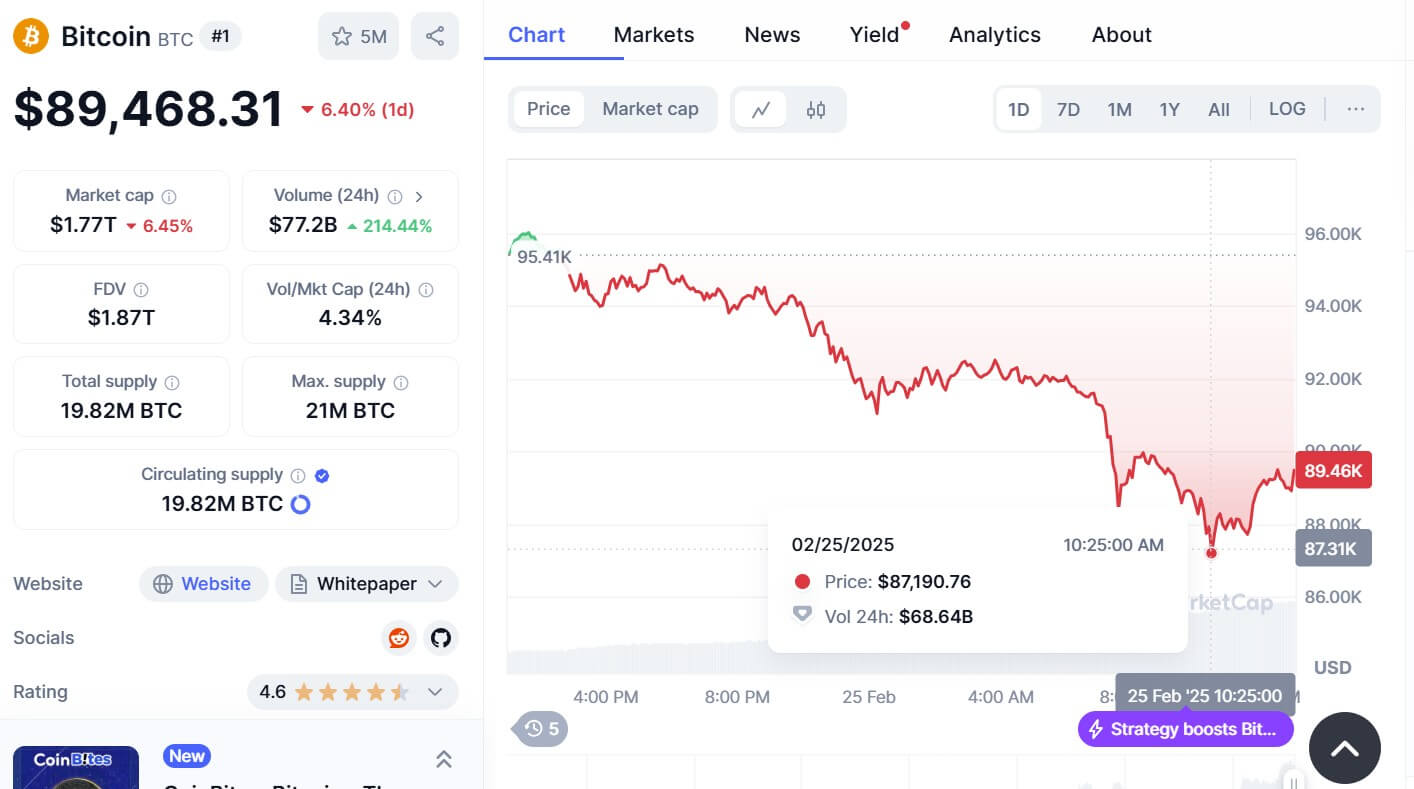
    Bitcoin’s price at $87,000. Source: CoinMarketCap

    On February 25 at 10:25 UTC, Bitcoin was trading at around $87,190, according to data from CoinMarketCap. At the time of publishing, it has risen slightly but remains under $90,000, a key figure to stay in bullish territory.

    According to Arthur Hayes, BitMEX’s co-founder, Bitcoin could drop to $70,000 if large hedge funds sell their positions in Bitcoin exchange-traded funds (ETFs).

    Impact of Trump’s tariffs

    The drop in value comes amid uncertainty about inflation, US President Donald Trump’s policies, and geopolitical events.

    Yesterday, Trump confirmed 25% trade tariffs on Canada and Mexico, causing the market to react as investors look to other avenues to put their money.

    According to James Toledano, COO at Unity Wallet, many believed that Bitcoin’s price would continue rising once Trump entered the White House, adding to CoinJournal:

    “But the reality is that the price has gone south, likely due to tariff trade wars, fragile peace talks in Eastern Europe, and fears around DeepSeek’s impact on the US tech sector. But this could also just be a momentary lapse of pricing reason.”

    Security breach at Bybit

    Last week, Hong Kong-based crypto exchange Bybit was the target of a major hack, resulting in the loss of nearly $1.5 billion worth of Ethereum from a single wallet.

    Despite Ben Zhou, Bybit’s founder and CEO, saying it had “fully closed the ETH gap,” raising funds to cover the losses and boost investor confidence, the fact remains that investors are shaken.

    Not only that, but neobank Infini suffered a $50 million hack yesterday. According to reports, insider access enabled the hacker to manipulate the platform’s smart contract it had developed after retaining administrative privileges unbeknownst to Infini.

    Following the theft, the hacker converted the stolen USDC into Dai and then purchased 17,696 Ethereum, valued at around $49 million at the time.

    “Additionally, global macroeconomic uncertainty and a downturn in traditional markets have weighed on Bitcoin, as risk assets remain highly sensitive to external pressures,” said Toledano.

    “Note, the S&P 500 which is the bellwether for the equities market is down over 4% over the last month and over 2% this past week alone. While 2 and 4 percentage points mean little in the cryptosphere, these figures are notable in TradFi from a loss perspective.”

    Source link

  • Bitcoin (BTC) drops below $57K again amid strong selling pressure

    Bitcoin (BTC) drops below $57K again amid strong selling pressure

    Bitcoin (BTC) drops below $57K again amid strong selling pressure
    • Bitcoin drops below $57K due to major institutional sell-offs and market pressure.
    • Short-term holders face unrealized losses, could trigger market volatility if they decide to cut their losses.
    • $51K is a crucial support level and long-term investors might see this as a buying opportunity.

    Bitcoin (BTC) has once again slipped below $57,000 as its turbulent journey continues. At press time, BTC was trading at $56,749.40, down 5.32% in a week.

    This latest dip is driven by a confluence of factors, including significant institutional sell-offs, the pressure from short-term holders facing unrealized losses, and ongoing spot market selling.

    Institutional sell-offs impact Bitcoin price

    A major factor behind Bitcoin’s price decline is the heavy selling activity by institutional investors. Prominent players such as Fidelity, Grayscale, Ark Invest, and Ceffu have significantly contributed to the downward pressure.

    Fidelity leads the charge, having sold 16,000 BTC, valued at approximately $915 million. Grayscale follows with the offloading of 15,000 BTC, amounting to roughly $858 million. Ark Invest has divested 7,000 BTC worth about $400.4 million, while Ceffu has sold nearly 3,124 BTC, totalling around $178 million.

    This institutional sell-off has been a crucial factor in Bitcoin’s drop. The substantial transfers of Bitcoin to exchanges suggest that these major players are either taking profits or rebalancing their portfolios.

    Interestingly, while these institutions are actively selling, BlackRock has maintained a neutral stance, avoiding both buying and selling Bitcoin amid the current market fluctuations.

    Risk of short-term holders exiting positions en mass

    The selling pressure is further exacerbated by the situation of short-term Bitcoin holders, who are currently facing significant unrealized losses.

    According to data from Glassnode, short-term holders who acquired Bitcoin in the last six months are experiencing financial stress, with their average cost basis ranging from $59,000 to $65,200, substantially above the current market price.

    This cohort’s financial strain is evident in key metrics, and their potential to exit positions en masse poses a considerable risk for increased market volatility.

    Despite the average Bitcoin investor remaining profitable, the substantial unrealized losses among short-term holders could potentially trigger broader market weakness if they decide to cut their losses.

    The $51,000 price level is highlighted as a critical support that must be maintained to preserve the current market structure.

    Potential for market stabilization

    As Bitcoin continues to experience strong selling pressure, its market behaviour reflects a complex interplay of institutional actions, short-term holder dynamics, and broader market conditions. While immediate prospects appear uncertain, particularly with the potential for further short-term declines, long-term investors may find value in this period of adjustment.

    Analysts have observed some absorption at lower price levels, which might suggest that Bitcoin could be poised for a period of sideways movement before making a decisive move.

    The current dip might present a buying opportunity for long-term investors who can weather short-term volatility.


    Source link

  • Bitcoin drops $28.8k amid huge crypto record huge outflows

    Bitcoin drops $28.8k amid huge crypto record huge outflows

    • Bitcoin price fell to $28,800 across major exchanges as Ethereum hit lows near $1,800.
    • Equities also showed signs of uncertainty with mixed trading recorded.
    • Crypto investment products saw outflows totaling $107 million, the primary focus being BTC.

    Bitcoin traded near the $28,800 early afternoon on Monday as caution dictated overall sentiment across the market.

    Stocks were mixed in midday trading on Monday as earnings season starts to wind down and investors brace for an inflation reading crucial to the Federal Reserve decision making.

    While the S&P 500 and Dow Jones Industrial Average held slightly positive ground at 0.5% and 0.9% respectively, the tech-heavy Nasdaq Composite and Rusell 2000 were down 0.1% and 0.2% respectively.

    BTC hovers at key level amid huge outflows

    On Monday, digital assets manager CoinShares released the latest weekly report on digital asset investment products flows. According to an analysis by the firm, total outflows for last week was $107 million.

    Bitcoin saw total weekly outflows of $111 million. Although outflows into short bitcoin products reportedly stopped for the first time in 14 weeks, those from the flagship cryptocurrency were the largest since March.

    Meanwhile, Ethereum recorded outflows of $6 million, while Solana outpaced the top altcoin with $9.5 million in inflows. There were also inflows of $0.5 million for XRP and $0.46 million for Litecoin. Uniswap had $0.8 million in outflows and Cardano with $0.3 million.

    James Butterfill, Head of Research at CoinShares noted in the report that the outflows have come amid increased profit taking deals in recent weeks. Also notable was the decline in weekly trading volumes for digital asset investment products and on-exchange volumes – which stood at 36% and 62% year-to-date respectively.

    Source link

  • Bitcoin correlation with gold drops, highlighting risk-on nature remains

    Bitcoin correlation with gold drops, highlighting risk-on nature remains

    Key Takeaways

    • Bitcoin’s correlation with gold is currently at its lowest level since FTX collapsed in November
    • Our Head of Research writes that while one day Bitcoin may become a store of value, the numbers say it currently trades like an extreme risk-on asset
    • Bitcoin lost 76% of its value amid the pullback in risk assets once central banks around the world transitioned to tight monetary policy amid the inflation crisis
    • Meanwhile, gold traded flat and is currently close to all-time highs
    • Bitcoin’s correlation with growth stocks and riskier sectors of the stock market remains tight

    One of the ultimate bull scenarios for Bitcoin is that it morphs into some kind of digital gold. 

    For whatever reason, humans have been obsessed with this weird, shiny metal for thousands of years. Stories date back even further, but we have concrete evidence that gold was an important symbol of wealth in Ancient Egypt in 3000 BC, as well as part of everyday life and mythology. 

    Bitcoin, on the other hand, was not around in Ancient Egypt. Nor was it around for the Middle Ages, the Great Depression in the early 20th century, a World War (yet?), the inflation and energy crisis of the 1970s, and it even missed most of the subprime mortgage crisis of 2008. 

    In fact, Bitcoin was launched in January 2009, the Genesis blocked mined only two months before the stock market bottomed. Over the next twelve years, not only did the stock market recover, but it went absolutely bananas. Between the 2009 trough and the peak at the end of 2021, the S&P 500 multiplied 7X while the Nasdaq jumped nearly 13X. In other words, Bitcoin was launched into one of the most explosive and longest bull markets in history. Until 2022, it had never known anything but basement-level interest rates and up-only markets. 

    Gold’s hedge properties are what Bitcoin seeks

    Once 2022 came, risk assets sold off. The Nasdaq shed a third of its value; the S&P 500 fell 20%. Bitcoin had dipped plenty before, but make no mistake: this was the first time it was staring a bear market in the wider economy in the face.

     Despite certain enthusiasts claiming Bitcoin would act as a hedge asset, this did not happen. By the end of 2022, Bitcoin was 76% off its high. In the most explosive inflationary environment since the 1970s and Bitcoin’s first bear market, the asset was getting crushed. There was no debate: Bitcoin was trading like a risk-on asset. And today, it still is.  

    That is not to say that the narrative could flip in the future. Personally, that is what I view as Bitcoin’s upside: a store of value akin to gold. But while we can debate whether that may one day happen, it is unequivocal that Bitcoin currently trades like a risk-on asset. These are the facts of the case, and these are undisputed, to borrow Kevin Bacon’s phrase from the absolute classic that is A Few Good Men. 

    Gold, on the other hand, traded flat during 2022, and is currently trading close to all-time highs. 

    Bitcoin and gold correlation dipping

    For all the reasons discussed above, the correlation between gold and Bitcoin is particularly interesting to track. Using the 60-Day Pearson indicator, I have plotted it on the below chart. 

    Immediately, the past month jumps out. The correlation was a near-perfect 0.86 at the start of June, and had been around this level since late April. And then, it fell. It currently sits at 0.16, the lowest mark since FTX collapsed in November, sending the crypto market into a tailspin. But why?

    Well, I don’t really know. And that is kind of the point. Bitcoin, as it tends to do sometimes, is rising at the moment. Most likely, this is due to news of asset managers Blackrock and Fidelity filing ETFs, but maybe it’s just Bitcoin doing its thing. Perhaps it is merely bouncing back from the sharp fall it took after the Binance and Coinbase lawsuits were announced back-to-back two weeks ago. 

    But if we stretch out the time horizon on the previous graph, we see that the correlation between gold and Bitcoin bounces around a lot.

    It is challenging to put any pattern on that, to say the least. I thought I might try a different metric, so in the next graph I have used 90-Day Pearson instead of 60-Day. Predictably, the trend is less volatile, but there still appears to be no meaningful relationship here. 

    I think it’s pretty clear that assessing the correlation coefficients directly proves that there is zero positive relationship between these two assets. 

    Federal Reserve holds the key

    In truth, I believe this actually says more about gold than Bitcoin. Gold is in a funny place at the moment, trading more off expectations of inflation and interest rate movements rather than current conditions. The correlation between gold and the stock market is therefore higher than what we have typically seen in the past. This is why we are seeing gold often advance when soft CPI numbers are announced, or when dovish Fed comments surface regarding interest rate policy.

    If we step back and look at the big picture, it really is not complicated. Bitcoin has gone from $68,00 in November 2021, when money was cheap and risk assets were trading at outrageous valuations, to $15,500 last November, seven months into the swiftest hiking cycle in recent memory and the worst inflation crisis in 50 years. Then, it doubled to $30,000 as inflation numbers fell away and expectations around the length of the hiking cycle softened. 

    Along with all the fakeouts and reverberation in between, that is a hell of a lot of movement and clearly trading like an extreme-risk asset. Meanwhile, gold has been far less volatile, relatively range-bound between $1,600 and $2,000 for three years now. 

    Again, while Bitcoin may one day seize the crown of an uncorrelated asset, or a portfolio hedge to inflation, that is clearly not the case today. The below chart is the simplest method of all to show this, plotting Bitcoin’s hand-in-hand relationship with the tech-heavy Nasdaq composite since the economy transitioned to this risk-off, tight monetary policy period. 

    A few months ago, Bitcoin rose during the banking crisis, sparking some to declare it as decoupling from risk assets and the fiat world. As I wrote back then, this is nothing more than wishful thinking. Rather, it moved off expectations that the Fed would not be able to hike as aggressively in future if banks were going under due to the strain of these higher rates (indeed, soon after, the correlation rose back up).

    The latest dip in correlation with gold, falling back down from the ultra-high 0.86ish value it has been for six weeks or so, is similar. There is nothing ambiguous about the situation at the moment – Bitcoin is trading like a risk-on asset. It may one day claim that coveted title of digital gold, but right now it is nowhere near.

    Source link

  • Volatility lowest since January, but until it drops further, Bitcoin serves no purpose

    Volatility lowest since January, but until it drops further, Bitcoin serves no purpose

    • Bitcoin’s volatility is a massive problem, writes our head of research, Dan Ashmore
    • The volatility is the lowest since January, but that doesn’t provide much solace with regards to Bitcoin’s actual utility
    • For Bitcoin to deliver on its potential, it needs to become boring, with volatility closer to gold’s famously steady return profile

    It’s relatively calm in Bitcoin markets right now, but that won’t last long. And it’s a massive, problem. 

    First, let us look at the short-term volatility, because I noticed over the last few days that is has come down a little. Plotting the 1-month volatility on an annualised basis, we are at the lowest mark since January, when this little Bitcoin surge was kicked off. 

    OK, fine. 

    But don’t confuse that with a steady market. The crypto markets remain highly capricious and capable of swinging back and forth and eye-watering speed. Volatility is still close to 50%, which in the context of any regular market, is truly insane. 

    Perhaps plotting the daily returns of Bitcoin against that of Tesla shows this better. Tesla is just about the most extreme member of the S&P 500, its stock price more volatile than its CEO’s Twitter feed. Comparing your volatility to Tesla is like comparing your ability to run a football team to Todd Boehly (seriously, wtf). 

    And yet, Bitcoin’s daily price changes not only match Tesla, but commonly exceed it. 

    Indeed, if we plot Bitcoin’s volatility back over a longer time period, we see that these fallow periods do occur, but rarely last long. Bitcoin and volatility are like Frank Lampard and Chelsea, apparently – occasionally apart, but you know that before long, they will be back. And they are terrible for each other. 

    Make no mistake about it, volatility is one of Bitcoin’s greatest drawbacks. It is difficult to imagine the asset ever achieving anything remotely close to a store-of-value status while it oscillates back and forth like it does. 

    If the ultimate vision for Bitcoin is some sort of digital gold, it has a hell of a long way to go. Flipping the earlier comparison from Tesla to gold is more apt, and puts the chasm between the two assets up in lights:

    Obviously, this could all change in the future. I don’t have a crystal ball. Regarding Bitcoin’s ultimate vision, it simply has to, because as it currently stands, Bitcoin is not achieving anything. 

    The arguments commonly point to the developing world. Bitcoin can offer a greater place to store one’s financial wealth, they argue. Again, this may prove true in time, but even a collapsing currency like the Argentinian peso is not as volatile as Bitcoin. A gradual decline such as the peso (and I am using gradual a bit liberally there, admittedly) is at least easier to plan for than Bitcoin, which can quite literally be 20% lower in the space of a couple of minutes. 

    While Bitcoin is capable of these massive price moves, it isn’t in a place to help anyone. That argument is currently better served to stablecoins, pegged to fiat currencies like the US dollar, which can be equally accessible but don’t swing in price (at least, the prudently-designed ones don’t). Now, their flaws could fill a whole new article which I won’t get into here, but the point is this: Bitcoin is literally useless while its volatility is as high as it currently is. 

    My friends often poke fun at me for chatting about gold, or doing analytical pieces on its price drivers. Boomer, they call me. And that’s fair – gold is boring as f**k, and watching its price chart is like watching paint dry. But that is kind of the point, isn’t it? Gold is a store of value, and therefore it should not be printing gains and losses that get Robinhood investors all hyped up. Otherwise, it wouldn’t be doing its job. 

    Bitcoin is the same. It needs to take a leaf out of gold’s book and become boring. Until that happens, there is no point to this mythical asset beyond wild speculation. 

    Source link

  • Bitcoin drops below $17,500 as Coinbase/Kraken report issues

    Bitcoin drops below $17,500 as Coinbase/Kraken report issues

    Bitcoin price fell more than 12% to touch lows of $17,114 on crypto exchange Coinbase.

    Bitcoin declined more than 12% on Tuesday as a stunned crypto world descended into sell-off territory on news that Binance, led by Changpeng Zhao, had signed a letter of intent (LOI) for the acquisition of crypto exchange FTX.

    Bitcoin sell-off pushes BTC below June 2022 lows

    After an initial upward spike for the crypto market amid a positive take, Bitcoin nosedived to lows of $17,114 on crypto exchange Coinbase. 

    The downside marks Bitcoin’s fall to its lowest price level since the crypto bloodbath in June, when the aftermath of the crash of Luna and Three Arrows Capital bankruptcy coincided with Bitcoin printing a low of $17,592.

    With the sell-off crashing the FTX (FTT) token as much as 85% within hours on Tuesday – from highs of $22 to lows of $4.60 – other markets followed suit as uncertainty and fear reigned supreme.

    Ethereum had fallen below $1,300 and Solana was getting smoked near $23.80 at the time of writing.

    Coinbase and Kraken report connectivity issues

    Meanwhile, leading crypto exchanges Kraken and Coinbase reported connectivity issues that only fueled the negative sentiment. 

    Kraken announced an investigation into reports that certain users were having connectivity issues on its website as well as via mobile.

    Coinbase also reported connectivity issues affecting its Coinbase.com, Coinbase Pro and Coinbase Prime platforms. An update the US-based crypto exchange posted an hour later noted improvement in network latency, but users were reportedly still having difficulty accessing the exchange’s various platforms.


    Source link