Tag: ETFs

  • Vanguard reverses course, opens door to Bitcoin, Ethereum, XRP, and Solana ETFs

    Vanguard reverses course, opens door to Bitcoin, Ethereum, XRP, and Solana ETFs

    Vanguard opens door to Bitcoin, Ethereum, XRP, and Solana ETFs

    • Vanguard now allows clients to trade Bitcoin, Ethereum, XRP, and Solana ETFs.
    • XRP ETFs have seen $756M inflows in 11 days, with no outflows recorded.
    • Goldman and other firms are boosting crypto exposure alongside Vanguard.

    In a dramatic shift that signals growing acceptance of digital assets by mainstream finance, Vanguard has opened its brokerage platform to regulated crypto ETFs.

    Starting this week, US investors can access exchange-traded funds tied to Bitcoin, Ethereum, XRP, and Solana, marking a major reversal from the firm’s long-held resistance to cryptocurrency.

    Notably, the move comes amid surging client demand and increasing institutional interest in digital assets, reshaping Vanguard’s traditional investment philosophy.

    Vanguard finally embraces crypto

    For years, Vanguard maintained a cautious stance toward cryptocurrencies, with former CEO Tim Buckley publicly dismissing BTC and other digital assets as too speculative and unsuitable for long-term portfolios.

    The firm consistently refused to offer crypto ETFs, emphasising stability and low-risk investments for retirement-focused clients.

    However, leadership changes paved the way for a rethink.

    Salim Ramji, formerly the global head of ETFs at BlackRock, assumed the CEO role and gradually steered Vanguard toward regulated crypto offerings.

    While the firm still will not create its own crypto ETFs or mutual funds, it now supports third-party products that meet regulatory standards, providing clients with access to digital assets while maintaining compliance.

    The platform expansion enables more than 50 million US brokerage clients to trade crypto ETFs alongside other non-core assets like gold.

    This could significantly increase market participation, with some predicting near-term price boosts in Bitcoin (BTC) and Ethereum (ETH).

    Vanguard’s inclusion of XRP ETFs

    Among the new offerings, XRP-based ETFs have generated particular excitement.

    In just 11 trading days, spot XRP ETFs have recorded net inflows exceeding $756 million, with total assets under management reaching $723 million.

    Remarkably, there have been no outflows, and major inflow events include $243 million during Canary Capital’s launch, $164 million tied to Grayscale and Franklin Templeton ETFs, and $89.65 million in the most recent session.

    This rapid accumulation is reducing the liquid XRP supply on exchanges, potentially creating a supply shock that could influence pricing.

    Mainstream finance accelerates crypto adoption

    Vanguard’s pivot reflects a broader trend among traditional financial institutions embracing crypto.

    Goldman Sachs, for example, is deepening its exposure through a $2 billion acquisition of Innovator Capital Management, which issues defined-outcome ETFs, including Bitcoin-linked structured funds.

    The bank has rapidly increased its holdings in Bitcoin and Ethereum ETFs, totalling billions in assets, while also developing infrastructure for tokenised financial products.

    Industry observers view these moves as part of a gradual yet significant integration of digital assets into mainstream portfolios, indicating that regulated, institutionally backed crypto investment is shifting from a niche to a standard.

    The implications of Vanguard’s decision extend beyond immediate market activity.

    By allowing access to regulated crypto ETFs, the firm is providing a channel for both retail and institutional investors to participate in digital asset markets within a familiar, compliant framework.

    This could draw additional inflows, potentially reshaping liquidity dynamics and market sentiment across Bitcoin, Ethereum, XRP, and Solana.

    For Vanguard, the shift represents not only a strategic response to client demand but also an acknowledgement that digital assets have become a permanent fixture in the global financial landscape.


    Source link

  • Crypto update: Bitcoin ETFs see $300M inflow as investors ‘buy the dip’

    Crypto update: Bitcoin ETFs see $300M inflow as investors ‘buy the dip’

    Crypto update: Bitcoin ETFs see $300M inflow as investors 'buy the dip'

    • US Bitcoin ETFs saw nearly $300 million in net inflows on Tuesday.
    • The inflows snapped a two-week streak of redemptions from the products.
    • Fidelity’s FBTC led the way with $165.9 million, followed by Ark’s ARKB.

    US-based Bitcoin ETFs have snapped a two-week streak of redemptions, pulling in nearly $300 million in net inflows on Tuesday as investors took advantage of lower prices to rotate back into cryptocurrency-linked products.

    The renewed buying interest, which follows a period of significant outflows, suggests that institutional investors are viewing the recent market dip as a buying opportunity, reaffirming their long-term conviction in the asset despite short-term volatility.

    A decisive reversal after weeks of outflows

    Early data from SoSoValue shows a significant reversal of last week’s trend, which saw over $1.17 billion withdrawn from digital asset investment products.

    Fidelity’s FBTC led the charge with $165.9 million in fresh capital, while Ark 21Shares’ ARKB added $102.5 million.

    Notably, even Grayscale’s GBTC, which has experienced consistent outflows for months, posted a net inflow of $24.1 million.

    This return of capital to US products contrasts with the European market, which has continued to see steady inflows, suggesting a more consistent long-term positioning from investors outside the United States.

    Altcoins continue to attract capital

    While Bitcoin and Ether products have been subject to macro-driven volatility, certain altcoins have continued to attract steady investment.

    According to data from CoinShares, Solana-linked products notched another $118 million in inflows last week, bringing its impressive nine-week total to $2.1 billion.

    This pattern indicates that investors are differentiating between core assets sensitive to macro pressures and emerging networks with strong on-chain momentum.

    Fundamentals remain strong as supply milestone nears

    Despite the recent price turbulence, market experts maintain that Bitcoin’s underlying fundamentals remain robust.

    Thomas Perfumo, a global economist at Kraken, highlighted an upcoming supply milestone as a key factor in the long-term investment case.

    “In approximately seven days, Bitcoin’s circulating supply will cross 19.95 million coins, 95% of its max supply of 21 million coins,” he wrote in a note provided to CoinDesk.

    Perfumo said this event underscores Bitcoin’s programmable scarcity and its enduring role as a “credibly neutral, globally accessible store of value.”

    Gold nears record highs amid fiscal warnings

    In the broader macroeconomic landscape, gold continued to trade near record highs at $4,134.6 per ounce.

    The precious metal’s strength is being fueled by growing concerns over US fiscal stability.

    Economist James Thorne has warned that the US has crossed a fiscal “Rubicon” that could trigger a “Bretton Woods 2.0” style reset, potentially revaluing gold to manage soaring debt levels.

    The impact of surging bullion prices is already being felt, with major producer Barrick Mining reporting a $1.3 billion quarterly profit and a dividend hike.

    Source link

  • Bitcoin leads rally amid Fed rate cut hopes, major ETFs boost crypto outlook

    Bitcoin leads rally amid Fed rate cut hopes, major ETFs boost crypto outlook

    Crypto Wrap: Bitcoin rallies over 4%, fueled by hopes of a Fed rate cut.

    • Bitcoin rallies over 4%, fueled by hopes of a Fed rate cut.
    • Solana, Dogecoin, and XRP gain momentum on upgrades and ETF excitement.
    • Token unlocks and Fed easing are set to reshape crypto markets this quarter.

    Crypto markets woke up on Wednesday with a spring in their step, charging higher as investors braced for a major central bank event.

    Bitcoin set the pace, rallying over 4% to clear the $116,000 mark, fueled in large part by growing bets that the US Federal Reserve is finally ready to deliver an interest rate cut on Wednesday.

    As rate-cut speculation took center stage, Bitcoin’s market cap soared to well over $2 trillion, cementing the number-one crypto’s dominance after weeks of volatile swings.

    Markets eye Fed-driven breakout

    Ethereum, the world’s top smart-contract platform, held strong above the $4,500 threshold. Investors have been piling into ETH on prospects for a supply squeeze, as well as ongoing accumulation by institutional players positioning ahead of the Fed’s meeting.

    Traders argued that a successful breakout above the stubborn $4,800 technical resistance could spark a new phase of risk-on flows across crypto, especially if macro conditions cooperate in the coming weeks.

    Solana added even more energy to the rally, gliding near $240, as a string of protocol upgrades and surging developer momentum fueled optimism about the network’s long-term prospects.

    Major exchanges reported large spot inflows, and Solana’s rapid-fire transaction speeds kept it in the conversation as a serious contender among the leading altcoins.

    Meme-friendly Dogecoin, ever the wild card, hovered around $0.27, down slightly on the day, but still up more than 100% from a year ago.

    Increased social activity and new integrations have helped Dogecoin keep its playful reputation, as trade volumes remain lively whenever the broader market shifts.

    Meanwhile, XRP is holding just under $3, stuck in a tight range as markets anxiously anticipate the launch of the first US spot XRP ETF on September 18.

    Speculation around the ETF’s potential inflows and its possible effect on price has helped XRP stay in focus despite the broader sector’s roller-coaster action.

    Technical watchers say a rally through $3.18 could unleash a new round of bullish momentum for Ripple’s token.

    Crypto industry poised for Q4 shakeup

    It isn’t just price charts and volatility levels dictating sentiment this week: all eyes remain locked on Washington as the US Federal Reserve kicks off its most consequential policy meeting in recent memory.

    With inflation trending lower and unemployment ticking up, markets broadly expect Fed Chair Jerome Powell to announce a 25 basis point rate cut, the first since 2020.

    For crypto, where high-growth bets are directly tied to easier money, the Fed’s pivot could drive a decisive shift in market psychology.

    “Fed easing typically gives permission for the crypto rally to keep going,” said one strategist.

    Many in the industry expect fresh liquidity to spark increased inflows, particularly into blue-chip tokens like Bitcoin and Ethereum, and may even encourage more institutional adoption as risk appetite returns.

    Away from the Fed drama, September is seeing a tidal wave of token unlocks, as over $4.5 billion in coins come into circulation across high-profile projects like Sui, Aptos, Ethena, and Arbitrum.

    While some worry about the impact of new supply, others view it as a crucial stress test for market depth and investor demand.

    Finally, excitement around the pending debut of the first US-based spot XRP ETF may mark a turning point for altcoins.

    If the ETF attracts robust inflows, along the lines of Bitcoin and Ethereum ETFs launched earlier this year, it could shift the narrative and trigger sustained price rallies in the sector.

    Source link

  • Bitcoin ETFs see first-ever outflow of $751 million as Ethereum funds gain $3.9 billion

    Bitcoin ETFs see first-ever outflow of $751 million as Ethereum funds gain $3.9 billion

    Bitcoin ETFs see first-ever outflow of $751 million as Ethereum funds gain $3.9 billion

    • Bitcoin ETFs saw a $751 million net outflow in August, a first-ever event.
    • Ethereum ETFs absorbed a massive $3.9 billion in net inflows in August.
    • BTC’s price has fallen below key short-term holder cost basis levels.

    A stunning and unprecedented reversal has rattled the very foundations of the cryptocurrency market.

    For the first time since their celebrated launch, the institutional tide that carried Bitcoin to a record high has turned, with spot ETFs bleeding hundreds of millions of dollars in August.

    At the same time, a powerful and quiet current of capital has been flowing into Ethereum, signaling a potential changing of the guard and the beginning of a major rotation story that could define the rest of the year.

    The scale of the divergence is stark. In August, just weeks after they powered the asset to a 124,000 dollar all-time high, Bitcoin spot funds shed a staggering 751 million dollars in net outflows.

    In that same period, Ethereum ETFs quietly absorbed an incredible 3.9 billion dollars, a profound role reversal that suggests institutional investors may be fundamentally rebalancing their crypto exposure.

    Bitcoin’s fragile foundation

    The pain for Bitcoin is not just in the ETF flow data; it’s etched into the blockchain itself. A recent report from the analytics firm Glassnode paints a picture of a market slipping from euphoria into deep fragility.

    The analysis shows Bitcoin’s price has fallen below the cost basis of both 1-month and 3-month holders, a critical development that leaves a huge cohort of recent investors underwater and dramatically increases the risk of a deeper, panic-driven sell-off.

    If the price continues to slide below the six-month cost basis near 107,000 dollars, Glassnode warns, it could accelerate losses toward the crucial 93,000 to 95,000 dollar support zone, a dense cluster of accumulation by long-term holders.

    Prediction markets are echoing this cautious sentiment.

    Traders on Polymarket now assign a 65 percent chance that Bitcoin revisits 100,000 dollars before it retakes 130,000 dollars, a clear sign that the July rally is now seen as overextended and unsustainable without a renewed wave of institutional demand.

    Ethereum: the quiet ballast

    While Bitcoin falters, Ethereum is emerging as a quiet and powerful source of stability. Its ETF inflows have been remarkably consistent, logging positive net subscriptions in 10 of the last 12 months.

    August’s 3.9 billion dollar haul has been the engine behind the token’s impressive 25 percent gain over the past 30 days, a stunning outperformance during a brutal market-wide correction.

    The conviction behind Ethereum’s rise is firm. Polymarket traders see over 90 percent odds of the asset holding above 3,800 dollars into early September, and longer-term bets give it a 71 percent chance of finishing 2025 above the coveted 5,000 dollar mark.

    As Bitcoin’s institutional tide flows out, Ethereum’s steadier bid is becoming the market’s new anchor. The great rotation may be in its early stages, but the signs are unmistakable.

    A new power dynamic is taking shape, and the battle for crypto’s throne is just beginning.

    Source link

  • US SEC announces approval of in-kind redemptions for Bitcoin and Ether ETFs

    US SEC announces approval of in-kind redemptions for Bitcoin and Ether ETFs

    US SEC announces approval of in-kind redemptions for Bitcoin and Ether ETFs

    • US SEC has approved “in-kind” redemptions for Bitcoin and Ether ETFs, allowing direct BTC/ETH share creation.
    • This move aligns US policy with Hong Kong, which has allowed in-kind redemptions for its crypto ETFs since their launch.
    • SEC Commissioner Mark Uyeda had previously criticized the initial cash-only approach, calling it a “troubling precedent.”

    In a significant move that brings US policy more in line with international standards, the Securities and Exchange Commission (SEC) announced on Wednesday that investors are now permitted to use “in-kind” redemptions for Bitcoin and Ether exchange-traded funds (ETFs).

    This decision allows institutional traders to create and redeem ETF shares directly in the underlying crypto assets, a shift that is expected to significantly improve market efficiency.

    The SEC’s decision lets institutional traders create and redeem ETF shares directly in BTC or ETH, a more efficient process that avoids the need for constant conversions to and from fiat currency.

    However, for those watching the global development of crypto products, this is not a novel concept. In Hong Kong, this functionality has been available from the start.

    In late 2023, during the early days of the regulatory process to bring crypto ETFs to market (which ultimately launched in April 2024), the city’s Securities and Futures Commission (SFC) mentioned in a circular that in-kind redemptions would be permitted.

    Part of the reason for this was a technical one: in Hong Kong, ETF issuers were required to partner with licensed local crypto exchanges and use approved custody solutions.

    This was not the case in Ontario, Canada, which had crypto ETFs first, nor was it initially in the US Additionally, Hong Kong did not experience the same prolonged and intense debate about the status of Ether as a potential security as was seen in the United States.

    In contrast, US regulators wrestled for months with a host of concerns, including custody arrangements, anti-money laundering (AML) risks, and the potential for market manipulation.

    While the SEC never issued an explicit ban on in-kind redemptions, ETF sponsors were required to remove this feature from their early filings.

    The Commission initially favored a cash-only redemption model, viewing it as a more cautious first step, citing untested operational processes and uncertainty over how to securely settle large-scale crypto transfers.

    Internal pushback and a ‘troubling precedent’

    This cautious stance was not without its critics, even from within the SEC. SEC Commissioner Mark Uyeda publicly criticized the agency’s approach during the landmark approval of spot Bitcoin ETFs in January 2024.

    He pointed out that commodity-based ETFs, such as those backed by physical gold, routinely use in-kind redemptions and questioned why crypto was being treated so differently.

    Uyeda argued that the SEC had failed to adequately explain why it considered cash-only redemptions to be “non-novel,” despite the clear deviation from standard practice for similar exchange-traded products.

    He warned that this lack of clear reasoning set a “troubling precedent” for future digital asset regulation. The latest decision to allow in-kind redemptions appears to be a tacit acknowledgment of these and other industry arguments.

    The episode ultimately highlights how Hong Kong’s regulator managed to move with greater clarity and cohesion from the very beginning of its crypto ETF journey.

    By enabling in-kind redemptions early on and pairing them with strict licensing and custody requirements, the SFC avoided the internal contradictions and policy drift that characterized the initial US rollout.

    Broader markets and industry moves

    This significant regulatory development comes amidst a mixed backdrop for global markets and continued deal-making in the crypto industry.

    • BTC: Bitcoin is trading above $117,500 after a modest rebound, but its momentum remains weak.

    • The market is contending with persistent ETF outflows, profit-taking from whales near the $118,000 level, and macroeconomic headwinds, including a firm US dollar and hawkish Fed expectations, which continue to limit its upside.

    • ETH: Ethereum is trading above $3,700. “Ethereum has proven in parallel with BTC since its inception to be the second most battle-tested network, and very likely institutions now see Ether the token as a formidable asymmetric bet alongside bitcoin,” said March Zheng, General Partner of Bizantine Capital, in a note to CoinDesk.

    • Gold: Gold rebounded to $3,334 on Tuesday, snapping a four-day losing streak ahead of a key Fed meeting, as traders priced in steady rates despite weak US job data.

    • Nikkei 255: Asia-Pacific markets opened mixed as US Commerce Secretary Howard Lutnick confirmed that President Trump’s Friday tariff deadline will proceed as planned, with Japan’s Nikkei 225 flat at the open.

    • S&P 500: US stocks closed lower on Tuesday, with the S&P 500 ending a six-day record streak as investors weighed corporate earnings, economic data, and the upcoming Fed rate decision.

    In other industry news, cryptocurrency exchange Kraken is reportedly set to raise $500 million in a new funding round at a lofty $15 billion valuation, according to a report from The Information on Tuesday, which cited people familiar with the matter.

    A spokesperson for Kraken declined to comment on the report. This news underscores the increased investor interest in cryptocurrency-focused companies, as the digital asset class benefits from growing regulatory clarity and rising institutional adoption.

    This trend has also prompted other crypto firms, including custody startup BitGo and asset manager Grayscale, to pursue US listings.

    Kraken has been actively investing capital to expand into various asset classes and grow its user base, and in March, the company announced it would acquire the futures trading platform NinjaTrader in a $1.5 billion deal.

    Source link

  • Bitcoin and Ethereum ETFs record $3.6B inflows this week

    Bitcoin and Ethereum ETFs record $3.6B inflows this week

    Bitcoin and Ethereum

    • Bitcoin ETFs saw $2.7 billion in weekly inflows, pushing BTC to an all-time high near $119,000.
    • Ethereum ETFs added $908 million, helping ETH climb 17% to a multi-month peak above $3,000.
    • BlackRock’s IBIT and ETHA dominated fund inflows, reflecting strong institutional demand for crypto exposure.

    Investor appetite for cryptocurrency exposure through exchange-traded funds (ETFs) reached a new high last week, with Bitcoin ETFs alone drawing in more than $2.7 billion in net inflows over five trading days.

    The surge in capital marked one of the strongest weekly performances for these financial vehicles, reflecting growing institutional demand on Wall Street.

    According to data from FarSide Investors, the standout activity occurred on Thursday and Friday.

    Thursday saw the second-largest daily inflow in the 18-month history of US-listed Bitcoin ETFs, totaling $1.18 billion.

    The inflows were spread across major funds: BlackRock’s IBIT received $448.5 million, Fidelity’s FBTC took in $324.3 million, and ARK Invest’s ARKB attracted $268.7 million.

    On Friday, the momentum continued with another $1.03 billion in inflows.

    BlackRock’s IBIT led decisively, drawing $953.5 million—far ahead of ARKB, which was second with just $23.5 million.

    Earlier in the week, inflows remained positive each day: $216.5 million on Monday, $80.1 million on Tuesday, and $215.7 million on Wednesday.

    The total net inflow for the week amounted to $2.72 billion, further highlighting the accelerating pace of institutional crypto adoption.

    Notably, the funds have seen only one day of net outflows (July 1) since June 9.

    Ethereum ETFs see record weekly gains

    Ethereum-based ETFs also recorded significant inflows last week, benefiting from increasing investor confidence ahead of their one-year anniversary.

    The funds brought in $908.1 million in net inflows for the week, according to FarSide data.

    Thursday was a standout day, setting a record for Ethereum ETFs with $383.1 million in inflows.

    BlackRock’s ETHA led the way, accounting for over $300 million of that figure.

    On Friday, ETHA continued to dominate, capturing $137.1 million of the total $204.9 million inflow.

    Wednesday added $211.3 million, while Monday and Tuesday contributed $62.1 million and $46.7 million, respectively.

    This sustained inflow into Ethereum funds helped propel ETH’s price higher.

    Starting the week around $2,500, Ethereum climbed past $3,000 on Friday. Although it has since pulled back slightly below $3,000, the asset remains up more than 17% for the week.

    Crypto prices react to institutional momentum

    The robust ETF inflows had a direct impact on the underlying asset prices.

    Bitcoin surged by more than $10,000 during the week, reaching an all-time high of nearly $119,000 on Friday.

    Ethereum similarly saw its best performance in months, fueled by increased capital inflows and renewed optimism among investors.

    In total, both Bitcoin and Ethereum ETFs drew more than $3.6 billion in capital last week, underscoring the expanding role of crypto assets in mainstream investment portfolios.

    With consistent inflows and new highs in asset prices, institutional interest in cryptocurrencies appears far from waning.

    Source link

  • Why Bitcoin ETFs face outflows post-recovery

    Why Bitcoin ETFs face outflows post-recovery

    Bitcoin ETFs seeing huge outflows despite BTC price recovery

    • $812M has left Bitcoin ETFs in April despite Bitcoin price recovery post‑tariff pause.
    • Institutions are shifting to bonds and AI/tech funds amid risk‑off sentiment.
    • Regulatory delays and media FUD also fuel cautious ETF positioning.

    Bitcoin ETFs have registered significant fund withdrawals even as spot Bitcoin (BTC) price regained ground following President Trump’s 90‑day suspension of reciprocal tariffs.

    The temporary tariff relief helped stabilize global markets, fueling a Bitcoin price rebound that saw it climb back toward the mid‑$80,000s.

    However, institutional investors have continued to pull money out of spot Bitcoin ETFs, culminating in a dramatic $171.10 million net outflow on April 17, according to Coinglass data.

    The most affected ETFs are Fidelity’s FBTC and ARK Invest’s ARKB, each of which has seen over $113 million in outflows.

    BlackRock’s IBIT, however, continues to enjoy modest inflows with $30.60 million inflows as of April 17, 2025.

    Bitwise’s BITB, VanEck’s HODL, and Grayscale Bitcoin Mini Trust ETF (BTC) have also weathered the storm with $12.8M, $6.7M, $2.4M, and $3.4M inflows respectively.

    Month‑to‑date flows show that more than $800 million departed Bitcoin ETFs in early April, following $767 million in March.

    This extended streak of weekly outflows eclipses even the heaviest withdrawal phases seen since these products debuted in January 2024.

    Why the huge Bitcoin ETFs outflows?

    Notably, this trend underscores a broader risk‑off sentiment among professional investors reluctant to reallocate capital into volatile digital assets.

    Surging US interest rates have rendered government bonds more appealing, prompting capital rotation out of crypto ventures.

    Concurrently, profit‑taking after Bitcoin’s late‑2024 rally motivated holders to crystallize gains, dampening demand for ETF exposure.

    Investors are also contending with fractured regulatory signals, as promised crypto‑friendly legislation remains stalled in Congress.

    Confusion surrounding token unlock schedules for structured Bitcoin products exacerbates fears of sudden supply surges.

    Moreover, strong inflows into AI and tech‑focused exchange‑traded funds have lured momentum‑driven capital away from crypto.

    Persistent media rhetoric around a “Bitcoin ETF exodus” further compounds negative sentiment and amplifies withdrawal pressures.

    Bitcoin miners have also felt the squeeze, with March profitability down 7.4% as average fees and prices cooled although leading miners like Marathon Digital and CleanSpark maintained robust production and expanding hash rates despite shrinking margins.

    Tax‑loss harvesting strategies and quarter‑end portfolio rebalancing have also applied technical selling pressure on ETF shares.

    The interplay of these forces paints a nuanced picture: spot Bitcoin prices can recover while ETF flows simultaneously languish.

    Investors now face a delicate balancing act between capturing crypto’s upside potential and managing exposure to its inherent volatility.

    A weaker US dollar amid shifting Federal Reserve forecasts has provided some tailwind for Bitcoin valuations in recent weeks.

    However, the comparative stability and yield of US Treasuries continue to attract institutional allocations away from high‑beta crypto instruments.

    As the market digests these divergent signals, the tug of war between price recovery and Bitcoin ETFs fund outflows may define next Bitcoin (BTC) maturation phase.

    Source link

  • Ethereum ETFs inflows surge as Bitcoin ETFs see major outflows

    Ethereum ETFs inflows surge as Bitcoin ETFs see major outflows

    Ethereum ETFs inflows surge while Bitcoin ETFs see major outflows
    • Ethereum ETFs inflows are outdoing Bitcoin ETF inflows.
    • BlackRock’s iShares Ethereum Trust (ETHA) ETF leads with a $89.51M inflow on Dec 23, 2024.
    • This Market shift may signal an altcoin season in 2025.

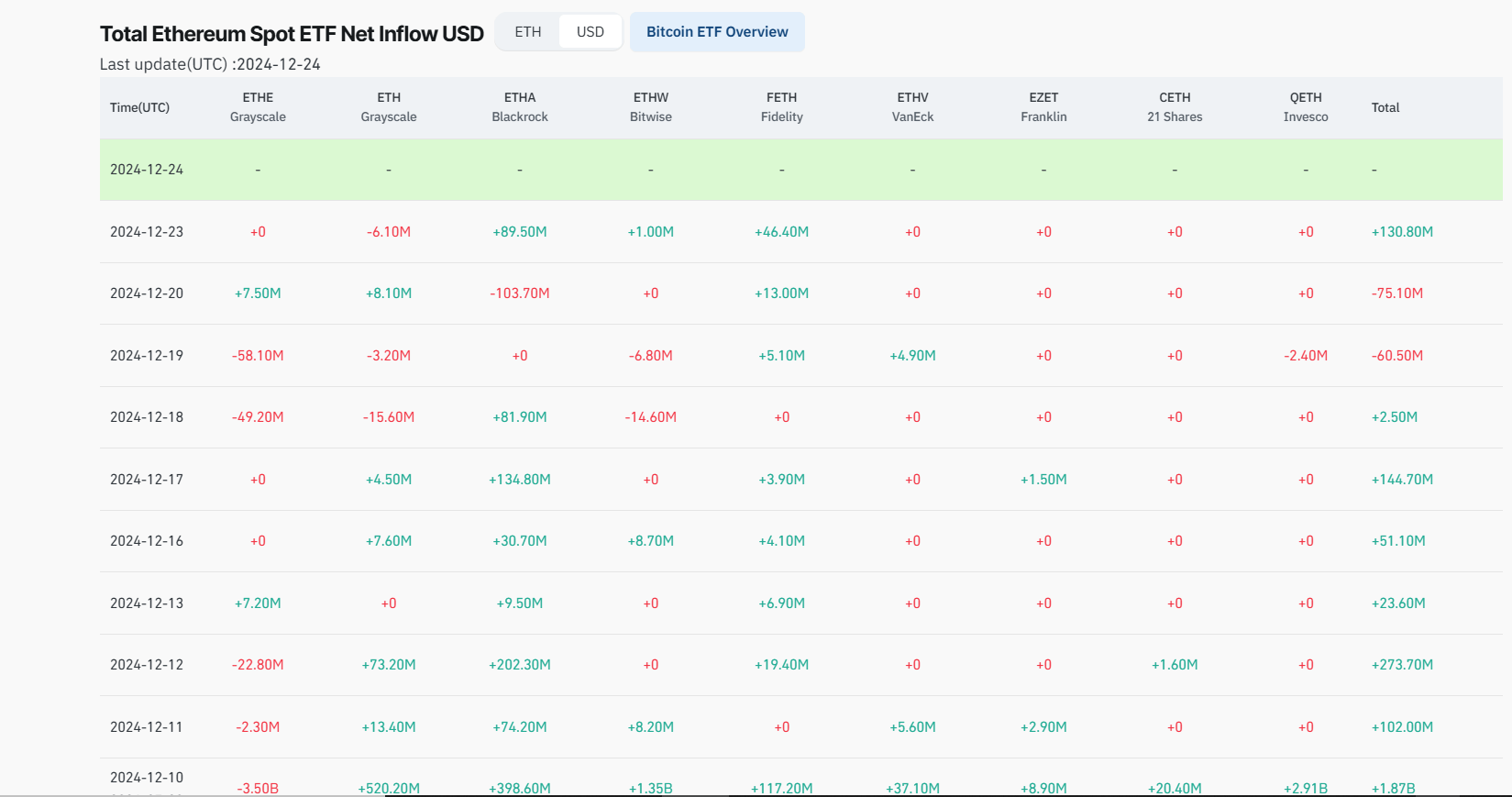
    In a surprising turn of events in the cryptocurrency market, Ethereum spot ETFs have been experiencing significant inflows, overshadowing the outflows noted in Bitcoin ETFs.

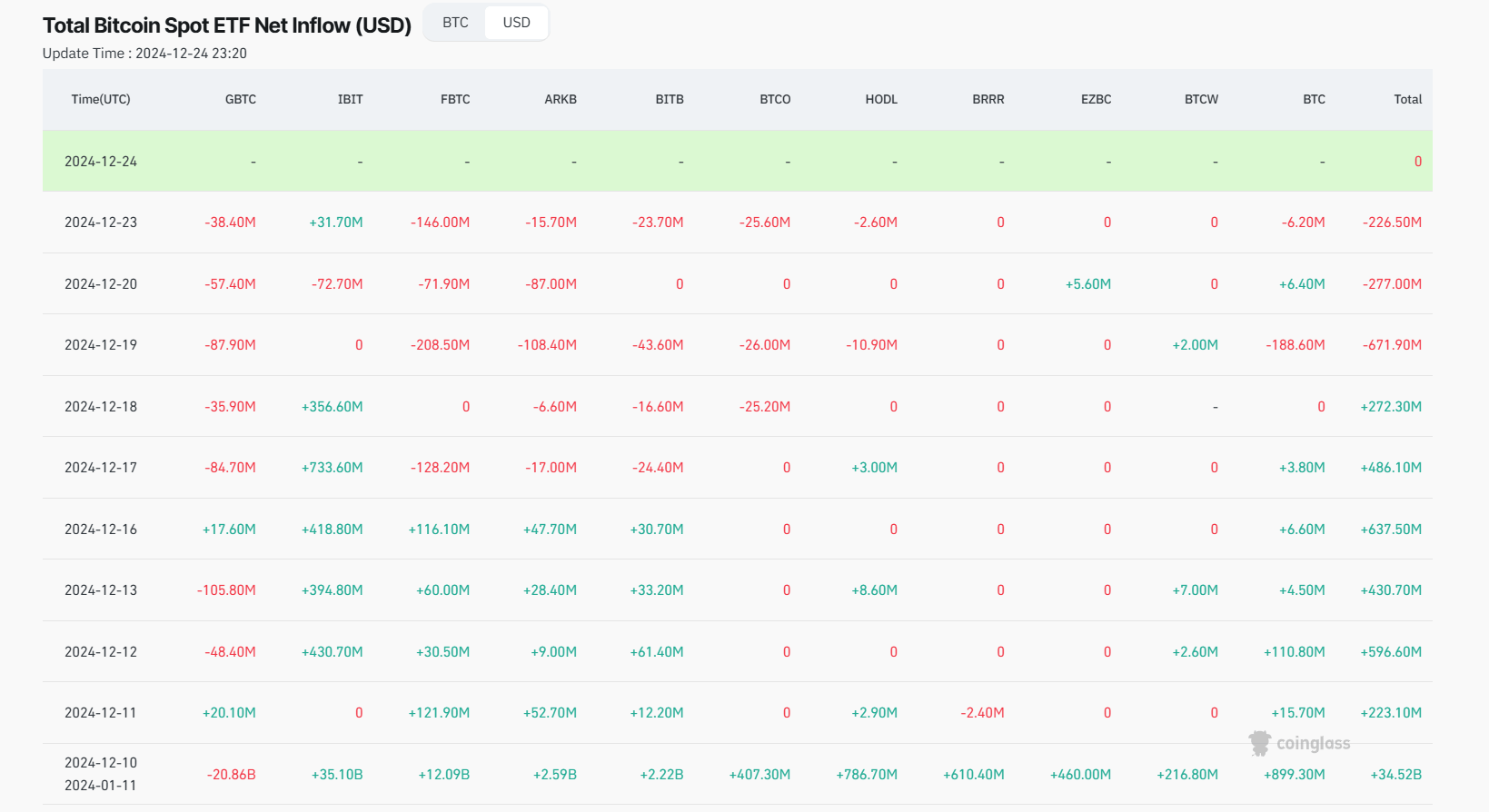
    On December 23, 2024, Ethereum ETFs recorded a net inflow of $130.8 million, with BlackRock’s iShares Ethereum Trust (ETHA) ETF leading with $89.50 million and Fidelity’s Ethereum ETF (FETH) adding $46.40 million according to Coinglass data. In stark contrast, Bitcoin ETFs saw outflows totalling $226.50 million on the same day.

    This trend has been consistent over recent weeks. For instance, on December 12, Ethereum spot ETFs had a cumulative net inflow of $273.70 million, continuing their streak of 14 consecutive days with positive inflows. BlackRock’s ETHA ETF alone saw a single-day net inflow of $202.30 million, while Grayscale’s Ethereum ETF (ETH) contributed $73.20 million.

    Ethereum ETFs inflows
    Source: Coinglass
    Bitcoin ETFs inflows
    Source: Coinglass

    The shift signals a possible start of an altcoin season

    Bitcoin ETFs, despite having higher trading volumes, have been facing outflows, suggesting a possible shift in investor sentiment towards Ethereum.

    Market analysts speculate that this could signal the onset of an ‘altcoin season’, where investors might be diversifying their portfolios beyond Bitcoin, with ETH leading the pack.

    This shift in investment flow is particularly notable as it comes at a time when Bitcoin has been dominating headlines with its price performance, reaching over $108,000 earlier in December.

    The underlying reasons for this trend might include Ethereum’s growing ecosystem, particularly in decentralized finance (DeFi) and non-fungible tokens (NFTs), which could be attracting investors looking for dynamic growth opportunities.

    Additionally, the regulatory environment under the incoming administration might be perceived as more favourable for Ethereum, given its broader use-case applications beyond just being a store of value like Bitcoin.

    This development raises questions about the future direction of crypto investments. While Bitcoin has long been the bellwether of the crypto market, Ethereum’s recent performance in the ETF space might hint at a rebalancing of investor interest, potentially leading to more balanced growth across different cryptocurrencies in 2025.

    Source link

  • US spot Bitcoin ETFs hit $30 billion in combined net inflows since January launch

    US spot Bitcoin ETFs hit $30 billion in combined net inflows since January launch

    • BlackRock’s IBIT attracted the most at over $600 million followed by Fidelity’s FBTC with $301 million
    • The 12 spot Bitcoin ETFs have brought in a combined $30.35 billion since launching in January

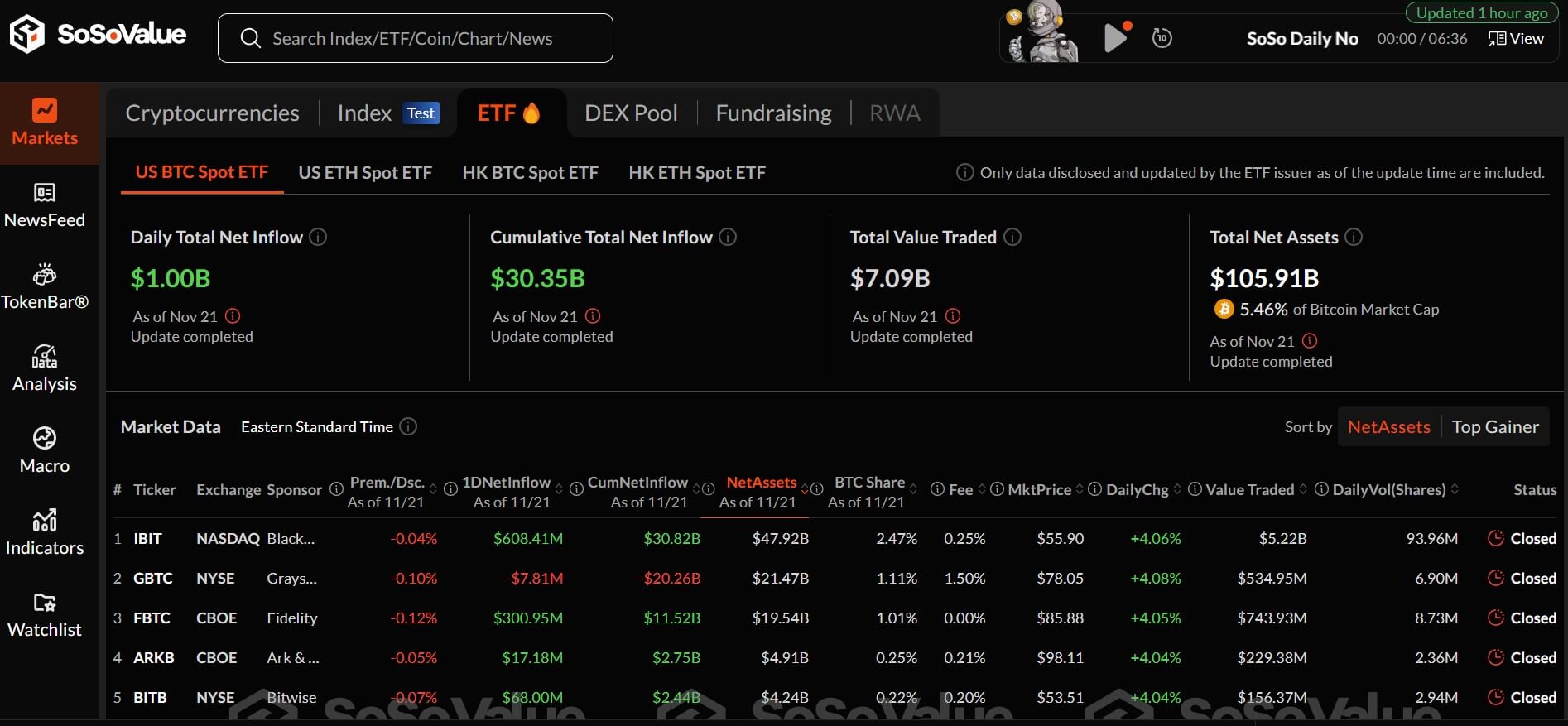
    US spot Bitcoin exchange-traded funds (ETFs) took in $1 billion in daily total net inflows yesterday as Bitcoin inched closer to the $100k mark.

    BlackRock’s iShares Bitcoin Trust (IBIT) saw the most inflows, attracting $608.41 million, according to SoSoValue data. Fidelity’s FBTC followed with $300.95 million. Bitwise’s Bitcoin ETF brought in $68 million and Ark and 21Shares’ ARKB attracted $17.18 million.

    Grayscale’s GBTC was the only one with negative net flows, recording $7.8 million outflows.

    The 12 spot Bitcoin ETFs have earned a combined $30.35 billion since launching in January following approval from the US Securities and Commission (SEC).

    US Spot Bitcoin value. Source: SoSoValue

    Elevated trade among the spot Bitcoin ETFs followed as Bitcoin climbed to the $100k mark on November 22, continuing its bull run.

    The inflows also come after BlackRock launched its options contracts earlier this week. During trading on day one, BlackRock’s options brought in nearly $2 billion, helping to push Bitcoin to more than $94,000.

    Grayscale announced this week that it was also launching Bitcoin ETF options following BlackRock’s impressive debut and a surge in investor interest.

    As trade continues through spot Bitcoin ETFs, it’s becoming clear that these avenues are one of the main ways for investors to hold Bitcoin. According to Bloomberg analyst Eric Balchunas, US Bitcoin ETFs hit $100 billion in assets, adding on X:

    “They’re now 97% of [the] way to passing Satoshi as [the] biggest holder and 82% of [the] way to passing gold ETFs.”

    Elsewhere, in the market, Ethereum is up by more than 7% over the past week at $3,285, Solana has seen a nearly 20% increase at $253, and XRP has risen close to 60% to $1.44 in the same time, according to CoinMarketCap.


    Source link

  • US spot Ethereum ETFs see largest daily outflows since July

    US spot Ethereum ETFs see largest daily outflows since July

    US spot Ethereum ETFs see largest daily outflows since July
    • Overall, US spot Ethereum ETFs saw $79.21 million in outflows on Monday, the largest since July
    • Grayscale’s ETHE recorded a significant $80.55 million outflow on the same day.
    • Spot Bitcoin ETFs had modest inflows of $4.56 million, led by Fidelity’s FBTC.

    On Monday, US spot Ethereum ETFs experienced their largest daily outflows since late July, totalling $79.21 million.

    This significant drop was primarily driven by the Grayscale Ethereum Trust (ETHE), which recorded an outflow of $80.55 million, marking its most substantial outflow since July 31.

    According to data from Sosovalue, ETHE was the only spot Ethereum ETF to report outflows on that day, highlighting a challenging period for the asset class.

    In contrast, Bitwise’s ETHW managed to post a modest inflow of $1.34 million, while the remaining seven spot Ethereum ETFs registered no significant movement.

    The total trading volume for the nine Ethereum ETFs reached $167.35 million, reflecting an increase from $139.47 million the previous Friday. This uptick in trading volume indicates that despite the outflows, investor activity in the Ethereum ETF space remains notable.

    Meanwhile, spot Bitcoin ETFs fared better, experiencing modest inflows of $4.56 million on the same day. This marks the continuation of a three-day streak of inflows, led by Fidelity’s FBTC, which attracted $24.93 million.

    BlackRock’s IBIT, the largest Bitcoin ETF by net assets, also saw positive movement, with inflows of $11.54 million.

    However, Grayscale’s Bitcoin Trust (GBTC) recorded a $40.33 million outflow, making it the only spot Bitcoin ETF to face losses on Monday.

    As the cryptocurrency market fluctuates, with Bitcoin dropping 1.1% to approximately $63,122 and Ether falling 1.32% to around $2,627, these recent developments underline the volatile nature of digital asset investments. Investors will be keenly watching how these trends evolve in the coming days.

    Source link