Tag: Ether

  • The altcoin uprising: Ether, Solana, and BNB defy market fear as Bitcoin stalls

    The altcoin uprising: Ether, Solana, and BNB defy market fear as Bitcoin stalls

    The altcoin uprising: Ether, Solana, and BNB defy market fear as Bitcoin stalls

    • Major altcoins like Ether and Solana are strongly outperforming Bitcoin.
    • BNB, the token of BNB Chain, surged 6% to a new all-time high of 875.
    • Bitcoin’s market dominance is on the verge of hitting a new six-month low.

    In a stunning display of defiance, a powerful cohort of major altcoins staged a dramatic comeback on Wednesday, completely eclipsing Bitcoin and brushing off a wave of risk-aversion that sent traditional stock markets lower.

    The move signals a potential changing of the guard, as leadership in the digital asset space appears to be shifting, at least for now, from the king to its court.

    The rebellion was led by BNB, the native token of the BNB Chain, which blasted through to a fresh all-time high, surging 6% to hit 875.

    The ferocity of the rebound was just as palpable in the Ethereum market, where Ether (ETH) rocketed 7% from its overnight lows to 4,350, completely erasing all of Tuesday’s losses in a single, powerful move.

    Some market observers speculated the rally was fueled by ETH treasury firms strategically buying the dip.

    The strength was broad-based. Solana’s SOL gained a formidable 6.1%, also outpacing its recent decline, while tokens for ChainLink and AAVE put on even more impressive shows, soaring 10% and 7%, respectively.

    A king on shaky ground

    While the altcoin market was exploding with activity, Bitcoin was a sea of calm. The leading cryptocurrency advanced a modest 1.4% from its lows, trading just above 114,000.

    This tepid performance was more in line with the broader capital markets, where major stock indices like the S&P 500 and the tech-heavy Nasdaq closed in the red.

    This stark divergence is forcing a market-wide reassessment. The relative strength of altcoins during a period of fear is a notable and potentially significant signal.

    Bitcoin’s dominance—a key metric measuring its share of the total crypto market capitalization—is now teetering on the brink of a new six-month low.

    Historically, a sustained fall in Bitcoin’s dominance is the classic harbinger of an “altcoin season,” a period where smaller, riskier tokens take the lead.

    But before investors get carried away by dreams of repeating the wild, speculative rallies of past cycles, a crucial note of caution has been sounded.

    Analysts at ByteTree, led by Shehriyar Ali and Charlie Morris, warn that the rules of the game have fundamentally changed.

    “An alt season may be brewing, but it will not look like the wild rallies of the past,” their report stated. 

    Instead, it will be defined by selective, fundamentals-driven growth, rewarding quality projects and penalising those without substance.

    The message is clear: the era of blind speculation may be over. The current uprising is not lifting all boats equally.

    Instead, it appears to be a more discerning, mature rebellion, one that is selectively rewarding projects perceived to have genuine value and long-term potential.

    Source link

  • US SEC announces approval of in-kind redemptions for Bitcoin and Ether ETFs

    US SEC announces approval of in-kind redemptions for Bitcoin and Ether ETFs

    US SEC announces approval of in-kind redemptions for Bitcoin and Ether ETFs

    • US SEC has approved “in-kind” redemptions for Bitcoin and Ether ETFs, allowing direct BTC/ETH share creation.
    • This move aligns US policy with Hong Kong, which has allowed in-kind redemptions for its crypto ETFs since their launch.
    • SEC Commissioner Mark Uyeda had previously criticized the initial cash-only approach, calling it a “troubling precedent.”

    In a significant move that brings US policy more in line with international standards, the Securities and Exchange Commission (SEC) announced on Wednesday that investors are now permitted to use “in-kind” redemptions for Bitcoin and Ether exchange-traded funds (ETFs).

    This decision allows institutional traders to create and redeem ETF shares directly in the underlying crypto assets, a shift that is expected to significantly improve market efficiency.

    The SEC’s decision lets institutional traders create and redeem ETF shares directly in BTC or ETH, a more efficient process that avoids the need for constant conversions to and from fiat currency.

    However, for those watching the global development of crypto products, this is not a novel concept. In Hong Kong, this functionality has been available from the start.

    In late 2023, during the early days of the regulatory process to bring crypto ETFs to market (which ultimately launched in April 2024), the city’s Securities and Futures Commission (SFC) mentioned in a circular that in-kind redemptions would be permitted.

    Part of the reason for this was a technical one: in Hong Kong, ETF issuers were required to partner with licensed local crypto exchanges and use approved custody solutions.

    This was not the case in Ontario, Canada, which had crypto ETFs first, nor was it initially in the US Additionally, Hong Kong did not experience the same prolonged and intense debate about the status of Ether as a potential security as was seen in the United States.

    In contrast, US regulators wrestled for months with a host of concerns, including custody arrangements, anti-money laundering (AML) risks, and the potential for market manipulation.

    While the SEC never issued an explicit ban on in-kind redemptions, ETF sponsors were required to remove this feature from their early filings.

    The Commission initially favored a cash-only redemption model, viewing it as a more cautious first step, citing untested operational processes and uncertainty over how to securely settle large-scale crypto transfers.

    Internal pushback and a ‘troubling precedent’

    This cautious stance was not without its critics, even from within the SEC. SEC Commissioner Mark Uyeda publicly criticized the agency’s approach during the landmark approval of spot Bitcoin ETFs in January 2024.

    He pointed out that commodity-based ETFs, such as those backed by physical gold, routinely use in-kind redemptions and questioned why crypto was being treated so differently.

    Uyeda argued that the SEC had failed to adequately explain why it considered cash-only redemptions to be “non-novel,” despite the clear deviation from standard practice for similar exchange-traded products.

    He warned that this lack of clear reasoning set a “troubling precedent” for future digital asset regulation. The latest decision to allow in-kind redemptions appears to be a tacit acknowledgment of these and other industry arguments.

    The episode ultimately highlights how Hong Kong’s regulator managed to move with greater clarity and cohesion from the very beginning of its crypto ETF journey.

    By enabling in-kind redemptions early on and pairing them with strict licensing and custody requirements, the SFC avoided the internal contradictions and policy drift that characterized the initial US rollout.

    Broader markets and industry moves

    This significant regulatory development comes amidst a mixed backdrop for global markets and continued deal-making in the crypto industry.

    • BTC: Bitcoin is trading above $117,500 after a modest rebound, but its momentum remains weak.

    • The market is contending with persistent ETF outflows, profit-taking from whales near the $118,000 level, and macroeconomic headwinds, including a firm US dollar and hawkish Fed expectations, which continue to limit its upside.

    • ETH: Ethereum is trading above $3,700. “Ethereum has proven in parallel with BTC since its inception to be the second most battle-tested network, and very likely institutions now see Ether the token as a formidable asymmetric bet alongside bitcoin,” said March Zheng, General Partner of Bizantine Capital, in a note to CoinDesk.

    • Gold: Gold rebounded to $3,334 on Tuesday, snapping a four-day losing streak ahead of a key Fed meeting, as traders priced in steady rates despite weak US job data.

    • Nikkei 255: Asia-Pacific markets opened mixed as US Commerce Secretary Howard Lutnick confirmed that President Trump’s Friday tariff deadline will proceed as planned, with Japan’s Nikkei 225 flat at the open.

    • S&P 500: US stocks closed lower on Tuesday, with the S&P 500 ending a six-day record streak as investors weighed corporate earnings, economic data, and the upcoming Fed rate decision.

    In other industry news, cryptocurrency exchange Kraken is reportedly set to raise $500 million in a new funding round at a lofty $15 billion valuation, according to a report from The Information on Tuesday, which cited people familiar with the matter.

    A spokesperson for Kraken declined to comment on the report. This news underscores the increased investor interest in cryptocurrency-focused companies, as the digital asset class benefits from growing regulatory clarity and rising institutional adoption.

    This trend has also prompted other crypto firms, including custody startup BitGo and asset manager Grayscale, to pursue US listings.

    Kraken has been actively investing capital to expand into various asset classes and grow its user base, and in March, the company announced it would acquire the futures trading platform NinjaTrader in a $1.5 billion deal.

    Source link

  • Ether outperforms Bitcoin in May; ETH derivatives volume surpasses BTC on OKX

    Ether outperforms Bitcoin in May; ETH derivatives volume surpasses BTC on OKX

    Ether outperforms Bitcoin in May; ETH derivatives volume surpasses BTC on OKX

    • Ether (ETH) at $2,770, up nearly 11% this month, outperforming Bitcoin’s (BTC) 5% rise.
    • ETH (45.2%) now overshadows BTC (38.1%) in trading volume on OKX’s perpetual futures market.
    • Despite BTC volatility, institutions are “buying the dips,” with long-term holder supply growing, per Glassnode.

    As Asian markets kicked off their Thursday trading, Ether (ETH) was changing hands at $2,770, having demonstrated robust performance throughout the month.

    This strength, particularly in derivatives markets where it’s reportedly overshadowing Bitcoin (BTC), signals a growing institutional appetite for Ethereum’s structural growth potential and its pivotal role in bridging decentralized finance (DeFi) with traditional finance (TradFi).

    Meanwhile, the broader crypto landscape is seeing a significant surge in stablecoin activity, with Tron emerging as a key beneficiary.

    Ether has notably outperformed Bitcoin this month, with CoinDesk market data showing an almost 11% rise for ETH compared to BTC’s 5% gain.

    This divergence is partly attributed to increasing institutional trading demand for Ethereum. Lennix Lai, Chief Commercial Officer at crypto exchange OKX, told CoinDesk in an interview that sophisticated investors are increasingly betting on ETH, a trend evident in its derivatives market activity.

    “Ethereum is overshadowing BTC on our perpetual futures market, with ETH accounting for 45.2% of trading volume over the past week. BTC, by comparison, sits at 38.1%,” Lai revealed.

    This finding aligns with similar trends observed on other major derivatives platforms like Deribit, as CoinDesk recently reported, suggesting a significant shift in how institutional players are allocating capital within the crypto space.

    This isn’t to say that institutional interest in Bitcoin has waned. A recent report from on-chain analytics firm Glassnode indicates that despite Bitcoin’s recent price volatility, institutions have been actively “buying the dips.”

    Glassnode’s analysis showed that long-term holders (LTHs) realized over $930 million in profits per day during recent BTC rallies, a distribution level rivaling those seen at previous market cycle peaks.

    Remarkably, instead of triggering a broader sell-off, the supply held by these LTHs actually grew.

    “This dynamic highlights that maturation and accumulation pressures are outweighing distribution behavior,” Glassnode analysts wrote, noting that this is “highly atypical for late-stage bull markets.”

    Despite these underlying strengths, both leading cryptocurrencies remain susceptible to geopolitical risks and unpredictable “black swan” events, such as the recent public dispute between US President Donald Trump and tech billionaire Elon Musk.

    Such episodes serve as stark reminders that market sentiment can shift rapidly, even within structurally strong markets.

    However, beneath this surface-level volatility, institutional conviction appears to remain intact.

    Ethereum is increasingly being viewed as the preferred vehicle for accessing regulated DeFi opportunities, while Bitcoin continues to benefit from long-term accumulation by institutions, often via Exchange Traded Funds (ETFs).

    “Macro uncertainties remain, but $3,000 ETH looks increasingly likely,” Lai concluded, offering a bullish outlook for Ethereum’s near-term price potential.

    Stablecoin surge: liquidity pours in, Tron leads the charge

    The stablecoin market is experiencing a significant boom, recently hitting an all-time high market capitalization of $228 billion, marking a 17% increase year-to-date, according to a new report from CryptoQuant.

    This surge in dollar-pegged liquidity is being driven by renewed investor confidence, buoyed by factors such as the blockbuster Initial Public Offering (IPO) of stablecoin issuer Circle, rising yields in DeFi protocols, and improving regulatory clarity in the US This influx of capital is quietly redrawing the map of where liquidity resides on-chain.

    “The amount of stablecoins on centralized exchanges has also reached record high levels, supporting crypto trading liquidity,” CryptoQuant reported.

    Their data indicates that the total value of ERC20 stablecoins (those built on Ethereum) on centralized exchanges has climbed to a record $50 billion.

    Interestingly, most of this growth in exchange stablecoin reserves has been a result of the increase in USDC reserves on these platforms, which have grown by 1.6 times so far in 2025 to reach $8 billion.

    When it comes to the blockchain protocols benefiting most from these stablecoin inflows, Tron has emerged as the clear leader.

    Tron’s combination of fast transaction finality and deep integrations with major stablecoin issuers like Tether is credited with making it a “liquidity magnet.”

    Presto Research, in a recently released report echoing these findings, noted that Tron notched over $6 billion in net stablecoin inflows in May alone.

    This figure topped all other chains and positioned Tron with the second-highest number of daily active users, just behind Solana.

    Tron was also the top performer in terms of native total value locked (TVL) growth.

    In contrast, both Ethereum and Solana experienced significant stablecoin outflows and losses in bridge volume during the same period, according to Presto’s data.

    This suggests a potential lack of new yield opportunities or major protocol upgrades attractive enough to retain or draw in fresh stablecoin capital on those networks.

    Presto’s data confirms a broader trend: institutional and retail capital alike are increasingly rotating towards alternative Layer 1 and Layer 2 solutions like Base, Solana (despite recent outflows, it still attracts users), and Tron.

    The common denominators among these favored chains appear to be faster execution speeds, more dynamic and evolving ecosystems, and, in some cases, more substantial incentive programs.

    Source link

  • Bitcoin ETFs outperform Ether ETFs as BlackRock’s IBIT leads peers

    Bitcoin ETFs outperform Ether ETFs as BlackRock’s IBIT leads peers

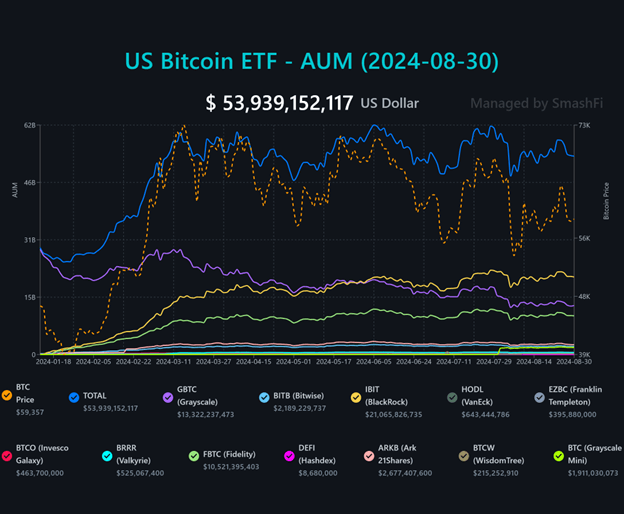
    Bitcoin ETF flows outperform Ether ETFs as BlackRock's IBIT leads peers
    • Bitcoin ETFs have attracted $5B net inflows while Ether ETFs have seen $500M net outflows.
    • BlackRock’s IBIT leads with over $224M in a single day, currently holding over 350,000 BTC.
    • Ether ETFs are struggling due to liquidity issues and Grayscale’s $2.5B outflows.

    Recent trends in the cryptocurrency exchange-traded funds (ETF) market have highlighted a significant divergence in the performance of Bitcoin and Ether ETFs.

    Comparing Bitcoin ETF Flow data to Ethereum ETF Flow data on Farside Investors, Ether spot ETFs have underwhelmed compared to their Bitcoin counterparts. Since their launch, Ether ETFs have experienced net outflows of approximately $500 million, a stark contrast to the $5 billion net inflows recorded by BTC ETFs during a similar period following their debut.

    Several factors contribute to this disparity. To start with, Bitcoin’s “first mover advantage,” higher liquidity, and lack of staking opportunities in Ether ETFs have made Bitcoin more appealing to institutional investors.

    Additionally, unexpected outflows from Grayscale’s Ethereum Trust (ETHE), amounting to $2.5 billion, far exceeding the bank’s initial $1 billion estimate, have further dampened Ether ETF performance. To counter these outflows, Grayscale introduced a mini-Ether ETF, but it has only managed to attract $200 million in inflows.

    In contrast, BTC ETFs have shown resilience and robust performance with US-based BTC ETFs recording an impressive eight-day winning streak, with net inflows totalling $202 million led by BlackRock’s iShares Bitcoin Trust (IBIT).

    On August 26 alone, IBIT attracted over $224 million in net inflows bringing its total Bitcoin holdings to over 350,000 BTC, solidifying its dominance in the market.

    Bitcoin ETF flows outperform Ether ETFs as BlackRock's IBIT leads peers
    US Bitcoin ETF AUM, August January 18 – August 30, 2024|Source: Bitcoin ETF Fund Flows

    Competing funds such as those managed by Franklin Templeton and WisdomTree also saw positive inflows, while others, including Fidelity, Bitwise, and VanEck, reported negative flows. Notably, Grayscale’s Bitcoin Trust (GBTC) saw a decline in redemptions over the past two weeks, indicating stabilization in the market.

    As investor confidence in Bitcoin ETFs grows, asset managers are increasingly exploring combined ETFs that offer exposure to both Bitcoin and Ethereum, reflecting the evolving dynamics of the cryptocurrency investment landscape.

    Source link

  • Bitcoin, Ether prices up as stocks tank on new bank fears

    Bitcoin, Ether prices up as stocks tank on new bank fears

    • Bitcoin (BTC) and Ethereum (ETH) prices rose nearly 2% respectively as stocks plunged.
    • The S&P 500 was down 1.5% as two bank stocks plummeted.
    • BTC and ETH gains saw altcoins in the top 10 cryptocurrencies by market cap up.

    Bitcoin (BTC) price moved above $28,500 again on Tuesday, rising more than 2% in early morning trades during the US trading session. The upside was yet another attempt by Bitcoin bulls to establish a fresj footing in the key price range.

    Elsewhere, the price of Ethereum (ETH) rose above $1,860 to hit a new 24-hour high as crypto spot markets climbed. The Ether token was 1.9% up at the time of writing, gains that were being mirrored across the top 10 cryptocurrencies by market cap list.

    BTC and ETH have traded to year-to-date highs above $31,000 and $2,100 respectively.

    Stocks tank on bank fears

    US stocks opened lower on Tuesday as stock prices of another two US banks plunged amid the latest turmoil in the banking sector. The S&P 500 was down 1.5% while Nasdaq was shedding 1.3%.

    After share prices of First Republic Bank fell in the lead up to its takeover by JPMorgan, Tuesday saw prices of Pacwest (PACW) and Western Alliance (WAL) stocks bleed massively.

    At about 12:30 pm ET, the PACW and WAL share prices were down 26% and 20% respectively.

    The two bank stocks had plummeted more than 30% earlier as investor concerns around the turbulence within the US banking system resurfaced following the losses that followed the collapse of Silicon Valley Bank.

    Also on investors’ minds this week is the Fed’s meeting that kicked off on Tuesday. While the market has the anticipated 25bps interest rate hike baked in for after the FMC meeting, what the central bank says in relation to what next is seen as key.

    Economist Mohamed A. El-Erian, commented on the market outlook, stating via a tweet:

    The roller coaster continues with, this time around, a 20 bps drop in the yield on 2-year Treasuries.  With such a key market segment continuing to be in urgent need of stabilization, it remains to be seen if the Fed serves this function tomorrow or, instead, is again a source of volatility.”

    Barry Knapp of Ironsides Macroeconomics says the Fed’s approach to the inflation question is fraught and dubious. The central bank has to consider what the market is telling it. He shared his views in an interview with CNBC’s Squawk Box.


    Source link

  • CME Group to expand BTC and Ether options expiries in May

    CME Group to expand BTC and Ether options expiries in May

    • CME group says demand from clients has increased amid the heightened market volatility.
    • The marketplace plans to expand expiries for its standard and micro-sized BTC and Ether options contracts.
    • Approval would see the derivatives platform make the changes on 22 May, 2023.

    Derivatives marketplace CME Group is seeking to expand its options expiries for Bitcoin and Ethereum, according to an announcement published today, 17 April 2023.

    The platform, which says the plans are subject to regulatory approval, indicates that the plan is to have its suite of crypto options for BTC and ETH contracts expiries be available every business week day – Monday to Friday.

    Currently, expiries for micro-sized options on the two crypto futures are available on Monday, Wednesday and Friday. The CME also offers monthly and quarterly expiries for BTC and ETH options on its futures contracts.

    If approved, the company will look to have the new expiries available beginning 22 May.

    Client demand for BTC and ETH products

    Giovanni Vicioso, CME Group Global Head of Cryptocurrency Products said the goal is to have market participants access options contracts that offer “greater precision and versatility” for managing short-term Bitcoin and Ethereum price risk.

    Against a backdrop of heightened market volatility in the digital asset sector, we continue to see clients turn to a trusted, regulated venue like CME Group for reliable and efficient cryptocurrency risk management products,” Vicioso added.

    CME Group has seen an increase in demand for Bitcoin and Ethereum futures and options. The top two assets by market cap are also the two best cryptocurrencies for crypto derivatives trading

    The bitcoin’s numbers in Q1, 2023 for CME achieved a notional of over $3 billion, a record in terms of daily average. The marketplace also saw a record BTC options contracts of 2,357 traded on 22 March 22. Open interest rose to an all-time high of 14,700 contracts on 31 March and could soar further amid a long-term bullish Bitcoin price prediction, particularly going into the next halving.

    The all-time high for Ether options contracts was 311 on 22 February, while OI hit a record 1,800 contracts on 24 March.

    Source link