
Tag: expansion

  • Babylon pushes Bitcoin into on-chain finance as a16z crypto backs expansion

    Babylon pushes Bitcoin into on-chain finance as a16z crypto backs expansion

    Babylon pushes Bitcoin into on-chain finance as a16z crypto backs expansion

    • Trustless BTCVaults aim to use Bitcoin as on-chain collateral without wrappers or custodians.
    • Babylon’s staking previously reached over $2 billion in total value locked.
    • An integration with Aave V4 is expected to bring native Bitcoin collateral to DeFi by April 2026.

    Babylon is moving to widen Bitcoin’s role in on-chain finance, following fresh backing from venture capital firm a16z Crypto.

    The investment supports Babylon’s transition from a single-purpose staking platform toward a broader financial infrastructure built directly on Bitcoin.

    Rather than focusing only on yield, the project is positioning BTC as usable collateral across lending and other decentralised applications, without relying on wrapped tokens or custodial bridges.

    The shift reflects a growing push across crypto markets to unlock capital efficiency from Bitcoin’s large but largely inactive supply, while keeping security anchored to the Bitcoin network itself.

    a16z crypto investment

    On Dec. 7, a16z Crypto disclosed a $15 million investment in Babylon, made through the purchase of Babylon’s native BABY tokens.

    Babylon was originally developed as a Bitcoin staking protocol that allows BTC holders to earn yield without transferring assets off the Bitcoin network.

    The firm said the investment reflects confidence in Babylon’s approach to extending Bitcoin’s functionality beyond staking, while preserving Bitcoin’s core security assumptions.

    a16z positioned the project as a potential neutral alternative to wrapped BTC models, which currently dominate decentralised finance but introduce reliance on issuers, custodians, or multi-signature structures.

    Trustless BTCVaults explained

    Babylon is now expanding into lending infrastructure through what it calls Trustless BTCVaults.

    These vaults are designed to allow Bitcoin to act as verifiable on-chain collateral without bridges, wrappers, or custodians.

    The architecture relies on cryptographic tools such as witness encryption and garbled circuits to enable conditional execution tied directly to Bitcoin transactions.

    The aim is to let Bitcoin interact with decentralised applications while remaining native to its own network.

    According to a16z, this design could reduce counterparty and settlement risks that arise when BTC is represented on other blockchains via synthetic tokens.

    Babylon’s approach targets the large pool of Bitcoin capital that currently sits idle, estimated at more than $1.4 trillion, by making it usable in lending, credit, and other capital-efficient use cases.

    Founders and technical roots

    Babylon was founded by David Tse and Fisher Yu.

    Tse is a professor at Stanford University and is known for his academic work in information theory and blockchain research.

    a16z highlighted Tse’s long-standing role in mentoring crypto founders and researchers as part of its rationale for backing the project.

    The firm framed the investment as support for technically driven infrastructure that could reshape how Bitcoin integrates with decentralised finance, rather than incremental improvements to existing staking models.

    From staking to DeFi integration

    Babylon’s staking protocol has previously drawn significant demand.

    Earlier staking caps recorded more than $2 billion in total value locked, with participation from institutional custodians such as BitGo and exchange partners including Kraken.

    More recently, development has shifted toward BTCVaults and native Bitcoin lending.

    In early December 2025, Babylon and Aave announced that native Bitcoin would be used as collateral on Aave V4.

    The proposed integration includes Aave’s first Bitcoin-backed “Spoke”, enabling borrowing and lending against BTC without converting it into ERC-20 tokens.

    The launch is expected around April 2026.

    If successful, it could open new decentralised finance markets built directly on Bitcoin’s base layer, with potential extensions into perpetual futures, stablecoins, and other financial primitives.
    Source link

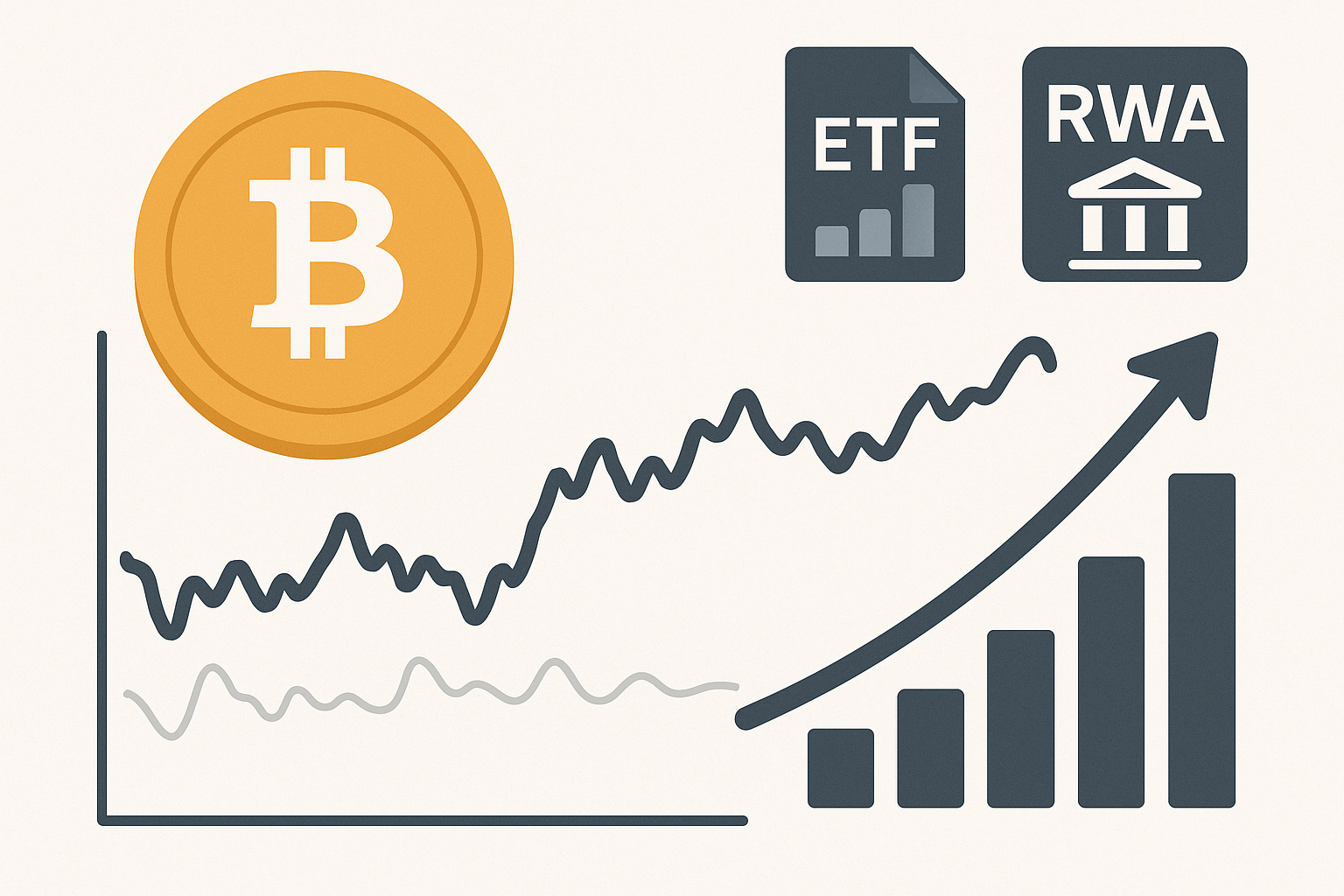
  • Glassnode report reveals Bitcoin’s growing stability amid ETF activity and RWA expansion

    Glassnode report reveals Bitcoin’s growing stability amid ETF activity and RWA expansion

    Glassnode report reveals Bitcoin’s growing stability amid ETF activity and RWA expansion

    • Bitcoin’s 2025 cycle shows rising institutional flows, lower volatility, and deeper liquidity.
    • Tokenized real-world assets surge to $24 billion, boosting institutional adoption and on-chain activity.
    • ETFs reshape Bitcoin liquidity as stablecoins remain key rails in a more mature digital asset market.

    Bitcoin’s latest cycle is developing under a very different market structure, with data from Glassnode and Fasanara Capital pointing to deeper institutional participation, rapid growth in tokenized real-world assets, and a notable drop in volatility.

    Their Q4 Digital Assets Report highlights how Bitcoin’s behaviour has shifted as regulated investment channels expand, and liquidity becomes more stable across spot, derivatives, and on-chain markets.

    The findings show how ETF flows, settlement activity, and broader adoption of tokenised instruments are shaping a more mature phase in the digital asset ecosystem.

    These structural changes are defining how capital moves through Bitcoin in 2025.

    Institutional flows reshape the cycle

    The report estimated that Bitcoin has absorbed around $732 billion in new capital during this cycle.

    This has occurred alongside a clear decline in one-year realised volatility, which has fallen by nearly half.

    Glassnode linked this trend to increased depth across major markets and a larger share of trading driven by institutional strategies.

    Glassnode also reported that Bitcoin settled approximately $6.9 trillion over the past 90 days.

    This puts Bitcoin in a range comparable to payment networks such as Visa and Mastercard.

    Even with more trading moving into ETF and brokerage channels, the report found that Bitcoin and stablecoins still dominate value transfer on public blockchains.

    ETF channels deepen liquidity

    ETF-linked demand has reshaped how investment enters and exits Bitcoin.

    Instead of relying mainly on on-chain movement or exchange activity, a greater share of flows now passes through regulated investment vehicles.

    According to the report, this shift has encouraged smoother liquidity conditions and fewer sharp price changes in spot markets.

    Traditional market makers and arbitrage firms have increased their presence due to ETF participation.

    Their involvement has tightened spreads and reduced disruption during periods of heightened selling pressure.

    This development reflects a broader alignment between digital asset markets and established financial infrastructure.

    Tokenized RWAs accelerate

    Tokenized real-world assets have expanded from $7 billion to $24 billion within one year.

    Glassnode stated that this rise reflects stronger institutional demand, including interest from pension funds, hedge funds, and corporations that want on-chain exposure to familiar financial instruments.

    Tokenized funds have gained momentum as asset managers test new distribution models and investors seek simplified access to traditional assets.

    Platforms involved in tokenised RWAs have strengthened custody, settlement, and compliance systems.

    This foundation has encouraged consistent inflows throughout 2025, supporting a growing segment of the market that links traditional assets with blockchain settlement rails.

    Stablecoin role strengthens

    Glassnode described the market structure as larger and more stable than in previous cycles.

    The data indicated deeper liquidity across spot, derivatives, and on-chain channels, which has contributed to a more measured trading environment.

    Reduced volatility has become a defining feature of the cycle, shaped by institutional trading strategies that tend to use steady allocation models.

    Stablecoins continue to serve as key connectors between traditional and digital financial systems.

    The report stated that stablecoin settlement demand remains substantial across centralised and decentralised platforms.

    Glassnode characterised the dual-rail system created by stablecoins and traditional infrastructure as a permanent part of the ecosystem, supporting both institutional flows and retail trading activity.

    Analysts referenced in the report expect institutional participation to expand as tokenised funds gain broader acceptance.

    Glassnode presented this phase as a turning point marked by heavier institutional flows, rising tokenisation, and reduced volatility.

    These factors suggest that Bitcoin and the wider digital asset sector are moving into a more structurally mature environment in 2025.

    Source link