Tag: gold

  • Deutsche Bank sees parallels between Gold and Bitcoin as central banks boost gold reserves

    Deutsche Bank sees parallels between Gold and Bitcoin as central banks boost gold reserves

    • Deutsche Bank says gold now makes up 24% of central bank reserves, the highest share since the 1990s.
    • Analyst Marion Laboure sees parallels between gold and Bitcoin as safe-haven, low-correlation assets.
    • Deutsche Bank predicts both Bitcoin and gold could join central bank reserves by 2030.

    Global central banks are expanding their gold holdings at a pace not seen in decades, a trend that could have major implications for Bitcoin, according to a new report from Deutsche Bank.

    The bank’s strategists noted that gold’s share of central bank reserves climbed to 24% in the second quarter, its highest level since the 1990s, marking a renewed confidence in the precious metal amid shifting global monetary dynamics.

    Deutsche Bank’s findings highlight how gold’s resurgence and Bitcoin’s momentum in 2025 share several common characteristics, particularly as investors and policymakers seek alternative stores of value in an uncertain economic environment.

    Central Banks’ Gold accumulation reaches multi-decade highs

    The report shows that official demand for gold has doubled compared to the 2011–2021 average, signaling an intensified effort by central banks to diversify away from fiat currencies.

    The strategists described this as a “significant shift in global finance,” echoing patterns seen throughout the 20th century when gold played a dominant role in global reserves.

    Gold’s renewed accumulation coincides with its climb past inflation-adjusted all-time highs.

    Although gold prices have been setting nominal records for several years, Deutsche Bank noted that only recently has the metal surpassed its real-adjusted peak from 1980.

    “It’s only in recent weeks that gold has finally surpassed its real-adjusted all-time highs from around this point 45 years ago,” the bank’s strategists wrote.

    They attributed the decades-long gap between those milestones to a combination of factors, including central bank gold sales, institutional sell-offs, and the rise of the fiat currency era.

    The report also recalled that gold’s formal role as a reserve asset ended in 1979 when the International Monetary Fund (IMF) prohibited member countries from pegging exchange rates to gold — a move that cemented the end of the Bretton Woods system.

    Bitcoin emerges as a modern parallel to Gold

    Deutsche Bank’s macro strategist Marion Laboure explored potential parallels between gold and Bitcoin in a report titled Gold’s reign, Bitcoin’s rise.”

    She observed that both assets have shown similar long-term performance patterns since their inception and share a reputation for high volatility and periods of underperformance.

    Laboure emphasized that both gold and Bitcoin have a low correlation with traditional financial assets, making them attractive options for diversification.

    These shared traits, she suggested, contribute to their appeal as potential “safe-haven” assets in times of market uncertainty.

    While Laboure acknowledged that Bitcoin’s volatility and lack of backing remain major concerns, she noted that volatility has declined to historic lows.

    Other challenges — including limited adoption, speculative behavior, cybersecurity risks, and liquidity constraints — continue to limit Bitcoin’s suitability as a mainstream reserve asset, but its trajectory is drawing increasing institutional attention.

    Looking ahead: Bitcoin and Gold in central bank reserves by 2030?

    Despite lingering skepticism among policymakers, Laboure predicted that both Bitcoin and gold could feature on central bank balance sheets by 2030.

    The forecast reflects a gradual convergence between traditional and digital stores of value, particularly as institutional adoption of Bitcoin expands and governments explore ways to diversify their reserves.

    Still, she cautioned that Bitcoin’s volatility and perceived risk profile remain key barriers for central banks, whose primary mandate is to preserve capital stability.

    Source link

  • Bitcoin remains under pressure as gold targets a new all-time high

    Bitcoin remains under pressure as gold targets a new all-time high

    Bitcoin remains under pressure as gold targets a new all-time high

    • Bitcoin’s rally attempt fails as it retreats to below 112,000 dollars.
    • Gold continues its quiet but powerful climb, nearing its all-time high.
    • In August, gold is up nearly 4 percent while Bitcoin has fallen over 5 percent.

    A hopeful rally in the cryptocurrency market was decisively crushed on Thursday, as steady selling pressure throughout the US trading session sent prices into a familiar retreat.

    The failed bounce underscores a growing sense of fatigue in the digital asset space and throws a stark and revealing light on the silent, powerful ascent of its analog rival: gold.

    After a brief flirtation with the 113,000 dollar level, Bitcoin (BTC) was beaten back, sinking to 111,800 late in the session for a loss of 0.7 percent over the past 24 hours.

    The selling was even more pronounced in other major tokens, with Ether (ETH) and XRP shedding a more sizable 2.1 percent and 1.4 percent, respectively.

    The one notable bright spot in a sea of red was Solana’s SOL, which managed to buck the trend with a respectable 3.1 percent gain.

    A silent ascent to the summit

    While the crypto market grapples with its own inertia, a different story is unfolding in the world of precious metals.

    Quietly, but with unshakable conviction, gold has been on the rise. The yellow metal added another 0.8 percent on Thursday, climbing to 3,477 dollars per ounce.

    This puts the safe-haven asset just a few dollars shy of the record high of 3,534 dollars it touched earlier this month.

    The performance in August paints an even more dramatic picture of this great divergence: while Bitcoin has slid 5.2 percent, gold has rallied by nearly 4 percent.

    The great disconnect

    This decoupling is the great mystery currently haunting the market.

    The very same macroeconomic tailwinds that are propelling gold higher—namely, the prospect of lower interest rates and a weaker US dollar—are conspicuously failing to ignite any significant bid for “digital gold.”

    The fundamental case for Bitcoin as an inflation hedge and a store of value is being put to a severe test, and for now, it is failing.

    A September showdown looms

    The stage is now set for a potentially volatile final four months of the year.

    The resumption of Federal Reserve rate cuts appears to be firmly on the table for September, a move that could be amplified by President Trump’s appointment of one or possibly two new, likely dovish, members to the Fed’s board.

    As these powerful forces converge, the market is watching to see if Bitcoin can finally catch the golden tailwind or if its strange and troubling disconnect is a sign of a deeper malaise.

    Source link

  • JPMorgan says Bitcoin is undervalued compared to gold as volatility plummets

    JPMorgan says Bitcoin is undervalued compared to gold as volatility plummets

    The report suggests this shift is making Bitcoin more credible, much like traditional assets. It’s solidifying its role as both an investment and a store of value in mainstream markets.

    In fact, corporate treasuries now hold more than 6% of the total Bitcoin supply.

    Publicly traded companies are also gaining exposure by being included in stock indices, which brings in more money without them having to directly trade crypto.

    Following up on that, JPMorgan’s analysis also shows that Bitcoin is undervalued by about $16,000 when you compare it to gold, using models that account for volatility.

    Their report puts an implied price target for Bitcoin at roughly $126,000.

    This suggests there’s a lot of room for the price to grow as the market catches up to Bitcoin’s new stability and its growing role with institutional investors.

    Even though Bitcoin’s price has been resiliently holding above $111,000, this valuation gap means there’s still a lot of potential for it to appreciate further as more people adopt it and its volatility stays low.

    Market dynamics and future outlook

    In their analysis, JPMorgan also points to a shift in market dynamics. Passive capital, which is the money coming from index funds that buy shares in companies holding Bitcoin, is creating a steady demand.

    This helps shield Bitcoin from being driven solely by speculative trading.

    They also noted that the 200-day moving average has been a strong technical support level, which reinforces a long-term bullish outlook even with small, short-term price swings.

    Still, some indicators show that traders are keeping cautious hedging positions in the options markets. This reflects a more short-term bearish sentiment, even though the overall trend remains positive.

    Source link

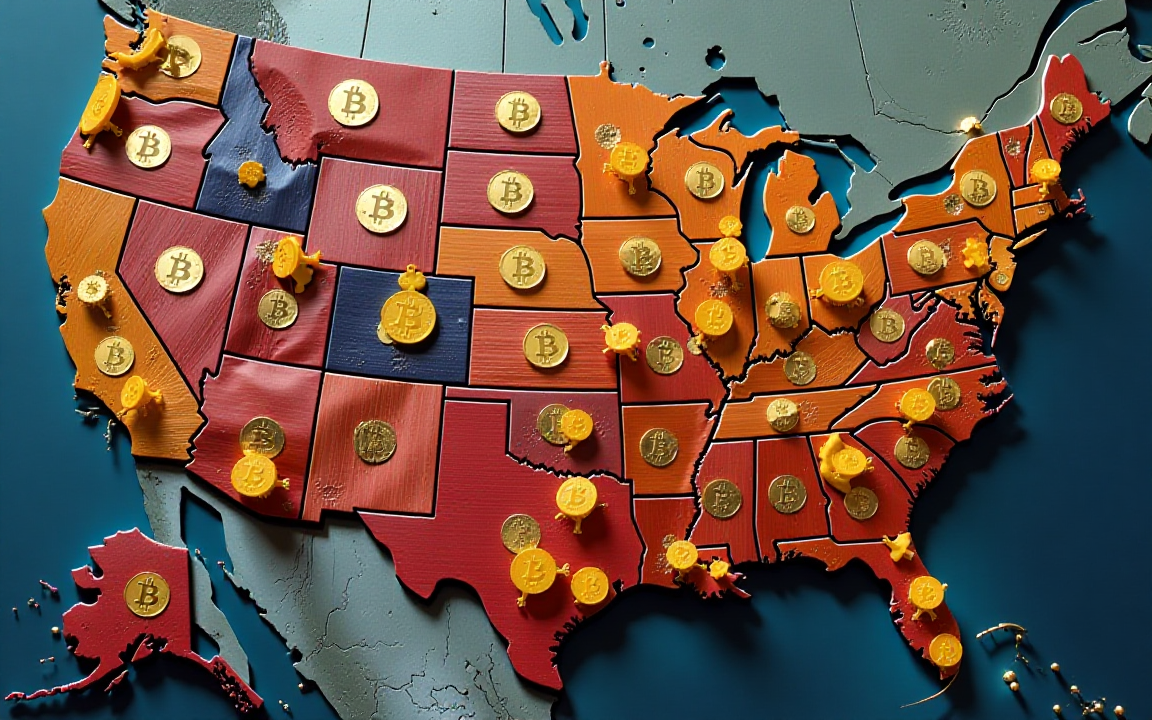
  • Bitcoin ownership surpasses gold in the US as 50M Americans hold BTC

    Bitcoin ownership surpasses gold in the US as 50M Americans hold BTC

    Bitcoin ownership in the US

    • 50 million Americans now own Bitcoin, surpassing 37 million gold holders.
    • US firms hold 94.8% of publicly traded companies’ Bitcoin reserves.
    • US leads globally with 40% of all Bitcoin companies headquartered domestically.

    Bitcoin has officially outpaced gold in US ownership, marking a significant pivot in the country’s investment landscape.

    According to a new report released on 20 May by Bitcoin investment firm River, roughly 50 million Americans now own Bitcoin, compared to 37 million who own gold.

    This data underscores the rise of Bitcoin as a preferred store of value, reshaping traditional notions of economic security and reserve asset status.

    As Bitcoin ownership expands, it’s increasingly seen not just as a speculative instrument, but as a fundamental part of US financial infrastructure.

    US leads in global Bitcoin adoption and infrastructure

    The River report notes that the United States is the global leader in Bitcoin adoption, with 40 percent of all Bitcoin-related companies headquartered in the country.

    American firms also hold 94.8 percent of all Bitcoin owned by publicly traded companies worldwide, reflecting significant institutional backing.

    This dominance is supported by a robust ecosystem comprising crypto-focused startups, spot ETF launches, and policies promoting digital asset development.

    Regulatory momentum in Washington has further strengthened Bitcoin’s foundation in the financial system. Recent discussions around treating Bitcoin as a potential strategic reserve asset suggest growing political acceptance.

    Several politicians have floated the idea of the US government maintaining a Bitcoin reserve, signalling institutional confidence amid rising concerns over the US dollar’s long-term stability.

    Strategic demand rises amid economic uncertainty

    The shift toward Bitcoin is occurring alongside broader macroeconomic concerns. Moody’s recent downgrade of the US credit rating—ending over a century of top-tier ratings—has reinforced the appeal of decentralised alternatives.

    Investors increasingly view Bitcoin as a hedge against fiscal instability and inflation, particularly given its fixed supply and decentralised governance model.

    Bitcoin also offers practical advantages over gold in the digital age. The ease of storage, cross-border transfer, and liquidity make it an attractive option for both individual and institutional investors.

    This is particularly relevant in an era where digital finance is becoming the norm and where traditional safe-haven assets like gold face logistical and accessibility limitations.

    Rising ownership brings attention to volatility risks

    While Bitcoin is gaining legitimacy as a reserve asset, it remains a volatile asset class. Unlike gold, which has maintained relatively steady valuations over time, Bitcoin has experienced frequent price swings—something that may deter more risk-averse investors.

    Nonetheless, the market appears to be increasingly tolerant of this volatility, especially as long-term returns continue to outperform traditional assets.

    Institutional support also plays a key role in this shift. Major asset managers such as BlackRock are incorporating Bitcoin into their portfolios, further validating its status.

    Meanwhile, crypto ETFs and custodial services are helping to bridge the gap between traditional finance and the digital asset space, making it easier for Americans to gain exposure to Bitcoin without navigating complex self-custody solutions.

    As Bitcoin ownership grows, it reflects not just a shift in preference, but a broader transformation in how Americans perceive financial security and resilience.

    The trend is still developing, but the numbers now place Bitcoin squarely ahead of gold—at least in terms of how many Americans are betting on it.

    Source link

  • Bitcoin decouples? Crypto gains while gold pauses amid trade uncertainty

    Bitcoin decouples? Crypto gains while gold pauses amid trade uncertainty

    Bitcoin nears $94K, eyes Breakout as gold stalls; ETF flows surge

    • Bitcoin rallied to $93,600 (+12.2% weekly) despite mixed US-China trade signals.
    • US Spot Bitcoin ETFs saw nearly $1.3 billion net inflows this week, signaling strong institutional demand.
    • Analysts suggest Bitcoin is decoupling from risk assets, acting more like “digital gold.”

    The cryptocurrency market showed renewed vigor recently, with Bitcoin pushing towards $94,000, although the rally encountered some friction Wednesday following cautious remarks from US Treasury Secretary Scott Bessent regarding the timeline for a comprehensive US-China trade deal.

    Despite this, strong institutional inflows and a potential divergence from traditional risk assets are fueling speculation about Bitcoin’s next major move.

    Bitcoin (BTC) climbed 2.6% over the preceding 24 hours and logged a 12.2% gain over the past seven days, reaching levels near $93,600 – territory not seen since early March.

    While Bitcoin led the charge, broader crypto market strength was evident.

    The CoinDesk 20 index, tracking top digital assets (excluding stablecoins, memecoins, and exchange tokens), rose 4.2% over 24 hours.

    Altcoins like Sui (SUI) posted impressive 24% gains, with Cardano (ADA) and Chainlink (LINK) also advancing around 7%.

    Crypto-related equities, after a strong start, saw gains moderate throughout the day.

    Mining firms Bitdeer (BTDR) and Core Scientific (CORZ) pared back double-digit advances to close up roughly 4%, while Coinbase (COIN) and MicroStrategy (MSTR) finished with gains of 2.1% and 1.4%, respectively.

    The backdrop for this rally included seemingly conflicting signals on the trade front. Earlier in the week, President Donald Trump suggested tariffs on China would “come down substantially” post-deal.

    However, Secretary Bessent tempered expectations on Wednesday, stating no unilateral offer to cut tariffs had been made and predicting a full resolution would likely take “two to three years to achieve.”

    Decoupling debate: Bitcoin mirrors gold amid uncertainty?

    This persistent trade uncertainty, paradoxically, might be contributing to Bitcoin’s strength relative to traditional markets. Some analysts believe the market may be moving past the initial shock of tariff threats.

    “Markets priced in the initial tough stances and tariff threats, which kept a lid on risk appetite over the past two months,” Paul Howard, director at crypto trading firm Wincent, told CoinDesk.

    “History suggests that once the opening volleys pass, more constructive developments and easing volatility typically follow,” he added, suggesting this environment could ultimately support risk assets like crypto.

    The narrative of Bitcoin acting as “digital gold” – a hedge against macroeconomic uncertainty and potential currency debasement – appears to be gaining traction.

    Institutional conviction: ETF flows surge past $1 billion this week

    Underscoring the renewed interest, particularly from larger players, has been the significant turnaround in flows for US-listed spot Bitcoin ETFs.

    According to SoSoValue data, these funds have attracted nearly $1.3 billion in net inflows so far this week alone, marking their strongest daily inflow on Tuesday since mid-January.

    “This [crypto] rally isn’t retail-driven hype—it’s institutional capital positioning ahead of what many see as a new monetary and political regime,” asserted Matt Mena, crypto research strategist at digital asset manager 21Shares.

    “More investors are turning to it not just as a speculative asset, but as a flight to safety amid rising uncertainty across traditional markets.”

    Gold pauses, bitcoin poised? Historical patterns eyed

    Adding another layer to the bullish case is the recent performance of traditional gold.

    After a remarkable run that saw it surge 35% over four months to breach $3,500 per ounce, gold prices pulled back Wednesday, down roughly 2.5% to around $3,290.

    Some analysts interpret this stalling action in gold, following its massive rally, as potentially bullish for Bitcoin.

    Charles Edwards, founder of Capriole Investments, highlighted this dynamic.

    Posting a chart on X (formerly Twitter), he noted that historically, Bitcoin’s major upward moves have often followed significant gold rallies, albeit with a lag of a few months.

    “Bitcoin is showing significant strength,” Edwards stated.

    “We have decoupled from risk assets and the market is now starting to front-run the fact that bitcoin is digital gold. If risk assets were to decay further from here, BTC is the ultimate QE [quantitative easing] hedge.”

    Eyes on $95K: resistance looms despite bullish momentum

    Despite the strong price action and positive indicators, technical hurdles remain.

    Matt Mena from 21Shares cautioned that Bitcoin faces near-term resistance around the critical $95,000 level.

    He suggested a potential pullback could occur before a decisive breakout above this zone. Successfully clearing $95,000 is seen by many traders as key to unlocking further significant upside potential.

    The combination of renewed institutional demand, the compelling “digital gold” narrative gaining traction as traditional gold pauses, and supportive historical patterns suggests Bitcoin may be gearing up for its next major leg higher, with the $95,000 level serving as the immediate gateway.

    Source link

  • Bitcoin gains 12%, mirrors gold as trade war, recession fears mount

    Bitcoin gains 12%, mirrors gold as trade war, recession fears mount

    Bitcoin gains 12%, mirrors gold as trade war, recession fears mount

    • Bitcoin gained 12% in two weeks to April 22, showing resilience amid US-China tariffs.
    • Observers note Bitcoin decoupling from stocks, behaving more like gold (safe haven).
    • US plans for a Strategic Bitcoin Reserve potentially bolster its asset status (Nansen CEO).

    Bitcoin has demonstrated notable strength in recent weeks, seemingly shrugging off the escalating trade tensions between the US and China that have unsettled broader financial markets.

    This resilience, marked by a significant price increase, is fueling observations that the cryptocurrency is increasingly behaving like a traditional safe-haven asset, akin to gold, rather than mirroring the volatility often seen in tech-heavy indices like the Nasdaq.

    Divergence amid trade turmoil

    In the two weeks leading up to April 22, Bitcoin registered a solid 12% price gain.

    This upward movement occurred even as the trade dispute intensified, with the US imposing tariffs reported up to 125% on China, prompting reciprocal measures from Beijing.

    Unlike many other assets sensitive to global trade disruptions, Bitcoin appeared relatively insulated, strengthening the argument for its potential role as a store of value during geopolitical uncertainty.

    Alex Svanevik, CEO of crypto intelligence firm Nansen, highlighted this trend, noting Bitcoin’s apparent “decoupling” from traditional stock markets.

    “Unlike altcoins and major indexes like the S&P 500, Bitcoin has remained relatively stable despite the global trade tensions,” Svanevik observed, according to the analysis.

    However, he cautioned that while resilient to specific trade issues, Bitcoin remains susceptible to broader macroeconomic headwinds, particularly the growing fears of a potential economic recession.

    Bolstering the safe-haven narrative: US reserve plans

    Adding another layer to Bitcoin’s evolving status is the concept of a potential US Strategic Bitcoin Reserve.

    Plans outlined in a presidential executive order suggest the government intends to hold Bitcoin, initially comprising assets seized in criminal investigations.

    More significantly, the order details potential future strategies for acquiring more Bitcoin, possibly funded through tariff revenues or by re-evaluating the Treasury’s gold certificates to generate surplus funds, potentially avoiding the need to sell existing gold reserves.

    Svanevik believes such “regulatory developments will play a significant role in Bitcoin’s growth as a global asset,” potentially enhancing its legitimacy and appeal.

    Recession shadow looms despite crypto gains

    While Bitcoin charts its course, the macroeconomic outlook remains clouded. Concerns about a potential US recession are intensifying, acting as a significant counterweight to bullish sentiment in risk assets.

    A recent report from JPMorgan notably increased its estimated probability of a US recession occurring in 2025 from 40% to 60%.

    The report underscored that existing tariffs, particularly citing the high 145% tariff on China in this context, continue to pose a “significant threat to global growth.”

    Against this backdrop, the Federal Reserve is anticipated to begin easing monetary policy, likely starting in September 2025 with further rate cuts expected through January 2026.

    While monetary easing could stimulate the economy, it might also influence demand dynamics for assets perceived as riskier, potentially including Bitcoin, depending on how investors weigh inflation hedges versus growth prospects.

    Navigating an uncertain future

    Bitcoin’s trajectory appears increasingly shaped by a complex interplay of factors.

    Its resilience during the recent trade friction supports the narrative of it maturing into a gold-like store of value.

    Continued institutional interest and potential government actions like the Strategic Reserve could further solidify this perception.

    However, the looming threat of a broader economic downturn and ongoing regulatory developments, particularly in the US, remain critical variables.

    As global economic anxieties persist, Bitcoin’s ability to maintain its appeal as a hedge against turbulence will be closely watched.

    Source link

  • Tether increases its Bitcoin and gold holdings to $4.8B and $5B respectively

    Tether increases its Bitcoin and gold holdings to $4.8B and $5B respectively

    Tether increases its Bitcoin and gold holdings to $4.8B and $5B respectively
    • Tether (USDT) circulation surged to $120B, marking a 30% increase in 2024.
    • Tether’s Bitcoin and gold holdings increased to $4.8B and $5B, respectively.
    • Tether’s net equity doubled to $14.2B, while it faces ongoing legal challenges.

    Tether has announced a substantial increase in its Bitcoin and gold reserves, as detailed in its latest Q3 2024 Consolidated Financials Figures and Reserves Report.

    Tether’s Bitcoin holdings have reached an impressive $4.8 billion, while its gold reserves now stand at $5 billion, reflecting the company’s strategy to bolster its asset base amid rising global demand for its stablecoin, USDT.

    Circulation of USDT increases by 30%

    This quarter has been particularly notable for Tether, as the circulation of USDT has soared to a record $120 billion, marking a 30% increase in 2024.

    This surge adds $27.8 billion year-to-date and positions Tether’s market cap close to that of its competitor, Circle’s USDC, which currently stands at $35 billion according to CoinGecko data.

    Tether’s growth is indicative of the increasing reliance on stablecoins within the cryptocurrency ecosystem, driven by greater adoption and market confidence.

    Tether expands its US Treasury Bills holdings

    Additionally, Tether has significantly expanded its holdings in US Treasury Bills, which now total $84.5 billion, constituting the largest segment of its reserves. This strategic move has contributed to Tether’s robust financial health, with net equity doubling to $14.2 billion from $7 billion at the end of 2023.

    Furthermore, through its subsidiary, Tether Investments Limited, the company manages an additional $7.7 billion in assets across sectors such as sustainable energy, Bitcoin mining, and data infrastructure. However, these assets are not included in the reserves backing Tether tokens.

    Despite its growth, Tether is currently navigating three civil litigation proceedings involving its holdings and operations. Notably, these cases include a class action related to Bitcoin’s price decline in 2017-2018, a lawsuit stemming from the Celsius bankruptcy, and a dispute over USDT in a non-Tether controlled wallet.

    Source link

  • Paul Tudor Jones says he’s long gold and Bitcoin

    Paul Tudor Jones says he’s long gold and Bitcoin

    • Billionaire Paul Tudor Jones is bullish on gold and Bitcoin
    • The hedge fund manager told CNBC that commodities are under-owned

    Paul Tudor Jones says he is long the precious metal gold and digital asset Bitcoin (BTC) ahead of the US election and as inflationary pressures look to persist beyond the November vote.

    The billionaire hedge fund manager shared his investment strategy during an interview with CNBC’s Andrew Ross Sorkin on October 22. Jones, the founder and chief investment officer of Tudor Investment, told Sorkin that his trading strategy is long gold and long Bitcoin.

    Bitcoin, gold

    According to the Tudor Investment CIO, the market has commodities “ridiculously under-owned” and that’s why he’s bullish on commodities as well. Jones also has Nasdaq as a long-term bet – despite who wins the US presidential election. Data on Polymarket shows most crypto traders on the platform are leaning toward Donald Trump.

    While he takes a bullish outlook on BTC, gold, and commodities in general, Jones is bearish on bonds amid worrying government spending. He believes if the government doesn’t get serious about this, it’s a scenario that could see the bond market hit a major sell-off.

    Amid this outlook, the hedge fund manager doesn’t plan to own any fixed income.

    “The question is after this election will we have a Minsky moment here in the United States and US debt markets?” he commented.

    Bitcoin’s price hovered around $67,500 at the time of writing on Tuesday, October 22, up 52% year-to-date and 125% over the past year. The cryptocurrency rallied to an all-time high of $73k in March.

    Meanwhile, gold has been on a tear in recent weeks. As of Tuesday, the precious metal’s price ticked $2,747.68 for an all-time high. Gold’s price has increased over 33% year-to-date.


    Source link

  • Gold ETFs down $2.4 billion in 2024 as BTC and this memecoin soak up liquidity

    Gold ETFs down $2.4 billion in 2024 as BTC and this memecoin soak up liquidity

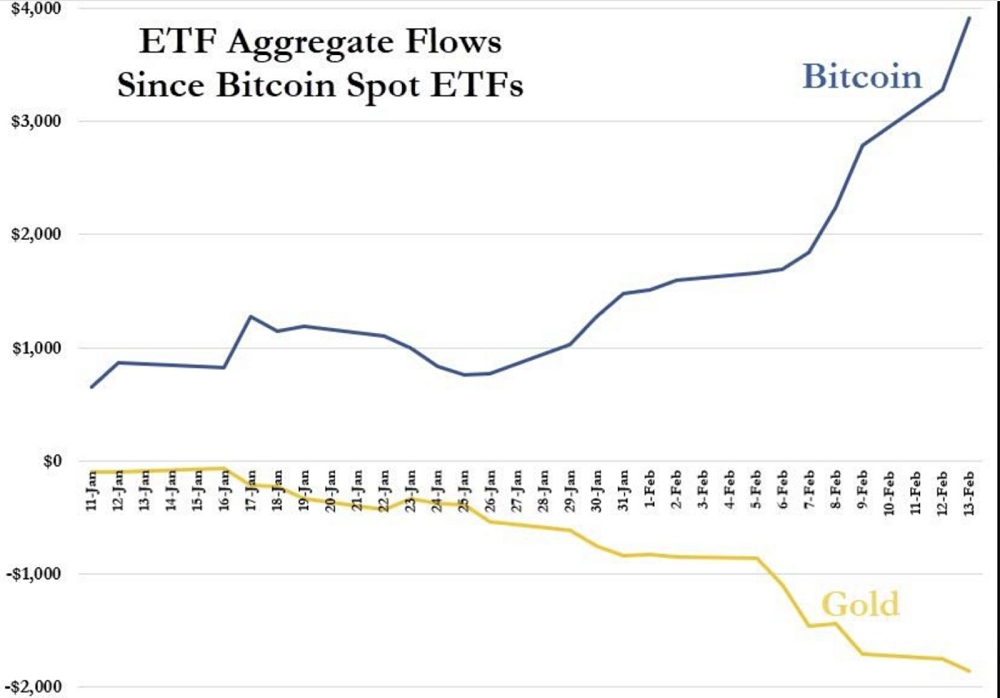
    It’s 2024, and the investment landscape is undeniably shifting – traditional safe havens like gold ETFs are experiencing notable outflows in contrast to Bitcoin ETFs, which have seen a substantial increase in interest since their debut at the beginning of the year. This change suggests investors are exploring new territories, possibly looking for alternatives that promise both security and growth in these uncertain times as we had highlighted in this article.

    In this narrative, Galaxy Fox ($GFOX) is also heading to a lucrative road, soaking up liquidity and selling out over 2.7 billion tokens throughout the presale. Why is crypto leaning from gold to $BTC, and how is $GFOX surpassing some of the best altcoins?

    Bitcoin vs Gold in 2024

    In the year 2024, the difference between investments in gold and Bitcoin has become much more obvious. A total of $2.4 billion has been pulled out of gold ETFs, with the biggest amounts being $230.4 million and $423.6 million from BlackRock’s iShares Gold Trust Micro and iShares Gold Trust, respectively. 

    In contrast, Bitcoin ETFs have seen an opposite trend. With record-breaking volumes and a noticeable move towards digital assets, the ten authorized spot Bitcoin ETFs have collected an incredible $3.89 billion in inflows since their inception in early January.

    Source: X/Jameson Lopp


    There has been an even more fundamental shift in investor attitude, and this change is reflected in the figures. Bitcoin has gained 23.5%, reaching a two-year high, while gold, which is usually a safe haven during uncertain times, has fallen 3.4% to a two-month low. The difference shows that investors are starting to see Bitcoin as a good substitute for gold, attracted by its high return potential in the present economic climate.

    Bloomberg analyst Eric Balchunas is among many who think this trend might mean more diversification into US stocks and digital assets than a straight shift from gold to Bitcoin. It suggests that investors’ priorities are changing and that digital currencies may soon be considered as good as, or perhaps better than, conventional assets like gold as a store of value.

    Investors troop to Galaxy Fox

    Bitcoin’s success is directly reflected in the overall crypto market, and the current crypto stats are no exception. Among the top 10 altcoins, Galaxy Fox is a name you’ll often hear from analysts discussing the potential best altcoins.

    Galaxy Fox, one of the best crypto ICOs so far, is split into ten separate stages, and at each stage, it gradually raises the value of the $GFOX tokens. This means early investors have the chance to see their deposits grow by 450%, a temptation hardly anyone should miss. 

    However, with such a lucrative opportunity, competition arises, and investors have been rushing to soak up the $GFOX tokens at their lowest rate. This has resulted in the presale stages selling out quickly, and currently, $GFOX is on the verge of closing its 8th stage. 

    However, the window to step in and buy $GFOX in the 8th stage is still there, though narrow, and if you make it, you secure yourself a 33% gain, as two more presale stages will naturally increase the price of $GFOX. 

    Notably, the charm of $GFOX is not only in its rewarding presale but also in its hybrid memecoin/P2E ecosystem, which is fully dedicated to community engagement and will reward you at multiple steps during your participation.

    Bottom Line

    As the latest market dynamics show, Bitcoin has become the new gold, which means cryptocurrencies as a whole are about to experience more adoption and trust. 

    In these directions, experts often suggest identifying low-cap gems with tangible utility and future potential, as those are the best altcoins that would pay off the most in the bull run.

    Learn more about $GFOX, visit Galaxy Fox Presale or join the Community.


    Source link

  • Bitcoin’s correlation with gold sinks to two-year low, a warning for investors

    Bitcoin’s correlation with gold sinks to two-year low, a warning for investors

    Key Takeaways

    • Bitcoin’s correlation with gold is at a two-year low
    • Divergence highlights yet again that Bitcoin remains a risk-on asset
    • This may change in the future, but for now, Bitcoin resides on the long-end of the risk spectrum 
    • With full effects of tight monetary policy still to come, market should not get ahead of itself

    Bitcoin’s correlation with gold continues to fall, highlighting the oft-repeated goal of achieving a store-of-value status akin to digital gold remains a long way off for now. 

    We looked into this last month, when the correlation between gold and Bitcoin fell to the lowest value since the FTX collapse in November, an event which sparked mayhem in the crypto markets while the rest of the financial world traded quite placidly, including gold. 

    Since then, the correlation has continued to fall. Indeed, looking at the more volatile 30-day Pearson correlation metric, the relationship is approaching a near-perfect negative one over the past thirty days. The last time it dipped this close to -1 was over two years ago (it nearly hit this level post-FTX also). 

    While the prior metric is a little noisy and bounces around a lot due to the rolling 30-day window sample size, the next chart displays the same indicator but over a 60-day rolling window. Outside of the FTX collapse in November, the 60-day correlation is the lowest it has been in eighteen months, when Russia invaded Ukraine in February 2022 and sparked extreme volatility in the financial markets.

    What does this tell us? Not much, really, beyond what we already know: Bitcoin trades like a risk-on asset. That much has been clear over the past two years or so, as one of the fastest rate hiking cycles in recent history has pulled the rug out from risk assets. The Nasdaq shed a third of its value last year in what was the worst year for stocks since 2008. Bitcoin was far from immune, falling down to a low of $15,500 in the aftermath of the FTX collapse. 

    While the question over whether Bitcoin can decouple from risk assets in the long term remains one of the most intriguing, the numbers make it blindingly obvious that this has not happened to date. The pullback during last year’s bear market also emphatically strikes down any assumption that Bitcoin’s days of violent drawdowns were behind it (we are most definitely not in a “supercycle”), with the fall of over 75% from peak to trough being the fourth-worst in the last decade. 

    The recent dip in correlation follows a turbulent period in the crypto markets. The SEC sued both Binance and Coinbase, the two biggest exchanges on the planet, in the first week of June. Last week, Ripple secured a big win when a (partial) ruling on its two-year battle with the SEC seemed to imply it is not a security (although ambiguity does remain and there will likely be an appeals process). 

    These developments are obviously specific to the crypto markets, and with crypto not yet having a tangible impact on traditional finance markets, the turbulence did not carry over. 

    Additionally, the decoupling of gold and Bitcoin pours cold water on the theory that Bitcoin had already obtained its “hedge” status, which was spoken in some quarters as the asset rose amid the banking wobbles in March. In reality, while this price action was intriguing, it was likely more to do with the market pricing in a lower chance of future interest rate rises, as we discussed here

    “In a lot of ways, Bitcoin’s correlation with gold can be viewed as a progress tracker on the path to achieving the holy grail: an uncorrelated store of value for investors”, says Max Coupland, director of CoinJournal. “With this correlation dipping to a two-year low, it is clear there is a long way to go yet. Bitcoin remains highly susceptible to the whims of the stock market and the macro economy, and that is worth bearing in mind for investors amid the recent rise in crypto valuations”. 

    Remember, last year represented the first time in Bitcoin’s history that it observed a pullback in the stock market. Prior to that, it was humming along in the longest and most explosive bull markets in history, kicked off almost to the day when Bitcoin was launched (the stock market bottomed in March 2009, two months after the genesis block was mined). 

    All in all, Bitcoin is still trading like a risk asset, and it has experienced the pain of that label in the past eighteen months as interest rates have spiked aggressively. While it is up over 80% thus far in 2023, it remains 56% off its peak from November 2021. 

    Nonetheless, things are undoubtedly brighter today than they were nine months ago, when FTX collapsed and the world seemed destined for a gruesome recession. While that recession still may come (and indeed the prospect of lagged effects of tightened monetary policy loom large), economic indicators have been remarkably resilient while hopes of a soft landing have risen. 

    Personally, I fear the market may be getting ahead of itself, but what do I know? The sheer scale of rising from a zero-rate environment to a climate where T-bills are paying north of 5% is ferocious, and won’t be shrugged off lightly. Indeed, looking at previous cycles throughout history, the stock market has tended to pull back further after hikes have ended. 

    While past performance is never indicative of the future, it certainly should provide food for thought, as phrases such as “meme stock”, “altcoin” and “robinhood” creep back into the vernacular. 

    But whatever happens, the charts are clear: Bitcoin is still a risk-on asset. That means if the blood does hit the streets, gold will strongly outperform its digital cousin. Maybe that will change one day, but for now, the numbers don’t lie. 

    If you use our data, then we would appreciate a link back to https://coinjournal.net. Crediting our work with a link helps us to keep providing you with data analysis research.

    Source link