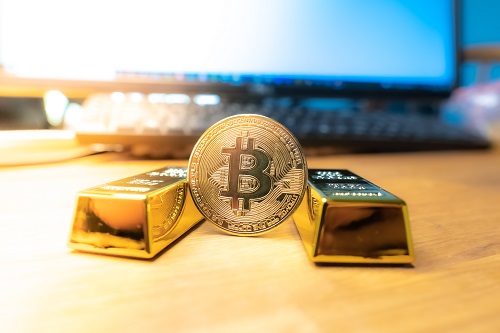
Tag: gold

  • Bitcoin’s correlation with gold sinks to two-year low, a warning for investors

    Bitcoin’s correlation with gold sinks to two-year low, a warning for investors

    Key Takeaways

    • Bitcoin’s correlation with gold is at a two-year low
    • Divergence highlights yet again that Bitcoin remains a risk-on asset
    • This may change in the future, but for now, Bitcoin resides on the long-end of the risk spectrum 
    • With full effects of tight monetary policy still to come, market should not get ahead of itself

    Bitcoin’s correlation with gold continues to fall, highlighting the oft-repeated goal of achieving a store-of-value status akin to digital gold remains a long way off for now. 

    We looked into this last month, when the correlation between gold and Bitcoin fell to the lowest value since the FTX collapse in November, an event which sparked mayhem in the crypto markets while the rest of the financial world traded quite placidly, including gold. 

    Since then, the correlation has continued to fall. Indeed, looking at the more volatile 30-day Pearson correlation metric, the relationship is approaching a near-perfect negative one over the past thirty days. The last time it dipped this close to -1 was over two years ago (it nearly hit this level post-FTX also). 

    While the prior metric is a little noisy and bounces around a lot due to the rolling 30-day window sample size, the next chart displays the same indicator but over a 60-day rolling window. Outside of the FTX collapse in November, the 60-day correlation is the lowest it has been in eighteen months, when Russia invaded Ukraine in February 2022 and sparked extreme volatility in the financial markets.

    What does this tell us? Not much, really, beyond what we already know: Bitcoin trades like a risk-on asset. That much has been clear over the past two years or so, as one of the fastest rate hiking cycles in recent history has pulled the rug out from risk assets. The Nasdaq shed a third of its value last year in what was the worst year for stocks since 2008. Bitcoin was far from immune, falling down to a low of $15,500 in the aftermath of the FTX collapse. 

    While the question over whether Bitcoin can decouple from risk assets in the long term remains one of the most intriguing, the numbers make it blindingly obvious that this has not happened to date. The pullback during last year’s bear market also emphatically strikes down any assumption that Bitcoin’s days of violent drawdowns were behind it (we are most definitely not in a “supercycle”), with the fall of over 75% from peak to trough being the fourth-worst in the last decade. 

    The recent dip in correlation follows a turbulent period in the crypto markets. The SEC sued both Binance and Coinbase, the two biggest exchanges on the planet, in the first week of June. Last week, Ripple secured a big win when a (partial) ruling on its two-year battle with the SEC seemed to imply it is not a security (although ambiguity does remain and there will likely be an appeals process). 

    These developments are obviously specific to the crypto markets, and with crypto not yet having a tangible impact on traditional finance markets, the turbulence did not carry over. 

    Additionally, the decoupling of gold and Bitcoin pours cold water on the theory that Bitcoin had already obtained its “hedge” status, which was spoken in some quarters as the asset rose amid the banking wobbles in March. In reality, while this price action was intriguing, it was likely more to do with the market pricing in a lower chance of future interest rate rises, as we discussed here

    “In a lot of ways, Bitcoin’s correlation with gold can be viewed as a progress tracker on the path to achieving the holy grail: an uncorrelated store of value for investors”, says Max Coupland, director of CoinJournal. “With this correlation dipping to a two-year low, it is clear there is a long way to go yet. Bitcoin remains highly susceptible to the whims of the stock market and the macro economy, and that is worth bearing in mind for investors amid the recent rise in crypto valuations”. 

    Remember, last year represented the first time in Bitcoin’s history that it observed a pullback in the stock market. Prior to that, it was humming along in the longest and most explosive bull markets in history, kicked off almost to the day when Bitcoin was launched (the stock market bottomed in March 2009, two months after the genesis block was mined). 

    All in all, Bitcoin is still trading like a risk asset, and it has experienced the pain of that label in the past eighteen months as interest rates have spiked aggressively. While it is up over 80% thus far in 2023, it remains 56% off its peak from November 2021. 

    Nonetheless, things are undoubtedly brighter today than they were nine months ago, when FTX collapsed and the world seemed destined for a gruesome recession. While that recession still may come (and indeed the prospect of lagged effects of tightened monetary policy loom large), economic indicators have been remarkably resilient while hopes of a soft landing have risen. 

    Personally, I fear the market may be getting ahead of itself, but what do I know? The sheer scale of rising from a zero-rate environment to a climate where T-bills are paying north of 5% is ferocious, and won’t be shrugged off lightly. Indeed, looking at previous cycles throughout history, the stock market has tended to pull back further after hikes have ended. 

    While past performance is never indicative of the future, it certainly should provide food for thought, as phrases such as “meme stock”, “altcoin” and “robinhood” creep back into the vernacular. 

    But whatever happens, the charts are clear: Bitcoin is still a risk-on asset. That means if the blood does hit the streets, gold will strongly outperform its digital cousin. Maybe that will change one day, but for now, the numbers don’t lie. 

    If you use our data, then we would appreciate a link back to https://coinjournal.net. Crediting our work with a link helps us to keep providing you with data analysis research.
    Source link

  • ‘crypto is digitalising gold in many way’

    ‘crypto is digitalising gold in many way’

    blackrock ceo larry fink crypto digitalising gold
    • BlackRock CEO Larry Fink was all praise for BTC in a recent interview.
    • The asset manager refiled for a Spot Bitcoin ETF earlier this week.
    • Bitcoin is currently up close to 90% versus the start of the year.

    Bitcoin made a new 52-week high this morning after Larry Fink – the Chief Executive of BlackRock Inc agreed that it was a valuable international asset.

    Fink is now constructive on Bitcoin

    Fink had once dubbed the BTC an index of money laundering. But in a recent interview with Fox Business, he was all praise for the world’s largest cryptocurrency by market cap.

    I do believe the role of crypto is digitalising gold in many ways. Instead of investing in gold as a hedge against inflation or the onerous problem of any one country.

    Earlier this week, the asset manager refiled for a Spot Bitcoin ETF after the U.S. Securities and Exchange Commission asked for more clarity on its initial application.

    BlackRock Inc currently has about $9.5 trillion worth of assets under management.

    Is a Spot Bitcoin ETF coming soon?

    Note that BlackRock has a history of getting regulatory approval for nearly every exchange-traded fund it has ever filed for.

    That’s important considering many experts forecast a Spot Bitcoin ETF to unlock further upside in Bitcoin. The digital currency is already up close to 90% for the year at writing.

    BlackRock has already made money investing in BTC and expects the crypto asset to grow further moving forward. According to CEO Larry Fink:

    The foundation of BlackRock is about hope. You have for retirement because you believe tomorrow is better than today.

    Source link

  • Bitcoin correlation with gold drops, highlighting risk-on nature remains

    Bitcoin correlation with gold drops, highlighting risk-on nature remains

    Key Takeaways

    • Bitcoin’s correlation with gold is currently at its lowest level since FTX collapsed in November
    • Our Head of Research writes that while one day Bitcoin may become a store of value, the numbers say it currently trades like an extreme risk-on asset
    • Bitcoin lost 76% of its value amid the pullback in risk assets once central banks around the world transitioned to tight monetary policy amid the inflation crisis
    • Meanwhile, gold traded flat and is currently close to all-time highs
    • Bitcoin’s correlation with growth stocks and riskier sectors of the stock market remains tight

    One of the ultimate bull scenarios for Bitcoin is that it morphs into some kind of digital gold. 

    For whatever reason, humans have been obsessed with this weird, shiny metal for thousands of years. Stories date back even further, but we have concrete evidence that gold was an important symbol of wealth in Ancient Egypt in 3000 BC, as well as part of everyday life and mythology. 

    Bitcoin, on the other hand, was not around in Ancient Egypt. Nor was it around for the Middle Ages, the Great Depression in the early 20th century, a World War (yet?), the inflation and energy crisis of the 1970s, and it even missed most of the subprime mortgage crisis of 2008. 

    In fact, Bitcoin was launched in January 2009, the Genesis blocked mined only two months before the stock market bottomed. Over the next twelve years, not only did the stock market recover, but it went absolutely bananas. Between the 2009 trough and the peak at the end of 2021, the S&P 500 multiplied 7X while the Nasdaq jumped nearly 13X. In other words, Bitcoin was launched into one of the most explosive and longest bull markets in history. Until 2022, it had never known anything but basement-level interest rates and up-only markets. 

    Gold’s hedge properties are what Bitcoin seeks

    Once 2022 came, risk assets sold off. The Nasdaq shed a third of its value; the S&P 500 fell 20%. Bitcoin had dipped plenty before, but make no mistake: this was the first time it was staring a bear market in the wider economy in the face.

     Despite certain enthusiasts claiming Bitcoin would act as a hedge asset, this did not happen. By the end of 2022, Bitcoin was 76% off its high. In the most explosive inflationary environment since the 1970s and Bitcoin’s first bear market, the asset was getting crushed. There was no debate: Bitcoin was trading like a risk-on asset. And today, it still is.  

    That is not to say that the narrative could flip in the future. Personally, that is what I view as Bitcoin’s upside: a store of value akin to gold. But while we can debate whether that may one day happen, it is unequivocal that Bitcoin currently trades like a risk-on asset. These are the facts of the case, and these are undisputed, to borrow Kevin Bacon’s phrase from the absolute classic that is A Few Good Men. 

    Gold, on the other hand, traded flat during 2022, and is currently trading close to all-time highs. 

    Bitcoin and gold correlation dipping

    For all the reasons discussed above, the correlation between gold and Bitcoin is particularly interesting to track. Using the 60-Day Pearson indicator, I have plotted it on the below chart. 

    Immediately, the past month jumps out. The correlation was a near-perfect 0.86 at the start of June, and had been around this level since late April. And then, it fell. It currently sits at 0.16, the lowest mark since FTX collapsed in November, sending the crypto market into a tailspin. But why?

    Well, I don’t really know. And that is kind of the point. Bitcoin, as it tends to do sometimes, is rising at the moment. Most likely, this is due to news of asset managers Blackrock and Fidelity filing ETFs, but maybe it’s just Bitcoin doing its thing. Perhaps it is merely bouncing back from the sharp fall it took after the Binance and Coinbase lawsuits were announced back-to-back two weeks ago. 

    But if we stretch out the time horizon on the previous graph, we see that the correlation between gold and Bitcoin bounces around a lot.

    It is challenging to put any pattern on that, to say the least. I thought I might try a different metric, so in the next graph I have used 90-Day Pearson instead of 60-Day. Predictably, the trend is less volatile, but there still appears to be no meaningful relationship here. 

    I think it’s pretty clear that assessing the correlation coefficients directly proves that there is zero positive relationship between these two assets. 

    Federal Reserve holds the key

    In truth, I believe this actually says more about gold than Bitcoin. Gold is in a funny place at the moment, trading more off expectations of inflation and interest rate movements rather than current conditions. The correlation between gold and the stock market is therefore higher than what we have typically seen in the past. This is why we are seeing gold often advance when soft CPI numbers are announced, or when dovish Fed comments surface regarding interest rate policy.

    If we step back and look at the big picture, it really is not complicated. Bitcoin has gone from $68,00 in November 2021, when money was cheap and risk assets were trading at outrageous valuations, to $15,500 last November, seven months into the swiftest hiking cycle in recent memory and the worst inflation crisis in 50 years. Then, it doubled to $30,000 as inflation numbers fell away and expectations around the length of the hiking cycle softened. 

    Along with all the fakeouts and reverberation in between, that is a hell of a lot of movement and clearly trading like an extreme-risk asset. Meanwhile, gold has been far less volatile, relatively range-bound between $1,600 and $2,000 for three years now. 

    Again, while Bitcoin may one day seize the crown of an uncorrelated asset, or a portfolio hedge to inflation, that is clearly not the case today. The below chart is the simplest method of all to show this, plotting Bitcoin’s hand-in-hand relationship with the tech-heavy Nasdaq composite since the economy transitioned to this risk-off, tight monetary policy period. 

    A few months ago, Bitcoin rose during the banking crisis, sparking some to declare it as decoupling from risk assets and the fiat world. As I wrote back then, this is nothing more than wishful thinking. Rather, it moved off expectations that the Fed would not be able to hike as aggressively in future if banks were going under due to the strain of these higher rates (indeed, soon after, the correlation rose back up).

    The latest dip in correlation with gold, falling back down from the ultra-high 0.86ish value it has been for six weeks or so, is similar. There is nothing ambiguous about the situation at the moment – Bitcoin is trading like a risk-on asset. It may one day claim that coveted title of digital gold, but right now it is nowhere near.

    Source link