
Tag: Grayscale

  • Grayscale Bitcoin Fund up 25% this year, but discount still killing investors

    Grayscale Bitcoin Fund up 25% this year, but discount still killing investors

    Key Takeaways

    • GBTC Fund is up 25% since the start of the year, compared to a 4% rise in the underlying asset, Bitcoin
    • The discount is now back to where it was prior to the FTX collapse, at 37%
    • The discount had hit an all-time high of 50% only four weeks ago


    The largest Bitcoin fund in the world, the Grayscale Bitcoin Trust, has seen its value jump by 25% since the start of the year. Bitcoin, on the other hand, is only up about 4% on the year.

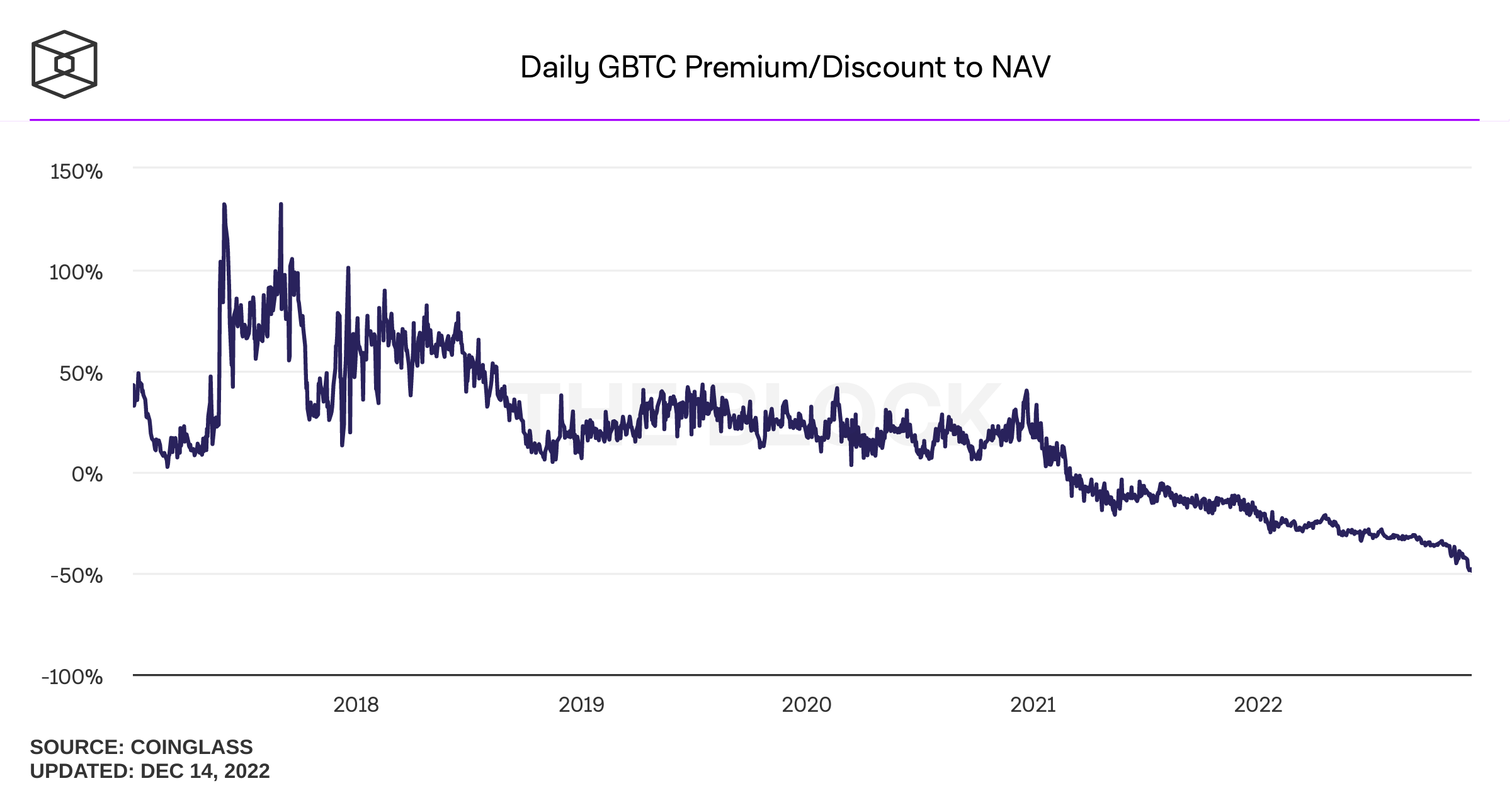
    This means that the discount to the underlying asset, Bitcoin, is at its smallest level in months. I had analysed the divergence in December, only four weeks ago, when the discount hit an all-time high of 50%.

    Today, the discount sits at 37%, back to where it was before the ignominious collapse of FTX.

    What is the Grayscale discount?

    Grayscale is a trust which provides an avenue for investors to gain exposure to Bitcoin without physically buying Bitcoin. This can be convenient for institutions or other entities who may not be able to participate I the Bitcoin market directly for regulatory or legal reasons.

    But Grayscale has rarely traded at the same price as its net asset value. Previously, it had traded at a premium to the underlying Bitcoin as shares surged with investors desperate to get exposure to the high-flying cryptocurrency.

    Today, however, it is the opposite – a steep discount. While there is a chunky fee of 2% that explains some of the discount, this does not come close enough to bridging a discount of 30%+ that we have seen consistently in this crypto winter.

    The SEC recently denied Grayscale’s application to convert the trust into an exchange-traded fund, spelling bearish action around the fund. There has also been the rise of more competition, with similar funds being launched, especially in Europe, and filings for Bitcoin ETFs.

    But the most significant worry was surrounding the safety of reserves. This issue grew legs after the FTX collapse, as speculation mounted that Grayscale’s parent company, Digital Currency Group (DCG), may file for bankruptcy.

    DCG is also the parent company to Genesis, which recently laid off 30% of its staff and is reportedly considering bankruptcy. Concern grew when Grayscale refused to publish a proof of reserves report, suddenly in vogue following the nefarious actions behind the scenes at FTX.

    It cited “security concerns” as the reason that this would not be possible, but analysts decried this, with it very unclear what security concerns could be ignited by the publishing of public records on the blockchain.

    Why has the discount closed?

    While the discount is still enormous at 37%, this has narrowed from the staggering 50% it reached in the aftermath of the FTX implosion.

    There has been increasing pressure on DCG to address this discount, with calls from within the industry that the trust should allow investors to redeem their holdings, which would allow them to realise the full value of the Bitcoin they hold. This clamour may have helped narrow the gap somewhat.

    One hedge fund, Fir Tree, even launched a lawsuit against Grayscale, demanding that the company either lower its fees or allow redemptions such that the discount can be closed.

    But like everything in crypto right now, macro also has a part to play. The year has begun with crypto prices rising off increased optimism that inflation may have peaked. This follows a relatively serene month or so in crypto markets.

    The discount widened to a large degree in the aftermath of the FTX crash because people feared contagion and the chips were still falling. Similar to the peg on Tether slipping when the UST crisis occurred.

    Now that normal service has somewhat resumed, the discount has narrowed. Unfortunately for investors, it is still a staggering 37% off the net asset value. In a year where Bitcoin itself has plummeted, layering in a discount on top of that torrid price action is the last thing investors needed…


    Source link

  • Why has the Grayscale Bitcoin Trust discount hit an all-time high?

    Why has the Grayscale Bitcoin Trust discount hit an all-time high?

    Key Takeaways

    • Grayscale is the largest Bitcoin fund in the world
    • Discount to underlying asset (Bitcoin) has reached record levels, breaching 50%
    • Concern about reserves, higher fees and other hurdles explain the discount, which likely won’t close anytime soon


    The discount to net asset value of the Grayscale Bitcoin trust is at all-time highs. The discount briefly pushed past 50%, before pulling back slightly to where it currently sits at 48.8%.  

    This comes off the back of the SEC reaffirming its reasons for denying Grayscale’s application to convert the trust into an exchange-traded fund.

     The Grayscale Bitcoin Trust is the largest Bitcoin fund in the world, but it has rarely traded at the same level as its underlying asset, Bitcoin. The above chart shows that it had, until this year, traded at a premium since its launch compared to Bitcoin.

    This fund allows accredited investors to gain exposure to Bitcoin without worrying about storing or managing their holdings. It previously traded at a premium as demand for shares surged, with institutions wanting Bitcoin exposure. This convenience does come at a fee, however – and a rather hefty one at 2%.

    Demand falls for Grayscale in 2022

    Since March, the Grayscale shares have been trading at a discount to Bitcoin. The fund has $10.7 billion in assets under management, a stark 65% fall in the last year, reflecting the bloodbath in the crypto markets.

    But the discount to Bitcoin means shareholders are getting hit twice as hard.

    “The fact that Grayscale’s Bitcoin Trust is now trading at nearly 50% discount is just awful for holders of GBTC. It really highlights the vast differences in structure quality between different investment vehicles,” Bradley Duke, co-CEO at ETC Group, told CoinDesk last week.  

    A decline in inflows has been borne out of greater competition as many competitive funds have launched, especially in Europe, as well as multiple filings for Bitcoin ETFs in the US. The discount is also because investors have no way to redeem their holdings for Bitcoin in the trust, but all the while are being charged a 2% fee.

    However, these factors have typically been dulled by arbitrage traders taking advantage of the dichotomy in prices. But happenings this year have reduced that, too.

    Concern about Grayscale’s reserves

    Over the last month, concern has swelled in the market that Grayscale’s parent company, Digital Currency Group (DCG) may file for bankruptcy. This is due to the issues surrounding crypto broker Genesis, whose parent company is also DCG.

    Genesis have denied they will imminently file for bankruptcy, but the firm was caught up in the FTX collapse and is currently undergoing restructuring. Genesis halted withdrawals on November 15th.

    This concern has been elevated by questions around Grayscale’s reserves. Namely, whether they are true to their word and are holding all the underlying Bitcoin securely. With many major crypto companies publishing proof of reserves in the aftermath of the FTX crisis in order to assuage customer fear, Gray scale refused.

    “Due to security concerns, we do not make such on-chain wallet information and confirmation data publicly available through a cryptographic Proof-of-Reserve, or other advanced cryptographic accounting procedure,” Grayscale wrote in a statement.

    As I wrote at the time, I really can’t fathom how security concerns are a factor here. The blockchain is built so that this kind of information is available to the public.

    Final thoughts

    All in all, the discount sums up investors’ concern around Grayscale, as well as the extra fees and other hurdles which exist compared to owning the underlying. Arbitrage trades are self-destructive by nature, and hence it is notable that the discount is so large and has persisted for so long.

    Then again, there is risk here, as the same thing which I have been writing about for a while now – a lack of transparency – means that it cannot be known for 100% certainty what is going on behind the scenes. And that is why we are seeing a 50% discount.


    Source link