Tag: High

  • Solana price hits 17-month high above $54: What next for SOL?

    Solana price hits 17-month high above $54: What next for SOL?

    • Solana price rose to $54 on Friday, its highest level since May 2022.
    • SOL has outperformed top altcoins as positive catalysts aid bulls’ push, with price up 40% this past week and 138% over 30 days.
    • How far can Solana price rise? Data suggests further upside is possible.

    Solana continued its outperformance on Friday with another huge green candle as price rose 24% to climb to highs of $54. The cryptocurrency’s value has jumped more than 40% this past week and an impressive 138% over the last 30 days.

    According to data from CoinGecko, Solana price has increased by 220% in the past year – reclaiming levels it traded at before the collapse of crypto exchange FTX.

    Solana price breaks above $54

    Despite recent sell-off pressure, bulls have managed to push SOL price to its highest level since May 2022.

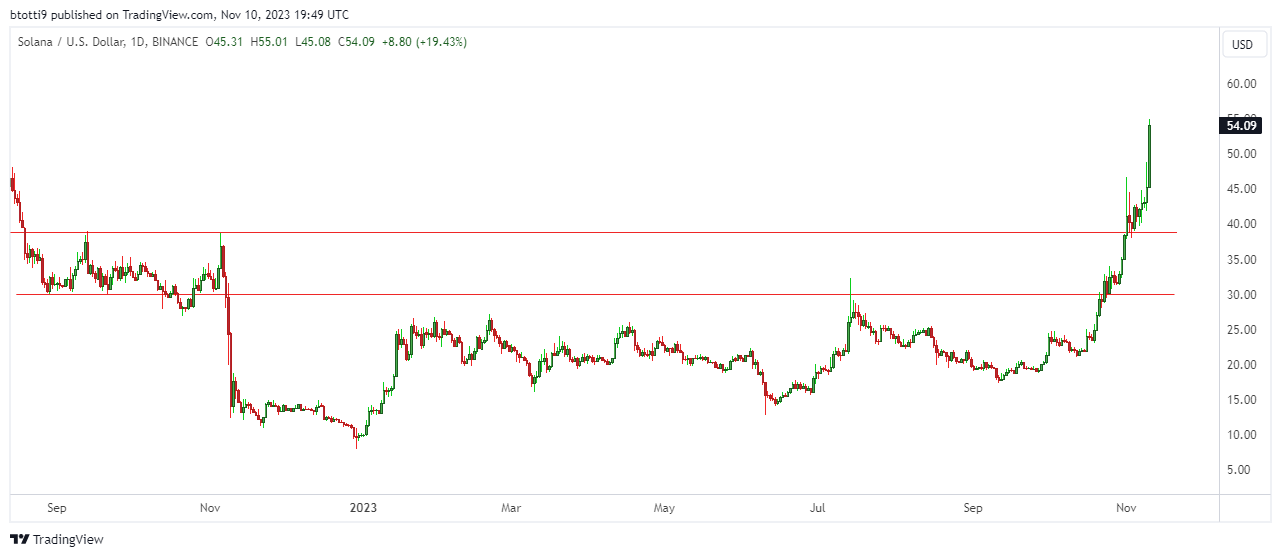
    The breakout to this 17-month high comes after buyers regained control at the critical $30 level, with this allowing for further upside to $38. A retest and fresh impetus allowed for this week’s parabolic move to $50.

    Solana price chart. Source:TradingView

    According to crypto data and market intelligence platform Santiment, Solana’s gains are accompanied by a major spike in crowd discussions about the coin.
    While funding rates have flipped higher, they are yet to enter the danger zone. Can SOL see more gains? 

    As highlighted earlier, Ethereum, Solana and other altcoins exploded today after news that BlackRock had filed for a spot Ethereum ETF.

    Also playing a role in the price surge was this week’s comments by Gary Gensler, the chairman of the US Securities and Exchange Commission (SEC). Gensler noted during an interview with CNBC that plans to revive FTX could work if those looking to do so adhered to the law.

    Gensler’s comments came at a time when reports indicated that entities looking to reboot the bankrupt exchange had come down to a final shortlist of three companies. It includes Bullish, a digital assets platform founded by a former New York Exchange executive.


    Source link

  • Bitcoin hints at sell signal after hitting 3-month high

    Bitcoin hints at sell signal after hitting 3-month high

    • Bitcoin price hit $30,369 on Saturday, its highest level since July.
    • While bulls could push higher in coming weeks, the immediate outlook suggests a bearish flip.
    • Crypto analyst Ali points to the TD Sequential indicator as hinting at a sell signal.

    Bitcoin price rose to its highest level since July when it broke above $30k to reach highs of $30,369 on Saturday. BTC is indeed looking for its fourth-biggest weekly gains year-to-date.

    However, although the benchmark crypto trading around $29,950 at the time of writing, an analyst says further retreat is possible given the potential for a key bearish signal.On the upside, market observers see a flip and weekly candle close above $31k as what bulls need to take control of the prevailing volatility.

    BTC price shows sell signal

    According to crypto analyst Ali, the potential for a head-and-shoulders pattern for BTC on the daily chart has received greater attention across the market. And in a chart shared on X on October 22, the analyst points to the possibility of the scenario unfolding given a key bearish signal – the TD Sequential indicator.

    Other than the sell signal hinted at after BTC price rose over the past several days, the overextended outlook is added to by the daily RSI that has previously triggered notable pullbacks.

    The $BTC daily chart hints at a possible sell signal emerging tomorrow, based on the TD Sequential indicator flashing a green 9 candlestick. Not to mention, the RSI reached 74.21 — a level triggering sharp corrections since March,” Ali wrote on X.

    Based on this outlook, the analyst noted:

    An impending price correction appears to be on the horizon unless #BTC manages to clock a daily candlestick close above $31,560.”

    A flip lower from the current resistance zone, and confirmation of the H&S pattern could mean a retest of immediate support around $28,492. A slight sell-off could also reignite the bearish target of $25k. 

    The flipside could be catalysed by positive ETF news, with buyers targeting a run to the $40k area.


    Source link

  • Shiba Memu shines as investor buying power hits 6-month high

    Shiba Memu shines as investor buying power hits 6-month high

    • Shiba Memu presale has hit $3.6 million as more investors buy into AI meme coin.
    • Meanwhile, stablecoin on exchanges is at a 6-month high, led by massive whale deposits.
    • What does spike in exchange buying power means for crypto, Shiba Memu?

    Although the crypto market is still largely in the accumulation phase amid the latest price movement, analysts are pointing to on-chain data to suggest a bull run might not be that far off. That has to do with an uptick in exchange holdings of the stablecoin Tether (USDT), a metric that has historically coincided with fresh opportunities for crypto investors.

    What does this strong bullish flip mean for Shiba Memu, a new crypto project that has raised nearly $3.6 million in its recently launched presale?

    Investor buying power jumps 7%, what it means

    As Bitcoin broke above $28k earlier this week, on-chain data shared by market intelligence platform Santiment pointed to a significant change in investor sentiment. This is down to the amount of Tether on exchanges, which data shows recently hit a six month high. The exchange buying power increased 7% from roughly 17.6% to 24.7%.

    It’s an increase that points to a spike in stablecoin buying power, often an accumulation phase that precedes a fresh entry into the market. A sharp rise in exchange buying power, which takes shape with whales in the forefront, tells the market investors know it’s time to buy the dip.

    The 10 largest addresses have also upped their $USDT holdings from $7.30B to $9.42B in 3 months,” Santiment wrote on X (formerly Twitter). It’s an outlook that suggests the next market dip could be significant, although that’s when investors seize on the opportunity to buy at discount prices.

    Often, BTC and ETH are top buys when prices crash. XRP and Polygon, two altcoins that are seeing month-high volumes driven by various factors, could be at the top of many investors’ watchlists.  However, as investors have always eyed the next bull market gem – one of the projects attracting most attention in Shiba Memu.

    Shiba Memu – marrying meme with AI

    Shiba Memu is a project that seeks to bring the benefits of artificial intelligence to the meme coin world.

    Dogecoin, Shiba Inu and other leading meme tokens have one feature in common – the inordinate reliance on human marketing effort to feed into the hype that drives traction. Shiba Memu stands out on this aspect among its would-be memesphere competitors. Mainly, it’s the AI-driven project’s leveraging of the new technology to create a marketing powerhouse that doesn’t rely on human effort.

    Apart from that, value for the community will be enhanced by functionality such as staking and interaction with decentralised applications (dApps).

    How does Shiba Memu work?

    Natural language processing, machine learning, predictive analytics and image/video recognition are among trends that define the project’s selling point. AI algorithms will be used to create a self-sustaining marketing machine, feeding on the meme-inspired world to drive adoption for SHMU.

    This will be achieved via a unique AI dashboard that will among other features offer direct interaction between the meme genius and Shiba Memu holders. Feedback and suggestions incorporated from users will give them a chance to earn extra SHMU.

    AI narrative – mainstream adoption is here

    One of the major venture funding developments this week has been the news that artificial intelligence startup Anthropic is looking to raise $2 billion from investors, led by Google. Reported by The Information, the details emerge just days after ecommerce behemoth Amazon.com Inc. said it would invest up to $4 billion in the OpenAI rival.  

    According to the report, Anthropic’s latest funding could see the company valued at $30 billion, a prospect that has ignited interest in AI following the high expectations championed by Microsoft, Nvidia and Palantir among others.

    Elsewhere is the continuing adoption of crypto and blockchain that has investor optimism on the industry’s future at new highs. Shiba Memu’s AI-powered project sits nicely at the intersection of these two technological developments.

    Indeed, interest in this AI-powered meme token has seen its presale attract remarkable investment from around the globe. Currently, that amount stands at $3.6 million and more will likely seek this early-bird opportunity.

    Learn more about Shiba Memu from its whitepaper or by joining the presale here.


    Source link

  • Bitcoin mining difficulty hits all-time high, above 50 trillion hashes

    Bitcoin mining difficulty hits all-time high, above 50 trillion hashes

    Key Takeaways

    • Bitcoin mining difficulty has surpassed 50 trillion hashes for the first time ever
    • Higher difficulty means more competition and less profit for miners, but also more security for the Bitcoin network
    • Higher mining difficulty means greater energy input required to mine Bitcoin, meaning greater cost for miners
    • Mining stocks have underperformed Bitcoin significantly over the last year

    It has never been so difficult to mine Bitcoin. Literally. Bitcoin mining difficulty continues to rise incessantly, surpassing the 50 trillion hash mark for the first time ever last week.

    What is Bitcoin mining difficulty?

    If it were not for the Bitcoin mining difficulty adjustment, blocks would be appended to the blockchain at an increasing speed as more miners joined the Bitcoin network. In such a way, the Bitcoin mining difficulty adjusts via an automatic algorithm to ensure blocks are appended to the ever-growing blockchain at consistent 10 minute intervals.

    As more miners join the network, difficulty rises. In such a way, blocks do not get discovered quicker as more miners join the network. This difficulty adjustment is thus vital to ensure the supply of Bitcoin is released at a pre-programmed pace, as outlined by the anonymous Satoshi Nakamoto in the Bitcoin whitepaper. 

    This explains how, in the early days, mining could be carried out on a personal laptop, because Bitcoin was so niche and miners were so few and far between – hence the mining difficulty was far lower. This is why you hear stories of miners who find (or lose) stashes of Bitcoin on old hard drives which were close to worthless when they were mined. 

    Today, however, Bitcoin is well and truly in the mainstream, and mining difficulty has risen accordingly. Most mining is carried out by supercomputers, while there are many public companies carrying out the task.  

    What does increasing mining difficulty mean?

    Mining difficulty is increasing because more computational power is being put towards Bitcoin mining. The hash rate is what we refer to as the computational power of the Bitcoin network. Looking at the chart, this is at an all-time high – which makes intuitive sense, given mining difficulty is also at an all-time high. 

    For the Bitcoin network as a whole, this is a good thing. Bitcoin’s hash rate is a crucial indicator of the security of the network. A higher hash rate means Bitcoin is more resistant to an attack by a malevolent actor. This is because the higher the hash rate, the more expensive and implausible it is for an actor (or a group of actors) to seize control of 51% of the network, when Bitcoin could be exposed to what is known as a 51% attack (coins could be double spent and the veracity of the blockchain would be in doubt). 

    However, there are downsides to this, too. I detailed this in depth last week in a report on Bitcoin mining stocks. In summary, more hash power means greater cost for miners, as the increased difficulty means a greater amount of energy is required to power the computers working to validate the transactions on the blockchain. This is why miners margins are getting cut into as more miners join the network (rising electricity costs also do not help). 

    “The rapid decline in the Bitcoin price, down from $68,000 at the peak of the bull market in late 2021, has obviously hurt the mining industry”, says Max Coupland, director of CoinJournal. “However, that is far from the only problem facing miners. The mining difficulty hitting an all-time high means greater amounts of energy are required to mine, at a time when inflation and the Russian war have pushed the price of energy up immensely”. 

    The mining industry is hence extremely volatile, as not only is it sensitive to the volatility of Bitcoin itself, but it also suffers from rising energy costs. The below chart demonstrates how mining stocks have underperformed Bitcoin in recent times. It looks at the Valkyrie Bitcoin Miners ETF, which tracks mining companies and was launched in February 2022. 

    With Bitcoin mining difficulty hitting an all-time high, racing past the 50 trillion hash mark for the first time ever, things won’t get any easier for miners. However, like always, it will ultimately come down to the Bitcoin price. With block rewards and transaction fees recouped in the form of Bitcoin, and the entire industry built upon this asset, mining companies will go as far as the Bitcoin price takes them.

    If you use our data, then we would appreciate a link back to https://coinjournal.net. Crediting our work with a link helps us to keep providing you with data analysis research.

    Source link

  • Bitcoin network hash rate hit a record high in May

    Bitcoin network hash rate hit a record high in May

    bitcoin network hash rate record high may
    • Bitcoin network activity climbed for the fifth month straight.
    • Mining difficulty and transaction fee also climbed in May.
    • The world’s largest cryptocurrency lost about 8.0% last month.

    Bitcoin may have lost about 8.0% last month on macro uncertainty but the network activity remained incredibly strong.

    JPMorgan analyst expects a slowdown in hash rate

    In May, the daily network hash rate – a closely followed metric that indicates network’s health climbed to a record high. It was the fifth consecutive month of increase for the said indicator.

    Simply put, larger the hash rate, the more secure is the network. Nonetheless, Reginald Smith – a JPMorgan analyst said in a note on Friday:

    Our sense is that network hash rate growth could slow over the coming months (possibly lagging BTC price appreciation) as funding available rack space is hard to come by.

    In terms of market cap, the 13 U.S. listed miners that JPMorgan tracks noted an aggregate increase of 5.0% last month to $6.7 billion.

    Mining difficulty and transaction fee also increased

    Mining difficulty – another metric that typically moves in tandem with the Bitcoin hash rate – also climbed to a record high in May.

    Recent data confirmed the crypto transaction fee to have increased last month as well. JPMorgan’s Smith also said in his research note:

    Transaction fees spiked to over 5 Bitcoin per block mined in early May, which should drive modest C2Q23 earnings upside for the industry at large.

    In recent weeks, though, Bitcoin transaction fees have returned close to its historic average of about 0.5 BTC per block mined. Last week, JPMorgan said Bitcoin should be trading at $45,000.

    Source link

  • Long-term Bitcoin holders at all-time high, but price not cooperating

    Long-term Bitcoin holders at all-time high, but price not cooperating

    Key Takeaways

    • Two-thirds of the Bitcoin supply has not moved in over a year
    • Metrics for percent of supply unmoved in 2+, 3+ and 5+ years also at all-time highs
    • The average hold period for Bitcoin on-chain is 3.8 years
    • Despite thesis that dwindling supply will boost price, this has not proved the case thus far

    The capped supply of Bitcoin has always offered an intriguing layer to analysis of the enigmatic asset. 

    Simply put, there are not many assets worldwide that offer an inelastic supply. Truthers argue that this cap will inevitably squeeze the price upwards through the simple economic theory of supply and demand. That is, assuming the demand continues to grow, of course. 

    Here, we look at this supply, and how many of the total supply of 21 million bitcoins (of which 19.3 million are currently in circulation) have not moved in quite some time.

    Percentage of Bitcoin supply unmoved in over a year at all-time high

    If one takes the 1+ year mark as a benchmark for long-term holders, that means a growing amount of Bitcoin supply is held by what constitutes long-term investors. 

    Two-thirds of the Bitcoin supply has not moved in over a year, an all-time high. That means no purchases or sales. 

    In expanding the timeframe out, we can look at what portion of this 67% has been held for even greater amounts of time. On the below chart, I have plotted the portion of supply that has been stagnant for 1+ years, 2+ years, 3+ years and 5+ years. 

    The results are interesting. Nearly half the supply – 49.3% – has not moved in over 2 years. Pushing out to 3+ years, the number is 39%. And 28.1% of the supply has not moved in 5+ years. The marks are all all-time highs.

    So, diamond hands? Well, sort of. The numbers are certainly large, but there are other variables at play. Most notably lost coins, for which it is impossible to know how many there are. Satoshi Nakamoto is estimated to own over one million coins, which is circa. 5% of the supply alone. 

    Long-term holders growing despite market carnage

    Nonetheless, to see such stout numbers following the year that crypto has had is notable. The average hold time of Bitcoin on-chain right now is 3.8 years.

    This comes less than a year after the collapse of LUNA (May-22) which sparked a meltdown crisis that ultimately bankrupted hedge fund Three Arrows Capital and sent a wave of contagion across the industry. 

    Things shook further when this contagion claimed crypto lender Celsius in June. The fallen crypto lender disclosed two months before, at the Bitcoin 2022 conference, that it held 150,000 Bitcoin, which would constitute 0.8% of the supply. 

    Unfortunately for investors, court filings by Kirkland & Ellis indicate that the firm has lost roughly 62,000 Bitcoin, and right now it is unclear how many they really held, nor how many the bankrupt firm now holds. 

    Then there was the staggering collapse of FTX in November.

    But despite this,  long-term holders do continue to grow, at least if on-chain metrics are to be trusted. 

    Dwindling supply not supporting price

    But as for the thesis that a dwindling supply will push price up, it has not worked to date. Bitcoin has collapsed while these metrics have all jumped to all-time highs. 

    What happens in the long-term remains to be seen. The advocates aren’t wrong when they reference simple supply and demand. This will undoubtedly help the price, and if long-term holders continue to hold, the liquidity drying up further can only squeeze the price upward. 

    On the other hand, every sale needs a bid order, and these have not been coming in quickly enough over the last two years. As I have written about repeatedly, Bitcoin continues to follow the macro cycle, trading like an extreme-risk asset making a mockery of those who claim it is any sort of inflation hedge. Look no further than its reaction to recent inflation readings and Federal Reserve meetings on interest rate policy for evidence of this. 

    Supply drying up is a good thing. But until Bitcoin sheds its high-risk image, it will continue to trade like a levered bet on the Nasdaq. Every asset needs a bid, people, and in times of uncertainty, the market has shown that Bitcoin is the last thing that investors want to hold. 

    Time will tell if this all changes. 


    Source link

  • Optimism token OP hits all-time high Bedrock upgrade news

    Optimism token OP hits all-time high Bedrock upgrade news

    • OP has rallied over 30% in the past 24 hours, reaching a new all-time high of $2.97 on Coinbase
    • Optimism is outperforming major coins even as cryptocurrencies rally on Thursday.
    • Gains for Optimism comes amid buying pressure after news of an upgrade proposal planned for activation on 15 March.

    Optimism is rallying again as excitement around the Ethereum layer 2 scaling solution increased following a major news announcement.

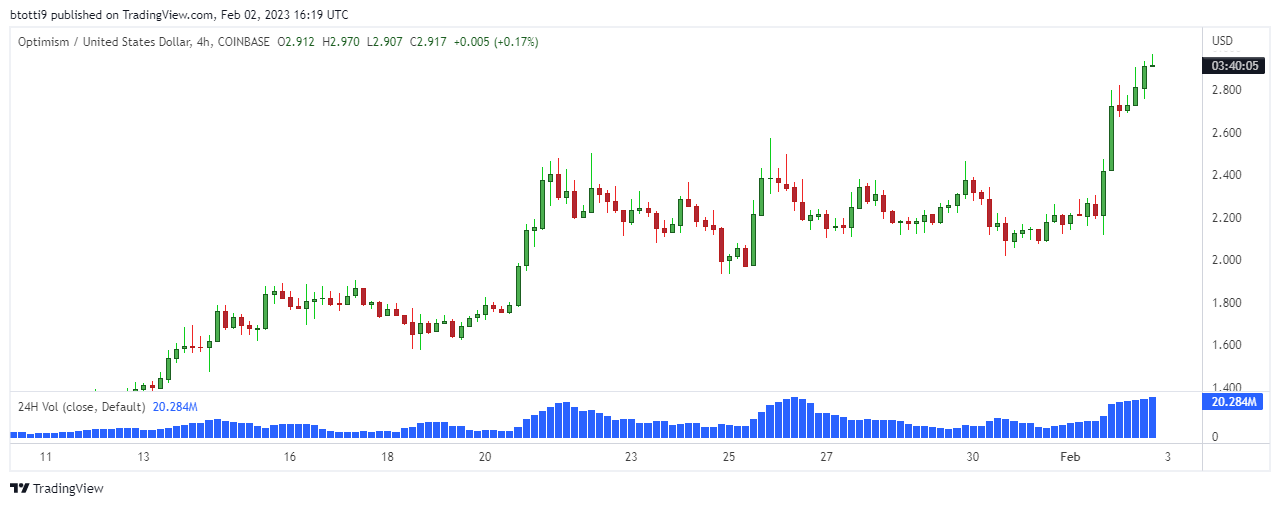
    As shown on the 4-hour chart below, OP reached a new all-time high of $2.97 on Coinbase. As of 11:20 am ET on 2 February, the platform’s native token OP was trading at $2.91, still up by more than 32% in the past 24 hours.

    Chart showing Optimism price rally to new all-time high on Coinbase. Source: TradingView.According to data from CoinGecko, the OP token price is up 205% in the past 30 days, outshing major coins. About 75% of the gains have come in the past two weeks as platform’s market capitalization steadily rose to currently stand around $625 million.

    Why OP token price is surging

    Optimism’s gains in the past few hours have come as buying pressure ramped up ahead of what promises to be groundbreaking network upgrade.

    On Wednesday, the Optimism Foundation released a proposal seeking to deploy an upgrade to the protocol’s mainnet. According to the proposal, the upgrade targets improving network performance via the Optimism Collective: Bedrock.

    It is the first major upgrade to the Optimism protocol and brings a rollups architecture to the protocol, with  transaction batching one of the main features highlighting the huge impact the upgrade could have for the blockchain’s performance.

    This upgrade offers a new level of modularity, simplicity, and Ethereum equivalence for Layer 2 solutions, providing unprecedented performance and functionality,” the Optimism Foundation wrote.

    Improvements set to be added via the Bedrock release include reduced transaction fees, high throughput and improved sync speeds.

    According to the team, the upgrade will not impact most users as the Optimism mainnet is “already EVM-equivalent.” However, some users including those running full and archive nodes have to take action in preparation for the upgrade.

    The Bedrock proposal is expected to go through a two-week voting period, with deployment to the mainnet scheduled for 15 March if it passes.


    Source link

  • Nearly 13 million bitcoins have not moved in over a year, an all-time high

    Nearly 13 million bitcoins have not moved in over a year, an all-time high

    Key Takeaways

    • An all-time high of 12.7 million bitcoins have not moved in over a year
    • That translates to two-thirds of the circulating supply
    • Only 7% of bitcoins have moved in the last month
    • History shows that long-term holders tend to rise as price falls, which may seem counter-intuitive
    • The real story is a little more nuanced, as falling trade volumes in bear markets provide a lurking variable which affects the data


    One of the intriguing things about blockchain is the public availability of all sorts of stats about the network.

    A lot is made of the fixed supply cap of Bitcoin, with the final supply of 21 million bitcoins slated to be hit by 2140. Bulls use this as a case in point as to why the asset is programmed to expand in price, as its scarcity will inevitably squeeze the asset upwards.

    By looking on-chain here at https://coinjournal.net/, we noticed a quirk in this data.

    Long-term holders continue to grow

    Despite the bloodbath that was cryptocurrency in the year 2022, long-term holders have continued to accumulate. Out of the 19.27 million bitcoins currently in circulation, 12.77 million bitcoins have not moved in over a year – an all-time high.

    It’s a pretty significant number. In the following chart, I have plotted these bitcoins against two other categories: firstly, bitcoins that have moved in the last month (traders), and secondly, bitcoins that have not moved in over a month but have moved within the last year (medium-term holders).

    Currently, we have 66% of bitcoins unmoved in over a year – again, an all-time high. The previous high was in September 2020 when the mark hit 63%. Prior to that, the previous high was April 2016 at 60%. 

    A further 27% of bitcoins have not moved in the last month, while the remaining 7% can be seen as traded bitcoins, moving around the blockchain in the last month.

    Why are long term holders growing?

    The obvious question is, why? Why are we seeing long-term holders growing so substantially when the market has been getting pummelled?

    Well, I decided to chart the percentage of long term holders against the bitcoin price. And the result is quite interesting – there definitely seems to be at least a moderate inverse relationship between price and long-term holders. That is, when price falls, long-term holders rise. Hmm.

    But in truth, this makes sense. As the price falls, volumes and interest in the market tend to dry up. With that, comes less trading, and by definition less holders under the one-month threshold.

    While the narrative of long-term holders soaking up increasing amounts of the Bitcoin supply is often painted in a bullish light, I’m not sure that tells the whole story when considering this historical pattern.

    Sure, it is a positive thing that the number of bitcoins that have not moved in more than one year are climbing, as it does show that these long-term holders have tended not to capitulate during the drawdowns.

    But a healthy trading market and high liquidity is associated with a bull market, which is part of the reason we are seeing an inverse relationship here. Look no further than trading volume in 2022, which fell 46% on centralised exchanges compared to the previous year – that’s trillions of dollars of activity no longer present.

    “Trading volumes have cratered across the crypto space. This has pulled down activity and it’s not surprising that the portion of bitcoins traded recently is therefore falling. The analysis of long-term holders is a more nuanced issue than the crude assumption that ‘more bitcoins in long-term wallets is bullish and therefore price will go up’. That is simply not what we have seen historically” said Max Coupland, Director of CoinJournal.

    I’ll continue to monitor all on-chain activity, as the market is certainly showing more life in these early stages of 2023, with softer inflation data giving impetus to the market that we may pivot off high interest rates sooner than previously expected. It will be interesting to keep tabs on the dynamics on-chain, therefore.

    But next time somebody declares it obviously bullish that there are less bitcoins being flung around the markets, perhaps remember that the situation is a little more complex than that.

    If you use our data, then we would appreciate a link back to https://coinjournal.net. Crediting our work with a link helps us to keep providing you with data analysis research.

    Source link

  • Bitcoin wallets with 100+ coins hit new one-year high

    Bitcoin wallets with 100+ coins hit new one-year high

    • Bitcoin addresses with 100 or more coins hit 16,120 on 19 December 2022.
    • Each address is worth $1.67 million at current prices, increasing the number of Bitcoin millionaires to the highest level since December 2021.
    • Data also shows hodling is on the rise despite crypto winter, with 46% of BTC last active in 2+ years and 1.6 million coins last active in 1-3 months.

    Bitcoin continues to consolidate around $16,700 after weathering recent sell-off pressure. Bears remain very much in the picture, given last week’s jump to above $18,000 and then the sharp fall to current levels.

    But there’s an opportunity in the midst of all the contagion – and that is what Bitcoiners are capitalizing on.

    Addresses with 100+ coins hit 1 year high

    According to the on-chain and exchange flows monitoring platform Glassnode, sharks and whales have aggressively added to their overall holdings in the past few days.

    Indeed, as the flagship cryptocurrency’s price hovers above its notable base on Monday, on-chain alerts for BTC indicate that addresses with 100+ bitcoins now hold the most coins since last December. Per the data, large accounts with at least $1,670,000 worth of BTC as of 19 December 2022 had jumped to 16,120.

    This is a new all-time high, with the last 1-year high being 16,106 addresses recorded on 23 December 2021.

    Bitcoin addressed holding 100 or more BTC reach one year high. Source: Glassnode

     46% of Bitcoin last active 2+ years

    As large investors scoop Bitcoin on the cheap, the number of hodlers (people who buy Bitcoin and hold onto their assets long term regardless of market conditions) has also increased. As CoinJournal recently reported, whales have been busy, buying over $726 million worth of BTC despite the FTX contagion.

    The latest data on this metric shows that the amount of BTC supply last active 2+ years has 46.3%, a 22-month high. According to Glassnode, 7.5 million BTC was being HODLed (the metric also counts lost coins) as Monday 19, December 2022. The last time the measure of hodled or lost BTC was this high was in January 2021.

    Meanwhile, the number of coins last active 1-3 months is now more than 1,603,380 bitcoins. The moving average translates to a 3-month high for the number of coins that have not moved for the last 30 to 90 days.


    Source link