Tag: highs

  • Bitcoin’s surge to record highs signals potential shift toward stability, says Deutsche Bank

    Bitcoin’s surge to record highs signals potential shift toward stability, says Deutsche Bank

    Bitcoin

    • Bitcoin hit a record high above $123,000, with Deutsche Bank noting a rare drop in volatility alongside the rally.
    • Analyst Marion Laboure sees signs of Bitcoin maturing as an asset, supported by regulatory clarity and institutional adoption.
    • Despite a short-term pullback, broader macro and micro factors point to a more stable, long-term trend for Bitcoin.

    Bitcoin may be entering a new phase of greater price stability, according to a recent analysis by Deutsche Bank.

    The cryptocurrency reached a record high above $123,000 on Monday, marking a roughly 75% gain from its levels in mid-November.

    Deutsche Bank analyst Marion Laboure noted that the sharp appreciation has been accompanied by a historic drop in volatility — an unusual but telling combination.

    “While excitement over the upcoming legislations has spurred Bitcoin’s sharp appreciation, it is notable that Bitcoin’s rise has also been accompanied by a historic decline in volatility levels,” Laboure wrote in a note to clients on Tuesday.

    She suggested this may point to an emerging decoupling of Bitcoin’s spot price from its traditional volatility, hinting at the digital asset’s evolution toward a more stable asset class.

    Laboure cited growing market adoption, clearer regulatory frameworks, and increased institutional involvement as contributing factors to this stabilization trend.

    Together, these dynamics are helping to shift Bitcoin away from the high-churn, speculative cycles that have historically defined its behavior.

    Regulatory and institutional tailwinds

    The record-breaking price movement comes as US lawmakers gathered for the “Crypto Week,” which investors hope will pave the way for a more supportive regulatory environment.

    While crypto legislation has long been a point of debate in Washington, proponents see this week’s discussions as a potential inflection point that could attract greater participation from institutional investors.

    In her analysis, Laboure emphasized the convergence of macro and micro factors currently driving Bitcoin’s performance.

    On the macro side, she pointed to rising geopolitical tensions, shifts in global trade policies including tariffs, and ongoing de-dollarization trends as adding complexity to traditional markets, making Bitcoin more attractive as an alternative asset.

    On the micro level, she highlighted the increasing participation of institutional investors and longer-term holding patterns among market participants.

    These trends, according to Laboure, suggest that Bitcoin’s role in portfolios is maturing.

    Rather than serving solely as a speculative tool, it is gradually being integrated into broader investment strategies.

    Short-term pullback, long-term outlook

    Despite the strong rally, Bitcoin experienced a modest retreat of over 2% in midday trading on Tuesday, falling back to around $117,000.

    However, Laboure cautioned against reading too much into short-term fluctuations, reiterating that broader adoption and regulatory clarity remain key pillars supporting the current trajectory.

    “Volatility remains inherent,” she acknowledged.

    However, the emerging conditions, from legislation and market structure to investor behavior, “suggest Bitcoin’s integration into portfolios is maturing, and potentially signals a more sustainable trend beyond previous instances of short-term market speculation.”

    As institutional interest deepens and the regulatory landscape evolves, analysts like Laboure believe Bitcoin could continue to see upward momentum while exhibiting more stable price behavior — a significant shift for an asset historically defined by extreme swings.

    Source link

  • SUI and SEI rally as Bitcoin tops $96K, breakouts signal 2025 highs

    SUI and SEI rally as Bitcoin tops $96K, breakouts signal 2025 highs

    • The surge in the altcoins comes amid a broader rally triggered by Bitcoin’s new milestone.
    • The daily chart for SUI reveals a bull flag pattern, often considered a continuation signal for uptrends.
    • After dipping below $0.14 earlier this year, the token has reversed its downtrend.

    As Bitcoin pushed past $96,000 this week, it reignited interest across the altcoin market.

    Among the tokens gaining significant traction are SUI and SEI, both of which are showing breakout signals following months of gradual upward movement.

    With bulls regaining control and wider market sentiment turning optimistic, analysts are now closely watching these two tokens to see if they can test their respective highs in 2025.

    Solana, another top-10 cryptocurrency by market cap, has also reclaimed levels above $150, contributing to renewed enthusiasm for smaller tokens like SUI and SEI.

    The current price action suggests growing accumulation among traders as technical patterns hint at continued bullish momentum.

    SUI’s $4 target comes into play

    SUI, the native token of the Layer 1 blockchain developed by Mysten Labs, is showing signs of a breakout from its recent consolidation phase.

    After rising 60% in a short span, the token managed to avoid a correction, instead consolidating within a narrow range for more than a week.

    This range-bound behaviour has now culminated in a bullish breakout, supported by technical indicators.

    The daily chart for SUI reveals a bull flag pattern, often considered a continuation signal for uptrends.

    The price is now approaching resistance near the $4 level, which will be the next major test.

    Source: CoinMarketCap

    Meanwhile, the 50-day moving average has flipped positive, confirming a potential bullish reversal.

    The MACD, though showing some decline in buying volume, remains above the zero line.

    A golden cross—where the 50-day moving average crosses above the 200-day—could also occur in the near term, bolstering the bullish case.

    Despite occasional dips in volume, SUI’s price action suggests investor confidence is still intact.

    If this trend continues, the token could aim for a new all-time high closer to $7 in 2025, especially if Bitcoin remains above its current support levels.

    SEI bulls eye $0.5 breakout

    SEI has also emerged as a strong gainer in the current cycle.

    After dipping below $0.14 earlier this year, the token has reversed its downtrend and is forming a pattern of higher highs and higher lows.

    More notably, it has broken through the bearish Gaussian Channel on the chart—a move typically interpreted as the beginning of a longer-term uptrend.

    Volume indicators, particularly the Chaikin Money Flow (CMF), show a clear uptick in capital inflows into SEI.

    The CMF has moved above zero for the first time in weeks, signalling increased investor interest.

    With resistance levels at $0.32, $0.40, and $0.44 coming into view, SEI appears poised for further gains.

    Source: CoinMarketCap

    A move past the $0.48–$0.50 zone, which marks a significant resistance area, could trigger a fresh leg up.

    If momentum sustains and market conditions remain favourable, SEI may well be on track to approach the $1 mark by mid-2025.

    This would represent a more than 7x gain from its previous lows, making it one of the standout performers of the cycle.

    Technical indicators support further gains

    Both tokens are showing confluence across several key indicators. SUI’s RSI remains in neutral territory, leaving room for more upside.

    SEI, on the other hand, has just crossed into bullish territory, suggesting its rally may still be in its early phase.

    Market watchers are now focusing on the next few days for confirmation of trend continuation.

    While external factors such as macroeconomic sentiment, US regulatory decisions, and Bitcoin volatility will continue to influence prices, the charts for SUI and SEI provide a positive technical outlook in the short-to-medium term.

    Source link

  • Bitcoin remains the focus as outflows hit March highs

    Bitcoin remains the focus as outflows hit March highs

    • Digital assets investment products saw outflows of $168 million last week, $146 million of which was for Bitcoin.
    • It’s the largest weekly outflows total since March 2023, according to a report by CoinShares.

    CoinShares’ latest weekly report on digital asset investment flows shows that the market witnessed its largest funds outflows in nearly six months last week. The outflows come as sentiment across cryptocurrency dips amid recent sell-off.

    Crypto sees $168 million in outflows

    According to the report, outflows totaled $168 million over the week to mark the largest outflow from crypto products since March 2023 when the US Securities and Exchange Commission (SEC) started its regulatory crackdown on major exchanges.

    The outflows in the week ended August 25 saw the monthly outflows stand at $278 million as sentiment continued to trend negative amid “exceptionally low trading volume.” Indeed, CoinShares data shows the investment products market traded $1.3 billion last week, about 16% off the year’s average.

    This negative sentiment we believe is due to the increasing acceptance that a spot-based ETF for Bitcoin in the US is likely to take longer than many expect, with recent delays being announced by the SEC,” said James Butterfill, head of research at CoinShares.

    Bitcoin continues to lead

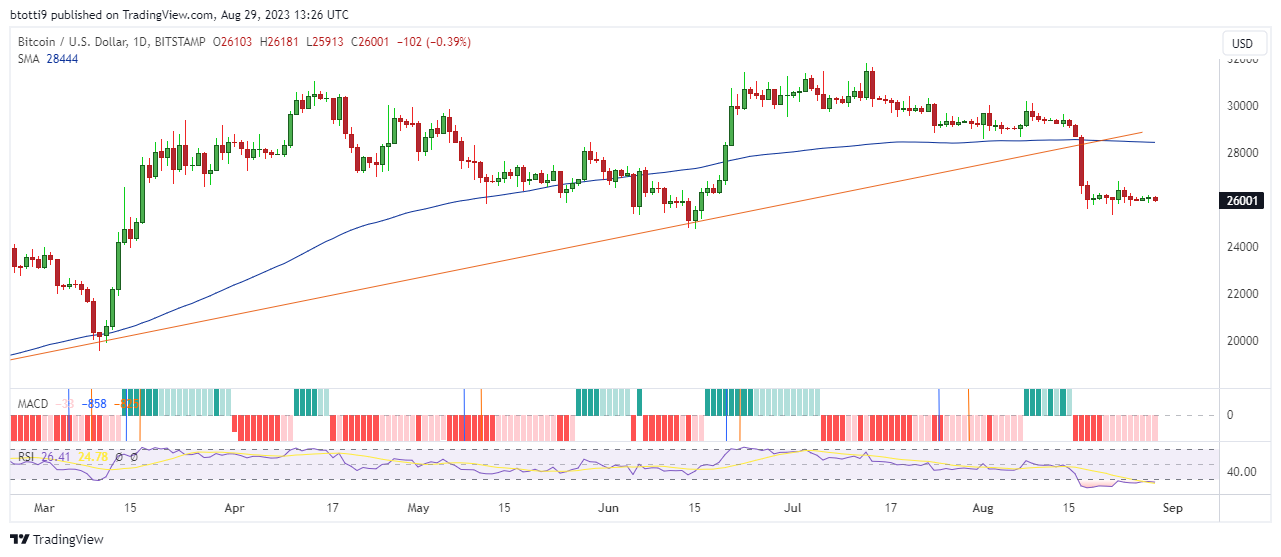
    The crypto market recently witnessed a sharp sell-off for Bitcoin, the benchmark cryptocurrency falling to lows of $25,350. The struggle to strengthen above $26k has illustrated the market jitters permeating the broader risk assets sector, with this shown in outflows from Bitcoin investment products.

    Bitcoin price chart

    However, while outflows totaled $149 million last week, the flagship crypto asset’s flows are net positive for the year at roughly $265 million. Meanwhile, investors are increasingly selling their short positions, with $4 million in outflows registered last week for an 18-week streak of outflows. 

    Data shows shorts outflows are currently 89% of the total AuM.

    In the altcoin market, Ethereum recorded outflows of $17 million, while XRP and Litecoin had minor inflows of $0.5 million and $0.44 million, respectively.


    Source link

  • What is the Bitcoin hash rate? And why is at all-time highs?

    What is the Bitcoin hash rate? And why is at all-time highs?

    Key Takeaways

    • The Bitcoin hash rate is the amount of computing power contributed towards mining
    • It has continued to take new all-time highs
    • This squeezes miners’ profitability, at a time when electricity costs have risen and the Bitcoin price has fallen
    • Overall, a high hash rate implies a healthy and more secure Bitcoin network


    “All-time high” is a phrase I haven’t used in a while when covering the cryptocurrency space. But if you look, there is something that continues to hit higher highs, and that is the Bitcoin hash rate.

    Bitcoin’s hash rate refers to the amount of computing power that is being contributed to the network through mining. And as the chart below shows, its inexorable rise during the pandemic does not seem to be slowing down. But what does this mean, and why is it rising?

    What is the Bitcoin hash rate?

    Gone are the days when anyone could mine on their personal computer. Today, mining is dominated by large mining pools, using specialised computers specifically designed for this purpose.

    The practice of mining actually involves these computers solving complex mathematical puzzles. Once this puzzle is solved, the latest block of transactions can be validated and attached to the blockchain, before the process repeats regarding the next block and the next mathematical puzzle. Once a puzzle is solved and a block validated, the miner responsible for this work gets paid in newly created bitcoins.

    This is all very complicated, but what is important to understand is that Bitcoin is programmed to release a specific number of Bitcoin over time, with the blockchain coded such that a new block is added (validated) every ten minutes.

    But as more computers join the network and the hash rate increases, these puzzles should get solved quicker, meaning quicker block time and more bitcoins released. Right? Well, here is the thing. A difficulty adjustment is coded into Bitcoin – that means that the more computing power that joins the network, the harder it is to solve those puzzles.

    Don’t ask me how this works, because I don’t even come close to understanding what is under the hood of the mythical beast that is the Bitcoin blockchain, but the main point is that as more miners join, the difficulty goes up.

    And as Bitcoin has become more popular (and risen in price), that is exactly what has happened. More miners have joined the network, and today it is a highly advanced process. Ten years ago, when only few miners existed, you and I could have pulled out our laptops and mined to a reasonable degree.

    Why is at all-time highs?

    There are a number of reasons why hash rate continues to surge to new highs. But the bottom line is that the increase in miners causes the hash rate to climb.

    Thus the question really asks why miners are continuing to join, when the price of Bitcoin has been plummeting. There are a couple of potential answers here.

    The first is that during the pandemic bull run, mining equipment was scarce and prices for items such as chips were sky-high. Many miners ordered new mining rigs during the bull run, but only received the equipment recently (or some, not even yet).

    Additionally, as the price of Bitcoin fell, the profitability of mining also decreased, given miners’ revenue is denominated in Bitcoin. New mining equipment has been developed and is selling for a lower price than previously, helping to push the number of miners higher.

    One other theory is the Ethereum Merge. This took place in September, when Ethereum transitioned from Proof-of-Work to Proof-of-Stake, meaning mining on the network ceased. Hence, some of these out-of-work Ethereum miners transitioned across to Bitcoin mining.

    What does a higher hash rate mean?

    The first consequence of an increasing hash rate is obviously greater pressure on miners. More competition and a higher required hash rate squeeze their profitability, especially at a time when electricity costs have risen and revenue (Bitcoin) has fallen.

    The best way to see this is to glance at the share price action throughout 2022 of some of the public mining companies.

    On the positive side, the Bitcoin hash rate is considered a security metric for the network. The higher the hash rate, the more secure the network, so in that context, the all-time high represents a good thing.

    This is why a high hash rate is generally looked upon favourably, as it implies a healthy network. Only problem is, miners are feeling the squeeze.

    Source link

  • Bitcoin bulls push BTC to highs of $23,300

    Bitcoin bulls push BTC to highs of $23,300

    • Bitcoin hit highs of $23,342 on Binance, with a breakout above $22k extending year-to-date gains.
    • BTC price is up 30% in a month and has recovered 47% since the decline to $15,500 lows.
    • Short liquidations were around $376 million in the past 24 hours.

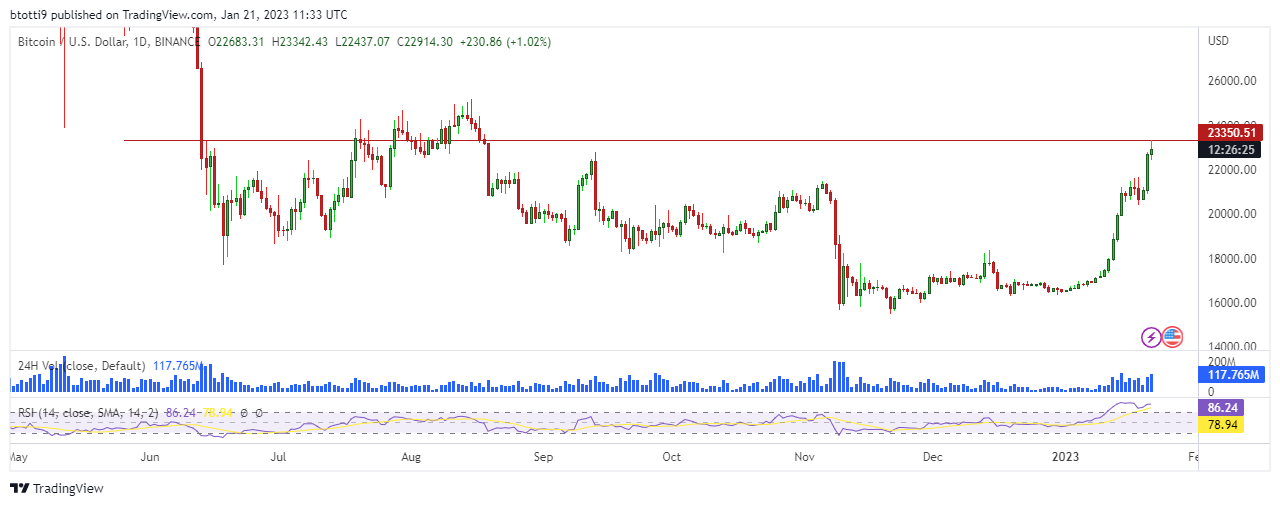
    Bitcoin price roared to highs above $23,000 on Saturday morning, rising to $23,342 on Binance as the price of the world’s largest cryptocurrency by market cap hit levels last seen in mid-August 2022.

    BTC was changing hands around $22,900 at the time of writing, about 9% up in the past 24 hours after shedding some of the gains. 

    The price of Bitcoin was, however, still 35% up in the past 30 days, and as crypto trader and analyst Rekt Capital pointed out earlier this morning, BTC had rallied over 47% since falling to lows of $15,500 amid the FTX dump.

    Bitcoin price chart showing BTC rally to $23,000 on 21 January, 2023. Source: TradingView

     On-chain data platform Santiment noted just before today’s break above $23k that Bitcoin’s price rally has come amid a bullish outlook from large BTC investors. As the firm highlights in the chart below, whale addresses with 1,000 to 10,000 BTC have in the past two weeks accumulated over 64,638 bitcoins worth more than $1.46 billion.

    Over $376 million in shorts liquidated

    As Bitcoin raced to highs near $23,350, liquidation data showed that in the past 24 hours, about 80,497 traders had been liquidated.

    According to Coinglass, the largest short liquidation was on Bitmex where an order worth $4.53million was rekt. The total liquidations as of 06:10 am ET on 21 January were $376.61 million. 

    Notably, total liquidations are not at the levels seen when BTC/USD broke above $20,000 last week towards erasing all post-FTX losses. Nonetheless, it still shows some traders are convinced this could be a gigantic bull trap. 

    But as it is, further upside momentum could see bulls target $25,000 or possibly higher if sentiment across risk markets helps bouy buy pressure.


    Source link

  • ApeCoin (APE) makes higher highs and higher lows but will buyers remain relentless

    ApeCoin (APE) makes higher highs and higher lows but will buyers remain relentless

    • ApeCoin had added 20% in a week

    • Yuga Labs NFTs had great success last year

    • The cryptocurrency has overcome resistance at $4.2 but faces a correction

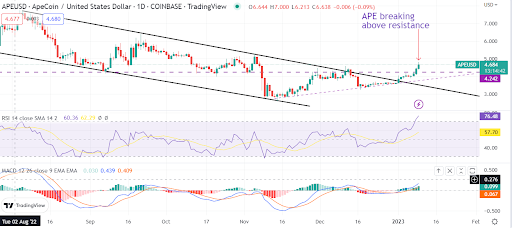
    As most cryptocurrencies generate relief rallies, investors could turn to ApeCoin (APE) for some quick bucks. Since the onset of Ape staking, bullish investors have been trying to break a crucial barrier at $4.2 unsuccessfully. However, the recent price action looks positive as APE trades at $4.66, breaking past the resistance zone. Should this be viewed as a bullish signal?

    According to CoinMarketCap data, ApeCoin has added 20% in a week. The cryptocurrency started the week on a higher note, jumping by an intraday of 12% On Monday. The gains in APE come amid the latest cryptocurrency news showing growing success for ApeCoin’s NFTs. The New Year update showed that Otherdeeds NFTs amassed $49.9 million in loyalties, the best performing in 2022. Other popular NFTs from Yuga Labs, BAYC, and MAYC, generated over $32.3 and $25.6 million in royalties, respectively. 

    Considering how popular Yuga Labs NFTs are, the latest news could have excited APE buyers. That partly explains the recent recoveries in APE price.

    ApeCoin breaking past the $4.2 resistance

    APE/USD Chart by TradingView

    From the technical outlook, APE trades slightly above the resistance of $4.2. The cryptocurrency has also overcome a descending channel that kept it bearish. The cryptocurrency has maintained a system of higher highs and higher lows since bottoming around $2.8. The MACD indicator has shifted above the neutral zone, affirming a bullish momentum. However, the reading on the RSI shows that APE is overbought.

    What could occur next for APE?

    The latest surge and indicators are positive for APE price. We expect the strengths to be sustained in the short and medium term, potentially reaching the next resistance at or above $5.1. 

    Nonetheless, with the high RSI reading, APE could be due for a correction before continuing higher. A possible price retreat could see APE back to $4.2, now a support, or short-term ascending trendline. Investors should buy APE on a correction.

    Where to buy APE

    eToro

    eToro offers a wide range of cryptos, such as Bitcoin, XRP and others, alongside crypto/fiat and crypto/crypto pairs. eToro users can connect with, learn from, and copy or get copied by other users.


    Buy APE with eToro today

    Public

    Public is an investing platform that allows you to invest stocks, ETFs, crypto, and alternative assets like fine art and collectibles—all in one place.


    Buy APE with Public today

    Source link