Tag: limited

  • Bitcoin faces quantum risk: why SegWit wallets may offer limited protection

    Bitcoin faces quantum risk: why SegWit wallets may offer limited protection

    Bitcoin faces quantum risk: Why SegWit wallets may offer limited protection

    • SegWit wallets delay public key exposure until the point of transaction.
    • Holding Bitcoin in SegWit addresses offers temporary protection if left untouched.
    • Critics believe practical quantum computing remains decades away.

    Quantum computing’s long-theorised threat to Bitcoin is resurfacing in the crypto conversation.

    The idea that a powerful enough quantum machine could break cryptographic security and expose Bitcoin keys has moved from theoretical chatter to practical concern.

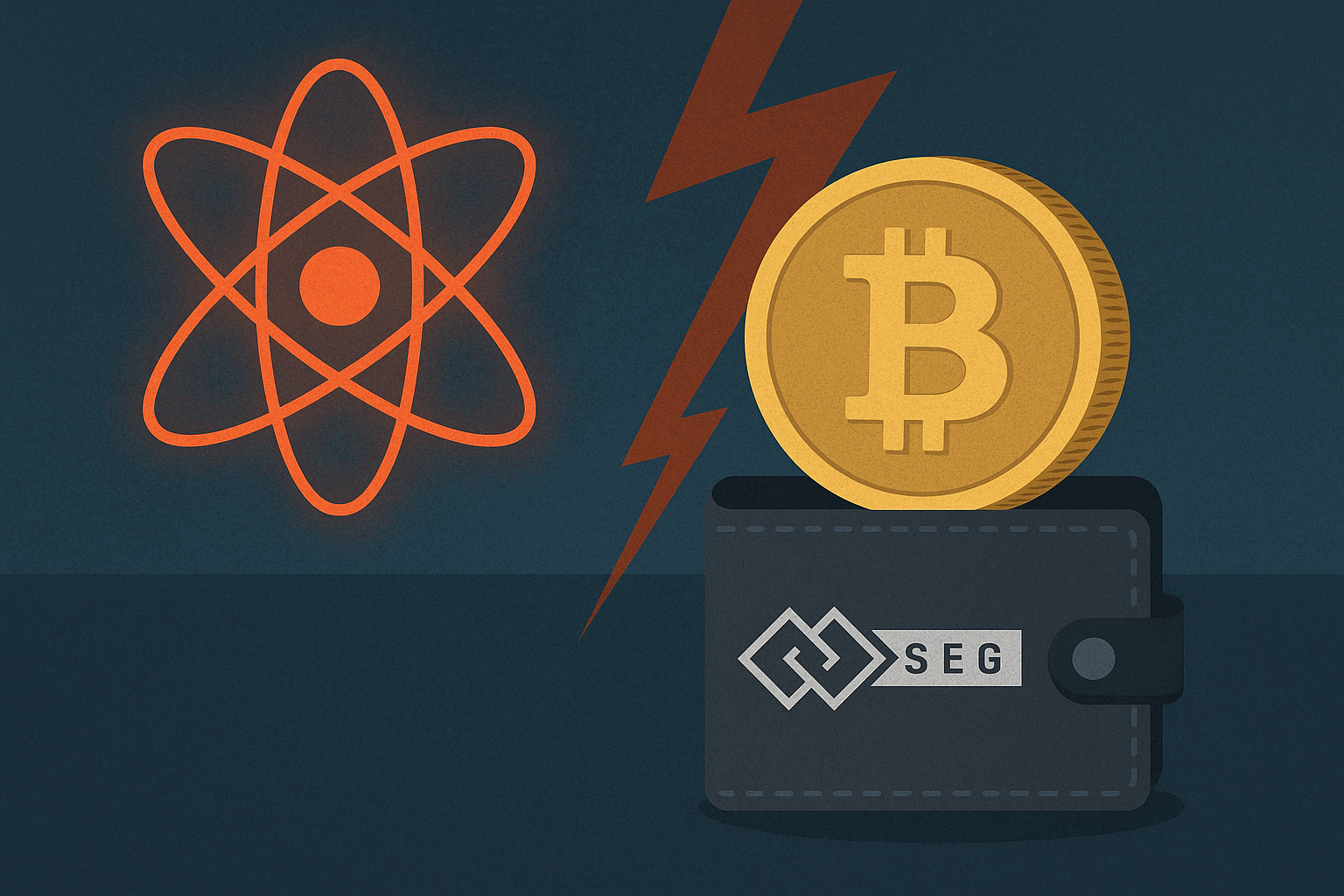
    Bitcoin analyst Willy Woo recently suggested a short-term safeguard: store Bitcoin in SegWit addresses for the next seven years.

    While the tactic has sparked debate, the broader community remains divided over whether quantum computers are a real, imminent threat or just the latest tech-driven scare.

    SegWit offers delayed public key exposure

    Segregated Witness (SegWit), introduced on 23 August 2017, is a protocol upgrade that changes how data is stored in Bitcoin transactions. Woo suggests that SegWit’s delayed public key exposure could act as a deterrent against quantum attacks.

    Unlike Taproot, which exposes the public key immediately within the address, SegWit only reveals it during transaction execution.

    This delay makes it harder for a quantum computer to reverse-engineer the private key from the public one before the transaction is completed.

    Under current conditions, exposing a public key does not present much of a problem. However, if and when quantum computing advances to the point of real-time decryption capabilities, the exposure window of Taproot wallets could be a key vulnerability.

    In contrast, SegWit’s hashing conceals the public key behind a layer of encryption until absolutely necessary. This may keep Bitcoin more secure during this anticipated transition period.

    Hodling in SegWit comes with major constraints

    While the SegWit method may offer protection, it carries a critical limitation. According to Woo, users must not move their Bitcoin from the SegWit address.

    Any outgoing transaction would expose the public key, potentially inviting a quantum attack if executed during the transaction.

    As such, this method is not viable for active traders or anyone needing liquidity in the short term. It is a static defence mechanism, not a dynamic solution.

    This approach effectively puts Bitcoin in a vault. It is safe but inaccessible. It is also only as secure as the continued absence of real-time quantum decryption.

    If a breakthrough comes earlier than anticipated, even SegWit-held coins could be compromised during withdrawal. Woo acknowledges that this is only an intermediary measure.

    It is meant to bridge the gap until a quantum-resistant Bitcoin protocol becomes available.

    Experts disagree over SegWit’s efficacy

    Not everyone agrees that SegWit provides any meaningful protection. Charles Edwards, founder of digital asset fund Capriole, has dismissed the idea as ineffective.

    He argues that SegWit is not a quantum-safe model and relying on it could delay necessary network upgrades.

    According to Edwards, the belief that Bitcoin has a seven-year buffer period could create complacency, weakening pressure to accelerate work on quantum-resistant algorithms.

    This disagreement underscores a broader lack of consensus in the crypto space on how seriously the community should take quantum risk.

    Although protocol upgrades are under development, there is concern among developers that current initiatives are progressing too slowly.

    Some argue that existing security layers were not built with quantum capabilities in mind, making them structurally vulnerable regardless of transaction format.

    Sceptics say quantum fears are overblown

    Despite the alarm, some in the community believe the risk is being overstated. Critics point to quantum computing’s persistent technical limitations.

    In a post in February, Bitcoin advocate Adrian Morris claimed quantum tech is “barely viable”, citing issues with thermodynamics, memory, and persistent calculations.

    Others argue that traditional financial systems and major banks would be far more attractive targets for early quantum attacks than a decentralised network like Bitcoin.

    Woo notes that Bitcoin held by custodians, such as ETFs or treasury firms, may be better shielded in the interim. This is only true if those institutions take proactive steps to secure their holdings.

    Until a comprehensive upgrade is implemented, the quantum debate will continue to shape discourse around Bitcoin’s long-term security.

    Source link

  • Bitcoin ETF may be a ‘limited’ benefit for Coinbase stock: Barclays

    Bitcoin ETF may be a ‘limited’ benefit for Coinbase stock: Barclays

    coinbase stock price forecast barclays analyst
    • Mike Novogratz expects SEC to approve a Spot Bitcoin ETF this year.
    • Barclays analyst does not expect that to be a huge benefit for Coinbase.
    • Coinbase stock is currently down over 30% versus its year-to-date high.

    Mike Novogratz – the Chief Executive of Galaxy Investment Partners expects the Securities & Exchange Commission to approve a Spot Bitcoin ETF by the end of this year.

    Here’s what Mike Novogratz said today on CNBC

    Last week, the U.S. regulator refrained from appealing a court’s ruling that said it did not have sufficient reason to block Grayscale from converting its flagship trust to an exchange-traded fund.

    Note that Galaxy itself has filed for a Spot Bitcoin ETF in collaboration with Invesco. On CNBC’s “Squawk Box”, Novogratz said today:

    Dialogue with SEC is heading in right direction. It is no longer talking how Bitcoin works. It’s just a recognised macro asset and that’s a huge psychological shift.

    The billionaire investor expects a positive news on the ETF front to lead the market higher. Still, Barclays is not entirely convinced that it will be a material catalyst for Coinbase Global Inc.

    Barclays analyst shares his view on Coinbase stock

    Analyst Benjamin Budish told clients in a research note today on Wednesday that approval of a Spot Bitcoin ETF will likely be a “limited” benefit for Coinbase.

    It is not clear how successful ETF launches would translate into a meaningful P&L benefit for Coinbase despite it being an integral service provider.

    He agreed that the Nasdaq-listed firm will serve as custodian for four BTC exchange-traded funds (at least) but said it is unlikely to earn significant custodial and prime brokerage fees.

    Barclays has an “underweight” rating on Coinbase stock with a price target of $70 that suggests another 6.0% downside from here. Earlier this week, Cathie Wood – the Founder of Ark Invest also took a positive tone on a Spot Bitcoin ETF approval.

    Source link

  • Bitcoin (BTC/USD) is still on a limited upside

    Bitcoin (BTC/USD) is still on a limited upside

    • Bitcoin lost 1% on Monday ahead of the US inflation data.

    • A crypto analyst expects the inflation data and Fed’s meeting to affect Bitcoin.

    • Bitcoin lacks a directional bias and could move in any direction.

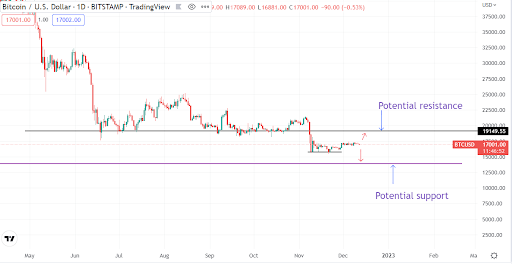
    Bitcoin (BTC/USD) traded down more than 1% on Monday, with the cryptocurrency’s price slightly below $17,000. Bitcoin has traded at this level since the start of the month. The price is also slightly improved from $16,000 at the end of November. But should we expect this price to improve?

    The limited upside in Bitcoin perhaps underlines that investors are still cautious about buying cryptocurrencies. That means a significant number expect Bitcoin to fall further as risk-on sentiment remains. Similarly, buyers are defending the $16,000 level. But as this bull-bear scenario unfolds, a popular crypto analyst expects two macro events to crush BTC further. The analyst, Nicholas Merten, says markets are warming up for the US inflation report and the Fed’s last meeting of the year.

    The US inflation report comes on December 12th, followed by the Fed’s meeting on December 14th. Higher-than-expected inflation is likely to raise speculations of policy tightening by the Federal Reserve. The analyst says already 80% of the market expects the Fed to hike rates by 50 basis points. If inflation comes hot, this will call for faster hikes. 

    Even if the Fed does not embark on fast rate hikes, Merten says markets will still be under pressure. The analyst says the lagging effects of previous policy actions could last longer.

    BTC on a slight upside amid weak momentum

    BTC/USD Chart by TradingView

    On the technical front, BTC trades within narrow ranges. The long-term momentum is bearish, although the cryptocurrency recovered slightly above $16,000. BTC’s next resistance lies at $19,000, while the support is at $14,000.

    Will BTC go lower or higher?

    A limited upside means that Bitcoin price could trade lower if the macro factors are not positive. Investors will monitor the inflation report and the Fed’s action for indicators of where BTC will go next.

    Where to buy BTC

    eToro

    eToro offers a wide range of cryptos, such as Bitcoin, XRP and others, alongside crypto/fiat and crypto/crypto pairs. eToro users can connect with, learn from, and copy or get copied by other users.


    Buy BTC with eToro today

    Bitstamp

    Bitstamp is a leading cryptocurrency exchange which offers trading in fiat currencies or popular cryptocurrencies.

    Bitstamp is a fully regulated company which offers users an intuitive interface, a high degree of security for your digital assets, excellent customer support and multiple withdrawal methods.


    Buy BTC with Bitstamp today

    Source link