Tag: lowest

  • Crypto Fear and Greed Index hits 30, lowest level in 18 months

    Crypto Fear and Greed Index hits 30, lowest level in 18 months

    • Crypto Fear and Greed Index is currently in the “fear” zone with a score of 30.
    • This is the lowest sentiment measure for Bitcoin (BTC) in nearly 18 months.

    The Crypto Fear and Greed Index, a measure of market sentiment for Bitcoin (BTC) and the broader crypto market, has dropped to 30, the lowest score it has reached in over one and half years.

    While BTC has traded lower during the current market cycle and the Crypto Fear & Greed Index has fallen into the “fear” zone, this is the first time it has done so since January last year.

    Crypto Fear & Greed Index drop to 30

    As Bitcoin price slipped below $60,000 on Monday, June 24, the index score nosedived more than 20 points to drop into the “fear” zone.

    The decline means the Bitcoin Fear & Greed Index is currently trending at levels last seen in January 2023. At the time, Bitcoin price was trading around $17,000 after the market reaction to the industry’s most shocking collapse so far – the implosion of the FTX crypto exchange.
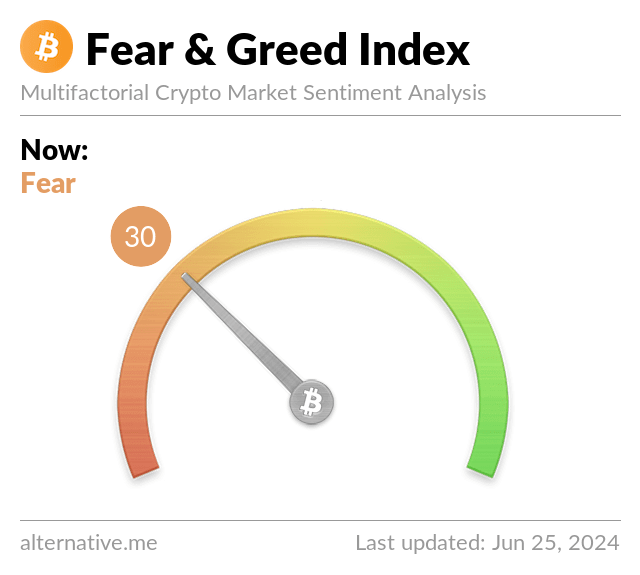
    Crypto Fear & Greed Index score is 30, now in “Fear” zone. Source: Alternative.me

    In May this year, Bitcoin price fell to lows of $56,500 and the index’s score dipped from neutral to fear.

    A bounce in price saw sentiment improve significantly to push the Fear & Greed Index to 74. “Greed” dominated then as Bitcoin broke above $71k, but that score flipped neutral and within hours on June 24, reached the 30 mark.

    Mt. Gox repayments and German government selling

    Catalysts for the latest declines include the Mt.Gox repayments news.

    A notice on Monday indicated that the exchange will begin repaying customers who’ve waited since the 2014 hack. Mt.Gox customers will receive Bitcoin and Bitcoin Cash. 

    Over $8.5 billion worth of BTC is with the exchange’s trustee. In April, analysts at K33 Research warned that Mt.Gox’ Bitcoin repayments could impact prices.

    Also attracting negative sentiment is the selling of Bitcoin by the German government. After sending 1,700 BTC to exchanges last week, including Coinbase and Kraken, Germany is at it again. 

    On Tuesday, Lookonchain shared on-chain data tracking wallets linked to the 50,000 BTC seizure the German government made early this year. The details show another 400 BTC deposited in CEXs.

    Source link

  • BTC hovers at $30k amid lowest historical volatility for 2023

    BTC hovers at $30k amid lowest historical volatility for 2023

    • BTC price is near the $30k mark, which bulls may be desperate to protect.
    • Bitcoin’s  historical volatility is at its lowest level in 2023.
    • Short-term bullish target could be above $34k, while major support is near $28.2k.

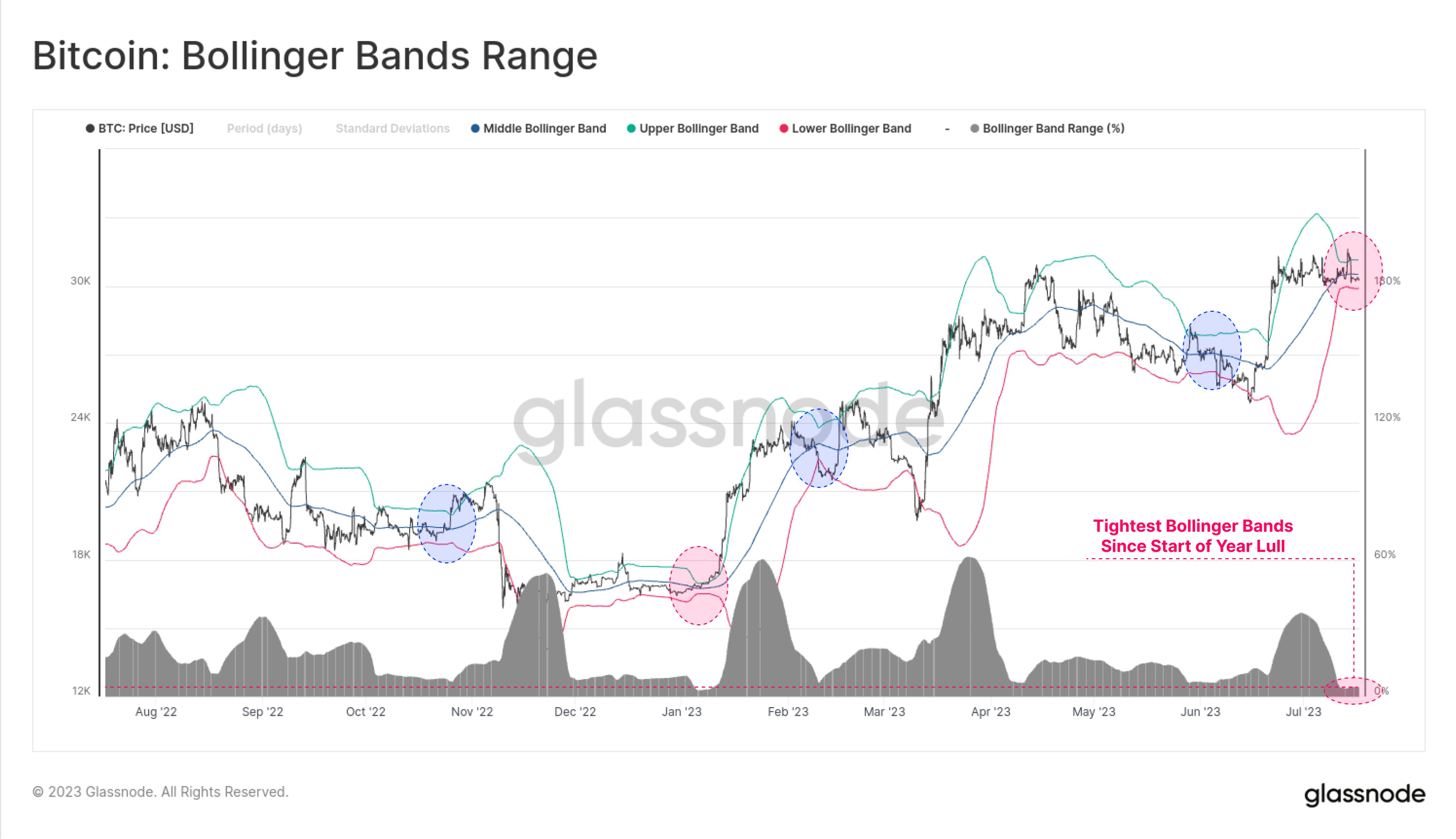
    Bitcoin’s price remains above $30,000 on Monday, but is seeing “remarkably little volatility.” According to a key technical analysis indicator for this measure, the prices are tightly squeezed to suggest a breakout in either direction could be big.

    Bitcoin price outlook: Bollinger Bands

    According to on-chain data and analytics provider Glassnode, the Bollinger Bands are tightly squeezed and a price range of only 4.2% separates the upper and lower bands. The platform notes that this outlook has Bitcoin at its quietest since early January.

    The digital asset market continues to see remarkably little volatility, with the classic 20-day Bollinger Bands experiencing an extreme squeeze. A price range of just 4.2% separates the upper and lower Bollinger bands, making this is the quietest #Bitcoin market since the lull in early January,” Glassnode analysts tweeted, sharing the chart below.

    Bitcoin price Bollinger Bands range. Source: Glassnode on Twitter. 

    In technical analysis, the Bollinger indicator offers a chart outlook where price trends reflect the market’s volatility. Traders use the indicator to identify overbought or oversold market conditions.

    Bitcoin recently broke from above the upper bands and currently fluctuates beneath the middle trendline. Support of the lower Bollinger bands is around the crucial $30k level.

    Data shows BTC price has declined from highs of $30,400 late Sunday, touching intraday lows of $30.079 on Monday morning. Currently at around $30,180, the top cryptocurrency by market cap is down about 0.5%.

    While accumulation around the current prices is staggering, bulls have to hold above this psychological support base. If not, bears could push lower first before a likely short squeeze catapults BTC/USD to potentially news YTD highs of $34k. The key downturn levels to watch in the short term are at $28,200 and $25,600.


    Source link

  • Volatility lowest since January, but until it drops further, Bitcoin serves no purpose

    Volatility lowest since January, but until it drops further, Bitcoin serves no purpose

    • Bitcoin’s volatility is a massive problem, writes our head of research, Dan Ashmore
    • The volatility is the lowest since January, but that doesn’t provide much solace with regards to Bitcoin’s actual utility
    • For Bitcoin to deliver on its potential, it needs to become boring, with volatility closer to gold’s famously steady return profile

    It’s relatively calm in Bitcoin markets right now, but that won’t last long. And it’s a massive, problem. 

    First, let us look at the short-term volatility, because I noticed over the last few days that is has come down a little. Plotting the 1-month volatility on an annualised basis, we are at the lowest mark since January, when this little Bitcoin surge was kicked off. 

    OK, fine. 

    But don’t confuse that with a steady market. The crypto markets remain highly capricious and capable of swinging back and forth and eye-watering speed. Volatility is still close to 50%, which in the context of any regular market, is truly insane. 

    Perhaps plotting the daily returns of Bitcoin against that of Tesla shows this better. Tesla is just about the most extreme member of the S&P 500, its stock price more volatile than its CEO’s Twitter feed. Comparing your volatility to Tesla is like comparing your ability to run a football team to Todd Boehly (seriously, wtf). 

    And yet, Bitcoin’s daily price changes not only match Tesla, but commonly exceed it. 

    Indeed, if we plot Bitcoin’s volatility back over a longer time period, we see that these fallow periods do occur, but rarely last long. Bitcoin and volatility are like Frank Lampard and Chelsea, apparently – occasionally apart, but you know that before long, they will be back. And they are terrible for each other. 

    Make no mistake about it, volatility is one of Bitcoin’s greatest drawbacks. It is difficult to imagine the asset ever achieving anything remotely close to a store-of-value status while it oscillates back and forth like it does. 

    If the ultimate vision for Bitcoin is some sort of digital gold, it has a hell of a long way to go. Flipping the earlier comparison from Tesla to gold is more apt, and puts the chasm between the two assets up in lights:

    Obviously, this could all change in the future. I don’t have a crystal ball. Regarding Bitcoin’s ultimate vision, it simply has to, because as it currently stands, Bitcoin is not achieving anything. 

    The arguments commonly point to the developing world. Bitcoin can offer a greater place to store one’s financial wealth, they argue. Again, this may prove true in time, but even a collapsing currency like the Argentinian peso is not as volatile as Bitcoin. A gradual decline such as the peso (and I am using gradual a bit liberally there, admittedly) is at least easier to plan for than Bitcoin, which can quite literally be 20% lower in the space of a couple of minutes. 

    While Bitcoin is capable of these massive price moves, it isn’t in a place to help anyone. That argument is currently better served to stablecoins, pegged to fiat currencies like the US dollar, which can be equally accessible but don’t swing in price (at least, the prudently-designed ones don’t). Now, their flaws could fill a whole new article which I won’t get into here, but the point is this: Bitcoin is literally useless while its volatility is as high as it currently is. 

    My friends often poke fun at me for chatting about gold, or doing analytical pieces on its price drivers. Boomer, they call me. And that’s fair – gold is boring as f**k, and watching its price chart is like watching paint dry. But that is kind of the point, isn’t it? Gold is a store of value, and therefore it should not be printing gains and losses that get Robinhood investors all hyped up. Otherwise, it wouldn’t be doing its job. 

    Bitcoin is the same. It needs to take a leaf out of gold’s book and become boring. Until that happens, there is no point to this mythical asset beyond wild speculation. 

    Source link

  • Bitcoin supply on exchanges the lowest since 2017, but why? On-chain report

    Bitcoin supply on exchanges the lowest since 2017, but why? On-chain report

    Key Takeaways

    • 11.8% of the Bitcoin supply is currently on exchanges, the lowest mark since 2017
    • Supply of Bitcoin on exchanges has been consistently falling since March 2020, when crypto bottomed ahead of the explosive pandemic bull run
    • Originally, people pulled Bitcoin to participate in vibrant crypto ecosystem, with high volumes and activity and much scope for yield
    • Today, volumes and interest have fallen, but pattern of Bitcoin fleeing exchanges has continued, albeit for different reasons
    • Bitcoins leaving exchanges in recent months are likely due to fears over security and transparency, heightened after FTX collapsed

    “Not your keys, not your coins”. 

    One of the oldest sayings in crypto. And after a year that saw one of the biggest exchanges around shockingly gamble away customer assets in secret, many will wish they had paid it more attention. 

    Now, people are listening. Although in truth, this has been happening all throughout the pandemic. The balance of bitcoins on exchanges is now down to 2.27 million – that is the lowest mark since March 2018, a month which saw “God’s Plan” by Drake being played on the radio over and over and over and over again. 

    The mark is even lower when compared to the overall supply. There is currently 11.8% of the Bitcoin supply on exchanges. This is the lowest mark since December 2017. 

    Crypto fans will remember December 2017 as the month that Bitcoin went absolutely bananas. I remember exactly where I was when I saw that Bitcoin had breached the $20,000 mark for the first time; it felt like a seminal moment. 

    It marked the top, incidentally, with the orange coin at $7,500 seven weeks later. Within a year, it wasn’t far above $3,000. It was a long and barren bear market with fortunes not turning around until COVID hit in 2020. 

    Where is the Bitcoin going?

    I say “not your keys, not your coins”, but this isn’t the only thing driving the movement of coins off exchanges. 

    As the above charts show, the Bitcoin supply on exchanges has been coming down since March 2020. This is also the month that COVID kicked off. Since I’ve been in crypto, I also believe it was the scariest time of all – Bitcoin plunged from close to $10,000 to $5,000 in a gruesome 48 hour stretch as markets around the world tried to figure out what exactly this COVID-19 thing was. 

    But after this, the bull market kicked into gear. So, why has Bitcoin on exchanges been falling throughout this period?

    The truth is, ironically, that it could be for the exact opposite of the matra behind “not your keys, not your coins”, at least in part. This is due to the rise of crypto lending platforms during the bull run – firms like Celsius, BlockFi, Voyager Digital and so on.

    These platforms offered a nice yield on Bitcoin, and this attracted billions of dollars of inflows. Now, you may notice one thing about those names: today, they are all bankrupt. Which means that, obviously, coins currently leaving exchanges in recent months are for other reasons. 

    So there could be a dual explanation here: during the bull run, coins were leaving exchanges for yield on centralised platforms. Or they were leaving exchanges for DEXs, or other destinations. Crypto was booming at this time; there were no shortage of things to do or yield to earn. 

    Today, however, volumes have been decimated. Looking at total value locked within DeFi, it is down to $50 billion, having been up to $180 billion in December 2021. That is a fall of 72%. Simply put, prices are down, volumes are down and interest in general is down. 

    This fallen volume and interest have likely reduced the pull of Bitcoin off exchanges. But this drop may have been replaced by people pulling Bitcoin at a similar rate, but for an entirely different reason: to be secure, and to send to cold storage. You can thank Sam and the various other scandals for this. 

    Source link