Tag: Market

  • No, Bitcoin has never seen a bear market before: Be careful

    No, Bitcoin has never seen a bear market before: Be careful

    Key Takeaways

    • Bitcoin has been through many bear markets before, always surging back to higher highs
    • Dan Ashmore, our Head of Research, cautions against naive extrapolation of past returns, however
    • Until this past year, stock markets had done nothing but rise during Bitcoin’s existence
    • Bitcoin was launched in 2009 as the stock markets bottomed, and the bull run afterward was one of the longest in history
    • This needs to be considered, cautions Ashmore, whilst sample size of Bitcoin trading with any sort of liquidity is also small

    Bitcoin is volatile. Also true: water is wet and the sky is blue. 

    A quick glance at a Bitcoin chart will tell you all you need to know about the meteoric rises and bone crushing pullbacks that the asset has produced over the years. In truth, it should be plotted on a scale, too. 

    When looking at Bitcoin markets, therefore, it is tempting to jump to the conclusion that “we have been here before”. Bull markets and bear markets, easy come and easy go. Or, as Jeff Bridges put it so poetically in the Big Lebowski, “strikes and gutters, ups and downs”. 

    While Bitcoin has drawn down many times before and, at least previously, always bounced back, I believe it is naive to extrapolate past resurgences into the present. Because no, we have not been here before. 

    To be clear, I am not saying Bitcoin will not rise to new heights again. It easily could (I hold Bitcoin as part of my portfolio, albeit via a monitored allocation and obeying the boring all adages of diversification and risk management, but hey – that is for another time). My point, however, is that we have zero point of reference for the current situation. Despite a surge of 75% in the last six months, Bitcoin is 60% off its high in Q4 of 2021, with many investors underwater if they opened positions in the past three years as Bitcoin truly established itself on the mainstream stage.  

    Let me explain why things are different this time around, and why assuming with blind confidence that Bitcoin will surge upward imminently may be misguided. First, the below are the biggest peak-to-trough drawdowns in Bitcoin history (the recent/current one is highlighted in yellow): 

    Clearly, Bitcoin has been here before. Right? 

    Well, no it hasn’t. Look at the dates of the above: all these drawdowns are from 2012 onwards. This is because Bitcoin was only launched in 2009. Indeed, it didn’t really have any sort of liquidity or infrastructure (such as exchanges or a marketplace) until 2012 (and even then, liquidity was extremely thin). 

    And consider what has happened in the wider economy since Bitcoin was launched in 2009. On March 9th 2009, two months after Bitcoin launched, the Nasdaq hit a low of 1268. The S&P 500 did the same, hitting a nadir of 676. 

    Since then, markets have enjoyed one of the most remarkable, longest and explosive bull runs in recent history, as basement-level interest rates propelled asset prices to dizzying all-time highs. By late 2021 at their peaks, the Nasdaq hit a level of 16,057, the S&P 500 4,793. Since those aforementioned lows in March 2009, that represents returns of 12.7X and 7.1X respectively. A historic period of gains.

    Presenting the returns of both the Nasdaq and S&P 500 since Bitcoin was launched in January 2009 (note – this goes back a couple of months before the trough of the stock market in March of that year and hence the returns are not as empathic as above) shows the run in markets visually throughout Bitcoin’s life:

    Or perhaps the next chart is better, showing quite how boisterous the stock market throughout Bitcoin’s life during the period up to and including 2021. 

    Therefore, every single dip in Bitcoin’s history took place whilst the wider financial markets were humming along swimmingly. This all changed in 2022, of course, when inflation spiralled and the world’s central banks began hiking rates at the fastest rate in recent memory. 

    Suddenly, for the first time in Bitcoin’s existence, it was ticking along block-by-block while financial markets elsewhere were falling. And they were falling quickly, the S&P 500 shedding nearly 20% in 2022, the Nasdaq losing over a third of its value. Not only were these losses the worst of any period in Bitcoin’s life, they were, aside from minor falls in 2011 and 2018, the only losses it had ever seen. 

    Therefore, this time is different. Blind faith in Bitcoin bouncing back aggressively because of the simple conclusion that it has done so before is a dangerous assumption to make. Again, Bitcoin could easily do exactly this, but it would be foolish to assume it is a guarantee because it has happened in the past. 

    The reality is that, until this past year, the world had no idea how Bitcoin would trade outside of the zero-interest rate vacuum that we have been operating in for the past decade. There is no trade history for Bitcoin going back to previous recessions, no chart one can pull up to assess how it weathered inflation in the 1970s, no reference point to anything but a stock market printing green candle after green candle. 

    Not only did all those previous resurgences come amid a period of cheap money and expanding central bank balance sheets, but Bitcoin markets were also incredibly illiquid. It took barely a drop of capital to move prices, as Bitcoin exploded from a fraction of a cent to thousands of dollars per coin. Bitcoin’s existence has been brief itself, at 14 years, but its status as a financial asset of any sort of liquidity is even briefer again. 

    So, for one last time: this is not a piece making any forecasts about the future of Bitcoin. I don’t want to wade into such murky waters (not here, anyway!). Rather, it is a piece cautioning that we have such a small sample size to work with when it comes to Bitcoin, and it is important to be cognisant of that when assessing how it trades. 

    Bitcoin has never experienced a bear market in the wider economy before. Until now. Overlooking that critical fact is a dangerous game to play.

    Source link

  • active addresses fall, market makers scale back, price softens

    active addresses fall, market makers scale back, price softens

    Key Takeaways

    • Number of addresses containing one Bitcoin or more crosses one million
    • Bitcoin relatively subdued despite trading at 2-month low
    • Two prominent market markers are scaling back activity in the space
    • Active addresses show notable decline in last week


    We wrote last week that nearly one million addresses on the Bitcoin network now contain at least one Bitcoin. That mark has now been passed, as the below chart shows. 

    As dramatic as that sounds, it doesn’t equate to one million people, as aggregate wallets exist (such as exchange wallets), not to mention the fact that one person often has more than one address. 

    Looking beyond this quirky threshold, there has not been too much of note occurring in the markets in recent weeks. The market has been somewhat soft, Bitcoin trading at $27,300 as I write this, a two-month low. It is down 7% over the past ten days, but that is not exactly a dramatic decline by Bitcoin’s standards. 

    Looking at activity on the network does show more notable developments, however. The below chart shows a perceptible break downwards when analysing the 7-day exponential moving average (EMA) of active addresses on the network.

    It is the biggest decline in activity over the last year. It is not immediately obvious what is causing it, but with the 7-day EMA running roughly between 800,000 and 1,000,000 addresses, the fall towards 600,000 does stand out. 

    Regarding possible catalysts, there has not been much beyond the continued big story of the year: the regulatory crackdown from the US. Coinbase CEO Brian Armstrong said the exchange would consider the UAE as an international hub, as the company reels from the punitive measures levelled against the industry in recent times – including a Wells notice served to Coinbase in March. 

    Congressman Brad Sherman was the latest lawmaker to slam the industry, making some startling comparisons that haven’t exactly gone down well in the industry:

    “Peru is way ahead of us (the US) in cocaine production. China is way ahead of us in organ harvesting. We don’t need to keep up on those things and we don’t need to keep up on crypto”. 

    Regardless of whether you agree or not, the industry is feeling the pinch of this hostile stance in the US. Last week, two prominent crypto market makers, Jane Street and Jump Crypto, announced they were scaling back their market making activity.

    This amounts to a blow to markets that are already very thin. Indeed, we have written multiple times what role the thin liquidy has played in Bitcoin’s run-up this year. In April, crypto profits, prices all hit their highest marks since June 2022. But so did volatility, as there has been a dearth of capital in the space ever since Alameda, one of the largest market makers, evaporated amid the FTX crash in November. And that liquidity is only going to get thinner again with the news out of Jane Street and Jump Crypto. 

    With thin liquidity comes high volatility, as it takes less capital to move prices. The below chart shows that volatility has fallen off since March, but is still trading above 40% on an annualised basis and up markedly since the start of the year. 

    While Bitcoin’s price fall from close to $30,000 to where it currently sits at $27,200 is nothing to write home about, the shallow nature of the markets hint that more volatility could be on the way. 


    Source link

  • Why is the crypto market down today? BTC briefly slips below $27k

    Why is the crypto market down today? BTC briefly slips below $27k

    Key takeaways

    • The cryptocurrency market is down by roughly 1% over the past 24 hours.

    • Bitcoin briefly dropped to $26,990 earlier today before recovering to now trade above $27,500.

    • The dump came due to reports that there was a transaction with the United States government’s BTC wallet.

    Why the crypto market is down today

    The cryptocurrency market recorded a sharp spike in movement a few hours ago. Bitcoin, the world’s leading cryptocurrency by market cap, was trading just above $28k earlier today.

    However, BTC fell below the $27k level for the first time in more than a week, briefly touching the $26,990 mark before retracing its movement.

    According to market experts, the sharp decline in Bitcoin’s price came as a result of a transaction from the United States government’s BTC wallet. 

    Data obtained from Blockstream showed that 9819.01814463 bitcoins were on the move from the wallet. This large transaction was reflected in the market, with Bitcoin dropping below the $27k mark for the first time in a month. 

    Bitcoin recovers to trade above $27,500

    The dump didn’t last long, as Bitcoin is now trading above the $27k level once again. At press time, the price of Bitcoin stands at $27,502, down by more than 2% in the last hour.

    Bitcoin is not the only cryptocurrency that recorded losses. Ether, the second-largest cryptocurrency by market cap, also dropped below the $1,800 mark earlier today before retracing to now trade at $18,36 per coin.


    Source link

  • Why the crypto market is down today

    Why the crypto market is down today

    • The crypto market cap was down 3.2% in the past 24 hours to $1.2 trillion as Binance halted BTC withdrawals.
    • The exchange’s action followed massive network congestion for Bitcoin amid increase in fees as tokens with inscriptions and ordinals pumped.
    • Meanwhile, Bitcoin (BTC) saw its market cap drop to $540 billion for a 45% market dominance.

    The total cryptocurrency market cap is down 3.2% to $1.2 trillion in the past 24 hours as of writing. The top two digital assets by market capitalization Bitcoin (BTC) and Ethereum (ETH) are both down more than 3% in the same period and -5.4% and -2.2% respectively over the past seven days.

    As a result, BTC price is below $28,000 while Ether is trading near $1,850 amid broader selling pressure for crypto.

    While most big cap tokens are down about 3 to 6%, Pepe (PEPE) and Sui (SUI) are the biggest losers in the top 100 coins with about -12% performance in the past 24 hours.

    Why crypto market is down today – look at Bitcoin

    The traditional markets continue to see some negativity as traders place new bets on regional banks plummeting again following last week’s bounce. The outlook isn’t the same for crypto and Bitcoin indeed rallied as multiple US bank stocks dumped.

    But why is the crypto market cap down? Notably, crypto remains volatile and BTC is finding it difficult to break higher following the rejections near $30,000. However, panic selling could be behind this latest down leg, particularly with such data as the one showing enormous BTC outflows from the Binance exchange. 

    Binance addressed the “outflows” funds movement between its hot and cold wallets amid the adjustments in BTC address. This comes after the exchange suspending Bitcoin transactions as the flagship network experienced massive congestion. It’s a scenario that saw transaction fees spike significantly.

    For instance, on Sunday, transaction fees in BTC block 788695 was 6.7 BTC, higher than the block subsidy of 6.25 BTC. On-chain data shows Bitcoin experienced a spike in blockspace demand, pushing transactions fees higher.

    According to on-chain analytics platform Glassnode, the high demand for blockspace is being driven by BRC-20 tokens. The tokens that use inscriptions and ordinals have been up as shown by the 9% gains for Stacks (STX) amid BTC price decline.

    As such, the Bitcoin market cap is down to $540 billion today, representing about 45% of market dominance. Ethereum‘s market dominance currently stands around 18.6%

    Bitcoin price prediction

    The announcement that Binance had suspended BTC withdrawals – on two occasions – looks to have spooked a few traders into action. But the crypto market cap could recoup some of the losses ahead of a crucial week with economic news. Binance is also reportedly eyeing Bitcoin Lightning Network transactions.

    Crypto analyst Michael van de Poppe highlights Bitcoin price levels at $27.4k or even $26.8k could provide the bounce area.

    Mentioned before that $29.2K was the key level to break for #Bitcoin. We did have a bounce towards it, but no break. Additionally some FUD regarding #Binance doesn’t help. Looking at $27.4K or $26.8K for potential longs towards the CME gap at $29.6K,” the analyst tweeted on Monday morning.


    Source link

  • Riot Platforms stock has moved to a bear market: buy the dip?

    Riot Platforms stock has moved to a bear market: buy the dip?

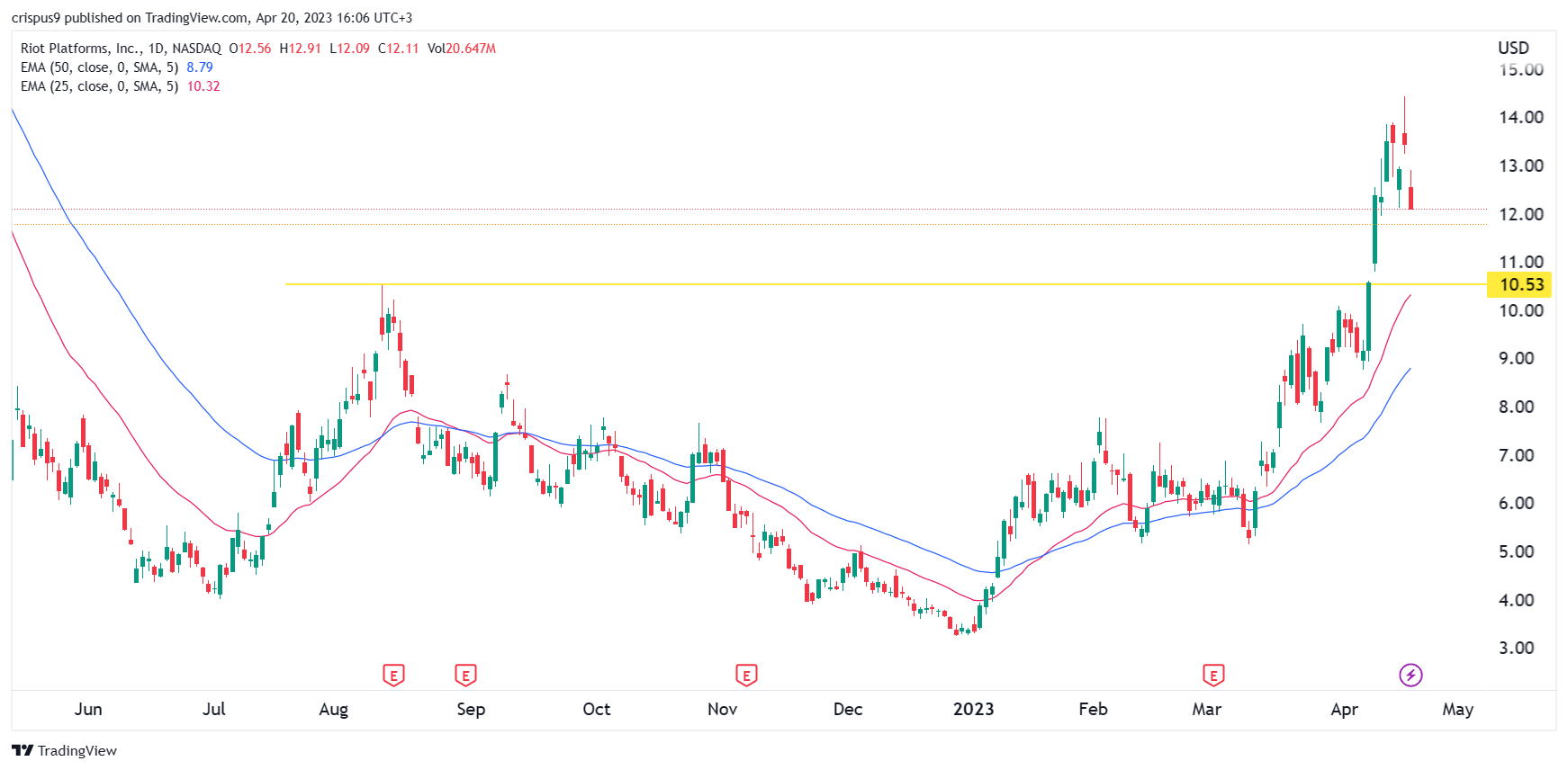
    Riot Platforms (NASDAQ: RIOT) stock price has drifted downwards in the past few days as Bitcoin and other cryptocurrencies retreated. The shares retreated to a low of $11.48 in the pre-market session. This means that the stock has dropped by more than 20% from the year-to-date high, meaning that it has moved to a bear market.

    Is it safe to buy the dip?

    Riot Blockchain is one of the biggest Bitcoin mining companies in the world. It competes with the likes of Argo Blockchain and Marathon Digital among others. Therefore, as in the other mining industry, these companies have a close correlation with the price of the underlying asset.

    This explains why the Riot Platforms stock price has jumped sharply this year. Between the lowest point in 2022 and the year-to-date high, RIOT shares were up by more than 338%, making it one of the best-performing stocks in the market.

    Therefore, to predict whether the Riot Blockchain stock price will bounce back, we need to understand why Bitcoin is falling and whether it will bounce back soon. As I wrote in this articlethe main reason for the crash is that bullish liquidations have jumped in the past two days.

    Liquidations happen when brokers and exchanges forcefully close positions of leveraged positions. Therefore, this usually puts prices under pressure.

    Another reason why this happened is that Bitcoin recently rose above the key resistance level at $30,000. Historically, cryptocurrencies tend to be a bit volatile when they move above or below a key support or resistance level. 

    The other reason is that several regional banks, including Western Alliance Bancorp, published strong results. Its inflows rose by more than $3 billion. As such, the risks of a banking crisis seens like they have been minimized. In a note, analysts at Bernstein said:

    “Any potential dislocation, whether on the bank’s credit side, or on the sovereign side …positions bitcoin perfectly as a safe-haven asset alongside gold.”

    Therefore, there is a likelihood that Bitcoin price will bounce back in the coming months as the Fed starts to pivot.

    Riot Platforms stock price forecast

    The daily chart shows that the RIOT share price formed a shooting star pattern on Wednesday. In technical analysis, this pattern is usually a bearish sign. The stock has jumped by more than 25-day and 50-day exponential moving averages. 

    It remains slightly above the key support level at $10.53, the highest level on 11th August. Therefore, I suspect that the shares will drop to the key support at $10.53. The stock will then resume the bullish trend as buyers target the year-to-date high of $14.51.

    How to buy Bitcoin

    eToro

    eToro offers a wide range of cryptos, such as Bitcoin, XRP and others, alongside crypto/fiat and crypto/crypto pairs. eToro users can connect with, learn from, and copy or get copied by other users.


    Buy BTC with eToro today

    Public

    Public is an investing platform that allows you to invest stocks, ETFs, crypto, and alternative assets like fine art and collectibles—all in one place.


    Buy BTC with Public today

    Source link

  • Analyst says CPI could be big market mover

    Analyst says CPI could be big market mover

    • Bitcoin price hovers above $28k with a ranged trading over the past month.
    • Analyst Michael van de Poppe says the US consumer price index report out this week could be a big market mover.
    • Bitcoin’s volume weighted average price (VWAP) is a metric to also watch.

    Bitcoin price continued its ranged trading this past weekend, with bulls retesting the $28,500 area. As the week starts, the top cryptocurrency could see an injection of volatility.

    Indeed, crypto analyst Rekt Capital says bitcoin remains “well positioned for mid- to long-term upside”, particularly as the cryptocurrency moves towards its next halving event. 

    But what about the next few days? Below is what analysts say about Bitcoin price this week.

    Bitcoin price prediction ahead of CPI data this week

    According to crypto analyst Michael van de Poppe, BTC is still in consolidation – which has stretched from around mid-March. But with big economic news on the cards this week, the market could be in for a bit of movement.

    In a comment on Bitcoin price he shared on Monday, van de Poppe said the upcoming Consumer Price Index (CPI) data expected on 12 April is a “big event this week.” 

    If buyers manage to retest the $28,600 level, its likely BTC will break higher.

    Bitcoin is still stuck in the range. Good move overnight to $28,500 and back to consolidation. Big event this week with CPI, probably the market mover. If another test of $28,600 takes place, I’m assuming we’ll be breaking out upwards,” the analyst noted.

    Here is the analyst’s Bitcoin price chart.

    Trading volume metric and BTC price outlook

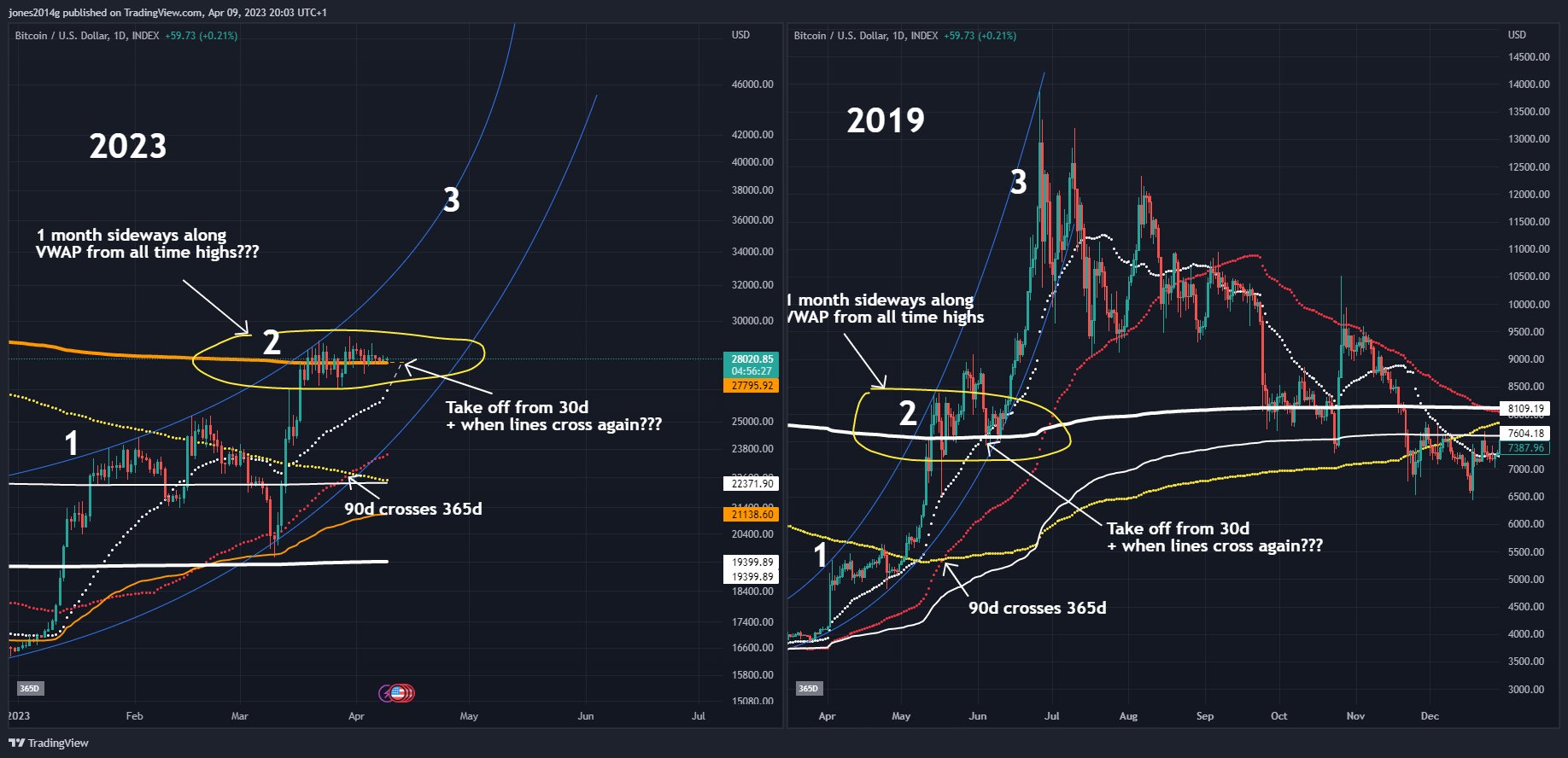
    Pseudonymous analyst bitcoindata21 also says the CPI news this week will likely be a major market catalyst. However, he also highlights Bitcoin’s Volume Weighted Average Price (VWAP), which he says currently sits on the benchmark cryptocurrency’s all-time highs.

    VWAP takes into account the average price of a trading asset as weighted by its total trading volume. 

    The metric helps analyse and forecast price movement based on the average value over a given period. In this case, bitcoindata21 highlights the 30-day VWAP on 15 April, with a potential upward crossing on 13 April.

    The chart below bitcoindata21 shared on Twitter shows a comparison of the 2019 and 2023 price movements.

    Bitcoin price VWAP historical data outlook comparing 2019 and 2023. Source: bitcoindata21 on Twitter.


    The 1-month sideways trading along the VWAP is similarly positioned as was in 2019 before BTC went on to hit a new all-time in the last bull market.


    Source link

  • Least amount of Bitcoin on exchanges since the previous bull market top in December 2017

    Least amount of Bitcoin on exchanges since the previous bull market top in December 2017

    Key Takeaways

    • The balance of Bitcoins on exchanges is in constant decline, now at the lowest point since December 2017 
    • Meanwhile, long-term investors continue to hold, soaking up the supply
    • Coins that have not been touched in 10 years now outnumber those held on exchanges 

    I wrote a piece last week on the exodus of stablecoins from exchanges, with the balance currently the lowest since October 2021, with 45% of the total balance of stablecoins on exchanges flowing out in the last four months. 

    But the glut in liquidity is not limited to stablecoins. The world’s biggest cryptocurrency is also seeing funds flow out. Only 11.8% of the total Bitcoin supply is currently on exchanges – that is the lowest since December 2017. 

    To jot your memory, December 2017 was the previous bull market peak. Bitcoin rose to within a hair of $20,000 before freefalling into a two-year-long bear market which ravaged the entire industry.

    Since January 2020, exchanges’ reserves of Bitcoin have been only going one way: down. It hints at the demand/supply imbalance that so many Bitcoin truthers advocate for, with the much-vaunted hard supply cap of 21 million coins for Bitcoin. 

    If demand keeps rising, they argue, the price can only go up because supply cannot keep up. 

    Central to this thesis is the resilience of long-term holders to keep a firm grasp on their bitcoins. And when assessing whether they have, the answer is a resounding yes. 

    The below chart presents long-term holders against the total exchange balance. In November 2022, the number of bitcoins last active 10+ years ago overtook the number of bitcoins on exchanges. 

    Of course, some of these long-term holders will be lost coins, either via their owner dying or losing their private keys. 

    But the stat is still interesting and speaks to the cohort of (very) early investors in Bitcoin who remain clinging to their coins with all their might. Remember, this includes the anonymous Satoshi Nakamoto, who is estimated to hold over 1 million coins, or 5% of the total supply. 

    Below is the chart displaying the current portion of the Bitcoin supply split out by time held and compared to the exchange balance. 

    The result is interesting, but even more so when considering that the last three years brought both the euphoric highs of Bitcoin at nearly $70,000 during the pandemic and then the bone-crushing fall through 2022, which saw it careen down towards $15,000. 

    In terms of the long-term trajectory of Bitcoin, it’s undoubtedly bullish. Of course, it all depends on whether the demand for additional Bitcoin will hold up. The supply may be getting squeezed, but that is all for nothing if the demand side doesn’t hold up its end of the bargain. 

    And on that note, the last year has been a big blow. Not only has capital flowed out of the space at an alarming rate, but a number of very high-profile scandals (LUNA, Celsius, FTX and so on) have rocked the space. The fear is that these episodes have dented the reputation of the cryptocurrency space and will inhibit the demand for Bitcoin on the intuitional side. Have people been put off moving into the space?

    It’s hard to say. But in looking at long-term holders, their confidence seems resolute. 

    Source link

  • No, Bitcoin is still as correlated as ever with the stock market

    No, Bitcoin is still as correlated as ever with the stock market

    Key Takeaways

    • Bitcoin’s recent surge has drawn surprise as banking sector has pulled stock market down
    • Declaring this a break in the correlation trend is a mistake, writes our Data Analyst Dan Ashmore, who says Bitcoin remains risk-on
    • Both the stock market and Bitcoin continue to trade off interest rate expectations, aside from isolated episodes of systemic risk to Bitcoin, the numbers show
    • Recent week shows a slightly softer relationship than normal, amounting to a less dramatic a less dramatic version of the price action around the FTX and Celsius collapses in 2022
    • Normal correlation bound to be resumed soon, our data shows

    One of the dominant storylines over the last year or two so has been the incredibly tight relationship between Bitcoin and the stock market. 

    We will get into the numbers shortly, but the mantra is that when the stock market jumps, Bitcoin jumps more. When the stock market falls, Bitcoin falls more. That is the bottom line. But is it true still true?

    Some market participants are starting to think that this relationship is shifting, especially given events of the past week. The word “uncorrelated” is thrown around a lot in markets, and now some are saying Bitcoin is making progress towards that status. I’m not so sure that is correct. 

    Correlation has been high since 2022 started 

    Let us first look back over the price action from the start of 2022, which more or less marked the stock market peak. 

    I’ll get deeper in the next section, but the best way to kick off an assessment of correlation is by the old-fashioned eye test. Let’s begin by charting Bitcoin’s returns against the Nasdaq since the start of 2022:

    It is immediately clear that there is a strong pattern here. 

    Before looking at correlation coefficients, by looking at the respective price action we can see that the assets have been in lockstep aside from two (visually notable) periods. The first is August 2022, when Bitcoin lagged behind the Nasdaq’s gains. It still gained, but it was outperformed by the Nasdaq – uncommon for periods of expansion. This was shortly after the contagion crisis sparked by Celsius (it filed for bankruptcy in mid-July). 

    The second period of divergence that jumps out is a much more noticeable one – November 2022. As the Nasdaq surged off softer inflation readings and optimism on interest rate policy, Bitcoin fell. Not only that, but it fell dramatically, down from $20,000 to $15,000. Of course, this was thanks to Sam Bankman-Fried and the FTX collapse, a bearish shock specific to crypto, much like Celsius was. 

    Let’s now graph the correlation itself. I won’t get too deep on the math, but I have used the 60-Day Pearson indicator and rolled it back to the start of 2022.  

    The results more or less back up what we discussed above. For the uninitiated, a correlation of 1 means a perfect relationship (the word count of this article and the number of words I have written this month, for example) while a correlation of 0 means no relationship (such as my word count per month and the number of T-Rexs spotted in New York City). 

    Celsius and FTX collapses are clear below, while the other dip occurs around the time of LUNA (the stock market also fell around this time as we transitioned to high interest rate policy).

    Correlation can be misleading

    This shows correlation, but not necessarily causation. My old maths teacher had a great way of explaining this difference. Shark bites and ice cream purchases may be correlated, but nobody would argue that digging into Ben and Jerries makes you more likely to be hunted by a great white shark.

    Instead, there is a lurking variable. In this case, on sunnier days, people are more likely to both swim at the beach and buy ice cream, and it is the swimming rather than the ice cream that makes a shark bite more likely. Swimming is the lurking variable. 

    While that example is exaggerated (shark bites are extremely rare, in case I’m arising a phobia of yours!), the point is a good one. In financial markets, we have another lurking variable. In truth, we have lots of them – there are an imaginable amount of variables that affect the stock market – but the big one this past year has been the Federal Reserve and its interest rate policy. 

    It is not the stock market that is causing Bitcoin to move, it is interest rate policy causing both the stock market and Bitcoin to move. And in turn, expectations about inflation have been the key factor feeding into interest rate expectations. This is why we have seen repeatedly big movements around CPI announcements and Fed meetings. 

    There is a saying, “correlations of risk assets go to 1 in times of crisis”. And when we transitioned into a new interest rate paradigm in April 2022, when it became clear inflation was rampant, that is exactly what happened. 

    All risk assets sold off, including both stocks and equities. Bitcoin, being more volatile, of course sold off more. And since then, bar the aforementioned episodes, the correlation has held. 

    Is the correlation falling?

    The big question is whether this correlation is falling. Indeed, that is the ultimate vision for Bitcoin. An uncorrelated store of value, akin to a digital form of gold.

    Some have looked at the price action of the past week or two and declared that this means we are seeing a lower correlation. But I think this is simply a smaller version of what we saw during the Celsius and FTX “decouplings”. A short-term dip in correlation in response to a specific event. 

    Bitcoin sold off drastically in the wake of the Silicon Valley Bank (SVB) troubles, before rebounding sharply once the US administration announced it was stepping in to guarantee deposits. 

    The stock market, on the other hand, also sold off but to a far lesser degree. And then with the banking turmoil striking Europe yesterday, Bitcoin held firm while markets wobbled. The declaration was that this must mean the famous decoupling is taking place. 

    I believe this is a fallacy and I think the numbers agree. 

    Bitcoin first sold off aggressively because SVB had the potential to be a crisis on the scale of Celsius and FTX, as Circle, the issuer of the world’s second-biggest stablecoin, USDC, holds $3.3 billion of reserves in the bank (and the original fear was that it may hold more, before the number was clarified). 

    USDC hence depegged, falling to below 90 cents on many exchanges. Obviously, a USDC collapse would have been harrowing for the industry and hence Bitcoin plummeted, falling to around $20,000. 

    While SVB presented an ominous threat to financial markets as a whole, the danger within cryptocurrency was elevated because of the importance of USDC to the industry, especially following the shutdown of BUSD last month.

    With 25% of Circle’s reserves in cash, there was fear of insolvency until it was clarified that only 8.25% of reserves were held in SVB, before the US administration stepped in to guarantee deposits in any case. 

    Once this fear was over, Bitcoin rallied back, reversing the fall when the crisis came to light. But stocks didn’t jump to the same extent. This makes sense.  

    Besides, the price action was not all that dramatic and the supposed “decoupling” was hardly drastic. European banks were hit Wednesday, but Thursday has largely seen a rebound, while on a whole, the stock market is doing just fine, showing moderate gains. 

    Looking at the correlation metric, it has barely moved over a longer time frame such as 60-day, and is already bouncing back. The 30-day metric shows more movement, but as with any smaller sample size, is always more volatile and less indicative. Both metrics already appear to be bouncing back in any case.

    Whatever way you swing it, a simple glance at the previously mentioned chart comparing the Nasdaq to Bitcoin is all you need to know. Bitcoin is trading like an extreme-risk asset, and that much is quite clear.

    The trillion dollar question is whether this will change in the future. Can Bitcoin finally decouple from risk assets and establish itself as an uncorrelated store of value? Can it become a true hedge asset?

    That may happen one day. But it hasn’t happened yet.

    Source link

  • Crypto volatility back to FTX levels, with $791 million of liquidations in 4 days as SVB collapse rocks market

    Crypto volatility back to FTX levels, with $791 million of liquidations in 4 days as SVB collapse rocks market

    Key Takeaways

    • Crypto volatility is back up to levels last seen when FTX collapsed in November
    • $791 million of liquidations rocked investors between Thursday and Sunday
    • $383 million of longs were liquidated on Thursday and Friday, the largest 48-hour number of the year
    • News that deposits will be made whole at SVB propelled the market upwards late on Sunday, with $150 million of short sellers liquidated as Bitcoin retook $22,000
    • Despite Fed move stablising prices and 2023 showing a bounceback, the long-term implications for the crypto market are negative here and should concern investors

    For once, it’s not crypto doing the collapsing. Trad-fi was feeling left out of the party, evidently, as the banking sector wobbled in a big way this weekend. 

    Silicon Valley Bank (SVB) is no more, in what amounts to the largest collapse of a US bank since 2008, when Lehman Brothers pulled its best Satoshi Nakamoto impression and disappeared into the ether (pun not intended). 

    While the drama may have centred in trad-fi, crypto bounced around aggressively over the weekend as a variety of knock-on effects rumbled. SVB was a crypto-friendly bank, as was Silvergate, which was announced to also be winding down last night. 

    This, as well as the fact that the entire financial markets wobbled, meant crypto faced a storm. We have dug into some of the movements here at https://coinjournal.net/ to sum up the carnage. 

    Liquidations 

    With violent price swings, liquidations were inevitable. Longs got caught out badly on Thursday and Friday, as the Bitcoin price fell south of $20,000. 

    There were $249 million of long liquidations across exchanges on Thursday, with Friday bringing an additional $134 million. The $383 million of long liquidations was the most in any 48 hour period this year. 

    Volatility

    Obviously, liquidations stem from volatility. Looking at Bitcoin to dissect the extent of the movements, the volatility is now back up to levels last seen when FTX collapsed in November. 

    The chart below shows that the metric had been rising steadily, before SVB going poof kicked it back up to a mark 3-Day volatility mark of 50%, last seen when Sam Bankman-Fried’s fun and games were revealed to the public.

    “We have been seeing relatively muted action in the crypto markets since the FTX collapse last November” said Max Coupland, Director of CoinJournal. “The SVB event served to kick volatility back up to levels we last saw amid all the crypto scandals of last year – not only FTX, but Celsius, LUNA etc. The difference with this event is that the crash was sparked in trad-fi for a change”.

    Crypto bounces back

    But all is well that ends well. Or something along those lines, as despite SVB going under, the Fed announced last night, after a weekend of chaos, that all deposits at SVB would be made whole. 

    The bail-out (if you can call it that, as SVB is still going under) quelled up fear in the markets that the issue could become systemic. Crypto roared back, with Bitcoin spiking back up to $22,000 at time of writing. And this time, it was shorts who got caught offside, with $150 million liquidated across the market Sunday. 

    Perhaps the biggest winner of all was the world’s second-biggest stablecoin, USDC. 25% of the stablecoin’s reserves are backed by cash. Crucially, 8.25% ($3.3 billion) of reserves were (are) trapped in SVB, with the stablecoin dipping below 90 cents on several major exchanges over the weekend. 

    At press time, the peg has been largely restored as the crypto market bounces upward, with Bitcoin north of $24,000.  

    What next for crypto?

    And so, the immediate storm appears to have been weathered in cryptoland. 

    Nonetheless, the past few days present as yet another crushing blow. Three of the big crypto banks – SVB, Silvergate and Signature – are now no more. These banks allowed crypto firms to offer on-ramping from fiat into crypto 24/7 through their settlement services, in contrast to the regular banking hours of the banking sector. 

    Liquidity and volume thus may dip even further in the crypto market, after a year that has already seen volumes, prices and interest in the space freefall. 

    Despite the Fed stepping in to shore up deposits and hence stabilising the stablecoin market and wider crypto prices, the long-term future of the cryptocurrency industry in the US has taken another heavy body blow this weekend. And with the US being the biggest financial market in the world, that is very bad news. 

    Coupled with the regulatory clampdown by the SEC in the last few months, 2023 has followed 2022 in creating a more hostile and bearish environment for the sector at large. 

    So crypto investors may have seen a bounceback in prices in the last few months, but this appears to be largely macro-driven correlation with the stock market, as the underlying events in the industry – regulation, more bankruptcies, and crypto-friendly banks shuttering – have not been positive. 

    If you use our data, then we would appreciate a link back to https://coinjournal.net. Crediting our work with a link helps us to keep providing you with data analysis research.


    Source link