Tag: Markets

  • Prediction markets tokens rise as other tokens dip: Gnosis, Augur price outlook

    Prediction markets tokens rise as other tokens dip: Gnosis, Augur price outlook

    • Bitcoin has suffered its worst weekly percentage loss since the collapse of FTX.
    • Some of the factors behind the dip include reports of SpaceX selling its BTC holdings and the Chinese property giant Evergrande bankruptcy filing.
    • Top prediction markets tokens have maintained a bullish trend amid the crypto meltdown.

    In what has caught most crypto investors by surprise, the price of Bitcoin (BTC) has decreased by 11.2% to about US$26k. Last week has been the worst week for Bitcoin (BTC) since FTX’s demise in November 2022.

    The market crash has not only affected BTC, seeing that the rest of the asset class has not fared any better. Ethereum (ETH) fell by approximately 9.5% to $1.7K and Binance-coin (BNB) dropped by about 9.8% to $217, just to mention a few of the top cryptocurrencies by market capitalization.

    While most of the top cryptocurrencies experienced a price dip, popular prediction markets tokens like Gnosis (GNO), SX Network (SX), Kleros (PNK), and Augur (REP) registered significant gains. Chancer (CHANCER), a new prediction markets token is also gaining traction as its token presale continues to gain traction.

    What caused the crypto market to drop?

    The price decrease was caused by a number of causes. They included speculation that SpaceX wrote down the value of its Bitcoin assets, the collapse of the Chinese real estate firm Evergrande, and rising yields in the US.

    SpaceX Bitcoin holdings

    The Wall Street Journal published a report late last week stating that Elon Musk’s space exploration company SpaceX marked down the value of the Bitcoin it had on its books by US$373 million for the years 2022 and 2021. The report claims that the business also sold a portion of the BTC it had at one point over the previous two years. The WSJ has identified documents that it claims offer uncommon insights into the business’s finances.

    However, the WSJ’s assertions cannot be independently verified because SpaceX is a privately held corporation. Musk acknowledged that SpaceX did acquire Bitcoin during a panel appearance in 2021, but it is unclear how much or when the commodity was purchased.

    Evergrande bankruptcy 

    In a disclosure made over the weekend, the Chinese real estate tycoon Evergrande filed for bankruptcy protection in the United States. The corporation reportedly took action to secure its assets while still trying to control its creditors.

    Before proposing a comprehensive off-shore debt restructuring program in 2021, Evergrande experienced a public meltdown and went into default on its obligations. The business currently seems to be on life support.

    Investors are worried that China’s enormous real estate market may become contagious. Country Gardens and other significant developers are not paying their debts either, and the industry—which is thought to account for up to 30% of Chinese GDP—is in serious need of government assistance.

    US Treasury yields

    US Treasury yields are skyrocketing and pushing away investors from risky markets like the crypto market and toward saving. As the US Federal Reserve gradually increased rates throughout the previous year to reach a target rate of slightly over 5%, bond yields increased.

    As strong US economic data keeps coming out, yields have increased this week in anticipation that rate rises will continue. Since 2011, the 30-year US Treasury yield has never been higher. Treasury bonds give a high, secure yield, which is detracting from the value of other asset types like shares and cryptocurrencies.

    Gnosis and Augur price prediction

    Gnosis has risen by 0.2% while Augur has registered a 1% surge after a bear week. In the past seven days, Gnosis dropped by 8.8% while Augur fell by 11.7%.

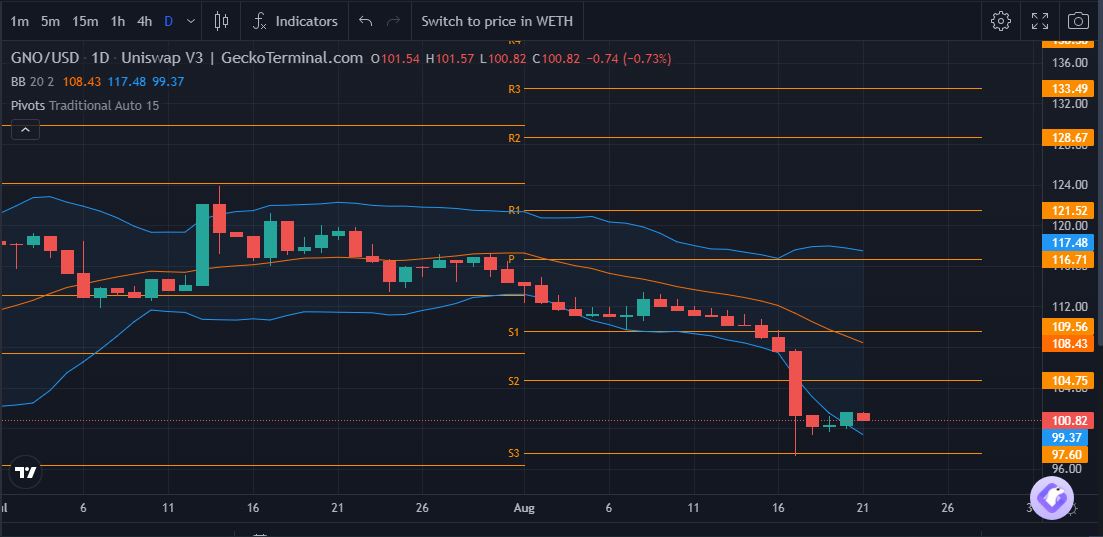
    Gnosis price daily chart


    Having bounced off the support at $97.60, the Gnosis (GNO) token is expected to test the resistance at $104.75. However, that depends on whether the current daily candlestick closes above the lower band line of the Bollinger Bands indicator.

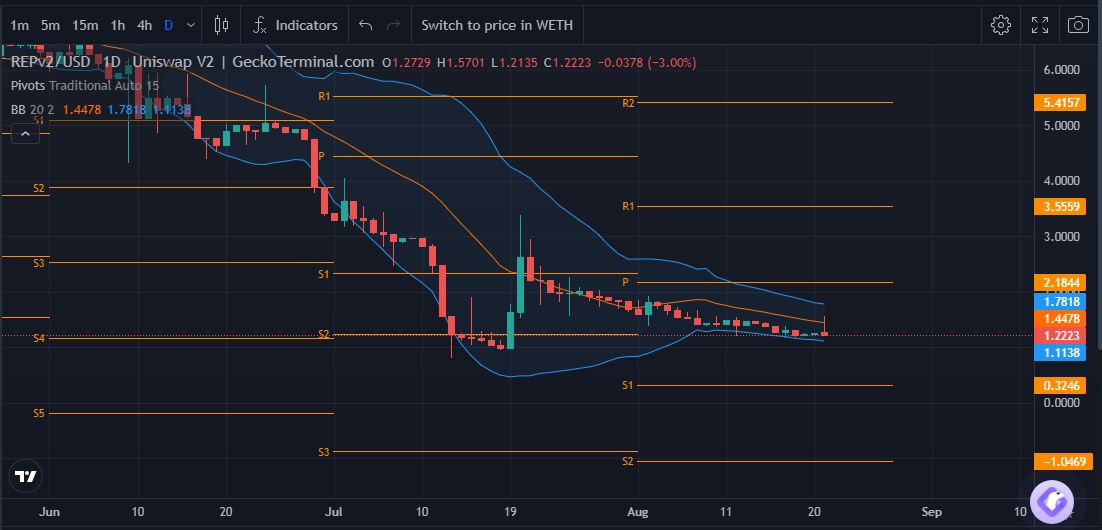
    Augur price daily chart


    Augur, on the other hand, seems to have slid into consolidation after erasing most of the gains it made between July 19 and July 20. All eyes are on the support at $0.3246 and the resistance at $2.1844. If the REP price jumps above the upper Bollinger Bands line, it could test the $2.1844 resistance level and if it drops below the lower Bollinger Bands line, it could drop to the support at $0.3246.

    The prediction markets tokens including Chancer, are expected to experience significant price gains as popular games including the English Premier League and the American MSL gather steam.

    Source link

  • Schwab-backed crypto exchange EDX Markets goes live

    Schwab-backed crypto exchange EDX Markets goes live

    new crypto exchange edx markets goes live
    • EDX officially launched trading in bitcoin, ether, litecoin, and bitcoin cash today.
    • The crypto exchange has also completed a second funding round with new investors.
    • EDX has plans of launching a clearinghouse business later this year as well.

    Investors can now trade bitcoin, litecoin, ether, and bitcoin cash on a new digital assets marketplace – EDX Markets.

    EDX Markets is backed by financial giants

    On Tuesday, the crypto exchange that has support from a bunch of Wall Street behemoths, including Fidelity, Charles Schwab and Citadel Securities launched trading in the said digital assets.

    EDX Markets had first revealed plans of launching a non-custodial exchange last year in September. In a press release this morning, its CEO Jamil Nazarali said:

    EDX’s ability to attract new investors and partners in the face of sector headwinds demonstrates strength of our platform and demand for a safe and compliant crypto market.

    It is noteworthy that neither of the four crypto assets available to trade on EDX were dubbed “securities” in the recent complaints the U.S. SEC has filed against Binance and Coinbase.

    EDX will soon launch a clearinghouse business

    In its press release, EDX Markets also confirmed today that it has completed a second round of funding with new investors. CEO Nazarali added:

    We are committed to bringing the best of traditional finance to cryptocurrency markets, with an infrastructure built by market experts to embed key institutional best practices.

    A non-custodial crypto exchange is known to be safer than the custodial wallet. On Tuesday, EDX Markets revealed plans of introducing a clearinghouse business in the coming months as well.

    The news arrives only days after BlackRock officially filed to launch a Spot Bitcoin ETF in the United States (read more), suggesting the long-term institutional demand remains intact despite the FTX fiasco and the ongoing regulatory crackdown.

    Source link

  • Bitcoin, stocks eye recovery after ECB news jolts markets

    Bitcoin, stocks eye recovery after ECB news jolts markets

    • Bitcoin retested the $25,000 area, while S&P 500 had gained about 1% after plunging on ECB interest rate hike news.
    • The ECB on Thursday surprised with a 50 basis point rate hike.
    • Reports that JPMorgan and Morgan Stanley are looking to help First Republic Bank buoyed stocks.

    Bitcoin and stocks have recovered slightly after trading lower as investors reacted to the latest monetary policy news from the European Central Bank (ECB.)

    On Thursday, markets were digesting recent events around US banks and the possible ramifications to the Federal Reserve’s next move on its rate hikes when the ECB announced a surprise 50 basis points interest rate hike. Stocks reacted lower and so did the crypto market, with crypto analyst Michael van de Poppe suggesting the Fed could follow suit at its meeting next week. 

    S&P 500, Bitcoin recover after ECB news

    The S&P 500 staged a slight recovery, thanks to the resurgence of regional bank shares.

    Despite trading down 0.7% at one point, the benchmark index was up 1% at 12:20 pm ET, while the Dow Jones Industrial Average that had initially plunged by more than 300 points, reversed and was hugging gains with just over 100 points, or 0.3% higher. Elsewhere, the Nasdaq Composite was up by 1.5%.

    While US stocks have rebounded higher amid reports that banking giants JPMorgan and Morgan Stanley were coming to the aid of embattled lender First Republic Bank, concerns remain and investors continue to be cautious. 

    Bitcoin toyed with resistance around $25,000 on Thursday as cryptocurrencies continued to track events around the stock market.

    The flagship cryptocurrency, which traded lower earlier in the day amid the highlighted broader market downswing, showed it’s still highly correlated to equities despite last week’s spike that had some observers suggesting a rising decorrelation.

    Indeed, as CoinJournal analyst Dan Ashmore argues in our deep dive published today, Bitcoin could eventually decouple from other risk assets. However, that’s an outlook that mostly doesn’t apply to the current trading scenario, with the two assets largely in lockstep.


    Source link

  • Bitcoin, stocks swing as markets react to CPI data

    Bitcoin, stocks swing as markets react to CPI data

    • Bitcoin price was trading sideways after hitting highs of $22,300, with major US indexes also down.
    • The markets’ reaction comes after hotter-than-expected inflation data for the first month of 2023.
    • US CPI rose 0.5% over the month and 6.5% year-over-year.

    Bitcoin was holding just above $22,000 at around 11:00 am ET, with the flagship cryptocurrency having swung from highs of $22,300 as the broader crypto market mirrored Wall Street following Tuesday’s US inflation data.

    Across crypto, Ethereum first ticked closer to $1,570 across major exchanges, rising as much as 5% before the upside cooled to see ETH trade near $1,540 at the time of writing. A similar picture held for Binance Coin, with BNB nearing $300 with about 3.5% in gains before shedding some of the gains.

    The action across US stocks also had the major indexes in the green premarket, before broader reaction to consumer price data released on Tuesday saw the major indexes trade lower.

    The S&P 500 rose nearly 0.7% but had flipped negative after the latest Consumer Price Index (CPI) data from the US Bureau of Labor Statistics showed inflation picked up over the past one month after consecutive months of declines. The S&P 500 was down 0.6% at the time of this report.

    The outlook was similar for the Dow Jones Industrial Average and the Nasdaq Composite, which were down about 0.8% and 0.6% respectively.

    Markets react to January CPI data

    On Tuesday morning, the US government’s data on inflation showed consumer prices rose 0.5% in January and 6.4% over the past twelve months, higher than the forecast 6.2%. 

    Even for the Core CPI, which leaves out the more volatile food and energy components, the readings were 0.4% in January and 5.6% year-over-year.

    The data thus showed inflation had picked up in the first month of 2023, coming in hotter than economists expected, with Wall Street reacting lower on the news as investors weigh what this means for the Fed’s interest rates path. Market observers say this could point to a higher for longer path that the Fed has previously pointed out.

    Tim Seymour, the CIO of Seymour Asset Management certainly thinks this could be on the cards now.


    Source link

  • Crypto markets rallying but damage remains severe

    Crypto markets rallying but damage remains severe

    Key Takeaways

    • Bitcoin is up close to 50% from its lows, but is still down over two-thirds from all-time highs
    • Some on-chain metrics show how much the rally pales in comparison to the prior fall 
    • Positive news from the industry remains few and far between, as market prepares for latest interest rate policy, to be revealed at FOMC meeting Wednesday

    Let us start with a riddle. How much profit/loss have you made if an asset you own rises by 47%, having previously fallen by 77%?

    The answer is a gruesome 67% loss. 

    That is the predicament facing Bitcoin investors who bought at all-time highs in late 2021. While markets have kicked off the year in scintillating fashion, it is important not to lose perspective. 

    Humans have short memories, though. With Bitcoin up nearly 50% from the lows post-FTX collapse, crypto markets have that giddy feel about them again. It’s amazing what hope can do for people, huh? And by hope, I mean hope that interest rates will come down again.

    Federal Reserve controls the Bitcoin price

    I wrote a piece last week about how this latest rally, if it shows anything, simply proves once and for all how much Bitcoin is trading as an extreme risk-on asset. 

    Bitcoin was crushed last year as central banks worldwide flipped hawkish for the first time in Bitcoin’s existence. With the cheap money of the last decade no longer available, and stout yields available on other investments such as T-bills, high-risk assets collapsed. 

    The tech sector, also notoriously sensitive to interest rates, has been sacking employees left, right and centre – Meta, Salesforce, Twitter, Google, and the list goes on. 

    This latest rally now comes as inflation begins to cool, with hope renewed that the pain of suffocating monetary policy will, in fact, one day come to an end. 

    Market remains ravaged

    While the picture undoubtedly looks rosier than this time two months ago, the crypto market is still in a world of pain. 

    Bankruptcies are still flowing – see Genesis filing last week – while there are numerous other potential downside catalysts as the market still delves through Sam Bankman-Fried’s chaotic mess: DCG still present a lot of uncertainty, for example.

    While prices have been running, there is no particularly good news to explain this rally. As I said, it’s all macro, with investors staring squarely at the Federal Reserve. 

    A couple of charts paint a good picture of the pain still present in markets. Despite the recent upturn, the net realised profit marker, which is an on-chain metric calculated by comparing the price of recent coins moved to the price at which they previously moved, shows how much the recent rally pales in comparison to the scale of the fall last year. 

    In truth, there is no need to complicate things. Despite the bluster of “hedge” narratives and “uncorrelated investment” that floated around through COVID, it is as clear as night and day that Bitcoin is trading off interest rate expectations right now. 

    The below chart is perhaps the most important one in all of crypto over the last couple of years. 

    That little bounce at the end could reverse very quickly depending on how things shake out at the upcoming Fed meeting. It could also do the opposite if things end up being more hawkish than the market has currently priced in. 

    Either way, it is clear what is moving markets right now.

    Source link

  • Its the calm before the storm in crypto markets

    Its the calm before the storm in crypto markets

    Key Takeaways

    • Crypto volatility has come down and extreme on-chain activity subsided in period of relative calm
    • Several concerning developments around Genesis, Gemini and DCG are still ongoing, however
    • Volatility could also spark up once the US inflation data is revealed this week
    • Period is reminiscent of the low drama environment pre-FTX in October 


    After a tumultuous rollercoaster following the shocking demise of FTX, a period of notable serenity has descended upon cryptocurrency markets. 

    With 2022 being a complete and utter bloodbath, it almost feels suspicious that there is even a couple of weeks of low drama in the digital market space. 

    But the metrics show that the last few weeks have been among the quietest of the last couple of years. Given the fear of contagion that transpired out of FTX’s collapse, that is a good thing. 

    Fear still elevated in crypto circles

    Having said that, there is plenty to be concerned about right now. As Coinbase CEO Brian Armstrong stated yesterday when he announced Coinbase was cutting an additional 20% of its workforce, there are likely “more shoes to drop” and there is “still a lot of market fear” out there. 

    Crypto lender Genesis last week laid off 30% of its workforce and is reportedly mulling bankruptcy. Crypto exchange Gemini, founded by the Winklevoss twins, has $900 million of customer assets stuck in limbo with Genesis, its sole lending partner for its Earn product. 

    The twins have demanded Barry Silbert, CEOP of Digital Currency Group (DCG), which owns Genesis, to step down, accusing him of defrauding Gemini Earn customers. 

    DCG fired back, calling it “another desperate and unconstructive publicity stunt from Cameron Winklevoss to deflect blame”. It also affirmed it was “preserving all legal remedies in response to these malicious, false, and defamatory attacks).  

    DCG is also the parent company of the Grayscale Bitcoin Trust, which has seen a massive discount to its net asset value, peaking at 50% in the aftermath of the FTX collapse as investors questioned whether reserves were safe (I wrote about GBTC yesterday).  

    Markets stand firm for now

    For now, while all these episodes play out, the markets are standing firm. Action has been relatively muted, and in fact there has been a tangible return to normal levels for a lot of on-chain activity that went wacky over recent periods. 

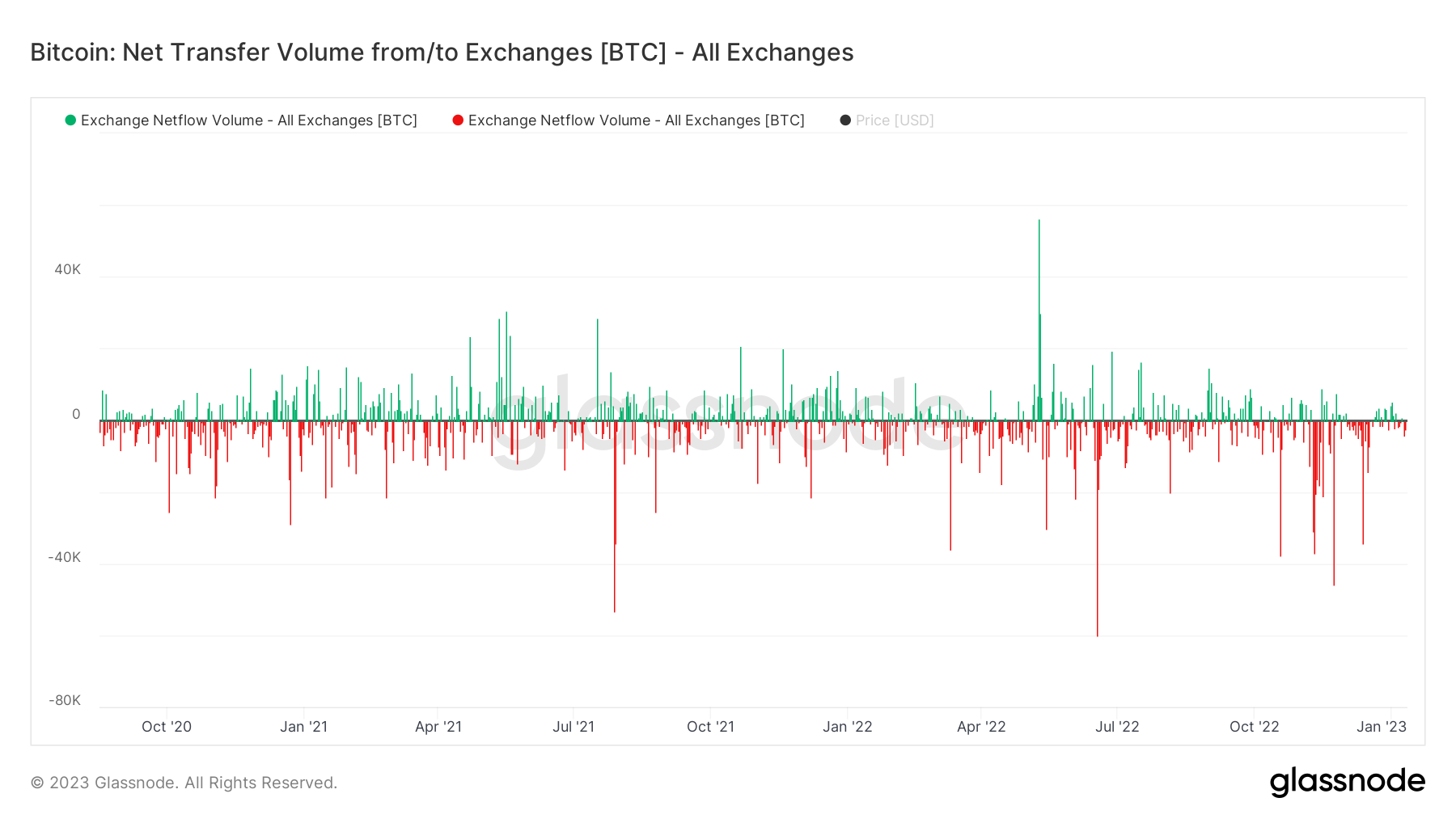
    The below snapshot shows the net transfer volume in and out of exchanges. Since the start of the year, the action has been tepid, having spiked to extreme levels in November and December as first FTX collapsed and then the questions spiked about the health of Binance

    This notion that activity has returned to normal is reinforced when looking a the volatility of Bitcoin. The world’s biggest cryptocurrency has been trading sideways for a while now, and the 30-Day Pearson measure of volatility shows how there was a perceptible drop back down to pre-FTX levels in December. 

    Macro climate looking more optimistic

    It hasn’t just been a respite from within crypto circles. The broader macro environment is looking at least a bit brighter today than it did last month. Inflation is still rampant, but there have been two consecutive readings below expectation, and there is renewed hope that it may have peaked.

    The most recent round of interest rate hikes kicked rates up 50 bps as opposed to 75 bps in the two prior months, and while Fed chair Jerome Powell and other central bank chiefs have affirmed that rates will continue to rise until inflation is conquered, the market has moved cautiously upward after European inflation came in at 9.2%, compared to 10.1% last month.

    Next up is the US CPI reading on Thursday, which will – as always – be a vitally important day in markets. Expect volatility in crypto markets as coins stare at the number to try to assess what Jerome Powell may do with regard to interest rate policy.

    After all, we know by now that crypto is very much holding the stock market’s hand – apart from when, you know, high-profile executives are revealed to be fraudulent (FTX), or top 10 coins cease to exist (LUNA).

    Never a dull moment for long in crypto

    Back in late October, Bitcoin was seemingly locked in crab motion around $20,000. With traders getting impatient, I warned how crypto could be one event away from a nasty downward wick. T

    Three weeks later, FTX collapsed. I never imagined this would happen, and the timing was coincidental, but the premise of the piece reminds me of how I feel now. It’s amazing how short memories are in markets, but we have been here before.

    Crypto won’t stay silent for long, and the asset class is far from out of the woods yet. The aforementioned ongoings around DCG, GBTC, Genesis and Gemini are just a few of the million things that could turn south at any moment.

    There is also the story around Binance chief Changpeng Zhao being under investigation for money laundering offences by the SEC, there is Coinbase laying off 20% of its workforce following a 905 drawdown in its share price, and God knows what will come out of testimonies in the Sam Bankman-Fried court proceedings.

    And then there is macro, where anything could happen to inflation, the Russian war in Ukraine or myriad other variables. It’s been a quiet couple of weeks but don’t worry – the madness will return soon.

    Source link

  • Bitcoin holds $16K as markets edged towards 2022 close

    Bitcoin holds $16K as markets edged towards 2022 close

    • Bitcoin was changing hands near $16,600 on Wednesday, about 1% down in the past 24 hours.
    • The cryptocurrency is heading for its worst yearly returns since 2018.
    • Stocks have also hit a brutal patch in 2022, with major US indexes headed for their worst annual returns since 2008.

    Bitcoin remained uncharacteristically uneventful on Wednesday, trading around $16,600 as investors weighed an end to a brutal 2022.

    The benchmark cryptocurrency was just in the red during early afternoon trading (2:10 pm ET) as Wall Street also turned negative amid fading optimism over China’s reopening.

    Markets to end 2022 lower

    In crypto, Bitcoin volatility has been at its 2022 low this week, with the surge towards $17,000 cooling off to leave the cryptocurrency 67% down in the past year.

    In fact, 2022 is shaping as the year with the second-worst returns for BTC since 2010. The digital gold’s performance during this markedly bear year has the asset on track for a worst return since the 73% drawdown in 2018.

    In the 2014 bear market, Bitcoin price fell 58%, with other years with lower returns being +35% in 2015 and +66% in 2021 – indeed Bitcoin is more than 75% down since its all-time high in 2021.

    As Bitcoin struggles to hold onto gains above $16k, the picture across the stock market is similar for the major US indexes. The S&P 500 is down 4.1% this month and over 20% year-to-date, while the Dow and the Nasdaq are -2.5% and -7.1% over the past 30 days respectively.

    The historically bullish season for equities has been largely negative, with ongoing investor jitters around inflation and rate hikes, and the overall outlook for the global economy, adding to the downward pressure that has persisted for most of the year.

    As such, while Bitcoin is set to see its worst yearly performance since 2018, US stocks are poised for their worst annual returns since 2008.

    Source link

  • Normalcy returning to crypto markets, on-chain data shows

    Normalcy returning to crypto markets, on-chain data shows

    Over the last few months, the crypto market has largely been pretty serene. Bitcoin had been in crab motion around $20,000 for quite a while, as it plodded along while waiting for the wider macro conditions to make a move.

    I wrote in late October to be cautious around this price action, and that Bitcoin could be one bearish event away from an aggressive downward wick. What I did not except was that event to be shake crypto to its bones, as one of the blue-chip companies in the space, FTX, inexplicably descended into insolvency.  

    This obviously shook markets. Last week I assessed how the flow of bitcoins out of exchanges has been fierce, as people’s trust in these central entities to store their coins was understandably at an all-time low. 

    In fact, I saw yesterday that 200,000 bitcoins have left exchanges since the FTX implosion. But now, the data suggests that the market is calming down a bit. And again, it seems like we may enter crab mode until macro provides an impetus one way or another – or an unexpected crypto-specific development comes out of the woodwork. 

    The first way to demonstrate that the dust is beginning to settle is by looking at Bitcoin’s volatility. This obviously spiked as Sam Bankman-Fried’s “games” were revealed to the public. But after remaining elevated throughout the last few weeks, it has fallen back down to more standard levels in the last few days.  

    Another way to view this is the falloff in large transactions. These transactions (defined as greater than $100,000) jumped up in the few days around the bankruptcy, but have fallen gradually since, back to the same levels we have seen throughout much of 2022.

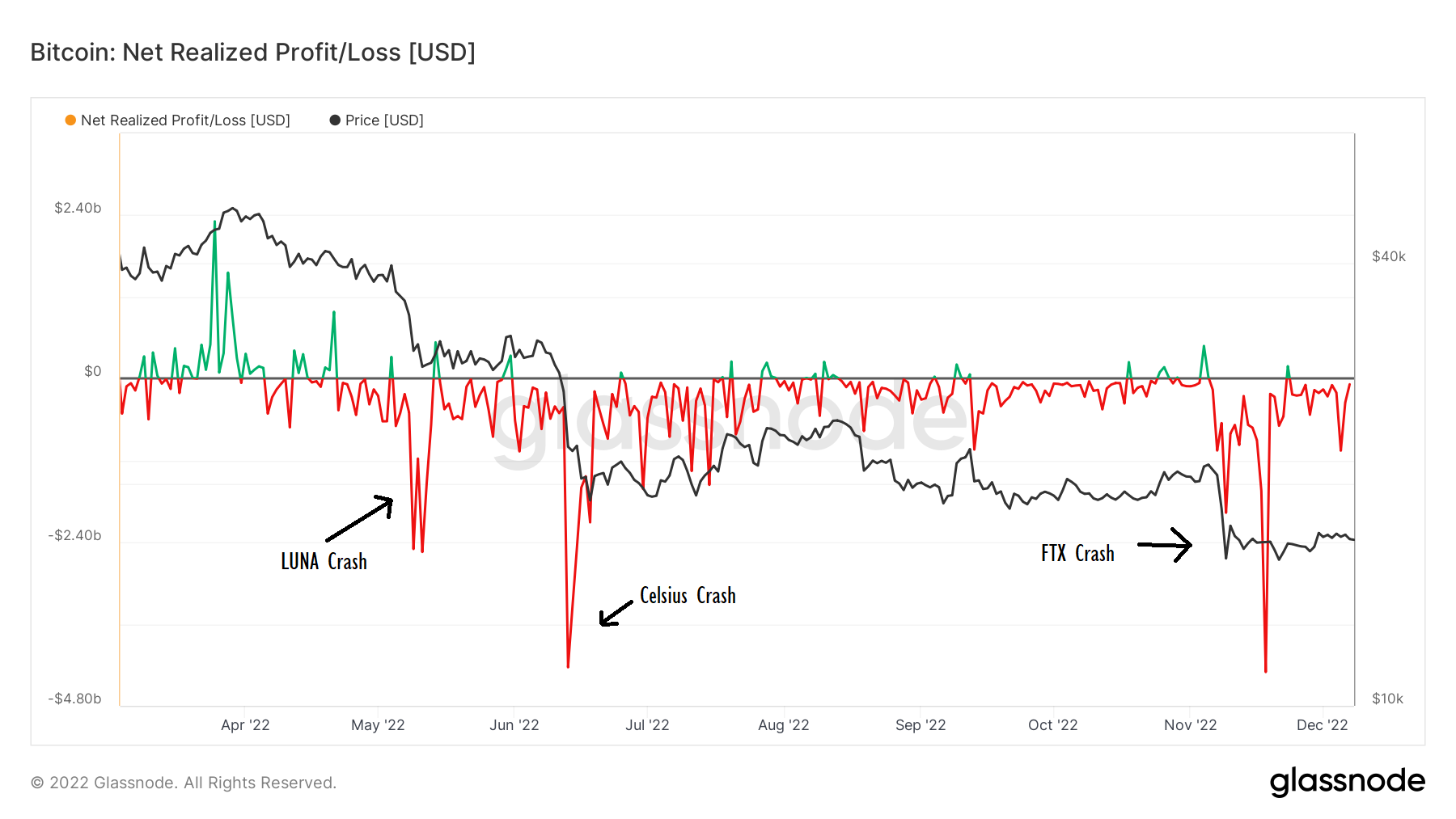
    Another useful metric to track is the net realised profit or loss of moved coins. This spikes in times of crisis as the price abruptly drops, before typically coming back towards the $0 mark as the markets calm down.

    The below chart shows this well, with trades on November 9th netting an ugly $2 billion loss, before November 18th then topped this with a $4.3 billion loss. That is lower than the worst mark post-Celsius crash ($4.2 billion loss) and Luna ($2.5 billion loss).

    This reflects the continued downward pressure on Bitcoin’s price, but the trend has bounced back up to close to zero again.

    FTX was a central part of the ecosystem, and its bankruptcy understandably rocked the market. As I wrote recently, this contagion is not over.

    Yet data from the last week or so suggests that normalcy is returning to the crypto markets. Going forward, it may tread water again for a while. With China opening up post-lockdown, the latest inflation numbers imminent and the EU ban on Russian crude imports, macro certainly has a lot going on. 

    Crypto investors will just need to hope that the crypto-native scandals are out of the way for the time being.  

    Source link

  • Here's Why Uniglo.io, Shiba Inu, And Dogecoin Will Do Well In Asian Markets – Business 2 Community

    Here's Why Uniglo.io, Shiba Inu, And Dogecoin Will Do Well In Asian Markets – Business 2 Community

    Many cryptocurrency projects are finding growth opportunities in Asia, where populations are expanding and income levels are rising. The volume of

    Source link

  • Dotmoovs (MOOV) price is soaring and it’s up 228% today: what is fuelling the uptrend?

    Dotmoovs (MOOV) price is soaring and it’s up 228% today: what is fuelling the uptrend?

    Several metaverse cryptocurrencies have been bullish as the crypto market traded sideways this week and one of the coins namely Dotmoovs (MOOV) has rallied by more than 228% today.

    At press time $MOOV was trading at $0.02192 up 228.72% having hit a daily high of $0.02528. It has a trading volume of $6,725,055 and a market cap of $7,997,493.

    This article explains the factors behind the current surge of Dotmovoovs (MOOV) price.

    What Is Dotmoovs (MOOV)?

    Before taking a deep dive into the current bullish trend, it’s important we first explain what Dotmoovs (MOOV) coin is.

    Dotmoovs (MOOV) is the native cryptocurrency of Dotmoovs, a peer-to-peer sports competition platform with an Artificial Intelligence (AI) algorithm that offers incredible Metaverse competitions and rewards winners using MOOV tokens.

    By using AI technology, Dotmoovs provides a play-to-Earn metaverse for users to participate in. At the moment, the platform has two types of sports: Dance with robust AI as the judge and freestyle football with an AI-powered referee to make judgments during competition.

    Dotmoovs also has a marketplace where users can purchase and collect NFTs.

    Why is Dotmoovs (MOOV) price rising?

    The main reason for the current surge of MOOV price is the hype around the upcoming release of the Dance Section.

    • Dance section release

    Once the Dance Section is launched, Dotmoovs’ users will be able to hold dance competitions and challenges within the app. It can be compared to TikTok and it will probably make Dotmoovs market valuation shoot to the moon.

    According to Dotmoovs’ team, the Dance feature will be launched during International Dance Day on the 29th of April this year.

    With the current bullish trend, it is clear that the market is extremely excited about the release of the upcoming launch of the Dotmoons Dance section.