Tag: miners

  • Bitcoin at risk of a 51% attack from two miners

    Bitcoin at risk of a 51% attack from two miners

    Bitcoin at risk of a 51% attack

    • Foundry USA and AntPool now control over half of Bitcoin’s hash power.
    • Bitcoin price is slipping toward $110,530, a crucial support level.
    • Macro fears and Fed shifts add pressure to already weak crypto markets.

    After Monero’s 51% takeover, two Bitcoin mining pools have sparked fears of a potential 51% attack on Bitcoin.

    Notably, the developments have raised critical questions about the security of the Bitcoin network and the stability of the wider crypto market.

    Also, the concerns over mining centralisation have intensified just as BTC faces steep price declines and broader macroeconomic pressures.

    Two mining pools dominate Bitcoin’s hash power

    Two major mining pools, Foundry USA and AntPool, now control more than half of Bitcoin’s total computing power.

    Foundry even mined eight consecutive blocks in a row, an event that is extremely rare and has heightened fears of network centralization.

    With over 51% of the hash power concentrated in just two entities, experts warn that Bitcoin is technically vulnerable to a 51% attack.

    In such a scenario, the dominant miners could potentially reorganize blocks, censor transactions, or undermine trust in the network.

    While such an attack would be extremely costly and perhaps self-defeating, the centralization trend has raised red flags across the community.

    Rising empty blocks and collapsing fees

    Alongside the hash power imbalance, analysts have noted an increase in the number of empty blocks being mined.

    Empty blocks generate lower transaction fees, which has led to collapsing revenues for miners and less efficient network usage.

    This situation has further fueled concerns about the long-term sustainability of the Bitcoin ecosystem, particularly as users demand greater efficiency from the blockchain.

    Although some commentators argue that a 51% attack would require an astronomical investment, estimated at around $1.1 trillion, they also admit that the risk of manipulation grows when power becomes too concentrated.

    Supporters of Bitcoin believe that no rational actor would spend such sums to destroy the very network that sustains their investment.

    Still, the perception of risk is enough to shake market confidence.

    Bitcoin price slides toward key support levels

    The security fears are unfolding at a delicate moment for Bitcoin’s price.

    After reaching an all-time high of $124,000 just last week, Bitcoin (BTC) has fallen sharply to around $113,000.

    The cryptocurrency is now approaching a crucial support level near $110,530, where buyers are expected to step in.

    If the price holds above that level, a rebound toward $120,000 and eventually $124,474 could follow.

    Some analysts like popular X commentator BitQuant are confident that Bitcoin is still on track to reach $145,000 without ever dipping below the six-figure mark.

    However, if Bitcoin breaks below the $110,530 support zone, the decline could deepen toward $107,000 or even $100,000.

    Short-term charts show bearish momentum, with the relative strength index in negative territory and the 20-day moving average sloping downward.

    Macro fears add pressure on crypto markets

    Beyond the technical charts, macroeconomic shocks are also weighing on sentiment.

    A recent shift in Federal Reserve policy, combined with Wall Street warnings about the newly passed Genius Act stablecoin bill, has unsettled investors.

    There are fears that the legislation could trigger a flood of withdrawals worth up to $6.6 trillion, posing systemic risks to both banking and crypto markets.


    Source link

  • US Bitcoin miners brace for bleak Q1 earnings amid tariff

    US Bitcoin miners brace for bleak Q1 earnings amid tariff

    The miner's paradox: why Trump's era isn't golden for US Bitcoin firms

    • Most major US public Bitcoin miners expected to report Q1 losses despite high BTC prices.
    • US tariffs on imported mining rigs raised costs and created strategic uncertainty for miners.
    • The April Bitcoin halving event further pressured revenue by cutting block rewards by 50%.

    Despite entering office with promises to champion the US Bitcoin mining industry, President Donald Trump’s return to the White House hasn’t translated into immediate prosperity for the sector.

    As American crypto miners prepare to release their first quarterly earnings since the administration change, analysts anticipate a challenging period marked by losses, squeezed margins, and operational headwinds, even against the backdrop of Bitcoin hitting record highs earlier in the year.

    The paradox of pain: losses despite high Bitcoin prices

    The prevailing expectation is one of financial strain.

    According to analyst estimates compiled by Bloomberg, seven out of the eight largest publicly traded Bitcoin miners based in the US are projected to report a net loss for the first quarter of 2025.

    This stark outlook contrasts sharply with the significant adjusted net income of $1.1 billion reported collectively by the group in the same period of 2024, now estimated to swing to a loss of $190 million.

    Among the cohort, only CleanSpark Inc. is anticipated by analysts to post a profit.

    This downturn comes despite Bitcoin reaching a record above $109,000 in January and averaging roughly 75% higher in price during the first quarter compared to the previous year.

    Concrete results are already emerging: Riot Platforms Inc., a major player, reported a Q1 loss of $296.4 million on Thursday, a dramatic reversal from its $211 million net income in Q1 2024.

    Competitive squeeze: record difficulty and rising costs

    Several factors are converging to pressure miners’ profitability.

    A primary challenge is the soaring level of competition within the network.

    Mining difficulty, a metric reflecting the total computing power dedicated to securing the Bitcoin blockchain, has repeatedly broken records in recent months.

    This surge in the global “hash rate” means more miners are competing for the same fixed amount of newly issued Bitcoin rewards.

    “This is going to be an interesting quarter for the Bitcoin miners and perhaps a difficult one over the past few months,” commented Brian Dobson, managing director at brokerage firm Clear Street.

    “We will see margin compression and lower revenues from Bitcoin mining due to that higher global difficulty rate.”

    This intense competition is partly a legacy of the late 2024 Bitcoin price surge, fueled by Trump’s pro-crypto stance, which prompted miners to rush orders for more powerful, specialized mining machines (rigs).

    Furthermore, rising energy costs in some key US mining states have added to operational expenses during the same period.

    Growth in international mining operations, including from Russia and China, has also intensified the global hash rate competition, according to Ethan Vera, COO at Luxor Technology.

    Tariff tremors and strategic hesitation

    Compounding the competitive pressure are the direct and indirect impacts of US trade policy.

    The specialized mining rigs essential for operations are mostly manufactured in Asia.

    Tariffs imposed on these machines, some originating from countries like Malaysia, directly increase capital expenditure for US miners.

    Vera noted that potential further tariff hikes “will be very detrimental, return profiles and growth forecasts can be hindered from that,” adding wryly, “With tariffs coming in, I think everyone outside the US will benefit from that.”

    Supply chains faced additional disruption early this year due to heavy border inspections and the US Commerce Department’s blacklisting of an AI affiliate (Xiamen Sophgo Technologies Ltd.) of Bitmain, the largest rig supplier, in January.

    More broadly, the unpredictable nature of tariff policy under the Trump administration is creating strategic paralysis.

    “The management teams are hesitant to develop a multi-year strategy based on what tariffs look like today when they realize that three months from now we could have a very different conversation on what the tariffs would look like,” explained Dobson.

    Capital crunch: shifting financing strategies

    Accessing capital has also become more challenging. Historically, many public miners relied heavily on “at-the-market” (ATM) stock offerings to raise billions for purchasing machines and funding energy-intensive operations.

    However, the retreat in the broader stock market since the post-election highs has made equity financing less attractive.

    Consequently, companies are increasingly turning towards debt instruments. MARA Holdings Inc., Riot Platforms, and CleanSpark have all utilized convertible bonds or credit facilities recently to secure liquidity.

    “I think the big public companies don’t want to sell shares in the current market, this is an expensive way for them to raise capital, whereas the debit instruments are just lower-cost capital,” Vera observed.

    Adding a final layer of difficulty is the impact of the Bitcoin “halving” event that occurred last April.

    This pre-programmed code update slashed the Bitcoin rewards paid to miners for validating transactions by 50%, directly cutting into their primary revenue stream.

    An unintended consequence?

    While President Trump campaigned on making the US a leader in Bitcoin mining, the first quarter under his administration seems defined by miners grappling with the challenging side effects of his broader policies.

    Tariffs are hiking equipment costs and potentially benefiting foreign competitors, while market volatility linked to policy uncertainty has hampered access to equity capital.

    As Vera concluded, “In terms of the tariffs, I don’t think Trump has Bitcoin mining as his number one priority to focus on… The trade war, for him, is the most important thing.”

    Source link

  • Bitcoin miners embrace efficiency and renewable energy

    Bitcoin miners embrace efficiency and renewable energy

    • Bitcoin mining is at the heart of the digital gold rush and it is a critical process that underpins the entire cryptocurrency ecosystem.
    • Bitcoin miners validate transactions, secure the network, and, in the process, earn newly minted Bitcoin.
    • The World Digital Mining Summit (WDMS) stands as a beacon of innovation and collaboration within this dynamic space.

    The recent World Digital Mining Summit (WDMS) witnessed a groundbreaking moment for the Bitcoin mining industry as Bitmain, a prominent player, unveiled its highly anticipated Antminer S21 and S21 Hydro ASIC miners. These state-of-the-art mining machines have set new industry standards for both performance and energy efficiency.

    The Antminer S21 boasts an impressive hashrate of 200 TH/s and an extraordinary efficiency rating of 17.5 J/T (joules per terahash), while the S21 Hydro delivers a remarkable hashrate of 335 TH/s with an efficiency of 16 J/T. These statistics mark a significant departure from the historical norm where most Bitcoin ASICs operated above the 20 J/T threshold.

    What makes these ASIC miners truly revolutionary is their unwavering focus on energy efficiency. In an environment where electricity costs continue to rise, the Antminer S21 series presents a glimpse into the future of Bitcoin mining. It’s a future where miners can optimize their operations for maximum output while consuming minimal energy, reflecting the industry’s commitment to sustainability and cost-effectiveness.

    Efficiency advancements and sustainability:

    One of the key trends that emerged at WDMS was the integration of renewable energy sources into Bitcoin mining operations. This trend is driven by two crucial factors: the relentless increase in electricity costs and the impending Bitcoin supply halving scheduled for April 2024.

    Miners are acutely aware of the need to reduce operational expenses to maintain profitability. Rising electricity costs have prompted them to seek sustainable energy solutions. By incorporating renewable energy sources like solar and hydroelectric power, miners aim to mitigate the impact of escalating energy bills and ensure the long-term viability of their operations.

    Renewable energy integration isn’t just about immediate cost savings; it aligns with a broader commitment to environmental responsibility. In a world increasingly focused on sustainability, miners view renewable energy as a strategic imperative for ensuring profitability and industry longevity.

    Upcoming Bitcoin Halving pose some challenges

    The looming Bitcoin supply halving represents a formidable challenge for miners, as it halves their block reward distribution. To address this challenge, miners have two pivotal choices: increasing their reliance on sustainable energy sources or making efficiency improvements to their ASIC fleets.

    These strategic decisions will determine their ability to adapt to the evolving mining landscape, where efficiency and sustainability are key.

    In conclusion, the WDMS showcased an industry in transition, with Bitcoin miners embracing efficiency-focused innovations and renewable energy integration. This commitment to sustainability and environmental responsibility reflects the industry’s adaptability and resilience. As the Bitcoin mining ecosystem evolves, it does so with a clear focus on efficiency, profitability, and a greener future.

    Source link

  • Why are Bitcoin miners struggling so much? Core Scientific file for bankruptcy

    Why are Bitcoin miners struggling so much? Core Scientific file for bankruptcy

    Key Takeaways

    • Core Scientific was worth over $4 billion last summer, but is down 985 form all-time highs
    • Rising electricity costs are hiking costs with falling Bitcoin prices hurting revenue
    • With hash rate near all-time highs, the entire mining industry is struggling

    The crypto winter continues to take victims. The latest to succumb to Chapter 11 bankruptcy is Bitcoin miner Core Scientific.

    Bitcoin’s plummeting price has quelled revenues significantly and, while cashflow is still positive, the revenue is not enough to cover operational costs. The goal is for the company to restructure under the Chapter 11 process rather than entirely liquidate.

    Core Scientific has been struggling all year, in line with miners across the industry as they get squeezed on both ends – falling revenue in the form of Bitcoin prices and rising costs as a result of surging electricity costs across the globe.

    The stock was trading at a market cap north of $4 billion last summer, but has now fallen 98% from all-time highs, its current market cap $70 million.

    The share price did triple in short order last week when financial services company B. Riley offered to provide the company with $72 million in non-cash financing. The stock has since given up some of those gains.

    Mining industry struggling

    Across the entire industry, miners are finding it tough. Electricity costs and the Bitcoin price are the two most vital inputs for the bottom line of a bitcoin miner, and both have moved significantly against them this year.

    So too has the hash rate, with it straddling near all-time highs for a lot of the year. A higher hash rate means more computing power is demanded to verify transactions on the Bitcoin blockchain. While a higher hash rate is thus seen as a positive because it increases the security of the network – it would cost more energy and time to take over the network – it also weighs on miners’ profit margins.

    When the hash rate hit another all-time high of 250 TH/s in early October, blockchain analytics company Glassnode warned that “miners are somewhat on the cusp of acute income stress”. This latest story about Core Scientific proves that.

    Looking at miner reserves, the number of bitcoins held by the large mining pools has also been steadily decreasing this year.

    Mining stocks are a  levered bet on Bitcoin

    It’s a poignant reminder that with these mining companies’ revenue denominated in Bitcoin, they are obviously extremely volatile stocks. Unfortunately, this year has brought the perfect storm giving rise to not only falling Bitcoin prices, but rising costs in the form of electricity, meaning miners have been hit twice as hard.

    Looking at share prices, many companies have fallen further than the price of Bitcoin, which as I write this is trading at $16,800, down 64% on the year. Many mining companies are seeing losses that dwarf that in 2022.

    They’ll hope that 2023 will bring better fortunes. But for Core Scientific, the road head is murkier. Now embroiled in the Chapter 11 process, it will hope to restructure and weather the storm, but there is no getting around the fact that the market for miners is likely to remain torrid in the short to medium term, at least.

    Source link

  • Are Bitcoin miners about to capitulate?

    Are Bitcoin miners about to capitulate?

    Something which is always interesting is assessing the mining activity on Bitcoin, especially in conjunction with what is happening the price and the wider market.

    After all, miners are the group who receive those freshly minted bitcoins as the blockchain continues to grow. Receiving this revenue in the native coin of the network means their actions can be indicative.

    Something notable is happening at the moment though. The hash rate, which means the amount of computational power being spent by the Bitcoin network – i.e. the number of miners – is rising. And it’s rising a lot.

    But at the same time, price is falling.

    We are printing all-time high after all-time high in hash rate. The price, however, has cratered, before trading sideways over the last few months around this $20,000 level.

    This is unusual. As the chart above shows, the last time we had a violent crash – May 2021 – the hash rate fell, too. This is natural – again, the revenue of these miners is Bitcoin, so why shouldn’t mining activity drop in response to a big price drop?

    Instead, the hash rate – and the difficulty of the network – remains high. Most people say this is a good thing. And they’re right – the higher the hash rate, the more secure the network. And the more secure the network, the healthier Bitcoin is.

    But does this make sense? Let’s look at this from an economic perspective. Are miners not selling as much as they should be? It seems as we crab sideways following this crash, miners are not letting up. You may point towards Ethereum’s switch to proof-of-stake in September as attracting more miners to Bitcoin, but the dates don’t really line up.

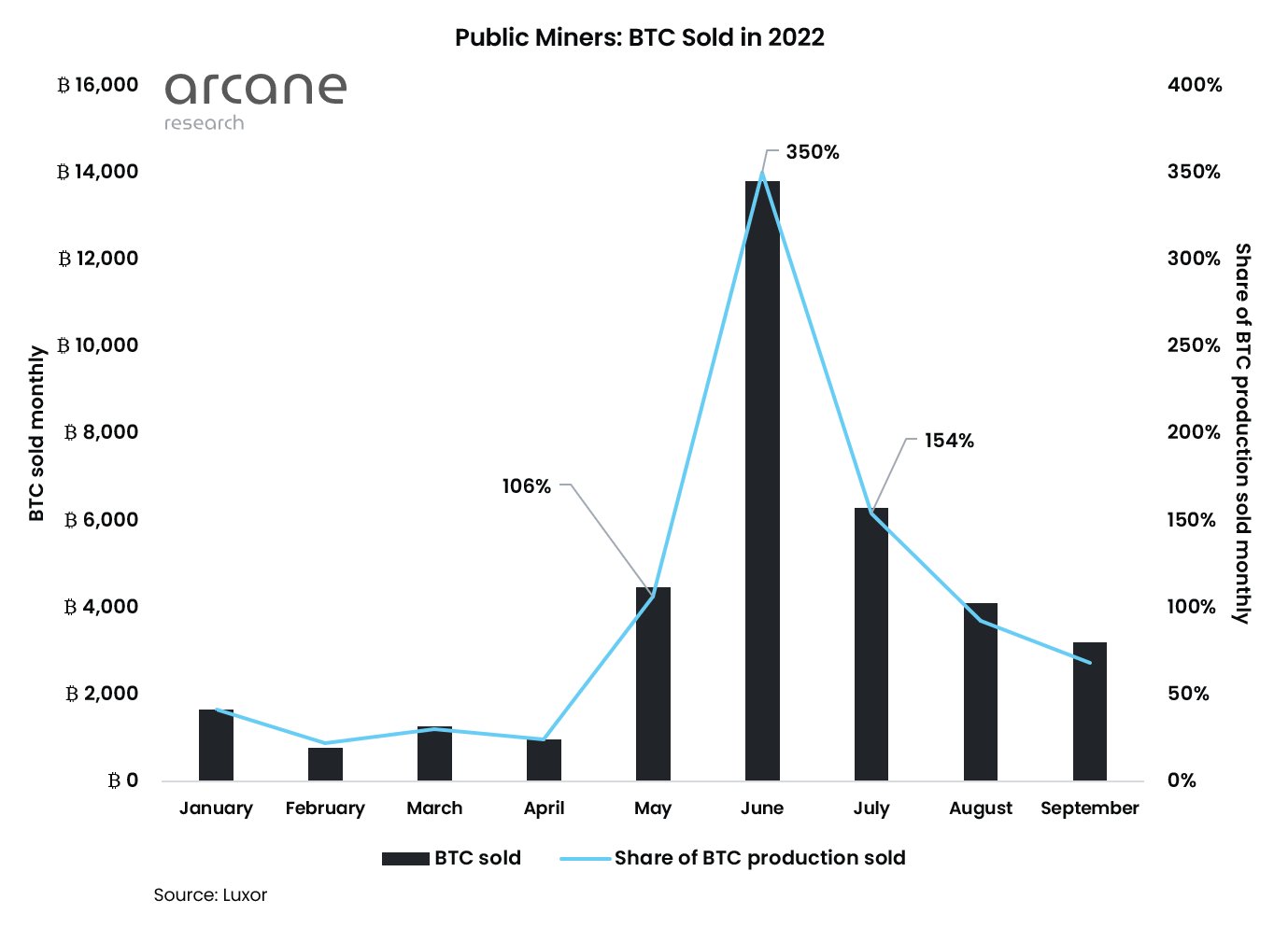
    Let’s check if the miners are selling (graph via arcane research).

    After the capitulation in the summer, they haven’t really been selling. But could this change soon?

    I wrote recently about how I believe we could be one event away from a nasty red wick for Bitcoin. In looking at the underlying mining data, I get more nervous again. Again, this is far from certain – and more a hunch – but let us check the last time we had a hash rate rising with a falling price.

    Mid 2018 this happened…and it wasn’t good.

    Let us zoom in a little on this time period – the above chart is a bit hectic. In peering into the 2018 window, we see exactly how this same pumping price hash rate occurred despite the falling in price. And then look what happened the price in late 2018. 

    So that’s worrying. And there are people pointing this out as a bearish indicator. But as anyone who follows my analysis knows, I am not exactly comfortable with extrapolating past Bitcoin cycles to today.

    Yes, this happened in 2018. But look at Bitcoin back then. Had you even heard of it? Because many hadn’t   – it was still a niche asset, not yet making noise in the trad-fi world. Not to mention, the macro climate is entirely different today, with us squarely in a new interest rate paradigm. A point that should never be forgotten in looking at past cycles: none of those cycles happened while we were in the midst of a wider bear market in the economy.

    But at the same time, it is not merely the fact this has happened before. For me, I am just a little puzzled that the selling of miners isn’t a bit higher here, or why the hash rate is mooning so aggressively.  

    So, in conclusion, this indicator is not causing me to run for the SELL button. But I do like using mining data in conjunction with my wider analysis, and it is a curious happening. And as I wrote last week, I do fear that this crab motion around $20,000 could end with a red wick. It’s a psychologically important level, and once we break hard below it, there is not much resistance.

    There are too many variables in the wider market that could easily go south, and Bitcoin has not given up too much since the contagionary wave of the summer – stocks have actually been worse. This underlying mining activity is not quelling those concerns, even if it is not accentuating it.

    Source link