Tag: months

  • Crypto Fear and Greed Index hits 30, lowest level in 18 months

    Crypto Fear and Greed Index hits 30, lowest level in 18 months

    • Crypto Fear and Greed Index is currently in the “fear” zone with a score of 30.
    • This is the lowest sentiment measure for Bitcoin (BTC) in nearly 18 months.

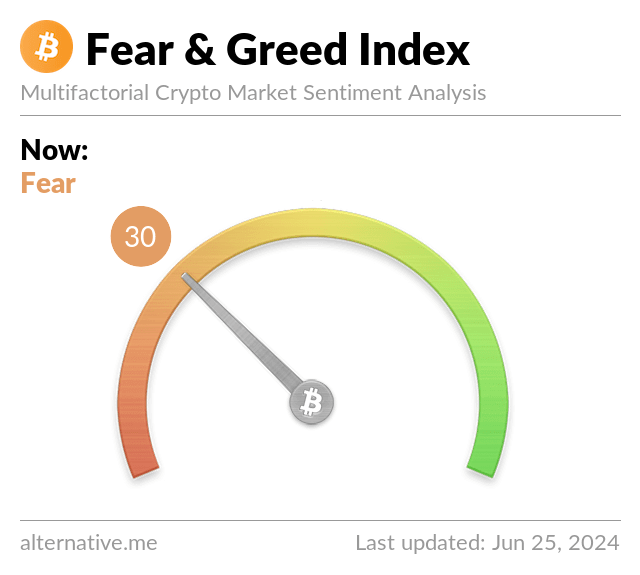
    The Crypto Fear and Greed Index, a measure of market sentiment for Bitcoin (BTC) and the broader crypto market, has dropped to 30, the lowest score it has reached in over one and half years.

    While BTC has traded lower during the current market cycle and the Crypto Fear & Greed Index has fallen into the “fear” zone, this is the first time it has done so since January last year.

    Crypto Fear & Greed Index drop to 30

    As Bitcoin price slipped below $60,000 on Monday, June 24, the index score nosedived more than 20 points to drop into the “fear” zone.

    The decline means the Bitcoin Fear & Greed Index is currently trending at levels last seen in January 2023. At the time, Bitcoin price was trading around $17,000 after the market reaction to the industry’s most shocking collapse so far – the implosion of the FTX crypto exchange.

    Crypto Fear & Greed Index score is 30, now in “Fear” zone. Source: Alternative.me

    In May this year, Bitcoin price fell to lows of $56,500 and the index’s score dipped from neutral to fear.

    A bounce in price saw sentiment improve significantly to push the Fear & Greed Index to 74. “Greed” dominated then as Bitcoin broke above $71k, but that score flipped neutral and within hours on June 24, reached the 30 mark.

    Mt. Gox repayments and German government selling

    Catalysts for the latest declines include the Mt.Gox repayments news.

    A notice on Monday indicated that the exchange will begin repaying customers who’ve waited since the 2014 hack. Mt.Gox customers will receive Bitcoin and Bitcoin Cash. 

    Over $8.5 billion worth of BTC is with the exchange’s trustee. In April, analysts at K33 Research warned that Mt.Gox’ Bitcoin repayments could impact prices.

    Also attracting negative sentiment is the selling of Bitcoin by the German government. After sending 1,700 BTC to exchanges last week, including Coinbase and Kraken, Germany is at it again. 

    On Tuesday, Lookonchain shared on-chain data tracking wallets linked to the 50,000 BTC seizure the German government made early this year. The details show another 400 BTC deposited in CEXs.

    Source link

  • 45% of stablecoin balance has left crypto exchanges in 4 months, but where has all the money gone?

    45% of stablecoin balance has left crypto exchanges in 4 months, but where has all the money gone?

    Key Takeaways

    • $23.6 billion of stablecoins are currently on exchanges, the least since October 2021
    • 45% of stablecoins have fled exchanges in the last four months
    • 61% of USDC has left exchanges in the three weeks since Silicon Valley Bank’s collapse, while 50% of BUSD has evaporated since regulators announced it was to shut down
    • Trend in falling supply of stablecoins has been ongoing since FTX collapsed in November, but has worsened recently
    • Capital is flowing into T-bills, with 5 times the amount of treasury accounts created last year as 2021
    • Bitcoin’s falling price and volumes are more extreme, but liquidity has been siphoned out of the markets at large due to rising interest rates 
    • Federal Reserve is now caught between rock and a hard place, as rising interest rates needed to combat inflation but banking sector wobbles may force its hand

    It’s always turbulent in the crypto markets. 

    The waters have been particularly choppy recently with regard to the stablecoin market. There are currently less stablecoins on crypto exchanges than at any point since October 2021. 

    But where is all the money going? Into Bitcoin? Hidden away in cold wallets? Away from crypto altogether?

    In this piece, we dig into the data to try to ascertain where exactly the money is moving, and why, as well as what it means for Bitcoin and how it all ties back to the Federal Reserve. 

    The flight of stablecoins

    First things first. Stablecoins are fleeing exchanges at an unprecedented speed. In less than four months, 45% of stablecoins have left exchanges. That is a drawdown from $43.1 billion to $23.6 billion, a pace that has never been seen before. 

    The chart shows a clear downward trajectory since the implosion of FTX in November 2022 – with the pace picking up since the turn of the year. 

    In the next chart, we focus on the outflows alone, helping us to zone in on the speed of these movementts and how they compares to previous periods of outflows. 

    We can see that in terms of precedent, we saw big spikes in outflows in May 2022 (when LUNA collapsed) and May 2021 (when Bitcoin freefall down from $58K to $37K in a week, despite no obvious trigger). But the difference this time is that the elevated pace of withdrawals has continued for a much longer time period, at four months and counting. 

    Perhaps layering in price gives more of an indication as to what is happening. In this next chart, we can see big drawdowns in Bitcoin price have coincided with large amounts of stablecoin withdrawals. 

    But it brings us to an interesting crossroads: this time seems different. As while FTX kicked off a Bitcoin drawdown to $15,500 from $20,000 in November, since then Bitcoin has increased 80%, back up towards $28,000. And yet, the stablecoin balance has continued downward. 

    BinanceUSD and UCD Coin run into problems, but Tether drained too

    So why is this time different? Why are withdrawals of stablecoins remaining elevated while Bitcoin surges?

    Well, the events around Binance USD and USD Coin are the most glaring. It was announced last month that Binance USD is shutting down due to US securities law (deep dive on that circus here). At the time, the stablecoin had a market cap of over $14 billion, the third biggest behind USDC and USDT. 

    In the words of CEO Changpeng Zhao, the developments meant that BUSD will slowly decline to zero.

    And that is what has started. 17% of BUSD was immediately pulled from exchanges in the days after the announcement. Today, the supply of BUSD on exchanges is 7.2 billion, 50% below the number upon announcement of the lawsuit. 

    But there is more here beyond the impact of BUSD’s regulatory-driven fall. Firstly, BUSD’s supply had been falling since the FTX debacle, when there was $22 billion on exchanges, as the above chart shows. 

    But there is also the case of USD Coin, the stablecoin issued by Circle, who kept 8.25% of the backing reserves in the felled Silicon Valley Bank. While deposits were since guaranteed by the US administration, the episode shook the market and sparked outflows that have not reversed. 

    On March 10th, as the SVB trouble and hence concern around USDC’s reserves came to light, there was $6.65 billion of USDC on exchanges. Today, less than three weeks later, there is $2.57 billion, a fall of 61% – completely wiping out the increase in the USDC supply on exchanges that had happened in the aftermath of the BUSD shutdown. 

    Which brings us to the third member of the three musketeers, Tether. Has the number one stablecoin hoovered (hoover means vacuum, for all you American readers) all the BUSD and USDC supply? Well, no. 

    As the world popped champagne on New Year’s Eve, there was $17.81 billion of Tether on exchanges. Today, on March 27th, there is $13.55 billion, a decline of 24%. 

    Putting the balance of all three stablecoins on one chart, the below can be seen – clearly, Tether has the lion’s share, but the balance of stablecoins across the board has evaporated. 

    “There is a lot of talk about Tether’s rise in market share”, said Max Coupland, director of CoinJournal. “That is a story in and of itself, but to us, the greater effect is the remarkable drawdown in the stablecoin market at large. Tether may have gained market share, but to see an evaporation of 24% of the USDT balance on exchanges is notable – and that it has gained market share despite this drawdown hammers home how stark the capital flight out of the entire space has been”. 

    Where is it all going?

    So, the natural question is then, where the f**k is all the money going?

    Since the start of the year, Bitcoin is up 64%, adding $209 billion to its market cap while climbing from $16,500 to $27,000. So are people just sending all their stablecoins from exchanges into Bitcoin?

    That is a difficult question to answer. Looking at the stablecoin supply ratio (SSR), which is the ratio of the Bitcoin supply to the supply of stablecoins, shows that it has risen significantly in the last few months (it had previously done the exact opposite). 

    But this doesn’t necessarily mean that stablecoins are flowing into Bitcoin, and concluding that feels like a reach. 

    In all likelihood, it simply means that the Bitcoin markets are becoming less liquid as capital is leaving the entire space. This would help explain why the move up this year has been so violent, as less buying power has been needed to move the dial. 

    Treasury market holds the answer to the riddle

    But let us not forget about where interest rates are right now. 6-month US treasury bills are currently paying close to 5% currently, 3-Month yields are at 4.6%. It’s starting to make a little more sense why there is less money in crypto right now, isn’t it?

    In fact, looking at TreasuryDirect.gov, the website where government bonds can be bought, there were 3.6 million accounts created in 2022 as interest rates surged – that is a five-fold increase from the previous year. And extrapolating the accounts created from the first ten weeks of the year, we are on track to see another 1.1 million created in 2023 (although the Federal Reserve’s updated plans may change that). . 

    This is what the Federal Reserve wants

    And this allows us to circle back to the very crux of the issue. Why is the Federal Reserve raising interest rates in the first place?

    The Fed has been raising rates to combat inflation which spiralled far quicker than they imagined. And it wasn’t only the pace, but it was the stickiness of the price rises – the “transient” dream pedalled was nothing more than that, a dream. 

    In order to topple that inflation, liquidity needed to be siphoned out of the system. Which, as this piece has demonstrated, is exactly what has happened. Bitcoin is a more volatile and thinner asset than other financial markets, which is why the effect has been so dramatic, but we have seen the price of risk assets freefall across the board over the last year. 

    In conclusion, there is nothing surprising about Bitcoin’s collapse in price, nor the flight from the capital market, when viewed in hindsight against the backdrop of the crippling rise in interest rates. 

    Of course, hindsight is everything, and investors were caught off guard badly here. Now, as the banking sector wobbles under the weight of these rising interest rates, the Federal Reserve is caught in between a rock and a hard place; it can stop raising rates and be the central bank that failed on the all-important inflation mandate, or it can raise rates further to battle inflation while risking more chaos in the banking sector. 

    The market is betting on the latter, that the Fed will move to softer monetary policy, which is why we have seen a rebound in the Bitcoin price. This has been exacerbated by the thin liquidity in the markets. 

    If a hawkish tone comes out of the Fed in future however, or the market’s confidence in a pivot drains, you can bet your bottom dollar that Bitcoin’s gains thus far in 2023 will be halted, if not reversed. Whatever happens, it certainly feels like the market and economy is currently at an inflection point. 

    If you use our data, then we would appreciate a link back to https://coinjournal.net. Crediting our work with a link helps us to keep providing you with data analysis research.


    Source link

  • Half a billion dollars of short sellers liquidated in biggest crypto rally in 9 months

    Half a billion dollars of short sellers liquidated in biggest crypto rally in 9 months

    Key Takeaways

    • The cryptocurrency market cap is back above $1 trillion following the biggest surge in 9 months 
    • Half a billion dollars of short sales were liquidated over the weekend, the most in three months
    • Bitcoin is back above $21,000, Ethereum above $1,500, while altcoins have soared
    • Despite powerful bounce, the market is still down close to 65%, having peaked at nearly $3 trillion in November 2021
    • Bear market drawdown at 77% for Bitcoin, but traders are wary this may only be a short-term relief rally

    For a few hours over the weekend, if you looked at a crypto chart, it felt like it was 2020 again.

    COVID may be fading into the rear-view mirror, but so had crypto prices. I produced a deep dive into some on-chain data last week which showed how torrid 2022 had been for investors, with 73% less bitcoin millionaires, a drawdown of $2 trillion in the overall crypto market, and a reputation dragged through the mud by various scandals. 

    Looking at data this week for coinjournal.net, it is a little more optimistic for crypto investors. 

    Half a billion dollars of short sellers liquidated

    The weekend brought a little respite, however. Bitcoin surged to its strongest rally in 9 months, taking the market by surprise and breaking upwards above $21,000. 

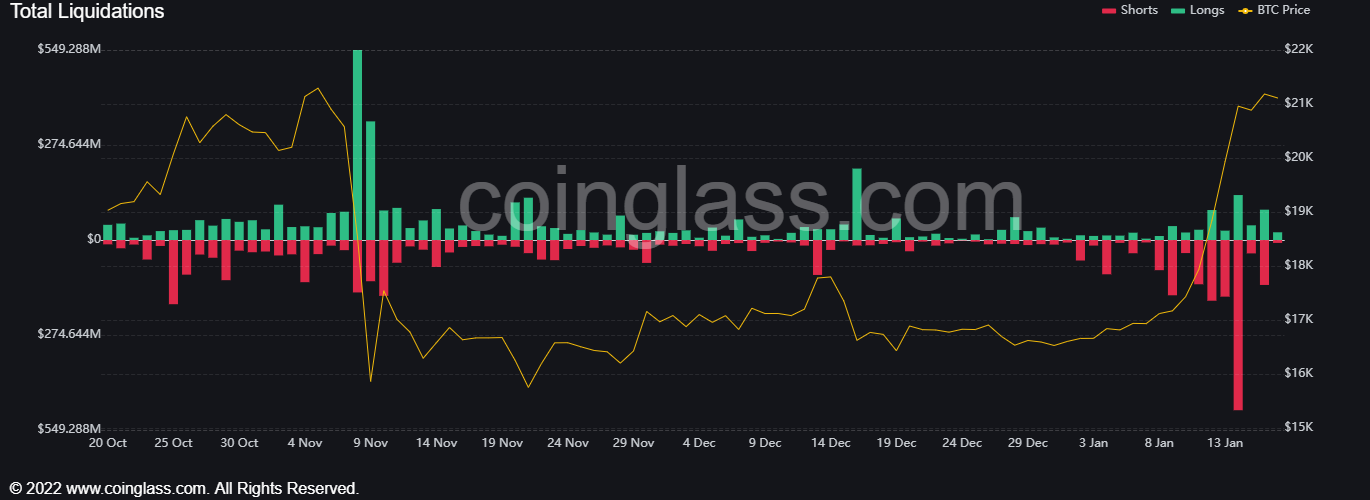
    Looking at data from Coinglass, there were over half a billion dollars of short sellers liquidated this past weekend. The below chart shows the extent of these liquidations, more or less matching the long liquidations back when FTX collapsed in early November. 

    Crypto market regains $1 trillion mark

    The bounce in digital assets followed softer-than-expected inflation data. This optimism that inflation may have peaked has caused investors to bet that the Federal Reserve may pivot off its high-interest rate policy sooner than previously expected. 

    As we know by now, high-interest rates have sucked the liquidity from the market, hurting risk assets across the board. Crypto is very much trading like one of these high-risk assets, and hence prices have collapsed as the Federal Reserve has implemented this tight monetary policy – and hence crypto exchanges have been less than kind to long traders. 

    2023 has brought hope that if inflation truly has peaked, a light at the end of the tunnel may be visible. The crypto market has surged to regain a $1 trillion dollar market cap as a result. It is still a far cry from the near-$3 trillion all-time high, but Bitcoin at $21,000 and Ether at $1,500 marks the highest prices for the duo since before the FTX scandal. 

    Has the crypto market bottomed?

    The glaring question facing investors now is whether this is merely a short-term relief rally, or whether the bottom is in. 

    As with most questions in the market, macro holds the key. 

    “The last couple of months have undoubtedly brought indicators of a more positive environment with regards to inflation, as well as the boost of the Chinese economy reopening,”  said Max Coupland, Director at CoinJournal. 

    “However, I do worry whether investors are jumping the gun by presuming that this means the Fed will now pivot sooner than expected. (Fed chair) Jerome Powell has been adamant that rates will not taper until inflation is firmly under control, and we are still a long way from the 2% target, while uncertainties such as the Russian war in Ukraine still loom as highly unpredictable”. 

    Let’s play the (very) hypothetical game of assuming the bottom is in. That would put the bear market at 13 months long, with a 77% drawdown from peak-to-trough for Bitcoin. 

    Historically, this would place it as the third biggest drawback in history. However, that would only be in percentage terms. The crypto market today is vastly different to years past, and the size of the capital wipeout is on a different level – or over $2 trillion, to be precise. 

    So, while the length and size of the bear market could perhaps imply we are in the latter stages, past data simply cannot be reliably extrapolated when it comes to crypto. Bitcoin only broke through as a mainstream asset in the last few years, and prior time periods featured low liquidity and a niche set of investors. 

    Today, we are also facing an unprecedented macro climate – rampant inflation, high interest rates for the first time in Bitcoin’s history, and a bear market in the wider economy for the first time since the 2008 crash – the same year Bitcoin was invented. 

    In wrapping up, the past weekend has been a welcome reprieve for crypto investors, and amounts to the most powerful surge in nine months, back before the collapses of LUNA, Celsius, FTX and the transition to high interest rates in the board economy. 

    But the road ahead remains tough for the market at large, with inflation still lofty, a war ongoing in Europe and myriad other macro variables oscillating. This week has been good news, but crypto investors won’t be counting their chickens quite yet. 

    The next mark on the calendar? The all-important FOMC meeting on February 1st, when the Federal Reserve will decide upon the latest interest policy. 

    If you use our data, then we would appreciate a link back to https://coinjournal.net. Crediting our work with a link helps us to keep providing you with data analysis research. 

    Research Methodology

    Liquidation data via Coinglass. Price data from Yahoo Finance. All other data via CoinJournal

    Source link

  • Crypto prices surge via strongest rally in 9 months, but why?

    Crypto prices surge via strongest rally in 9 months, but why?

    Key Takeaways

    • Bitcoin is back in the 20s, Ethereum has crossed $1,500 and altcoins are powering north in what is the biggest crypto rally in 9 month
    • Optimism that Federal Reserve will pivot off high interest policy sooner than expected, following cooler inflation data
    • Next big day for crypto markets is February 1st, when the Fed will decide on the latest interest rate policy
    • Solana is up 130% since the start of the year, leading the altcoins
    • Even memes are rising, with Dogecoin and Shiba Inu again making moves
    • Some analysts fear the market is premature in pricing in an earlier-than-expected Fed pivot


    Crypto markets are dishing out a heavy dose of nostalgia to start the year, off to their strongest rally in 9 months.

    Bitcoin is trading close to $21,000, Ethereum is at $1,500 and altcoins are powering aggressively upward, too.

    I took a snapshot of the market on this day last week, when markets had bounced to start the new year. One week later, the direction is the same – but the rally has been taken up a notch. The below chart presents crypto price returns to start the year, a sea of upward moves:

    What is causing prices to rise?

    Over the past year, inflation has perhaps replaced pandemic as the dirtiest word in our vocabularies. But it is for good reason, with the globe gripped by an inflation crisis the likes of which we haven’t seen since the 1970s.

    But in the last few weeks, just a little bit of optimism that inflation has peaked has seeped into the market. This has led to investors betting that the Federal Reserve will peel away from interest rate rises sooner than previously expected. And the markets are doing something that most people forgot they could – they’ve gone up. 

    The market in general has risen. The S&P 500 is up close to 5%. Crypto prices can throw up a 5% candle in a matter of minutes, but the stock market is obviously less volatile, and 5% amounts to a strong move – there were only four occasions throughout what was a very volatile 2022 when the market rose by this much in a week.

    Interest rates hold the key for the crypto markets. Altcoins trade like levered bets on Bitcoin, and Bitcoin has been trading like a levered bet on the S&P 500 over the last year or so. Ever since interest rates began to be hiked in April 2022, the Bitcoin price has been freefalling.

    While there have been wobbles drawn from the crypto market itself (the LUNA death spiral, Celsius crash and staggering FTX debacle spring to mind), the key variable is undoubtedly tight monetary policy suppressing the value of all risk assets. Bitcoin will not be allowed to rise until the Fed pivots, and this past week has seen investors move towards a stance that expects that pivot earlier than previously.

    Will it continue?

    The next key date is February 1st, when the Federal Reserve will meet to decide the latest interest rate policy. These FOMC meetings, alongside the monthly CPI report, have been the key drivers in markets over the last year.

    I wrote five days ago about how we would get volatility to end the week as we ran into the CPI report. That report came in as anticipated, but reflected another month of falling inflation, which as described earlier propelled markets upward.

    Nonetheless, the surge in prices is somewhat surprising when considering the words that have thus far come out of Fed chairman Jerome Powell’s mouth. He has been adamant that a pivot is not coming and has even taken swipes at the market’s perceived premature assumption that monetary policy will be loosened again.

    Indeed, there had been plenty of false starts in the market over the last year, with investors repeatedly betting that the Fed was bluffing over the extent and speed that interest rate hikes would be implemented. This is part of the reason that the subsequent move downward has been so fierce.

    In truth, the below chart paints the picture better than a thousand words:

    Altcoins making greater moves

    As we have seen repeatedly throughout crypto history, the higher-beta altcoins are printing gains significantly higher than Bitcoin. Of course, this comes from a lower base – the downside of higher beta is that when times are tough, the pain is that much more severe, and altcoins have certainly experienced that throughout this crypto winter.

    The gains have been led by Solana, the Layer 1 that has had a tumultuous year even by crypto standards. I wrote a deep dive on it two weeks ago, but the coin had plummeted from at one point holding the third spot behind Ethereum and Bitcoin to barely hanging on inside the top 20.

    A combination of repeated outages, top projects leaving for rival blockchains and a close connection with the disgraced Sam Bankman-Fried all contributed to Solana shaving 97% from its all-time high of $260, trading towards the end of 2022 at $7.70.

    But in typical crypto standards, a flip of sentiment led by the outright inexplicable meme coin BONK has helped to boost the coin, which is now trading at $23.40, having more than doubled in the last two weeks.

    Meme coins have been enjoying the gains across the board. This would normally be the part where I’d try input some analysis about why, but we know by now that there is no real pattern to the meme coin madness, so instead I will simply list the returns. Shiba Inu is up 29%, while the Daddy of them all, Dogecoin, has added 20% and is now trading at a market cap of $11.2 billion.

    What happens next?

    For now, investors are enjoying the gains, having simply tried to survive throughout 2022. But in looking at the market, while prices have soared, volatility remains low and volumes are still way off what they were during the pandemic.

    The market has been uncharacteristically serene since the FTX implosion, and this is the first real move of any significance. While optimism is obvious, investors remain somewhat cautious and prices are still extremely suppressed from this time last year.

    A 75% fall followed by a 20% rally still amounts to a 70% fall. So while the green candles are pretty this morning for traders – and long overdue – the scale of the damage to crypto here is still severe. Institutional adoption has likely been dented harshly by the myriad scandals, there is still the potential for more dominoes to fall in the FTX web of contagion, and macro/inflation remains highly uncertain.

    The last two weeks amount to some much-needed positive news not only for crypto, but for the economy as a whole. Investors are celebrating that with surging charts, but these are still uncertain times with many twists and turns ahead.

    Source link