- Cryptpcurrencies, Bitcoin and are altcoins – what’s the difference?
- What are the different types of altoins?
- Ethereum (ETH) and Tether (USDT) – the two most popular altcoins.
Do you know there are thousands of alternative coins, or altcoins? In the ten years since Bitcoin’s genesis block was created, thousands of alternative cryptocurrencies, or altcoins, have emerged as a result of blockchain innovation.
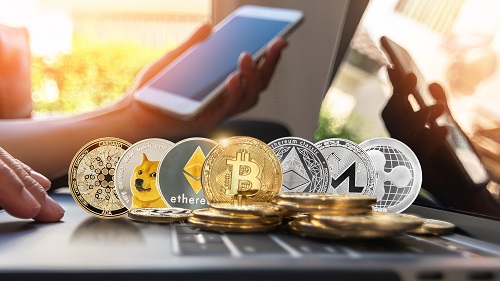
Altcoins are any coins or tokens that isn’t Bitcoin. Altcoins and their respective platforms can be created by anyone with an internet connection because blockchain is open-source. The variety of altcoins is growing.
Needless to say, altcoins have come a long way since Namecoin, the main altcoin, introduced the idea of colored coins that resembled non-fungible tokens, also known as NFTs.
Popular altcoins: What exactly are they?
Traditionally, altcoins are created to fill a need that arises from perceived market gaps that Bitcoin does not fill. Each digital asset is created with a specific goal in mind, some of which are similar to one another.
Tokens of use: Within a network, these offer services like purchasing services, paying network fees, and redeeming rewards.
Tokens of payment: These are exchanged for value in the form of currency.
Tokens for security: The Securities and Exchange Commission is in charge of these tokenized assets, which are traded on stock exchanges and held by an organization.
Stablecoins: In order to provide relative price stability, the value of a stablecoin is tied to an external reserve asset, such as precious metals or fiat currencies.
Memecoins: Memecoins are often created to take advantage of short-term gains and are based on viral internet trends.Heard of Dogecoin?
Tokens for governance: Users can vote with these utility tokens on a decentralized blockchain.
Altcoins can be created from scratch or, more frequently, forked from a code that already exists. When a blockchain separates from its parent chain to form a new network that adheres to a different software protocol, a fork takes place. The parent network is typically Bitcoin or Ethereum. Forks typically occur when developers disagree about the direction of a platform. They might change the source code to start a new chain.
Why an altcoin?
There are numerous factors that draw crypto investors to altcoins. They are what Bitcoin calls the “better mousetrap,” which means that they operate on improved versions of their previous blockchain networks.
Altcoins are the result of inventive solutions to previously unsolved software flaws, inefficiencies, and vulnerabilities. Due to their adaptability, altcoins have a better chance of long-term survival and more utility. They are better prepared for market developments in the future thanks to their adaptability in the crypto economy, which is unmatched by Bitcoin.
Lastly, because tokenomics is still in its infancy and there is room for expansion, altcoins are much more accessible. Altcoins, on the other hand, is regarded as a more risky investment. Altcoins have limited liquidity, a high level of market saturation, a smaller market cap, and a lack of credibility. They are also susceptible to scams, despite their relative price resilience.
We are highlighting the 20 market-favored altcoins that have come out on top halfway through 2022, which is another year marked by high volatility and a loss of $2 trillion. Major players ought to take advantage of the view while it lasts because, in crypto, tomorrow is not promised.
How to know DAO?
Decentralized autonomous organization, also known as an entity structure in which token holders, as opposed to a centralized authority, participate in the management and decision-making DApps for decentralized finance: software that can run entirely on a blockchain, also known as decentralized applications
NFTs: non-fungible tokens, also known as digital assets.
ERC-20: a token standard that is part of Ethereum and lets dApps use smart contracts to make their own coins or tokenized assets.
PoW lines: A consensus mechanism known as proof of work (PoS) only verifies a transaction after a certain amount of computational effort has been put into it.
Popular altcoins
The Ethereum cryptocurrency logo is a proof-of-stake consensus mechanism that avoids the computational power required in a PoW model by designating a class of its users to validate transactions.
Ethereum (ETH)
Ethereum (ETH) is the preferred blockchain for developers. Ethereum is a global decentralized software platform that uses blockchain technology and introduced smart contract functionality to DeFi.
In essence, Ethereum makes it possible for computer programs to automate transactions between two parties, eliminating the requirement for a middleman and reducing transaction costs while simultaneously increasing reliability.
It serves as a layer 1 or base network that can be built upon by anyone in the public. It currently supports 2,970 dApps and has more than 48,000 daily users. Many people consider Ethereum to be a pillar of the cryptocurrency space rather than an altcoin because of its centrality to the infrastructure of DeFi as we know it.
Tether (USDT)
Stablecoin vanguard, Tether is a first-generation centralized coin that guarantees a one-to-one fiat currency match and is fixed to the value of the US dollar.
The stablecoin, formerly known as Realcoin, was created in 2014 by developers Brock Pierce, Reeve Collins, and Craig Sellars to give investors a way to enter the cryptocurrency market without having to deal with its notoriously high volatility. Tether supports a variety of international currencies in addition to Ethereum and Bitcoin, as well as other well-known blockchains like the British pound and the Mexican peso.
The USDT, its native coin, consistently surpasses Bitcoin’s trading volume record for any cryptocurrency.
In an $18.5 million settlement in February 2021, a New York attorney general found Tether to have “recklessly and unlawfully covered up massive financial losses to keep their scheme going,” despite the company’s assertion that all transactions are fully backed by its reserves. Since then, Tether has changed its focus to U.S. Treasury holdings rather than commercial paper holdings and increased transparency across its website. Treasury Bills, while 28% are made up of commercial paper.
According to an official statement released in June, Tether intends to eventually reduce that number to zero. When the algorithmic stablecoin Terra crashed for $40 billion, it sparked a Tether run, prompting a large number of investors to withdraw their coins out of fear of insolvency. This provided an opportunity to disprove rumors and allegations.
By redeeming $16.3 billion, the company reduced the USDT supply by 20%.
Conclusion
We hope now you are familiar with alcoins. Either centralized or decentralized, all cryptocurrency-selling platforms fall into one of the above-mentioned altcoins. Similar to an issuing bank, a centralized authority is responsible for approving transactions and maintaining the blockchain ledger in centralized cryptocurrency exchanges (CEX), like Tether and Bitcoin.
A trustless, encrypted ledger that is validated by consensus and distributed to everyone in the chain is used in decentralized exchanges or trading platforms like thequantum-ai.com. Ownership is yet another important consideration. In contrast to centralized systems, token holders in a decentralized system retain full ownership of their digital assets.
Share this article
Categories
Tags