Tag: profittaking

  • Bitcoin eases from $122,000 high on profit-taking; CPI report looms

    Bitcoin eases from $122,000 high on profit-taking; CPI report looms

    Bitcoin eases from $122,000 high on profit-taking; CPI report looms

    • Bitcoin’s push toward new records was stopped by profit-taking, causing a price retreat from a high of $122,200 back to $118,500.
    • A technical gap in the CME futures market between $117,430 and $119,000 has created a potential target for a short-term price pullback.
    • Upcoming US inflation data, particularly the CPI, is considered the week’s most significant catalyst for potential market volatility.

    A promising overnight surge that propelled Bitcoin within sight of new records was cut short by a wave of profit-taking, pulling the leading cryptocurrency back and setting a cautious tone for the week.

    The market now holds its breath, caught between the allure of all-time highs and the looming shadow of critical economic data that could ignite significant price swings.

    After reaching a session high of $122,200, Bitcoin (BTC) saw its momentum fade, retreating 2.8% to land at $118,500.

    Despite the pullback, the digital asset remained slightly positive over a 24-hour period.

    In the broader crypto market, Ether (ETH) maintained its position above the $4,200 mark, while major altcoins such as Solana’s SOL (SOL), Dogecoin (DOGE), and Sui’s native token (SUI) experienced modest dips of 3%-4%.

    One technical indicator drawing considerable attention from traders is a “gap” left in the CME futures market, which, unlike the 24/7 crypto market, operates only on weekdays.

    This created a void between Friday’s closing price of $117,430 and Monday’s higher open at $119,000.[3] James Van Straten, senior analyst at CoinDesk, noted that historical precedent suggests Bitcoin often retraces to “fill” such gaps.

    “History suggests that BTC could pull back to revisit and ‘fill’ that gap,” he said.

    Economic crosswinds

    The market’s next significant directional move may well be dictated by macroeconomic forces.

    The release of the US Consumer Price Index (CPI) on Tuesday, followed by Producer Price Index (PPI) data, is circled on every trader’s calendar.

    These inflation reports are critical as they heavily influence the Federal Reserve’s monetary policy, which in turn impacts investor appetite for risk assets like Bitcoin.

    This sentiment was echoed by analysts at the crypto exchange Bitfinex, who believe the continuation of Bitcoin’s momentum is contingent on these US economic reports.

    “With market sensitivity to macro events running high, traders should prepare for increased volatility and the possibility of a retracement toward $110,000 in the near term,” the Bitfinex analysts wrote in a Monday market report.

    They added, “We believe that the ranging conditions and oscillation between the range highs and lows will continue, since price is constantly moving above and below the cost-basis of fresh buyers allowing for charged sentiments around key macro data releases.”

    A rally built on shaky ground?

    Beneath the surface of the recent price surge, however, are signs that the rally lacked broad-based participation. In a recent report, the analytics firm Glassnode described the sharp rebound from below $114,000 as a shift from “seller exhaustion to a strong rebound near recent ATHs.”

    Yet, this recovery was not accompanied by a surge in spot market buying.

    Glassnode data revealed that spot trading volumes actually fell by 22% to $5.7 billion, a figure near the statistical low, suggesting the upward price movement was driven more by strategic “positioning shifts than deep conviction buying.”

    While a metric known as the Spot Cumulative Volume Delta flipped 94% toward buy pressure—a sign that aggressive selling has subsided—it also points to renewed demand from a narrow base of traders rather than a widespread market rush.

    On the institutional front, the data presents a mixed, albeit slightly optimistic, picture. Outflows from US-listed spot bitcoin ETFs were halved, dropping to $311 million from $686 million in the preceding week, offering some relief.

    Even so, the total trade volume for these ETFs saw a 27.7% decline to $13.7 billion, indicating that overall activity remains subdued and close to its low band.

    Source link

  • Bitcoin drops to $115K amid third major wave of profit-taking, new tariff tensions

    Bitcoin drops to $115K amid third major wave of profit-taking, new tariff tensions

    Bitcoin drops to $115K amid third major wave of profit-taking, new tariff tensions

    • Bitcoin (BTC) fell 2.3% to ~$115,300, pressured by a third major wave of profit-taking and new US tariffs.
    • $6–8 billion in realized gains were recorded in late July, with an “OG whale” selling 80,000 BTC on July 25.
    • New tariff tensions, including measures targeting Canada, have rattled broader risk assets, including crypto.

    Bitcoin is poised to end the trading week in Asia on a weaker note, down 2.3% on the day and changing hands above the $115,300 mark.

    The leading cryptocurrency is grappling with a combination of renewed tariff pressure from the White House and a significant wave of profit-taking, following its historic run to new all-time highs.

    According to a new report by on-chain analytics firm CryptoQuant, the Bitcoin market has just experienced its third major profit-taking wave of the 2023–2025 bull cycle.

    A substantial $6–8 billion in realized gains were recorded in late July, indicating a significant number of investors chose to cash in on the recent price surge.

    Like the previous two phases of profit-taking in this cycle, this latest wave was defined by large spikes in the Spent Output Profit Ratio (SOPR), a metric that indicates whether coins being sold are in profit or loss. This was particularly evident among short-term holders.

    The wave was further intensified by a significant 80,000 BTC sell-off by an “OG whale” (an early, long-time holder) on July 25.

    The data provider also noted that “new whale cohorts”—those who have accumulated their Bitcoin within the last 155 days—were the dominant sellers during this period.

    In a clear sign of intent to exit positions at what were perceived as peak prices, exchange inflows surged to a massive 70,000 BTC in a single day after the OG whale’s sell-off.

    The selling pressure was not confined to Bitcoin alone; Ethereum-based whales holding assets like WBTC (Wrapped Bitcoin), USDT, and USDC also realized up to $40 million in daily profits, further supporting the narrative of a broad-based capital rotation out of some positions.

    Historically, these major profit-taking events have been followed by a two- to four-month period of market consolidation before the next major leg higher, CryptoQuant wrote in its report.

    That very pattern may be playing out again, particularly as appetite from US investors appears to be waning. The Coinbase premium, a key indicator that tracks the price difference between Coinbase and other global exchanges, has recently flipped negative.

    This suggests that American buyers are no longer willing to pay a premium for Bitcoin, a sign of cooling demand in a crucial market.

    Tariff jitters return, adding to market pressure

    Adding to this cautious internal market dynamic is the re-emergence of macroeconomic risk.

    A new round of global tariffs from the White House is dragging down markets in Asia, with Japan’s Nikkei 225 and South Korea’s KOSPI both opening in the red.

    Bitcoin, too, is not immune to these pressures. Historically, digital assets have tended to follow equity markets lower when the White House announces new tariffs, and while this correlation has shown signs of weakening, it has not disappeared entirely.

    President Trump’s latest tariff escalation, which includes new measures that specifically target Canada, has rattled broader risk assets, with equities, bonds, and crypto all seeing declines amidst fears of renewed inflation and further supply chain disruptions.

    Without a clear new macro catalyst or a resurgence of strong, structural inflows, risk-taking in the crypto market is likely to remain selective, with conviction being light. Market maker Enflux, in a note to CoinDesk, echoed this sentiment.

    “Until BTC or ETH can post a clean reclaim of recent local highs, price action may stay choppy and rotation thematic rather than trend-driven,” the firm stated, suggesting a period of sideways, volatile trading may lie ahead.

    Source link

  • Ethereum price forecast: ETH bull case remains intact despite strategic profit-taking

    Ethereum price forecast: ETH bull case remains intact despite strategic profit-taking

    Ethereum Price

    • Ethereum price is at $3,640 amid some profit-taking deals.
    • Despite some whales selling, institutional interest remains high and demand is absorbing the dump.
    • Analysts say the ETH bull market remains intact.

    Ethereum has retreated slightly from its highs of $3,856 as it dips nearly 4% in the past 24 hours amid some profit-taking moves.

    But while the top altcoin changes hands at $3,640 at the time of writing, analysts maintain Ethereum is on a bullish course and that ETH still has room to explode.

    ETH sees strategic profit taking

    The $4,000 mark remains elusive for Ethereum in 2025, with the highs of $3,856 marking a key peak since the declines from $4,000 in December 2024.

    It means Ethereum price has lagged as Bitcoin climbed to multiple new highs.

    Selling pressure at current levels alludes to likely struggles in the short term, analysts at Glassnode have noted.

    The outlook is down to the Cost Basis Distribution Heatmap of Ethereum, which Glassnode analysts say shows buyers are cashing out gains.

    This strategic profit-taking is calculated towards securing profits after ETH posted strong upward moves these past weeks.

    Sellers have included whales. Lookonchain shared on X that one whale has sold 8,000 ETH for over $30 million.

    Ethereum price forecast: here’s why bull case remains intact

    Despite the profit-taking, Glassnode highlights a fascinating scenario with equilibrium emerging.

    Notably, data shows new demand is steadily absorbing the supply hitting the market, with selling pressure yet to overwhelm buyer interest.

    It’s a resilient market structure for ETH that suggests pullback action is likely to dissipate as bulls take control.

    While some whales sell, others have accumulated. Also, institutional holders like SharpLink Gaming have been aggressive.

    The company has acquired a massive chunk of ETH in recent weeks.

    Helping buyers is overall market sentiment that sees open interest in ETH futures soar to all-time highs. OI currently sits around $58 billion per Coinglass, which indicates interest is elevated.

    Ethereum is also sporting gains amid staking explosion, spot ETF inflows and regulatory developments. The ETH spot ETF inflows for Ethereum reached 588,000 ETH last week – higher than recent peak.

    Traders will eye potential corrections for buy opportunities, with consolidation in the near term allowing for a retest of key supply zone areas.

    On the flipside, sellers may be encouraged by weakening on-balance volume and extended cashing out.

    The $3,500 remains important and robust support may be around $3,000.

    Yet, the RSI on the daily chart is not overextended as it hovers just below the overbought territory.

    The MACD also still boasts a bullish case scenario. The $4,000 threshold is therefore one to watch.


    Source link

  • Bitcoin price drop caused by profit-taking and macroeconomic conditions

    Bitcoin price drop caused by profit-taking and macroeconomic conditions

    BTC drops below $70k
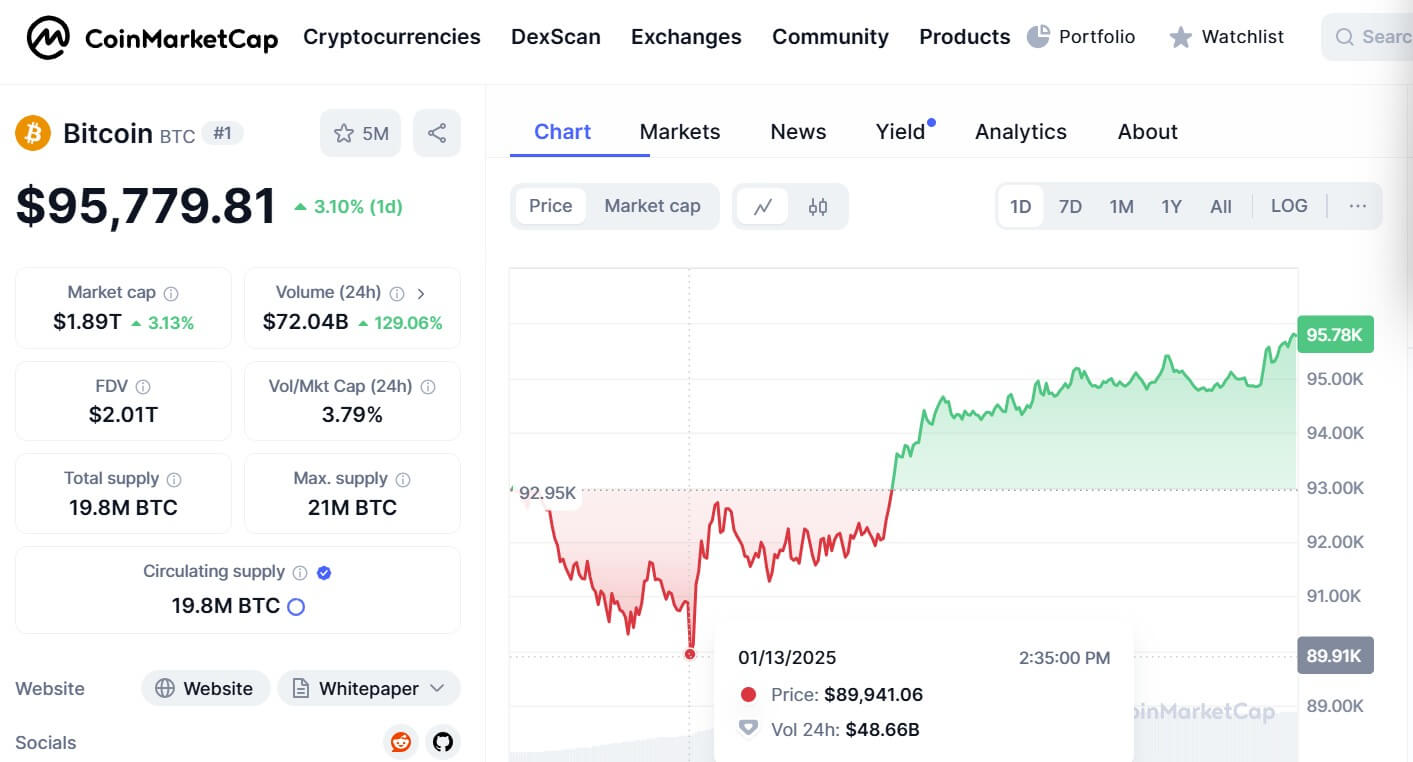
    • Bitcoin dropped to $89,900 on January 13, its lowest decline in two months
    • James Toledano, COO at Unity Wallet, said one of the reasons for the drop is profit-taking after Bitcoin hit $108,000 in mid-December
    • The inauguration of President-elect Donald Trump could spark renewed buying interest, Toledano said

    Bitcoin fell below $90,000 for the first time in two months, dropping 3.6% in 24 hours as the market experienced selling pressure.

    Data from CoinMarketCap shows that Bitcoin’s price dropped to around $89,900 on January 13. However, at the time of publication, it’s trading over $95,000.

    Bitcoin drops below $89,000. Source: CoinMarketCap

    According to James Toledano, COO at Unity Wallet, there are several reasons why Bitcoin’s price fell.

    “The first is profit-taking, after hitting a peak of around $108,300 in mid-December, the market has seen a massive amount of it, particularly following the election of pro-crypto President-elect Donald Trump,” he said to CoinJournal, adding:

    “Secondly, while institutional buying has continued contributing to Bitcoin reserves on exchanges hitting a seven-year low, trading volume remains subdued and this could simply be down to a seasonal slow-down.”

    Macroeconomics weigh on the market

    Recent analysis suggests that bleak economic expectations drive this bearish sentiment. This includes Trump’s tariff plans, the US Federal Reserve’s cautious approach to interest rate cuts, and a strong dollar.

    Zach Pandl, head of research at Grayscale Investments, said to CNBC that:

    “I would attribute the drawdown in the last two days largely to the market starting to appreciate that not every aspect of the Trump policy agenda is going to be positive for Bitcoin – and tariffs do introduce some new uncertainty.”

    As questions surround Trump’s forthcoming policies, it may have dampened enthusiasm, which can “lead to short-term volatility for an already highly volatile asset,” said Toledano.

    Some analysts believe Bitcoin can reach between $140,000 and $200,000 by mid-2025, so the current price action may appear concerning. Yet, it doesn’t necessarily signal the end of the bull run.

    “The inauguration of President-elect Trump is just seven days away and could be a pivotal moment, with markets anticipating announcements of pro-crypto policies that might spark renewed buying interest,” said Toledano. “Institutional accumulation, as reflected in falling exchange reserves also supports the view that demand remains strong despite low trading volumes.”

    Source link