Tag: regulatory

  • Michigan lawmakers introduce 4 crypto bills as Congressmen revive Blockchain Regulatory Certainty bill

    Michigan lawmakers introduce 4 crypto bills as Congressmen revive Blockchain Regulatory Certainty bill

    Michigan clears 4 crypto bills as Congress revives blockchain regulatory act

    • Michigan’s HB 4510 allows pension funds to invest in crypto ETFs.
    • HB 4512 enables Bitcoin mining at abandoned oil or gas wells.
    • HB 4513 offers income tax breaks to miners in remediation schemes.

    State and federal lawmakers are charting a new course for cryptocurrency in the United States.

    In Michigan, a legislative package of four crypto-focused bills is moving forward, combining pension fund exposure, environmental cleanups, and digital asset rights.

    At the same time, lawmakers in Washington have reintroduced a bill to clarify the regulatory obligations of blockchain developers and non-custodial providers.

    These coordinated efforts aim to balance innovation with accountability, as regulators seek to provide legal clarity without stifling decentralised finance.

    The push reflects a growing political will to define crypto’s role within the broader financial and technological landscape.

    Michigan bill allows crypto in pension funds

    One of the most significant pieces of Michigan’s legislation is House Bill 4510, which would permit state-managed retirement systems to invest in cryptocurrencies through regulated financial products, such as exchange-traded funds (ETFs).

    These investment vehicles must meet market capitalisation thresholds and be overseen by relevant financial authorities, offering a relatively conservative pathway for exposure to assets like Bitcoin.

    The proposal comes amid rising institutional interest in crypto and growing demand for diversified, inflation-resistant portfolios.

    If passed, the bill would position Michigan among a small group of US states, enabling public pension managers to hold crypto-linked assets under regulatory safeguards.

    Mining linked to abandoned wells and tax breaks

    In a bid to align crypto with environmental responsibility, Michigan’s HB 4512 and HB 4513 introduce an energy reuse programme targeting abandoned oil and gas wells.

    Under the plan, Bitcoin miners would be allowed to power operations using these dormant energy sites, provided they remediate environmental damage.

    Ownership transfers, well site assessments, and environmental progress tracking would be mandated under the bill, ensuring accountability.

    In return, miners participating in the scheme would qualify for income tax deductions under HB 4513.

    The measures are designed to attract miners with incentives while tackling legacy pollution problems.

    The bills reference Bitcoin explicitly and focus on “orphan well programmes” as a potential win-win for the energy and crypto sectors.

    State protection against CBDCs and digital discrimination

    Another critical element of Michigan’s proposal is House Bill 4511.

    This bill would prohibit state and local authorities from creating restrictions, licensing rules, or special taxes targeting digital assets solely based on their digital form.

    It also bans any state agency from endorsing or promoting a central bank digital currency (CBDC), drawing a clear line between decentralised cryptocurrencies and government-backed digital money.

    The legislation signals a strong defence of crypto users’ rights within Michigan, providing legal backing for miners, node operators, and token holders against targeted regulatory pressure.

    If adopted, it could set a precedent for other states seeking to protect decentralised finance ecosystems.

    Federal legislation aims to clarify developer rules

    While Michigan pursues state-level crypto integration, Washington is moving ahead with national reform.

    US Representatives Tom Emmer and Ritchie Torres recently reintroduced the Blockchain Regulatory Certainty Act, which seeks to establish clear boundaries on who qualifies as a “money transmitter” under federal law.

    The Act would exempt developers and non-custodial service providers, such as those who build blockchain protocols or run interfaces that never hold user funds, from financial licensing requirements.

    Only those who directly control consumer assets would be subject to oversight.

    The lawmakers argue this clarification is needed to keep blockchain talent and startups within the US, rather than pushing them offshore.

    “Today, @RepRitchie and I introduced the Blockchain Regulatory Certainty Act to protect blockchain developers and service providers that never custody consumer funds from unjust government prosecution,” Emmer posted on X on 3 May.

    The bill aims to address regulatory uncertainty that critics say has slowed domestic blockchain innovation and led to uneven enforcement.

    By drawing a regulatory line between developers and custodians, the bill hopes to ease legal pressures on creators and infrastructure providers.



    Source link

  • CRO price outlook amid Crypto.com’s new regulatory milestone

    CRO price outlook amid Crypto.com’s new regulatory milestone

    • Cronos (CRO) token eyes rally as Crypto.com hits another regulatory milestone.
    • The Crypto.com team announced it received a MiFID license.
    • Optimism across crypto, as well as this milestone, could spark a bullish rally for the Cronos price.

    Cronos (CRO) is eyeing a potential rally as Crypto.com, the company behind the token and Crypto.com exchange, secures another significant regulatory milestone.

    With the Markets in Financial Instruments Directive (MiFID) licence secured, CRO looks poised to ride positive sentiment for a breakout.

    While it’s not just Crypto.com’s regulatory traction that’s in focus, the expansion amid broader adoption could be massive for the Cronos token.

    Crypto.com secures MiFID licence

    Crypto.com announced on May 21, 2025, that it had secured a MiFID licence.

    The milestone comes after the company received approval from the Cyprus Securities and Exchange Commission (CySEC) to complete the acquisition of A.N. Allnew Investments Ltd.

    Allnew, already licensed by CySEC, allows Crypto.com to provide investment and ancillary services related to a wide range of financial instruments, including securities, derivatives, and contracts for difference.

    This licence enables Crypto.com to offer eligible users across the European Economic Area (EEA) a broader suite of financial products, marking a significant step in its expansion strategy.

    Crypto.com’s previous achievement in the regulatory market was in January 2025, when it received its Markets in Crypto-Assets (MiCA) licence.

    This enabled the platform to provide passport services across the EEA.

    The MiFID licence further solidifies Crypto.com’s position as a regulated financial services provider in the region.

    Kris Marszalek, co-founder and chief executive officer of Crypto.com, commented on this development.

    “Securing a MiFID licence alongside our MiCA licence further solidifies Crypto.com’s position in offering the most comprehensive and regulated suite of financial products for users in the EEA,” Marszalek said.

    “We have already expanded our brand presence in Europe since receiving our MiCA licence and we now look forward to providing customers across the region even more ways to engage with our platform through these new offerings.”

    CRO price outlook

    The MiFID licence adds to Crypto.com’s growing portfolio of global licences and registrations.

    Recent notable steps include acquisitions such as Fintek Securities Pty Ltd., Charterprime Ltd, Orion Principals Limited, and SEC-registered broker-dealer Watchdog Capital, LLC.

    Additionally, Crypto.com revealed its partnership with Canary Funds to establish the Canary CRO Trust, the first Private Investment Vehicle for CRO.

    The product is aimed at investors across the United States, which is a move that aligns with the company’s 2025 Roadmap.

    The developments, coupled with broader market sentiment, look likely to be a major catalyst for the Cronos token (CRO).

    In the past three months, CRO price reached highs of $0.1, while it hit $0.22 in December 2024.

    Currently, the token is showing bullish potential with the ascending triangle pattern.

    Source link

  • Bitcoin tests key levels near $95K as regulatory tailwinds emerge

    Bitcoin tests key levels near $95K as regulatory tailwinds emerge

    Crypto news today: Bitcoin holds firm above $93K, fueled by record ETF inflows and bullish forecast

    • Bitcoin holds steady above $93,000, showing resilience after earlier correction.
    • US Spot Bitcoin ETFs saw massive $1.2B+ weekly inflow (“Pac-Man mode”), signaling strong institutional demand.
    • US Federal Reserve joined OCC/FDIC in withdrawing previous restrictive crypto guidance for banks.

    Bitcoin continues to demonstrate significant resilience, maintaining levels above the crucial $93,000 mark after weathering a notable correction earlier this year.

    This stability is underpinned by a confluence of factors, including surging institutional interest evidenced by record ETF inflows, increasingly bullish long-term price predictions, and a potentially easing regulatory landscape.

    A primary driver of the recent strength has been the remarkable influx of capital into US-listed spot Bitcoin exchange-traded funds (ETFs).

    These investment vehicles experienced substantial demand this week, attracting nearly $1.3 billion in net inflows, according to data from SoSoValue.

    Tuesday alone saw inflows nearing the $1 billion mark, representing the strongest single day since mid-January.

    This brings the total assets under management across these spot Bitcoin ETFs to an impressive $103 billion.

    BlackRock’s iShares Bitcoin Trust (IBIT) continues to lead the pack, accumulating $2.7 billion year-to-date, including $346 million just last week.

    Observing the broad participation across ten of the eleven available funds, Bloomberg senior ETF analyst Eric Balchunas described the activity vividly, stating the ETFs had entered “Pac-Man mode.”

    This widespread buying across multiple providers, rather than concentration in just one or two, suggests a broadening base of institutional conviction.

    The total value traded across all spot Bitcoin ETFs reached $496 million, reflecting significant market activity.

    Lofty projections: ARK Invest eyes $2.4 million bitcoin

    Fueling longer-term optimism, prominent investment firm ARK Invest recently made headlines by significantly raising its 2030 price targets for Bitcoin.

    Citing institutional investment as a primary catalyst, ARK lifted its “bull case” scenario from $1.5 million to a striking $2.4 million per Bitcoin by the decade’s end.

    The firm also increased its “base” case to $1.2 million and its “bear” case to $500,000.

    ARK research analyst David Puell explained the rationale, estimating Bitcoin could achieve a 6.5% penetration rate within the massive $200 trillion global financial system in their most optimistic scenario.

    Furthermore, the firm’s model incorporates Bitcoin’s growing acceptance as “digital gold,” projecting it could capture up to 60% of gold’s approximately $18 trillion market capitalization.

    Technical picture: holding support, eyeing breakout

    From a technical analysis perspective, maintaining current levels is seen as critical.

    Analysts emphasize the importance of Bitcoin holding support above the $93,500 zone to avoid potential downward pressure.

    Crypto analyst Rekt Capital suggested BTC needs to consolidate above this level, ideally securing a weekly close above it, to “resynchronize with the former Reaccumulation range.”

    Bitcoin has demonstrated its ability to trade above this mark this week, potentially reflecting its appeal as a safe haven amid ongoing geopolitical and trade uncertainties.

    Sustaining this support could pave the way for a retest of the $100,000 barrier and potentially new all-time highs, according to expert consensus.

    Further technical indicators point towards underlying market strength.

    The amount of Bitcoin supply held in profit has reportedly surpassed the 16.7 million BTC “threshold of optimism.”

    Historical analysis suggests that when Bitcoin consistently holds above this zone (as seen in 2016, 2020, and 2024), significant price appreciation often follows within months.

    Traders like CrediBULL Crypto are looking for “one more leg on the lower timeframes” to confirm the breakout, suggesting momentum could potentially carry prices towards the $150,000 region if sustained.

    Regulatory winds shifting? Fed withdraws guidance

    Adding a potential tailwind, US banking regulators, including the Federal Reserve, recently took steps to withdraw previous crypto-specific guidance issued to banks in 2022 and 2023.

    These earlier notices had often required pre-approvals for banks engaging in crypto activities and highlighted perceived risks.

    By joining the Office of the Comptroller of the Currency (OCC) and the Federal Deposit Insurance Corp. (FDIC) in rescinding this guidance, the Fed stated the move aims to ensure its “expectations remain aligned with evolving risks and further support innovation in the banking system.”

    While not creating new rules, this withdrawal effectively places decisions on crypto engagement more firmly in the hands of bank managers and compliance teams, pending potential future legislation from Congress.

    Fed officials noted they “will instead monitor banks’ crypto-asset activities through the normal supervisory process,” potentially signaling a less prescriptive regulatory posture from these key agencies.

    The combination of strong institutional inflows, ambitious long-term outlooks, supportive technicals, and a potentially less restrictive regulatory environment paints a compelling picture for Bitcoin as it holds key levels and eyes its next potential move higher.

    Source link

  • NYSE Arca seeks regulatory nod for Grayscale crypto ETF

    NYSE Arca seeks regulatory nod for Grayscale crypto ETF

    • NYSE Arca is seeking regulatory approval to list an ETF of the Grayscale Digital Large Cap Fund
    • Grayscale recently filed to convert the fund to a spot ETF

    Securities exchange NYSE Arca is seeking regulatory approval to list a new crypto exchange-traded fund (ETF) by Grayscale.

    The ETF is aimed at tracking the Grayscale Digital Large Cap Fund, which the GBTC issuer launched in 2018.

    According to an October 29 filing, the NYSE Arca wants to list the $565 million fund, which Grayscale recently sought approval to convert into a spot ETF. Grayscale’s application came on October 16.

    The fund currently holds five spot crypto assets, including Bitcoin, Ethereum, and Solana, with BTC weighted at 76.5%, ETH at 16.88%, and SOL at 4.46% as of October 29.

    Other digital assets in the Digital Large Cap Fund are Avalanche and XRP, weighted at 0.58% and 1.58%, respectively.

    Recently, the US Securities and Exchange Commission (SEC) greenlighted the trading of options on NYSE’s spot Bitcoin exchange-traded products (ETPs). These included Grayscale’s flagship asset GBTC and the Mini Bitcoin Trust BTC.

    This comes as the industry continues to witness massive demand and investment in spot Bitcoin ETFs following SEC’s approval in January 2024.

    Spot ETFs inflows and holdings

    Inflows into spot ETFs, which includes Ether ETFs approved in May, has skyrocketed. According to SoSoValue data, US spot BTC ETFs have seen cumulative net inflows of $23.28 billion.

    Meanwhile, total net assets have surpassed $72.55 billion, with this accounting for over 5% of the BTC market cap. BlackRock’s IBIT holds $30 billion in assets.

    In a post on X on October 30, Bloomberg senior ETF analyst Eric Balchunas shared that spot Bitcoin ETFs were on track to surpass 1 million BTC holdings.

    Satoshi Nakamoto, the creator of Bitcoin who remains unknown, holds the most BTC today. Satoshi mined the coins in the early years of the flagship digital asset’s launch. Spot ETFs could surpass the 1.1 million figure within the next few days.

    Source link

  • Bitcoin correlation with stocks at 5-year low as regulatory crackdown takes toll

    Bitcoin correlation with stocks at 5-year low as regulatory crackdown takes toll

    Key Takeaways

    • Our Head of Research, Dan Ashmore, digs into Bitcoin’s relationship with stocks
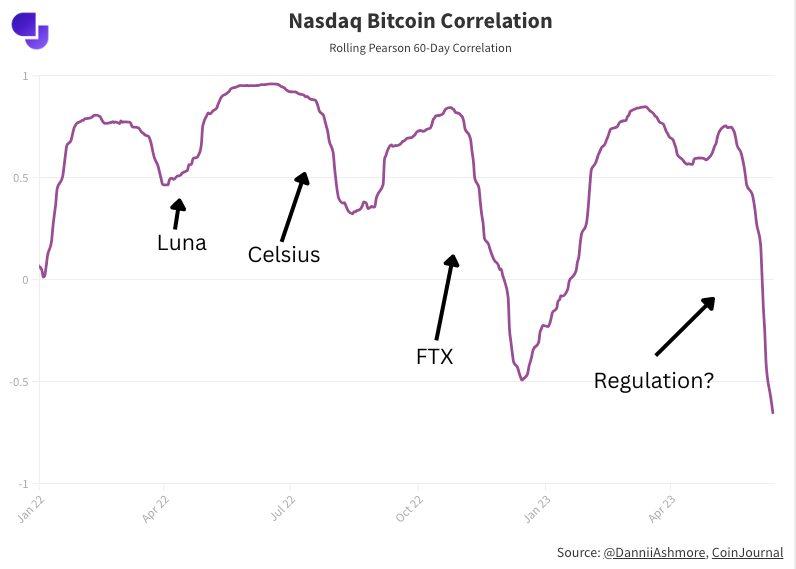
    • Correlation between Bitcoin and the Nasdaq is at its lowest point since 2018
    • The Nasdaq is up 10% in the last month as stocks have surged off softer forecasts around interest rates and the macro climate
    • Bitcoin is down 9% in the same time frame, the US regulatory crackdown spreading fear about crypto’s future in the country 
    • Ashmore writes that the break in correlation surpasses what was seen in November 2022 amid the FTX collapse, when Bitcoin fell to $15,000 while stocks increased off positive inflation readings

    After ten consecutive interest rate hikes, the US Federal Reserve this week paused its rate hiking policy. The move was nearly unanimously anticipated by the market and movement after the meeting was relatively minimal.  

    However, over the past month, markets have been flying. The S&P 500 is up 6% in the last 30 days, now only 8.8% off an all-time high, despite being 27% below the mark in October. The Nasdaq is up 10% over the same timeframe – that is 15% below its all-time high from November 2021 but a tremendous resurgence considering it shed a third of its value in 2022.  

    And yet, something is being left behind: Bitcoin. 

    Bitcoin is now trading below $25,000 for the first time in three months. I put together a deep dive in March analysing the its underlying price movement to show how tightly it trades with the stock market. This was at a time when Bitcoin was rallying and banks were wobbling amid the Silicon Valley Bank fiasco. Suddenly, it was fashionable to declare Bitcoin as decoupling from the stock market. Ultimately, that wasn’t true. However, something very interesting has happened in the last month. 

    First, take a look at the path of the Nasdaq and Bitcoin since the start of 2022, which roughly coincides with the start of the bear market: 

    Clearly, the two have moved in lockstep. But two episodes jump out: the first is November 2022, when Bitcoin fell and the Nasdaq surged. The second is this past month. We discussed the 10% jump in the Nasdaq over the last month. However, Bitcoin has fallen 9% in the same timeframe. This marks a clear departure from what we would expect. Plotting the correlation (using 60-Day Pearson) shows this more directly:

    I touched on November 2022 above, and the swift fall in correlation can be seen on the chart. This was when FTX collapsed, sending the crypto market into a tailspin. At the same time, however, stocks raced upwards as softer inflation numbers were met by lower expectations around the future path of interest rates. 

    There were also less dramatic (but equally temporary) decouplings between Bitcoin and stocks in April/May 2022 and June/July 2022. On the chart below, I have pencilled in incidents which occurred during these periods:

    Indeed, what is different about November (FTX) and today is that we see a Bitcoin fall happening at the same time as a Nasdaq surge. While the Luna and Celsius incidents hurt crypto immensely, they came as stocks were also struggling and so the effect is not as dramatic in terms of correlation breaks (although is still tangible on the chart).

    But today, we are seeing the biggest break in the correlation trend over the last couple of years – surpassing even FTX. The 60-Day Pearson currently sits at -0.66, whereas the lowest it hit during the FTX crisis was -0.49. 

    Regulatory crackdown is suppressing prices

    The reason is obvious. The great regulatory crackdown in the US is freaking the market out, and for very good reason. The two biggest crypto companies on the planet, Binance and Coinbase, were both sued last week. 

    Crypto.com has suspended its institutional exchange, citing weak demand amid the regulatory woes. eToro and Robinhood pulled a bunch of tokens from their platforms following confirmation from the SEC that it viewed them as securities. Liquidity is dropping like a stone

    I wrote in-depth about the concern following the announcement of the Coinbase lawsuit last week, so I won’t rehash it here (that analysis is here). While I believe Bitcoin should be able to weather the storm long-term, the picture appears far murkier for other cryptocurrencies. 

    Make no mistake about it, the crypto industry faces a massive problem as long as lawmakers continue to turn the screw. The crisis very much feels existential for a lot of the crypto market. 

    Regarding Bitcoin, enthusiasts dream of a day when it can decouple and claim that title of uncorrelated hedge asset, or a store-of-value, akin to gold. I’ve done a lot of work around what that hypothetical future could look like, or what could lead the market to that point. But for now this remains just that: hypothetical.  Because while the correlation is at its lowest point in five years, it is not being driven by fundamentals and thus will inevitably spike back up. This is nothing more than the market reacting to what is a very bearish development around regulation in the US. 

    It’s not how investors hoped a decoupling would come. But if anyone doubted the market’s fear over the regulatory woes, or questioned why Bitcoin had not fallen more, looking at the break in correlation paints a very clear picture of how detrimental Gary Gensler’s games have been to the cryptocurrency industry. 

    In truth, it is not hyperbole to say that this is the most out of whack Bitcoin’s correlation has ever been whilst trading as a mainstream financial asset. Because back when it last happened in 2018, Bitcoin traded with such thin liquidity that its price action is largely irrelevant to draw conclusions from going forward. 

    Source link