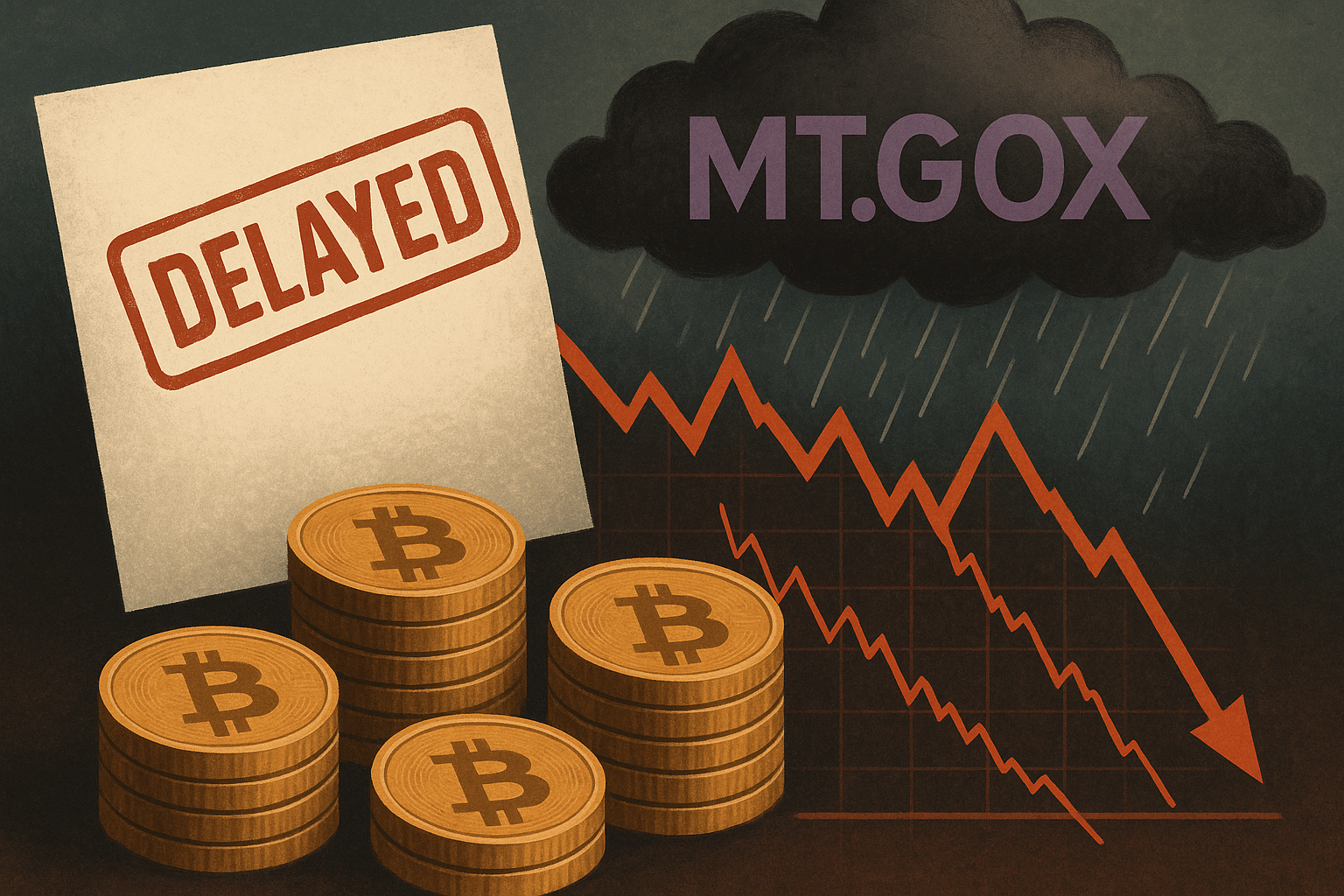

- Mt. Gox extends Bitcoin repayment deadline to Oct 2026 amid ongoing administrative hurdles.
- Once the top Bitcoin exchange, Mt. Gox’s collapse in 2014 led to the loss of 850,000 BTC.
- Arkham data shows holdings now down 75% to 34,690 BTC.
Mt. Gox, once the world’s largest Bitcoin exchange, has delayed repayments to its creditors until October 2026 — extending a saga that began more than a decade ago.
The announcement, made just days before its previous deadline of October 31, 2025, reflects ongoing administrative and technical challenges in finalising payments.
While many creditors who submitted paperwork have received partial repayments, a significant number are still waiting for their funds.
The Tokyo District Court approved the extension after the trustee cited the need for additional time to process remaining claims and complete settlements efficiently.
Delayed Bitcoin repayments extended to 2026
According to the latest notice, the Mt. Gox rehabilitation trustee confirmed that most base, early lump-sum, and intermediate repayments have been processed for creditors who completed the required steps.
However, repayments for others remain pending.
The trustee explained that it was “desirable to make the repayments to such rehabilitation creditors to the extent reasonably practicable,” leading the court to approve a new deadline of October 31, 2026.
This marks another chapter in one of the cryptocurrency industry’s longest-running recovery efforts.
Mt. Gox, which once handled over 70% of the world’s Bitcoin trading volume, collapsed in 2014 after a massive hack led to the loss of approximately 850,000 BTC.
The company subsequently filed for bankruptcy in Japan.
How the Mt. Gox collapse reshaped Bitcoin history
When Mt. Gox failed, the exchange’s bankruptcy shook investor confidence in digital assets and exposed vulnerabilities in early crypto infrastructure.
About 200,000 BTC were later recovered, but 650,000 BTC remain missing.
The recovery process transitioned into a court-supervised civil rehabilitation in Japan, during which a trustee began redistributing recovered Bitcoin and Bitcoin Cash (BCH) in 2024.
At the time of its collapse, Mt. Gox’s influence was unmatched.
The incident not only caused a sharp decline in Bitcoin prices but also prompted tighter regulatory oversight in key markets.
In the years since, it has become a landmark case in crypto regulation, bankruptcy law, and investor protection — shaping how global exchanges handle custody and insurance.
Market impact and sell-off concerns
With repayments scheduled to continue into 2026, traders and analysts have debated whether the eventual release of thousands of Bitcoin could trigger selling pressure.
Historically, such fears have surfaced each time Mt. Gox announced repayment progress.
However, recent on-chain data suggests that these effects may be limited.
According to Arkham Intelligence, Mt. Gox currently holds 34,690 BTC worth nearly $4 billion, down from about 142,000 BTC in mid-2024 — a decline of more than 75%.
Analysts tracking these wallets have noted that even large movements from the exchange have had only short-term effects on Bitcoin’s market price, indicating that most creditors are choosing to hold rather than sell immediately.
What’s next for creditors and the crypto market
The trustee’s revised timeline means that full repayments could now take another year, extending the wait for thousands of claimants worldwide.
For many early Bitcoin investors, the repayments represent not only financial recovery but also closure on one of crypto’s most notorious events.
Still, the Mt. Gox story continues to serve as a cautionary tale for digital asset investors.
It underscores the importance of secure custody, transparent operations, and regulatory compliance — principles that have since become standard practice across global crypto exchanges.