Tag: Report

  • Glassnode report reveals Bitcoin’s growing stability amid ETF activity and RWA expansion

    Glassnode report reveals Bitcoin’s growing stability amid ETF activity and RWA expansion

    Glassnode report reveals Bitcoin’s growing stability amid ETF activity and RWA expansion

    • Bitcoin’s 2025 cycle shows rising institutional flows, lower volatility, and deeper liquidity.
    • Tokenized real-world assets surge to $24 billion, boosting institutional adoption and on-chain activity.
    • ETFs reshape Bitcoin liquidity as stablecoins remain key rails in a more mature digital asset market.

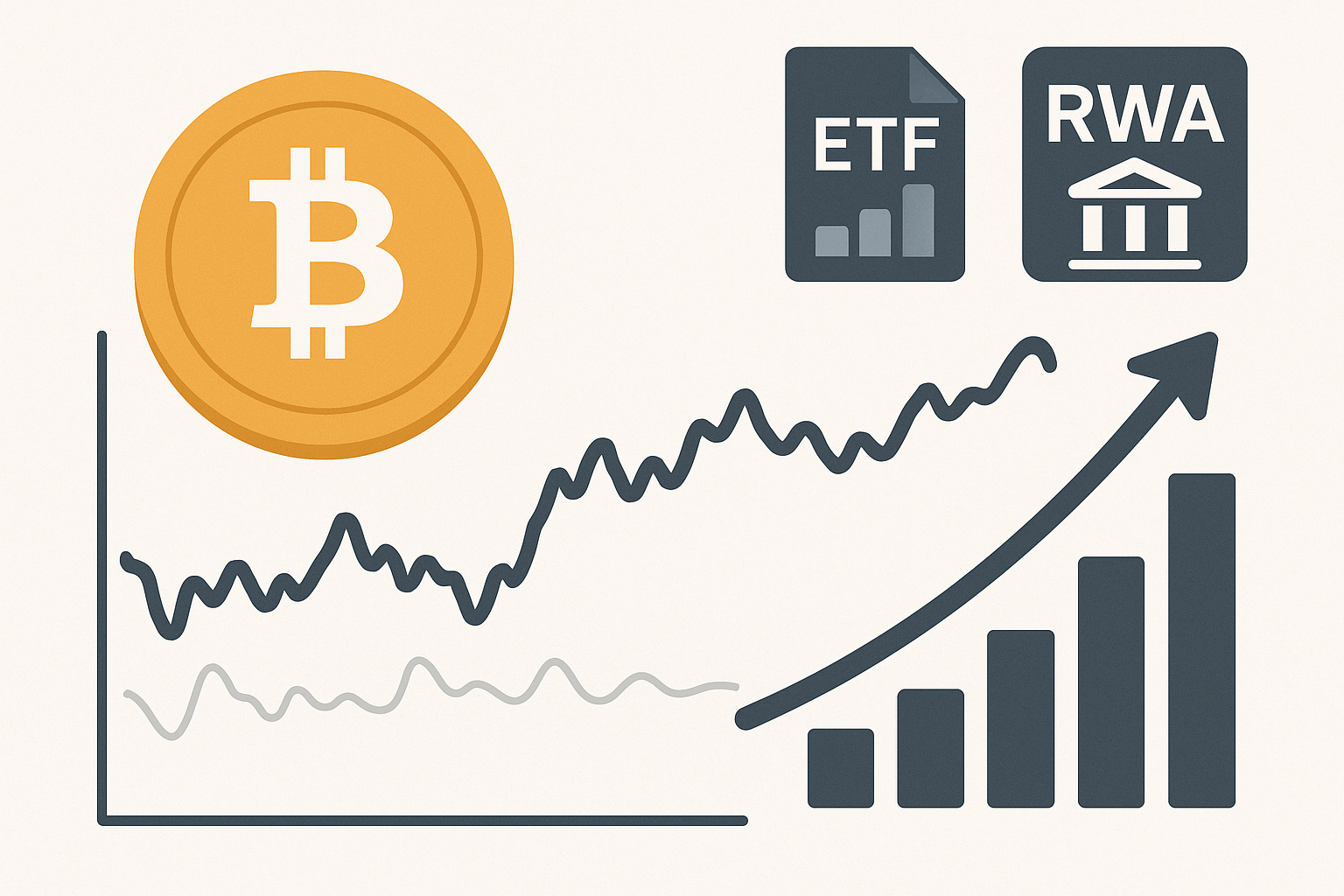
    Bitcoin’s latest cycle is developing under a very different market structure, with data from Glassnode and Fasanara Capital pointing to deeper institutional participation, rapid growth in tokenized real-world assets, and a notable drop in volatility.

    Their Q4 Digital Assets Report highlights how Bitcoin’s behaviour has shifted as regulated investment channels expand, and liquidity becomes more stable across spot, derivatives, and on-chain markets.

    The findings show how ETF flows, settlement activity, and broader adoption of tokenised instruments are shaping a more mature phase in the digital asset ecosystem.

    These structural changes are defining how capital moves through Bitcoin in 2025.

    Institutional flows reshape the cycle

    The report estimated that Bitcoin has absorbed around $732 billion in new capital during this cycle.

    This has occurred alongside a clear decline in one-year realised volatility, which has fallen by nearly half.

    Glassnode linked this trend to increased depth across major markets and a larger share of trading driven by institutional strategies.

    Glassnode also reported that Bitcoin settled approximately $6.9 trillion over the past 90 days.

    This puts Bitcoin in a range comparable to payment networks such as Visa and Mastercard.

    Even with more trading moving into ETF and brokerage channels, the report found that Bitcoin and stablecoins still dominate value transfer on public blockchains.

    ETF channels deepen liquidity

    ETF-linked demand has reshaped how investment enters and exits Bitcoin.

    Instead of relying mainly on on-chain movement or exchange activity, a greater share of flows now passes through regulated investment vehicles.

    According to the report, this shift has encouraged smoother liquidity conditions and fewer sharp price changes in spot markets.

    Traditional market makers and arbitrage firms have increased their presence due to ETF participation.

    Their involvement has tightened spreads and reduced disruption during periods of heightened selling pressure.

    This development reflects a broader alignment between digital asset markets and established financial infrastructure.

    Tokenized RWAs accelerate

    Tokenized real-world assets have expanded from $7 billion to $24 billion within one year.

    Glassnode stated that this rise reflects stronger institutional demand, including interest from pension funds, hedge funds, and corporations that want on-chain exposure to familiar financial instruments.

    Tokenized funds have gained momentum as asset managers test new distribution models and investors seek simplified access to traditional assets.

    Platforms involved in tokenised RWAs have strengthened custody, settlement, and compliance systems.

    This foundation has encouraged consistent inflows throughout 2025, supporting a growing segment of the market that links traditional assets with blockchain settlement rails.

    Stablecoin role strengthens

    Glassnode described the market structure as larger and more stable than in previous cycles.

    The data indicated deeper liquidity across spot, derivatives, and on-chain channels, which has contributed to a more measured trading environment.

    Reduced volatility has become a defining feature of the cycle, shaped by institutional trading strategies that tend to use steady allocation models.

    Stablecoins continue to serve as key connectors between traditional and digital financial systems.

    The report stated that stablecoin settlement demand remains substantial across centralised and decentralised platforms.

    Glassnode characterised the dual-rail system created by stablecoins and traditional infrastructure as a permanent part of the ecosystem, supporting both institutional flows and retail trading activity.

    Analysts referenced in the report expect institutional participation to expand as tokenised funds gain broader acceptance.

    Glassnode presented this phase as a turning point marked by heavier institutional flows, rising tokenisation, and reduced volatility.

    These factors suggest that Bitcoin and the wider digital asset sector are moving into a more structurally mature environment in 2025.

    Source link

  • Crypto wrap: Bitcoin, Ethereum, BNB, Solana, and XRP muted after CPI report

    Crypto wrap: Bitcoin, Ethereum, BNB, Solana, and XRP muted after CPI report

    Bitcoin Price

    • Cryptocurrencies including Bitcoin, Ethereum, BNB, Solana, and XRP traded higher and then pared gains.
    • Sentiment improved with the release of the US Consumer Price Index (CPI) report, but prices failed to rally.
    • Analysts say the CPI data makes a Federal Reserve rate cut on October 29 “highly probable”.

    Major cryptocurrencies including Bitcoin, Ethereum, BNB, Solana, and XRP have maintained steady prices despite Wall Street’s robust reaction to a key economic data release. 

    As such, the cryptocurrency market was largely muted on Friday October 24, 2025, with an initial price spike following the release of the US Consumer Price Index (CPI) report failing to flip into notable gains. 

    While several coins traded in the green, the subdued action meant the global crypto market capitalization, per CoinGecko, remained at $3.81 trillion.

    Sentiment was still largely negative as the Fear & Greed index hovered at 32 and was in fear territory.

    Meanwhile, global daily trading volume slipped to $153 billion.

    Bitcoin, Ethereum prices as investors react to CPI data

    The Bureau of Labor Statistics released the US CPI inflation report for September on Friday.

    Data showed inflation was cooler than expected, with headline CPI at 0.3% and core inflation at 0.2%.

    Meanwhile, both year-over-year measures for headline and core came in at 3%.

    Economist Mohamed El-Erian commented on what the data says:

    “This report makes a Federal Reserve rate cut next week highly probable. What happens beyond that, however, will depend on subsequent data, primarily confirmation of a softening labor market and continued disinflation.”

    Stocks however, soared amid the report and a host of other bullish factors.

    Bitcoin traded to highs of $111,842 before quickly retreating to $110,500.

    Ethereum on the other hand, rose slightly to near $4,000 before revisiting $3,870 and settling just above $3,900.

    Despite the cooling inflation data, analysts see a 99% likelihood of a Federal Reserve rate cut on October 29.

    This will feed into risk asset appeal and both BTC and ETH could rally past key supply walls around $115k and $4,250.

    BNB steady after Changpeng Zhao pardon

    BNB, the native token of Binance, has maintained its price at $1,106, with negligible movement post-CPI.

    The token is benefiting from Binance’s dominance in spot trading, and the news of President Donald Trump’s pardon of founder Changpeng Zhao buoyed the broader market.

    BNB price moved from lows of $1,048 to near $1,150 on October 24 before settling near the psychological $1,000 mark.

    Solana and XRP steady but below key levels

    Both Solana and XRP held steady at $190 and $2.49, respectively.

    Network activity, partnerships and acquisitions have complemented sentiment built around spot ETF anticipation and treasury strategy moves.

    However, SOL and XRP are below the key buy zones of $200 and $3.00, respectively.

    Confidence could skyrocket if bulls take out bears at these levels.

    News that Ripple is one of the crypto titans bankrolling donations for Trump’s White House ballroom project see XRP get further limelight.


    Source link

  • JPMorgan Chase to start accepting Bitcoin, Ethereum as loan collateral: report

    JPMorgan Chase to start accepting Bitcoin, Ethereum as loan collateral: report

    JPMorgan Chase to start accepting Bitcoin, Ethereum as loan collateral

    • JPMorgan will let clients use Bitcoin (BTC) and Ethereum (ETH) as collateral for loans.
    • The move marks a major shift from Jamie Dimon’s past crypto criticism.
    • Other major banks are expanding crypto custody and lending services.

    JPMorgan Chase & Co. is reportedly preparing to let institutional clients use BTC and ETH as collateral for loans by the end of the year, as per a Bloomberg report.

    The move marks one of the most significant steps yet by a major US bank toward integrating digital assets into traditional finance, signalling how fast cryptocurrencies are moving from the periphery to the core of global banking.

    JPMorgan’s changing tune on crypto

    For years, JPMorgan CEO Jamie Dimon was one of the fiercest critics of Bitcoin, calling it a “decentralised Ponzi scheme” and claiming that only criminals used it.

    Dimon’s comments often shaped how Wall Street viewed the cryptocurrency market.

    But Dimon’s tone has softened in recent years, especially since Donald Trump’s 2024 election win, which brought regulatory changes that have made it easier for banks to engage with digital assets.

    Now, Dimon’s JPMorgan is taking a major step that would have seemed unthinkable just a few years ago.

    The bank’s new program will reportedly allow institutional clients to pledge their Bitcoin and Ethereum holdings as collateral for loans.

    The assets will be held by a third-party custodian, ensuring compliance with existing financial and regulatory standards.

    From doubt to action

    Speculation about JPMorgan’s crypto-collateral plans first emerged earlier this year when the Financial Times reported that the bank was exploring such a move, potentially by 2026.

    At the time, scepticism ran high. Dimon’s long record of dismissing Bitcoin, combined with banks’ cautious approach to regulatory uncertainty, made the plan seem remote.

    However, the landscape has changed rapidly in 2025. With Bitcoin trading above $111,000 and Ethereum nearing $4,000, the digital asset market has reached unprecedented maturity and capitalisation.

    Bitcoin’s market cap has surged to over $2.2 trillion, while Ethereum’s market cap has climbed to nearly $478 billion.

    The rise in these asset prices, combined with increased institutional demand, has made cryptocurrencies more appealing as loan collateral.

    JPMorgan’s initiative will expand on its earlier decision to accept crypto-linked exchange-traded funds (ETFs) as collateral.

    Other banks are also integrating crypto

    JPMorgan’s shift mirrors a broader transformation across the financial sector.

    Morgan Stanley plans to open cryptocurrency access to retail investors through its E*Trade platform in the first half of next year.

    State Street, BNY Mellon, and Fidelity are all expanding their digital asset custody services, while BlackRock recently introduced new mechanisms allowing investors to convert Bitcoin directly into ETF holdings.

    Even long-time sceptics like Standard Chartered have revised their stance, recognising the growing importance of cryptocurrencies in global finance.

    These moves indicate that digital assets are no longer being viewed as speculative outliers but as legitimate components of diversified financial systems.

    Source link

  • Bitcoin eases from $122,000 high on profit-taking; CPI report looms

    Bitcoin eases from $122,000 high on profit-taking; CPI report looms

    Bitcoin eases from $122,000 high on profit-taking; CPI report looms

    • Bitcoin’s push toward new records was stopped by profit-taking, causing a price retreat from a high of $122,200 back to $118,500.
    • A technical gap in the CME futures market between $117,430 and $119,000 has created a potential target for a short-term price pullback.
    • Upcoming US inflation data, particularly the CPI, is considered the week’s most significant catalyst for potential market volatility.

    A promising overnight surge that propelled Bitcoin within sight of new records was cut short by a wave of profit-taking, pulling the leading cryptocurrency back and setting a cautious tone for the week.

    The market now holds its breath, caught between the allure of all-time highs and the looming shadow of critical economic data that could ignite significant price swings.

    After reaching a session high of $122,200, Bitcoin (BTC) saw its momentum fade, retreating 2.8% to land at $118,500.

    Despite the pullback, the digital asset remained slightly positive over a 24-hour period.

    In the broader crypto market, Ether (ETH) maintained its position above the $4,200 mark, while major altcoins such as Solana’s SOL (SOL), Dogecoin (DOGE), and Sui’s native token (SUI) experienced modest dips of 3%-4%.

    One technical indicator drawing considerable attention from traders is a “gap” left in the CME futures market, which, unlike the 24/7 crypto market, operates only on weekdays.

    This created a void between Friday’s closing price of $117,430 and Monday’s higher open at $119,000.[3] James Van Straten, senior analyst at CoinDesk, noted that historical precedent suggests Bitcoin often retraces to “fill” such gaps.

    “History suggests that BTC could pull back to revisit and ‘fill’ that gap,” he said.

    Economic crosswinds

    The market’s next significant directional move may well be dictated by macroeconomic forces.

    The release of the US Consumer Price Index (CPI) on Tuesday, followed by Producer Price Index (PPI) data, is circled on every trader’s calendar.

    These inflation reports are critical as they heavily influence the Federal Reserve’s monetary policy, which in turn impacts investor appetite for risk assets like Bitcoin.

    This sentiment was echoed by analysts at the crypto exchange Bitfinex, who believe the continuation of Bitcoin’s momentum is contingent on these US economic reports.

    “With market sensitivity to macro events running high, traders should prepare for increased volatility and the possibility of a retracement toward $110,000 in the near term,” the Bitfinex analysts wrote in a Monday market report.

    They added, “We believe that the ranging conditions and oscillation between the range highs and lows will continue, since price is constantly moving above and below the cost-basis of fresh buyers allowing for charged sentiments around key macro data releases.”

    A rally built on shaky ground?

    Beneath the surface of the recent price surge, however, are signs that the rally lacked broad-based participation. In a recent report, the analytics firm Glassnode described the sharp rebound from below $114,000 as a shift from “seller exhaustion to a strong rebound near recent ATHs.”

    Yet, this recovery was not accompanied by a surge in spot market buying.

    Glassnode data revealed that spot trading volumes actually fell by 22% to $5.7 billion, a figure near the statistical low, suggesting the upward price movement was driven more by strategic “positioning shifts than deep conviction buying.”

    While a metric known as the Spot Cumulative Volume Delta flipped 94% toward buy pressure—a sign that aggressive selling has subsided—it also points to renewed demand from a narrow base of traders rather than a widespread market rush.

    On the institutional front, the data presents a mixed, albeit slightly optimistic, picture. Outflows from US-listed spot bitcoin ETFs were halved, dropping to $311 million from $686 million in the preceding week, offering some relief.

    Even so, the total trade volume for these ETFs saw a 27.7% decline to $13.7 billion, indicating that overall activity remains subdued and close to its low band.

    Source link

  • Bitcoin price forecast: White House crypto report omitted BTC reserve update

    Bitcoin price forecast: White House crypto report omitted BTC reserve update

    Bitcoin price forecast

    • White House report omitted Bitcoin reserve update.
    • BTC holds steady near $118k with bullish technical signals.
    • ETF inflows and low selling pressure fuel price optimism.

    Bitcoin (BTC) is entering August 2025 in a position of strength, despite growing anticipation over a missed opportunity in Washington.

    On July 31, the White House released its long-awaited crypto policy report, but to the dismay of Bitcoin advocates, it made no substantive update on the Strategic Bitcoin Reserve initiative first announced in March.

    Nevertheless, as the federal silence lingered, market indicators revealed that BTC could be gearing up for another bullish breakout.

    This disconnect between regulatory direction and market performance is reshaping sentiment as traders weigh both political cues and on-chain metrics.

    White House fails to clarify on BTC reserve

    For months, Bitcoin supporters had looked forward to the July crypto policy report, especially after the Trump administration signalled a pro-Bitcoin stance earlier this year.

    In March, an executive order established the Strategic Bitcoin Reserve, drawing comparisons to El Salvador’s bold accumulation strategy.

    Hopes were high that the report would outline further steps to expand the reserve or detail future BTC acquisitions by the US government.

    However, the 166-page report only briefly mentioned the reserve initiative. Tucked away in its final section, the mention served more as a recap than an expansion plan.

    While the document introduced detailed proposals on regulation, banking access, and tax reform, it failed to address whether the US would actively purchase Bitcoin as a strategic asset.

    The omission disappointed many in the crypto community. Several analysts called it a missed opportunity, especially given Bitcoin’s growing stature on the global asset leaderboard.

    Still, others viewed the report’s tone as a step forward, with Bitcoin now being discussed independently from other digital assets — a clear sign of evolving recognition.

    Bitcoin (BTC) is resilient despite political ambiguity

    Even without direct government support through reserve accumulation, Bitcoin’s performance remains robust.

    The cryptocurrency surged to a new all-time high of approximately $123,000 on July 14.

    After a modest correction, it has been consolidating in a tight range between $117,000 and $118,000, currently trading at $118,383.

    This steady behaviour comes even as the broader crypto market has experienced more dramatic swings.

    The contrast has sparked speculation that Bitcoin’s price is preparing for a sharp move. Given the current low selling pressure and increased institutional interest, any upward shift could gather momentum quickly.

    The GENIUS Act, signed recently into law, also added to Bitcoin’s tailwinds by making stablecoins more accessible.

    Although rate cuts did not materialise in the latest Federal Reserve decision, the steady macro environment appears to be offering BTC room to rally independently.

    ETF inflows and technical signals remain bullish

    Market structure continues to favour the bulls. Spot Bitcoin ETFs saw massive inflows in mid-July, with over $2 billion entering the market in just two days.

    BlackRock’s IBIT alone now holds more than $80 billion in assets under management. These ETFs are now among the largest Bitcoin holders, owning around 1.4 million BTC — roughly 6.6% of the total supply.

    On the technical side, the MVRV ratio currently sits near its 365-day average at 2.2, historically a level that precedes major rallies.

    Bollinger Bands are tightening, and the RSI remains neutral at 42.65, suggesting there’s still room for price expansion.

    Bitcoin price analysis

    Going by the technical analysis, if BTC breaks above $119,900, a return to its all-time high could be swift.

    Trade volume also supports this outlook. In the past 24 hours alone, Bitcoin’s volume rose by 12%, reaching $70.3 billion.

    This growing activity, paired with strong holding behaviour among long-term investors, signals that upward pressure could intensify in the coming days.

    Source link

  • Ordinals and enterprise adoption drove network revenues for Bitcoin and Ethereum in May: Report

    Ordinals and enterprise adoption drove network revenues for Bitcoin and Ethereum in May: Report

    • Bitcoin revenue jumped 249% YoY in May, while Ethereum network fees rose 53.7% in May, according to a research report by the ETC Group.
    • Ordinals and enterprise adoption drove network revenues for Bitcoin and Ethereum respectively.
    • Regulation and macroeconomics remain key factors even as benefits of tokenisation attracts major banks.

    The current market outlook for Bitcoin and crypto continues to suffer from the flurry of activities around the actions of the US Securities and Exchange Commission (SEC) after it sued Binance and Coinbase. 

    While June started off with wild volatility that has pegged prices below key levels, a new report suggests the market headwinds in May did little to slow down network revenue generation for the world’s two largest blockchains by market cap over the month.

    Bitcoin and Ethereum network growth

    The report by German-based ETP (exchange-traded products) issuer ETC Group highlights a significant jump in network revenue for both Bitcoin and Ethereum over the past month. 

    ETC Group Research team’s Tom Rodgers (Head of Research) and Hanut Singh (a Research Analyst at ETC Group and formely with CoinJournal), shared the outlook via an overview of the biggest trends and events in crypto over the month – from regulation to macroeconomics and adoption as signaled by on-chain data.

    Writing in the Digital Assets and Metaverse Monthly Review: May 2023, Rodgers and Hanut noted that although continued headwinds saw the total crypto market cap flatline near $1.1 trillion. 

    On the macro level, the uncertainty around the US debt ceiling debate weighed on crypto markets. Elsewhere, the regulatory front saw the non-friendly approach by the US SEC and UK’s Financial Conduct Authority (FCA) continue to impact sentiment. 

    However, despite these factors, there was noteworthy growth in terms of network revenue for the leading blockchains.

    “…revenues generated by the two largest blockchains by market cap rose substantially in May due to increasing user bases and new technological developments, most notably Ordinals for Bitcoin, and increasing adoption for Ethereum enterprise solutions,” the ETC Group research team wrote.

    Ordinals helped push Bitcoin revenue up 249% YoY in May

    According to the ETC Group report, the weekly revenue on the Bitcoin network increased by 249% year over year in May. This was largely driven by the spike in Ordinals, which as CoinJournal reported here, saw BTC miners record multi-year highs in transaction revenue.

    The demand for the Bitcoin Ordinals meant transaction fees amounted to 29.57% of monthly revenue for miners – the last time it was that high was during the 2017 bull market that had seen the first real foray into crypto by institutional investors.

    Ethereum network fees jumped 53.7% in May

    For Ethereum, renewed interest in staking was visible in May despite the fears of a major withdrawal rout after the Shapella upgrade. Indeed, as the ETC Group report highlights, the supply of staked ETH on the mainnet rose from 14% to almost 20% at the end of the month. About $46 billion worth of ETH was staked, representing a 200% jump in the percentage of supply locked on the network.

    This has happened even as ETH supply has declined since the Merge. Meanwhile, monthly fees rose by 53.7% in the month – from $241 million in April to $448 million in May. Increased demand for Ethereum blockspace is behind the jump in total network fees, the researchers noted.

    Crypto regulation in the US

    While US presidential candidates Ron DeSantis (R) and Robert F. Kennedy Jr. (D) have indicated support for Bitcoin, the overall outlook on US crypto regulation remains largely hostile even with bipartisan engagements.

    The SEC recently ramped up its crackdown with the lawsuits against Binance and Coinbase, even as the crypto community highly anticipates the outcome of another high profile case between the SEC and Ripple Labs over the XRP token.

    This even as Asia emerged as a strong destination for crypto, led by Hong Kong’s recent regulatory guidelines that have seen OKX, Huobi and other exchanges apply for licenses. The adoption of the MiCA rules by Europe was also a notable event that could make the bloc attractive to more US-based crypto businesses.

    Tokenisation sees major banks eye blockchain adoption

    May also witnessed increased institutional interest in blockchain amid further growth in tokenisation.

    Interest peaked after State Street, the second-oldest US bank, hinted at a move likely to help bring $1.4 trillion worth of assets onto the blockchain via tokenisation of ETFs. The issue of tokenisation and its benefits had also previously been highlighted by the Bank of New York Mellon. 

    That’s also the view of Citibank, which has suggested tokenisation could see up to $4 trillion of liquid and illiquid assets brought on-chain.

    Source link

  • Report: Bitcoin mining stocks – extreme volatility and underperforming Bitcoin

    Report: Bitcoin mining stocks – extreme volatility and underperforming Bitcoin

    Key Takeaways

    • Bitcoin mining stocks have traded with significantly more volatility than Bitcoin itself
    • Mining stocks have underperformed, as rising energy costs and increased competition has cut into profits
    • Miners also overleveraged during the pandemic, purchasing new equipment with debt and holding onto Bitcoin stashes as prices fell
    • Fees on the network rose with the Ordinals protocol and thus provided miners relief, but have since fallen back to normal levels

    Anyone remotely interested in the cryptocurrency world will attest to the fact that Bitcoin is incredibly volatile. At one point in March 2020, it was $4,600. By November 2021, at the peak of the bull market pandemic, it hit $68,000. A year after that, it was back down to $15,500. And it is currently ticking along around the $27,000 mark.

    As we said, volatile. And yet, there is something even more volatile: Bitcoin mining stocks. 

    First, a quick explainer into Bitcoin mining for the uninitiated. For those familiar with how the industry works, you can skip this little introduction. 

    Bitcoin miners are in the middle of what is a peculiar economic model. Miners act as “volunteers”, validating transactions on the Bitcoin blockchain. Because Bitcoin is a decentralised network, there is no central authority to maintain the blockchain, hence the need for these “volunteers” to validate transactions. 

    I put quotation marks around the word “volunteers” because miners get paid for their work, so don’t really have a claim to the volunteer title. Vitally, miner revenue comes in the form of Bitcoin. This revenue stream is split into two streams – the block reward subsidy, which halves every four years, and transaction fees. 

    The bottom line is that miners pay a cost to maintain the blockchain, in the form of energy/electricity, and receive revenue in return, in the form of Bitcoin.

    Mining share price performance

    Two things have been true about the performance of bitcoin mining stocks to date. The first is that they are extremely correlated with the price of Bitcoin itself. The second is that they have shown far greater volatility. 

    The Valkyrie Bitcoin Miners ETF is a good way to demonstrate the performance of mining stocks. It was launched in February 2022 and allocates at least 80% of holdings to companies which derive at least 50% of their revenue or profit from bitcoin mining operations. 

    Launched as the bear market started to engulf crypto, it has underperformed Bitcoin significantly, down 59% while Bitcoin is down 37% in the same timeframe. However, since the start of the year when markets have been a bit softer, it has outperformed: up 142% against Bitcoin’s rise of 62%. 

    Why have mining stocks suffered?

    This has been the pattern that has consistently held: mining stocks almost trade like a levered bet on Bitcoin. Obviously, their entire business depends on the popularity of Bitcoin. Not only is their revenue literally denominated in it, but the more people use Bitcoin, the more transactions there are to be validated and the more lucrative mining is. 

    As a result, mining stocks have struggled immensely during the bear market. Despite rebounding this year as crypto markets have turned more optimistic in line with the macro climate and expectations around the future path of interest rates, mining stocks are still far below the prices at which they traded at 18 months ago. 

    There are a few reasons why the fall has been more than one would have perhaps expected. The first is resource management. Bitcoin miners get paid in Bitcoin, but they can sell their holdings if they wish. As prices surged during the pandemic, on-chain data shows that this did not occur. Instead, miners largely held onto their stash. 

    We looked at this in a recent piece, and the below chart presents this well. It displays a relatively constant pattern of miners offloading Bitcoins. However, the behaviour or speed of selling does not waver as Bitcoin’s price spikes immensely, rising from $5,000 in March 2020 to $68,000 in November 2021. This is seen by the huge uptick in miner reserves in USD terms, while there is no change to the trajectory of reserves in BTC terms. 

    In essence, it implies that miners did not monetise an increased amount of their Bitcoin as those Bitcoins appreciated in dollar terms. The more Bitcoin you hold, the more volatile your stock is going to be. 

    In retrospect, this seems a mistake. While miners were always going to struggle with the price of Bitcoin falling so violently, a refusal to diversify their holdings meant they were betting even heavier on Bitcoin’s price holding. That proved to be a bad bet. 

    Bitcoin hash rate is at all-time highs

    Not only did miners not sell much Bitcoin as it rose in price, but many invested in more equipment as mining revenues surged in line with the rocketing prices during COVID. Even worse, many miners also turned to debt to finance new equipment – equipment which was selling for bloated prices as more and more miners entered the game. 

    This equipment has since fallen in price, just as the Bitcoin price has. The below chart shows the growth in hash rate on the network – a measure of the total computing power mining Bitcoin. The rise has been incessant. 

    While greater hash power is excellent for Bitcoin overall and is vital for the security of the network, it does make things more challenging for miners. More hash power in essence means more competition. 

    Due to the wonderful kaleidoscope of incentives laid out by Satoshi Nakamoto in their Bitcoin whitepaper, this also means a difficulty adjustment will kick in – meaning the more miners on the network, the harder it is to mine Bitcoins. This is necessary in order to keep Bitcoin on track to hit its final supply of 21 million bitcoins in 2140. Otherwise, an increase in miners would validate transactions quicker and hence more Bitcoin would be released into circulation. 

    This sounds complicated, and the intricacies of it are. But the bottom line is that more hash power on the network means it requires more energy to mine Bitcoin – another thing which is eating into the bottom line of miners. 

    And what happened to energy costs over the last year? Surging inflation and the war in Ukraine has sent electricity prices aggressively upward. The below chart shows the movement in the US, the most popular mining destination. 

    This means that miners are getting double squeezed – on the revenue side, a falling Bitcoin price is obviously reducing their revenue, while on the cost side, the price of energy has also risen. Higher costs and falling revenue is…not good. And down goes the share price. 

    Are Bitcoin mining fees rising?

    One point mentioned in crypto circles recently has been the increase of transaction fees on the Bitcoin network. As we covered recently, this can be attributed to increased activity on the network as a result of the Bitcoin Ordinals protocol. In other words, Bitcoin NFTs and memes, which exploded onto the scene in recent months. 

    The only issue is, this spike in fees proved to be brief. The below chart shows how the percentage of miner revenue derived from fees has fallen right back down to earth. 

    While the Ordinals protocol was certainly a bonus for miners, its effect has worn off and it appears unlikely to disrupt the age-old pattern: as the price of Bitcoin rises in bull markets, more people use the Bitcoin network, meaning more transaction fees. In bear markets, the opposite happens. This is what the below chart shows – the percent of miner revenue derived from fees tracks the Bitcoin price quite well (remember, the other part of revenue is the block subsidy award, which is pre-set and price agnostic, halving every four years).

    Final thoughts

    To wrap this mining report up, the reality is that miners will always suffer when the price of Bitcoin is falling, and outperform when it rises. This is because more people use Bitcoin when prices are rising, meaning more transactions and more revenue. 

    In the last year, miners have also been fighting a battle on the costs front, as inflation and an energy crisis have pumped the cost of electricity up, even if the worst of that may be in the rear window. Then there is the fact that many miners overleveraged themselves by purchasing more equipment at heightened prices on debt. Not to mention the decision by many to hold their revenue in Bitcoin rather than monetise into fiat. 

    Competition is now also fierce, input costs rising incessantly, the hash rate on the network near all-time highs. Put it this way: the days of college students mining on laptops are long gone.

    All these factors have contributed to what has been an extremely challenging environment for miners over the past year. It also explains why mining stocks are even more volatile than one of the most volatile mainstream financial assets: Bitcoin itself. 

    Source link

  • Bitcoin supply on exchanges the lowest since 2017, but why? On-chain report

    Bitcoin supply on exchanges the lowest since 2017, but why? On-chain report

    Key Takeaways

    • 11.8% of the Bitcoin supply is currently on exchanges, the lowest mark since 2017
    • Supply of Bitcoin on exchanges has been consistently falling since March 2020, when crypto bottomed ahead of the explosive pandemic bull run
    • Originally, people pulled Bitcoin to participate in vibrant crypto ecosystem, with high volumes and activity and much scope for yield
    • Today, volumes and interest have fallen, but pattern of Bitcoin fleeing exchanges has continued, albeit for different reasons
    • Bitcoins leaving exchanges in recent months are likely due to fears over security and transparency, heightened after FTX collapsed

    “Not your keys, not your coins”. 

    One of the oldest sayings in crypto. And after a year that saw one of the biggest exchanges around shockingly gamble away customer assets in secret, many will wish they had paid it more attention. 

    Now, people are listening. Although in truth, this has been happening all throughout the pandemic. The balance of bitcoins on exchanges is now down to 2.27 million – that is the lowest mark since March 2018, a month which saw “God’s Plan” by Drake being played on the radio over and over and over and over again. 

    The mark is even lower when compared to the overall supply. There is currently 11.8% of the Bitcoin supply on exchanges. This is the lowest mark since December 2017. 

    Crypto fans will remember December 2017 as the month that Bitcoin went absolutely bananas. I remember exactly where I was when I saw that Bitcoin had breached the $20,000 mark for the first time; it felt like a seminal moment. 

    It marked the top, incidentally, with the orange coin at $7,500 seven weeks later. Within a year, it wasn’t far above $3,000. It was a long and barren bear market with fortunes not turning around until COVID hit in 2020. 

    Where is the Bitcoin going?

    I say “not your keys, not your coins”, but this isn’t the only thing driving the movement of coins off exchanges. 

    As the above charts show, the Bitcoin supply on exchanges has been coming down since March 2020. This is also the month that COVID kicked off. Since I’ve been in crypto, I also believe it was the scariest time of all – Bitcoin plunged from close to $10,000 to $5,000 in a gruesome 48 hour stretch as markets around the world tried to figure out what exactly this COVID-19 thing was. 

    But after this, the bull market kicked into gear. So, why has Bitcoin on exchanges been falling throughout this period?

    The truth is, ironically, that it could be for the exact opposite of the matra behind “not your keys, not your coins”, at least in part. This is due to the rise of crypto lending platforms during the bull run – firms like Celsius, BlockFi, Voyager Digital and so on.

    These platforms offered a nice yield on Bitcoin, and this attracted billions of dollars of inflows. Now, you may notice one thing about those names: today, they are all bankrupt. Which means that, obviously, coins currently leaving exchanges in recent months are for other reasons. 

    So there could be a dual explanation here: during the bull run, coins were leaving exchanges for yield on centralised platforms. Or they were leaving exchanges for DEXs, or other destinations. Crypto was booming at this time; there were no shortage of things to do or yield to earn. 

    Today, however, volumes have been decimated. Looking at total value locked within DeFi, it is down to $50 billion, having been up to $180 billion in December 2021. That is a fall of 72%. Simply put, prices are down, volumes are down and interest in general is down. 

    This fallen volume and interest have likely reduced the pull of Bitcoin off exchanges. But this drop may have been replaced by people pulling Bitcoin at a similar rate, but for an entirely different reason: to be secure, and to send to cold storage. You can thank Sam and the various other scandals for this. 

    Source link

  • Bitcoin sees $23.3K amid market reaction to US jobs report

    Bitcoin sees $23.3K amid market reaction to US jobs report

    • Bitcoin price fell slightly to retest support near $23,250 on Friday.
    • The top cryptocurrency’s price action mirrored early trades on Wall Street as the market reacted to US economic data.
    • The US added 517,000 jobs, against an estimated 188,000 and unemployment fell to 53-year low of 3.4%.

    Bitcoin responded to Friday’s US jobs report by swinging nearly 2% lower to trade around $23,250 early morning. As CoinJournal reported, Bitcoin fell against the US dollar after it briefly touched highs of $24,086. 

    Across crypto, Ethereum had slipped towards $1,600 with about 1.4% in losses.

    Bitcoin and stocks react to US jobs data

    As noted, early action across cryptocurrency prices mirrored the opening on Wall Street, where the three major US indices swung lower after the January jobs report showed a higher-than-expected rise in nonfarm payroll.

    Data released by the US Bureau of Labor Statistics showed the labour market added 517,000 jobs in the first month of 2023. The statistic indicated an unexpected growth, exceeding the 188,000 estimated by economists.

    The US economy added far more jobs in January than the 223,000 managed in December, with the unemployment rate falling to its lowest level in over half a century. Per the data, unemployment is now down to 3.4%, the lowest level for the US since 1969. Economists expected the unemployment rate at 3.5%

    The market’s reaction to the economic data, together with sentiment around disappointing earnings results from across Big Tech, fueled an early sell-off on Wall Street. It’s also likely down to nervousness over what this means for the Fed’s inflation outlook.

    The S&P 500 fell nearly 1%, while the Dow Jones Industrial Average declined by 100 points before regaining some footing. The Nasdaq Composite, impacted by a decline across tech stocks, shed more than 1.3% in early trading.

    The major indices are trying to recoup the early losses, as is Bitcoin that is trading near $23,500 as of 10.25 am ET. If bulls regain the upside momentum, BTC is likely to retest its intraday highs just above $24,000.


    Source link

  • What to expect in crypto ahead of inflation report, as Bitcoin banks eight straight days of gains

    What to expect in crypto ahead of inflation report, as Bitcoin banks eight straight days of gains

    Key Takeaways

    • Bitcoin has increased for eight straight days, now up 9.2% on the year
    • Period of low volatility in the crypto markets paired with softer inflation data has sent prices upward
    • Latest CPI report is out Thursday which will trigger volatility and is vitally important for the market following increased optimism over last month or so
    • Altcoins could move violently on the report, while Bitcoin will likely shake off its $18,000 mark if data comes in below or above expectation


    Bitcoin has banked eight straight days of price rises, as the new year has kicked off assiduously for cryptocurrency investors.

    Whereas 2022 brought nothing but pain and freefalling prices, 2023 has thus far been the exact opposite. Bitcoin is up above $18,000 and Ethereum close to $1,400, good for rises of 9.2% and 16.4% respectively year-to-date. Many altcoins are up even more.

    Volatility has reduced in the crypto markets

    The macro climate is pushing prices upward. I wrote a piece analysing the softer climate last week, but optimism has crept into the market that inflation may have peaked and that the possibility of a pivot from the Federal Reserve off its policy of heightened interest rates may be coming soon than previously anticipated.  

    It should be noted that while this is a nice rally, it is hardly a violent breakout. Cryptocurrencies are notoriously volatile and there has actually been an unusual serenity that has washed over markets over the past couple of weeks.

    A quick glance at the chart for the daily returns of Ethereum illustrates that there has been a perceptible fall in volatility.

    Inflation data to be released Thursday

    I write this on Thursday morning, with the all-important US inflation data to be released this afternoon. If we know anything by now, it is that inflation numbers rule the world. If there is anything in the current climate that will produce volatility, it is the CPI report.

    As mentioned above, this relief rally has largely been predicated on softer inflation leading to the hope that the Federal Reserve will pivot off its high-interest-rate policy sooner than anticipated. Another positive inflation number would give further impetus to crypto prices. It is not hard to imagine Bitcoin pushing up towards $20,000 and Ethereum to $1,500 if the number comes in cooler than anticipated.

    On the flip side, of course, is the potential for the number to disappoint investors. Following two straight months of positive inflation, a step back this afternoon would be a body blow for crypto, and it would not be a surprise to see it drop sharply as all the optimism of the last month gets released in an instant.

    The inflation number is expected at 6.5%. This would be a decline from the prior month of 7.1%. Should the number come in at 6.7% or higher, this would represent a major disappointment and crypto will likely freefall. Do not be surprised to see Bitcoin down at $16,500 in this scenario.

    The data will be released at 1:30 PM GMT (8:30 AM ET), and it is the last CPI report before the Federal Reserve’s February 1st interest rate decision.

    Altcoins showing signs of life

    However bad things have been for Bitcoin and Ethereum, the landscape has been a hell of a lot worse for altcoins. Below are the percentage returns in 2022 from the top 10 coins as of 1st January 2022.

    As is standard, these coins are significantly more volatile, and trade like leveraged bets on Bitcoin. It follows that this year, the jumps have also been stronger than the number 1 crypto. 

    Looking at the top 10 coins from Jan 1st this year, some of the returns have been seismic, albeit from a significantly lower base. Remember, a 90% drop followed by a 50% rise is still the same as an 85% drop from the original starting point. A simple math problem that many investors do not understand. Hence, the past couple of weeks have been positive, but this is still a space that has been absolutely ravaged by the bloodbath that was 2022, and it will take a very long time to recover from. 

    Final thoughts

    This is a pivotal week for the markets and it will be a true gauge of how far the battle against inflation has come. Central banks have been adamant that inflation is the number one priority, and the consequent interest rate policy has crushed risk assets over the last year.

    Things are tough in the markets, but with a third straight month of OK inflation data, it could point toward a light at the end of the tunnel. Then again, the world is teetering on the edge of a recession as it is, and if inflation takes a step back, it will be a double whammy of high rates and still-persistent inflation. As always, risk assets will feel the pain. 

    Crypto investors will just have to hope that the pivotal CPI number doesn’t dare tick up beyond 6.5%. 

    Source link