Tag: selloff

  • Bitcoin under pressure as ETF outflows and margin liquidations drive sharp selloff

    Bitcoin under pressure as ETF outflows and margin liquidations drive sharp selloff

    Bitcoin under pressure

    • Bitcoin ETF outflows and shrinking liquidity intensified the recent BTC price decline.
    • Margin liquidations accelerated the selloff as key support levels broke.
    • Correlation with tech stocks added pressure amid broader risk-off sentiment.

    Bitcoin price has come under intense pressure in recent weeks, with the market enduring a deep pullback fueled by weakening demand, heavy ETF outflows, and a wave of forced liquidations.

    The downturn has erased months of gains and pushed traders to question whether the latest slide marks a temporary setback or the start of a deeper cycle reset.

    ETF outflows add fuel to the decline

    Bitcoin’s slide has been sharp and persistent since its early October peak above $126,000.

    Since the October peak, the cryptocurrency has shed almost $800 billion in value, sinking to levels last seen in the spring.

    ETFs, once a stabilising force for Bitcoin (BTC), are now driving additional weakness.

    BlackRock’s IBIT ETF, which previously absorbed sell-offs, has posted its largest monthly redemption on record, with $520 million leaving the fund.

    This reversal marks a shift in institutional sentiment and has become a major source of downward pressure.

    A recent NYDIG research highlights how ETF outflows, shrinking stablecoin supplies, and changing corporate treasury strategies are eroding the demand engine that supported Bitcoin earlier this year.

    Greg Cipolaro of NYDIG describes the current cycle as a “negative feedback loop,” in which factors that once boosted the market are now accelerating the downturn.

    This shift has placed Bitcoin under sustained selling pressure at a time when broader risk appetite is also weakening.

    A key part of this shift can be seen in the stablecoin market, where supplies have declined for the first time in months, with some tokens losing significant value after liquidation events.

    In addition, digital asset treasuries, once active Bitcoin buyers, are pulling back as they reduce liabilities through asset sales or share buybacks.

    These moves have contributed to a steady drain of liquidity across the crypto sector.

    Bitcoin price outlook

    From a technical standpoint, Bitcoin has plunged into oversold territory and printed a hammer candle, hinting at a potential swing low.

    Eyes are now on $88,500, which capped rallies earlier in the year and briefly halted last week’s selloff.

    A sustained break above it could create conditions for a short-term recovery, with targets near $94,000 and $95,000.

    However, that setup faces stiff resistance from broader market sentiment.

    Bitcoin’s tight relationship with risk assets adds another layer of complexity.

    The correlation between Bitcoin and Nasdaq 100 futures has climbed to unusually high levels, reaching near 0.96.

    When tech stocks fall, Bitcoin tends to follow, and recent turbulence tied to concerns over an AI bubble has weighed heavily on both markets.

    Bitcoin dominance has also slipped to multi-month lows, signalling that capital is drifting away from BTC and into either safer assets or high-risk alternatives.

    The market is also seeing increased volatility from margin liquidations.

    Leveraged positions, especially in perpetual futures, have magnified the recent moves.

    As Bitcoin fell below $87,000, more than $900 million in positions were wiped out, with longs taking most of the damage.

    Notably, liquidation cascades have become a recurring theme, deepening each leg lower.

    Furthermore, oscillating indicators, including the Relative Strength Index (RSI) and Moving Average Convergence Divergence (MACD), remain bearish, hinting that previous bounces have been sold into quickly.

    Bitcoin price analysis
    Bitcoin price analysis | Source: TradingView

    A drop below recent lows could open the door to a retest of the $76,000 region, where Bitcoin (BTC) stabilised during an earlier market shock linked to tariff fears.

    Source link

  • Nillion (NIL) price crashes 50% after unauthorized market-maker sell-off

    Nillion (NIL) price crashes 50% after unauthorized market-maker sell-off

    Nillion Price Crash

    • Nillion price fell more than 50% as altcoins battled sell-off pressure.
    • The team has accused a market maker of dumping the platform’s native token.
    • Despite the price dump, the team has initiated a token buyback using treasury funds.

    The price of Nillion (NIL), a token associated with a private computing network that champions data privacy, has crashed sharply over the past 24 hours.

    As cryptocurrencies tanked amid macro jitters, the small-cap token’s price plunged from above $0.21 to under $0.10. Sellers touched lows of $0.0.086.

    NIL’s brutal 50% crash was accompanied by a staggering 680% jump in daily volume. A panicked market saw Nillion price dumping, and accelerated on Wednesday as  nearly $200 million in sell-side volume brutalized buyers. 

    But why such aggressive selling for the native token of the private computing network?

    NIL price crashes by over 50%: what happened?

    On November 20, 2025, the Nillion team released a statement on X.

    According to the platform, the sharp drop that saw NIL suffer a bloodbath happened as a market maker sold huge chunks of the token.

    This sale was allegedly authorized. The post did not name the entity in question.

    However, it alleged the partner switched off communication both as they sold and after the price-impacting event. 

    “If you were surprised by yesterday’s price action, you’re not alone,” the team noted. “Our entire team was confused until we realized what happened: a market maker sold NIL tokens without legal authorization from the Nillion Association. Then, refusing to respond to any team communications during the flash sale and hours following.”

    To help mitigate the impact, Nillion said it has deployed treasury funds to buy back tokens.

    Meanwhile, collaboration with exchanges has helped freeze accounts and wallets tied to the dumping. The project is also taking legal action.

    Nillion price outlook

    NIL ranks as one of the biggest losers across the crypto market in the past 24 hours, with current declines over the period at 36% at the time of writing.

    After the initial price dump to lows of $0.086, NIL bulls attempted a swift bounce.

    However, the brief gains faded at $0.14. Price is up 37% from that intraday low, but the recovery has stalled, and NIL hovers just above $0.118.

    Nillion Price Chart
    NIL price chart by CoinMarketCap

    Price has traded above this mark for much of the day, and technically, it appears buyers are exhausted.

    Sentiment is down, and the path of least resistance could be lower. Overall, downbeat sentiment for most altcoins suggests NIL may break below $0.10 again.

    Nillion price reached an all-time high of $0.95 in March 2025, which means current price levels are more than 87% off that peak. The token traded above $0.24 earlier in the week and above $0.33 in October.

    Source link

  • Plume network crashes to new all-time low as crypto sell-off deepens

    Plume network crashes to new all-time low as crypto sell-off deepens

    Plume Price Flames

    • PLUME hit an all-time low of $0.035, which had the token down 85% from its March peak of $0.247.
    • Losses came amid sustained bearish pressure, with a 26% single-day crash erasing millions off its market cap.
    • Plume Network saw a total of over $440,000 in futures liquidations, most of it longs.

    As markets bled, Plume Network’s price dropped sharply to hit an all-time low of $0.035 and rank among the top losers in the past 24 hours across crypto.

    PLUME, the native token of the blockchain platform dedicated to bridging traditional finance with decentralized ecosystems, plummeted as Bitcoin flipped red.

    BTC fell to a new multi-month low, erasing significant gains as bulls failed to defend levels all the way to $95,800.

    Plume price drops to a new all-time low

    The PLUME token traded at $0.0349 at the time of writing, having reached unprecedented new all-time lows amid a fresh crypto crash.

    Initially, the altcoin surged on hype surrounding Plume’s full-stack RWA chain to hit $0.247 in March. But its price has declined steadily since, and accelerated to the latest low amid heightened selling pressure.

    Plume Price
    Plume Network chart by CoinGecko

    In the past few months, whale addresses have sporadically dominated accumulation rounds.

    However, retail panic has taken on the upper hand. Market data shows over $440,000 in 24-hour liquidations, seeing long positions dominating at over $392,000.

    Per CoinGecko, Plume has recorded over $60 million in daily trading volume. That’s an 83% spike in the past 24 hours, which highlights the corresponding selling.

    What’s next for PLUME price?

    For Plume, a sustained break below $0.035 could invite further capitulation. Potentially, bears might fancy $0.03.

    Notably, this dump arrives despite robust fundamentals. Plume’s SEC registration as a transfer agent in Q3 2025 has unlocked pathways for regulated tokenized securities and on-chain IPOs.

    Furthermore, recent integrations, such as the acquisition of liquid staking protocol Dinero, bolster institutional appeal.

    However, social sentiment has soured amid macroeconomic strains, including jitters around the Federal Reserve’s interest path.

    Analysts say the odds of a rate cut in December have fallen, and reaction has largely been negative.

    Despite the carnage, Plume’s long term outlook could mirror expected rebounds for the crypto sector. Nest Protocol’s recent relaunch, with 100 million PLUME allocation to stakers, has drawn significant interest.

    This means recovery could hinge on bulls reclaiming $0.05 support.

    A broader uptick in RWA adoption and overall bullish strength could allow for a potential rebound to $0.075 and likely $1.

    Nonetheless,  the 26% dump could accelerate downside action if uncertainty further grips the market. That $0.03 mark is critical for bulls over the coming weeks.

    Over the past week, the Plume price has plunged by nearly 30%. It’s down 64% in the past three months.

    Source link

  • Bittensor (TAO) plunges 16% amid broader crypto sell-off

    Bittensor (TAO) plunges 16% amid broader crypto sell-off

    Bittensor TAO Token

    • Bittensor’s token plunged 16% in 24 hours to hit lows of $389.
    • Losses for the top artificial intelligence coin came amid profit-taking following a recent spike.
    • Fed’s hawkish stance, the Balancer exploit, and AI-capital rotation has fueled risk-off sentiment.

    Bittensor’s native token, TAO, has tumbled 16% over the past 24 hours, dipping to lows of $389 as it outpaced the artificial intelligence sector’s overall decline of 9%.

    Losses for Bittensor came as Bitcoin slipped to near $100,000, and the total market capitalization dropped to under $3.4 trillion.

    While analysts remain bullish for BTC and the broader market, investors are grappling with a confluence of macroeconomic pressures.

    Sector-specific headwinds are also in play and could add to declines driven by panic selling.

    Bittensor’s TAO plunges amid profit-taking

    Bittensor is a decentralized machine learning protocol that incentivizes collaborative AI model training through its blockchain.

    The native token TAO’s price has outperformed recently, tapping into gains for AI-related stocks like Nvidia.

    However, the token’s value cratered to $3.89, marking a 16% intraday loss.

    Bulls have attempted a recovery, but the price hovers at $400, down from highs of $488.

    Meanwhile, trading volume surged 17% to $712 million, a scenario that reflects the heightened panic selling.

    Like across the broader market, this comes as retail and institutional holders liquidate positions on jitters around the waning AI-driven rally.

    The plunge appears exacerbated by profit-taking following the launch of Europe’s first staked TAO exchange-traded product (ETP) by Safello.

    It initially sparked a major rally, but bulls have since failed to sustain momentum.

    Broader crypto market sell-off

    The cryptocurrency ecosystem has suffered a substantial loss, with over $250 billion evaporating in market value within 24 hours, culminating in a 5.8% contraction in overall market capitalisation to $3.4 trillion.

    Bittensor’s underperformance against Bitcoin, down 6% to near $100,000, and top altcoins, in relative terms, highlights TAO’s vulnerability in a risk-off environment.

    Sentiment is in the fear zone.

    This outlook sees Ethereum down 8% to $3,340, breaching key support at $3,550 and erasing 18% over the week.

    Solana and XRP have also posted key losses, and liquidations across derivatives markets exceeded $1.13 billion.

    A lot of the downbeat sentiment is the reaction to Federal Reserve officials’ remarks that have cut bets for a December rate cut.

    Meanwhile, Wall Street jitters have seen US spot Bitcoin and Ethereum ETFs log four consecutive days of outflows.

    The Balancer crypto hack incident also dented sentiment.

    “The latest $128M Balancer exploit is a reminder of something fundamental: most smart contracts today rely on audit-based hope. Developers write complex code, auditors review it, and everyone hopes there are no hidden logic flaws. But hope isn’t assurance,”Bitcoin finance platform Blockstream noted on X.


    Source link

  • Crypto slump worsens as Bitcoin slips amid a broad market sell-off

    Crypto slump worsens as Bitcoin slips amid a broad market sell-off

    Crypto slump worsens as Bitcoin slips amid a broad market sell-off

    • The crypto market’s October slump has worsened, with a 3% drop.
    • Bitcoin slipped below $110,000 and Ethereum fell below $3,900.
    • The market has lost roughly $370 billion in value this month alone.

    The cryptocurrency market’s brutal October slump has worsened, with a fresh 3% drop sending Bitcoin below the key $110,000 level and dragging most major altcoins deep into the red.

    The broad-based drawdown is the latest chapter in one of the harshest months of the year for the digital asset space, as a potent combination of thinning institutional support, technical disruptions, and simmering macroeconomic tensions creates a powerful “risk-off” wave.

    The scale of the recent carnage is immense. The market has now erased roughly $370 billion in value this month alone, with as much as $19 billion in leveraged positions being liquidated.

    Futures open interest has also been decimated, with $65 billion wiped out, resetting market activity to the levels of early 2025.

    Institutional support thins as ETF outflows accelerate

    A key driver of the recent weakness has been a dramatic and worrying reversal in institutional sentiment.

    After months of powerful inflows, spot Bitcoin ETFs have become a source of intense selling pressure, posting a staggering $1.23 billion in weekly net outflows.

    This included a massive $366 million outflow on Friday alone, a move that removed a critical layer of buying support from an already fragile market.

    A perfect storm: an AWS outage and a SpaceX scare

    This fundamental weakness was compounded by a perfect storm of technical and psychological blows.

    A major outage at Amazon Web Services (AWS) disrupted access to a number of leading crypto venues, including the US giant Coinbase and several DeFi front-ends.

    The disruption widened spreads and accelerated forced liquidations, with over $240 million in long positions being wiped out in just 24 hours, a move that briefly pushed Bitcoin toward $107,500.

    Market nerves were frayed further after on-chain trackers flagged a large transfer of 2,395 BTC ($268 million) from a wallet associated with SpaceX.

    While analysts suggested the flows were likely internal custody reshuffles, the timing sparked a wave of “Is Musk selling?” headlines, adding another layer of fear to an already anxious market.

    What to watch next as the market hangs in the balance

    Technically, the market is now at a critical inflection point. Bitcoin is facing a thick layer of resistance between $112,000 and $115,500, with key support levels now sitting at $108,000 and $105,000.

    A decisive daily close back above the 50-day moving average (around $113,000) is needed to stabilize the market. Failure to do so keeps the psychological $100,000 zone firmly in play and raises the risk of a much deeper bearish phase.

    The near-term catalysts remain firmly in the macroeconomic arena, with the upcoming US CPI print and any fresh hints from the Federal Reserve on interest rates likely to be the next major market-moving events.

    For now, a battered and bruised crypto market is left to lick its wounds and wait for the storm to pass.

    Source link

  • Aster price tanks 20% as sell-off pressure hits altcoins

    Aster price tanks 20% as sell-off pressure hits altcoins

    Aster Price Bearish

    • Aster price fell 20% to near $1 as sell-off pressure hit altcoins
    • The altcoin touched its all-time high of $2.42 in September, but has declined amid broader selling.
    • Altcoins are dumping as Bitcoin slips to under $106,000.

    Aster (ASTER)’s parabolic gains in recent weeks are quickly fading in the rearview mirror as cryptocurrencies plummet.

    The decentralized exchange’s governance token fell nearly 20% to inch closer to the $1 support level, with bulls succumbing to broader sell-off dynamics.

    Aster has erased significant gains, and broader risks could see bears take control.

    Aster price extends decline amid 20% dip

    With crypto in red early Friday, Aster’s price plunged  20% to hit lows of $1.08 across major exchanges and trading platforms. 

    Having changed hands above $1.36, the double-digit declines over the past 24 hours meant ASTER ranked among the top losers alongside Zcash, Mantle, SPX6900 and Morpho. 

    Aster’s sharp downturn extends a multi-day decline since bulls failed to hold onto gains near $1.60.

    The token had surged to the mark after bouncing off lows seen during the crypto crash on October 10.

    In the past week, Aster’s price has fallen more than 32%, as profit-taking and broader macroeconomic pressures weighed on sentiment.

    The next-generation decentralized perpetuals and spot exchange, built on the BNB Chain, had previously drawn significant attention from investors and traders alike.

    Aster’s rapid rise had been bolstered by recent listings on major platforms such as Robinhood and Binance, which helped fuel earlier momentum.

    However, the euphoria looks to be dissipating as sell-off pressure across cryptocurrencies mounts.

    Bitcoin dipped below $105,000  early Friday. As bears touched lows of $104,597 after a 4% drop in the last 24 hours, top altcoins plummeted. 

    Ethereum, Solana and XRP all dipped to or below key support levels, intensifying the bloodbath.

    What next as Aster revisits $1 level?

    Currently, Aster’s price flirts with the $1 psychological threshold.

    This is a key level that bulls have to defend to avoid giving up further ground.

    Prices, as the chart below shows, have recently consolidated above the critical mark.

    ASTER price chart by TradingView

    However, the sharp decline and breakdown from a descending triangle pattern mean bulls are at risk of more pain.

    The token’s all-time high of $2.42 on September 24 is well off.

    Nonetheless, technical indicators such as the Relative Strength Index (RSI) on the daily put ASTER in oversold territory.

    What this suggests is that exhausted selling could allow bulls to target a rebound. 

    Any downward pressure could nonetheless see the support at $1.00 collapse.

    Data from Coinglass shows a sharp decline in open interest for Aster, now at $477 million.

    Bullish positions have borne the brunt of the correction, with long liquidations accounting for nearly 90% of total liquidations — more than $10 million out of $12 million in the past 24 hours.

    Short positions made up just $1.73 million of the total.

    For bulls, a decisive breakout above $1 remains critical to regain momentum.

    Conversely, sustained selling pressure below $0.85 would likely hand control to the bears.

    Source link

  • Bitcoin price forecast: BTC price steadies as long-term holder selloff cools

    Bitcoin price forecast: BTC price steadies as long-term holder selloff cools

    Bitcoin price forecast

    • Long-term holder (LTH) selloffs cool, easing Bitcoin price selling pressure.
    • BTC price holds above $116,817 despite rejection near $122K.
    • CPI data may decide the next major BTC price move.

    Bitcoin price forecast shows BTC price steadying as long-term holder selloffs cool.

    Meanwhile, traders are watching on-chain flows and macro prints for signs of the next directional move.

    Long-term holders’ selloff cools

    Long-term holders have materially reduced daily sales, and consequently, the market has seen a clear shift toward holding.

    According to on-chain data, daily LTH sales slipped below $1 billion in August, after averaging above that threshold in July, and this shift has removed a notable chunk of selling pressure.

    Moreover, the reduced flow of coins to exchanges, according to Coinglass, has coincided with renewed accumulation, which in turn supports a calmer BTC price near current range levels.

    On-chain evidence points to accumulation

    Binary Coin Days Destroyed has dropped toward zero, signalling that older coins are not moving and therefore are being held longer.

    Bitcoin Binary CDD chart.

    Additionally, the Fund Flow Ratio sits at unusually low levels, around 0.057, and this suggests fewer assets are being sent to exchanges.

    Consequently, spot market net inflows — including a recent $51 million buy day after a $242 million sell-off on August 10 — reinforce that demand is returning more steadily than before.

    Triangle breakout holds, but risks remain

    Technically, Bitcoin broke upward from a triangle and remains above the $116,817 breakout threshold, which means momentum is still intact.

    However, recent attempts to clear $122,000 ended with a rejection and a “gravestone” doji candlestick, and hence, traders note that the path to a new ATH may not be smooth.

    Bitcoin price chart analysis

    Meanwhile, a CME futures gap near $117K and four-hour 200MA/EMA confluence add short-term technical magnetism that could invite retests before any sustained push higher.

    CPI and Fed policy could tilt the scales

    Macro catalysts are front and centre because upcoming US CPI figures influence rate-cut expectations and dollar strength.

    If core inflation prints higher than expected — for example, near 3.1% — then Fed-cut odds for September would likely decline, and as a result BTC price may face pressure.

    Conversely, a softer CPI near 2.9% would boost rate-cut prospects, weaken the dollar, and likely favour renewed upside for crypto and BTC price momentum.

    Two plausible paths for Bitcoin traders

    On the bullish path, continued LTH holding, steady capital inflows, and a break above recent highs could carry BTC to new discovery above $123,000 and into a $120K–$125K zone.

    On the bearish path, a confirmed distribution phase — as some Wyckoff-analysing traders warn — could open a markdown toward the $92K–$95K area, and therefore, traders must respect risk controls.

    Thus, momentum and macro prints will decide whether the market grinds higher or re-enters a corrective phase.

    Bitcoin price forecast: What traders should watch

    Watch whether BTC holds $116,817 and whether exchange inflows remain subdued, because these are immediate signs of supply drying up.

    Also, monitor short-term technical confluence at the CME gap near $117K and the reaction to CPI data, since both can trigger quick directional moves.

    While sentiment includes bullish voices like the co-founder of PayPal, Peter Thiel, who sees structural undervaluation, traders should remain nimble and factor in both upside targets and downside scenarios.

    The current Bitcoin forecast balances improved on-chain accumulation against near-term macro risk, and this equilibrium shapes the prevailing BTC price outlook.


    Source link

  • Bitcoin rebounds to $115K after weekend selloff; Institutional ETF flows in focus

    Bitcoin rebounds to $115K after weekend selloff; Institutional ETF flows in focus

    Bitcoin rebounds to $115K after weekend selloff; Institutional ETF flows in focus

    • Bitcoin (BTC) has rebounded to trade above $115,000 after a selloff that saw over $1B in liquidations.
    • The recent correction was driven by weak US jobs data and a new wave of US tariffs.
    • QCP Capital views the selloff as a “leverage flush,” noting that the broader structural setup for BTC remains intact.

    Bitcoin (BTC) is staging a modest rebound as the East Asian trading day gets underway, changing hands at just over the $115,000 mark.

    This recovery comes after a punishing selloff last week that saw over $1 billion in leveraged long positions liquidated and the leading cryptocurrency briefly test the $113,000 level.

    While the bounce is a welcome sign for bulls, the market remains on edge, with investors carefully weighing signs of institutional stabilization against persistent macroeconomic fears.

    The aftermath of a ‘leverage flush’: a cautious optimism

    The latest market correction, which marked Bitcoin’s third consecutive Friday selloff, was fueled by a hawkish macroeconomic cocktail.

    Weaker-than-expected US jobs data, combined with a fresh wave of tariffs announced by Washington, triggered a broader “risk-off” mood that hit both equities and crypto.

    Altcoins bore the brunt of this downward move, with Solana (SOL) falling nearly 20% on the week and Ethereum (ETH) losing close to 10%.

    Despite this sharp drop, some market observers, like trading firm QCP Capital, remain cautiously optimistic. “The broader structural setup remains intact,” the firm wrote in a Monday note, pointing to the fact that Bitcoin had achieved its highest-ever monthly close in July.

    QCP views the recent selloff not as a fundamental trend reversal, but rather as a necessary “leverage flush”—a painful but healthy shakeout of over-leveraged positions that has historically cleared the path for renewed accumulation and the next leg higher.

    Hedging and headwinds: investors still price in downside risk

    That said, market hedging behavior suggests that investors are not yet ruling out the possibility of deeper downside.

    On the prediction market Polymarket, traders are currently assigning a 49% probability that Bitcoin will dip below the $100,000 mark before the end of 2025.

    This represents a 2 percentage point increase from the day prior, indicating that near-term anxiety is still very much present.

    This pricing reflects a market that is still on a knife’s edge.

    Downside tail risk is clearly being priced in, despite a host of supportive long-term fundamentals, which include increasing regulatory clarity, growing stablecoin adoption, and a wave of real-world asset tokenization initiatives.

    The next major catalyst for the market could come during the Asia trading day, as US issuers report their latest ETF flow data, which typically happens by mid-day Hong Kong time.

    The market’s stabilization appears to be supported by some early positive signs on this front, with Bitwise reporting $18.74 million in net inflows, a potential reversal after one of the largest ETF outflow days on record last Friday.

    If these ETF inflows continue to show strength and implied volatility begins to compress, it may provide the confirmation that the market needs to fully embrace the “buy-the-dip” narrative and shake off the macro jitters that have kept it stuck in neutral.

    Broader market snapshot

    • BTC: Bitcoin is trading back above $115,000, signaling early signs of market stabilization after a volatile week.

    • ETH: Ether is holding steady around $3,700, with Polymarket traders showing confidence that it will break above the $4,000 mark sometime in August.

    • Gold: Gold extended its rally for a third consecutive session on Monday, rising to a two-week high. The move was driven by soft US economic data, which has boosted expectations of a September Federal Reserve rate cut. CME traders are now pricing in an 86% chance of that happening.

    • Nikkei 225: Asia-Pacific markets opened higher after US President Donald Trump unveiled plans to sharply increase tariffs on Indian exports. Japan’s Nikkei 225 rose 0.54% at the open.

    • S&P 500: US stocks rebounded sharply on Monday, with the S&P 500 rising 1.47% to 6,329.94. The move snapped a four-day losing streak and marked the index’s best single session since May.

    Source link

  • Bitcoin rebounds after massive sell-off; BRETT and Poodlana shine

    Bitcoin rebounds after massive sell-off; BRETT and Poodlana shine

    • Bitcoin trades above $55k after a sharp sell-off that saw it break below $50k.
    • Brett (BRETT) meme coin is leading top gainers among the top 100 coins by market cap.
    • Poodlana has surpassed $5 million in presale with 10 days to go before it lists on DEX.

    Several altcoins are green as the price of Bitcoin rebounds from the lows reached on Monday amid the staggering sell-off that engulfed crypto and stocks.

    As Bitcoin (BTC) price looks to extend its bounce above $55k, meme coin Brett (BRETT) is leading the altcoin flip with over 30% gains in 24 hours. Meanwhile, traders eyeing the new Solana-based meme coin Poodlana (POODL) have increased the presale tempo as the project surpasses the $5 million mark.

    Bitcoin trades above $55k as market eyes recovery

    Matt Hougan, the chief investment officer of Bitwise, is bullish despite the crypto crash.

    He in a post on X on Monday that the meltdown that eviscerated the crypto market on Aug. 5, 2024 was comparable to the crash that hit global capital markets in mid-March 2020.

    As happened then, Bitcoin led cryptocurrencies lower amid the chaotic reaction to the Covid pandemic. But the market bounced, and Hougan believes the current downturn could offer such an opportunity.

    Bitcoin has recovered some of the losses seen when it dropped to below $50k, and could benefit from an explosive bounce if the declines represented a fresh bottom.

    BRETT leads market gainers with 30% spike in 24 hours

    The crypto market has returned to above $2 trillion in market cap as several altcoins post notable gains in the past 24 hours. Although Ethereum (ETH), Solana (SOL) and BNB (BNB) have registered decent gains during the early Asian hours, the biggest gainer at the time of writing is Base meme coin Brett (BRETT).

    According to CoinMarketCap data, BRETT has seen a 33% jump in its price to reach a 24-high of $0.094. Brett’s trading volume has increased 5% to over $93.8 million. While BRETT is outpacing Bittensor (TAO), AIOZ Network (AIOZ), Ondo Finance (ONDO), and Akash Network (AKT) at the time of writing, its price remains in the red over the past week and month.

    BRETT price is down 31% over the past week, while its losses over the past month are around 23%.

    Poodlana presale: Traders scoop POODL

    Poodlana (POODL) is attracting huge attention despite the current market outlook. Having launched its presale on July 17, the new Solana meme coin has seen its total raise surpass $5 million in a record 20 days.

    Solana’s newest meme coin describes itself as the project ‘where crypto meets couture.’ It’s inspired by the poodle, a dog breed that’s driving the fashion world wild, with top global celebrities and elites keen on making a statement with poodle fashion.

    This merging of fashion and crypto to drive the new era of dog-themed market tokens has found its greatest traction in Asia, with China, Japan and Korea leading the new crypto wave. Poodlana’s presale success suggests its launch could be an explosive debut in the market.

    When is the Poodlana DEX launch?

    Because Poodlana offered a 30-day presale, the project expects to list its token on Aug. 16. The presle price started at $0.06 and will hit $0.0539 in the last presale stage, before hitting the DEX within an hour of the token sale closing.

    That means traders looking to position with a new SOL meme coin at discounted prices have 10 days only to buy POODL. Details also show Poodlana will launch with 100% of its presale tokens unlocked.

    Currently, POODL is priced at $0.0416, with the next stage set to see it rise to $0.0458.

    You can discover more about this new meme coin by joining the community here.


    Source link

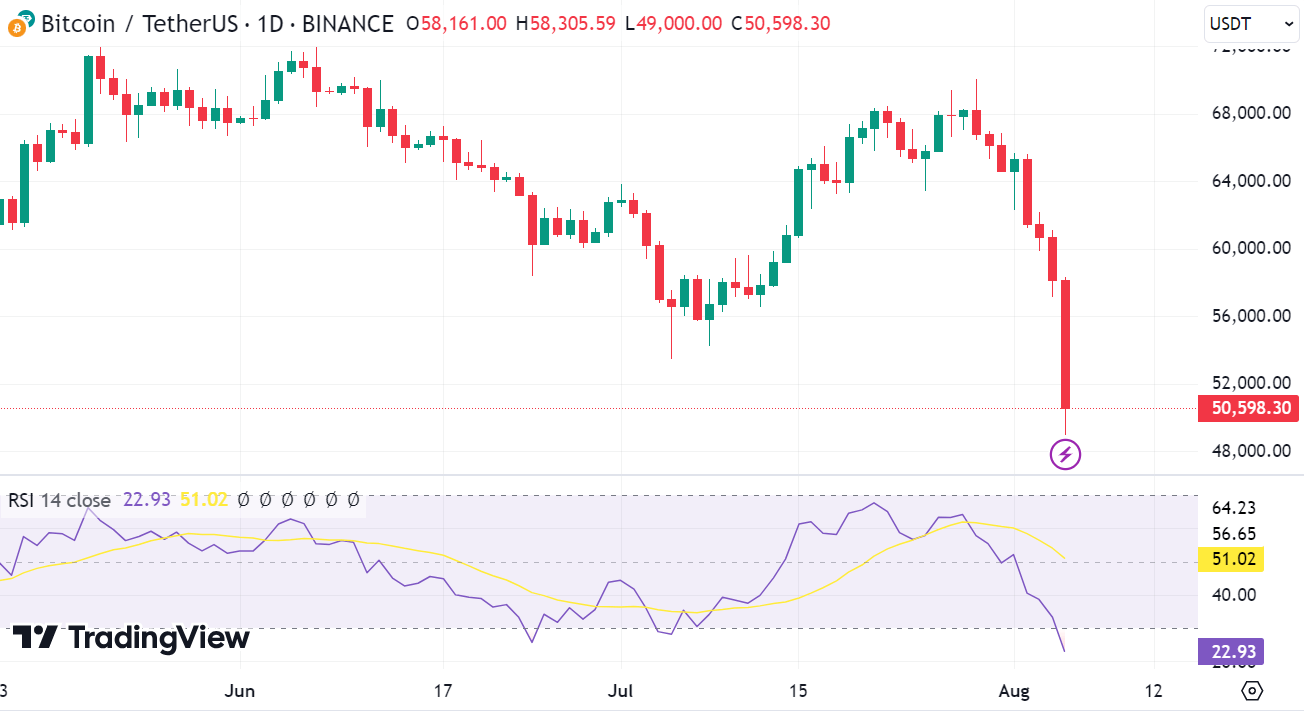
  • Bitcoin tumbles, tests $49,000, amid major crypto selloff

    Bitcoin tumbles, tests $49,000, amid major crypto selloff

    Bitcoin tumbles, tests $49,000, amid major crypto selloff
    • Bitcoin briefly tests $49k before rebounding to $51k amid a $270 billion crypto market selloff.
    • Concerns over the US recession and Japan’s rate hike trigger market turmoil.
    • FBI warns of rising crypto scams during increased market volatility.

    The cryptocurrency market has experienced a significant downturn today, shedding approximately $270 billion in value over 24 hours according to CoinGecko data. Leading this decline, Bitcoin plummeted by almost 20%, reaching $49,121, its lowest level since February at $53,091.

    Bitcoin price chart

    Ether also suffered a substantial drop of 21%, falling to $2,300, erasing its gains for the year. Other cryptocurrencies like Binance’s BNB and Solana have also suffered significant losses.

    Bank of Japa hikes its benchmark interest rate

    This dramatic downturn in the crypto market coincided with a broader selloff in equities, particularly in Asia-Pacific markets, exacerbated by Japan’s Nikkei 225 falling by as much as 7%.

    The Bank of Japan’s decision to hike its benchmark interest rate to the highest level in 16 years triggered this selloff, sending shockwaves through financial markets.

    The US Nasdaq also slid into correction territory, marking its worst three-week stretch since September 2022, further contributing to the decline in risky assets, including cryptocurrencies.

    The market’s reaction was influenced by Japan’s monetary tightening and the US Federal Reserve’s recent actions.

    Although the Fed opted to hold its benchmark rate steady, it did not indicate a rate cut in September, which many market experts had anticipated.

    This uncertainty added to the market’s anxiety, causing traders to price in a 100% chance of lower US base rates in September.

    Concerns of a potential US recession

    The selloff reflects growing concerns about a potential US recession, triggered by softer economic data and rising geopolitical tensions.

    Tony Sycamore, a market analyst at IG, highlighted that Bitcoin and other cryptocurrencies are risk assets and are highly susceptible to market volatility. He noted that Bitcoin is currently testing crucial support levels and must hold the $53,000 mark to prevent further declines.

    However, at press time Bitcoin was trading at $51,657, well below this support level, despite making a comeback from around $49k.

    FBI issues warning

    The cryptocurrency market’s volatility has also heightened security concerns. The FBI has issued a warning about scammers exploiting the market crash to steal users’ funds.

    The FBI advised users to be cautious of unsolicited messages or calls indicating account problems and urged them to verify any issues through official channels. The agency’s warning comes amid a significant increase in crypto-related fraud and hacking incidents.

    In the first half of 2024, hackers stole nearly $1.4 billion worth of crypto, more than double the amount stolen in the same period in 2023.

    This increase is attributed to the rising value of various tokens, including Bitcoin, Ethereum, and Solana. Ari Redbord, global head of policy at TRM Labs, noted that while the security of the cryptocurrency ecosystem has not fundamentally changed, the higher value of tokens has made them more attractive targets for criminals.

    As Bitcoin and other cryptocurrencies navigate these turbulent times, investors and users should remain vigilant about market conditions and potential security threats.


    Source link