Tag: shows

  • Bitcoin treasury purchase size collapses 86%, data shows

    • Total BTC treasury holdings have hit a record high of 840,000 BTC.
    • However, the average purchase size has collapsed by a staggering 86 percent.
    • This waning demand was the key driver of the Q2 Bitcoin rally.

    They were the heroes of the last great rally, the talk of the town at the recent BTC Asia conference, their voracious appetite for Bitcoin single-handedly driving the market to new heights.

    But a shadow has fallen over the world of the corporate Bitcoin treasury.

    A new report reveals a worrying trend beneath the surface: while their total holdings are larger than ever, their conviction, measured by the size of their buys, has collapsed.

    The great contradiction: more players, smaller bets

    The on-chain data, laid bare in a new report from CryptoQuant, tells a tale of two conflicting truths.

    On one hand, the aggregate Bitcoin treasury holdings have surged to a record 840,000 BTC, a war chest led by the titan Strategy, which holds 637,000 BTC. Transaction activity also remains near record levels, with 46 deals in August alone.

    But on the other hand, the average size of these purchases has fallen off a cliff. Strategy bought just 1,200 BTC per transaction in August, while other firms averaged a mere 343 BTC.

    Both of these figures are down a staggering 86 percent from their peaks in early 2025. In total, Strategy acquired only 3,700 BTC in August, a whisper compared to the 134,000 BTC it bought at its peak last year.

    This is not the behavior of a market brimming with confidence; it is the sign of smaller, more hesitant buys, a clear signal of liquidity constraints or waning conviction.

    The ghost of rallies past

    This dramatic slowdown is a major concern for investors because it was the relentless engine of treasury accumulation that drove Bitcoin’s spectacular price growth in the second quarter.

    As CoinDesk reported at the time, by late August 2025, institutions were absorbing more than 3,100 BTC a day against a mere 450 being mined.

    This created a powerful 6-to-1 demand-supply imbalance that sent prices soaring.

    Now, that engine is sputtering. This slouching demand raises the critical risk that the market’s current price strength may not be sustainable if the giants of the space continue to nibble cautiously rather than devour at scale.

    A new hope? The rise of Asia’s treasury front

    But as the Western giants grow hesitant, a new front in the treasury movement is opening in the East.

    According to a Bitwise report, 28 new treasury companies were formed in July and August alone, collectively adding over 140,000 BTC to their coffers.

    More significantly, Asia is emerging as the next major battleground. Taiwan-based Sora Ventures has launched a massive 1 billion dollar fund specifically to seed new regional treasury firms, with an initial commitment of 200 million dollars.

    This new vehicle will pool institutional capital to support a fresh wave of entrants, a different model from the region’s current largest player, Metaplanet.

    The stage is now set for a fascinating and pivotal confrontation.

    The central question that will define the next phase of Bitcoin adoption—and its price—is whether this new, hungry wave of Asian treasuries can offset the shrinking appetite of the incumbents who first blazed the trail.

    Market updates

    BTC: Bitcoin remains resilient for now, trading in the 110,000–113,000 dollar range. The price is being supported by broad expectations of Federal Reserve rate cuts and continued, if smaller, institutional inflows via ETFs.

    ETH: Ethereum is trading near the 4,300 dollar level. Its recent weakness, marked by a 3.8 percent weekly decline, is being attributed to ETF outflows and the historically subdued trading that characterizes “Red September.”

    However, its longer-term outlook remains positive, buoyed by deep institutional interest and growing staking activity.

    Source link

  • Ethereum price prediction: ETH derivatives data shows weak momentum

    Ethereum price prediction: ETH derivatives data shows weak momentum

    Ethereum price prediction

    • ETH derivatives show weak momentum despite strong ETF inflows.
    • Ethereum’s network activity and TVL continue to decline.
    • Technical analysis hints at long-term upside, but traders stay cautious.

    Ethereum (ETH) has seen a strong price surge in recent weeks, gaining more than 54% over the past month and trading at around $3,755 at press time.

    However, despite this rally and strong spot ETF inflows, derivatives market data paints a very different picture, casting doubt on whether Ethereum can break through the psychologically significant $4,000 level any time soon.

    In essence, the disconnect between bullish institutional inflows and weak derivatives metrics raises several questions for market participants.

    Is Ethereum’s recent rally sustainable, or is it merely a reflection of speculative optimism driven by ETF hype?

    Furthermore, are investors losing confidence in Ethereum’s network fundamentals amid rising competition from rival blockchains?

    Derivatives market tells a cautious tale

    While Ethereum’s spot market has been energised by inflows into exchange-traded funds, futures data shows traders are hesitant to commit to leveraged bullish positions.

    As of Thursday, the annualised funding rate for ETH perpetual futures had fallen back to 9%, down from 19% earlier in the week, with the ETH OI-weighted funding rate dropping to 0.0043% from 0.0163% on July 21.

    ETH OI-weighted funding rate

    This suggests waning demand for long positions, even after a near 46% gain in ETH price since early July.

    This behaviour is unusual. Historically, rising prices coincide with stronger futures premiums, yet the current trend indicates hesitation.

    The 3-month ETH futures premium has also softened slightly to 6%, down from 8% just days ago.

    While this still sits within a neutral range, it reveals a reluctance among whales and market makers to bet aggressively on further price appreciation in the near term.

    Ethereum network weakness frustrates investors

    The cautious tone in derivatives is likely being fueled by stagnant on-chain activity.

    Ethereum’s total value locked (TVL) dropped to a five-month low of 23.4 million ETH, falling 11% in just 30 days.

    That sharp decline comes despite ETH’s rising dollar value and highlights a significant reduction in the volume of assets being deployed within the ecosystem.

    In contrast, Solana’s TVL only fell 4% during the same period, while BNB Chain’s TVL rose 15% in native token terms.

    These shifts show that competing platforms are either maintaining or growing their utility at a time when Ethereum’s activity appears to be plateauing.

    Even more concerning is Ethereum’s decline in dominance among decentralised exchange (DEX) volumes.

    According to DefiLlama, Ethereum recorded $81.32 billion in DEX activity over the past month.

    Solana surpassed that with $82.9 billion, while BNB Chain led with a staggering $189.2 billion.

    These figures highlight that Ethereum is no longer the go-to platform for certain core DeFi activities.

    Technical analysis signals a mixed ETH price outlook

    Despite lukewarm derivative activity, technical analysts remain divided on Ethereum’s future trajectory.

    Popular investor Ivan On Tech has pointed to a symmetrical triangle pattern that could lead to a breakout toward $7,709, more than double the current price.

    Meanwhile, another analyst, Mikycrypto Bull, has identified a long-term ascending triangle formation dating back five years, which could theoretically launch ETH as high as $16,700.

    Adding to the bullish sentiment is a recent MACD crossover on the monthly chart, a signal that has preceded major rallies in previous cycles.

    However, while long-term technicals hint at explosive potential, short-term forecasts are more cautious.

    ETH must first break through $4,100 and hold above $3,700 to sustain its upward momentum.

    Corporate confidence grows amid market doubts

    Institutional and corporate adoption of Ethereum continues to grow.

    Firms such as SharpLink Gaming and World Liberty Financial have accumulated substantial ETH reserves in recent months.

    SharpLink now holds over 438,000 ETH and actively stakes its assets to generate passive income.

    World Liberty Financial has acquired over 77,000 ETH, with recent purchases near $3,294 per coin.

    These moves suggest that some institutions are positioning Ethereum as a long-term strategic asset.

    Their investments reflect confidence in Ethereum’s evolving role as foundational infrastructure for decentralised applications and finance.


    Source link

  • Bitcoin Pepe’s presale hits $2.77M as survey shows memecoins’ rewards outweigh risks

    Bitcoin Pepe’s presale hits $2.77M as survey shows memecoins’ rewards outweigh risks

    Bitcoin Pepe’s presale hits $2.77M as survey shows memecoins’ rewards outweigh risks

    • Bitcoin Pepe presale hits $2.77M as momentum builds.
    • Enthusiasts believe the LIBRA scandal calls for clearer memecoin regulation.
    • Kraken survey shows 76% of investors see memecoin rewards outweighing risks.

    Bitcoin Pepe, heralded as the world’s only Bitcoin Meme ICO, has made headlines by raising $2.77 million out of its $2.85 million presale target in its fourth presale stage.

    The Bitcoin Pepe presale is structured in such a way that the BPEP token price increases as the presale stages progress. For instance, with the fourth stage almost completed, the price is expected to rise from the current price of $0.0243 per token to $0.0255 in the fifth presale stage.

    Notably, the Bitcoin Pepe project aims to bring Solana-like technology to the Bitcoin blockchain, introducing concepts like a Meme Layer-2 for BTC with instant transactions and ultra-low fees. The initiative also includes the launch of a new token standard, PEP-20, allowing for meme coin creation directly on Bitcoin, which they argue is the only blockchain that will “live forever.”

    Regulatory challenges highlighted by the LIBRA scandal

    While Bitcoin Pepe seems to be a success, the memecoin market was recently thrown into confusion following the rug pull of LIBRA, which was expected to be a successful crypto project after it was endorsed by Argentine President Javier Milei.

    Following the LIBRA debacle, which is partly blamed on possible insider trading, Nic Puckrin from Coin Bureau has criticized US regulators for failing to provide a framework that could prevent such incidents.

    According to Puckrin, this vacuum has allowed for fraudulent schemes to proliferate, leading to calls for agencies like the SEC or CFTC to step in. However, there’s a counterargument, with some like Christopher Perkins suggesting that memecoins already enjoy a degree of regulatory clarity under commodity laws, though the broader legal landscape remains grey for these digital assets.

    76% of memecoin investors believe rewards outweigh risks

    Despite the risks associated with meme coins, a recent Kraken survey reveals a surprisingly positive outlook on memecoins.

    According to the survey, an overwhelming 76% of investors believe that the potential rewards of investing in memecoins justify the risks involved. This sentiment is backed by 85% of US crypto holders who have ventured into the memecoin market, driven by factors like price volatility, FOMO, and social endorsements.

    Interestingly, while both genders invest in memecoins at similar rates, the survey shows that women tend to be more cautious, generally allocating a smaller portion of their portfolio to these high-risk assets.

    The survey also highlights that while many are optimistic about memecoins’ performance in 2025, the majority still approach these investments with caution, dedicating only a small fraction of their portfolio to memecoins. This cautious optimism reflects a broader understanding of memecoins’ role in the crypto ecosystem, not just as speculative assets but also as a source of entertainment and diversification.

    With that said, the Bitcoin Pepe (BPEP) memecoin leverages Bitcoin’s security and Solana’s speed, offering investors a compelling memcoin alternative that will possibly outshine previously launched meme coins.


    Source link

  • JP Morgan reports shows 13% of Americans are into crypto

    JP Morgan reports shows 13% of Americans are into crypto

    • JP Morgan has released a new report showing that more than 13% of the American population have transferred funds into crypto accounts.
    • The research sampled 5 million customers with checking accounts, 600,000 of whom had transferred money into a crypto account.
    • Most new investors first fund a crypto account during spikes for Bitcoin price, according to the report.

    Nearly 44 million Americans have ever transferred money into a crypto-related account, according to details shared in a new report by JP Morgan.

    In a report titled ‘The Dynamics and Demographics of US Household Crypto-Asset Use’, released on 13 December, the financial giant estimates that about 13% of the population has sent money to a crypto account. Per the bank’s data, involvement in crypto by the general population spiked during the COVID-19 pandemic, with more money finding its way into cryptocurrency investments as individuals’ personal savings also increased.

    The report covered close to 5 million active checking account users, more than 600,000 of whom were shown to have transferred funds to crypto accounts.

    Transfers to crypto accounts tripled between 2020 and 2022

    Cryptocurrency adoption across the United States has been steady, with other statistics suggesting similar adoption rates to what’s contained in this latest report.

    While JP Morgan says that only a tiny fraction of the US population was in crypto five years ago, its researchers found that the last three years have witnessed a huge jump in adoption. From the sample indicated, the banking giant estimated that crypto users in the US increased from a pre-pandemic population share of less than 3% to almost 15% by mid-2022.

    Of those to fund crypto accounts from their checking accounts, the research data shows a 300% spike. Cumulatively, only 3% of the population had transferred funds into a digital asset-related account prior to the pandemic. 

    That figure more than tripled in the last three years, with the trend seeing more than 43 million Americans, or 13% of the population funding crypto accounts.

    New investors increase when Bitcoin price spikes

    Another observation from the research is that funding of crypto accounts is that the transfers have largely come at a time when the price of Bitcoin is going up. Large volumes occur during bull markets or sharp rallies, with the trend going back to 2015, JP Morgan said.

    For most new users, the deposits span a few days and have coincided with the price of bitcoin seeing a trailing monthly change of +25%. It is this time that many people look to trade Bitcoin and other cryptocurrencies.

    Also observable is that most investors only make small transfers to their crypto accounts – less than a month’s pay. Indeed, the median transfer for the majority of investors is $620. Nonetheless, about 15% of individuals transfer more than a month’s worth of income. The share is even higher among high-income individuals.

    Source link

  • Normalcy returning to crypto markets, on-chain data shows

    Normalcy returning to crypto markets, on-chain data shows

    Over the last few months, the crypto market has largely been pretty serene. Bitcoin had been in crab motion around $20,000 for quite a while, as it plodded along while waiting for the wider macro conditions to make a move.

    I wrote in late October to be cautious around this price action, and that Bitcoin could be one bearish event away from an aggressive downward wick. What I did not except was that event to be shake crypto to its bones, as one of the blue-chip companies in the space, FTX, inexplicably descended into insolvency.  

    This obviously shook markets. Last week I assessed how the flow of bitcoins out of exchanges has been fierce, as people’s trust in these central entities to store their coins was understandably at an all-time low. 

    In fact, I saw yesterday that 200,000 bitcoins have left exchanges since the FTX implosion. But now, the data suggests that the market is calming down a bit. And again, it seems like we may enter crab mode until macro provides an impetus one way or another – or an unexpected crypto-specific development comes out of the woodwork. 

    The first way to demonstrate that the dust is beginning to settle is by looking at Bitcoin’s volatility. This obviously spiked as Sam Bankman-Fried’s “games” were revealed to the public. But after remaining elevated throughout the last few weeks, it has fallen back down to more standard levels in the last few days.  

    Another way to view this is the falloff in large transactions. These transactions (defined as greater than $100,000) jumped up in the few days around the bankruptcy, but have fallen gradually since, back to the same levels we have seen throughout much of 2022.

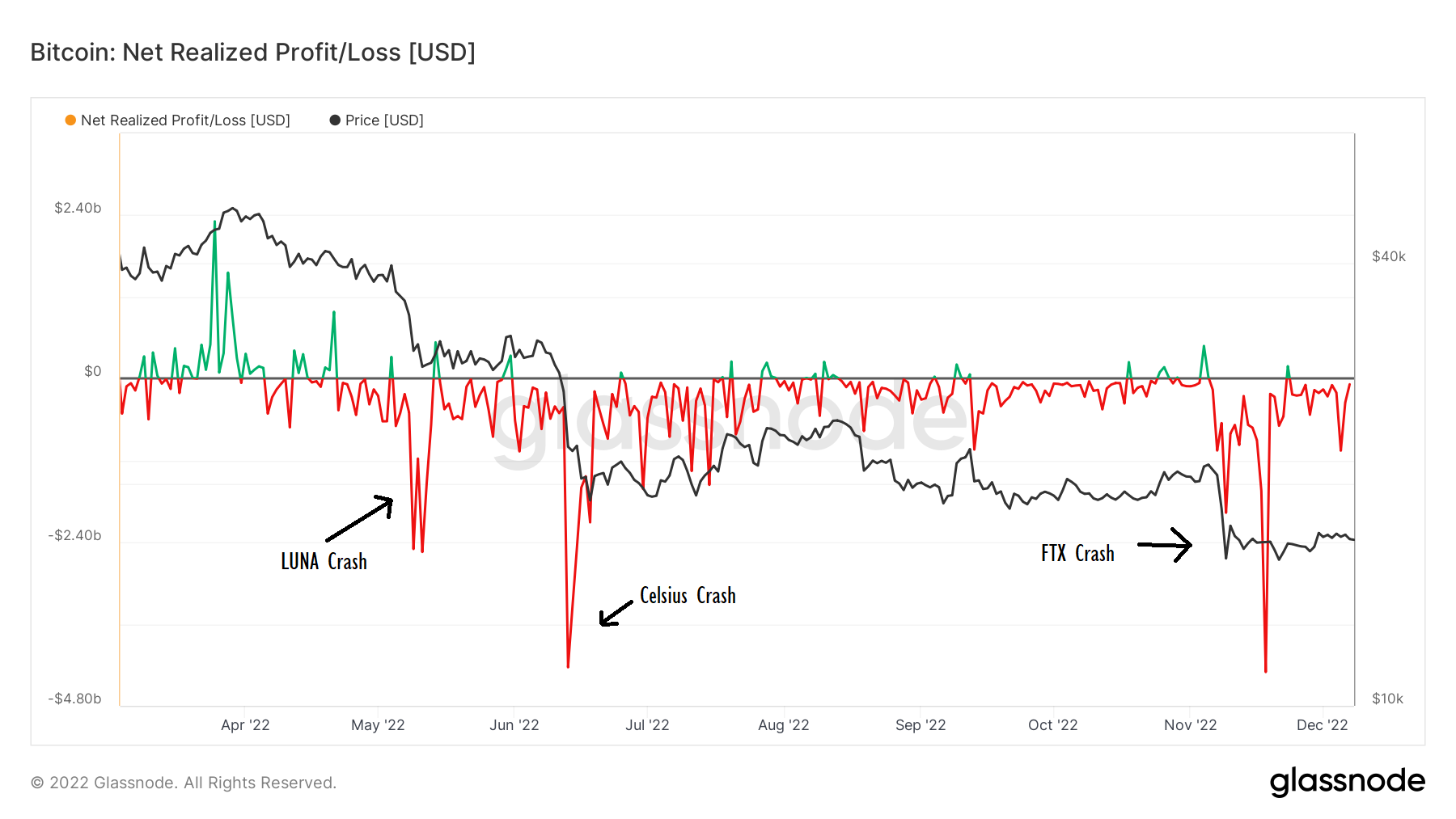
    Another useful metric to track is the net realised profit or loss of moved coins. This spikes in times of crisis as the price abruptly drops, before typically coming back towards the $0 mark as the markets calm down.

    The below chart shows this well, with trades on November 9th netting an ugly $2 billion loss, before November 18th then topped this with a $4.3 billion loss. That is lower than the worst mark post-Celsius crash ($4.2 billion loss) and Luna ($2.5 billion loss).

    This reflects the continued downward pressure on Bitcoin’s price, but the trend has bounced back up to close to zero again.

    FTX was a central part of the ecosystem, and its bankruptcy understandably rocked the market. As I wrote recently, this contagion is not over.

    Yet data from the last week or so suggests that normalcy is returning to the crypto markets. Going forward, it may tread water again for a while. With China opening up post-lockdown, the latest inflation numbers imminent and the EU ban on Russian crude imports, macro certainly has a lot going on. 

    Crypto investors will just need to hope that the crypto-native scandals are out of the way for the time being.  

    Source link